Home Blog Page 6

The Biggest Problem With Your Financial Planning (It’s Not What You Think)

“The greatest enemy of a good plan is the dream of a perfect plan.” – Carl von Clausewitz

What do you think is the biggest threat to your financial plan?

A market crash? A job loss? Bad advice from your cousin’s friend who “dabbles in stocks”? All of those can hurt. But in 25 years of managing money for Indian families, the single biggest destroyer of financial plans isn’t an external event. It’s your own behaviour.

Not your intelligence. Not your income. Not even your knowledge of finance. Your behaviour. The decisions you make when you’re scared, greedy, bored, or just too busy to pay attention.

Financial planning involves many things: your money, your goals, your personality, and your habits. It’s a decades-long activity. And while we can control some variables, we often underestimate the five silent killers that derail even well-made plans.

⚡ Quick Answer

The biggest problem with most financial plans isn’t the investments chosen or the returns earned. It’s investor behaviour: emotional decisions, herd mentality, and the inability to stick to a plan when markets get volatile. A fee-only financial advisor’s most important job isn’t picking funds. It’s stopping you from sabotaging your own plan.

Biggest Problem With Your Financial Planning, And How to Fix It

The 5 Things That Actually Derail Financial Plans

Before we talk about behaviour, let’s acknowledge the usual suspects. Most financial plans run into trouble because of one or more of these:

  • Unexpected loss of income (job loss, business downturn, health emergency)
  • Mismanagement of income and expenses (lifestyle inflation, no budget discipline)
  • Unexpected financial burden (parent’s health costs, child’s education abroad)
  • Underperformance of investments (wrong product selection, poor timing)
  • Our own behaviour (fear, greed, overconfidence, avoidance)

The first four are somewhat outside your control. The fifth one? That’s entirely on you. And it’s the one that causes the most damage.

Your Behaviour Is the Biggest Problem With Your Financial Planning

Social, cognitive, and emotional factors play a powerful role in financial decisions. Sometimes, they make you act against your own financial interests without you even realising it.

Let me give you three real examples I’ve seen in my practice:

Manas (name changed), a 38-year-old product manager in Hyderabad, bought a stock because all his colleagues were buying it. The stock had already appreciated 60% in two months. He bought at the peak. Six months later, it was down 35% and he was still holding, hoping for a recovery. Classic herd mentality followed by loss aversion.

Shilpa (name changed), a 45-year-old doctor in Delhi, invested 100% of her savings in bank FDs. She was scared of every other asset class. She had ₹1.2 crore in FDs earning 6.5%. After inflation and 30% tax bracket, her real return was actually negative. Her “safe” choice was silently destroying her retirement corpus.

Riya (name changed), a 50-year-old HR director in Mumbai, invested in random tax-saving products in the last week of March every year. No strategy, no asset allocation, just whatever the agent pushed. She had 7 ELSS funds, 4 insurance policies sold as investments, and an NPS account she’d forgotten about. Her portfolio was a junkyard of impulse decisions.

Must Read – Behavioural Finance: How Your Mind Sabotages Your Money Decisions

How Can a Financial Advisor Help You

Recognise yourself in Manas, Shilpa, or Riya?

A financial plan built around your behaviour changes everything.

Talk to a Financial Planner

What Nobody Tells You About Financial Planning Problems

Here’s something most financial articles won’t say: even your financial advisor can be behavioural biased.

A 2022 study published in the Journal of Business Research found that financial planners, despite training and experience, are not immune to cognitive biases. Overconfident advisors tend to recommend concentrated portfolios. Loss-averse advisors tend to be overly conservative, even when clients have a 20-year horizon.

This is why the fee-only model matters. When an advisor earns commissions from product sales, their bias is baked into the revenue model. When they earn a flat fee regardless of what you buy, the incentive to sell you the wrong product disappears. The best financial advisor isn’t the one with the best stock picks. It’s the one who manages their own biases as well as yours.

✅ Tip

When evaluating a financial advisor, don’t just ask about their returns. Ask them: “What was the worst advice you ever gave, and what did you learn from it?” An honest answer tells you more than any credential.

How a Financial Advisor Actually Fixes This

Most people think financial advisors just pick mutual funds. That’s like saying a doctor just writes prescriptions. The real value of a good financial planner goes far beyond product selection:

They get your finances in order. Portfolio consolidation, nominations, joint holders, documentation, will preparation. The boring but critical stuff most people keep postponing until it’s too late.

They plan your taxes proactively. Not in the last week of March. In April itself, for the entire year ahead. The difference between reactive and proactive tax planning can easily be ₹50,000-₹1,00,000 per year for senior executives.

They set goals without emotional bias. You might want a ₹5 crore house because your friend just bought one. A good planner will show you whether that goal aligns with your actual financial capacity or whether it will destroy your retirement.

They sell underperforming assets without attachment. You won’t sell that stock your father recommended because it feels disrespectful. Your advisor has no such emotional baggage. He sees a number, not a memory.

They review your finances when you won’t. When you’re busy or stressed, finances take a backseat. Your planner keeps reviewing, rebalancing, and course-correcting even when you’re not paying attention.

They balance your emotions. When markets crash 30% and your portfolio shows a ₹15 lakh notional loss, your advisor is the person who stops you from pressing the panic button. This single intervention, done even once in your investing lifetime, can save you more than the advisor’s entire fee.

Must Read – 6 Steps of Financial Planning Process

Financial planning is not an event. It’s a relationship.

The right advisor doesn’t just manage your money. They manage the most unpredictable variable in your portfolio: you.

Start Your Financial Plan

Frequently Asked Questions

What is the biggest problem with financial planning in India?

The biggest problem is investor behaviour, not investment selection. Emotional decisions like panic selling during crashes, chasing last year’s best performers, or investing in random products to save tax in March cause more financial damage than any market event. A structured plan with a disciplined review process fixes most of these problems.

How does behaviour affect my financial plan?

Behavioural biases like loss aversion (holding losers too long), herd mentality (buying because everyone else is), and overconfidence (believing you can time the market) lead to poor decisions that compound over years. Even highly educated investors fall prey to these biases because they’re emotional, not logical, responses.

Do I really need a financial advisor?

If you can honestly say you didn’t panic during the March 2020 crash, you review your portfolio quarterly, you have a written financial plan, and you never buy financial products based on someone’s tip, then maybe you don’t. For everyone else, a fee-only financial advisor acts as a behavioural coach who prevents your worst impulses from destroying your plan.

How do I choose the right financial planner?

Look for a SEBI-registered investment advisor (RIA) who charges a fee, not commissions. Ask about their process, not their returns. A good planner follows a structured 6-step process: establishing the relationship, gathering data, analysing your finances, developing a plan, implementing it, and reviewing it regularly. If they skip straight to product recommendations, walk away.

Your financial plan doesn’t need to be perfect. It needs to survive contact with your emotions. That’s the real test.

Do the Right Thing and Sit Tight.

💬 Your Turn

What’s the biggest mistake you’ve made with your financial plan? Not the market that went down, but a decision you made that you now regret. Share in the comments.


ELSS Mutual Fund: Best Tax Saving Investment in India (2026 Guide)

Every March, the same conversation repeats in offices across India. Someone asks the accounts team for the list of tax-saving options. Someone else recommends an endowment policy. A third person mentions PPF. And almost nobody brings up ELSS, even though it has the shortest lock-in period, the highest return potential, and the same Section 80C deduction as everything else.

After 25 years in financial planning, I can tell you that ELSS remains one of the most underused tax-saving instruments available to Indian investors. Not because it is complicated. Because most people do not understand how the tax rules actually work, especially after the changes made in Budget 2018, 2020, and 2024.

This guide covers everything: what ELSS mutual funds are, the current tax rules, how they compare to other 80C options, and what to look for when choosing one.

Quick Answer

ELSS (Equity Linked Savings Scheme) is a mutual fund that invests primarily in equities and qualifies for Section 80C deduction up to Rs. 1.5 lakh per year under the old tax regime. It has a 3-year lock-in, which is the shortest among all 80C instruments. Gains on redemption are treated as LTCG and taxed at 12.5% on amounts exceeding Rs. 1.25 lakh annually. Dividends are taxed at your slab rate. ELSS is not tax-free on returns, but it remains one of the best 80C options due to return potential and liquidity.

ELSS Mutual Fund Tax Saving Investment India 2026

Table of Contents

What Is an ELSS Mutual Fund?

ELSS stands for Equity Linked Savings Scheme. It is a category of mutual fund that invests at least 80% of its portfolio in equities and equity-related instruments. It is regulated by SEBI, like all mutual funds, and classified under the tax-saving category under Section 80C of the Income Tax Act.

What sets ELSS apart from regular diversified equity funds is one thing: the mandatory 3-year lock-in period from the date of each investment. You cannot redeem ELSS units before 3 years. There is no exit option, no premature withdrawal, no exception. This is the price of the tax deduction.

Because of the mandatory lock-in, all ELSS redemptions after the 3-year period are automatically classified as Long-Term Capital Gains. There is no scenario where an ELSS redemption gives rise to Short-Term Capital Gains under normal circumstances.

The Tax Benefits of ELSS

Section 80C deduction at investment. You can claim a deduction of up to Rs. 1.5 lakh per financial year on ELSS investments under Section 80C. This is the same overall limit shared with EPF contributions, PPF, life insurance premium, home loan principal, and NSC. You cannot claim more than Rs. 1.5 lakh in total across all 80C instruments combined.

Critically: the Section 80C deduction for ELSS is available only under the old tax regime. If you have opted for the new tax regime, you cannot claim any 80C deduction at all. This is the single most important thing to check before investing in ELSS for tax purposes.

Maximum tax saving. For a person in the 30% tax bracket under the old regime, a full Rs. 1.5 lakh ELSS investment saves Rs. 46,800 in tax (Rs. 45,000 at 30% plus 4% cess). For someone in the 20% bracket, the saving is Rs. 31,200.

ELSS Tax Rules in 2026: What Has Changed

The original ELSS article on this site contained several statements about tax that are now factually wrong. These are the corrections:

Old claim: “Capital gains from ELSS are completely tax-free.” This was true before Budget 2018. It is no longer true. Since April 1, 2018, Long-Term Capital Gains on equity mutual funds including ELSS above Rs. 1.25 lakh per year are taxable at 12.5% (rate updated in Budget 2024, exemption limit increased from Rs. 1 lakh to Rs. 1.25 lakh).

Old claim: “Dividends from ELSS are tax-free.” This was true until March 2020. Since Budget 2020, dividends from all mutual funds including ELSS are fully taxable in the investor’s hands at their applicable slab rate. The Dividend Distribution Tax paid by fund houses was abolished and replaced with direct taxation in investors’ hands. If dividends paid exceed Rs. 5,000 in a year, the fund house deducts 10% TDS before crediting the amount.

Old claim: “80C limit for ELSS is Rs. 1 lakh.” The Section 80C limit was enhanced to Rs. 1.5 lakh in Budget 2014 and has remained there since. The correct maximum deduction is Rs. 1.5 lakh.

Critical: Check Your Tax Regime Before Investing

The Section 80C deduction for ELSS applies only under the old tax regime. The new tax regime does not allow 80C deductions. If you or your employer has opted for the new regime by default, ELSS gives you no tax benefit at investment, though the capital gains tax treatment remains the same. Always confirm your regime before March-end ELSS investments.

ELSS vs Other 80C Instruments

Instrument Lock-in Returns Tax on Returns
ELSS 3 years Market-linked equity LTCG at 12.5% above Rs. 1.25 lakh
PPF 15 years 7.1% (current rate) Completely tax-free (EEE)
EPF Till retirement 8.25% (current rate) Tax-free up to contribution limit
Tax Saving FD 5 years 6.5 to 7.5% (bank dependent) Interest taxable at slab rate
NSC 5 years 7.7% Interest taxable at slab rate
SCSS (Senior Citizens) 5 years 8.2% Interest taxable at slab rate

ELSS has the shortest lock-in among all 80C instruments. PPF is tax-free on returns but locks money for 15 years and offers capped returns. Tax-saving FDs have a 5-year lock-in with returns fully taxable. NSC has taxable returns. For a person in the 30% bracket with a 5-plus year view, ELSS typically wins on post-tax returns over any fixed income 80C option. The trade-off is equity volatility.

“Tax saving should be the result of your investment planning, not the other way around. Choose ELSS because it fits your financial goals and timeline, not just because it saves tax in March.”

How to Invest in ELSS

ELSS investments can be made through your mutual fund account, any registered platform or app, or directly with the fund house. You can invest via lump sum or SIP. The minimum investment for most ELSS funds starts at Rs. 500.

Each SIP instalment in ELSS has its own separate 3-year lock-in from the date of that specific SIP payment. A SIP started in April 2023 will have the April 2023 instalment unlocking in April 2026, the May 2023 instalment unlocking in May 2026, and so on. You cannot redeem the entire SIP corpus at once after 3 years if the SIPs are ongoing.

The 80C deduction is available in the year you invest. If you invest Rs. 50,000 in ELSS in December 2025, you can claim the deduction in FY 2025-26. If you invest Rs. 50,000 in April 2026, it counts for FY 2026-27.

Something Worth Noticing

Most people invest in ELSS in a panic in February or March to meet the tax-saving deadline. This is the worst time. You invest a lump sum at whatever the market level is. A far better approach is to start an ELSS SIP in April at the beginning of the financial year, let it run through the year, and reach your Rs. 1.5 lakh target through 12 monthly instalments with rupee cost averaging working in your favor.

SIP vs Lump Sum in ELSS

Both are valid approaches, but they serve different purposes and have different lock-in implications.

A lump sum investment locks the entire amount for 3 years from the date of investment. If you invest Rs. 1.5 lakh in a single transaction today, you can redeem the full Rs. 1.5 lakh (plus gains) in one shot after 3 years. This simplifies redemption planning.

An SIP investment locks each instalment separately. After 3 years, only the instalments that have individually completed 3 years become available for redemption. For someone doing a 12-month SIP of Rs. 12,500 per month, the April instalment unlocks in April Year 4, the May instalment in May Year 4, and so on. The corpus does not all become available at once.

For most investors, SIP is preferable because it avoids the year-end scramble, benefits from rupee cost averaging over the year, and ensures disciplined regular investing. The staggered redemption is manageable with proper planning.

How to Choose an ELSS Fund

There are over 40 ELSS funds available in India. Choosing based on last year’s returns is the most common and most dangerous approach. A fund that returned 45% last year often did so because of concentrated sector bets that may not repeat.

What actually matters when choosing an ELSS fund:

Long-term track record. Look at 7 to 10 year performance, not 1 to 3 year returns. Only long periods reveal whether the fund manager’s process is durable or just lucky. Consistency across multiple market cycles matters more than peak returns.

Portfolio concentration. Some ELSS funds hold 30 stocks. Some hold 60. Concentrated portfolios magnify both gains and losses. More diversified portfolios tend to be less volatile. Match this to your temperament.

Fund manager tenure. If a fund had a stellar 10-year record under a manager who left 2 years ago, that record belongs to the old manager. Check how long the current manager has been running the fund.

Expense ratio. A difference of 0.5% in annual expense ratio compounds significantly over 10 to 15 years. All else being equal, lower expense ratios are better for long-term investors.

Do not chase the top-ranked fund from any single year. ELSS is a long-term instrument. Choose a fund you can stay invested in through market downturns, not just during bull runs. For broader mutual fund evaluation principles, see our post on the benefits of mutual funds in India.

ELSS and Retirement Planning

ELSS can play a meaningful role in a retirement portfolio, but it is a building block, not a complete strategy. For someone in their 40s or early 50s building toward retirement, ELSS serves as the tax-efficient equity component of their annual savings for as long as they remain in the old tax regime.

The 3-year lock-in is rarely a constraint for retirement-focused investors since the investment horizon is 10 to 20 years anyway. The real advantage is the annual tax saving that effectively reduces your cost of equity investing by Rs. 46,800 per year for a 30% bracket taxpayer.

However, ELSS alone is not a retirement plan. It addresses tax saving and equity exposure for the accumulation phase. Debt allocation, goal-linked planning, withdrawal strategy, and healthcare provisioning are separate conversations. The broader mutual fund framework needs to work alongside ELSS rather than treating it as the entire equity strategy.

Is Your Tax Saving Aligned With Your Retirement Plan?

Most people save tax in isolation and plan for retirement in isolation. The most effective approach connects both. If you are 45 to 60 and want to ensure your tax-saving investments are actually building your retirement corpus, let us review the full picture together.

Book a Free 30-Min Call

Frequently Asked Questions

Are ELSS returns tax-free in 2026?
No. ELSS gains on redemption are treated as Long-Term Capital Gains (LTCG). Gains up to Rs. 1.25 lakh per year are exempt. Gains above Rs. 1.25 lakh are taxed at 12.5%. This changed from Budget 2018 onwards. The old claim that ELSS returns are completely tax-free is no longer accurate.

What is the 80C deduction limit for ELSS?
Rs. 1.5 lakh per financial year, shared with all other 80C instruments combined. This limit is available only under the old tax regime. Under the new tax regime, no 80C deduction applies.

Are ELSS dividends taxable?
Yes. Since Budget 2020, dividends from all mutual funds including ELSS are taxed in the investor’s hands at their applicable income tax slab rate. They are no longer tax-free. If dividends exceed Rs. 5,000 in a year, the fund house deducts 10% TDS before payment.

What is the lock-in period for ELSS?
3 years from the date of each investment. This is the shortest lock-in among all Section 80C instruments. For SIP investments, each instalment has its own 3-year lock-in from the date of that specific payment.

Can I invest in ELSS if I am in the new tax regime?
You can invest, but you will not get the Section 80C tax deduction. The new tax regime does not allow 80C deductions. The capital gains tax treatment on redemption remains the same regardless of your tax regime.

How much tax does an ELSS investor save?
For a 30% bracket taxpayer investing the full Rs. 1.5 lakh: tax saving is Rs. 46,800 per year (Rs. 45,000 at 30% plus 4% cess). For a 20% bracket taxpayer: Rs. 31,200 per year.

How do I choose the best ELSS fund?
Look at 7 to 10 year performance track record across market cycles, not just recent returns. Check fund manager tenure, portfolio concentration, and expense ratio. Avoid chasing last year’s top performer. Consistency and process quality matter more than peak returns.

Before You Go

Related reading: When Not to Invest in ELSS and 11 Unusual Ways of Saving Tax in India.

Are you investing in ELSS under the old or new tax regime? Has the change in LTCG rules affected your approach? Share in the comments.

One question for you: If ELSS returns are no longer completely tax-free, does that change how you think about it compared to PPF for your 80C allocation?

Why Do Stock Prices Change? The 4 Factors Every Investor Must Understand

“Price is what you pay. Value is what you get.” – Warren Buffett

March 2020. The Sensex fell 38% in 40 days. Clients were calling every hour. One of them asked me a question I have never forgotten: “Hemant, what changed? Three weeks ago everyone was saying the market would hit 45,000. Now the same experts are saying it will fall to 20,000. The companies are the same. What changed?”

The answer to that question is what this article is about. Stock prices are not the same as company values. They move for reasons that go far beyond quarterly earnings – and understanding those reasons is the difference between an investor who holds through corrections and one who sells at the bottom.

⚡ Quick Answer

Stock prices change due to four categories of factors: fundamental (company earnings and growth expectations), economic (GDP growth, interest rates, inflation), technical (momentum, liquidity, algorithmic trading), and sentimental (fear, greed, news, FII flows). In the short term, sentiment and technical factors dominate. In the long term, fundamentals prevail. This is why a great business bought at a reasonable price almost always rewards a patient investor – and why trying to trade on short-term price movements is a game most retail investors lose.

Key factors why stock prices change in India - fundamentals, sentiment, economy

Factor 1: Fundamentals – The Anchor That Always Wins Long-Term

A stock represents ownership in a business. At the most basic level, the price you pay reflects two things: the earnings the business generates today, and the market’s expectation of how those earnings will grow in the future.

Current earnings (EPS). Earnings Per Share – the company’s net profit divided by its outstanding shares – is the most direct measure of what you are buying. The Price-to-Earnings (P/E) ratio tells you how many years of current earnings you are paying for. A P/E of 20 means you are paying 20 years of current earnings for the stock. Whether that is cheap or expensive depends on the growth expectations for those earnings.

Future growth expectations. This is where most of the volatility lives. If a company is expected to double its earnings in 3 years, investors will pay a high P/E today in anticipation of those earnings. If those growth expectations are revised downward – even slightly – the price can fall sharply even though the company’s current earnings are unchanged. This is why high-growth companies have high P/E ratios and are more volatile than slow-growth businesses.

“The question my client asked in March 2020 had a simple answer: sentiment changed, not companies. The businesses were the same. The earnings would recover. The investor who understood this and held – or better, bought more – was rewarded. The one who sold because the price fell missed one of the fastest recoveries in market history.”

– Hemant Beniwal, CFP, CTEP | Founder, RetireWise

Factor 2: Economic Conditions – The Tide That Lifts All Boats

Company fundamentals do not exist in isolation. They are embedded in an economy, and the health of that economy affects every company’s earnings capacity.

GDP growth. When the economy grows, consumer spending increases, businesses invest more, and corporate earnings tend to rise across the board. A strong GDP growth environment creates a tailwind for stock prices. When GDP contracts or decelerates, the reverse happens.

Interest rates. The RBI’s repo rate is the single most important macroeconomic variable for stock prices. When the RBI raises interest rates, two things happen: borrowing becomes more expensive for companies (reducing profits), and fixed-income alternatives like FDs and bonds become more attractive relative to equities (reducing demand for stocks). Both forces push stock prices lower. Rate cuts have the opposite effect. This is why markets often rally when the RBI cuts rates.

Inflation. Moderate inflation is healthy for corporate earnings – companies can raise prices and grow revenues. High inflation erodes consumer purchasing power and squeezes margins. It also typically triggers rate increases from the RBI, with the secondary effects described above.

Economic factors affecting stock prices in India

Do short-term stock market movements keep you up at night?

A RetireWise retirement plan includes a stress-tested investment strategy designed to hold through market volatility – so your retirement corpus is not dependent on predicting market direction.

Book a Free 30-Min Call

Factor 3: Technical Factors – The Short-Term Noise

In the very short term – hours to days – stock prices are often driven by factors that have nothing to do with business value.

Momentum and trends. Stocks that have recently risen attract attention. Algorithms and momentum traders buy because the price is rising, not because the business has changed. This creates self-reinforcing uptrends. Until sentiment shifts, at which point the same momentum works in reverse. The oscillations in both directions can be extreme and entirely irrational from a business value perspective.

Liquidity. A heavily traded stock (high liquidity) can absorb large buy and sell orders without moving the price dramatically. A thinly traded small-cap stock can move 5-10% on a relatively small transaction simply because there are few willing buyers or sellers at any given price. Small and mid-cap stocks carry a permanent liquidity discount for this reason.

Institutional flows. Foreign Institutional Investors (FIIs) can move the broader market simply through the scale of their buying and selling. When global risk appetite falls – as in 2022 when the US Federal Reserve began aggressive rate hikes – FIIs sell emerging market equities indiscriminately, regardless of individual company quality. This creates price falls that bear no relationship to the underlying businesses.

Factor 4: Sentiment – The Most Powerful Short-Term Driver

Stock markets are aggregated human psychology as much as they are aggregated business value. And human psychology is driven by two emotions: fear and greed.

In bull markets, optimism feeds on itself. Valuations stretch far beyond what fundamentals justify. In bear markets, fear feeds on itself. Valuations compress far below what fundamentals support. Both extremes create opportunities for investors who understand this dynamic and act counter-cyclically.

News – positive or negative – is the trigger that shifts sentiment. A quarterly earnings beat, a regulatory change, a geopolitical event, a pandemic, a management scandal – each of these shifts the market’s collective mood, which immediately moves prices. Whether those price moves are justified by the underlying business reality is a separate question that the market eventually answers, but usually much later.

How stock price changes due to market sentiment

The Practical Implication for Retirement Investors

Understanding why stock prices change leads to one clear conclusion for the retirement investor: short-term price movements are mostly noise. They reflect sentiment, momentum, and macroeconomic reactions – not changes in the underlying value of the businesses you own through equity mutual funds.

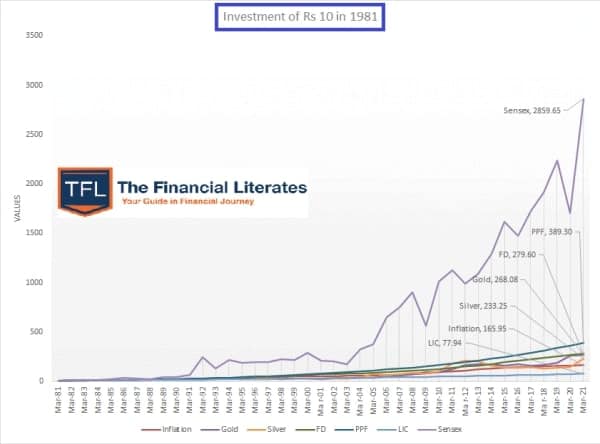
Asian Paints traded at Rs 30 in 2005. Rs 80 in 2009 (after falling through the 2008 global financial crisis). By January 2021, it had touched Rs 2,845 – nearly 35 times the 2009 low. The business was excellent throughout this period. The price reflected that excellence over time, even while short-term movements bore no relationship to the business’s actual quality.

This is why time in the market, not timing the market, is the fundamental principle of equity investing for retirement.

Read – Direct Investing in Stocks: Why Most Indian Retail Investors Lose Money

Read – Portfolio Rebalancing: When and How to Rebalance

Frequently Asked Questions

If fundamentals determine long-term stock value, why do good companies sometimes perform poorly for years?

Even fundamentally strong companies can underperform for extended periods if they are bought at too high a valuation. A wonderful business bought at 60x earnings may take 5-10 years for the business growth to “catch up” to the price paid. This is why valuation – what you pay relative to what you get – matters alongside business quality. It is also why diversifying through mutual funds rather than concentrating in individual stocks protects against paying too high a price for any single business.

How much should I follow daily market news as a retirement investor?

Minimally. The news that drives daily market movements is almost entirely irrelevant to a 15-20 year retirement investment horizon. In 25 years of advising clients, the most financially successful ones were almost always those who checked their portfolios less frequently, not more. If your retirement plan is properly constructed for your risk capacity and timeline, a 20% market correction should trigger a rebalancing review, not a panic exit. Daily news should trigger neither.

Should I try to buy when prices fall sharply, like in a market crash?

Timing market corrections is extremely difficult even for professionals – the 2020 COVID crash recovered faster than almost anyone predicted. A more reliable approach: maintain a standing SIP that automatically buys more units when prices fall (since the same rupee amount buys more units at lower NAVs), and rebalance your portfolio according to your target allocation when equity drifts significantly below its target weight. These mechanical approaches capture the benefit of lower prices without requiring you to predict market bottoms.

Stock prices tell you what someone was willing to pay at a given moment under a given set of emotions. Business value is what the underlying enterprise is actually worth based on its earnings capacity. Over the short term, price and value diverge frequently. Over the long term, they converge reliably. The retirement investor’s job is to own good businesses through good funds, maintain the right allocation, and let time do the work.

Price is what you pay. Value is what you get. Time is what closes the gap.

Want an investment strategy that is designed for long-term value, not short-term noise?

RetireWise builds retirement portfolios based on long-term fundamentals and disciplined allocation – so market volatility is a feature of the plan, not a threat to it.

See Our Retirement Planning Service

💬 Your Turn

Has understanding why stock prices change made you a calmer investor? Or do you still find yourself reacting to market movements? Share your experience in the comments.

Emergency Fund in India: How Much Do You Really Need? (The Answer Will Surprise You)

“In preparing for battle I have always found that plans are useless, but planning is indispensable.”

– Dwight D. Eisenhower

Vikram (name changed) was a 52-year-old VP at a large manufacturing company in Pune. Good salary. Smart investor. Well-read about personal finance. He had a 6-month emergency fund sitting neatly in a savings account.

Then his company went through a restructuring. His role was eliminated. It took him 11 months to find a comparable position. By month 7, he was dipping into his equity mutual funds – at the worst possible time, because the market had corrected 18% that year.

His emergency fund was not wrong. It was just sized for a world that no longer exists for senior professionals.

⚡ Quick Answer

An emergency fund is 3-12 months of essential expenses kept in liquid, accessible accounts – separate from investments. The right amount depends on your income stability, EMI load, dependents, and career risk. For most senior executives in India earning Rs 3L+/month, 6 months is the floor, not the target.

What is an Emergency Fund – and What is Not

An emergency fund is a dedicated corpus for genuinely unexpected financial shocks. The operative word is unexpected. A car that is 8 years old breaking down is not an emergency. It is a predictable expense you chose not to plan for. Your daughter’s college admission is not an emergency. It is a goal with a known deadline.

Real emergencies fall into three categories:


  • Income emergencies: job loss, sudden business slowdown, a forced career break

  • Medical emergencies: hospitalisation without cashless facility, a critical illness in the family

  • Asset emergencies: sudden replacement needed – not planned replacement

What is NOT your emergency fund: your credit card limit, your PPF account, your EPF corpus, or your equity mutual funds. These are either debt, locked, or subject to market risk at the worst possible time.

🚫 The Credit Card Trap

Credit card debt in India charges 36-42% annual interest. Using a card as your “emergency fund” means a Rs 2 lakh medical bill becomes Rs 2.8 lakh in 12 months if not fully repaid. That is not a safety net. That is a debt trap with good marketing.

How Much Emergency Fund Do You Actually Need?

The universal “3-6 months” rule was designed for a salaried employee in the 1970s with a stable government job, no EMIs, and a joint family support system. It does not translate cleanly to a senior executive in 2026 with a Rs 1.2 lakh home loan EMI, two school-going children, and a corporate career where restructurings happen every 3 years.

Here is a more honest framework based on what I have seen in practice:

Your Situation Recommended Cover
Stable job, working spouse, no or low EMIs 3-4 months expenses
Stable job, single income, moderate EMIs (25-40% of salary) 6 months expenses + 3 months EMI
Senior executive (VP and above), single income, high EMI load 9-12 months expenses
Business owner or variable income professional 12 months expenses minimum
Pre-retirement (within 5 years of retirement) 12-18 months – see next section

Add one more month for each of these factors: elderly parent with health issues, child with special needs, a home loan with floating rate above 9%, or a single-income household in a city with high cost of living.

Is your retirement corpus sized correctly for 25+ years?

An emergency fund is one layer of protection. A withdrawal strategy is another. At RetireWise, we build both into your retirement blueprint.

See How RetireWise Works

The Emergency Fund Decay Problem

Here is the part that almost no financial planning article in India discusses. And it matters enormously if you are in your 40s or approaching retirement.

Your emergency fund has an invisible enemy. Not inflation – though that matters too. The real enemy is what I call the Emergency Fund Decay Problem: your fund was sized for your life 3 years ago, not your life today.

Think about it. When a 35-year-old calculates a 6-month emergency fund, their monthly expense might be Rs 80,000. So they park Rs 4.8 lakh and feel covered. By the time they are 45, their monthly expense is Rs 1.6 lakh – lifestyle upgrades, school fees, aging parents, a bigger home loan. But the emergency fund is still Rs 5.2 lakh (it earned some interest). That Rs 5.2 lakh now covers just over 3 months. They did not notice the decay. Nobody told them to recalibrate.

“Most people build an emergency fund once and forget it. Life inflates. The fund doesn’t. Ten years later, they have a false sense of security built on a number that no longer matches their reality.”

– Hemant Beniwal, CFP, CTEP | Founder, RetireWise

There is a second dimension to this problem – and this is where it gets specifically dangerous for senior executives near retirement.

When you are at the VP or Director level, finding a comparable role after a job loss takes longer than it did at 30. The market for Rs 50L+ CTC roles is thin. Headhunters tell you 8-10 months is typical. In a downturn, 12-14 months is not unusual. Your emergency fund was sized for a 35-year-old’s job market reality. You are now 50.

THE SENIOR EXECUTIVE RE-EMPLOYMENT GAP (India, 2024-25)

Age 30-35: Avg job search time after layoff = 2-3 months

Age 40-45: Avg job search time after layoff = 5-7 months

Age 48-55: Avg job search time after layoff = 9-14 months

Source: SEBI & industry surveys. Senior executive = CTC above Rs 40L/year.

This is why I recommend that anyone above 45 – especially those in senior corporate roles – treat 12 months as their emergency fund baseline, not their maximum. The 6-month rule was built for a 32-year-old software engineer. You are not that person anymore.

There is a third layer to the decay problem that connects directly to retirement planning. If you are within 5 years of retirement and a job loss forces you to liquidate equity investments during a market downturn, you trigger what financial planners call sequence of returns risk – you sell investments at depressed prices, and those specific units can never recover for you. A well-sized emergency fund is your buffer against this. It buys you time to wait for markets to recover before you are forced to sell.

The rule of thumb I use with clients: at age 50+, your emergency fund should be large enough to cover your essential expenses for at least the length of your expected job search – plus 3 months extra as a buffer for medical surprises.

EMERGENCY FUND FORMULA FOR SENIOR EXECUTIVES (Age 45+)

Monthly Essential Expenses x (Expected Job Search Months + 3)

Essential expenses = housing + food + EMIs + school fees + basic healthcare. Not Netflix, dining out, or discretionary.

Where to Keep Your Emergency Fund

The golden rule: liquid first, returns second. An emergency fund that earns 1% more but takes 3 days to access has failed its only job.

A practical 3-layer structure that works well for most families:

1

Instant Layer – 10 to 15% in cash or savings account

Keep enough at home (in a secure place) and in your savings account to handle a Rs 20,000-50,000 immediate expense. Medical registration, late-night travel, urgent repairs. No ATM wait, no bank transfer delay.

2

Core Layer – 60 to 70% in savings account with FD sweep

A separate bank account (not your salary account) with auto-sweep into FDs. SBI’s MOD facility, HDFC’s FlexiDeposit, ICICI’s Money Multiplier – all work well. You earn near-FD rates, the money sweeps back automatically when needed. ATM card attached for immediate access.

3

Reserve Layer – 20 to 25% in liquid or overnight mutual funds

Liquid mutual funds (HDFC Liquid, Parag Parikh Liquid, SBI Liquid) credit money in T+1 business days and typically earn 6.5-7% annually. Use this layer only if your core layer is depleted. Do not use arbitrage funds or ultra-short-duration funds for emergency money – slightly higher returns, but redemption timelines vary.

✅ One Rule That Prevents Most Mistakes

Keep the ATM card for your emergency fund account in a drawer at home – not in your wallet. The minor inconvenience of fetching it is your last line of defense against spending it on non-emergencies.

How to Build Your Emergency Fund – Even If You Are Starting Late

Most people who do not have an emergency fund did not decide not to have one. They simply never got around to building it systematically.

The fastest way to build it is to treat the first month as a sprint, not a marathon. Take your next month’s bonus, a fixed deposit that is maturing, or any one-time income and park it directly. That seeds the account. After that, set up an automatic transfer of Rs 10,000-25,000 per month until you hit your target.

If you have EMIs eating into savings, build in two stages. Stage 1: reach 3 months cover in 6-9 months. Then pause and attack high-interest debt. Stage 2: resume building toward your full target once the debt is cleared.

And once it is built – review it every 2 years. Set a calendar reminder. Your life changes. Your fund should keep pace.

Read next: What is Financial Planning? The 6-Step Process That Actually Works

Your emergency fund is one piece. Retirement is the whole puzzle.

At RetireWise, we build a written retirement blueprint – corpus sizing, withdrawal strategy, risk buffers. SEBI Registered. Fee-only.

See the RetireWise Service

Vikram eventually rebuilt. It took him 18 months to get back to financial stability. He now keeps 14 months of expenses in his emergency fund. He says it is the best decision he made in his 50s – not because he expects to use it, but because it changed how he sleeps at night.

An emergency fund is not about fear. It is about freedom – the freedom to make decisions without panic.

💬 Your Turn

When did you last recalculate whether your emergency fund still matches your current monthly expenses? Tell me in the comments – I suspect many readers will find a gap they did not know existed.

10 Investment Mistakes That Cost Indian Investors Lakhs Every Year

“The stock market is designed to transfer money from the active to the patient.” – Warren Buffett

How many investment mistakes have you made in the last 12 months?

If your answer is “none,” you’re either lying or you’re not investing at all. Every investor makes mistakes. The difference between those who build wealth and those who don’t isn’t the absence of errors. It’s the speed at which they recognise and correct them.

After 25 years of reviewing portfolios, I’ve seen the same 10 mistakes repeat themselves across thousands of investors. Senior executives earning ₹50 lakh a year make the same errors as first-time investors. The mistakes aren’t about intelligence. They’re about behaviour, emotion, and the illusions we carry about how markets work.

Quick Answer

The 10 most common investment mistakes in India: no plan, short time horizon, chasing past returns, timing the market, mixing insurance with investment, following the herd, excessive churning, unrealistic expectations, refusing to accept losses, and over-monitoring. SEBI data shows 91% of individual F&O traders lost money, averaging ₹1.1 lakh per year. Most mistakes are behavioural, not technical.

10 Investment Mistakes to Avoid by Investor

10 Investment Mistakes Every Indian Investor Must Avoid

1. No Investment Plan Critical

People buy products without a plan. In the name of “investment,” they accumulate insurance policies, random mutual funds, and fixed deposits with no strategy connecting them. No wind is right unless you know which harbour you’re sailing to.

Vikram (name changed), a 46-year-old CTO in Pune, had 14 “investments” when he came to me. Three ULIPs, four traditional insurance plans, two ELSS funds from different agents, three FDs, a PPF, and an NPS. When I asked him what financial goal each one was linked to, he went silent. None of them were linked to anything. They were just products bought impulsively over 15 years.

2. Too Short a Time Horizon

The most powerful wealth creation tool isn’t a product. It’s time. But investors want quick returns even when their goals are 15-20 years away. They take unnecessary risks like F&O trading or stock picking to “speed things up.” SEBI data shows 91% of individual F&O traders lost an average of ₹1.1 lakh per year. Patience isn’t just a virtue in investing. It’s the entire strategy.

Must Read – 15 Types of Risk in Investment Every Indian Should Know

3. Chasing Last Year’s Best Performer

The fund that gave 40% last year becomes everyone’s favourite. But recent past performance is one of the worst predictors of future returns. The small-cap fund that topped the charts in 2024 might be at the bottom in 2026. Always look at 5-10 year track records, and even then, treat them as just one data point, not the whole picture.

4. Trying to Time the Market

“I’ll invest when the market corrects.” How many people said that in 2020, 2022, and 2024? And how many of them actually invested at the bottom? Almost none. Even professional fund managers can’t consistently time the market. The more you try, the worse your returns get. In the stock market, inactivity often beats activity.

Time IN the market > Timing the market. A ₹10,000 monthly SIP in Nifty 50 over 20 years (2004-2024) turned into ₹1.2 Cr regardless of when you started.

Investing Mistakes to Avoid

5. Mixing Insurance with Investment Critical

Insurance is for protection today: “What if the breadwinner is no more?” Investment is for the future: “In 15 years, I need ₹50 lakh for my daughter’s education.” Mixing these two is like wearing a raincoat to a swimming pool. It doesn’t serve either purpose well. A pure term plan for insurance and mutual funds for investment will always outperform any combo product.

6. Following the Herd

Investment is not football where teamwork wins. It’s chess where individual strategy matters. When your colleague makes money in a stock, your brain tells you “I should’ve bought that too.” But you never hear about the 5 stocks he lost money on. Herd mentality is amplified in 2026: WhatsApp groups, Telegram channels, and “finfluencers” with zero SEBI registration are driving millions of retail investors into decisions based on FOMO, not fundamentals.

Must Read – 7 Simple Steps to Effective Investment Strategies for Young Investors

7. Excessive Portfolio Churning

Switching funds every 6 months because something else “looks better” does only two things: it increases your tax burden and makes your distributor richer. Many distributors and bankers actively encourage churning because it generates fresh commissions for them. You’re not a client in that relationship. You’re a target.

8. Unrealistic Return Expectations

Expecting 20% returns consistently from equity is like expecting it to rain perfectly on your farm every monsoon. Equity returns are linked to economic growth. If India grows at 10-12% nominally, equity will give you 12-15% over the long run. FDs will give you what the interest rate environment allows. Anyone promising more is either naive or lying.

9. Refusing to Accept a Loss

What would you do if you took a wrong turn while driving? You’d turn back, even if it costs you time and petrol. But most investors don’t apply this logic to their portfolio. They hold onto a losing stock because “selling means accepting the loss.” But the loss already exists. Selling just makes it visible. Not selling doesn’t make it disappear.

10. Over-Monitoring Your Investments

Checking your portfolio every day is not discipline. It’s addiction. And it’s harmful. The more you watch, the more likely you are to react to noise instead of signal. Give your investments time to grow. Review quarterly. Rebalance annually. The rest of the time, live your life.

Making More Than 3 of These Mistakes Right Now?

A structured portfolio review can identify what’s costing you money and fix it before it compounds further.

Book a Free 30-Min Call

What Nobody Tells You About Investment Mistakes

Here’s the part that most “top 10 mistakes” articles leave out.

The costliest investment mistake isn’t any single wrong decision. It’s the cumulative effect of small, invisible errors compounding over decades. A 1% higher expense ratio on your mutual funds sustained over 25 years on a ₹50 lakh portfolio costs you roughly ₹35-40 lakh in lost returns. You’ll never notice it because it doesn’t show up as a “loss” anywhere. It’s the money you never made.

Similarly, staying in an expensive insurance plan instead of switching to term plan plus mutual fund can cost ₹20-30 lakh over 20 years. The agent won’t tell you this. The insurance company won’t show you this.

The biggest investment mistakes aren’t the dramatic ones. They’re the quiet ones that compound silently while you’re not watching.

Your Investments Should Work as Hard as You Do

A financial plan that catches these invisible costs is worth more than the best stock pick.

Book a Free 30-Min Call

Frequently Asked Questions

What is the biggest investment mistake in India?

Investing without a plan. Most Indians accumulate financial products over the years without any strategy connecting them to specific life goals. This leads to overlapping investments, gaps in protection, and poor returns despite decades of saving.

Why do retail investors lose money in the stock market?

SEBI data shows 91% of individual F&O traders lost an average of ₹1.1 lakh per year. The main reasons: trying to time the market, following tips from unregistered advisors, overtrading, and letting emotions like FOMO and panic drive decisions. Most losses come from speculating, not investing.

How can I avoid common investment mistakes?

Start with a written financial plan linked to specific goals. Use a pure term plan for insurance and mutual funds for wealth creation. Invest through SIPs for discipline. Review your portfolio quarterly, not daily. Work with a SEBI-registered advisor who puts your interests first.

Is it wrong to check my portfolio daily?

Checking daily doesn’t help. It increases anxiety and the temptation to react to short-term noise. The best approach: review quarterly, rebalance annually, and only make changes when your life circumstances change – not when markets move.

The market forgives bad timing. It doesn’t forgive bad behaviour repeated for decades.

It’s not a Numbers Game… It’s a Mind Game.

Your Turn

Which of these 10 mistakes have you made? And more importantly, which one are you still making right now? Be honest in the comments.

Pradhan Mantri Vaya Vandana Yojana (PMVVY) — Closed for New Investment. Here Are Your Best Alternatives

If you are a senior citizen searching for the Pradhan Mantri Vaya Vandana Yojana, I need to tell you something upfront — this scheme is no longer available for new investors. PMVVY closed for fresh subscriptions on 31st March 2023, and the government has not reopened it.

I know this is frustrating. You probably heard from a friend or family member that PMVVY was a solid government-backed pension option. And they were right — it was. But the window has shut.

The good news? There are alternatives today that offer even better returns than PMVVY ever did. Let me walk you through everything — what PMVVY was, what happens if you already have it, and where you should put your money instead.

⚡ Quick Answer

PMVVY is closed for new subscriptions since March 2023. Existing policyholders will continue receiving their pension till maturity. For new investments, the Senior Citizens Savings Scheme (SCSS) at 8.2% is now the best government-backed option for senior citizens, followed by Post Office MIS at 7.4%.

Infographic cover for article asking whether a senior citizen should invest in Pradhan Mantri Vaya Vandana Yojana (PMVVY) pension scheme

What Was Pradhan Mantri Vaya Vandana Yojana?

PMVVY was launched in 2017 by the Government of India and operated by LIC. It was designed specifically for senior citizens aged 60 and above who wanted guaranteed pension income.

The idea was simple — you pay a lump sum, and LIC pays you a fixed pension every month (or quarter, or year) for 10 years. At the end of 10 years, you get your entire investment back. If you passed away during the term, the full purchase price went to your nominee.

Think of it like parking your retirement corpus in a government vault, drawing a fixed monthly salary from it, and getting it all back when the vault opens in 10 years. Not a bad deal at all.

Why Did PMVVY Close?

The scheme was originally available till March 2020. It got extended twice — first to March 2022, then to March 2023. After that, the government did not extend it further.

The likely reason? The subsidy burden. The government was paying the difference between market rates and the guaranteed rate offered to investors. As interest rates fluctuated, this became expensive.

Whatever the reason, the result is clear — no new PMVVY policies can be purchased after 31st March 2023.

🚫 Scheme Closed

PMVVY stopped accepting new investments on 31st March 2023. If any agent or website tells you it is still available, be cautious — that information is outdated.

Already Have PMVVY? Here Is What You Need to Know

If you purchased PMVVY before the deadline, your policy continues as normal. Here are the key things to remember:

Your pension payments will continue for the full 10-year term. The rate you were promised at the time of purchase remains locked in — it does not change. At maturity, your full purchase price is returned to you.

You can take a loan against your PMVVY after completing 3 years. The loan amount can go up to 75% of your purchase price, though the interest on the loan gets deducted from your pension.

If you face a critical or terminal illness (yourself or your spouse), you can surrender the policy prematurely. You will receive 98% of the purchase price.

One important reminder — submit your Life Certificate (Jeevan Pramaan) every November. Miss this, and your pension payments may get delayed.

PMVVY vs SCSS vs Post Office MIS — Which Is Better Today?

Since PMVVY is closed, let me show you how the alternatives compare. I am putting them side by side so you can see the full picture at a glance.

Senior Citizens Savings Scheme (SCSS)

Interest Rate: 8.2% per annum (April–June 2026)

Tenure: 5 years (extendable by 3 years) · Max investment: ₹30 lakh · Interest paid quarterly · Tax deduction under Section 80C · Premature withdrawal allowed with penalty · Available at post offices and authorised banks · Government-backed, zero credit risk

PMVVY (Closed for New Investment)

Last Offered Rate: 7.40% per annum

Tenure: 10 years · Max investment was ₹15 lakh per person · Pension paid monthly/quarterly/yearly · No Section 80C benefit · Premature exit only for critical illness · Operated by LIC · Closed since 31st March 2023

Post Office Monthly Income Scheme (POMIS)

Interest Rate: 7.4% per annum (April–June 2026)

Tenure: 5 years · Max investment: ₹9 lakh (single) / ₹15 lakh (joint) · Monthly interest payout · No Section 80C benefit · Premature withdrawal with penalty after 1 year · Government-backed

Look at those numbers. SCSS at 8.2% actually beats the rate PMVVY offered in its last phase. And SCSS gives you a Section 80C deduction that PMVVY never did.

Not sure which combination of schemes fits your retirement income needs?

A retirement income plan is not about picking one product — it is about building the right mix for your situation.

Explore Retirement Planning Options →

My Recommendation for Senior Citizens in 2026

After 20 years of working with retirees, here is what I have seen work best — a layered approach rather than putting everything into one scheme.

Ramesh (name changed), a 63-year-old retired bank officer, came to me last year. He had ₹40 lakh in retirement savings and wanted guaranteed monthly income. Here is what we built for him:

He invested ₹30 lakh in SCSS — that gives him roughly ₹61,500 per quarter (about ₹20,500 per month). The remaining ₹9 lakh went into Post Office MIS — adding ₹5,550 per month. Together, he gets about ₹26,000 per month in guaranteed income.

That is the power of combining two government-backed schemes. No market risk. No sleepless nights. Just predictable income every month.

But I also told Ramesh something that made him uncomfortable — guaranteed schemes alone will not protect him from inflation over 20-25 years. That is why a small allocation to systematic withdrawal plans from equity mutual funds matters even in retirement.

The Inflation Reality No One Talks About

Here is a truth most retirement articles skip — fixed-income schemes give you peace of mind today, but inflation quietly eats away at their real value over time.

At 6% inflation, ₹26,000 per month today will feel like ₹14,500 in purchasing power ten years from now. That is not a scare tactic. That is basic maths.

This is why I always recommend that senior citizens keep 70-75% of their corpus in safe, guaranteed instruments (SCSS, POMIS, bank FDs) and 20-25% in a well-diversified portfolio that has some equity exposure. The remaining 5-10% should stay in liquid instruments for emergencies — because medical expenses do not wait for maturity dates.

Tax Treatment — What Senior Citizens Must Know

Interest income from SCSS, POMIS, and bank FDs is fully taxable. It gets added to your total income and taxed as per your slab.

However, there are two important relief measures. First, under the new tax regime (default from FY 2024-25), senior citizens can earn up to ₹50,000 in interest income without TDS if they submit Form 15H. Second, under Section 80TTB, senior citizens can claim a deduction of up to ₹50,000 on interest earned from deposits (this applies under the old tax regime).

SCSS also qualifies for Section 80C deduction up to ₹1.5 lakh — a benefit that neither PMVVY nor POMIS offers.

My advice? If your total income is below the taxable limit, always submit Form 15H at the beginning of the financial year. Do not wait for TDS to be deducted and then claim a refund — that is unnecessary hassle.

What About NRIs?

If you are an NRI reading this hoping to invest in these schemes — SCSS, PMVVY, and POMIS are all restricted to resident Indians. NRIs are not eligible.

For NRI-specific retirement options, I have covered this in detail at NPS for NRIs. Also read about the reverse mortgage option if you own property in India.

Frequently Asked Questions

Can I still buy PMVVY in 2026?

No. PMVVY closed for new subscriptions on 31st March 2023. The government has not announced any extension or new version of the scheme.

What happens to my existing PMVVY policy?

Nothing changes. Your pension continues for the full 10-year term at the rate promised when you purchased. At maturity, your purchase price is returned.

Which is the best alternative to PMVVY right now?

The Senior Citizens Savings Scheme (SCSS) at 8.2% is the best government-backed alternative. It offers a higher interest rate than PMVVY’s last offered rate of 7.40%, plus it qualifies for Section 80C tax deduction.

Can I invest in both SCSS and POMIS?

Yes. There is no restriction. Many retirees invest the maximum in SCSS (₹30 lakh) and put additional money in POMIS (up to ₹9 lakh individually or ₹15 lakh jointly) to maximise guaranteed monthly income.

Is SCSS interest rate fixed for the entire tenure?

Yes. Whatever rate is prevailing when you open your SCSS account gets locked in for the full 5-year term. Even if rates change later, your rate remains the same.

Confused about building a retirement income strategy?

I help senior citizens and pre-retirees create income plans that balance safety, growth, and peace of mind.

Talk to a Retirement Planner →

Schemes come and go. PMVVY closed. Tomorrow, something else might close. What does not change is the principle — retirement income needs multiple pillars, not one pillar.

Your retirement is too important to depend on a single government scheme.

💬 Your Turn

Are you an existing PMVVY holder? Or are you exploring alternatives for the first time? Share your current retirement income mix — I personally respond to every comment.

5 Best Investment Options for Senior Citizens in India (2026 Update)

You spent 30 or 35 years working. Waking up early, dealing with office politics, meeting deadlines, sacrificing weekends. And now — finally — it is your money’s turn to work for you.

But here is the problem. The moment you retire, everyone has an opinion on what you should do with your savings. Your neighbour recommends a fixed deposit. Your nephew says mutual funds. Your bank relationship manager pushes some annuity product. And you sit there, overwhelmed, knowing that one wrong move with your retirement corpus could cost you years of peace.

I have worked with hundreds of retirees over the past two decades. And the ones who sleep well at night are not the ones with the most money — they are the ones with the right mix of investments. Let me show you what that mix looks like.

⚡ Quick Answer

The 5 best investment options for senior citizens in India are: SCSS (8.2%), Post Office MIS (7.4%), Bank Fixed Deposits (up to 7.05% for seniors), Debt Mutual Funds (for tax efficiency), and a small Equity Mutual Fund allocation via SWP (for inflation protection). Build a layered portfolio — do not put everything in one product.

Hero image for article on 5 best investment options for senior citizens in India including SCSS, POMIS, pension plans and FDs

The 5 Best Investment Options for Senior Citizens in 2026

Before I dive into each option, let me share the framework I use with every retired client — the Bucket Approach. Divide your retirement corpus into three buckets: Safety (60-70%), Income (15-20%), and Growth (10-20%). The five options below fit into these buckets perfectly.

1. Senior Citizens Savings Scheme (SCSS) — The Gold Standard

Senior Citizens Savings Scheme (SCSS)

Interest Rate: 8.2% per annum (April–June 2026)

Tenure: 5 years (extendable by 3 years) · Max investment: ₹30 lakh · Interest paid quarterly · Section 80C tax benefit · Premature withdrawal allowed · Available at post offices and banks · Government-backed

If I had to pick just one investment for a senior citizen, this would be it. SCSS is the single best government-backed savings instrument available to retirees today.

Here is why it wins. At 8.2%, the rate beats every major bank FD and even the now-closed PMVVY. Your interest is paid quarterly — so you get actual money in your bank account every three months, not just on paper. The investment limit was raised to ₹30 lakh in 2023, so a couple can park up to ₹60 lakh between two accounts. And unlike most fixed-income products, SCSS qualifies for Section 80C deduction — saving you tax while earning high interest.

Sunita (name changed), a retired school principal, invested her full ₹30 lakh gratuity in SCSS when she retired last year. She gets approximately ₹61,500 every quarter — about ₹20,500 per month — without touching her principal. That is the kind of predictability retirees need.

The one limitation? If interest rates rise further, you are locked in at the rate you started with. But honestly, 8.2% locked for 5 years is a deal most retirees should grab with both hands.

2. Post Office Monthly Income Scheme (POMIS) — Your Monthly Salary Replacement

Post Office Monthly Income Scheme (POMIS)

Interest Rate: 7.4% per annum (April–June 2026)

Tenure: 5 years · Max investment: ₹9 lakh (single) / ₹15 lakh (joint) · Monthly payout · No Section 80C benefit · Premature withdrawal after 1 year with penalty · Government-backed

SCSS pays quarterly. But what if you need monthly income — like a salary replacement? That is where POMIS comes in.

The Post Office Monthly Income Scheme pays you interest every single month. At ₹9 lakh invested, you get ₹5,550 per month. If you open a joint account with your spouse and invest the maximum ₹15 lakh, that is ₹9,250 per month — deposited like clockwork.

The beauty of POMIS is its simplicity. No market fluctuations, no NAV calculations, no exit loads. You invest, you get a fixed monthly amount, and at the end of 5 years you get your money back. For senior citizens who want to replicate the feeling of a monthly salary, POMIS is the closest thing to it.

Combine SCSS and POMIS, and you have ₹39 lakh working for you — generating roughly ₹26,000 per month in completely guaranteed income. That covers basic expenses for many retired households.

Want a customised retirement income plan for your situation?

Every retiree’s needs are different. I help build income plans that match your expenses, risk appetite, and goals.

Explore Retirement Planning →

3. Bank Fixed Deposits — The Familiar Comfort

Bank Fixed Deposits (Senior Citizen Rates)

Interest Rate: 6.50% – 7.50% (varies by bank, April 2026)

Tenure: 7 days to 10 years · No upper investment limit · Senior citizens get extra 0.25%–0.50% over regular rates · Quarterly/monthly interest options · Tax-saving FD (5-year lock-in) qualifies for 80C · Premature withdrawal with penalty

I know, I know — FDs are boring. But here is what I tell my clients: boring is good when you are retired.

Bank FDs remain the most accessible and liquid fixed-income option for senior citizens. Every bank in India offers them, the process is simple, and you can break them anytime (with a small penalty). SBI currently offers up to 7.05% for senior citizens on certain tenures. HDFC Bank goes up to 7.00%.

The real value of FDs in a retirement portfolio is not the rate — it is the flexibility. You can ladder your FDs across different maturity dates, so you always have money coming up. A senior citizen with ₹20 lakh in FDs might split it into 4 deposits of ₹5 lakh each, maturing every year. That way, you always have access to funds without breaking your entire corpus.

One important tip — if your total interest income from all sources stays below ₹50,000, submit Form 15H to your bank. This prevents unnecessary TDS deduction.

The limitation? FD rates rarely beat inflation over the long term. Think of FDs as your liquidity buffer and emergency fund — not your growth engine.

4. Debt Mutual Funds — The Tax-Efficient Alternative

Debt Mutual Funds (Short Duration / Corporate Bond Funds)

Returns: 6.5% – 7.5% (indicative, varies by fund)

No lock-in period · Gains taxed at your income slab rate (post-April 2023 investments) · Higher liquidity than FDs · Professional fund management · Subject to market risk (though lower than equity) · SWP option available for regular income

Here is something most retirement articles do not tell you — for senior citizens in the 20% or 30% tax bracket, debt mutual funds can deliver better post-tax returns than FDs.

Why? Because with FDs, your entire interest is added to your income every year and taxed at your slab rate. With debt mutual funds, you only pay tax when you actually redeem — and you can control the timing of redemption through a Systematic Withdrawal Plan (SWP).

An important change to note — for debt fund investments made after 1st April 2023, there is no indexation benefit. Gains are taxed at your slab rate regardless of holding period. This reduced the tax advantage compared to the old rules, but the timing flexibility still helps.

I recommend debt funds primarily for senior citizens who have already maxed out SCSS and POMIS and still have surplus to invest. Short duration funds and corporate bond funds from reputed AMCs work well — they offer slightly better returns than bank FDs with reasonable safety.

“The biggest risk in retirement is not losing money in the market. It is outliving your money because you played it too safe.”

— Hemant Beniwal, Certified Financial Planner

5. Equity Mutual Funds via SWP — The Inflation Shield

Equity Mutual Funds (via Systematic Withdrawal Plan)

Returns: 10% – 12% historically (long-term, not guaranteed)

No lock-in (open-ended funds) · LTCG taxed at 12.5% above ₹1.25 lakh exemption · STCG taxed at 20% · SWP creates regular income from corpus · Subject to market risk · Best for 10%–20% of retirement corpus · Professional management

I can already hear the objection — “Hemant, I am retired. I should not be in equities.” I understand the fear. But let me share some maths.

If you retire at 60 and live to 85 (which is increasingly common), you have a 25-year investment horizon. At 6% inflation, the ₹50,000 per month you need today will become ₹1.29 lakh per month in 15 years. Can SCSS and FDs alone keep up? They cannot.

A small allocation — 15-20% of your corpus — in well-diversified equity mutual funds (like balanced advantage funds or large-cap funds) can make a significant difference. And you do not need to monitor markets daily. Set up a Systematic Withdrawal Plan that draws 5-6% per year from your equity corpus, and let compounding do the rest.

Arun (name changed), a 65-year-old retired IAS officer, put ₹15 lakh into a balanced advantage fund three years ago and set up an SWP of ₹8,000 per month. His corpus has not only sustained the withdrawals — it has actually grown slightly, even after market corrections. That is the power of staying invested for the long term.

Of course, this is not for everyone. If market volatility gives you sleepless nights, even 10% allocation is too much. But for those who can handle short-term dips for long-term gain, equity is not optional in retirement — it is essential.

Two Schemes That Are No Longer Available

You may have heard about Pradhan Mantri Vaya Vandana Yojana (PMVVY) and Varistha Pension Bima Yojana (VPBY). Both were excellent government-backed pension options. Unfortunately, both are now closed for new investment — PMVVY closed in March 2023, and VPBY has been discontinued since 2015.

If you already hold either of these, your existing policies continue normally. But for new investments, the five options listed above are your best choices. For a detailed analysis of PMVVY and its alternatives, read my complete PMVVY guide.

How to Build Your Retirement Income Portfolio

Let me give you a practical allocation framework based on what has worked for my clients:

Kavita (name changed), 62, retired with ₹60 lakh. Here is the portfolio we built together:

She put ₹30 lakh in SCSS — generating about ₹61,500 quarterly. Another ₹9 lakh went into POMIS — adding ₹5,550 monthly. She laddered ₹10 lakh across bank FDs for liquidity and emergencies. ₹5 lakh went into a short-duration debt fund with an SWP option. And ₹6 lakh went into a balanced advantage fund as her inflation hedge.

Total guaranteed monthly income: approximately ₹26,050. Plus the growth component working silently in the background. She does not check her mutual fund portfolio daily. She checks it once a quarter. And she sleeps well.

That is what a good post-retirement plan looks like — not one investment, but a system.

Tax Benefits Every Senior Citizen Must Claim

Beyond choosing the right investments, make sure you are claiming every tax benefit available to you:

Under Section 80C, SCSS investment qualifies for deduction up to ₹1.5 lakh. Tax-saving bank FDs (5-year lock-in) also qualify. This applies under the old tax regime.

Under Section 80TTB (old regime only), senior citizens can claim deduction of up to ₹50,000 on interest income from bank deposits, post office deposits, and cooperative bank deposits.

Under Section 80D, senior citizens can claim up to ₹50,000 for health insurance premium payment — for themselves and their spouse. If you are paying premium for your parents (super senior citizens), an additional ₹50,000 deduction is available.

Submit Form 15H at the start of every financial year if your total income is below the taxable threshold. This prevents banks and post offices from deducting TDS on your interest. Many senior citizens forget this simple step and then chase refunds for months.

What About NRIs?

If you are a Non-Resident Indian, most of these options are not available to you. SCSS, POMIS, and PMVVY are restricted to resident Indians only. Bank FDs are available to NRIs but under different rules (NRE/NRO accounts). Mutual funds are available with KYC compliance.

For NRI-specific retirement planning, I have a detailed guide on NPS options and other strategies that work across borders.

Your retirement deserves more than guesswork

I help retirees build income portfolios that cover expenses today and protect purchasing power for decades ahead.

Get a Retirement Income Plan →

You worked for decades to build your savings. Now it is time to make those savings work — not just sit in one place collecting dust.

Retirement is not about having the most money. It is about never running out.

💬 Your Turn

What does your retirement income mix look like right now? Are you relying on just one or two products, or have you built a layered portfolio? Share below — I read and respond to every comment.

How to Calculate Your Net Worth – And Why Most Indians Get It Wrong

Here is a question I ask every new client in our first meeting.

“What is your net worth?”

Most people pause. Some give me their salary. Some mention their portfolio value. A few guess at a number. Very rarely does someone come in with the actual figure calculated correctly.

In 25 years of practice, I have found that net worth is the single number that separates people who are genuinely building wealth from those who are earning well but going nowhere financially. And most Indians have never calculated it.

Quick Answer

Net worth = Total Assets minus Total Liabilities. Assets include everything you own that has monetary value – investments, property, EPF, gold, cash. Liabilities include everything you owe – home loan, car loan, personal loans, credit card outstanding. A positive and growing net worth means you are building wealth. A stagnant or declining net worth means something is wrong, regardless of how high your salary is.

Why Net Worth Matters More Than Income

A senior executive earning Rs 40 lakh per year with Rs 80 lakh in loans and Rs 30 lakh in assets has a negative net worth. A schoolteacher earning Rs 8 lakh per year with a paid-off house, Rs 25 lakh in mutual funds, and no debt has a net worth of Rs 80 lakh.

Who is wealthier? The answer is obvious. And it has nothing to do with income.

Income is a flow. Net worth is a stock. Income tells you how much water is flowing into your bucket. Net worth tells you how much is actually in the bucket. You can have a strong flow and a leaking bucket. Net worth shows you the leak.

I have met executives earning Rs 50 lakh per year who had less real wealth than a government schoolteacher retiring after 30 years of service. The teacher had EPF, a pension, a paid-off house, and zero debt. The executive had two home loans, a car loan, a lifestyle that consumed every rupee, and a portfolio that looked impressive until you subtracted what was owed.

How to Calculate Your Net Worth

Step 1: List all your assets at current market value.

Financial assets: bank balances, fixed deposits, mutual fund portfolio at current NAV, stocks at current market price, PPF balance, EPF balance, NPS balance, bonds, NSC, post office savings.

Physical assets: current market value of property you own – not what you paid, but what it would sell for today. Gold at today’s rate for jewellery plus coins plus bars. Vehicles at current resale value.

Business assets: if you own a business, include a conservative estimate. When in doubt, value lower.

Add all of these. This is your total assets.

Step 2: List all your liabilities.

Loans outstanding: home loan balance, car loan balance, personal loan balance, education loan balance. Use the outstanding principal, not the original loan amount.

Credit dues: total credit card outstanding – not your limit, what you actually owe today.

Other: informal borrowings, business loans taken personally, advances from family.

Add all of these. This is your total liabilities.

Step 3: Net Worth = Total Assets minus Total Liabilities.

Do you know your net worth – and whether it is on track for retirement?

A fee-only advisor calculates your net worth, benchmarks it against your retirement goal, and builds a plan to close the gap.

Talk to a RetireWise Advisor

The Mistakes That Make Most Net Worth Calculations Wrong

Using purchase price for property instead of market value. A flat bought for Rs 50 lakh in 2010 may be worth Rs 1.2 crore today – or Rs 45 lakh if the locality has stagnated. Use what it would actually sell for.

Forgetting EPF and NPS entirely. For a 45-year-old with 20 years of employment, EPF alone can be Rs 40-80 lakh. These are real assets that many people exclude because they feel distant and locked away.

Ignoring gold jewellery. The average Indian household holds Rs 10-25 lakh worth of gold that never gets counted. At April 2026 prices, even 100 grams is worth approximately Rs 9-10 lakh. Count it.

Including full property value without deducting the loan. If your flat is worth Rs 1 crore and your outstanding home loan is Rs 60 lakh, your net equity is Rs 40 lakh – not Rs 1 crore. Always net it.

Counting the car at purchase price. A Rs 18 lakh car bought two years ago is worth Rs 11-12 lakh today at best. Use current resale value.

The Question Most Clients Cannot Answer

Here is something I ask every client who thinks they are on track for retirement.

“What percentage of your net worth is liquid – meaning you could access it within 30 days without selling your home?”

For most Indian professionals in their 40s, the answer is uncomfortable. They have Rs 1.5-2 crore in net worth on paper. But Rs 80 lakh is locked in property. Rs 40 lakh is in EPF inaccessible until 58. Another Rs 20 lakh is in PPF with 5 years remaining. The actual liquid portfolio available for a retirement shortfall or medical emergency is Rs 20-30 lakh.

Net worth matters. But the composition – how much is liquid, how much is illiquid, how much is income-generating – matters just as much. A retirement corpus needs to be liquid and income-generating. A property you live in is neither. Count it in net worth, yes. But do not count on it to fund your retirement income.

Why High Earners Avoid Calculating This Number

Why do high-income professionals avoid calculating their net worth? It is not laziness.

Psychologists call it the ostrich effect – the tendency to avoid information that might be negative. The executive earning Rs 50 lakh per year who has never calculated net worth subconsciously knows the number might not look good relative to the income. Better not to check.

The same person reviews their portfolio daily when markets are up. They stop opening the investment app when markets fall 15%. Seek confirming information, avoid disconfirming information. The pattern is identical.

The result is a slow, invisible gap between what someone believes their financial position to be and what it actually is. This gap gets discovered at the worst possible time – a forced early retirement, a medical crisis, a job loss at 52. The cost of delayed financial self-awareness compounds just like investment returns – but in the wrong direction.

What Is a Good Net Worth by Age?

A rough benchmark for Indian professionals earning Rs 20-50 lakh per year: net worth should be approximately 1x annual income by 30, 3-4x by 40, 6-8x by 50, and 15-20x annual expenses by 60.

If you are 45 and earning Rs 30 lakh per year, your net worth should be in the range of Rs 90 lakh to Rs 1.2 crore as a minimum. Below this, you have a gap. Understanding your retirement corpus requirement starts with knowing your current net worth honestly.

Track It Annually – The Trend Is the Point

Calculate your net worth once – then recalculate every April at the start of the financial year. The trend matters as much as the number.

A rising net worth means you are accumulating faster than you are spending and borrowing. A flat net worth despite strong income means lifestyle inflation is consuming everything. A falling net worth is a serious warning: expenses are out of control, debt is growing, or assets are declining faster than savings are building. A financial plan built on accurate net worth data is the only kind that actually works.

Frequently Asked Questions

Should I include my home in my net worth calculation?

Yes – but correctly. List the current market value as an asset and the outstanding home loan as a liability. The net equity (value minus loan) is your real wealth from that property. A common mistake is listing the property value without deducting the loan – this significantly overstates net worth. Also: your primary residence is not a liquid asset. Count it in net worth, but do not count on it to fund retirement income.

What is a good net worth by age for an Indian professional?

A useful benchmark: 1x annual income by 30, 3-4x by 40, 6-8x by 50, and 15-20x annual expenses by 60. For someone earning Rs 30 lakh per year, a net worth of Rs 90 lakh to Rs 1.2 crore by age 40 is a reasonable floor. The more important indicator is the trend: net worth growing faster than inflation means you are building real wealth.

My net worth is largely in property and EPF. Is that a problem?

It is not a problem per se, but it is a liquidity risk. Property cannot be sold in 30 days. EPF is inaccessible before 58 in most circumstances. If 80-90% of your net worth sits in these two buckets, your liquid portfolio may be too thin for a retirement shortfall or medical emergency. A balanced net worth approaching retirement should include meaningful liquid financial assets – equity mutual funds, FDs, debt funds – that can be accessed without selling the home.

How do I value my business in my net worth?

Use a conservative multiple of annual profits – typically 2-3x for a small professional practice or service business. If the business depends entirely on your personal involvement and would not easily sell to someone else, value it at zero or near-zero for net worth purposes. Overvaluing a business creates false comfort – you may believe you are retirement-ready when the business valuation is the only thing making the numbers work, and that value may not be realisable when you actually need it.

Your salary tells you what you earn. Your net worth tells you what you have built. The two numbers are often very different. The gap between them is the story of your financial life – and it is worth reading honestly.

Calculate your net worth today. Then calculate it again next year. The direction of that number is the most honest measure of your financial progress.

Your Turn

Have you calculated your net worth recently – and what percentage of it is actually liquid? That second number often surprises people more than the first. Share below.