Home Blog

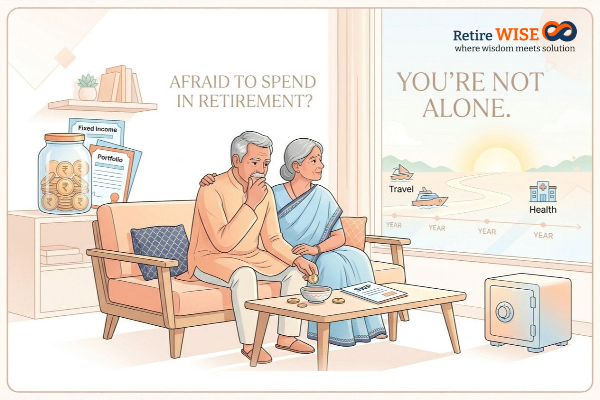
Afraid to Spend in Retirement? You’re Not Alone.

“The goal is not more money. The goal is living life on your terms.” — Chris Brogan

Here is a question nobody in personal finance seems to ask.

You spent 30 years building a retirement corpus. You were disciplined. You stayed invested through crashes. You sacrificed holidays, upgrades, and comforts because the future mattered more than the present. And now the future is here.

So why are you still living like it isn’t?

Most conversations about retirement planning in India focus on one problem: not having enough. And it is a real problem. But there is a second problem that gets almost no attention. Having enough, and not knowing it.

This is one of the most underexamined questions in retirement planning. When does saving for the future start holding back the present?

⚡ Quick Answer

Knowing how much is enough for retirement in India is not just a mathematical question. It is a psychological one. Many retirees who have built adequate or generous corpuses continue to under-spend because they have never formally answered the question: “Am I allowed to enjoy this?” A well-structured retirement plan does not just tell you what you have. It tells you what you can safely spend.. so that years of discipline finally translate into years of living.

spending-in-retirement

Two Kinds of Retirement Problems

The retirement planning industry almost exclusively addresses one kind of problem: not having built enough corpus. There are calculators, articles, rule-of-thumb multiples, and social media posts dedicated to telling you the number you need and how far behind you are.

But there is a second kind of problem that sits on the other side of that coin. Having the corpus and not being able to use it with confidence.

The first problem is mathematical. The second is behavioural. And in my experience of 25 years working with senior professionals across India, the second problem is far more common among people who actually planned well.

A person who has not saved enough needs a financial plan. A person who has saved enough but cannot bring themselves to spend needs something different entirely: a clear picture of what their corpus can sustain, permission backed by numbers, and a structure that removes the anxiety of “what if this runs out?”

Both are retirement planning problems. Only one gets written about.

Where This Fear Comes From

The frugality that builds a great retirement corpus does not switch off at retirement. For most people, it becomes the default operating mode. After decades of treating every rupee as a future asset, spending it on the present feels almost wrong.

There is also something deeper at work. Most people never formally answer the question: how much is enough? The goal post kept moving. At ₹1 crore, the target became ₹3 crore. At ₹3 crore, it became ₹5 crore. More always felt safer than less. And at retirement, there is no number that feels definitively sufficient because that number was never actually calculated.

When you have never quantified enough, you cannot feel it even when you have reached it.

There is also an asymmetry in how we perceive financial mistakes. Spending too much and running out of money is a visible, frightening outcome. Spending too little and leaving a large unspent corpus feels like prudence, not error.

But dying with 40% of your corpus unspent, having denied yourself experiences and comfort in your 60s and 70s out of an anxiety that turned out to be unfounded, is also a failure of planning. It is just a failure nobody talks about.

🎬 Think of a film director who spent years perfecting a script. The research was thorough. The preparation was meticulous. But when the green light finally came, he kept rewriting instead of shooting. The problem was never the script. It was the inability to say “this is ready.” A retirement corpus that is never drawn from with confidence is the financial equivalent of a film that never gets made.

The Question That Changes Everything

Retirement planning is not just about building the corpus. It is about gaining the confidence to actually enjoy what you built.

That confidence does not come from a vague sense that things should be fine. It comes from a specific, calculated answer to one question: given my corpus, my expenses, the inflation I will face, and the returns my portfolio will generate, what can I safely spend each month for the next 25 to 30 years?

When that number is calculated carefully, reviewed by a professional, and built into a withdrawal structure, something shifts. The spending stops feeling like depletion. It starts feeling like income. Like a salary from the work of a lifetime.

That shift, from anxiety to clarity, is what retirement planning should ultimately deliver. Not just a corpus. A permission structure built around it.

When Saving for the Future Starts Holding Back the Present

There is a point in every financial life where continued saving stops being prudent and starts being avoidance.

If you are 65, your corpus is well above your calculated needs, your expenses are covered, your health insurance is in place, and you are still making lifestyle compromises because “you never know what might happen” that is not financial wisdom. That is financial anxiety presenting itself as discipline.

The same traits that make someone a great accumulator can work against them in retirement if they are not consciously recalibrated. The skills that build wealth are not always the skills that allow you to enjoy it.

This carries an additional layer in India. Many in this generation built their corpus during economic uncertainty, sometimes starting from very little. The memory of scarcity does not fade simply because the balance sheet has changed. For some, it never fades entirely.

A good retirement plan acknowledges this. It does not just show you a projection. It shows you the floor: the corpus level below which you would genuinely be at risk. And it shows you the space above that floor.. the room you have to live, travel, give, and spend without compromising what matters.

What “Enough” Actually Looks Like in India

How much is enough for retirement in India is a deeply personal calculation. But there are anchors.

A corpus is broadly sufficient when it can generate your required monthly income, inflation-adjusted, for 25 to 30 years, without depleting entirely before the end of that period. For most urban professionals spending ₹1.5 to 2 lakhs a month in retirement, this typically means a corpus of ₹4 to 6 crores, depending on age at retirement, return assumptions, and healthcare provisions.

But sufficiency is only half the question. The other half is structure. A corpus of ₹6 crores sitting without a withdrawal plan leaves its owner no more confident than someone with half that amount. The same corpus, structured through a bucket approach with near-term liquidity secured, medium-term income planned, and long-term growth maintained, creates an entirely different experience of retirement.

The structure is what converts the number into confidence. Without structure, even a generous corpus can feel precarious. With it, even a modest corpus can feel sufficient.

Intentional Simplicity vs Uninformed Frugality

There is an important distinction worth making carefully here.

Some people live modestly in retirement because they genuinely prefer it. They have no desire for a luxury car, expensive holidays, or an upgraded lifestyle. Their simplicity is a considered choice. That is entirely valid and, in many ways, admirable. Intentional simplicity is a form of contentment, not a constraint.

But there is a different kind of modest living that comes not from contentment but from never having calculated whether something else was possible. From continuing the habits of accumulation long past the point where accumulation was the goal. From a quiet background anxiety that was never addressed because the right question was never asked.

The difference between the two is not the lifestyle. It is whether the choice was made freely.

One group knows they have enough and has chosen simplicity. The other suspects they might have enough but has never confirmed it, and lives accordingly.

Retirement planning, done properly, resolves that uncertainty. It gives you the calculation, the structure, and the answer. And then the choice of how to live is genuinely yours.

A thought worth sitting with

A lot of times when we speak with people planning their retirement, we notice a gap between what they want and what they actually need. This is not unique to finance — it shows up across many of life’s important decisions.

You may want emotional safety and the reassurance of an untouched corpus. But your real need may be different.. to know, with clarity, what you can spend and what remains protected. That clarity is not a threat to security. It is the foundation of it.

What Good Retirement Planning Actually Delivers

A retirement plan that stops at “you have accumulated X crores” has done half the job.

The second half includes: What is your safe monthly withdrawal? How does that change at 70 versus 80? What happens to the plan if markets fall significantly in year three? What is the minimum corpus floor below which you should not go? How do you draw income without eroding the long-term growth component?

When these questions are answered, and the answers are built into a clear withdrawal structure, something important happens. The anxiety is replaced by a framework. The uncertainty is replaced by clarity. And the money, finally, starts doing what it was always meant to do.

The mechanics of how to draw income systematically without making your corpus vulnerable are worth understanding in detail. Most retirees treat SWP as a retirement strategy when it is actually just a withdrawal tool- this post explains what the real strategy looks like and why the distinction matters.

And if the question of whether your corpus will actually last 25 to 30 years concerns you, this post on what retirees expect versus what they actually experience is worth reading before you make any assumptions about sufficiency.

Do you know your safe monthly withdrawal number?

RetireWise builds retirement plans that answer this question precisely.. not just how much you have, but what you can spend, confidently, for the next 25 years.

See the RetireWise Service →

You worked decades to build the corpus. The plan should give you the clarity to actually use it.. not just the reassurance that it exists.

Knowing you have enough is not the destination. Believing it is.

💬 Your Turn

If you are at or near retirement — do you feel confident that you know what you can safely spend each month? Or does that question still feel unanswered? Drop your thoughts below.
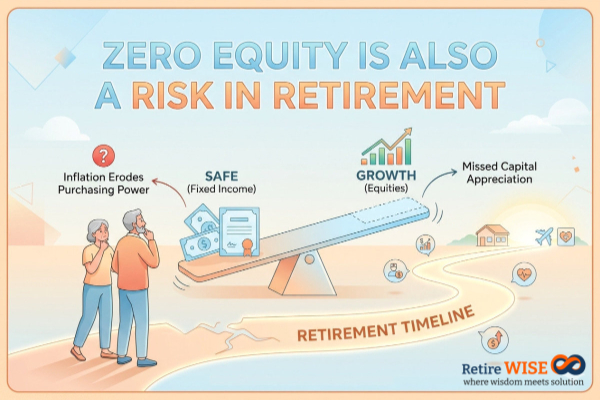
Zero Equity Is Also a Risk in Retirement. It Just Doesn’t Show Up on Day One.

“Risk comes from not knowing what you’re doing.” — Warren Buffett

What if the decision that feels safest today quietly undermines your retirement over the next 20 years?

Most people who move entirely out of equity at retirement are not being reckless. They are being careful. They have lived through market crashes. They know what a 30% portfolio drop feels like. The sleepless nights, the urge to sell, the anxiety of watching years of savings shrink in weeks. That experience is real, and the caution that follows it is completely understandable.

But there is a second risk in retirement. One that does not send you an alert. One that does not show up on your portfolio statement. One that arrives slowly, over years, until one day, usually somewhere in your early 70s, the numbers stop adding up.

Zero equity is not the absence of risk. It is the substitution of one risk for another. And the second risk is considerably harder to see coming.

⚡ Quick Answer

Avoiding equity entirely in retirement eliminates market volatility but creates three slower, more damaging risks: inflation eroding purchasing power, longevity causing the corpus to run out, and falling interest rates shrinking income year after year. For most retirees, an equity allocation of 20 to 30% in retirement, structured carefully through a bucket approach, is not speculation. It is responsible retirement planning.

equity retirement

The Illusion of Safety: Why Zero Equity Feels Right

Think of Amitabh Bachchan’s character in any film where he plays a patriarch who holds everything together quietly, asking for nothing. Calm on the surface. Stable. Reassuring. But if his foundation is slowly crumbling and nobody checks, the whole structure eventually collapses. Not dramatically, but inevitably.

A zero-equity retirement portfolio plays exactly this role. It looks steady for years. The quarterly statements show no losses. There is no drama, no panic, nothing to act on. But underneath, inflation is doing its work. Quietly. Consistently. Without asking your permission.

The comfort of fixed deposits, bonds, and debt funds is real in the early years of retirement. Returns are predictable. The portfolio value does not swing. This apparent stability is not deceiving you. It is simply not telling you the full story.

The full story involves purchasing power. And time.

The Three Risks Nobody Warns You About at Retirement

Inflation risk is the most familiar but the most consistently underestimated. Consumer inflation in India averages 6 to 7% over the long run. Healthcare inflation runs considerably faster, closer to 12 to 14% annually for hospitalisation and specialist care. Apply the Rule of 72: at 7% inflation, your expenses double every 10 years. If you need ₹1 lakh a month today, you will need ₹2 lakhs at 70 and roughly ₹4 lakhs at 80.

A fixed deposit earning 7% keeps pace with today’s inflation. It does not grow your purchasing power. Over two decades, it leaves your corpus running in place while your actual expenses have run well ahead.

Longevity risk is the one most people do not plan for honestly. We are living meaningfully longer than our parents did. A person retiring at 60 today in reasonable health should plan for a 25 to 30 year retirement. A corpus that feels comfortable at 60 can feel pressured at 72 and genuinely concerning at 78.

Reinvestment risk is the quietest of the three. When your fixed deposits mature and interest rates have fallen, as they did significantly between 2019 and 2022 in India, you cannot renew at the same rate. Your income from the same corpus shrinks. You did not lose capital. But your monthly income did. This is the category of loss that rarely gets named, which is precisely why it catches people off guard.

🏏 Think of a batsman who decides to just survive and not score. In the first few overs, the strategy looks solid. No wickets lost, no drama. But at the end of 20 overs, the scoreboard tells a different story. A retirement corpus with zero equity is playing the same innings. No drama early. A difficult position later.

What the Numbers Actually Show

Two people, both retiring at 60 with ₹3 crores and current monthly expenses of ₹1.2 lakhs.

📊 Zero Equity vs Balanced Allocation — How the Gap Builds Over 20 Years

Parameter Person A (Zero Equity) Person B (25 to 30% Equity)
Starting corpus ₹3 crores ₹3 crores
Portfolio return ~6.5% (FDs, bonds, SCSS) ~8 to 9% (blended)
Expense inflation assumed 7% per year 7% per year
Monthly expense at age 70 ~₹2.4 lakhs ~₹2.4 lakhs
Corpus at age 75 Significantly depleted Still growing
Corpus at age 80 Near exhaustion Meaningful balance remains
Volatility experienced None Some, managed by bucket structure

*Indicative figures for illustration. Actual outcomes depend on withdrawal rate, expense pattern, and market returns.

The difference is not in how much risk Person B took. It is in which risk they chose to manage. Person A managed volatility. Person B managed longevity. Both made a deliberate choice. Only one will have financial comfort at 78.

Why It Does Not Show Up on Day One

In the first five years of retirement, a zero-equity portfolio genuinely looks like the right decision. No market crashes. No panic. No difficult quarterly statements. People with equity in their portfolios are experiencing volatility and you are not. That contrast feels like confirmation.

But the comparison is not quite right. You are comparing the visible discomfort of equity volatility with the invisible erosion of purchasing power. Volatility shows up on a screen. Inflation does not send you a monthly update.

The gap begins to open around year eight to ten. Expenses that were ₹1.5 lakhs a month are now ₹2.2 lakhs. The FD income has not kept pace. Small adjustments begin. Fewer long trips, deferred home repairs, choosing the more affordable hospital. Nothing alarming individually. But the direction is set.

By year fifteen to twenty, what began as caution has become a structural gap between income and need. You do not feel the mistake in your 60s. You pay for it in your 70s.

💡 People fear market crashes because they are visible, sudden, and emotionally intense. Inflation is invisible, gradual, and almost entirely unemotional. Visible risk gets managed. Invisible risk gets ignored. This asymmetry is one of the most persistent patterns in retirement decision-making.

The Tax Dimension Most People Overlook

There is one more layer that consistently goes unexamined.

Fixed income returns are largely taxable. FD interest is added to your income and taxed at your applicable slab. For someone in the 20 to 30% bracket, a nominal 7% FD return becomes an effective 4.9 to 5.6% post-tax return. Against 7% inflation, your purchasing power is actually shrinking every year even before you spend a rupee.

Equity mutual funds held for over a year attract long-term capital gains tax at 12.5%, and only on gains above ₹1.25 lakhs annually. For most retirees drawing systematically from their corpus, the effective tax on equity returns is meaningfully lower than on FD interest.

After-tax real return, what remains after both tax and inflation, is the only return that actually matters in retirement. A portfolio that looks conservative on paper can be quietly losing ground in real purchasing power every single year.

How Much Equity Should a Retiree Actually Hold?

This is the question most people never get a straight answer on. The right equity allocation in retirement is not zero, but it is also not what you held during your accumulation years.

For most Indian retirees, an ideal equity allocation of 20 to 30% of the total retirement corpus strikes the right balance. This retirement portfolio equity percentage is high enough to provide long-term purchasing power protection while keeping the majority of the corpus in stable instruments.

Should retirees invest in equity at all? The answer is yes, but with the right structure. The equity portion should never be the source of near-term income. It should sit untouched in a long-term bucket, insulated from short-term market swings, working quietly over a 10 to 15 year horizon.

The question is not whether to have stock exposure after retirement. The question is how to structure that exposure so that market volatility never forces a wrong decision at the wrong time.

Why Thoughtful People Still Choose Zero Equity

The decision to move entirely to fixed income is rarely irrational. It is usually a reasonable, considered response to a real past experience.

Market losses leave what researchers describe as a scar effect. The emotional memory of a sharp portfolio decline persists long after the portfolio has recovered. The mind holds on to the feeling of loss far more intensely than it registers the subsequent rebuilding. This is not a weakness. It is how human psychology works, the same protective instinct that makes us careful after any genuinely painful experience.

The difficulty is that retirement is a 25 to 30 year journey, not a 3 year event. The risk horizon for someone at 60 is genuinely long. And over 15 to 20 years, equity markets in India have historically rewarded patient investors, not because markets are smooth or predictable year to year, but because the long-run growth of the economy tends to be reflected in equity prices over meaningful time horizons.

The question worth asking is not whether equity is safe. Equity is not safe in the short term, and that is simply true.

The more useful question is whether a 25-year retirement portfolio with zero equity is actually safe. The honest answer is: it is considerably more comfortable in the early years, and considerably more vulnerable in the later ones.

Volatility is visible risk. Inflation is invisible risk. We naturally manage what we can see and feel. We tend to ignore what arrives slowly and without announcement.

What a Better Approach Looks Like

The answer is not a return to aggressive equity investing. A concentrated equity portfolio at 60 carries its own genuine risks, particularly sequence of returns risk, where a market downturn in the early years of retirement can do lasting damage to a corpus that has no time to fully recover.

The answer is structured balance through a bucket framework.

The short-term bucket covers two to three years of expenses in liquid funds and short-duration debt. No market risk. No volatility. Complete peace of mind regardless of what markets do. This bucket exists so that a falling market never forces a bad decision.

The medium-term bucket covers roughly years four to ten in a mix of debt mutual funds, balanced advantage funds, and stable instruments like SCSS. It refills the short-term bucket systematically each year.

The long-term bucket holds a modest 20 to 30% of the total corpus in equity mutual funds. This bucket is not touched for years. Its single purpose is to ensure that the corpus in your 70s and 80s retains the purchasing power needed for the life you planned.

Equity in the long-term bucket is not about chasing returns. It is about not falling behind inflation over decades.

The mechanics of how to draw income from this structure, without selling equity at the wrong time, are worth understanding in detail. Most retirees treat SWP as a retirement strategy when it is actually just a withdrawal tool — this post explains what the real strategy looks like.

The Honest Conversation Nobody Has

In 25 years of working with people approaching and living through retirement, I have sat with many who were genuinely hurt by equity at some earlier point. That experience deserves to be taken seriously, not explained away.

But I have also sat with people in their mid-70s who made every safe choice at 60 and found themselves quietly adjusting their lifestyle, leaning on their children for medical expenses, or watching a corpus that once felt more than sufficient slowly become insufficient.

Both forms of difficulty are real. One arrives loudly and immediately. The other arrives slowly and without warning.

A thought worth sitting with

A lot of times when I speak with people planning their retirement, I notice a gap between what they want and what they actually need. This is not unique to finance, it shows up across many of life’s important decisions.

You may want emotional safety and zero volatility. But your real need may be different, to accept a measured amount of discomfort today, so that your financial security remains intact for the 25 years ahead. That is not a compromise. That is the plan working exactly as it should.

The goal of good retirement planning is not to remove all discomfort. It is to choose which discomfort you manage deliberately, rather than let a different and quieter discomfort manage you over time.

Is your retirement corpus structured to last 25 years and not just 10?

At RetireWise, we build withdrawal strategies specifically for senior executives, balancing stability, inflation protection, and the long-term growth your corpus needs to survive.

See the RetireWise Service →

The biggest risk in retirement is not market volatility. It is running out of growth when you still have years left to live.

Safety that protects you today but not tomorrow is not safety. It is just a slower way to arrive at the same problem.

💬 Your Turn

When you think about your retirement portfolio, which risk concerns you more — a sharp market fall that you can see, or a slow 20-year erosion of purchasing power that you cannot? Drop your thoughts below. I read every comment.
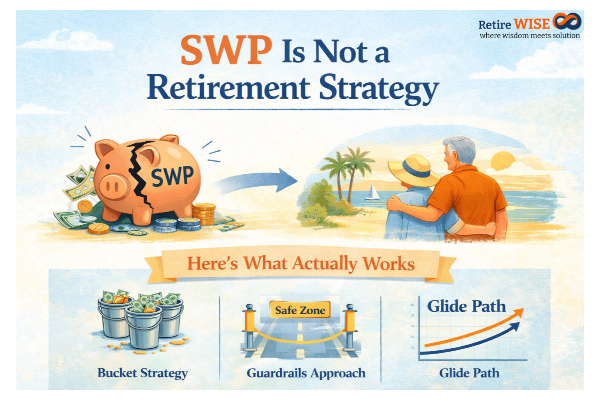
SWP Is Not a Retirement Strategy — It’s Just a Tool. Here’s What Actually Works.

Every mutual fund company in India wants you to believe the same story: “Start SIP in your 30s. Switch to SWP at 60. Retirement solved.”

It’s a neat narrative. It sells products. And it’s dangerously incomplete.

I’ve been advising retirees for 25 years. And I can tell you — the people who relied on SWP alone as their retirement income “strategy” are the same people who called me in a panic during the 2020 crash, the 2022 correction, and the 2008 meltdown. Not because SWP is bad. But because SWP without a withdrawal strategy is like driving a car without brakes. It works beautifully on a straight road. On a mountain pass, it kills.

Have you ever asked your advisor how sequence of returns risk will affect your SWP in the first five years of retirement?

If the answer is a blank stare — you need a better plan.

⚡ Quick Answer

SWP (Systematic Withdrawal Plan) is a mutual fund feature, not a retirement strategy. A real retirement income strategy uses multiple frameworks — the Bucket Strategy to protect against market crashes, the Guardrails Approach to adjust withdrawals dynamically, and a Dynamic Glide Path to shift your equity allocation as you age. This post explains all three in detail, with ₹ examples, shows exactly why “SIP + SWP” is a marketing pitch, and gives you the complete toolkit including SCSS, POMIS, FD ladders, annuities, and NPS.

Systematic-Withdrawal-Plan

The “SIP + SWP” Lie That AMCs Don’t Want You to Question

Walk into any mutual fund presentation these days. The slide deck is predictable: “Invest ₹25,000/month via SIP for 25 years. Accumulate ₹3 crore. Switch to SWP of ₹1.5 lakh/month. Live happily ever after.”

Sounds beautiful. Here’s what they don’t show on that slide.

They don’t show what happens if markets fall 40% in your first year of retirement — like they did in 2008. They don’t show that your ₹3 crore drops to ₹1.8 crore while you’re still withdrawing ₹1.5 lakh every month. They don’t show that you’re now selling units at rock-bottom prices — units that can never recover because they’ve been sold. They don’t show that by year 5, your corpus is permanently damaged, and no subsequent bull run can fully repair it.

This is called sequence of returns risk. And it is the single most dangerous threat to any retiree using SWP as their only income source.

Let me show you exactly how devastating it is.

Sequence of Returns Risk — The Silent Killer Nobody Explains

Think of your retirement corpus as a bucket of water with a hole in the bottom. Water drains out every month (your SWP). Rain falls in periodically (market returns). If the rain comes early and heavy, the bucket stays full. If there’s a drought in the first few years — and water keeps draining — the bucket empties and no amount of later rain can refill it.

Here’s the maths that keeps me up at night:

Scenario A — Good returns first: Meera (name changed) retires with ₹2 crore. Markets return +15%, +12%, +8% in years 1-3. She withdraws ₹1 lakh/month. After 3 years, her corpus has grown to ₹2.4 crore despite withdrawals. She’s safe.

Scenario B — Bad returns first: Deepak (name changed) retires with the same ₹2 crore on the same day as Meera. Same SWP of ₹1 lakh/month. But his fund sequence is -20%, -8%, +5% in years 1-3. After 3 years, his corpus is ₹1.35 crore. He’s withdrawn ₹36 lakh AND lost ₹65 lakh to poor sequence. His corpus is permanently 44% smaller than Meera’s.

Both faced the same average return over 20 years. Same SWP amount. Same fund. But Deepak’s retirement is in trouble and Meera’s isn’t. The only difference? The ORDER in which returns arrived.

This is not a theoretical risk. Indian equity markets have delivered -52% (2008), -38% (2020 briefly), and -23% (2022). If any of these hit in your first 3 years of SWP, you’re Deepak.

🚫 The Hard Truth About SWP

SWP redeems a fixed rupee amount every month — which means in falling markets, you’re selling MORE units to generate the same income. Those extra units sold are gone forever. This is why the first 5 years of retirement are the most dangerous period for any SWP-based plan. Your entire retirement outcome can be determined by what markets do in those 5 years — not the next 25.

No AMC slide deck shows you this chart. Because if they did, “SIP + SWP” would look a lot less like a strategy and a lot more like a gamble.

Strategy 1: The Bucket Strategy — Your Crash Shield

The Bucket Strategy is the answer to sequence risk. It’s elegantly simple: divide your retirement corpus into three time-based buckets, so you NEVER have to sell equity in a falling market.

Bucket 1 — Immediate (0-3 years): ₹36-45 lakh
This is your “sleep well” money. Parked in FD ladders, liquid funds, and savings accounts. It covers 3 years of expenses regardless of what markets do. When Sensex drops from 80,000 to 50,000, you don’t care — because next month’s ₹1.2 lakh comes from this bucket, not from your equity fund.

Bucket 2 — Medium-term (3-7 years): ₹50-60 lakh
SCSS (8.2% guaranteed, max ₹30 lakh), POMIS (7.4%, max ₹9 lakh individual / ₹15 lakh joint), short-term debt funds, and conservative hybrid funds. This bridges the gap between safety and growth. As Bucket 1 depletes, you refill it from Bucket 2 — but only when debt markets are stable, not during a crisis.

Bucket 3 — Long-term (7+ years): ₹80 lakh – ₹1.2 crore
This is where SWP lives — and it’s the ONLY bucket where SWP belongs. Equity hybrid funds, balanced advantage funds, or a diversified equity portfolio. Because this money has a 7+ year horizon, it can survive one or two crashes and still come out ahead. You draw from this bucket to refill Buckets 1 and 2 — but only when markets are UP, never when they’re down.

The blueprint for ₹2 crore:

Bucket Allocation Where Monthly Income
Bucket 1 (0-3 yrs) ₹40 lakh FD ladder + liquid fund ₹1.1 lakh (draw-down)
Bucket 2 (3-7 yrs) ₹55 lakh SCSS ₹30L + POMIS ₹15L + debt fund ₹10L ~₹30,000 (interest/coupons)
Bucket 3 (7+ yrs) ₹1.05 crore Equity hybrid fund (SWP) SWP ₹50,000 (when markets are up)
Total ₹2 crore ~₹80,000-90,000

The magic of buckets isn’t financial — it’s psychological. When Sensex crashes 35%, Deepak (with SWP-only) panics and stops his SWP, locking in losses. Meera (with buckets) sips her chai and says “Bucket 1 has me covered for 3 years. I’ll wait.” By the time Bucket 1 runs low, markets have recovered, and she refills it from Bucket 3 at higher values.

The Bucket Strategy doesn’t give you higher returns. It gives you the ability to stay the course — which, in retirement, is worth more than any extra percentage point.

Strategy 2: The Guardrails Approach — Spending That Adjusts Automatically

The Guardrails Approach, developed by Jonathan Guyton and William Klinger, solves a different problem: what if your fixed SWP amount is too high in bad years and too low in good years?

Here’s how it works. You start with an initial withdrawal rate — say 5% of your corpus, which is ₹1 lakh/month on ₹2.4 crore. Then you set two guardrails:

Upper guardrail: If your current withdrawal rate rises 20% above the initial rate (meaning your portfolio has dropped significantly), you CUT your withdrawal by 10%.

Lower guardrail: If your current withdrawal rate falls 20% below the initial rate (meaning your portfolio has grown significantly), you INCREASE your withdrawal by 10%.

Let me walk through a real example.

Priya (name changed) starts retirement with ₹2 crore. Initial SWP: ₹83,000/month (5% annually). Her guardrails are set at 4% (lower) and 6% (upper).

Year 1: Markets crash. Corpus drops to ₹1.5 crore. Her withdrawal rate is now 6.6% (₹83,000 × 12 ÷ ₹1.5 crore). This breaches the upper guardrail of 6%. She cuts her withdrawal by 10% to ₹75,000/month.

Year 3: Markets recover. Corpus rises to ₹2.5 crore. Her withdrawal rate falls to 3.6% (₹75,000 × 12 ÷ ₹2.5 crore). This breaches the lower guardrail of 4%. She increases her withdrawal by 10% to ₹82,500/month.

The Guardrails Approach lets you start with a HIGHER initial withdrawal rate (5-5.5% vs the traditional 4%) because you’ve built in automatic correction mechanisms. Research by Morningstar found that guardrails can provide the highest starting safe withdrawal rate — up to 5.2% — because the system self-corrects before the portfolio suffers permanent damage.

The uncomfortable part: Guardrails require you to accept that your income will fluctuate. In a bad market, you might need to cut spending by 10%. For someone whose monthly expenses are fixed (EMIs, medical insurance, society maintenance), that 10% cut can be painful. This is why Guardrails work best COMBINED with the Bucket Strategy — the guaranteed buckets cover non-negotiable expenses, while the guardrails-adjusted SWP covers discretionary spending.

Strategy 3: Dynamic Glide Path — Managing Your Equity Allocation Through Retirement

As you move through retirement, your relationship with risk changes — and your equity allocation should change with it.

The traditional approach, which I recommend as the starting point for most Indian retirees, is to reduce equity exposure as you age. The logic is straightforward. Early in retirement, a major market crash can permanently impair your corpus while you are still drawing from it. You have less time to recover. Capital preservation matters more. As you move deeper into retirement, the sequence risk window closes — but a different risk emerges: inflation quietly eroding your purchasing power over a 20-30 year horizon.

This creates a three-phase framework that I use with clients at RetireWise:

Phase 1 — Early Retirement (Years 1-10): Reduce equity gradually
Start with moderate equity exposure and reduce it over the first decade. The priority is protecting your corpus during the highest-risk sequence period. Bucket 1 and Bucket 2 do the heavy lifting for income — your equity (Bucket 3) is left to compound undisturbed.

Phase 2 — Mid Retirement (Years 10-20): Continue reducing, stabilise
By this stage, sequence risk has diminished significantly. You’ve survived the danger zone. Continue reducing equity — not because you can’t tolerate risk, but because your income needs are increasingly met by guaranteed sources and you need less growth engine.

Phase 3 — Late Retirement (Years 20+): Adjust based on remaining assets
This is where the decision becomes personal and depends entirely on your situation. If your corpus is healthy and well ahead of your projected needs, you can afford to hold more equity to leave a legacy or fund unexpected late-life healthcare. If your corpus has depleted faster than expected, you may need to reduce equity further and shift to guaranteed income. There is no single answer — this requires a review with your advisor.

A practical glide path for a typical Indian retiree retiring at 60:

Phase Age Equity Debt + Fixed Primary Risk Being Managed
Early Retirement 60-70 40-50% → reducing 50-60% Sequence of returns risk
Mid Retirement 70-80 25-35% 65-75% Capital preservation + inflation
Late Retirement 80+ 20-40% (depends on corpus) 60-80% Longevity + legacy vs liquidity

A note on newer research: Some academic work — notably from Wade Pfau and Michael Kitces — suggests a “rising equity glide path” may theoretically produce better outcomes in certain US-based simulations. The logic is that starting with low equity reduces sequence risk, then gradually increasing equity fights inflation in later years. While intellectually interesting, I do not recommend this as a default approach for Indian retirees. Most Indian retirees do not have a guaranteed pension floor (like Social Security in the US) which is what makes the rising path safer in those models. Without that guaranteed base, increasing equity exposure into your 70s and 80s adds meaningful risk for most people. Where a rising or flat allocation makes sense — for clients with very strong guaranteed income floors, substantial surplus assets, or specific legacy goals — we customise accordingly. But the default should be reducing equity as you age, and adjusting late based on what your corpus actually looks like.

Most advisors know SWP. Very few know withdrawal strategy.

Bucket Strategy, Guardrails, and Dynamic Glide Path aren’t standard industry offerings — they require a planner who thinks beyond product sales.

Talk to a Withdrawal Strategy Specialist →

The Complete Income Toolkit — Beyond SWP

SWP lives in Bucket 3. But what fills Buckets 1 and 2? Here’s the full toolkit, with current numbers.

SCSS (Senior Citizen Savings Scheme): 8.2% guaranteed, government-backed. Max ₹30 lakh. Quarterly interest. Section 80C benefit on investment. This is the anchor of Bucket 2. Every retiree should max this out on Day 1. Read more about senior citizen investment options.

POMIS (Post Office Monthly Income Scheme): 7.4%, monthly payout. Max ₹9 lakh individual / ₹15 lakh joint. 5-year lock-in. Combined SCSS + POMIS gives about ₹35,000/month in guaranteed income — enough to cover non-negotiable monthly expenses for many retirees.

FD Ladder: 5-rung ladder with FDs maturing annually. At 7-7.5% (senior citizen rates), ₹30 lakh in FDs generates about ₹18,000/month. More importantly, the laddered maturity gives you annual access to principal without break penalties. This IS Bucket 1.

Annuity (LIC Jeevan Akshay / HDFC Life Sanchay Plus): Guaranteed lifetime income. But at 5-6% IRR, it barely keeps pace with inflation. Not inflation-adjusted. Your ₹50,000 annuity feels like ₹25,000 in 12 years. Use sparingly — 10-15% of corpus at most, for the absolute floor of guaranteed income. See my LIC Jeevan Akshay review.

NPS Withdrawal: Non-government subscribers can now withdraw up to 80% as lump sum (if corpus > ₹12 lakh). Only 60% is confirmed tax-free under Section 10(12A). The mandatory 20% annuity becomes your guaranteed floor. Deploy the lump sum into Buckets 1-3. Learn more about the National Pension System.

Rental Income: If you already own property, rental yields of 2-3% in metros supplement your income. But buying property at retirement specifically for rental income? The maths rarely works. ₹1 crore in property gives you ₹20,000/month rent. The same ₹1 crore in SCSS + SWP gives ₹55,000-60,000/month. Consider a reverse mortgage if you own your home but need income.

How SWP Actually Works — The Mechanics

Now that we’ve established that SWP is a tool (not a strategy), let me explain how the tool works — because you’ll still use it inside Bucket 3.

Every month, the fund house redeems units worth your chosen amount (say ₹50,000) and deposits the money to your bank account. It’s a SIP in reverse.

Tax efficiency (FY 2025-26): Only the capital gains portion of each redemption is taxed — not the full withdrawal. Equity fund STCG (within 12 months) = 20%. Equity fund LTCG (after 12 months) = 12.5% above ₹1.25 lakh annual exemption. Always start SWP at least 12 months after investing. Learn more about mutual fund taxation.

Fund selection for SWP: This is where most people go wrong. SWP from a small-cap fund is gambling, not planning. SWP from a pure debt fund barely beats inflation. The sweet spot: Equity Hybrid (Aggressive Hybrid) with 65-75% equity, or Balanced Advantage Funds that dynamically manage allocation. Low volatility with enough growth to fight inflation.

Withdrawal rate: Stay between 4-6% annually. At 4%, your corpus likely outlives you. At 6%, it survives 25+ years with decent market returns. Above 8%? You’re on borrowed time.

What History Shows — SWP Performance Charts

These charts from the balanced fund category tell a powerful story about both the promise and the peril of SWP.

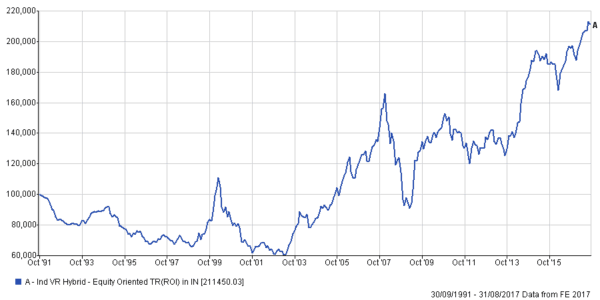
SWP performance balanced fund 8 percent withdrawal from 1991 showing sequence risk impact

8% withdrawal from 1991 (Harshad Mehta era): ₹1 lakh invested, ₹666/month withdrawn. Corpus dropped 40% in first decade — classic sequence risk. It eventually recovered, but the first 10 years were terrifying. This is EXACTLY why Bucket 1 exists.

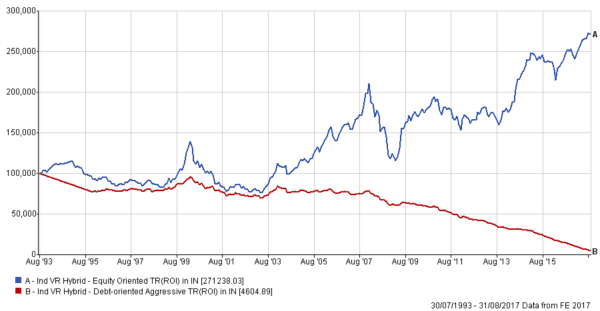
10 percent SWP withdrawal rate depleting MIP corpus showing danger of high withdrawal rates

10% withdrawal — the danger zone: At 10% withdrawal, the conservative hybrid fund corpus dropped to nearly zero. This chart should be mandatory viewing for anyone who thinks “I’ll just withdraw 8-10% and be fine.”

The 5 SWP Mistakes That Destroy Retirements

Mistake 1: Treating SWP as a strategy, not a tool. SWP tells you HOW to withdraw. It doesn’t tell you HOW MUCH, WHEN, or FROM WHERE. You need Buckets + Guardrails + Glide Path for that. Read Is ₹1 Crore Enough to Retire?.

Mistake 2: Starting SWP immediately. Wait 12 months to get LTCG treatment (12.5% vs 20%). Use Bucket 1 for year one expenses.

Mistake 3: Stopping SWP during crashes. If you have Bucket 1 with 3 years of safety, you don’t NEED to stop SWP. But if your entire income comes from one SWP, panic is rational.

Mistake 4: No annual review. Every year: check corpus levels, adjust for inflation (increase SWP by 5-6%), check if guardrails have been breached, rebalance glide path. One meeting per year can save decades of regret.

Mistake 5: Believing “SIP + SWP = Retirement Solved.” It’s not solved. It’s started. The accumulation phase (SIP) is the easy part. The decumulation phase (withdrawal) is where retirements succeed or fail. And the mutual fund industry has zero incentive to make decumulation complicated — because complicated doesn’t fit on a sales brochure. Check our guide on the best retirement plans in India.

Putting It All Together — The Three-Layer Retirement Income System

Here’s the framework we use at RetireWise for every client. Not one of these layers works alone. Together, they’re resilient.

Layer 1 — The Floor (Guaranteed Income): SCSS + POMIS + small annuity. This covers your absolute non-negotiable expenses — medicines, food, utilities, insurance premiums. Even if markets crash 50% tomorrow, this layer keeps paying. No decisions required. No stomach needed.

Layer 2 — The Buffer (Crash Protection): FD ladder + liquid funds + short-term debt. This covers 2-3 years of the gap between Layer 1 and your actual expenses. It buys time for your equity to recover after a crash. This is the layer that prevents panic selling.

Layer 3 — The Engine (Growth + Inflation): SWP from equity hybrid funds, managed with Guardrails and a Dynamic Glide Path. This is where the heavy lifting happens — beating inflation over 25-30 years so your ₹75,000 in year 1 becomes ₹1.5 lakh by year 15 (in real purchasing power). But this engine only works because Layers 1 and 2 protect it from being shut down prematurely.

This is what the three stages of retirement actually look like in practice — each stage draws differently from these three layers.

For those who haven’t started planning yet: it’s never too late to start saving for retirement, but the later you start, the more your withdrawal strategy matters — because your corpus will be smaller and less forgiving of mistakes.

Your retirement income plan shouldn’t depend on one tool

Bucket Strategy + Guardrails + Dynamic Glide Path = a system that survives crashes, adjusts to markets, and beats inflation for 30 years.

Build Your Withdrawal Strategy →

The mutual fund industry gave you SIP for the accumulation phase. For the decumulation phase — the phase that actually determines whether your retirement works — they gave you a sales pitch called SWP and called it a day. The real strategy is yours to build.

It’s not a numbers game. It’s a mind game. And SWP is just the wrench. The blueprint is Buckets, Guardrails, and a Glide Path built for YOUR life.

💬 Your Turn

Has your advisor ever explained sequence of returns risk to you? Do you have a withdrawal strategy — or just an SWP? Share where you are in your retirement planning, and I’ll tell you which of these three frameworks matters most for your situation.

New Gratuity Rules 2026: How the 50% Wage Rule Changes Your Payout (With Calculator)

🆕 Updated April 2026

India’s Code on Social Security, 2020 became legally effective November 21, 2025. New rules on wage definition, fixed-term eligibility, and settlement timelines now apply. This article has been fully updated to reflect the changes.

My partner Vikas worked 5 years at a financial company before he quit to join our financial planning firm.

When he left, he received Rs 4.8 lakh in gratuity. No fanfare. No announcement. It simply arrived in his account.

He had no idea it was coming. He had never tracked it. And he had certainly never thought about how to invest it.

Now imagine his situation today — under the new rules. The same 5 years of service, the same salary — but his gratuity would be 40 to 70% higher because the wage base used in the calculation has fundamentally changed.

This post covers everything: the old rules, what changed in 2026, how to calculate your new gratuity, and what to do with the money when it arrives.

⚡ Quick Answer — 2026 Update

Gratuity calculation formula stays the same: Basic Salary × 15/26 × Years of Service. What changed: wages used for calculation must now be minimum 50% of your total CTC — up from whatever low basic your employer had structured. Result: gratuities are 40–70% higher for many private sector employees. Fixed-term employees now qualify after 1 year (down from 5). Tax-free limit unchanged at Rs 20 lakh. New rules effective November 21, 2025.

new gratuity rules 2026

What Changed in 2026 — The 3 New Gratuity Rules

The Code on Social Security, 2020 became legally enforceable on November 21, 2025. April 1, 2026 is when most companies are restructuring payrolls to comply. Three changes matter for you as an employee.

Change 1 — The 50% Wage Rule (Biggest Impact)

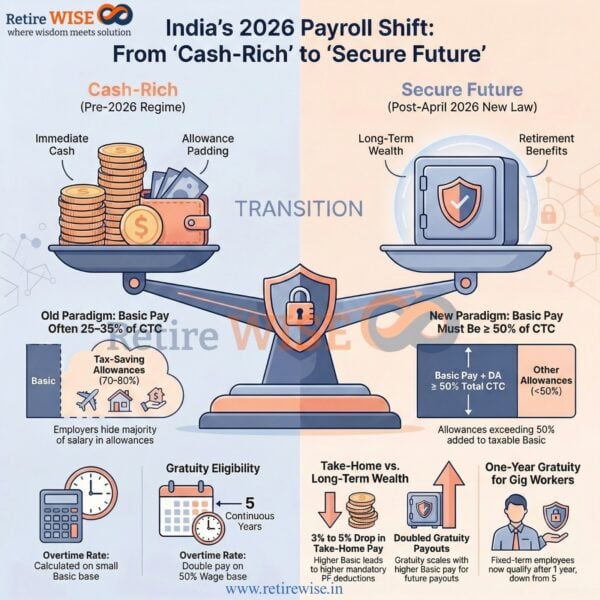
Previously, employers legally structured salary so that your “basic pay” — the figure used to calculate gratuity — was as low as 20 to 30% of your total CTC. The rest was HRA, special allowances, performance bonuses, and so on. Result: lower gratuity liability for the employer, lower payout for you.

Under the new rules, your basic pay + DA must be at least 50% of your total CTC. If allowances exceed 50% of total remuneration, the excess is added back into wages for calculation. Employers can no longer artificially suppress the gratuity base.

Before vs After — Rs 1 lakh CTC, 10 years service

Parameter Old Structure New (2026)
Monthly basic used for gratuity Rs 30,000 (30% of CTC) Rs 50,000 (50% of CTC)
Gratuity after 5 years Rs 86,538 Rs 1,44,231 (+67%)
Gratuity after 10 years Rs 1,73,077 Rs 2,88,462 (+67%)
Gratuity after 20 years Rs 3,46,154 Rs 5,76,923 (+67%)

Source: ClearTax/Livemint. Actual increase varies by existing salary structure.

One important note: your take-home salary may decrease slightly as a result. When basic pay goes up to meet the 50% rule, PF contributions (12% of basic) also go up. You receive more in retirement benefits and less in monthly cash. This is a structural shift from “cash now” to “security later.” It’s not a pay cut.

Change 2 — Fixed-Term Employees: Gratuity After 1 Year

Previously, only employees with 5+ continuous years of service qualified. If you were on a fixed-term contract of 3 years, you received nothing when it ended.

Under the new rules, fixed-term employees are eligible for pro-rata gratuity after just 1 year of continuous service. This covers millions of contract workers, professionals on time-bound assignments, and employees in the gig-adjacent economy who were previously excluded.

📋 Example: Meena completes a 2-year fixed-term contract earning Rs 30,000 basic/month. Under old rules: zero gratuity. Under new rules: 30,000 × 15/26 × 2 = Rs 34,615. She receives this on contract completion.

For permanent employees, the 5-year rule still applies. This change only benefits those on fixed-term contracts.

Change 3 — Full & Final Settlement: 2 Working Days

Previously, gratuity had to be paid within 30 days — a rule companies often stretched to months. Under the new codes, full and final settlements including all dues must be completed within 2 working days of exit in most cases.

If payment is delayed beyond the statutory deadline, the employer must pay simple interest from the due date. Non-compliance penalties under the new codes are significantly steeper than under the old Payment of Gratuity Act.

gratuity meaning calculation

What Is Gratuity in India?

Gratuity is a lump sum payment made by an employer to an employee as a token of gratitude for continuous service. It’s now governed by the Code on Social Security, 2020 (which replaces the Payment of Gratuity Act, 1972) and is mandatory for all companies with 10 or more employees.

Think of it as your employer’s final “thank you” — paid at the time you leave, retire, or in the unfortunate event of death or disability. It’s not a bonus. It’s not discretionary. If you’ve served the required period, your employer is legally obligated to pay it.

Who Is Eligible for Gratuity?

Situation Eligible? Notes
Permanent employee — 5+ years, resigned or retired Yes Full gratuity payable
4 years 10 months service (permanent) Yes — rounds up to 5 years 6+ months in final year = round up
4 years 5 months service (permanent) No Under 5 months in final year = no gratuity
Fixed-term employee — 1+ year (NEW 2026) Yes — pro-rata Major change: was 5 years, now 1 year
Death during service Yes — regardless of tenure Paid to nominee for all years worked
Disability during service Yes — regardless of tenure Paid for all years worked
Terminated for misconduct No Violence or morally wrong acts only
Retrenched for performance or cost-cutting Yes — if eligible tenure served Retrenchment does not forfeit gratuity

Gratuity Calculator 2026 — New Rules

Enter your CTC, current basic pay, and years of service. The calculator applies the 50% wage rule automatically and shows your old vs new gratuity side by side.

📋 The 4 years 10 months rule: If you’re at 4 years and 7 or more months, it rounds up to 5 completed years and you qualify. If you’re at 4 years and 5 months, you don’t qualify. A few weeks’ timing can cost you lakhs — check your dates carefully before resigning.

Gratuity Tax Rules — What You Actually Keep

Category Tax Exemption What Is Taxable
Central/State Govt employees 100% exempt — no limit Nothing
Private sector — covered under Act Lowest of: Rs 20 lakh / actual / formula Amount above Rs 20 lakh at slab rate
Private sector — NOT covered under Act Lowest of: Rs 20 lakh / actual / ½ × avg × years Amount above exemption at slab rate

The Rs 20 lakh tax-free limit was set in 2018 and remains unchanged. Note that with higher gratuity payouts under the new 50% wage rule, senior executives with very long tenures and high salaries may now breach the Rs 20 lakh ceiling — something that was rare before. Plan accordingly.

The Question Nobody Asks: What Do You Do With the Money?

For a 58-year-old senior executive, Rs 15 to 25 lakh in gratuity arriving at retirement isn’t just a number. It’s potentially 18 months of living expenses. It’s the seed of a retirement income layer. It’s money that, invested wisely, can work for the next 25 years.

And yet most people do one of two things: park it in a savings account “temporarily” (and it stays there), or let a relationship manager talk them into a single premium insurance product. Neither is a plan.

🚨 The real risk with gratuity: It arrives as a lump sum in an account that already feels full. The psychological pressure to “do something with it” leads most people into bad decisions — guaranteed plans, unit-linked insurance, or fixed deposits that don’t beat inflation. The absence of a plan is itself a plan — and usually a poor one.

For a deeper look at how to structure retirement income when large lump sums arrive, read our guide on the best investment options for senior citizens in India. And if you’re evaluating insurance products being pitched at retirement, read our honest review of the LIC Jeevan Akshay VII annuity plan before making any decisions.

Retiring soon? Gratuity arriving this year?

At RetireWise, we help senior executives build a layered retirement income plan before the lump sums arrive — so the money goes where it should, not where the next caller directs it.

Explore RetireWise

Frequently Asked Questions — 2026 Gratuity Rules

Will my gratuity increase under the new rules?

Most likely yes, if your employer previously structured basic pay below 50% of CTC. Under the 50% wage rule, the base for gratuity calculation goes up — increasing payouts by 40 to 70% for many private sector employees. The formula itself hasn’t changed.

When exactly do the new rules apply?

The Code on Social Security, 2020 became legally effective November 21, 2025. April 1, 2026 is the financial year start when most companies are implementing payroll restructuring to comply. The law applies to all exits from November 21, 2025 onwards — the higher wage base applies to your entire completed tenure for calculation purposes.

Will my take-home salary go down because of the 50% rule?

Possibly, marginally. When basic pay increases to meet the 50% rule, PF contributions (12% of basic) also increase. If your total CTC stays the same, the net-in-hand decreases slightly. This isn’t a pay cut — it’s a redistribution from current income to retirement savings. Some employers may restructure CTCs rather than reduce take-home.

I am on a fixed-term contract. Am I now eligible for gratuity?

Yes, if you’ve completed at least 1 year of continuous service with the same employer. Under the new rules, fixed-term employees receive pro-rata gratuity at contract completion or exit. This is one of the most significant changes in the new labour codes.

What if I have worked 4 years and 8 months?

You qualify for gratuity. Six or more months in the final year rounds up to a full completed year. Four years and 8 months = 5 completed years for gratuity purposes. Time your resignation carefully — a few weeks can make the difference between qualifying and not.

Is the Rs 20 lakh tax-free limit also changing?

No. The Rs 20 lakh tax-free limit is unchanged. However, with higher gratuity payouts under the 50% wage rule, senior executives with long tenures and high salaries may now exceed this ceiling more commonly than before. Any amount above Rs 20 lakh is taxed at your applicable slab rate.

Can my employer refuse to pay the higher gratuity?

No. The 50% wage rule is a legal mandate under the Code on Social Security, 2020. Employers who fail to restructure salary or pay the correct gratuity amount face higher penalties than under the old Payment of Gratuity Act. If you believe you’ve been underpaid, you can approach the Controlling Authority under the relevant labour code.

Gratuity is not a gift. It’s deferred compensation you earned — one year at a time.

Under the new rules, you’ve earned more than you thought.

💬 Your Turn

Have you calculated your gratuity under the new 50% wage rule? Does your employer’s current salary structure already comply — or do you expect a payroll restructure? Share below.

National Pension Scheme (NPS): A Retirement Advisor’s Honest Review

“It is the more obligation to honor the right of the citizen to live with dignity even in the retired life.” — Franklin D. Roosevelt, 1935

Most people who ask me about the National Pension Scheme want a simple yes or no. Should I invest in NPS or not? After 25 years of sitting across the table from senior executives planning their retirement, I’ve learned that the honest answer is more nuanced than a thumbs up or thumbs down.

NPS is a genuinely useful instrument for a specific purpose. But it’s widely misunderstood, often mis-sold, and the one aspect of it that truly matters at retirement — the annuity requirement — remains a problem that nobody in the financial industry talks about enough.

This is my honest review. No product commission. No incentive to recommend it. Just what I’ve seen work, and what I’ve seen go wrong, with real clients over two and a half decades.

⚡ Quick Answer

NPS is worth investing in primarily for one reason: the additional Rs 50,000 tax deduction under Section 80CCD(1B), available over and above the Rs 1.5 lakh limit under 80C. If you’re in the 30% tax bracket, that one move saves you Rs 15,600 every year. The equity portion of NPS (Scheme E) has historically delivered 12 to 14% returns over the long term, which is competitive. However, the mandatory 40% annuity requirement at retirement remains the biggest structural weakness of the scheme. Use NPS as a tax-efficient supplement to your main retirement portfolio, not as your primary retirement vehicle.

National Pension Scheme NPS honest review by retirement advisor in India

What is the National Pension Scheme and How Does It Work?

The National Pension Scheme was launched on May 1, 2009. Before it came into existence, India operated on a Defined Benefit system for government employees — you put in your years of service and walked out with a fixed pension for life. If the corpus ran short, the government covered the gap. It was expensive, unsustainable, and the government knew it.

NPS replaced this with a Defined Contribution model. What you get at retirement depends entirely on how much you contributed and how well your chosen fund manager invested that money. The government no longer bears the risk. You do.

All Indian citizens between 18 and 75 years of age can join voluntarily. All central government employees who joined service after January 1, 2004 are compulsorily enrolled. State government employees and private sector workers join on a voluntary basis.

The regulator for NPS is the Pension Fund Regulatory and Development Authority, commonly known as PFRDA. It was established in August 2003 specifically to develop and regulate pension funds in India.

🌾 Think of NPS like a professionally managed farm that you co-own with several other farmers. Everyone puts in their seeds and labour. What you harvest at the end depends on how well the farm was managed — not on any government guarantee. The land is good, the infrastructure is solid, but the yield is never promised in advance.

The Two Account Types: Tier 1 and Tier 2

When you open an NPS account, you’re assigned a unique 16-digit Permanent Retirement Account Number, or PRAN. This number travels with you across jobs and cities for your entire working life. The records are maintained by a Central Record-Keeping Agency, currently Protean eGov Technologies (formerly NSDL).

There are two types of accounts within NPS. The Tier 1 account is the core retirement account. It’s non-withdrawable until you reach 60, with partial withdrawals allowed only in specific circumstances like a medical emergency, higher education of children, or purchase of a first home. At maturity, you must use a minimum of 40% of the accumulated corpus to purchase an annuity plan. The remaining 60% can be withdrawn as a lump sum, tax-free.

The Tier 2 account is essentially a voluntary savings account linked to your PRAN. You can deposit and withdraw freely, but it comes with no tax benefits unless you’re a central government employee. For most private sector investors, Tier 2 offers no material advantage over a liquid mutual fund, so I rarely recommend it as a priority.

The minimum annual contribution to keep a Tier 1 account active is Rs 1,000. There’s no upper limit on how much you can contribute, but the tax benefit is capped, as we’ll see in the tax section below.

Investment Options: How Your NPS Money Is Managed

As of 2026, there are 11 pension fund managers operating under NPS: SBI Pension Funds, LIC Pension Fund, UTI Retirement Solutions, HDFC Pension Management, ICICI Prudential Pension Fund, Kotak Mahindra Pension Fund, Aditya Birla Sun Life Pension Management, Tata Pension Management, Axis Pension Fund Management, and DSP Pension Fund Managers. Max Life Pension Fund ceased operations in April 2025.

Your contributions are invested across four asset classes. Scheme E invests in equities and can hold up to 75% of your portfolio. Scheme C invests in corporate bonds and other fixed income instruments. Scheme G invests in government securities. Scheme A, which invested in alternative assets like infrastructure investment trusts and real estate investment trusts, was discontinued from January 16, 2026.

You have two choices on how to allocate. Active Choice lets you decide what percentage goes into each scheme, subject to the 75% equity cap. Auto Choice is a lifecycle-based option where the system automatically shifts your allocation from equity-heavy to debt-heavy as you age. For a 35-year-old, equity exposure starts at 75%. By age 55, it’s automatically reduced to around 25%.

💡 Which option should you choose?

If you’re between 35 and 50 and comfortable with some market exposure, Active Choice with 60 to 75% in Scheme E is likely the better long-term decision. Auto Choice is designed for investors who genuinely don’t want to think about allocation. The problem is that Auto Choice often reduces equity exposure earlier than is optimal for someone who still has 15 to 20 years until retirement. In my experience, active and engaged investors do better by staying in Active Choice and reviewing their allocation every 3 to 5 years.

NPS Fund Performance in 2026: What the Numbers Actually Show

One of the most common questions I get is which fund manager to choose. The honest answer is that over a 10 to 20 year retirement horizon, the differences between the top fund managers tend to narrow. What matters far more is staying invested consistently and not pulling out during market corrections.

That said, here’s the current picture as of early 2026, based on data from PFRDA and independent tracking platforms.

Fund Manager 3-Year Returns (Equity) 5-Year Returns (Equity) Verdict
LIC Pension Fund 9.01% 7.52% Top 3-year performer
UTI Retirement Solutions 9.01% 7.48% Consistent performer
SBI Pension Fund 8.73% 7.18% Solid, long track record
HDFC Pension ~8.5% Competitive Reliable, large AUM
DSP Pension Fund Standout short-term Newer, limited data Watch — early results strong

Source: PFRDA data, ClearTax analysis, January 2026. Returns are approximate and change periodically. Check npstrust.org.in for the latest figures before investing.

💡 Important context: NPS equity schemes (Scheme E) have delivered 12 to 14% over longer periods of 10 years and above, which is competitive with actively managed large-cap mutual funds. The 3 and 5-year numbers look modest because recent market volatility has compressed short-term returns across all market-linked instruments. Don’t judge an NPS fund by its 1-year number. It’s a 20-year vehicle.

One important update for 2026: the total NPS assets under management have crossed Rs 13.83 lakh crore, with private sector participation growing at over 24% year-on-year. This scale brings down costs further. NPS currently charges between 0.05% and 0.11% as fund management fees, making it one of the cheapest retirement vehicles available in India.

The Tax Case for NPS: Where It Genuinely Wins

Here’s the most compelling reason to invest in NPS, and I’ll keep it simple.

Under the old tax regime, Section 80C allows you a deduction of up to Rs 1.5 lakh. Your EPF contributions, PPF, ELSS, and life insurance premiums all eat into this limit. Most salaried professionals exhaust it quickly. Section 80CCD(1B) gives you an additional Rs 50,000 deduction specifically for NPS Tier 1 contributions. This is over and above the 80C limit. In the 30% tax bracket, this saves you Rs 15,600 every year — money you simply keep by making one additional investment decision.

Under the new tax regime, most deductions have been removed. However, employer contributions to NPS under Section 80CCD(2) are still available as a deduction, capped at 14% of basic salary plus dearness allowance for private sector employees. If your employer offers NPS as a benefit, this deduction survives even under the new regime. For someone with a basic salary of Rs 1 lakh per month, the employer can contribute Rs 14,000 monthly to NPS and you get a deduction on that entire amount.

Old Tax Regime

Additional Rs 50,000 deduction under 80CCD(1B) — over and above the Rs 1.5 lakh 80C limit. Total potential deduction: Rs 2 lakh per year. At 30% slab, annual tax saving: Rs 15,600 to Rs 20,800 depending on surcharge.

New Tax Regime

Individual contribution deductions aren’t available. But employer’s NPS contribution under 80CCD(2) is deductible up to 14% of basic for private sector employees. If your employer offers NPS, take it.

At maturity, when you turn 60, up to 60% of the corpus withdrawn as a lump sum is completely tax-free. The 40% that goes into an annuity isn’t taxed at the time of purchase. However, the monthly pension you receive from the annuity is taxable as income in the year you receive it. The tax is deferred, not eliminated.

You can also now opt for a Systematic Lump Sum Withdrawal, or SLW, from NPS Tier 1 after retirement. This works similarly to a Systematic Withdrawal Plan in mutual funds — allowing you to draw a fixed amount periodically rather than taking the entire 60% at once. This is a valuable new feature that gives NPS more flexibility than it had even three years ago. For more on how to structure withdrawals in retirement, read our guide on saving for retirement with the right instruments.

The Honest Problem with NPS: The 40% Annuity Requirement

I’ve been saying this since NPS launched, and my view hasn’t changed in 2026. The mandatory annuity requirement is the single biggest structural weakness of this scheme, and every investor needs to understand it before committing serious money.

When you retire, at least 40% of your NPS corpus must be used to buy an annuity from an insurance company. You can’t choose to invest it elsewhere. You can’t put it into mutual funds. You can’t keep it as a lump sum. It goes into an annuity, and it stays there, paying you a monthly income for the rest of your life.

The problem is that annuity rates in India are low and the options remain limited. A corpus of Rs 1 crore invested in a typical annuity plan today might generate Rs 5,500 to Rs 6,500 per month. That’s Rs 66,000 to Rs 78,000 per year, a return of roughly 6.5% — and this income is fully taxable. Compare that to a Systematic Withdrawal Plan from a debt-oriented mutual fund or a Senior Citizens Savings Scheme, where the corpus remains your property and can be passed on to your heirs.

🚨 The uncomfortable truth: Once your money goes into an annuity, it’s gone. Your nominee gets nothing from that 40% when you pass away — unless you specifically chose a joint life or return-of-purchase-price annuity, both of which give you even lower monthly income. The NPS forces a compromise that most people don’t fully understand when they start investing. I don’t believe in mixing insurance and investment — and an annuity is precisely that compromise.

I’m still not fully convinced that this structure is optimal for most Indian retirees. The annuity market has grown since 2009, and there are more options today than there were when NPS first launched. But the range remains narrow and the returns remain sub-optimal compared to what a well-structured retirement portfolio can deliver. For a 55-year-old senior executive planning to retire at 60, this single feature can significantly impact the quality of retirement income.

For a deeper look at how to structure your retirement income without relying on annuities, read our post on the three stages of retirement and how each stage requires a different investment approach.

NPS Vatsalya: A New Chapter for Young Investors

One significant development from Budget 2024 is NPS Vatsalya, which allows parents to open NPS accounts for minor children below 18 years of age. The tax benefits under Section 80CCD(1B) have been extended to contributions made to these accounts as well.

The idea is to get compound interest working from as early as possible. A parent who starts a Rs 2,000 monthly contribution for a child at age 5, growing it by 10% annually, can potentially build a substantial corpus by the time the child turns 60. Whether this makes sense over a child’s education fund or a Sukanya Samriddhi Yojana depends on the specific family situation, but it’s a useful new option for long-term thinkers.

How to Apply for NPS in 2026

Applying for NPS today is significantly easier than it was in 2019. You can open an account entirely online through the eNPS portal at enps.nsdl.com. You need an Aadhaar card, PAN card, and a bank account. The process takes under 30 minutes in most cases.

Offline applications can be submitted through any authorised Point of Presence, or PoP. These include most major banks, India Post, and several financial institutions registered with PFRDA. The PoP network is now much wider than it was when this post was first written.

One word of caution that remains as relevant today as it was in 2009: when you approach a bank for NPS, some relationship managers may attempt to redirect you towards ULIP plans, citing similar tax benefits. ULIPs combine insurance and investment in a single product. NPS doesn’t. They serve completely different purposes. Always read the product documentation carefully before signing.

Should You Invest in NPS? My Honest View in 2026

If you’re a salaried professional in the 30% tax bracket, investing Rs 50,000 per year in NPS Tier 1 under 80CCD(1B) is a straightforward decision. The tax saving alone justifies it. Treat it as a mandatory annual habit and don’t overthink the fund manager selection — any of the top three or four managers will serve you well over a 15 to 20 year horizon.

If your employer contributes to NPS on your behalf, accept it without question. That’s free money with a tax deduction attached.

Beyond the Rs 50,000 annual contribution, I’d pause. The annuity requirement means a significant portion of your wealth will be locked into an instrument with limited flexibility at the moment you need flexibility most — retirement. Your primary retirement vehicle should be a well-diversified equity mutual fund SIP that you own completely, with no forced annuity requirement and full inheritance rights for your family. NPS works best as a layer on top of that foundation, not as the foundation itself.

The RetireWise NPS Verdict in 2026

Use NPS for: the Rs 50,000 additional tax deduction, employer NPS contributions, and the disciplined long-term lock-in if you tend to dip into your savings. Don’t use NPS as: your primary retirement corpus vehicle, a replacement for equity mutual fund SIPs, or a way to generate flexible post-retirement income. Keep it to Rs 50,000 per year unless you have a compelling employer-match or tax reason to go higher.

Frequently Asked Questions About NPS

What is the difference between NPS Tier 1 and Tier 2?

Tier 1 is the core retirement account with restrictions on withdrawal and mandatory annuity at maturity, but it offers the full tax benefit. Tier 2 is a flexible savings account linked to your PRAN with no withdrawal restrictions, but it offers no tax benefit for private sector investors. Most people should focus only on Tier 1.

Can I withdraw from NPS before 60?

Partial withdrawals from Tier 1 are allowed after 3 years of subscription for specific purposes: higher education of children, marriage of children, purchase or construction of a first home, and certain medical treatments. You can withdraw up to 25% of your own contributions (not including employer contributions). Premature exit before 60 requires 80% of the corpus to go into an annuity, with only 20% available as a lump sum.

Is NPS better than PPF for retirement?

They serve different roles. PPF offers guaranteed, tax-free returns at 7.1% with zero market risk and full liquidity after 15 years. NPS offers market-linked returns with the potential for 12 to 14% over long periods, plus an extra tax deduction not available in PPF. The ideal approach is to have both — PPF as the stable anchor and NPS as the growth layer for the Rs 50,000 tax-saving advantage.

What happens to NPS if I change jobs?

Your PRAN is fully portable. When you change employers, your NPS account continues uninterrupted. Your new employer can begin contributing to the same PRAN. You don’t need to open a new account or transfer any corpus. This is one of NPS’s strongest features for private sector employees who switch companies.

Can I change my NPS fund manager?

Short answer: yes. You can switch your pension fund manager once per year for Tier 1 accounts. For Tier 2 accounts, you can switch at any time. The process is online through the eNPS portal. However, I’d caution against switching frequently based on short-term performance. Give any fund manager at least 3 to 5 years before making a judgment.

What is NPS Vatsalya?

NPS Vatsalya is a variant introduced in Budget 2024 that allows parents and guardians to open NPS accounts for minor children under 18 years of age. The tax benefits under 80CCD(1B) apply to contributions made to these accounts as well. When the child turns 18, the account automatically converts to a regular NPS account. Minimum opening contribution is Rs 1,000.

NPS is one piece of the retirement puzzle. Not the whole picture.

At RetireWise, we help senior executives build retirement plans that combine the right instruments in the right proportions — NPS, mutual funds, EPF, PPF — tailored to your income, timeline, and retirement goals.

Explore RetireWise

NPS won’t make you rich. It won’t give you the flexibility you need in the early years of retirement. But used correctly, it’s a tax-efficient, low-cost, government-regulated instrument that earns its place in every serious retirement plan.

The key word is “correctly.” Use it for the Rs 50,000 tax benefit. Build your real retirement wealth elsewhere.

💬 Over to You

Are you currently investing in NPS? Do you use it purely for the tax benefit, or have you made it a larger part of your retirement plan? Share your approach in the comments below.

Club Mahindra Membership is my biggest Financial Mistake

Upfront I am accepting that buying Club Mahindra Membership was my biggest financial mistake. Readers may be thinking “biggest is a comparative word – that means there must be few more”. 🙂 Yes, Why not. I am also a human and allowed to make some mistakes. Each day one takes 4-5 financial decisions and if not more, there is a fair chance that few of them will prove to be wrong. Sometimes money involved can be small for eg going for a newly released movie. If your family likes the movie – then fine. But what if the opposite happens? (If the decision was wrong – cost Rs 1500-2000 if tickets bought in Royale or Rs 500-1000 if bought tickets for Executive class and additional loss of Rs 200-300 if buying Pepsi or eatables – even choosing large or small Pepsi is a financial decision – impact Rs 100 on the budget)

Let me also share that one decision which is a blunder for one person can be a small mistake for other & for the third person it may also prove to be right – again financial planner’s favorite line “it depends on person to person”. So why I am saying Club Mahindra Membership is MY biggest mistake (in short) – because:

  • Amount & time involved is huge.
  • It doesn’t suit my type of person, who doesn’t want to sit & enjoy – I want to explore the places in & around the city that I am visiting.
  • It was mis-sold – lots of things were hidden & misrepresented.
  • I am frugal when it comes to food on a trip & they charge me bomb for that
  • There is a big difference between what Club Mahindra promises, what people expect & what they deliver. Must Read –Diabetes health insurance

Club Mahindra Holidays Membership Features

If you want to know about membership features, check their website…..

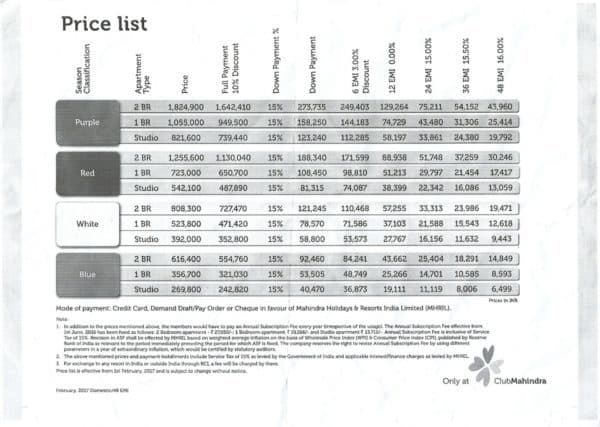
Club Mahindra Membership Fees

Before looking at the Club Mahindra Holidays Membership Fees we have to understand – criteria on what this fee is based on.

First is a type of Rooms

  • Studio Apartment – is a room for 3 adults or 2 adults & 2 kids.
  • 1 Bed Room (BR) – room for 4 adults
  • 2 BR – room for 6 adults

Must Read – Market Bubbles And The Damage They Cause

Second is Type of Seasons

Club Mahindra has divided 52 weeks into 4 Seasons/Colors.  (Check Season chart here)

  • Purple:  This is a period like New Year, summer holidays, or Diwali holidays.
  • Red: Its second-best category which covers all major long holidays & peak season for a particular location.
  • White: Normal Season
  • Blue: It’s offseason

[ss_click_to_tweet tweet=”Club Mahindra Membership is my biggest Financial Mistake” content=”” style=”default”]

Membership is also divided into these categories where you can utilize holidays in your season or lower. So Purple Members can have holidays in any season but white can only go for White & Blue. A holiday in a higher season is also possible but there are limitations like bookings can only be made 15 days in advance & you can jump only one season so White can think of going in red but not in purple.

Must Read –How you benefit from long term orientation in Life and in Investing?

Club Mahindra Membership Fees (2017 – 2018)

Club Mahindra Membership Fees 2017 2018

Price


Just to share a lot of existing members are willing to sell their membership at 30-40% discounts.

Club Mahindra Membership Annual Subscription Fees (ASF)

Club Mahindra Claims their membership is Inflation Free but other than one-time fees members have to pay Club Mahindra membership annual subscription fees (irrespective of usage), depending on the type of room they own. They charge ASF on the type of rooms so Studio will pay the lowest ASF & 2 Bed Room will pay the highest. But at the time of booking you can choose any room so I am having Studio but can book 2 BR & pay 50% less ASF. (You people will be feeling pity about me & I am feeling same for people who have bought 1 BR & 2 BR) This fee is not fixed – it increases every year according to urban inflation numbers.

ASF Charges in 2011-2012 (in bracket 2010-2011) – including service tax

  • Studio Rs 9,681 (Rs 8,994)
  • 1 BR Rs 13,593 (Rs 12,629)
  • 2 BR Rs 19,069 (Rs 17,717)

Must Read – What is finance planning

Club Mahindra Membership Cancellation Policy

They have a very transparent membership cancellation policy that there is 10 days free-look period – where the whole amount can be refunded but I was not allowed to use that. After 10 days you can cancel the membership but there will be no refund – sounds similar to our favorite endowment plans. But after that, if you want you can sell your membership in the open market – but there are no buyers. Check sites like Quikr or Olx and you will find a lot of sellers but no buyers.

In the last financial year, there were 4000 membership cancellations – I assume that as they don’t have a proper cancellation policy, these are the people who have not paid Annual Subscription Fees (ASF) & their membership was automatically canceled.

44% of members are not utilizing their holidays

Club Mahindra Holidays can advertise “Happy Families” but the truth is 44% of members are not availing their holidays. Why?

The First & biggest reason is there is a gap between the number of members & inventory (number of units) available in the resorts.  They proudly say that their membership is increased by 26% Compounded annualized growth rate but their Inventory was not able to keep pace & just grown by 22%. The gap was 9% in 2005, which has now grown to 26%.  (You can check the below table – Club Mahindra Members Vs Inventory)

club mahindra members vs inventory

Second, Club Mahindra gives resorts on rental to nonmembers, even in the peak season. So members compete with nonmembers. Their annual report show earning of Rs 15 Cr from rental they have received from nonmembers. If I assume Rs 4000 per night room rent – it turns to 3% of the total available inventory.

Third, when there is a big gap in available inventory & some competition from nonmembers; few people will definitely be disappointed because they will not get what they desire. Club Mahindra expects that people should plan their holidays 6 months in advance – I think I can do it but it’s not possible for people who are in jobs. Their annual report shows that occupancy was at 77% & if we adjust even 2% that was utilized by nonmembers so member occupancy is at 75%. If we compare that with the number of members, it turns out to be 44%. (check below graph – Club Mahindra Yearly Membership Unutilised)

club mahindra membership unutilised

I don’t think I again have to tell you that Club Mahindra charges Annual Subscription Fees (ASF) irrespective of you go on holidays or not. In addition, they don’t allow members to accumulate more than 3 years (21 days) holidays. If members don’t pay ASF, their membership will seize.

My Story 

I am passionate about traveling – I bought Club Mahindra Red Studio in Feb 2008. Just after my sister’s marriage, we were having some cash in our account & coincidentally we were also planning to buy LCD TV. Then came THE SUNDAY & I saw an advertisement in a local newspaper, where Club Mahindra also shared about FREE Sony Bravia TV. My mind stopped working something similar to when people see emotional ads of child plans. I called up the number & the executive reached my doorstep in 2 hours. In the next 5 days, we finished all formalities & were part of Club Mahindra roller coaster rides.

There is a lot of bitter experience with Club Mahindra – starting from purchasing to doing bookings to services in resorts to checkouts but I must appreciate they have good properties.

Must-Read –Personal Finance Lessons from the Olympics

My Mistakes – from which you should learn

They sayLearning from your mistakes is smart, learning from the mistakes of others is wise.” But learning from own mistake is really expensive….

I have not analyzed my requirement: I am passionate about traveling but they have resorts at limited locations. When I go to someplace I try to explore other good places which are close to that city – I don’t like sitting on the poolside throughout the day. 31st Dec 2010 I visited Jim Corbett – I had bookings for 4 nights. You won’t believe we spent very little time in the resort – we were more interested in visiting Nainital & Ranikhet. Even we spent one night in some other hotel because we thought rather than going back to resort to sleep let’s directly go from Nanital to Ranikhet. 🙁

I have not researched the product before buying: I have not researched the product & matching it with my requirement. I believed in brand Mahindra, the limited information that was shared by the executive & my gut feeling. After buying the product I started searching about how existing members feel about it & I was shocked.  But that was too late.

I agreed for the things that were not documented – I was interested in Red Studio because that was most flexible in usage as I can go in Red, White, or Blue & even purple if there is some chance in the last 15 days (purple weeks were not available at that time for purchase). I can choose any type of room & that too with lower ASF.

But the executive said FREE TV is only available with 1 BR so first you buy White 1 BR & we can later convert it in Red Studio. It took me 7 months in conversion & that too after a lot of threatening calls & what not.

There are a lot more things to share about Club Mahindra Membership but I will try to share that in the comment section. If you are a member of any such time-share resort or planning to buy one or approached by someone, please share your views in the comment section.

Mutual Funds or Direct Equity? What a New Investor Really Needs to Know

“The stock market is a device for transferring money from the impatient to the patient.” – Warren Buffett

A new client called me recently, markets were down. He had a perfectly sensible question: why not just buy good companies now, at cheaper prices, and hold for 10-15 years?

It sounds exactly right, it sounds like what Buffett does. It sounds like what your neighbour who bought Infosys shares in 2005 did.

But here is the thing nobody tells you. Identifying a good company is not the same as making money from its stock. And holding that stock when it falls 40% – without panicking, is harder than it sounds on a peaceful Sunday morning.

In 25 years of advising, I have seen this pattern repeat itself endlessly. Smart people. Good intentions. Wrong approach for their stage of the journey.

⚡ Quick Answer

For most new investors, mutual funds are the better starting point – not because stocks are bad, but because mutual funds give you professional management, instant diversification across 30-60 companies, and the discipline of SIP without requiring you to read balance sheets or stay emotionally calm during market crashes. Direct equity can work well, but only for those who have the time, training, and temperament to do it right. Most people overestimate all three.


direct equity vs mutual funds India

First, Let Us Clear One Big Confusion

Many new investors think mutual funds and stocks are two completely different things. They are not.

A mutual fund IS stocks. When you invest in an equity mutual fund, the fund manager takes your money and buys shares of companies – the same Reliance, HDFC Bank, TCS, and Infosys that you would buy yourself. If markets are down and a good company’s share price has fallen, a skilled fund manager can buy more of that company’s stock too. That is exactly what active fund managers do.

The difference is not what is bought. The difference is who is doing the buying, how much research goes into each decision, and how many companies are held to spread the risk.

Think of it like cricket. You can walk onto the pitch yourself and face a 140 km/h delivery from Jasprit Bumrah. Or you can have Virat Kohli bat on your behalf. The ball is the same, the stadium is the same. But the outcome is likely to be very different.

What Direct Equity Actually Demands From You

The dream version of stock investing goes like this: buy Infosys at ₹100, hold for 20 years, retire rich. The reality involves a few things that dream does not show.

It demands your time. To pick stocks with any consistency, you need to read annual reports, understand profit margins, track management quality, follow sector news, and monitor global developments that affect Indian companies. This is not a part-time activity. Professional fund managers do this full-time, with a team of research analysts and access to data that retail investors simply do not have.

It demands expertise. SPIVA data from December 2024 shows that 80% of professionally managed large-cap funds failed to beat the Nifty 50 index over 10 years. These are full-time professionals with Bloomberg terminals and decades of experience. If 80% of them cannot consistently beat the market, it is worth asking honestly – what is the realistic outcome for someone checking stock prices between meetings?

It demands emotional steel. Imagine you bought shares of a good, well-run company at ₹500. Over the next 18 months, due to a market correction, the price falls to ₹280. The business is fine. Nothing has changed fundamentally. But your screen shows a loss of 44%. Can you hold? Can you even buy more? Most people cannot. They sell at ₹280, then watch the stock recover to ₹700 over the next two years. This one behavioural mistake alone destroys more wealth than bad stock picks do.

“If 80% of full-time professionals cannot beat the index over 10 years, it is worth asking honestly – what is the realistic outcome for someone checking stock prices between meetings?”

– Hemant Beniwal, CFP, CTEP | Founder, RetireWise

The “Good Stock at a Lower Price” Trap

This is the specific reasoning that trips most new investors: “Markets are down. This is a great company. I will buy at a discount and hold long term.”

The logic seems solid. But it has one hidden problem. “Good company” and “good stock at this price” are not the same thing.

A genuinely strong business can still be an expensive stock. And a stock that has fallen 60% can still be overpriced if the business itself has deteriorated. The key question, the one that separates a skilled investor from someone making an expensive guess – is: Why is this stock available at a lower price?

Sometimes the answer is irrational market fear. The company is fine, investors panicked, and buying is the right call. But sometimes the answer is that analysts who track this company closely have already discovered bad news – a regulatory problem, a management issue, a competitive threat, that has not yet reached your WhatsApp group. You are buying what smart money is selling.

I call this the Discount Store Mistake. When clothes go on sale, buying more makes sense – the quality has not changed, only the price has. But a stock is not a shirt. When a stock’s price falls, it could mean fear (opportunity) or it could mean the business itself has weakened (trap). Without the knowledge to tell the difference, you are not value investing. You are speculating with a value investing label on it.

🚫 The Number That Should Stop You

In FY 2024-25, individual traders in India’s F&O segment lost a combined ₹1,05,603 crore. That is over one lakh crore rupees, gone. The average per-person loss was ₹1.1 lakh. SEBI now mandates this warning at every broker login: 9 out of 10 individual traders incur losses.

What Mutual Funds Actually Give You

Mutual funds solve the three problems that trip up most direct investors, without requiring you to become a full-time analyst.

Diversification built in. A single equity mutual fund holds 30 to 60 companies. If one company in the portfolio runs into trouble (remember the Satyam fraud?), the damage to your portfolio is limited to 2-3%. If you held that company directly and it was 20% of your portfolio, the damage is a different story entirely.

Professional management. Fund managers attend company management meetings, access proprietary research, and track global developments. They are not infallible but they are significantly better positioned than a retail investor with a smartphone and a TV channel.

The SIP discipline. A Systematic Investment Plan makes you invest every month regardless of what markets are doing. When markets fall, you automatically buy more units at cheaper prices. When markets rise, you buy fewer units. Over time, this rupee cost averaging smooths out your average purchase price in a way that is nearly impossible to replicate through manual stock picking.

India’s mutual fund industry today manages over ₹68 lakh crore in assets. Monthly SIP inflows have crossed ₹26,000 crore as of early 2026. These are not uninformed investors, they are millions of people who have understood one simple truth: simplicity, done consistently, beats cleverness done occasionally.

What You Need Direct Stocks Mutual Funds (SIP)
Time to research 5-10 hours per week minimum 30 minutes to set up, then done
Knowledge required Balance sheets, valuations, sector trends Basic understanding of fund category
Diversification Manual – needs ₹10-15 lakh to spread across 15+ stocks Automatic – ₹500 SIP gets you 30-60 companies
Annual cost Brokerage + STT + GST on every trade 0.1% to 1.5% expense ratio (index funds from 0.1%)
Tax (2026) LTCG 12.5% above ₹1.25L / STCG 20% Same – LTCG 12.5% above ₹1.25L / STCG 20%
Emotional demand Very high – you see individual stock prices daily Lower – NAV moves slower, SIP runs on autopilot
If market falls 30% You see each stock’s loss individually SIP keeps buying cheaper units automatically

New to investing and not sure where to start?

A single 30-minute conversation is enough to build a simple, structured investment plan. No jargon. No products being sold.

Book a Free 30-Min Call

The Tax Picture in 2026

One question that comes up often: is there a tax advantage to holding stocks directly versus through a mutual fund?

The answer, as of 2026, is no. Both are taxed identically for equity exposure.

Long-term capital gains (LTCG) on holdings above 12 months: taxed at 12.5% on gains above ₹1.25 lakh per year. This applies to both direct equity and equity mutual funds. Short-term capital gains (STCG) on holdings below 12 months: taxed at 20% for both. Budget 2026-27 made no further changes to equity taxation.

The cost difference is in the expense ratio of mutual funds – typically 0.5% to 1.5% for actively managed funds, and as low as 0.1% for index funds. SEBI’s December 2025 regulations have reduced these caps further from April 2026. Direct stocks carry no annual fund cost but every buy and sell transaction attracts brokerage, STT, exchange charges, and GST. For a genuine long-term investor who buys and holds without churning, direct stocks can actually cost less. But most people do not hold without churning.

Note: Mutual funds and direct stocks have similar taxation, but mutual funds offer an important advantage – you pay tax only when you redeem your investment. In stocks, every sale is a taxable event. This allows mutual fund investors to benefit from better long-term compounding.

The One Edge a Retail Investor Actually Has

A fund manager covering 200 companies across sectors cannot know any single industry or company as deeply as someone who works in it every day. A doctor who understands hospital economics, a telecom engineer who can assess which tower companies are building real infrastructure, a banker who can read between the lines of an NBFC’s loan book – these people have genuine insight that no Bloomberg terminal can replace. Domain expertise from your own profession is the one real edge a retail investor has over a fund manager. If you have that edge in a specific sector, a small allocation to those companies makes sense. Outside your domain of expertise, a mutual fund will almost always serve you better.

Keep your direct equity to the sectors you genuinely understand. Keep everything else in diversified funds.

When Direct Equity Makes Sense

I am not arguing against direct equity. Several of my clients hold individual stocks and do it well. But there is a clear profile of who should be doing this.

You are ready for direct equity if you have 5-10 hours a week to track the companies you own, the emotional discipline to watch your portfolio fall 40% without selling, a total equity corpus large enough that mistakes are not catastrophic, and ideally 3-5 years of following markets before you put serious money at risk.

Even then, the sensible approach is to keep direct equity to 10-20% of your total equity allocation. The rest belongs in diversified mutual funds or index funds. The core of your wealth should be in boring, predictable products. Experimentation happens at the edges – not in the centre.

Read – Direct Investing in Stocks: Why Most Indian Retail Investors Lose Money

The Honest Starting Point for a New Investor

If you are just beginning, here is what I would actually tell you to do – the same thing I tell every new client who asks this question.

Start with a Nifty 50 index fund or a flexi cap fund SIP. Even ₹2,000 or ₹5,000 a month. Set it up on and then do nothing for three years.

Watch how you feel when the market drops 20%. If you stayed the course and even added more, you have the temperament for equity investing and you can start exploring more options. If you panicked and paused the SIP, that is valuable self-knowledge. No book, no course, no YouTube video could have given you that information as honestly as actual money in actual markets.

Think of it like a film. A new actor does not start with a lead role in a big-budget production. They learn their craft first: small roles, understanding the camera, developing their range. Direct equity investing is the lead role. Mutual fund SIPs are where you learn the craft. Most people try to skip directly to the lead role. And most of them get it wrong.

Read – NPS: A Retirement Advisor’s Honest Review

Frequently Asked Questions

Is it better to invest in mutual funds or buy stocks directly?

For most investors, especially beginners – mutual funds are the better choice. They offer instant diversification, professional management, and the SIP discipline that removes emotion from investing. Direct stocks can work well, but only for investors with the time, skill, and emotional discipline to manage a portfolio through full market cycles. The vast majority of retail investors who attempt direct stock picking underperform a simple index fund over 10 or more years.

Do mutual funds also buy stocks? Is it the same as direct equity?

Yes. An equity mutual fund invests in the same stocks that trade on NSE and BSE – the same Reliance, Infosys, HDFC Bank you would buy directly. The difference is that a professional fund manager makes the buy and sell decisions, the portfolio holds 30-60 companies to spread risk, and you benefit from economies of scale. Mutual funds are not a different asset class. They are a smarter delivery mechanism for equity ownership.

What are the tax differences between mutual funds and direct stocks in 2026?

There is no tax difference. Both equity mutual funds and direct stocks are taxed at LTCG 12.5% (above ₹1.25 lakh, for holdings over 12 months) and STCG 20% (for holdings under 12 months). The cost difference is in expense ratios for mutual funds versus transaction costs for direct equity.

How much money do I need to start investing in stocks directly?

There is no minimum for a single stock. But to build a properly diversified portfolio of 15-20 companies, the minimum needed to meaningfully spread concentration risk – most advisors suggest at least ₹10-15 lakh. Below that level, mutual funds give you far better diversification per rupee invested.

The goal of investing is not to feel clever. The goal is to retire with enough. Simplicity, done consistently, gets you there. Complexity, done occasionally, usually doesn’t.

It’s not a Numbers Game. It’s a Mind Game.

Ready to build a proper investment plan?

25 years. 500+ families. A structured plan built around your income, your goals, and your temperament.

See Our Retirement Planning Service

💬 Your Turn

Have you tried direct equity investing? Be honest, did your XIRR over 5 years beat a simple Nifty 50 index fund? What was the hardest part – picking the right stocks, or staying calm when they fell? Share in the comments.

Healthcare Planning for Retirement in India — The 2026 Guide Most Senior Executives Skip

A few months ago, I got a call from Anil (name changed). His father had been admitted to a top Bangalore hospital after a stroke. Eleven days in the ICU, three days in the step-down unit, and a bill of Rs 12.4 lakh. His father had no health insurance. Anil had a corporate policy covering his parents, but the cover was Rs 5 lakh — not nearly enough.

The phone call wasn’t about money, though. It was about something harder. “Hemant, I’ve been saving for retirement since I was 28. I’m 47 now. I’ve done everything right. But I never once thought about healthcare as a separate bucket. I always assumed my retirement corpus would cover it. Am I wrong?”

I wasn’t in a position to lie to him. Yes — he was wrong. Not because he hadn’t saved enough. He had. But because the way Indians think about retirement — as one single bucket of money that handles everything — doesn’t survive contact with modern medical inflation.

Healthcare is not a sub-heading of retirement planning. It’s a separate crisis that happens during retirement. And after 25 years of advising senior executives, I can tell you: this is the one thing almost everyone underestimates.

⚡ Quick Answer

Medical inflation in India is running at 11.5-14% annually — nearly 3x general inflation and the highest in Asia. A Rs 5 lakh hospitalisation today could cost Rs 30-40 lakh in 20 years. A comprehensive retirement healthcare plan needs three pillars: (1) adequate health insurance that continues post-retirement, (2) a separate healthcare contingency corpus beyond your retirement fund, and (3) long-term care planning. Most senior executives only plan for the first. The IRDAI’s 2024-25 reforms have removed age caps and reduced PED waiting periods — now is the time to act.

Why Healthcare Planning is Different from Retirement Planning

Most people bundle healthcare into retirement. “I’ll save Rs 10 crore by age 60 and that will handle everything — living expenses, travel, medical bills.” It sounds logical. It’s also dangerously wrong.

Here’s why. Retirement expenses are predictable. Monthly groceries, utilities, travel — you can estimate these within 10-15%. Healthcare expenses are not. One major hospitalisation, one unexpected surgery, one chronic condition requiring daily medication for 15 years — and your “comfortable corpus” becomes inadequate. Fast.

Let me show you what medical inflation actually does to costs over time.

Medical Inflation in India — The 2026 Reality

Indicator 2026 Reality
Medical Inflation Rate 11.5% – 14% per annum (highest in Asia)
General CPI Inflation ~4-5% per annum
Average Hospitalisation Cost (Major Treatment) Rs 3-5 lakh
Complex Surgery / Critical Illness Rs 5-8 lakh and above
ICU Charges (per day) Rs 10,000+ (exclusive of treatment)
Out-of-Pocket Share of Hospital Bills 62%
Families Borrowing to Pay Medical Bills 23%

Source: ACKO, PolicyBazaar, Onsurity Medical Inflation Reports 2026.

🚫 The Inflation Reality

At 14% medical inflation, a Rs 5 lakh hospitalisation today will cost approximately Rs 19 lakh in 10 years, Rs 37 lakh in 15 years, and a shocking Rs 70 lakh in 20 years. If you’re 45 today and planning to retire at 60, the healthcare bills you’ll face at 75 are not the ones you see in hospitals today. They’ll be 5-8x higher.

What a Medical Bill Today Will Cost You Later

Today’s Cost In 10 Years In 15 Years In 20 Years
Rs 1 lakh Rs 3.7 lakh Rs 7.1 lakh Rs 13.7 lakh
Rs 5 lakh Rs 18.5 lakh Rs 35.6 lakh Rs 68.7 lakh
Rs 10 lakh Rs 37.1 lakh Rs 71.4 lakh Rs 1.37 crore

Projections assume 14% annual medical inflation.

These numbers should stop you cold. A hip replacement that costs Rs 3 lakh today will cost you Rs 41 lakh in 20 years. A cardiac bypass at Rs 5 lakh today? Rs 69 lakh. If you’re 45 now, that’s the bill you’ll potentially face at 65.

The Three Pillars of Healthcare Planning for Retirement

Let me structure this properly. A comprehensive healthcare plan needs three separate components — each with its own purpose, funding approach, and timeline.

PILLAR 1 Health Insurance That Lasts Past Retirement

Your employer’s corporate policy ends the day you retire. Don’t rely on it. Buy your own family floater now — preferably in your 30s or 40s — so you build up no-claim bonuses and cross the pre-existing disease waiting period before you actually need the cover.

PILLAR 2 Healthcare Contingency Corpus

Even the best insurance has gaps — OPD, consumables, home care, dental, vision, and procedures excluded from the policy. Build a separate corpus of Rs 25-50 lakh specifically for healthcare. Don’t mix it with your retirement corpus. Keep it in liquid debt funds or FDs where it earns decent returns but is accessible instantly.

PILLAR 3 Long-Term Care Planning

Assisted living, home nursing, and daily caregiving in India can cost Rs 30,000-1,00,000 per month today. This is the expense most Indian families discover too late. Start planning for this as early as 45-50. Some life insurance companies now offer long-term care riders — useful for specific cases but expensive.

Not sure how much healthcare corpus you actually need for retirement?

A proper financial plan projects healthcare costs separately from retirement expenses — using realistic medical inflation assumptions for your age, family history, and city.

Talk to a SEBI-Registered Advisor

IRDAI’s 2024-25 Reforms — Why This is the Year to Act

For 20 years, senior citizens struggled to get adequate health insurance. Insurance companies routinely rejected applicants above 65. Premiums doubled arbitrarily at renewal. Pre-existing disease clauses locked out the very conditions senior citizens actually needed covered.

In 2024-25, IRDAI pushed through a set of reforms that changed the game. If you haven’t updated your understanding of health insurance since 2020, you’re missing the most significant regulatory shift in a generation.

Old Rule New Rule (2024-25)
Upper age limit of 65 for new policies No upper age limit. Every insurer must offer at least one product without age restrictions.
PED waiting period of 48 months Reduced to maximum 36 months
Unpredictable annual premium hikes Senior citizen premium increases capped at 10% per year (prior IRDAI approval for more)
Denial for severe conditions Insurers cannot refuse policies for cancer, heart/renal failure, or AIDS
Long grievance timelines for seniors Mandatory separate grievance channel for senior citizens

If you have parents in the 60-75 bracket who were denied coverage earlier, re-approach insurers now. The rules have changed in their favour. For a deeper dive, read our guide to health insurance for parents in India.

Before You Start — The Groundwork That Actually Matters

Visit the Family Doctor (If You Still Have One)

A family doctor who knows your history is worth more than any diagnostic test. Unfortunately, the concept has almost disappeared in urban India. If you still have one, don’t lose them. Share your family’s medical history — your father’s heart condition, your mother’s diabetes, that uncle who had early-onset Parkinson’s. Patterns matter. Knowing what to watch for lets you catch problems 10-15 years before they become catastrophic.

If you don’t have a family doctor, do this: get a comprehensive annual health checkup from a reputed hospital. Rs 5,000-15,000 today. Potential savings? Lakhs. One client of mine caught stage-1 prostate cancer in a routine screening at 54 and treated it for Rs 3 lakh. Another client ignored routine checkups and was diagnosed at stage 3 — his treatment cost Rs 18 lakh over two years.

Involve the Family in the Conversation

This is the hardest part for most Indian men. We don’t discuss money with our families. We don’t discuss our health with our families. We certainly don’t discuss what happens if we get sick.

Start the conversation early. Your spouse needs to know where the insurance documents are. Your children need to know what your wishes are for end-of-life care. Nobody likes talking about this. Everybody needs to.

I’ve seen families fight over medical decisions at the ICU door because the father never told anyone his preference. Don’t be that family.

The Emergency Folder — Every Senior Executive Needs One

This is the single most underrated document in Indian households. An “Emergency Folder” — physical or digital — with everything your family would need if something happened to you:

  • Contact list — specialist doctors, family members, advisor, lawyer, insurance agents
  • All prescriptions and diagnostic reports, updated annually
  • Health insurance policies with card numbers, hospital network, helpline numbers
  • Living will — your wishes for life-support and end-of-life care
  • Durable power of attorney for healthcare — who makes medical decisions if you can’t
  • Organ/body donation cards, if applicable
  • DNR (Do Not Resuscitate) order, if you have one

Share this folder with your spouse, kids, or primary caregiver. For a complete system on managing your financial and medical documents — including DigiLocker and digital nominee registration — read our guide to managing financial documents in India.

The Hidden Expenses Nobody Talks About

Even with the best health insurance, a significant portion of healthcare costs come out of your pocket. Here’s what your insurance typically doesn’t cover:

OFTEN UNCOVERED Out-of-Pocket Expenses

OPD consultations, regular diagnostic tests, OTC medications, dental and vision care, physiotherapy, home nursing, transportation to hospitals, caregiver accompaniment costs, non-allopathic treatments, and most daycare procedures. In old age, these “small” expenses can total Rs 2-5 lakh per year — and your insurance won’t pay a paisa.

Long-Term Care — The Elephant in the Room

Nobody wants to imagine needing someone to help them bathe, eat, or walk. But if statistics are any guide, 40-50% of Indians over 75 will need some form of assisted care. The question isn’t whether you’ll need it. It’s whether you’ll be prepared when you do.

Here’s the rough cost landscape in 2026:

Type of Care Monthly Cost (2026)
Day-time attendant (basic help) Rs 15,000 – 25,000
Full-time home nurse (trained) Rs 40,000 – 70,000
Assisted living facility (mid-tier) Rs 50,000 – 1,50,000
Premium senior living community Rs 1,50,000+

Apply 10% annual inflation to these numbers for 15 years from now and you’ll see why long-term care is the biggest hidden expense of modern Indian retirement.

“Health insurance covers hospitalisation. It does not cover the reality of growing old. That’s a different problem with a different answer — and the answer is money set aside, decades in advance.”

Lifestyle — The Free Medicine Everyone Ignores

Here’s the uncomfortable truth I share with every client: you can’t out-insure a bad lifestyle. You cannot save your way out of 30 years of poor sleep, sedentary work, stress eating, and skipped checkups. The cheapest healthcare strategy is preventive. It costs nothing and pays the most.

A 45-year-old senior executive who walks 10,000 steps a day, sleeps 7 hours, eats consciously, and gets annual checkups will spend 60-70% less on healthcare over the next 30 years than one who doesn’t. That’s not a guess — that’s what the actuarial data says about what insurance companies see in claims.

Yoga, walking, playing with grandchildren, laughing with friends in city parks — these are not just “good for you.” They are measurable cost-savers. The Indian retiree with a strong social circle lives 5-7 years longer than one who doesn’t. That’s better than almost any medicine on the market.

Update and Review — The Plan Nobody Revisits

A plan frozen in time is worse than no plan. It gives you a false sense of security while your assumptions silently go stale.

Review your healthcare plan every 2-3 years. Have your health insurance premiums crossed the 10% IRDAI cap? Has your corpus kept pace with medical inflation? Has your family composition changed? Has a parent’s or sibling’s diagnosis changed your family history? All of these should trigger a plan update.

When did you last review your retirement healthcare plan?

If the answer is “never” or “years ago,” now is the time. A structured review can identify gaps before a crisis exposes them.

Get a Healthcare Plan Review

You worked 30 years to retire with dignity. Don’t let a hospital bill take it all away in 30 days. Plan for your health like you plan for your wealth — separately, seriously, and starting today.

Prepare for the worst. Hope for the best. Enjoy the present.

💬 Your Turn

Do you have a separate healthcare corpus outside your retirement fund? Or are you planning to handle everything from one bucket? Share your approach in the comments — I read every one.