
Last Updated on April 20, 2026 by Hemant Beniwal
“The goal is not more money. The goal is living life on your terms.” — Chris Brogan
Here is a question nobody in personal finance seems to ask.
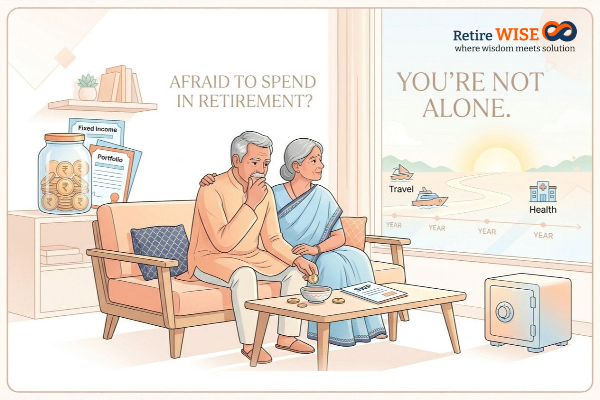
You spent 30 years building a retirement corpus. You were disciplined. You stayed invested through crashes. You sacrificed holidays, upgrades, and comforts because the future mattered more than the present. And now the future is here.
So why are you still living like it isn’t?
Most conversations about retirement planning in India focus on one problem: not having enough. And it is a real problem. But there is a second problem that gets almost no attention. Having enough, and not knowing it.
This is one of the most underexamined questions in retirement planning. When does saving for the future start holding back the present?
⚡ Quick Answer
Knowing how much is enough for retirement in India is not just a mathematical question. It is a psychological one. Many retirees who have built adequate or generous corpuses continue to under-spend because they have never formally answered the question: “Am I allowed to enjoy this?” A well-structured retirement plan does not just tell you what you have. It tells you what you can safely spend.. so that years of discipline finally translate into years of living.
Two Kinds of Retirement Problems
The retirement planning industry almost exclusively addresses one kind of problem: not having built enough corpus. There are calculators, articles, rule-of-thumb multiples, and social media posts dedicated to telling you the number you need and how far behind you are.
But there is a second kind of problem that sits on the other side of that coin. Having the corpus and not being able to use it with confidence.
The first problem is mathematical. The second is behavioural. And in my experience of 25 years working with senior professionals across India, the second problem is far more common among people who actually planned well.
A person who has not saved enough needs a financial plan. A person who has saved enough but cannot bring themselves to spend needs something different entirely: a clear picture of what their corpus can sustain, permission backed by numbers, and a structure that removes the anxiety of “what if this runs out?”
Both are retirement planning problems. Only one gets written about.
Where This Fear Comes From
The frugality that builds a great retirement corpus does not switch off at retirement. For most people, it becomes the default operating mode. After decades of treating every rupee as a future asset, spending it on the present feels almost wrong.
There is also something deeper at work. Most people never formally answer the question: how much is enough? The goal post kept moving. At ₹1 crore, the target became ₹3 crore. At ₹3 crore, it became ₹5 crore. More always felt safer than less. And at retirement, there is no number that feels definitively sufficient because that number was never actually calculated.
When you have never quantified enough, you cannot feel it even when you have reached it.
There is also an asymmetry in how we perceive financial mistakes. Spending too much and running out of money is a visible, frightening outcome. Spending too little and leaving a large unspent corpus feels like prudence, not error.
But dying with 40% of your corpus unspent, having denied yourself experiences and comfort in your 60s and 70s out of an anxiety that turned out to be unfounded, is also a failure of planning. It is just a failure nobody talks about.
🎬 Think of a film director who spent years perfecting a script. The research was thorough. The preparation was meticulous. But when the green light finally came, he kept rewriting instead of shooting. The problem was never the script. It was the inability to say “this is ready.” A retirement corpus that is never drawn from with confidence is the financial equivalent of a film that never gets made.
The Question That Changes Everything
Retirement planning is not just about building the corpus. It is about gaining the confidence to actually enjoy what you built.
That confidence does not come from a vague sense that things should be fine. It comes from a specific, calculated answer to one question: given my corpus, my expenses, the inflation I will face, and the returns my portfolio will generate, what can I safely spend each month for the next 25 to 30 years?
When that number is calculated carefully, reviewed by a professional, and built into a withdrawal structure, something shifts. The spending stops feeling like depletion. It starts feeling like income. Like a salary from the work of a lifetime.
That shift, from anxiety to clarity, is what retirement planning should ultimately deliver. Not just a corpus. A permission structure built around it.
When Saving for the Future Starts Holding Back the Present
There is a point in every financial life where continued saving stops being prudent and starts being avoidance.
If you are 65, your corpus is well above your calculated needs, your expenses are covered, your health insurance is in place, and you are still making lifestyle compromises because “you never know what might happen” that is not financial wisdom. That is financial anxiety presenting itself as discipline.
The same traits that make someone a great accumulator can work against them in retirement if they are not consciously recalibrated. The skills that build wealth are not always the skills that allow you to enjoy it.
This carries an additional layer in India. Many in this generation built their corpus during economic uncertainty, sometimes starting from very little. The memory of scarcity does not fade simply because the balance sheet has changed. For some, it never fades entirely.
A good retirement plan acknowledges this. It does not just show you a projection. It shows you the floor: the corpus level below which you would genuinely be at risk. And it shows you the space above that floor.. the room you have to live, travel, give, and spend without compromising what matters.
What “Enough” Actually Looks Like in India
How much is enough for retirement in India is a deeply personal calculation. But there are anchors.
A corpus is broadly sufficient when it can generate your required monthly income, inflation-adjusted, for 25 to 30 years, without depleting entirely before the end of that period. For most urban professionals spending ₹1.5 to 2 lakhs a month in retirement, this typically means a corpus of ₹4 to 6 crores, depending on age at retirement, return assumptions, and healthcare provisions.
But sufficiency is only half the question. The other half is structure. A corpus of ₹6 crores sitting without a withdrawal plan leaves its owner no more confident than someone with half that amount. The same corpus, structured through a bucket approach with near-term liquidity secured, medium-term income planned, and long-term growth maintained, creates an entirely different experience of retirement.
The structure is what converts the number into confidence. Without structure, even a generous corpus can feel precarious. With it, even a modest corpus can feel sufficient.
Intentional Simplicity vs Uninformed Frugality
There is an important distinction worth making carefully here.
Some people live modestly in retirement because they genuinely prefer it. They have no desire for a luxury car, expensive holidays, or an upgraded lifestyle. Their simplicity is a considered choice. That is entirely valid and, in many ways, admirable. Intentional simplicity is a form of contentment, not a constraint.
But there is a different kind of modest living that comes not from contentment but from never having calculated whether something else was possible. From continuing the habits of accumulation long past the point where accumulation was the goal. From a quiet background anxiety that was never addressed because the right question was never asked.
The difference between the two is not the lifestyle. It is whether the choice was made freely.
One group knows they have enough and has chosen simplicity. The other suspects they might have enough but has never confirmed it, and lives accordingly.
Retirement planning, done properly, resolves that uncertainty. It gives you the calculation, the structure, and the answer. And then the choice of how to live is genuinely yours.
A thought worth sitting with
A lot of times when we speak with people planning their retirement, we notice a gap between what they want and what they actually need. This is not unique to finance — it shows up across many of life’s important decisions.
You may want emotional safety and the reassurance of an untouched corpus. But your real need may be different.. to know, with clarity, what you can spend and what remains protected. That clarity is not a threat to security. It is the foundation of it.
What Good Retirement Planning Actually Delivers
A retirement plan that stops at “you have accumulated X crores” has done half the job.
The second half includes: What is your safe monthly withdrawal? How does that change at 70 versus 80? What happens to the plan if markets fall significantly in year three? What is the minimum corpus floor below which you should not go? How do you draw income without eroding the long-term growth component?
When these questions are answered, and the answers are built into a clear withdrawal structure, something important happens. The anxiety is replaced by a framework. The uncertainty is replaced by clarity. And the money, finally, starts doing what it was always meant to do.
The mechanics of how to draw income systematically without making your corpus vulnerable are worth understanding in detail. Most retirees treat SWP as a retirement strategy when it is actually just a withdrawal tool- this post explains what the real strategy looks like and why the distinction matters.
And if the question of whether your corpus will actually last 25 to 30 years concerns you, this post on what retirees expect versus what they actually experience is worth reading before you make any assumptions about sufficiency.
Do you know your safe monthly withdrawal number?
RetireWise builds retirement plans that answer this question precisely.. not just how much you have, but what you can spend, confidently, for the next 25 years.
You worked decades to build the corpus. The plan should give you the clarity to actually use it.. not just the reassurance that it exists.
Knowing you have enough is not the destination. Believing it is.
💬 Your Turn
If you are at or near retirement — do you feel confident that you know what you can safely spend each month? Or does that question still feel unanswered? Drop your thoughts below.