
Last Updated on April 13, 2026 by Hemant Beniwal
“Risk comes from not knowing what you’re doing.” — Warren Buffett
What if the decision that feels safest today quietly undermines your retirement over the next 20 years?
Most people who move entirely out of equity at retirement are not being reckless. They are being careful. They have lived through market crashes. They know what a 30% portfolio drop feels like. The sleepless nights, the urge to sell, the anxiety of watching years of savings shrink in weeks. That experience is real, and the caution that follows it is completely understandable.
But there is a second risk in retirement. One that does not send you an alert. One that does not show up on your portfolio statement. One that arrives slowly, over years, until one day, usually somewhere in your early 70s, the numbers stop adding up.
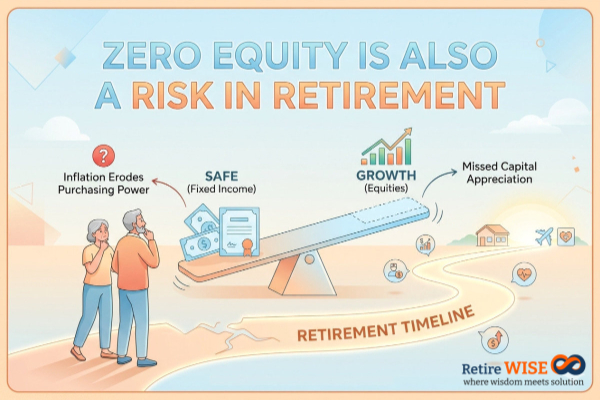
Zero equity is not the absence of risk. It is the substitution of one risk for another. And the second risk is considerably harder to see coming.
⚡ Quick Answer
Avoiding equity entirely in retirement eliminates market volatility but creates three slower, more damaging risks: inflation eroding purchasing power, longevity causing the corpus to run out, and falling interest rates shrinking income year after year. For most retirees, an equity allocation of 20 to 30% in retirement, structured carefully through a bucket approach, is not speculation. It is responsible retirement planning.
The Illusion of Safety: Why Zero Equity Feels Right
Think of Amitabh Bachchan’s character in any film where he plays a patriarch who holds everything together quietly, asking for nothing. Calm on the surface. Stable. Reassuring. But if his foundation is slowly crumbling and nobody checks, the whole structure eventually collapses. Not dramatically, but inevitably.
A zero-equity retirement portfolio plays exactly this role. It looks steady for years. The quarterly statements show no losses. There is no drama, no panic, nothing to act on. But underneath, inflation is doing its work. Quietly. Consistently. Without asking your permission.
The comfort of fixed deposits, bonds, and debt funds is real in the early years of retirement. Returns are predictable. The portfolio value does not swing. This apparent stability is not deceiving you. It is simply not telling you the full story.
The full story involves purchasing power. And time.
The Three Risks Nobody Warns You About at Retirement
Inflation risk is the most familiar but the most consistently underestimated. Consumer inflation in India averages 6 to 7% over the long run. Healthcare inflation runs considerably faster, closer to 12 to 14% annually for hospitalisation and specialist care. Apply the Rule of 72: at 7% inflation, your expenses double every 10 years. If you need ₹1 lakh a month today, you will need ₹2 lakhs at 70 and roughly ₹4 lakhs at 80.
A fixed deposit earning 7% keeps pace with today’s inflation. It does not grow your purchasing power. Over two decades, it leaves your corpus running in place while your actual expenses have run well ahead.
Longevity risk is the one most people do not plan for honestly. We are living meaningfully longer than our parents did. A person retiring at 60 today in reasonable health should plan for a 25 to 30 year retirement. A corpus that feels comfortable at 60 can feel pressured at 72 and genuinely concerning at 78.
Reinvestment risk is the quietest of the three. When your fixed deposits mature and interest rates have fallen, as they did significantly between 2019 and 2022 in India, you cannot renew at the same rate. Your income from the same corpus shrinks. You did not lose capital. But your monthly income did. This is the category of loss that rarely gets named, which is precisely why it catches people off guard.
🏏 Think of a batsman who decides to just survive and not score. In the first few overs, the strategy looks solid. No wickets lost, no drama. But at the end of 20 overs, the scoreboard tells a different story. A retirement corpus with zero equity is playing the same innings. No drama early. A difficult position later.
What the Numbers Actually Show
Two people, both retiring at 60 with ₹3 crores and current monthly expenses of ₹1.2 lakhs.
📊 Zero Equity vs Balanced Allocation — How the Gap Builds Over 20 Years
| Parameter | Person A (Zero Equity) | Person B (25 to 30% Equity) |
|---|---|---|
| Starting corpus | ₹3 crores | ₹3 crores |
| Portfolio return | ~6.5% (FDs, bonds, SCSS) | ~8 to 9% (blended) |
| Expense inflation assumed | 7% per year | 7% per year |
| Monthly expense at age 70 | ~₹2.4 lakhs | ~₹2.4 lakhs |
| Corpus at age 75 | Significantly depleted | Still growing |
| Corpus at age 80 | Near exhaustion | Meaningful balance remains |
| Volatility experienced | None | Some, managed by bucket structure |
*Indicative figures for illustration. Actual outcomes depend on withdrawal rate, expense pattern, and market returns.
The difference is not in how much risk Person B took. It is in which risk they chose to manage. Person A managed volatility. Person B managed longevity. Both made a deliberate choice. Only one will have financial comfort at 78.
Why It Does Not Show Up on Day One
In the first five years of retirement, a zero-equity portfolio genuinely looks like the right decision. No market crashes. No panic. No difficult quarterly statements. People with equity in their portfolios are experiencing volatility and you are not. That contrast feels like confirmation.
But the comparison is not quite right. You are comparing the visible discomfort of equity volatility with the invisible erosion of purchasing power. Volatility shows up on a screen. Inflation does not send you a monthly update.
The gap begins to open around year eight to ten. Expenses that were ₹1.5 lakhs a month are now ₹2.2 lakhs. The FD income has not kept pace. Small adjustments begin. Fewer long trips, deferred home repairs, choosing the more affordable hospital. Nothing alarming individually. But the direction is set.
By year fifteen to twenty, what began as caution has become a structural gap between income and need. You do not feel the mistake in your 60s. You pay for it in your 70s.
💡 People fear market crashes because they are visible, sudden, and emotionally intense. Inflation is invisible, gradual, and almost entirely unemotional. Visible risk gets managed. Invisible risk gets ignored. This asymmetry is one of the most persistent patterns in retirement decision-making.
The Tax Dimension Most People Overlook
There is one more layer that consistently goes unexamined.
Fixed income returns are largely taxable. FD interest is added to your income and taxed at your applicable slab. For someone in the 20 to 30% bracket, a nominal 7% FD return becomes an effective 4.9 to 5.6% post-tax return. Against 7% inflation, your purchasing power is actually shrinking every year even before you spend a rupee.
Equity mutual funds held for over a year attract long-term capital gains tax at 12.5%, and only on gains above ₹1.25 lakhs annually. For most retirees drawing systematically from their corpus, the effective tax on equity returns is meaningfully lower than on FD interest.
After-tax real return, what remains after both tax and inflation, is the only return that actually matters in retirement. A portfolio that looks conservative on paper can be quietly losing ground in real purchasing power every single year.
How Much Equity Should a Retiree Actually Hold?
This is the question most people never get a straight answer on. The right equity allocation in retirement is not zero, but it is also not what you held during your accumulation years.
For most Indian retirees, an ideal equity allocation of 20 to 30% of the total retirement corpus strikes the right balance. This retirement portfolio equity percentage is high enough to provide long-term purchasing power protection while keeping the majority of the corpus in stable instruments.
Should retirees invest in equity at all? The answer is yes, but with the right structure. The equity portion should never be the source of near-term income. It should sit untouched in a long-term bucket, insulated from short-term market swings, working quietly over a 10 to 15 year horizon.
The question is not whether to have stock exposure after retirement. The question is how to structure that exposure so that market volatility never forces a wrong decision at the wrong time.
Why Thoughtful People Still Choose Zero Equity
The decision to move entirely to fixed income is rarely irrational. It is usually a reasonable, considered response to a real past experience.
Market losses leave what researchers describe as a scar effect. The emotional memory of a sharp portfolio decline persists long after the portfolio has recovered. The mind holds on to the feeling of loss far more intensely than it registers the subsequent rebuilding. This is not a weakness. It is how human psychology works, the same protective instinct that makes us careful after any genuinely painful experience.
The difficulty is that retirement is a 25 to 30 year journey, not a 3 year event. The risk horizon for someone at 60 is genuinely long. And over 15 to 20 years, equity markets in India have historically rewarded patient investors, not because markets are smooth or predictable year to year, but because the long-run growth of the economy tends to be reflected in equity prices over meaningful time horizons.
The question worth asking is not whether equity is safe. Equity is not safe in the short term, and that is simply true.
The more useful question is whether a 25-year retirement portfolio with zero equity is actually safe. The honest answer is: it is considerably more comfortable in the early years, and considerably more vulnerable in the later ones.
Volatility is visible risk. Inflation is invisible risk. We naturally manage what we can see and feel. We tend to ignore what arrives slowly and without announcement.
What a Better Approach Looks Like
The answer is not a return to aggressive equity investing. A concentrated equity portfolio at 60 carries its own genuine risks, particularly sequence of returns risk, where a market downturn in the early years of retirement can do lasting damage to a corpus that has no time to fully recover.
The answer is structured balance through a bucket framework.
The short-term bucket covers two to three years of expenses in liquid funds and short-duration debt. No market risk. No volatility. Complete peace of mind regardless of what markets do. This bucket exists so that a falling market never forces a bad decision.
The medium-term bucket covers roughly years four to ten in a mix of debt mutual funds, balanced advantage funds, and stable instruments like SCSS. It refills the short-term bucket systematically each year.
The long-term bucket holds a modest 20 to 30% of the total corpus in equity mutual funds. This bucket is not touched for years. Its single purpose is to ensure that the corpus in your 70s and 80s retains the purchasing power needed for the life you planned.
Equity in the long-term bucket is not about chasing returns. It is about not falling behind inflation over decades.
The mechanics of how to draw income from this structure, without selling equity at the wrong time, are worth understanding in detail. Most retirees treat SWP as a retirement strategy when it is actually just a withdrawal tool — this post explains what the real strategy looks like.
The Honest Conversation Nobody Has
In 25 years of working with people approaching and living through retirement, I have sat with many who were genuinely hurt by equity at some earlier point. That experience deserves to be taken seriously, not explained away.
But I have also sat with people in their mid-70s who made every safe choice at 60 and found themselves quietly adjusting their lifestyle, leaning on their children for medical expenses, or watching a corpus that once felt more than sufficient slowly become insufficient.
Both forms of difficulty are real. One arrives loudly and immediately. The other arrives slowly and without warning.
A thought worth sitting with
A lot of times when I speak with people planning their retirement, I notice a gap between what they want and what they actually need. This is not unique to finance, it shows up across many of life’s important decisions.
You may want emotional safety and zero volatility. But your real need may be different, to accept a measured amount of discomfort today, so that your financial security remains intact for the 25 years ahead. That is not a compromise. That is the plan working exactly as it should.
The goal of good retirement planning is not to remove all discomfort. It is to choose which discomfort you manage deliberately, rather than let a different and quieter discomfort manage you over time.
Is your retirement corpus structured to last 25 years and not just 10?
At RetireWise, we build withdrawal strategies specifically for senior executives, balancing stability, inflation protection, and the long-term growth your corpus needs to survive.
The biggest risk in retirement is not market volatility. It is running out of growth when you still have years left to live.
Safety that protects you today but not tomorrow is not safety. It is just a slower way to arrive at the same problem.
💬 Your Turn
When you think about your retirement portfolio, which risk concerns you more — a sharp market fall that you can see, or a slow 20-year erosion of purchasing power that you cannot? Drop your thoughts below. I read every comment.