
Last Updated on April 4, 2026 by teamtfl
“It is the more obligation to honor the right of the citizen to live with dignity even in the retired life.” — Franklin D. Roosevelt, 1935
Ramesh was 62. He’d just received Rs 80 lakh in gratuity after 35 years at a PSU bank.
His relationship manager called the same week. “Sir, LIC Jeevan Akshay. Guaranteed income for life. Safest option for you.”
Ramesh invested Rs 60 lakh. All of it.
When he came to me six months later, there was nothing left to do. The decision was permanent. The money was gone. The income was fixed forever. No exit. No flexibility. No inflation adjustment beyond 3% — in a country where healthcare costs rise at 12 to 15% annually.
He hadn’t bought safety. He’d bought a trap with a guaranteed income label on it.
This post is for anyone who’s been told the same thing — or is about to be.
⚡ Quick Answer
LIC Jeevan Akshay VII (Plan 857) is a single premium immediate annuity plan. You pay a lumpsum once, LIC pays you guaranteed income for life. For a 60-year-old investing Rs 10 lakh under Option A, the annual payout is approximately Rs 1,82,200 — but this includes a return of your own capital, not purely a yield. Annuity income is fully taxable. The plan offers 10 options. The two biggest problems: the decision is irreversible, and the income doesn’t beat inflation. Best used as one income layer in a retirement plan of Rs 3 crore or more — never as your only source.
What Is an Immediate Annuity — and Why Most People Buy It Wrong
An immediate annuity is simple on paper. You give a lumpsum to an insurance company. They pay you a fixed income every month for the rest of your life. That’s the entire product.
The income starts immediately — typically one month after purchase. The rate is locked at the time of buying and never changes. Not even if interest rates double. Not even if inflation doubles.
This is where most people make the mistake.
They hear “guaranteed income for life” and they think “safe.” But there’s a critical difference between guaranteed and adequate. Jeevan Akshay guarantees you’ll receive income. It doesn’t guarantee that income will keep up with your life.
The other thing people miss: with an FD or SCSS, your principal is still yours. With an immediate annuity, your lumpsum is gone permanently. You’re exchanging capital for income — forever.
🌾 Think of it like buying a cow that produces milk every day for life. You pay once. The cow never stops giving milk. But you can never sell the cow back. The milk amount is fixed — it never increases, unless you specifically bought the cow that gives 3% more milk each year. And that cow costs more upfront.
LIC Jeevan Akshay VII: What the Current Plan Actually Offers
LIC Jeevan Akshay VII (Plan 857, UIN 512N337V04) is the current version. The older Jeevan Akshay VI has been discontinued. If someone’s showing you Jeevan Akshay VI brochures, walk away — that plan no longer exists.
Plan 857 is non-participating and non-linked — meaning no market exposure, no bonuses, no upside. What you see at purchase is what you get for life.
- Minimum purchase: Rs 1 lakh (age 30+) or Rs 10 lakh (age 25–29)
- No maximum limit
- Available online and offline — online purchase gives a 2% higher annuity rate
- GST of 1.8% is payable on the purchase price at the time of investment
- Annuity can be paid monthly, quarterly, half-yearly, or annually
The 10 Annuity Options — and the One Decision You Cannot Undo
One significant upgrade in Plan 857 over the old Jeevan Akshay VI is the expansion from 7 to 10 annuity options. Choose carefully. Once you choose, it’s permanent.
| Option | What You Get | What Happens After Death | Best For |
|---|---|---|---|
| A | Life annuity — highest payout | Payments stop. Nothing to nominee. | Maximum income, no inheritance goals |
| B, C, D, E | Life + guaranteed period (5/10/15/20 years) | Nominee gets remaining payments if death within guaranteed period | Some death benefit protection |
| F | Life + return of purchase price on death | Full purchase price returned to nominee | Corpus preservation for heirs |
| G | Life + 3% annual increase | Payments stop on death | Inflation-conscious (partial protection only) |
| H, I | Joint life — 50% or 100% to surviving spouse | Reduced annuity continues to surviving spouse | Couples wanting spouse protection |
| J | Joint life + 100% to spouse + return of purchase price | Full purchase price to nominee after both pass | Couples wanting full corpus preservation |
Critical note: Loan facility and surrender are available only under Options F and J. For every other option — A, B, C, D, E, G, H, I — there’s no exit and no loan. Ever.
What Are the Actual Payouts? (And the Number That Misleads You)
Rates vary by age, option, and purchase price. Online purchase adds ~2%. Here are illustrative figures for a 60-year-old male:
| Purchase Price | Option A — Annual Payout | Approximate Monthly | Note |
|---|---|---|---|
| Rs 10 lakh | Rs 1,82,200/year | ~Rs 15,183/month | Includes your own capital being returned |
| Rs 50 lakh | ~Rs 9,11,000/year | ~Rs 75,917/month | Includes your own capital being returned |
| Rs 50 lakh (Joint, Option J) | Rs 3,34,500/year + corpus back | ~Rs 27,875/month | Real yield ~6 to 6.5% since corpus is returned |
Illustrative rates based on liccalculator.in (2026). Actual rates vary by age, gender, and policy date. Verify at licindia.in before purchase.
🚨 The number that misleads everyone: The Rs 1,82,200 payout on Rs 10 lakh isn’t an 18.2% interest rate. It’s a payout ratio that blends yield plus a gradual return of your own capital over your expected lifespan. Strip out the capital return, and the actual yield is approximately 5.5 to 6.5% per annum for a 60-year-old. After 30% tax, that drops to 3.8 to 4.5%. Against India’s 6 to 7% consumer inflation, you’re effectively earning negative real returns on money that’s permanently gone. Meanwhile, SCSS at 8.2% keeps your full principal intact and delivers 5.7% post-tax.
The Private Insurers Are Now Worth Comparing
When the original version of this post was written, LIC held over 95% of India’s annuity market. That’s changed. ICICI Prudential Life, HDFC Life, SBI Life, and Bajaj Allianz all offer immediate annuity products worth evaluating.
Rates differ meaningfully by age and option. Don’t default to LIC because of brand name. Run a comparison before committing.
That said, the two structural limitations of annuity products remain the same regardless of insurer. First, annuity income is fully taxable at your slab rate — no special treatment. Second, most high-payout options leave nothing for your heirs. The money goes to the insurer when you die.
The 3% annual increase option (Option G) offers some inflation cover. But India’s consumer inflation averages 6 to 7% and healthcare runs at 12 to 15%. 3% annual increase isn’t inflation protection. It’s inflation delay.
For a deeper look at structuring retirement income beyond annuities, read our post on NPS and the annuity problem in Indian retirement planning.
Annuity vs SCSS vs FD: The Honest Head-to-Head
| Factor | LIC Jeevan Akshay VII | SCSS | Bank FD (Senior Citizen) |
|---|---|---|---|
| Income guarantee | For life — never runs out | 5 years (extendable) | Fixed term |
| Your principal | Gone permanently (except F, J) | Fully intact | Fully intact |
| Taxation | Fully taxable | Fully taxable | Fully taxable |
| Inflation protection | 3% option only — not enough | None | Can reinvest at new rates |
| Longevity protection | Pays for life regardless | Stops after term | Stops after term |
| Can you get money back? | No (except F/J options) | Yes — good liquidity | Yes (with penalty) |
The annuity wins on exactly one thing: it can’t run out. If your family has longevity history and you genuinely fear outliving a Rs 3 to 4 crore corpus, that one feature is worth paying for. For everyone else, SCSS plus FD plus debt SWP gives you similar income, complete flexibility, and your principal intact.
The Real Disadvantages Nobody Tells You
The yield problem is first. For a 60-year-old on Option A, the payout includes both a yield component and your own capital being returned gradually. Strip out the capital return, and the real yield is approximately 5.5 to 6.5% — not the headline payout ratio. After 30% tax, you’re looking at 3.8 to 4.5%. Against 6 to 7% inflation, that’s effectively negative in real terms. And it never improves.
The permanence problem is second. Once signed, there’s no going back for most options. Health changes. Tax laws change. Your needs change. The annuity doesn’t. The same Rs 50 lakh kept in a mix of SCSS, FDs, and a debt mutual fund SWP gives you income, flexibility, and emergency access — all three. The annuity gives you income alone.
The inheritance problem is third. Options A, G, H, and I leave nothing to your heirs. The money goes to LIC when you die. Options F and J return the original purchase price to nominees — but not inflation-adjusted. Rs 50 lakh in 2026 becomes Rs 50 lakh for your heirs in 2046. In real terms, that’s roughly Rs 15 to 18 lakh today.
💡 How to think about this product correctly: An annuity isn’t an investment. It’s longevity insurance. You’re paying a premium to protect against the single risk of outliving your money. If that risk is real for you — and your corpus is large enough — a small annuity allocation makes sense. If your entire retirement plan sits in an annuity, you haven’t planned for retirement. You’ve paid for the illusion of planning.
For a complete picture of retirement income layering — bucket strategy, SWP, SCSS, and when annuity fits in — read our article on the best investment options for senior citizens in India.
Should You Buy LIC Jeevan Akshay VII? The Honest Verdict
This product makes sense for a specific, narrow profile. You’re 60 or above. You’ve already built a retirement corpus of Rs 3 crore or more through equity, PPF, and EPF. You have a spouse to protect. And you fear one or both of you will live into your 80s or 90s.
In that case, allocating 10 to 15% of your corpus — roughly Rs 30 to 45 lakh on a Rs 3 crore base — to a joint life annuity under Option J creates a guaranteed income floor that no market crash can touch. It’s not your entire retirement. It’s your floor.
What this isn’t suitable for: being your primary retirement income. Ramesh’s mistake was putting Rs 60 lakh into an annuity when that was most of what he had. A floor needs walls. An annuity needs the rest of your plan to be working alongside it.
Always buy online — the 2% rebate is real money over a lifetime. Always compare HDFC Life, ICICI Prudential Life, and SBI Life rates alongside LIC before committing. Don’t assume LIC is cheapest or best simply because of name recognition.
The RetireWise Verdict on LIC Jeevan Akshay VII
Use only if: retirement corpus is Rs 3 crore or more, longevity risk is real, and a guaranteed income floor is genuinely needed. Allocate Rs 30 to 60 lakh maximum — never your entire corpus. Choose Option J for couples who want corpus returned to heirs. Buy online. Compare competing insurers first. Don’t buy this because a bank RM called you. Buy it because it solves a specific problem in a plan that already works.
Frequently Asked Questions
Thinking about where annuity fits in your retirement plan?
At RetireWise, we build layered retirement income plans for senior executives — annuity, SWP, SCSS, and equity working together. Every client situation is different. Let us show you how yours fits together.
An annuity guarantees you’ll never run out of income. It doesn’t guarantee the income will be enough.
Use it as a floor. Never as a ceiling.
💬 Your Turn
Have you bought an annuity — or consciously decided against it? What made the difference? Share below, it helps other readers make a more informed decision.
Originally reviewed by Jitendra PS Solanki, CFP. Updated and significantly expanded by Hemant Beniwal, SEBI-registered RIA, to reflect LIC Jeevan Akshay VII (Plan 857) and 2026 market conditions.
In all times , LIC and SBI investments are quite best , when compared to others.
Guaranteed monthly returns with Return of Capital to nominees is the best option.
In these days of more cheaters, relying on Government institutions are healthy.
Does Jeevan Akshay plan enjoy sovereign guarantee by Govt of India?
Can you please clarify whether Lic pension plans are backed by sovereign guarantee of Govt of India. If the answer is yes, then all things being equal, it makes sense to invest in Lic rather than bank fixed deposits. Reason is not far fetched as only Rs one lakh is guaranteed in the banks thru Deposit insurance. Should the bank go bust, you are on your own and doomed….
Best thing about annuity is that one has a fiscal discipline, in the sense that the principal cannot be accessed easily and therefore, no scope for wanton spends while earning a salary like figure every month albeit a lesser sum. FDs require a lot of maturity not to be had at, since one is vulnerable to various kinds of pressures as one gets older. Best is to have an intelligent mix of both
My Birth ( 1.1.1953 ) age 64 yrs & Wife ( 16.7.1958 ) age 59 yrs wants to invest 15 Lacs for monthly or Quarterly interest in my saving account. Wife is House wife & I am working & filling return for Income Tax . Already invested 15 Lacs in Bank @8.30% for Sr Citizen scheme . Please advice where to invest further.
I am 58 yrs + lady . In my office I could not opt pension . Thus I want to invest 15 lac in jeevan Akhyay VI. Is it a good investment? Is this amt added to my income right now? If i want to take annuity after 60 yrs , then what will be the scenario?
Is there any other investment plan for myself/
My mother who is 69 years old, she wants to invest Rs. 5.0 Lakhs in Jeevan Akshay-VI, can you guide us which option she select?? pls reply.
Hi Chetan,
Normally people are going for “Annuity for life with return of purchase price on death of the annuitant” – you can talk to LIC agent
I am 33+. Want to invest 1000000 in on line Jeevan Akshay vi policy with immediate annuity. If I opt for vii how much I will get per month?
In the table u provided, it shows 6930.00 for 1 lakh opt vii. For online purchase u mentioned 1% additional rate will be provided. Will it be then 7930.00 or something else?
Hi Shantanu,
I will suggest to get in touch with LIC for exact quotes.
Hi,
if i invest 25Lakhs in LIC Jeevan Akshay VI, how much amount will get yearly and how much tax i need to pay?
i need to pay tax/gst/service on priciple amount 25Lakhs? iam NRI and already paid income tax for this amount in overseas.
So Please clarify how much amount i should pay for 25L investment and how much amount i will receive after tax deduction?
By the by my age is 46 and Plan option is no.7
Please suggest… thanks
I am 61 yrs old, willing to invest 20 lakhs in LIC jivan akshay 6, Option 7, for a guaranteed income, alternatively is looking for HDFC prudent/ Balanced fund.What is advisable ? I don’t get any pension from my employer.Can I divide amt.Between these two options, pl.advise at early time.on my mail.
Hi Mr Mohan,
You can consider that buy my suggestion is get in touch with a Financial Planner in your are.. he can see the bigger picture & than make suggestions.
You should also read https://www.retirewise.in/systematic-withdrawal-plan/
Hi,
I’m NRI, Age 45, can buy LIC Jeevan Akshay VI Policy in online?
is there any taxable in NRI status? If relocate to India any changes/taxes applicable? If taxable how much tax will deduct?
If buy on wife name as no income/house wife, is there any differences?
Any differences between online vs offline/agent purchase this policy.
Preferable option 7.
Please advise… thanks in advance.
Regards,
Rambabu
Hi Rambabu,
Yes it will be taxable in both the cases – tax depends on your slab.
No benifit in transferring to wife.. clubbing provision will apply.https://www.retirewise.in/understanding-clubbing-of-income-blunders-people-make/
Online will give you bit higher annuity.
sir
i want to invest 500000 in this policy under F clause my age is 36 years,
i want to know that it Fixed interest rate for life time or change in future.
suppose i get 36000 per year so it will countine for life time or in future it may be decrease to 10000 per year, if it is guarteed return plan when it is in clause of policy. please send me link or image of that clause in lic website.
Hi Dilip,
I will not suggest Annuity at the age of 36 – even at the age of 60, one should think 10 times before buying an annuity.
Dear Dilip,
The rates offered in Jeevan Akshay Immediate Annuity plan are guaranteed, they are not going to reduce once it is executed on your bond for Rs.5 Lakhs.
Whne the purchase price (Capital) is returned to nominee, is the amount taxable in the hands of the Nominee ? Since it can be large amount, the Nominee will face a large tax liability in the year of receipt !
Hi,
It’s not taxable right now.. not sure when wealth tax be introduced.
Dear Sir,
I had a fixed deposit in Canara Bank account. A marketing Manager from the same bank advised me to deposit in Aviva Insurance where I will get more than 12% in 2006. So I agreed and deposited for 5 years. I thought it will help me to purchase a house. After 5 years, I got 1/3% and balance 2/3% went annuity which I deposited with LIC. I did not wanted this annuity, still Aviva Insurance cheated me and told me it is compulsory annuity. What a non sense. Annuity should be only if we agree because it is our hard earned money. Can I file case against Aviva Insurance for sending my money to annuity? I have already purchased many LIC policies for me and my family. Now I want money urgently, can I get this money out? What is this annuity plan? It should be only for those who deposit in annuity wilfully, in case he/she does not want annuity then it should be allowed to cancel immediately. Please advise me should I file a case, if I do not get my money on time? Please tell me, should I file a case against Aviva Insurance or LIC? Thank you.
Rajesh,
That’s the structure of pension plans in India. Only 1/3rd you can commute at vesting age and rest needs to be purchased at Annuity. Yes if the product has been missold to you can always file a complaint with the Relevant authority. But annuity once starts you do not have option to withdraw or cancel it.
Dear Rajesh,
How did you fill the form provided by Aviva people? You filled the form for an single premium plan leading to purchase of annuity at vesting. One must very careful in doing such financial transactions.
Further, its almost impossible to withdraw your money once invested, because you have signed and agreed to all the terms given by Aviva, I don’t see any fault by LIC of India here.
How may number of Plan ( Jeevan Akshay) one can buy?
Suppose Now I want to buy one plan for 2.5 Lacs and in coming can I buy more plans in same name?
Yes Sarfuddin – that’s possible. As such there’s no limit.
Annuity for NRE will be credited to NRE if the single premium comes out of NRE account. Also no tax liability until you maintain your NRI status. I just booked it.
This is a good product for someone who has a plan to complement his retirement funds through a steady income. If you are young and don’t need immediate annuity for consumption, take the annuity into a high yielding product until you need to . This compensates for the risk and also the inflation bit in the short term by then you can build another corpus for your golden years.
Works best for a NRI like a 40 year old. Option 7 is the best the way I see it for a married person with kids. No service tax, no income tax and go online to get 1 percent rebate. Also add the benefit of extra rate if the amount is higher.
Look at also the comfort of credit into your account without worrying about any market volatility or reinvestment risk. Sovereign guarantee even if a financial crisis hits that prolongs for 5 years. Trust me we are going to see a financial landscape that is unprecedented.
@Ramesh, can you share your email id, I need to take your advice on the points you have mentioned.
Jeevan Akshay VI also charges 14% service tax . So if you want to purchase or invest 10Lakhs , the service tax is 140000. So in total you need 1140000 /- to get policy for 1000000/-
Is it a typo ? Should not be more than 2% I guess.
I am working overseas, I want to buy LIC Jeevan Akhsay VI policy, Can annuity will be credited to my NRE account. I can pay my contribution from my NRE account.
Dear sir,
Plz read carefully,Because service tax for 200000 is 7500 they will not tell this details and u can not have option to take back amount in further …..because i have taken policy for my mother and now they telling for 2 laks,7250 is service tax so my total amount is now 193000. Be careful sir when u are taking this policy…………..
I am going to retire on 30th April next year and have three questions…
1) In annuity Plans i and ii, is the purchase price returnable?
3) If not, I would prefer to consider Plan iii.
4) Do I have to pay service tax while buying the Annuity? If yes, what’s the rate?
5) While paying the annuity, does LIC deduct Income Tax at source?
Grateful if you kinely let me know.
Thanks & regards
Tanmoy Lahiri
In Jeevan Akshya 6, pension does not change every year. It remains constant. So 10k per month will remain as it is through out your life.
You need to invest 15 lacs without nominee to get approx 10k per month.
You need to invest 17.5 lacs with nominee to get approx 10k per month.
Nominee means return of purchase price in above example.
Hello,
I want Rs 10,000/- a month (pension) DOB March’ 1969′. Please kindly explain both the Jeevan Akshay policies i.e. Without nominee(here I don’t get my money back) and with nominee.
Another question is if I get Rs. 10000/- pension for the first year, how much would be on second and third year I would get?
Jayesh
when annuity rates are revised of Jeevan Akshay VI immediate annuity plan .Please inform revised rates if these are changed.
Thanking you.
Regards,
Parmanand Jethwani
I HAVE ICICI PRUDENTIAL LIFE INSURANCE POLICY LIFETIME SUPER PENSION.
I HAVE PAID TOTAL PREMIUM AMOUNT Rs 300000/- MATURITY DATE IS 13/03/2017.
I MAY GET ABOUT RS 600000/-AT THE TIME OF MATURITY.
1/3RD AMOUNT WILL BE GIVEN TO ACCOUNT HOLDER IMMMIDIATELY AND REMAINING 2/3RD AMOUNT WILL BE INVESTED IN ANNUITY.
MY DOB IS 05/11/1942.I WANT TO KNOW WHICH IS BEST SCHEME FOR ME & WHICH COMPANY WILL BE BETTER
SUCH AS NPS, LIC,ICICI,HDFC, AVIVA INDIA LTD., ETC.
PLEASE INFORM HOW MUCH APPROXIMATE AMOUNT I WILL GET AS A PENSION AT THE PRESENT RATE.
THANKING YOU
REGARDS,
PARMANAND JETHANI
It is highly unlikely that you will get 6 Lacs from ICICI if you have paid 3 Lacs. Why dont you check on current Fund value or surrender value. You will get a realistic idea (read as real shock).
I HAVE ICICI PRUDENTIAL LIFE INSURANCE POLICY LIFETIME SUPER PENSION.
I HAVE PAID TOTAL PREMIUM AMOUNT Rs 300000/- MATURITY DATE IS 13/03/2017.
I MAY GET ABOUT RS 750000/-AT THE TIME OF MATURITY.
1/3RD AMOUNT WILL BE GIVEN TO ACCOUNT HOLDER IMMMIDIATELY AND REMAINING 2/3RD AMOUNT WILL BE INVESTED IN ANNUITY.
MY DOB IS 05/11/1942.I WANT TO KNOW WHICH IS BEST SCHEME FOR ME & WHICH COMPANY WILL BE BETTER
SUCH AS NPS, LIC,ICICI,HDFC, AVIVA INDIA LTD., ETC.
PLEASE INFORM HOW MUCH APPROXIMATE AMOUNT I WILL GET AS A PENSION.
THANKING YOU
REGARDS,
PARMANAND JETHANI
I HAVE ICICI PRUDENTIAL LIFE INSURANCE POLICY LIFETIME SUPER PENSION.
I HAVE PAID TOTAL PREMIUM AMOUNT Rs 300000/- MATURITY DATE IS 13/03/2017.
I MAY GET ABOUT RS 600000/-AT THE TIME OF MATURITY.
1/3RD AMOUNT WILL BE GIVEN TO ACCOUNT HOLDER IMMMIDIATELY AND REMAINING 2/3RD AMOUNT WILL BE INVESTED IN ANNUITY.
MY DOB IS 05/11/1942.I WANT TO KNOW WHICH IS BEST SCHEME FOR ME & WHICH COMPANY WILL BE BETTER
SUCH AS NPS, LIC,ICICI,HDFC, AVIVA INDIA LTD., ETC.
PLEASE INFORM HOW MUCH APPROXIMATE AMOUNT I WILL GET AS A PENSION CONSIDERING AT PRESENT RATE
WAITING FOR YOUR FAVOURABLE REPLY. THANKING YOU
REGARDS,
PARMANAND JETHANI
Dear Sir
I am 49 years old. I want to take Jeevan Akshay 6 policy. I want invest Rs.500000/-. opted for case 7.
According to LIC Calculator monthly annuity works out to Rs. 2929/-. I would like to know whether it is net payment to me or any deductions will be there from LIC.. pl clarify.
Further if I take policy through online, as per LIC document I am supposed to get annuity Rs.2929 + 1% (29.29) = Rs.. 2958.29/- OR I get annuity of Rs.2929/- only for premium of Rs. 495000/- Kindly explain in detail.
Thanks
Manjunatha C
The above review of Jeevan Akshay VI immediate annuity plan seems to be outdated. Are these annuity rates applicable today in September 2015?
Mahavir,
You can check the company website where annuity rates are clearly mentioned.
hello sir my name harish i invest arount 10 lac which plan i am investment pls suggest and which age i am purchase annunity and higher rate
Sir,I had taken ICICI Pru Life Time Super Pension Plan in the month March 2007
for 10 years term.I had paid 3 premiums of 100000/-each. My policy is in force.
My total investment is 300000/-I have to invest 67% in annuity.Please advise best annuity scheme with their max monthly return & which option will be more suitable
.I can invest annuity in savings scheme like Senior Citizen Saving Scheme (SCSS) or Post Office Monthly Income Scheme (POMIS), My DOB is 05-12-1942
Your guidance will be very helpful to me in investment.
Sir,I had taken ICICI Pru Life Time Super Pension Plan in the month March 2007
for 10 years term.I had paid 3 premiums of 100000/-each. My policy is in force.
My total investment is 300000/-I have to invest 67% in annuity.Please advise best annuity scheme with their max monthly return & which option will be more suitable
.I can invest annuity in savings scheme like Senior Citizen Saving Scheme (SCSS) or Post Office Monthly Income Scheme (POMIS), My DOB is 05-12-1942
Your guidance will be very helpful to me in investment.
Parmanand,
SCSS and POMIS are not annuity scheme but only for a fixed term. Post the term you have to again reinvest the amount. The only risk now is that interest rates may not be the same. For annuity either a product like LIC Immediate Annuity or even the scheme you are invested are available. But the rates are good only after age of 70. If you opt for then annuity only to you option will give you higher amount. You can work out investing in multiple options to get the maximum out of your corpus. You will have to take a decision based on what interest rates you will be receiving on the day your term gets completed.
Can One Surrender LIC akshay plan ?? If yes how much does one get back of there principal amount ???
Varun,
Annuity plans cannot be surrendered and so there is no surrender value.
Hi Jitendra,
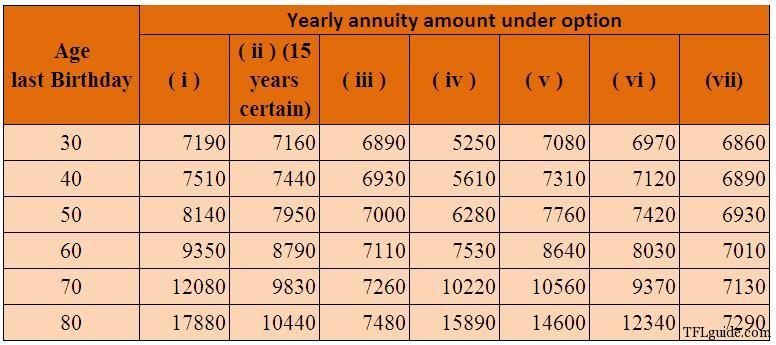
I am presently 49 years and in 30% tax payer slab. My wife is house-wife and do not have any income. Can I buy Jevan Akshay VI with option 7, for amount of 60 L against her name? Should any tax applicable to her? If I purchase on line policy, will we get 7930 (6930 + online 1% rebate) x 60L = 475800 per year. (39650 per month) We have one son of age 16 years. Should he get all amount of 60L after our death.
Please provide your guidence
Thanks in advance
Uday C
Hi Uday,
LIC offers two incentives:
1. If it is online purchase, there is 1% addition, which you are aware of, but have misunderstood it.
The pension amount increases by 1%. LIC says you will get 1% pension extra if you buy pension online. Now note that this 1% is not on total purchase price but on already calculated pension.
Example. If someone buys a pension from LIC OF INDIA buy investing Rs 1 cr and he get Rs 7,50,000 per annum pension,now if someone buys pension online he will get Rs 7,50,000+7500 (1% extra) =Rs 7,57,500.
So the benefit of online vs offline is not as huge as you imagine it to be. Further, note it and understand carefully that, in case of online purchase, you / your family member has to personally co-ordinate with LIC in case of changes. It will happen twice in case of option 7 i.e. death of 1st person and then death of 2nd person.
2. Further, if purchase price is more than 2.5 Lacs, then annuity rates are higher. The chart rate of 6930 is with out this addition. So you are bound to get even higher, because your purchase price is 60Lacs.
However, you have ignored one fact that service tax of 3.09% is applicable on entire purchase price of 60 Lacs.
About your other queries:
Yes, you can buy pension in name of your wife. LIC does NOT deduct any TDS. So it is up to you to manage the taxation. Below permissible limits, the pension will go tax free if your wife does not have any other income. Beyond the limit, it is taxable as per tax slab.
Yes, after death of both parents, your son will get 60Lacs. This however, will be tax free. Service tax paid at time of purchase is NOT returned.
Hope I have answered all your queries. Feel free to ask more.
Sourabh,
In both these investment the return you receive is taxable. However, in a fixed deposit senior citizens are offered an additional interest. Which will be more beneficial will depend on what rate you receive in fixed deposit. In current scenario the interest rate in fixed deposit for senior citizens is good enough. But FD may not give you monthly payout.
So look at the rates offered in FD and then you can compare easily which is yielding you more.
Hi Jitendra,
For a retired individual, who intends to invest a sum of Rs 20lakhs. Which is a better option-
1. Fixed Deposit
2. Immidiate annunity plans like Jeevan Akshay.
For a period of 10 years which would give higer returns, considering the taxation aspect as well.
Dear sir
I’m 33 years right now, I am thinking of investing upto2 lakhs in this plan.
But I’m unsure if this plan will benefit me as a retirement plan. I would like a plan where I get yearly or monthly returns after 20 or 30 years Please advise me if LIC has any particular policies which would suit my requirements. I’m a bit wary of private companies.
Vanessa,
The requirement you have illustrated would have been met by pension plans. But unfortunately they are not an ideal product to invest due to many disadvantages. A wiser approach will be to accumulate corpus for your retirement through mutual funds and when you reach the target goal you can consider options for generating the income you need.
Dear sir, i’m shyam kumar, 31 years old. if i invest 2 lacks in Jeevan Akshay VI, how much amount i will get, if i opt for annuity pay. could you please provide details. please suggest best suitable plan for my age. my annual earnings are 5 LPA
Shyam,
At your age you may not get a very good amount since annuity rates are lower at younger age. The surplus you have should be utilized for your goals effectively for which you will have to identify them first. You should take the help of a financial planner to work on your requirement.
I would like to know that how much amount is required to purchase this pension plan under option VII in order to get annuity Rs 40000/- per month.
Soibam,
For this much annuity you will require approx Rs 70-80 lakh. The actual amount will be based on the age of pension holder as the annuity varies accordingly.
As a thumb rule remember PO MIS gives Rs 700/- per month for Rs.1,00,000 deposit(Rs.8400 per yr). All pension plans are near this only. And you get ur principal on death.
My wife age is 38 yrs, i would like to invest 10 lakhs, how much she gets in 60 years old onwards? Please advice
Ravi,
The amount of pension your spouse will receive will be based on how much the investible surplus grows. Since there is almost 22 year when she reach that age, you need to invest this surplus wisely. On reaching the age you will then have to evaluate options for generating the required income. This can be mixed of variable or fixed instruments based on what options are available during that period.
my father age is 65 and he is not employee and not having income and i am presently doing private job and i have 1lac rupees can this plan benefit for my father
Kiran,
The plan can give a monthly income to your father. The amount of income you can get from the table. But you need to take into consideration that the income will be same throughout and if your father income needs increases in future due to inflation, this may fall short. Look at other alternatives and hen decide.
Open a post office Monthly scheme where he will get Rs 700/- per month with principal back. Another is eAnnuity of SBI where for 10 yrs he will get Rs 1265.15 per month.
I am already Annuity Plan member.Whether this year I have to submit “LIFE CERTIFICATE?”Hope to receive answer. Thanks
Mr.Kamrakar,
You can get this information from the company you have bought annuity.
Sir,I had taken ICICI Pru Life Time Super Pension Plan in the month March 2007
for 10 years term.I had paid 3 premiums of 100000/-each. My policy is in force.
I have to intrest in 67% in annuity.Please advise best annuity scheme with their
max monthly return & which option will be more suitable.My DOB is 05/11/1942
My total investment is 300000/-.
Your guidance will be very helpful to me in investment.
Please send your comments via e-mail ([email protected])
Dear expert,
I am planning to buy a JA IV for my mother.she is 58 years.I want her to get 6000 a month.She dooesnt fall under tax bracket.Can you tell me how much should i invest to get the same.
Khan,
You may need Rs 8-10 lakh for meeting this income need. Actual amount will be based on the option you choose.
I am year old.
I want to invest Rs. 1,00,000/- one time for pension. i am working private secotr and i am not in tax bracket.
Your guidence will be very helpful to me in investment.
Thanking you.
Dear Mr. Singh,
Thanks for the explanation and calculations. I have a question.
Can we combine options on this policy? I would like to combine option 3 and 7. Is it possible?
Dear Mr. Vaibhav,
You cannot buy annuity with two options in the same product.
I am 54 year old.
I want Rs. 20,000 per month. I am not in tax bracket. So how much & where to invest ? which is the best option.
Your guidence will be very helpful to me in investment.
Thanking you.
Mr.Dinesh,
It will be difficult to count any single option for generating this income. The amount of corpus you need to invest should be based on a calculation which take inflation into consideration and a time horizon. It may be easy to identify in the Annuity product (It may be 25-30 lakh for this income) as the amount is same for lifetime cause there is no inflation indexation. But ideally there should be a mix of options with some giving your investment a growth while few earn you a fixed income.
Return on investment in LIC Jeevan Akshay is not attractive as in banks. Particularly for bank employees. As of now I am getting 10.85 % on FD invested by me(9.35 % +1 %[For ex staff]+0.50 % for Senior citizens) with entire amount returnable on maturity( years). In LIC 7.01 %, that is a difference of 3.84 % which works out to nearly Rs 4,480.00 per month on a FD of Rs 14 lakhs)
In my opinion, any investment less than 9 % tax free return is of no use to Senior citizens, particularly for those who do not have any pension scheme.
Dear Mr. Shankar,
Yes Prima Facie FD is yielding you higher returns. But every investment has its own characteristics. FD returns will lower down with fall in interest rates and it is not a lifetime income. Then you will have to consider other options. On other hand Annuity income is lower but is a lifetime income. However, both are taxable and so someone with taxable income will have to consider more options. Its difficult to meet all needs with a single investment avenue. One has to consider combination of options to ensure the longevity risk can be taken care.
An agent explained me that Max Life Partner Plus Insurance Policy is best ever policy, can any one please guide me , that shall I go for it or not. My age is 36 years. Premium is 72,300 per year.
Thanks in advance.
Sram,
The pension plans have not been a wiser option considering the high cost associated and after IRDA changes even companies have not been interested enough. There is no best ever policy and unless you earn a decent returns on your accumulation you won’t be able to accumulate a good corpus. Mutual funds would be more wiser option or accumulating money for your retirement income.
Hi,
I like thank you for details
Could you please clarify the below details
1. What is difference between Fixed deposit and LIC Jeevan Akshay VI – Immediate Annuity Plan if I need monthly payments
2. Which one will get higher returns(Fized deposit with monthly interest and Jeevan Akshay VI – Immediate Annuity Plan)
3. Is the return tax free for Jeevan Akshay VI – Immediate Annuity Plan
4. How long will I get pension with this LIC scheme?
5. After my death how much amount my nominess will get? its same lupsum amount I paid initially?
Thanks in advance for your support 🙂
Hi Neethu,
1. From the point of taxability both are taxable by adding to your income. But a Fixed Deposit is for a specific tenure and you generally don’t have a monthly payout. Annuity is a series of payment , can be monthly also, and have a lifetime option. The other difference is the payout rare which is based on age of person in case of annuities.So at higher age you have higher payout. FD is a fixed interest option for every individual.
2.As i said Annuity returns vary with age. So you need to check rates at your age and then evaluate options.
3.No annuities are taxable.
4.You have multiple options from which you can choose.
5. If you have opted for then nominee will get lumpsum. You have options of annuity to spouse after death or only annuity to you for lifetime.Again the rates will vary as per the options.
I hope this clarifies your doubts.
Hello Sir,
i m 27 year old i want to invest 2,00,000 in jeevan akshay vi online policy
& i want monthy income immidiately after investment
Please confirm how much i return
Best Regards
Shiv kumar
Hi Shiv,
Minimum age for the product is 30 years. Longer the payout for the company lower the returns. So at your age you may have the lowest returns. evaluate other alternatives too where you can also have the growth of your investment also such as SWP in debt mutual funds.
Dear Solanki,
Appreciate if you could advise me on the following
1) I am a NRI looking forward to coming back .I want to get Rs 30,000 monthly pension ,starting 2014 .
Please advise me what are the most risk free schemes I can invest in to get that amount & I am looking for a 3% increase yearly .I understand that Jeevan akshay is good what about other schemes available.
Thanks
Dear Kiron,
Its essential that your money also grows in the long term to sustain the income you desire.For this some amount of equity exposure will be good. You can consider debt mutual funds along with having some amount invested in equity through balanced mutual funds. Alternatively, Monthly income plans in debt funds have some equity exposure and they give periodic dividends. However, the dividends is not assured but there are god schemes who have been consistent.
Regards
Dear Solanki,
I want to get Rs 30,000 pension ,please advise where & how much should I invest to get a monthly pension of this amount with 3% increase every year .I am 56 years of age & non resident Indian planing to return.I intend to get a pension from 2014 .Thanks
sir I want to buy this lic policy my monthly income is 7500 only i want to invest some money and increase my monthly income
I have taken HDFC unit liked pension plan. Maturity Time due , I have to invest in 67% in annuity. Pl advise best annuity scheme with their monthly return. My age is about 63 years. My one time investment is 1,50,000/-.
Dear Mr.Singh,
Apart from Jeevan Akshay, Star Union Daichi life Insurance has comparable returns. You can consider either of these.
I just turned sixty. If I invest Rs. 500000/- in Jeevan Akshay VI what amount will I get if I opt for monthly returns, and when I conk off will the principal be paid to my nominee? Also what are the tax implications???
Thank you,
Adlai
Dear Mr. Adlai,
You can refer to the table from the article which give you rates for different options.
The annuity you will receive will be added to your income and taxed accordingly.
Unfortunately there is no mention about income tax benefits one gets if you purchase Jeevan Akshay VI policy. Suppose I purchase a ploicy of Rs `1 Lakh can take this 1 Lakh as it is for my income tax benefits. That is,. can I get Rs 30000 benefit if I am in 30 % tax bracet ?
Dear Mr. Kalyanaraman,
There is no tax benefit on purchased amount.
Hey Mr. Hemant,
Where did you find the info that SBI Life offers better returns than JA VI?? From what i see from their site is not true. SBI life says for 60 yr old person the annuity for life is 6761 whereas your table shows it as 9350. Do you have any inherent problem with LIC that you almost always write negative about it?
I really don’t understand !!!
When you talk about transfer of your UK fund, you have to go through QROPS system and there is no option of closing the UK pension fund and investing it in anything you like. So, you only have limited options under UK HRMS schemes to transfer.
Not at all attractive…. Why can’t they put the amount in Fixed Deposit and earn at least 9% interest monthly ?
Syd, Bhushan.
I believe transfer of UK pension to LIC can be done through QROPS of UK. Please refer to
So coming abck to Syd’s question, could you provide more information as I also wish to do the same. Thank you.
I am 38 and want to transfer my UK pension fund to LIC’s Jeevan Akshay 6 (option 7). Is this permitted under current rules? For a fund of about 50 lacs, what benefits am I looking at? thank you.
From my understanding, if by transfer you mean – some transfer from UK authorities to LIC, it cant be done. You would have to encash UK pension fund and make lump sum payment to LIC. Please note that pension would be paid in INR only. It will be added to your income, and therefore would be taxable. Pension should be about 3,65,750 pa.
Hi Syd,
To transfer UK pension fund to India, you need a policy that is qualified under QROPS (google it). Now, there are many in the market but when you approach those providers in India, they are simply not aware. I literally had to show them on the internet that it could be done. The only provider that is actively aware and is in fact seeking such funds was ING Life insurance New Best Years policy and they did the transfer for me in under 2 months.
Granted that ING New Best years is quite expensive (its effectively a pension policy with a vesting date and then annuity, charges about 3-4% in AMC, charges etc) but at the time I was looking, I met all the leading insurers who were listed under QROPS and ING was the only one that knew actively how to do it.
I want lic plan to get rs 6000 per month my dob4-4-1970
Hi Mukesh,
Talk to some agent or check LIC site.
My age is 31. I want to invest 30,00,000 in Jeevan Akshay VI immediate annuity (option 4) with increase of 3% every year. According to the new online plan including the higher incentives, If i go for this online policy, how much exactly will i get initially monthly?
Dear sarvan
Going by the annuity table, you will receive approx Rs 1.57 lakh annually.Haven’t considered the rebate of 1% here.
Dear hemant hemant sir has already written the arcticle on this u should read this http://www.tflguide.com/2010/02/exit-strategies-for-mis-sold-insurance-policies.html.for term insurance u can opt for any plan from companies like lic anmol jeevan,amulya jeevan apart from this online term plans are very cheap like icici pru I care,hdfc life click to protect.hope this ll help u.
Hi,
New to this website .. Couple of questions
1. I have LIC Endowment policy which is 5+ years old and premium amount is around 35k which recently i cam to know its not worth of investment. Should i convert this policy to ‘Paid UP’ or surrender it?
2. I have other LIC ULIP policy which is also 5+ years, should I surrender it off?
Planning to buy ‘TERM POLICY” please suggest which is better off.
With Regards,
Hemanth
What many people do not know is that LIC’s first Jeevan Akshay came with an ASSURED return of 12%, the FD rates in those days were around 14-15%, you read it right 15%, if anyone would have taken the argument of FD v/s Annuity then, he would never have put any money in Jeevan Akshay and when the Bank interest rates went to 5% in 2003-2005, it was these people who bought it then, who were smiling all the way to the bank, BTW they are still receiving 12 % today, as it is assured for life with return of purchase price to the nominee.
So an annuity is life time product, PLEASE do not compare it with bank FD’s for eternity, part of you money should be in a product like this, part should be in Bank FD’s and similar products as they also have the liquidity aspect, you should NEVER put all your money in a single product especially one where premature withdrawal is not allowed
Pricing annuity products is a big challenge globally because of the longetivity risk.We have an added problem in India due to absence of long term debt products so reinvestment risk is faced by the Insurance Companies.Further IRDA investment regulations does not give any scope for risk taking by Fund Managers so as to generate higher return.Funds has to be invested in Govt Securities and AA rated instruments.So the Companies can generate say 9% ,out of which expenses of 2% gone.So returns are around 7%.
Even Bank FD can not beat inflation.But the depositors bears the reinvestment risk where as in Annuity the Companies bears it.This is a plus for annuity buyers.By active management through debt instruments,u can save 2%i.e expenses charged by Companies.If you still want better, take the help of a Professional Financial Planner.
You are right Prakash. Its the absence of long maturity debt products and some stringent regulations which force companies to price the products so higher.
So one has to look at mix of products to meet the requirement today.Hopefully the market will evolve and we will see more such products with better rates with SBI Life and private players joining the race and IRDA shifting the annuity burden from LIC to other players.
I believe the author has missed out on mentioning benefits of investing larger amounts. For example, for 40 year old investing 1 Cr under option (iii), annuity rate increases from 6.93% to 7.33%.
Now for those comparing it with FD, please understand that FD has a limited tenure, maximum 10 yrs. Renewal of FD after 10yrs will not be at same rate.
Annuity rate is fixed for life. For someone aged 40, we are looking at possibly 40 years of annuity period. Which other instrument can offer guarantee for 40 yrs ? NONE.
It has its limitations, but does not mean its useless !
Bhushan,
I think in the article nowhere it is mentioned that Annuity is a useless product. It has its advantages and disadvantages.On Rs 1 crore as you are mentioning, the annuity which a 40 year old will receive is surely going to be taxable.Now if he falls in highest tax slab, the post tax returns on 7.33% falls to approx 5% on a simple mathematics.And this annuity is fixed i.e. does not increase with inflation. So after 10 years your annuity income fall short of your requirements which has increased due to inflation.
If annuity has been tax free or there has been products which were inflation indexed then surely the annuity products would have been considerable.But in today’s scenario relying on these fully for your income requirement for life may not be a viable option.As i said in article it can be looked as supplement with other products if you have the needed surplus.
I hope this clears your doubt.
Jitender
I did not quite understand ravi’s calculatuon for mother gettign 3000 pm on 200000 annuity buy?? I have similar situation with mother so thinking to go for?
sunilk – the annuity amount for 100000 is 17880 for a person of 80 years. this is under option (i)
so for 200000 , the annuity will be 17880 x 2 = 36760/- per year
36760 / 12 ~ 3000/- per month
Sunil,
The look at the annuity table in the article where Rs 17880 is the yearly pension for Rs 2 lakh.Now double it for Rs 2 lakh and it will give you the figure what Ravi has calculated.That’s the monthly pension his mother will receive for life and when she dies nothing is returned.
Ravi,
as Jitendra correctly mentioned , in this case you don’t get any amount on the death of your mother unlike the bank FD which returns your principal at maturity. So, financially speaking,to recover the amount of Rs2L invested today in LIC jeevan akshay your mother should be alive till 87 years, (assumed discount rate of 7.5%) –excuse me for being so blunt,please. Maybe better to invest in a good diversified equity MF and do a systematic withdrawal of Rs3000 p.m.
how do you calculate rate of return when you consider the option of no return of purchase price (like option {i})
my mother turns 80 next month. if i buy an annuity with 200000 , then she gets 3000/- per month approx. as long as she lives. if i invest the 200000 in a bank @ 9% , i can provide her with just 1500/- per month.
is this calculation correct ?
Ravi,
Annuities rates are higher when the age is more like your mother.This is due to the fact that companies assumes a longevity and the liability of paying till life is less that age. So at age 80 the rates can beat FD rates due to this reason.Hence, buying an annuity for your mother at this age may prove more beneficial.
Let me first pray for a long life for your mother.
If you want more monthly pension, add some more money and take an FD for 10 years from ICICI bank. They pay 10% so for 3 lacs, you can give your mother Rs2,500/- per month. and the sum remains with you, which on expiry of mother, will be inherited to you as taxfree asset from your mother.
Did you liked this idea?
This is infact a better idea. I like it.
Please note that in option (i), there is no return of capital.
FD has return of capital.
Your calculation of 3000 pm and 1500 pm is correct.
But to calculate yield, you need end date, which in case of option (i) is not available. Unless, you want to assume longevity up to say age 85 or 90.
No, calculation is wrong. 200000 as FD with interest rate of 9% p.a. it should be 15000 / month.
Enjoyed reading and learning about annuity products. But I don’t think these are an attractive option at all. Bank FDs are much better option.
This product needs more flexibility and much better returns in order to get some serious investors. Companies should look at inflation indexed annuities like Pattu mentioned.
Manikaran,
Thanks.
Yes, managing income post retirement is a crucial aspect where you requires active management. Annuities fails in many aspect for meeting retirement needs. But considering that insurance companies have taken a step in coming out with these products i am hoping that the rates will improve going forward.
Nice review jitendra.
Sometimes i wonder that when 10 year govt sec papers are at more than 8% , bank fixed deposit rates are at more than 9% , then how can someone advise a retiree to invest in such kind of product where the rates are in the range of 7%-7.5%. In this high inflated economy , even 9% is not looking enough , how would one survive on 7%.
I totally agree with pattu saying
“Two aspects of personal finance post retirement is clear: It requires active management, likely more than what one did during employment.
Professional help is crucial at this stage.”
This is the worst possible investment option. A bank FD is much better. Current rate is over 9% and on death, the nominee gets the principle amount and can then choose to continue. Interest can be credited Qrtrly / yrly etc. In LIC if you want the principle money back you have to accept a lower rate of return what kind of crap is that??? How can this be an investment option for a retiree?
This is absolutely right, these annuity plans are basically a well marketed joke
The nationalized bank deduct TDS more than 10000rs intrest. The ratio of intrest is 7% also there. If we invest 100000 rs than 8000rs will be deduct automatically. For that i have to fill up 15G .is it effective?.
Good one. If am not wrong we dont have inflation indexed annuities in India with the exception of govt pension where DA offered twice a year is linked to inflation. It may not be a bad idea to annuiatize about 40% of pension (say guarantee food on the table alone for life) and actively invest the rest and then progressively ladder the annuity as one becomes unable to manage money actively.
Two aspects of personal finance post retirement is clear: It requires active management, likely more than what one did during employment.
Professional help is crucial at this stage.
As an emerging area of specialization only a few CFPs would have experience in advising retirees over extended periods of time, say 10 years. Looking for this experience may be important.
Pattu,
Jeevan Akshay offers an option of 3% rise in annuity every year.Star Union Daichi offers 5% rise in annuity every year.But then annuity rates in both these options are too low. So the problem remains that we do not have annuity at present which can be linked to inflation.My guess is that the annuity market is going to improve in the future.
Annuities today are more of supplement where you can have some basic needs covered through them and rest you have to look at other wiser options.Yes you are right in the aspect that today you have to do an active management by combining various options in your retirement.
What is the second option ? can you clarify me?
(Annuity payable for 5, 10, 15 or 20 years certain and thereafter as long as the annuitant is alive.)
Second question is – Is the anuity rate will change in future or it is guranteed?
Manjunath,
In the option annuity is fixed for the term decided. Even if annuitant dies during the term the company will pay keep paying the annuity till the term.Post this period annuity is paid only till annuitant is alive.
Annuities are assured for the life.
It is fixed through out life