
Last Updated on April 21, 2026 by teamtfl
“A budget tells us what we can’t afford, but it doesn’t keep us from buying it.” – William Feather
A client of mine – a senior manager at a large IT company – came for his annual plan review one year. His salary had gone up by 35% in three years. His savings rate had not moved.
He was confused. I was not. I had seen this pattern many times. Income rises. Lifestyle rises with it. Sometimes faster. The gap between earning and saving stays the same or widens, regardless of how much the salary grows.
Einstein is credited with defining insanity as doing the same thing over and over and expecting different results. If your income has grown 50% in five years but your financial position feels the same, something in the pattern needs to change – and it is not usually the income number.
⚡ Quick Answer
Budgeting is the first and most essential step in financial planning. Not because you need to track every rupee forever, but because without a budget you are making financial decisions in a vacuum – without knowing how each spending choice affects your retirement corpus, your children’s education, or your long-term goals. A budget converts vague financial anxiety into specific, solvable problems. It is the foundation everything else is built on.

The Real Problem: Decisions Made in Vacuum
Consider this question: how much money is currently in your savings bank account? Take 30 seconds to answer. Most people will reach for their phone to check. Some will not be able to answer without checking at all.
Now ask a different question: how much should be in your savings bank account? Not how much is there – how much should be there, based on your monthly expenses, your goals, and your upcoming commitments?
If you cannot answer the second question, you are managing money reactively rather than proactively. You are finding out what your financial position is rather than directing it to where it should be.
This is what a budget solves. It creates the difference between asking “how much do I have?” and knowing “how much I should have and why.”
Why Income Growth Alone Does Not Work
In 25 years of advising, I have rarely seen someone who needed a higher income to improve their financial position. The clients who struggled at Rs 1 lakh per month struggled at Rs 2 lakh per month with a different lifestyle, different EMIs, and different spending categories.
The pattern is consistent because the underlying structure is unchanged. Lifestyle expenses expand to fill available income. New income creates new possibilities – a better car, a foreign vacation, a better apartment – and each of these feels like a reasonable choice in isolation. The problem is that no single choice is unreasonable. The aggregate of all of them is.
A budget is the only mechanism that lets you see the aggregate before you commit to it. Without one, you are making each spending decision without knowing its cumulative impact on your long-term financial position.
“Many studies show financial issues are the biggest reason for family disputes. In my practice, the households with the most harmony around money are almost always the ones with a shared budget. Not because they have more money – but because they have fewer surprises.”
– Hemant Beniwal, CFP, CTEP | Founder, RetireWise
The “I Need It Now” Problem
Digital commerce and embedded credit have dramatically lowered the friction on impulsive spending. Buy now pay later, one-click checkout, EMIs on everything from phones to flights – the mechanisms all exist to remove the pause between wanting and buying.
The pause is where rational decision-making lives. A budget creates that pause by design. It forces the question: did I plan for this purchase? If not, what am I giving up to make it?
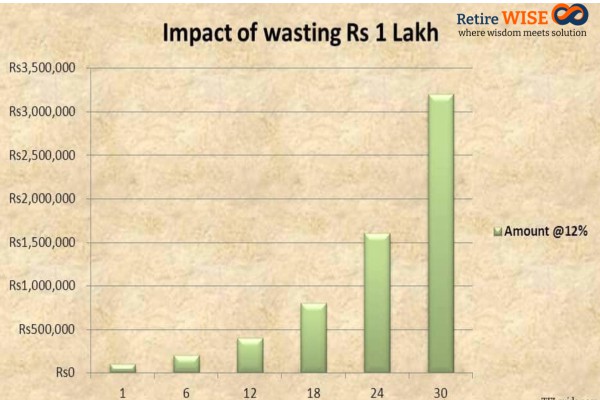
The exchange rate between current spending and retirement corpus is significant. Rs 1 lakh spent unnecessarily today, in a household that has 20 years to retirement and invests at 12% annual returns, costs approximately Rs 9.6 lakh in retirement corpus. That is not a theoretical number – it is the actual compounding cost of the decision.
Is unplanned spending silently eroding your retirement corpus?
A RetireWise retirement plan includes a household cash flow analysis – identifying where money is going and what structural changes would most improve your retirement trajectory.
You Are the CFO of Your Family
Every company – large or small – operates with a budget. Revenue is projected. Expenses are categorised. Variances are analysed. No business that skips this survives for long, because without a budget, you cannot tell whether you are growing or declining until the crisis is already here.
Your family is a financial unit with the same structure: income coming in, expenses going out, goals to fund, obligations to meet. You are the CFO. A CFO who does not know the budget position is not doing their job – regardless of whether the company is profitable or not.
The budget does not have to be complicated. It needs to be honest and it needs to be kept. A simple spreadsheet with 10-12 expense categories, updated monthly, covers most of what a household budget needs to do. The sophistication matters far less than the consistency.
Needs vs Wants: The Framework That Changes Everything
The most practical budgeting principle is the distinction between needs and wants – and the discipline to see it clearly in your own spending.
A car is a need for many families. A car that costs Rs 5 lakh is a need; upgrading to a Rs 15 lakh car for comfort is partly a want. A vacation is a want – whether it is Rs 50,000 within India or Rs 3 lakh abroad is a choice, and the difference is Rs 2.5 lakh that either goes toward retirement or does not.
Before any significant unplanned purchase, try these four questions: Do I need this or want this? Do I need it now or can this wait a week? What savings or investment do I give up to buy this? Did I plan for this in my budget?
These questions do not prevent all discretionary spending. They are not meant to. They create a pause where rational consideration can happen before commitment does.
Read – 7 Financial Planning Mistakes That Are Costing You Retirement Security
Read – 7 Ways to Reduce the Financial Side Effects of Marriage
Frequently Asked Questions
How do I actually start a household budget if I have never made one?
Start with last month. Pull your bank and credit card statements. Categorise every expense into 10-12 buckets: housing (rent/EMI), groceries, utilities, transport, dining/entertainment, children’s education, insurance premiums, investments/SIPs, clothing, health, miscellaneous. Add them up. Compare to your income. The gap between income and all expenses is your actual monthly savings rate – which is often different from what people think it is. Once you can see the full picture, you can decide which categories to reduce. Do this for 3 consecutive months before making any structural changes, so you have a realistic picture rather than a best-month picture.
What percentage of income should I be saving?
There is no universal answer, but here is a practical frame for different life stages. Early career (25-35, no dependents): aim for 30-40% savings rate. Mid-career (35-50, with EMIs and children): 20-30% is realistic. Pre-retirement (50-60): push savings rate as high as possible – children may be less dependent, lifestyle is established, and this is the highest-impact decade for retirement corpus building. If your current savings rate is below 15% and you have retirement goals, that is the most urgent thing to address in your financial plan.
I have a budget but I always overspend in certain categories. How do I fix this?
First, check whether the budget is realistic for those categories. Undershooting your budget is not discipline – it is inaccurate planning that creates the pressure to overspend. If the budget is realistic and you still overspend, the issue is usually discretionary categories – dining, shopping, entertainment. Practical fixes: envelope budgeting for cash categories (take out the planned amount, when it is gone it is gone), a 24-hour rule on any non-essential purchase above a threshold, and monthly budget reviews with your spouse so both partners are accountable to the same numbers.
A budget does not restrict your lifestyle. It reveals the true cost of your choices – and gives you the information to make them deliberately rather than by default. Every hour spent getting your budget right is worth months of investment returns. Not because budgeting generates returns, but because it closes the leaks that quietly undo them.
You cannot invest what you do not save. You cannot save without knowing where your money goes.
Want a retirement plan that starts with your real household cash flow?
RetireWise builds retirement plans on the foundation of honest cash flow analysis – not aspirational budgets that look good on paper.
💬 Your Turn
Do you have a working household budget right now? If yes – what was your biggest insight when you first made one? If no – what is stopping you? Share in the comments.
ALLur writings are like a close freinds advice,who cares us more and pacify the unreasonable fears and doubts. THANK U JI.
God bless you . You are doing service to humanity which is service to God. thanks and best regards.
Dear sir,
Heartly thanks for provide us valueable financial guidance.
Thanks and regards
hariom gurjar
Hi Experts,
I am 30, married since 5 years & with 2 year kid. My goals are buying house (2 years from now), daughter’s study & marriage, pension (needed 25 years from now) & a significant health corpus. I don’t have any loans/debts etc. Could you please comment on & suggest/modify my MF portfolio below ( started since Dec, 2011 ) ? Any advice from your side would be highly appreciated.
Fund Category Monthly Allocation
ICICI Pru Focussed Bluechip Equity Fund Large Cap 3000
ICICI Pru Discovery Fund Midcap & Small cap 3000
IDFC Premier Equity – A (G) Midcap & Small cap 3000
SBI Magnum Emerging Busi (G) Midcap & Small cap 5000
UTI MNC Fund (G) Diversified Equity 2000
Reliance Gold Savings Fund (G) Gold 2000
SBI Magnum FMCG Fund (G) Sectoral-FMCG 3000
Regards,
Rahul
nice one
i wud like to ask one doubt….i hav done SIP in 4 mutual funds for last 9 months…market was steady( no profit), but now its done well…..good profit….should i ignore and continue my SIP, or book profit by keeping it in debt fund and re-enter the fund later. Please tell about this BOOKING profit …to do /not to do. Is it good to close my eyes and just stick to continue SIP like a rock immaterial of the ups and downs….??
Dear Seenu,
SIP is one of the good tool available to benefit from the compounding. The longer is your horizon more will be your wealth creation. If you have allinged these investment with your goals then you should stick to your objective. Monitor your investments periodically for any underperformance.
spendful. com
This proves useful for Budgeting as well as tracking and following your budget.
Budget is useful only when you track your expenses with your budget… This site is very useful for this purpose… use it you will never forget it…
It’s an eye opener.
Hi Nice post.
What’s your view on Aviva Health Secure the latest plan they are offering online?
plz advice.
thanks!
It is vey helpful article who never things to future 🙂 I like it Hemant. Keep Going….
Dear Hemant,
Real Eye opener… Al your articles are simple, clear and precise.
Good work. Keep going.
Regards
Sanooj S
Doha,
Qatar
Thanks Sanooj.
Dear Sir,
Good article. Keep it up!. You are doing a yeoman service to the society, where people have forgotten the basic rules of savings due to so many distractions arising due to the unbridled expenses that are expended by the present day young generations, often many a time exceeding their income limit which eventually push them in to debt trap. As you rightly said if they are able to distinguish between the need and wants, then their life would be pleasant for ever.
DEAR HEMANT
YOU HAVE OPENED MY EYES ON THE DIFFERENCE BETWEEN NEEDS&WANTS.
GREAT ARTICLE
THANK YOU
RAM
True indeed, The future belongs to savers and not spenders. Some times I feel pity for the people who splurge, they do not get bothered because they fall in higher bracket income. But does it justify to blow away the money? God help them.
In today’s technological times, every body is bombarded with some or the other thing via clever advertising. Many people get carried away and spend at the spurn of the movement. But wiser is the person who ignores them and spends only for the badly needed things.
If people start saving more and spending less, they will be a happier lot in future.
Well budgeting plays an important role in deciding where to spend and where to save for the future. If someone is not budgeting then at least he/she must help oneself by spending bare minimum and save. And the savings should be channeled to long term capital protected and growth oriented investments.
It is easy for us to say to hold money in savings bank. But now a days adverstisements motivate us to an extent that we will spend the amount. We do so because we know we have some cushion. So I feel one should start investments into right instruments regularly without posessing more amounts in saving accounts. This way even our money can grow more
Most people have very weak basics and they can not progress unless they get their basics right. There has to be someone to teach basics.
Hey Hemant,
Once again its a marvellous article. Thanks for the same.
Let me share that being wife I do my part of budgeting for sure. I save 70% of my monthly salary but as any middle class woman I get confused when it comes to invest the amount.
With the help of your articles and learning out of it, I have got PPF with 2000 monthly deposit. Also I buy 2 gm gold just to keep it secure for my son’s marriage (which is a responsibilty after 22-25 years).
I still have money which I want to invest through SIP. But market volatility scares me as at present I an not in a position to lose money.
Please advise and correct me where ever you know I am wrong.
Regards,
Nishi
Hi Nishi,
You will not learn investment game without entering the swimming pool – start with small amount in some balanced fund.
@ Srivatsan & Hemant,
Thanks for guidance regarding SIP.
Nobody wants to lose money. All investments carry some amount of risk. Investments are not for risk averse people.
Though I have been reading articles regardig per. finance for the past 10 years I haven’t came across like yours which is very sharp (for those who understand them clearly) and yet very simple. Earlier I used to save for all my goals without target & budget. After Budgeting, one way I found to stick to my investment requirements is to follow the the Rule is ‘Income – Savings = Spending ‘ which gives me confidence that I will acheive all of my goals with less difficulty which could not been done without BUDGETTING.
Hi Murale,
Income – Savings = Spending – this is awesome way to reach our goals. I wrote a short article on this
https://www.retirewise.in/2011/07/budget-for-your-savings-and-not-spending.html
This is very simple rule follow and will take care of the budgeting automatically. I have been following the same all these years and seldom became victim of the “want” syndrome.
Hello Hemant,
Since I joined into this blog, I am regularly reading your articles, those are really impressive and making everyone to think a lot. Thanks for your articles and especially for your time. I really salute for all your notes.
And now I am scarred and I dont know where I stand financially. If I provide you some details about me, will you guide me how should I manage my finance ? if you say yes I will provide you my current financial status ( since, I do not waste your time ).
Hi Deepak,
I will suggest you to go through archives
https://www.retirewise.in/archives
Still if you don’t find your answers – add your query under most relevant article 🙂
or the gentleman can take your paid financial services 😉
This is the most sensible thing to do.
Hi Srivatsan,
Yesterday I got an interesting message – don’t read in context of your comment, even I don’t want NBW from AIDWA.
Lot of Men don’t realize the true worth of their wives………
……………. until a judge decides the Alimony amount. 🙂
Its a very good lesson learnt article.
Hi Sanjay,
Only learning won’t help – you should start making budgets.
Hi Hemant,
I have been preparing budget since last year and i am totally aware of my expenses, investments etc. Budgeting has helped me a lot to plan for different things. I can say that i have a good control over my finances since last year.
Thanks,
Hitesh
Great Hitesh
Dear Hemant
Thanks for your lessons/articles, i am sure it really helps a lot for the readers. I started to read your blog since last feb and surprisingly i managed to save/invest upto 1 lakh in 3 months period, before it took at least 1 yr to reach this amount. Thanks a lot..
and certainly sharing your blog with all my coworkers and and friends …. still continuing..
Thanks for sharing – “gyan bantene se hi badhta hai” 🙂
Every individual on this earth must read and act on this step. Thanks a lot!!!
Thanks Amit – must share it with your friends.
Hi Hemant,
What U hv told is absolutely true… In fact I hv already implemented each & every points that you have mentioned above. Only this way I was able to save 47% of my income every month.
B4 Budgeting it was 0%… So, now I feel in control of my Finances and hv peace of mind…
-Natz
Hi Natz,
Thanks you shared this – hope this will motivate other readers to start budgeting. 47% is awesome number 🙂
Good basic tips which are often overlooked.Control desires and plan to achieve your desire by regular savings.
Well said gee.
Hi Hemant,
You have hit the nail on the head. Any finance journey starts with a BUDGET. As basic as it may seem, most of the households do not have a budget to see which areas are the most expensive ones and if any adjustments can be made to reduce the impact on savings.
Budgettting also helps in future investments and life goals and making informed decisions. Good write up and keep the good stuff coming 🙂
Regards
Lloyd
Hi Lloyd,
People think B for Budget is B for Boring but they miss that it can save them from B for Bankruptcy. 😉
You are B for Best 🙂
Its a Great article.
Thanks Nishaj
Comments are closed.