
Last Updated on April 26, 2026 by teamtfl
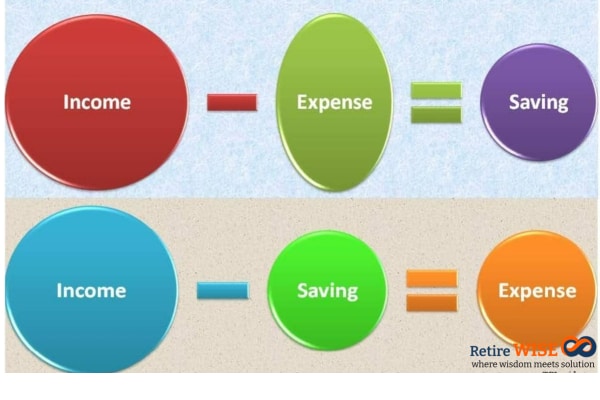
Warren Buffett said it simply: “Do not save what is left after spending. Spend what is left after saving.”
Most people do the opposite. The salary arrives. The EMIs go out. The household expenses follow. The school fees, the fuel, the groceries, the dining out. At the end of the month, whatever remains – if anything – is “savings.”
That is not saving. That is financial leftover management. And it is the reason most people reach 55 with far less than they expected.
Quick Answer
Savings must be a fixed, non-negotiable outflow – like your EMI – not a residual after expenses. The moment your salary arrives, your SIP, PPF, and insurance premium should go out automatically. What remains is your spending budget. This single structural change – paying yourself first – has more impact on long-term wealth than any investment selection decision.
Why expense-first saving always fails
There is a behavioural economics principle called Parkinson’s Law of Money: expenses expand to fill available income. It applies universally – to the person earning Rs.50,000 per month and the person earning Rs.5 lakh per month.
When you save what remains after spending, you are implicitly allowing lifestyle to determine your savings rate. And lifestyle, left to its own devices, always expands. The salary increment becomes a new EMI. The bonus becomes a vacation. The annual raise becomes a better apartment.
None of these are wrong choices in isolation. The problem is that they crowd out savings in a way that is invisible in the moment but catastrophic over 20 years.
A client I met in 2021 – 52 years old, earning Rs.4 lakh per month – had been doing this for 25 years. His income had grown 8x over that period. His savings rate had stayed at roughly 5 to 8% throughout. He had approximately Rs.85 lakh in investable assets. He needed Rs.8 to 10 crore to retire at 58. The gap was not created by bad investments. It was created by 25 years of saving what was left.
How to build a savings-first system
The savings-first approach requires one structural change: automate savings to leave your account before your discretionary spending begins.
Step 1: Calculate your savings target, not your savings residual. Your savings rate should be derived from your goals, not from what remains after expenses. Work backwards: what corpus do you need by retirement age? How much do you need to save monthly to get there? That number is your savings target – not whatever happens to be left.
A rough starting benchmark for wealth creation: save at minimum 20 to 30% of gross income if you are between 30 and 40, and 30 to 40% if you are between 40 and 50. These are not arbitrary – they are derived from the compounding math of reaching a Rs.5 to 10 crore retirement corpus over 15 to 25 years.
Step 2: Automate everything on the 1st or 2nd of the month. EPF goes automatically. Set your SIP to debit on salary credit day. Set PPF transfer as a standing instruction. Set your term and health insurance premiums on auto-pay. By the time you consciously think about money, the savings are already gone.
Step 3: Build your expense budget from what remains. This is the reversal. You are not saving from your income – you are spending from your post-savings income. The psychological shift is significant: lifestyle decisions are now constrained by what is left after commitments, not by what you earn.
Step 4: Build an emergency buffer first. Before aggressive long-term investing, you need 4 to 6 months of household expenses in a liquid fund or savings account. Without this buffer, any unexpected expense – medical, car breakdown, home repair – forces you to redeem long-term investments at possibly the wrong time. The emergency fund is what allows the long-term investments to stay invested.
Step 5: Step up savings with every income increase. When your salary rises by 20%, do not let lifestyle absorb the entire increase. A rule: at minimum 50% of every increment goes to increased SIP or investment. The other 50% can go to improved lifestyle. Done consistently over 10 years, this rule doubles your savings rate while still allowing meaningful lifestyle improvement.
Tax-saving investments – the forced savings trap
For most salaried Indians, the only deliberate savings decision made in the year is in January and February: the tax-saving rush to fill Section 80C. ELSS, PPF, insurance premiums – all purchased under deadline pressure to avoid tax.
This is better than nothing. But it has a structural problem: the motivation is tax avoidance, not goal achievement. The amount invested is determined by the 80C limit (Rs.1.5 lakh per year) rather than by what your retirement corpus calculation requires. And it happens in a rush, at possibly the worst time of year to invest (February is often not a market low).
A better approach: start ELSS SIPs in April. Spread the Rs.1.5 lakh over 12 months. Treat the 80C limit as the floor on savings, not the ceiling. And determine the total savings amount based on your goals, not on the tax code.
Also read: ELSS: Why It Is the Only Tax-Saving Instrument Worth Choosing for Equity Investors
The solid base before you invest for goals
Before any goal-based investing begins, there is a non-negotiable foundation:
- Emergency fund: 4 to 6 months of household expenses in a liquid fund. Non-negotiable.
- Term insurance: Minimum 10x annual income, preferably 15 to 20x if you have significant liabilities. Not negotiable.
- Health insurance: Rs.25 to 50 lakh family floater plus a super top-up plan. The base is not negotiable; the amount can be calibrated.
Only after this foundation is in place does long-term goal investing begin. Investing for retirement while having no emergency fund is building the second floor without a first.
Also read: Are You Ready for Your Retirement? The Corpus Calculation Most Indians Get Wrong
What is your current savings rate as a percentage of gross income?
Most people I ask cannot answer this question immediately. If you do not know your savings rate, you cannot manage it. A financial plan starts with knowing this number – and then building a system to make it non-negotiable.
Frequently asked questions
What is the right savings rate for retirement planning in India?
A general benchmark: 20 to 30% of gross income if you are in your 30s, and 30 to 40% if you are in your 40s. These rates are derived from the compounding math of reaching a Rs.5 to 10 crore retirement corpus over 15 to 25 years at typical equity mutual fund returns. The exact required savings rate depends on your current corpus, target retirement age, expected lifestyle cost, and investment return assumptions. Calculate your specific number rather than relying on general benchmarks.
How do I start saving more when expenses already consume my salary?
The most effective change is structural, not motivational. Set up a SIP that debits on salary credit day – before you see the money in your account. Start small if necessary (even Rs.5,000 per month) and step up by Rs.2,000 to Rs.5,000 every 6 months. Separately, allocate at least 50% of every salary increment to increased savings before lifestyle captures it. The key insight: you will not miss money you never see. Once the system is automated, the behaviour change is automatic.
Should I build an emergency fund before investing for long-term goals?
Yes, always. An emergency fund of 4 to 6 months of household expenses in a liquid fund is the first financial priority – before SIPs, before PPF, before ELSS. Without it, any unexpected expense forces redemption of long-term investments at possibly the wrong time – disrupting compounding and potentially triggering capital gains tax. The emergency fund is what allows long-term investments to stay invested through market corrections and personal setbacks.
What is your current savings rate? And do you save deliberately at the start of the month, or from what is left at the end? Share in the comments – there is no judgement, only useful comparison.
I completely agree with Hemanth, Anil and Manshu. As you said Expenses should be income-savings. Also I decided long back that I never use Credit Card in my life. I don’t need it. I can manage my financial things with 2-3 Debit Cards.
Cheers to Hemanth for educating the people in personal finance!!
Wow. another gudie for better financial planning 🙂
hope I had come across this early in my life. I feel I am too late, though I am 28 now.
Hi! Hemant,
Thanks a lot .
Hi Hemant,
Learn a lot but still its a never ending process. As like SIP i want to know more about liquid funds . How can we identify the good one for our short term investments.
Reagrds,
Hi Munish,
You can go for low expense liquid plus fund from some good amc. There will be not much difference in performance & as your horizon is short term it will not impact much in your final outcome.
Hi Subroto
Read the post Child Future Plan-Complete Guide.
hemant sir,
I want a very good policy for my child with low investment and high return.I have done some study also but all child plan looks similar with one another.
Will you please guide me in finding good child policy and kindly suggest me the name of the policy and from which house
Hi Subroto,
Read this article
https://www.retirewise.in/2011/07/child-future-plan.html
Hello Hemant,
I would like to ask you one question.. I know that you are not a big fan of insurance investment policies and you have put some valid points as well regarding the same n I totally agree with that.. you have also said that PF is the best form of debt investment with 8 %. Recently I have seen some of the financial experts saying that Govt is actually doing charity by keeping PF rate upto 8 % and in the future it might reduce to 5.5 or 6 %. So my question here is that is it the right strategy to invest money in PF as a debt option because LIC has some very good options of debt scheme like Jeevan aastha which has guaranteed returns of 10% and the locking period of just 5 yrs and also gives tax benefit. I know that Jeevan Aastha policy is closed but LIC keeps on coming with such policies time n time again apart from ridiculous Ulip policies.
So why not prefer LIC for debt instead of PF.. would like to hear your views on this Hemant..
Hi Manoj,
I am not sure about the latest updates on Jeevan Aastha – but it was never 10%. It is Rs 100 bonus per 1000 SA (create confusion of 10%) but it is much less than this & definitely lower than 8% CAGR that you are getting in PPF.
Govt is trying to link PPF rates with market rates(gilt) but sooner or later everything is going to be market linked. If they do this in current year – you can expect rate hike. (means more than 8%)
Hello All,
Another excellent article by Hemant.. Proper planning is necessary to achieve the target..Even If we plan for a vacation..one should plan it 1 year before..and the money that you spend for vacation should be the money that is left with you after completing the investment for that particular year of your portfolio.
Hi Manoj,
Have you read this – something related to vacation 😉
https://www.retirewise.in/2011/01/personal-finance-tips.html
Hi Hemant
About five years back I used to do a lot of impulsive shopping.The reason for this was that I used to keep a lot of cash at home and carry my credit cards with me whenever I used to go out.The strategy adopted by me is as follows.
Since I have two ATMs very close to my house I keep very small amount of cash at home as I can withdraw cash from ATMs using my Debit Card as and when needed.
I have locked my Credit Cards and I have not used one for the last five years.
I do not use netbanking or mobilebanking for carrying out any financial transactions.
I never use my debit card for making any payment.It is used only as an ATM card for withdrawing cash.
Hi Anil,
Misuse of credit cards is the biggest reason – why younger generation moving in debt trap. Power of card makes you blind – will never be able to diffrentiate between needs & wants.
Hi Hemant
Thanks! Fortunately, although my daughter has two debit cards, she has not started using them so far.Whenever she wants to buy anything she prefers to take money from me.
I think if you have some moderately hard goals of saving money, it motivates you to keep aside something at the beginning of every month, and build savings.
At the end of say six months or so you have a decent chunk of change, and the mental satisfaction of having achieved something, and that spurs some more good behavior. Keeping these kind of goals have worked for me, and I’ll recommend others to try it out as well.
Hi Manshu and Hemant
I agree.Having clear cut goals in life is the most important motivating factor for saving and investing. Unfortunately, most of the people just want to save and others to save and invest without having well defined goals.Another point about lack of serious saving and investing is ignorance of the impact of inflation on quickly eroding savings. Unless people are made aware of the consequences of ever increasing inflation, people can not be expected to take investing seriously.I think the main focus has to be on inflation in any serious and meaningful investor education.
Hi Manshu,
I agree with you & once you have a good chunk of money – it gives you motivation to be on track. Even if someone starts budgeting expenses – he should start with fixed expenses rather than variable expenses.
Hi Hemant and Manshu
I think good financial behaviour is the key issue here.Whereas a good chunk of money is a motivating force for a person with rational financial behaviour to invest, it spurs a person with irrational financial behaviour to splurge.I think what people need most are lessons in Behavioural Finance.