

Last Updated on April 10, 2026 by Hemant Beniwal
“The investor’s chief problem — and even his worst enemy — is likely to be himself.” — Benjamin Graham
Have you ever wondered why the smartest people you know — engineers, doctors, CXOs — make the dumbest money decisions?
I have. For 25 years, I’ve sat across from highly educated professionals who can run billion-dollar divisions but can’t stop themselves from panic-selling when markets drop 10%. It’s not about intelligence. It’s not about information. It’s about something far more powerful — your own mind working against you.
Think of it like cricket. There are 3 stages to master any sport: training, practice, and the match itself.
Training is boring. Nobody posts Instagram stories from the nets. But as Muhammad Ali once said — “I train so that I can dance well in the boxing ring.” Now ask yourself: you spend years building your career, but how much time have you spent training your investment mind?
Practice feels great. You play with friends, there’s no pressure, you hit glorious cover drives and think you should’ve been a cricketer. But then comes the tournament. Suddenly, with thousands watching and every point counting, those beautiful shots disappear. You become cautious. Tentative. Afraid.
This is exactly what happens with your money. You research stocks calmly on a Sunday morning. You build a strategy. Then the market crashes 800 points on a Monday, and everything you planned goes out the window. Your fingers hover over the “sell” button — not because the fundamentals changed, but because your emotions hijacked the controls.
⚡ Quick Answer
Behavioral finance studies why investors make irrational decisions driven by emotions and cognitive biases — not logic. Understanding your investor personality type (prospect thinker, regret avoider, recency follower, or over-reactor) is the first step to making smarter financial decisions. The real risk in investing isn’t the market — it’s your own behaviour.
What Is Behavioural Finance — And Why Should You Care?
Traditional economics assumes you’re a rational human being. That you weigh all options, calculate probabilities, and make the optimal choice.
Let me be direct. That’s nonsense.
Behavioural finance is the study of how psychology — your fears, your greed, your ego, your past experiences — shapes every financial decision you make. It combines insights from psychology and neuroscience with the reality of how people actually invest, save, and spend.
Financial planning isn’t just about numbers and spreadsheets. It involves decision-making — and every decision passes through the filter of your personality, your childhood relationship with money, and the emotional scratches life has left on your subconscious.
In my experience, the biggest gap in most investors’ knowledge isn’t about which mutual fund to buy. It’s about understanding why they do what they do with money.
The Four Investor Personalities — Which One Are You?
Over 25 years of sitting across the table from investors, I’ve observed that financial behaviour broadly falls into four patterns. See if you recognise yourself.
1. The Prospect Thinker
Imagine this: I tell you a product has an 80% chance of giving 12% returns, but a 20% chance of losing some capital. What do you hear?
If you’re a prospect thinker, you heard only one thing — “20% chance of losing money.” The 80% upside doesn’t exist for you. You want 100% capital protection, or you won’t invest at all.
Suresh (name changed), a 54-year-old VP at an IT company in Pune, kept ₹2.3 crore in bank FDs earning 6% because he couldn’t stomach even a theoretical possibility of loss. After inflation and tax, his money was actually shrinking every year. The “safe” choice was the most dangerous one.
2. The Regret Avoider
These investors don’t want to feel regret — so they simply don’t decide. They won’t sell a stock that’s hit their target because “what if it goes higher?” They won’t sell a losing stock because selling makes the loss real.
They follow the herd. If everyone is buying, they buy. If everyone is panicking, they panic. It feels safer to be wrong with the crowd than right alone.
3. The Recency Follower
Whatever happened last week is the only reality for this investor. If small-caps gave 40% returns last year, small-caps are the greatest thing ever. If they crashed this month, they’re terrible forever.
Recency bias is particularly dangerous in India right now. With lakhs of new Demat accounts opened post-COVID and social media amplifying every market move, this bias has become an epidemic. A 2025 SEBI investor survey found that only about 9.5% of Indian households actively invest in securities despite much higher awareness — the gap is partly driven by recency-biased investors who enter during bull runs and exit after the first correction.
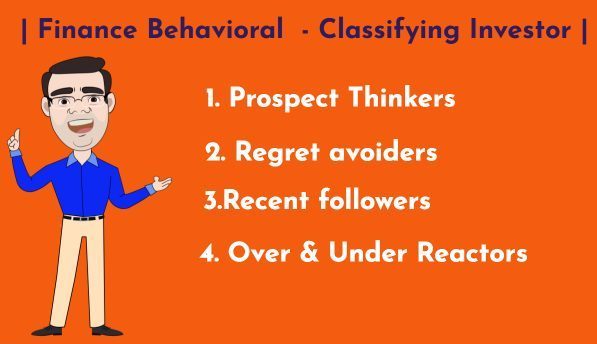
4. The Over-Reactor (and the Under-Reactor)
The overconfident investor exaggerates his own talent and forgets the role of luck and factors beyond his control. Here’s the irony — the more successful someone has been in their career, the more likely they are to be overconfident about investing. Running a business well doesn’t automatically make you a good investor.
Then there’s the pessimist — the under-reactor. This person avoids all financial decisions. Won’t meet an advisor. Won’t open a statement. Won’t even discuss retirement planning with their spouse. Avoidance feels like safety, but it’s just slow financial erosion.
The biggest threat to your portfolio isn’t a market crash. It’s the person looking back at you in the mirror.
Struggling to figure out which investor personality is costing you money?
A structured financial plan built around your behaviour — not just your goals — changes everything.
The 5 Costly Mistakes These Biases Cause
Every investor personality type listed above leads to predictable mistakes. Here are the five I see most often:
- ▶Imagining losses that may never happen — and letting that fear paralyse you into inaction or FD-only portfolios.
- ▶Believing you need expert-level knowledge to invest — so you delay for years while inflation eats your savings.
- ▶Investing without a time horizon — putting retirement money into instruments meant for 2-year goals, or vice versa.
- ▶Confirmation bias on steroids — reading only what supports your existing view, ignoring anything that challenges it. WhatsApp groups and Twitter echo chambers have made this worse than ever.
- ▶Underestimating small, timely decisions — dismissing a ₹10,000/month SIP because it “won’t make a difference,” while that same SIP at 12% CAGR over 20 years builds ₹1 crore.
What Nobody Tells You About Investor Behaviour
Here’s something most financial advisors won’t say out loud — and most articles on behavioural finance completely miss.
Losing ₹1 lakh hurts your brain roughly twice as much as gaining ₹1 lakh makes it happy. This isn’t a personality flaw. It’s how human brains are wired — the pain of loss is literally more intense than the pleasure of an equal gain. Psychologists call this loss aversion, but I call it the reason most Indian families sit on ₹15-20 lakh in savings accounts earning less than inflation.
They think they’re being safe. They’re actually losing money every single year — just slowly enough that it doesn’t feel like a loss.
And here’s the part that should worry you: being financially literate doesn’t protect you from this. Even people who know the maths — who can calculate compound interest in their sleep — make the same emotional mistakes when markets get volatile. Knowledge helps in calm times. In a crash, your amygdala takes over and your spreadsheet becomes useless.
The only thing that actually works? Building a decision-making system before the crisis hits. Pre-decided rules for when to buy, when to sell, when to rebalance — written down, not just in your head. Because in the middle of a 30% market fall, “I’ll stay calm” is not a plan. It’s a wish.
This is why the best investors in the world aren’t the smartest. They’re the most disciplined. They’ve built systems that protect them from their own instincts.
How to Actually Improve Your Financial Behaviour
You may not like this, but here’s the truth — knowing about biases doesn’t automatically fix them. If it did, every psychology professor would be a billionaire investor.
Here’s what actually works, based on what I’ve seen with clients over two decades.
1. Start with humility
Accept that you — yes, you with your IIT degree and corner office — are not immune to irrational behaviour with money. The market doesn’t care about your designation.
2. Build a system, not a strategy
A system is a set of pre-decided rules you follow regardless of how you feel. “I will rebalance my portfolio every April” is a system. “I’ll sell when I feel the market is too high” is a disaster waiting to happen.
3. Diversify — not because textbooks say so
Diversification is the only free lunch in investing. It protects you from your own overconfidence in any single bet.
4. Follow the business, not the ticker
Stop watching stock prices every day. Check the fundamentals every quarter. The price of your investment on a random Tuesday in March tells you nothing about its 10-year trajectory.
5. Minimise noise
Unfollow the market pundits on Twitter. Leave the WhatsApp investment groups. Every piece of noise is a trigger for one of the biases we just discussed.
6. Get a trusted partner
If you aren’t sure of your decisions — and you shouldn’t be, because nobody should be fully confident about the future — work with a fee-only financial planner who has no incentive except your wellbeing.
7. Admit mistakes fast, but learn the right lessons
Selling a stock that fell 50% isn’t always a mistake — sometimes the mistake was buying it. Don’t confuse bad outcomes with bad decisions, or good outcomes with good decisions.
Must Read — WHY Do We Make Financial Mistakes?
Your investments reflect your behaviour, not your intelligence
A financial plan that accounts for your psychology — not just your numbers — is the difference between retiring well and just retiring.
Frequently Asked Questions on Behavioural Finance
What is behavioural finance in simple words?
Behavioural finance is the study of how your emotions, biases, and psychology affect your financial decisions. Instead of assuming investors are always rational, it acknowledges that fear, greed, overconfidence, and herd mentality drive most money decisions — often leading to costly mistakes.
What are the most common behavioural biases in investing?
The five most common biases are: loss aversion (fearing losses more than valuing gains), confirmation bias (seeking information that supports your existing views), recency bias (overweighting recent events), overconfidence bias (overestimating your own ability), and herd mentality (following the crowd). The pain of losing money is felt roughly twice as strongly as equivalent gains — which is why most investors hold losers too long and sell winners too early.
How can I overcome behavioural biases in my investments?
Build a rules-based system for your investments — pre-decide when to buy, sell, and rebalance. Reduce noise by limiting financial news consumption. Diversify to protect against overconfidence. Most importantly, work with a fee-only financial advisor who acts as a behavioural coach, keeping you from your own worst impulses during market volatility.
Is behavioural finance relevant for Indian investors?
Extremely. With the post-COVID explosion in retail Demat accounts, social media-driven investment advice, and WhatsApp forward culture, Indian investors are more exposed to behavioural traps than ever before. A 2025 SEBI survey showed only 9.5% of Indian households actively invest in securities despite high awareness — this participation gap is largely a behavioural problem, not a knowledge one.
You won’t get another life to get this right. The market will test your discipline a hundred times. Your job isn’t to be smarter than the market — it’s to be smarter than your own instincts.
It’s not a Numbers Game… It’s a Mind Game.
💬 Your Turn
Which of the four investor personalities do you see in yourself — prospect thinker, regret avoider, recency follower, or over-reactor? And has it ever cost you money? Share your story in the comments.
Hi Hemant,
i m a B.tech graduate from reputed institute. m working for a PSU( Govt company) as a assistant executive engineer. my annual salary is around 6.25lakhs(Next year it will become 7.25 lakhs). my age is 25. i am very much interested in CFP. i would like to change my profession. is it possible? and can i earn more than what am earning now?.. please guide me in detail..
Thanx…
I don’t see any reason why you want to change your profession. You are not doing bad. Stick to your present job.
hey overall the article was gud but not able to download this guide
Hi Hemant
Very useful article.However, I was not able to download and read the guide.