
Home Blog Page 48

Mis-Selling in Insurance and Financial Products: How to Recognise It and Protect Yourself

3

Have you ever bought a financial product you did not need, did not understand, and only later realised was never meant to serve you?

If yes, you are not alone. And you are not foolish. You were systematically targeted.

⚡ Quick Answer

Mis-selling in financial products happens when an agent or advisor recommends a product based on their commission — not your need. It is the most widespread form of financial fraud in India and it is largely legal. The only protection is understanding what mis-selling looks like, how to recognise it, and what to do when it has happened to you.

The First Blog Post We Ever Wrote Was About This

When we started The Financial Literates in 2008 — which later became RetireWise — the first article we published was about mis-selling. Twelve days after we launched, SEBI banned entry loads on mutual funds, which was the biggest structural driver of mis-selling in the industry at that time.

Fifteen years later, the ban is in place. But mis-selling has not disappeared. It has evolved. New products, new tactics, new channels — but the same fundamental conflict of interest: the person advising you is paid more when you buy what is bad for you.

What Mis-Selling Actually Looks Like

Mis-selling is not always obvious. It rarely involves outright lies. More often, it involves selective truth — sharing only the parts of a product that sound attractive while hiding the parts that are harmful.

Here are the most common patterns I have seen in 25 years:

Insurance disguised as investment: A traditional endowment plan or money-back policy is presented as a savings and investment product. The agent emphasises the “guaranteed” returns and the maturity amount. He does not mention that the IRR (internal rate of return) is typically 4-5% — less than a savings account in real terms. The product looks safe. It is actually very expensive insurance combined with very poor returns.

ULIP presented as pure investment: Unit-linked insurance plans are sold as equity market investments with insurance built in. What the agent rarely explains clearly: in the early years, a significant portion of your premium goes to charges, not investment. The combination of insurance and investment in one product is almost always inferior to buying them separately — a term plan plus a mutual fund.

Mutual fund churn: An agent recommends switching from one mutual fund to another. The reason given is “better performance prospects.” The real reason is a fresh commission. Each switch generates a new entry (if the agent is working outside the direct plan) and restarts the exit load period. Your returns suffer. His income is maintained.

Wrong product for the goal: Recommending a small-cap fund to a 58-year-old pre-retiree. Recommending a 20-year endowment plan to a 25-year-old who needs flexibility. Recommending a fixed deposit to a 35-year-old with a 25-year investment horizon. The product is not fraudulent — but it is wrong for the person and the goal.

Not sure if you have been mis-sold a financial product?

A fee-only advisor reviews your existing products with no conflict of interest — and gives you an honest picture of what to keep, what to exit, and what you actually need.

Talk to a RetireWise Advisor

Why Mis-Selling Persists Despite SEBI and IRDAI

Both SEBI (for mutual funds and investments) and IRDAI (for insurance) have regulations designed to prevent mis-selling. Both have grievance redressal mechanisms. So why does mis-selling remain so widespread?

Three reasons.

Commission structures create incentives that regulations cannot fully override. An insurance agent earns 25-40% of the first-year premium on a traditional plan. A fee-only advisor earns the same flat fee whether you buy a product or not. The incentive structure is completely different. Regulation can mandate disclosures — it cannot change human nature.

Complexity creates information asymmetry. Most financial products — especially insurance — are deliberately complex. The customer cannot easily evaluate what they are buying. They rely on the agent. The agent has a conflict of interest. This asymmetry is the fundamental enabler of mis-selling.

Grievance processes are slow and intimidating. Filing a complaint with IRDAI or going to the Insurance Ombudsman is not something most people do for a Rs 50,000 policy. The friction of complaining keeps most mis-selling invisible.

How to Protect Yourself

Ask the simple question: What is your commission on this product? In India, distributors and agents are required to disclose their commissions if asked. If someone is unwilling to answer, that is your answer.

Calculate the IRR yourself: For any insurance-linked investment product, ask for the full premium schedule and the maturity benefit. Calculate the IRR using a simple spreadsheet or online calculator. If the IRR is below 7%, the product is almost certainly a poor investment regardless of how it has been presented.

Separate insurance from investment: This is the single most important rule. Buy term insurance for pure protection. Buy mutual funds for investment. Never mix them. Insurance is an expense, not an investment — and treating it as one costs you dearly over 20 years.

Verify the product against your goal: Before buying anything, write down: what is this product for? What goal does it serve? What is my investment horizon? Then check if the product’s structure actually matches that answer.

Use a SEBI-registered fee-only advisor: A fee-only advisor charges you for advice — not for products. Their income does not change whether you buy or don’t buy. This completely eliminates the conflict of interest that drives mis-selling. Choosing the right financial advisor is one of the most important financial decisions you will make.

If You Have Already Been Mis-Sold

This happens to good, educated people. Do not be embarrassed — be informed about your options.

For insurance products: Most traditional plans can be made paid-up after 3 years of premiums — meaning you stop paying but the policy continues at a reduced benefit. This is often better than surrendering early (when surrender values are very low) or continuing to throw good money after bad.

For ULIPs: After the 5-year lock-in, evaluate the total returns against what a comparable mutual fund would have delivered. If the gap is significant — and it often is — a structured exit makes sense.

For mutual funds bought through regular plans: Switch to direct plans. The difference in expense ratio (typically 0.5-1%) compounds significantly over a decade. Every 1% in unnecessary costs is 1% compounding against you every year.

Frequently Asked Questions on Mis-Selling

What is the difference between mis-selling and fraud in financial products?

Fraud involves outright lies — fake policies, forged signatures, non-existent products. Mis-selling is subtler and largely legal: it means recommending a product that does not suit your needs, often through selective disclosure or deliberate omission of important information. Mis-selling is far more widespread than fraud because it operates within the law, driven by commission incentives. Both cause financial harm — but mis-selling is harder to prove and challenge.

How do I know if I have been mis-sold an insurance policy?

Calculate the IRR of your policy. Take your annual premium, the policy term, and the maturity benefit. If the internal rate of return is below 6-7%, you have almost certainly been mis-sold an investment product disguised as insurance. Other signals: the agent emphasised returns rather than cover, you do not know what the life cover amount is, or the policy was described primarily as a “savings” or “investment” plan.

Can I get a refund if I was mis-sold a financial product in India?

For insurance, IRDAI’s free look period (15-30 days from policy receipt) allows cancellation with full refund. After that, surrender values apply, which are very low in early years. For mis-selling complaints beyond the free-look period, you can approach the Insurance Ombudsman (for insurance) or SEBI SCORES portal (for securities). Outcomes vary, but documented complaints have resulted in refunds in clear mis-selling cases.

Are banks more trustworthy than insurance agents for financial advice?

Not necessarily. Banks earn significant commissions selling insurance and investment products — particularly bancassurance products where the bank is a corporate agent for an insurer. A bank relationship manager has the same structural conflict of interest as an independent agent. The trustworthiness of advice depends entirely on the incentive structure, not the channel. A fee-only SEBI-registered advisor — who earns nothing from product sales — is structurally more aligned with your interests than any commission-based channel.

The financial services industry is not evil. But it is not neutral either. When someone’s income depends on what you buy, their advice will always be shaped by that incentive — consciously or not. The only way to get truly unbiased advice is to pay for it directly.

Understanding people before numbers. That is what financial planning should look like — and it is what mis-selling never delivers.

💬 Your Turn

Have you ever discovered you were mis-sold a financial product? What was it, and how did you find out? Your experience shared here could save someone else from making the same mistake.


Retirement Planning Guide for Indians: Everything You Need to Know (2026)

A client came to me at 58. He had spent 30 years working hard, earning well, and investing reasonably. When we sat down and did the actual calculation, something surprising emerged. Not a crisis – he was not financially ruined. But the retirement he had imagined and the retirement his numbers could actually fund were two different things. The gap was about Rs. 60,000 per month in sustainable withdrawal.

He had three years to close it. We did. But it required significant changes to his allocation, his savings rate for those final years, and his timeline expectations. If he had come at 53 instead of 58, the changes would have been minor. At 58, they were uncomfortable.

This is the central problem with retirement planning in India. Not that people do not care. Not that they do not invest. It is that most people have never done the actual calculation – what corpus do I need, what will my money sustainably generate, and am I on track?

This guide answers all of it.

Quick Answer

Retirement planning is the process of calculating how much corpus you need to sustain your lifestyle for 25 to 30 years post-retirement, building that corpus systematically during your working years, and then managing withdrawals so the money lasts. The three numbers you need: monthly expenses at retirement (inflation-adjusted), safe withdrawal rate (typically 4 to 5% annually), and years to retirement. Everything else is a detail. Most Indian investors focus entirely on corpus accumulation and never plan the withdrawal phase. Both matter equally.

Retirement Planning Guide India 2026

Table of Contents

Watch: My Doordarshan Interview on Retirement Planning

In October 2010, I was invited to Mumbai to appear on the Money Plant Show – a nationwide financial literacy drive by MCX-SX and Doordarshan. The episode was titled “Financial Planning: Retirement” and was telecast on DD1 (Doordarshan National) on 16th October 2010.

I was a bit nervous going in. The earlier guests had included Mr. G. N. Bajpai (Former Chairman, SEBI), Mr. A. P. Kurian (Chairman, AMFI), and other luminaries. The anchor fired questions without pause. I had conjunctivitis that day and could barely keep my eyes open under the studio lights. But everything went well – recorded in one take, no cuts.

The questions covered everything from why retirement is a challenge, to investment avenues, to how retirees can reduce tax. I am sharing all three parts here – they hold up well fifteen years later because the fundamentals have not changed.

Part 1 – What makes retirement a challenge, and who should plan for it

Part 2 – Investment avenues for retirement, asset allocation, and finding a good advisor

Part 3 – Senior citizen tax benefits, achieving post-retirement goals, and protecting against mis-selling

The full written guide below covers these topics in depth with 2026 numbers and updated rules. Watch the videos for the practitioner perspective, then read the guide for the current framework.

Why Retirement Has Become Harder Than It Used to Be

The retirement challenge has intensified over the last two decades for reasons that have nothing to do with market performance. Four structural shifts have made it harder.

Nuclear families have replaced joint families as the default. The traditional support structure where multiple earning members in a joint family collectively supported retired parents has weakened. Most urban Indian retirees today are financially on their own. This is not a criticism – it is a reality that changes the corpus calculation significantly.

Medical costs are inflating at 12 to 14% annually. A procedure that cost Rs. 3 lakh in 2010 can easily cost Rs. 15 to 18 lakh today. Health insurance helps, but it does not cover everything, and premiums rise steeply after 60. A retirement plan without a dedicated healthcare reserve is incomplete.

Longevity has increased substantially. A 60-year-old Indian today should plan for a retirement of at least 25 to 30 years. Many will live longer. This means a corpus that once seemed sufficient for 15 years now needs to last twice as long. The longer the retirement, the more inflation and sequence-of-returns risk matter.

Pension coverage is thin for the private sector. Unlike government employees who receive defined pension benefits, the vast majority of private sector workers retire with a lump sum from EPF and whatever personal investments they have managed to build. There is no guaranteed income floor. Every rupee of retirement income must come from the corpus they have built.

How to Calculate Your Retirement Corpus

Most people guess at a round number. “I need Rs. 2 crore.” Or “Rs. 5 crore should be enough.” These numbers have no basis without a calculation. Here is the framework.

Step 1: Establish your current monthly expenses. Not income – expenses. What does your household actually spend each month? Include rent or EMI, food, utilities, transport, children’s education, insurance premiums, lifestyle expenses, and discretionary spending. Be honest. Most people underestimate by 20 to 30%.

Step 2: Adjust for retirement lifestyle. Some expenses disappear at retirement (work commute, children’s education, EPF/PPF contributions). Others increase (healthcare, leisure, household help). A reasonable assumption for most Indian executives is that retirement expenses will be 70 to 80% of current expenses in the first decade, and may increase in real terms as healthcare needs grow.

Step 3: Inflate to your retirement date. Use 6% general inflation. If your current monthly expense is Rs. 1.5 lakh and you retire in 15 years, the same lifestyle will cost approximately Rs. 3.6 lakh per month at retirement. This is not optional arithmetic. Every year you skip this step, you underestimate your corpus requirement.

Step 4: Calculate the corpus using the withdrawal rate method. At a 4% safe annual withdrawal rate, multiply your annual retirement expense by 25. Annual retirement expense of Rs. 43 lakh (Rs. 3.6 lakh monthly) requires a corpus of approximately Rs. 10.75 crore. This sounds large. That is because most people have not done this calculation and would be surprised by the real number.

Step 5: Subtract expected income streams. EPF corpus at retirement. PPF balance. Any pension or annuity income. NPS corpus converted to annuity. Rental income. The net gap is what you need to build through systematic investing.

“Is Rs. 1 crore enough to retire? Almost certainly not for most Indian executives. Is Rs. 5 crore enough? It depends entirely on your lifestyle, your retirement age, and how long you live. There is no right number without your specific calculation. Do the arithmetic.”

Building the Corpus: Instruments and Strategy

Equity is not optional for long horizons. A 40-year-old with a 20-year accumulation horizon needs equity to beat inflation and generate real growth. Parking everything in FDs and debt instruments during the accumulation phase is not conservative – it is a slow guarantee of falling short.

The SIP increment rule. Every time your income increases, at least 50% of the increment should go to SIP enhancement. Most people increase lifestyle with every increment and maintain the same SIP. This is the single most common reason people arrive near retirement with insufficient corpus despite decades of investing.

EPF is the foundation, not the whole structure. EPF at 8.25% current interest rate, compounding tax-free, is one of the best guaranteed instruments available. But for most private sector executives, EPF alone will fund only 20 to 30% of the retirement corpus needed. Do not treat EPF as your retirement plan. Treat it as your retirement foundation.

Asset allocation must shift as you approach retirement. Begin shifting 1 to 2% from equity to debt annually from age 50, reaching roughly 40 to 50% equity by retirement. Market corrections 3 to 5 years before your retirement date can permanently impair a corpus if it is heavily equity-weighted with no buffer.

NPS as a tax-efficient retirement vehicle. The National Pension System offers additional Section 80CCD(1B) deduction of Rs. 50,000 beyond the 80C limit. The mandatory 40% annuity at retirement creates a guaranteed income floor – a feature, not a drawback, for retirement planning.

Don’t Mix Insurance and Investment

Insurance plans marketed as retirement products – endowment plans, money-back policies, and ULIPs – are consistently the most expensive and least efficient way to build retirement corpus. The IRR on most traditional insurance products is 4 to 6%. Buy term insurance for life cover. Build retirement corpus through equity mutual funds and NPS. Keep them completely separate.

Want to See Our Retirement Planning Services?

RetireWise works with senior executives aged 45 to 60 to build retirement plans that cover both accumulation and withdrawal. See how we work and what our planning process covers.

See Our Services

The Part Nobody Plans: Withdrawal Strategy

This is where most Indian retirement planning ends prematurely. People spend years thinking about building a corpus and almost no time thinking about how to convert that corpus into income that lasts 25 to 30 years.

The 4% rule and its Indian context. The widely cited 4% safe withdrawal rate suggests withdrawing 4% of your initial corpus annually (with inflation adjustment) gives a 95%+ probability of the corpus lasting 30 years. In an Indian context with higher inflation (6 to 7% vs 2 to 3% in the US), a more conservative 3.5 to 4% withdrawal rate is prudent.

The bucket strategy for retirement income. Divide the retirement corpus into three buckets. Bucket 1 holds 1 to 2 years of expenses in liquid form. Bucket 2 holds 3 to 7 years of expenses in moderate-risk instruments like debt mutual funds, FDs, SCSS. Bucket 3 holds the long-term growth component in equity mutual funds. Each year, refill Bucket 1 from Bucket 2, and refill Bucket 2 from Bucket 3 when equity has performed. This insulates you from sequence-of-returns risk.

SWP vs dividend options. An SWP from an equity or hybrid mutual fund gives you a regular monthly withdrawal while the remaining corpus stays invested. This is more tax-efficient than a dividend option. Dividend income is taxed at slab rate since Budget 2020. SWP from growth option taxes only the appreciation portion as LTCG at redemption.

Healthcare as a separate reserve. Maintain a separate healthcare reserve of Rs. 20 to 30 lakh for a couple, growing with medical inflation, in liquid instruments. A major health event drawing on the main corpus during a market downturn is one of the most damaging scenarios in retirement planning.

Something Worth Noticing

Most retirement planning conversations in India are entirely about corpus accumulation. Very few are about withdrawal – how to structure drawdown, what to do if markets fall in year 2 of retirement, how to ensure the money lasts 30 years. The withdrawal strategy is at least as important as the accumulation strategy. For most retirees, it is more important. Plan both.

Retirement Planning by Age

In your 30s: Build the foundation. Start a SIP and do not stop it. An Rs. 10,000 monthly SIP at 12% for 30 years reaches approximately Rs. 3.5 crore. The same SIP started 10 years later reaches only Rs. 1 crore. Get term insurance and health insurance. Do not withdraw EPF when changing jobs.

In your 40s: Accelerate and calculate. Do the corpus arithmetic. Maximize SIP contributions with every increment. Review asset allocation. Consider NPS if you have not started. This is also the decade where mis-sold insurance products can quietly drain a significant portion of potential retirement savings.

In your 50s: Protect and position. Begin the gradual shift from equity to debt. Fund your emergency reserve and healthcare reserve. Map the final gap between projected corpus and requirement. Review nominations and will status. Plan the transition from accumulation to withdrawal mode.

At and after retirement: Manage the drawdown. Implement the bucket strategy. Set up SWP. Review the portfolio annually to rebalance and refill buckets. Ensure health insurance is in force. Review the plan with an advisor annually.

The 5 Retirement Planning Mistakes I See Most Often

1. Treating EPF as the entire retirement plan. EPF will cover 20 to 30% of the corpus needed. The rest requires active investing over a long period.

2. Withdrawing EPF on every job change. Each withdrawal destroys years of tax-free compounding at 8.25%. Transfer, never withdraw.

3. No healthcare reserve. A single major hospitalization can draw Rs. 10 to 20 lakh from a retirement corpus. A separate reserve prevents this.

4. Buying insurance products instead of investment products. The IRR on most endowment and money-back plans is 4 to 6%. Equity mutual funds have historically delivered 12 to 14% over 15 or more year periods. That compounding difference is enormous over 20 years.

5. Never calculating the actual corpus requirement. Investing without knowing the target is not planning. It is saving. Do the arithmetic.

Key Benefits Available to Senior Citizens in India (2026)

Senior Citizens Savings Scheme (SCSS). Currently offering 8.2% per annum with quarterly interest payouts. Maximum deposit Rs. 30 lakh. Government-backed. The best guaranteed income instrument for retirees.

Higher FD rates. Banks offer 0.25 to 0.5% higher interest for senior citizens. Several banks offering 7.75 to 8% for specific tenures as of 2026.

Higher TDS threshold. Senior citizens can receive up to Rs. 50,000 in FD interest annually without TDS (vs Rs. 40,000 for general category). Submit Form 15H if annual tax liability is nil.

Enhanced Section 80D deduction. Up to Rs. 50,000 in medical insurance premium deduction, vs Rs. 25,000 for non-seniors.

No advance tax obligation. Senior citizens above 60 without business income are exempt from paying advance tax.

Want to Know Exactly Where You Stand?

The calculation in this guide is the framework. Your numbers – your expenses, your corpus, your timeline, your existing investments – are what determine whether you are on track. If you are 45 to 60 and want a clear answer to “will my retirement money last?”, let us work through it together.

Book a Free 30-Min Call

Frequently Asked Questions

How much corpus do I need to retire in India?
The formula is: (monthly retirement expenses x 12) divided by your safe withdrawal rate. At a 4% withdrawal rate, annual expenses of Rs. 30 lakh require a corpus of Rs. 7.5 crore. The key variable is your actual expense level at retirement, inflated to your retirement date.

What is the best investment for retirement in India?
During accumulation: equity mutual funds via SIP, NPS for additional tax benefit, EPF as a guaranteed debt anchor. During withdrawal: SCSS for guaranteed income, SWP from balanced or hybrid mutual funds, short-duration debt funds for the near-term bucket, and maintained equity exposure (30 to 40%) for purchasing power protection.

Is NPS good for retirement planning?
Yes. NPS offers an additional Rs. 50,000 deduction under Section 80CCD(1B). The 40% mandatory annuity at retirement creates a guaranteed income floor. The lock-in until 60 is actually appropriate for retirement money. For most private sector employees, NPS is a valuable supplement to EPF and SIPs.

At what age should I start retirement planning?
As early as possible. The difference between starting at 30 and starting at 40 is roughly 3 times the final corpus due to compounding. At 50, urgency is real but options still exist. At 58, options narrow significantly.

How do I ensure my retirement corpus lasts 30 years?
Maintain a safe withdrawal rate (3.5 to 4%), keep some equity in the portfolio even in retirement to protect against inflation, and use the bucket strategy to avoid forced selling during downturns.

What happens to my EPF after retirement?
EPF can be withdrawn entirely after retirement. The withdrawal is tax-free if you have completed 5 or more years of continuous service. After 58, you can keep the EPF corpus invested earning 8.25% for up to 3 years before withdrawing.

Before You Go

Related reading: How to Set SMART Financial Goals and Importance of Financial Planning in Your Life.

What is the single retirement planning question you have been putting off answering? Share in the comments – we read every one.

One question for you: Have you done the actual corpus calculation for your retirement, or are you working toward a number you arrived at intuitively?

What Is Equity? The Right Way to Think About It (And Why Most Indians Get It Wrong)

“In the short run, the market is a voting machine. In the long run, it is a weighing machine.” – Benjamin Graham

Here is a paradox that most Indian investors live with: they know equities have given the best returns of any asset class over any 15-20 year period. They have seen the charts. They have heard the stories. And yet, most of them have not made serious money in equity markets.

This is not because the markets failed them. It is because of how they think about equity.

⚡ Quick Answer

Equity means ownership in a business. When you buy a share or invest in an equity mutual fund, you become a part-owner of that company’s earnings, assets, and growth. Equity delivers superior long-term returns because businesses grow earnings over time. But those returns require patience – the same patience you would give your own business. Most investors fail in equity not because markets are risky, but because they apply short-term thinking to a long-term asset class.

Equity as a long-term asset - why time in market beats timing the market

Equity Is Ownership, Not a Price Movement

This is the most important reframe. When you buy 10 shares of a company that has 1,000 shares outstanding, you own 1% of that business. Everything that business earns, everything it owns, and every rupee it retains to grow – 1% of that is yours.

Now ask yourself: if someone asked you to become a 1% partner in a profitable business, how long would you commit before deciding whether it was working? One week? One month? Most people would say at least 2-3 years, probably 5. You would not judge a legitimate business by what happened in the first few quarters.

Yet when the same investment is packaged as a share or a mutual fund unit, investors check the price daily. They panic if it falls 15% in three months. They exit at the worst moments – market bottoms – convinced that something is fundamentally broken.

Nothing is broken. Businesses fluctuate in short-term price without changing in fundamental value. The investor who understands this owns equity differently from one who does not.

The Farming Principle

Equity follows the logic of farming. You sow a seed. You water it. You wait with patience. The harvest comes – but not on your timeline, on the plant’s timeline.

We keep gold for generations. Grandparents start fixed deposits for grandchildren. But nobody says “I’m starting an equity SIP today so my grandchildren will have a significant corpus in 30 years.” That is precisely what they should be saying. The same family that buys physical gold (which underperforms equity over every long period) will not invest in HDFC Bank or Infosys shares for their grandchildren’s education – even though the businesses they would be owning are far more likely to compound wealth over 30 years than any yellow metal.

The question is not whether equity will work. The question is whether you will stay invested long enough for it to work.

RetireWise builds retirement plans that use equity as the primary long-term wealth-building tool – with the right allocation, the right funds, and the right behavioural framework to stay invested through every correction.

See How RetireWise Uses Equity in Your Plan

Speculation vs. Fundamental Investing

Equity delivers two types of return. Speculative return comes from short-term price movement – buying at Rs 100 and selling at Rs 120 within weeks. Fundamental return comes from business growth – the company earning more, expanding, and retaining earnings that compound into share price over years.

The vast majority of Indian retail equity investors are seeking speculative returns. They time the market instead of giving time to the market. This is the primary reason the average Indian equity investor consistently underperforms the index. The Nifty delivers 12-13% CAGR over long periods. The average equity mutual fund investor in India has earned significantly less – because they buy after rallies and sell after corrections, systematically reversing the buy-low-sell-high principle.

Fundamental investing requires a different mental posture. You buy businesses you understand. You hold them long enough for the underlying earnings growth to translate into price appreciation. You ignore short-term price movements as noise. You do not check the portfolio daily.

What Risk Actually Means in Equity

Most Indians say equity is risky. They are not wrong – but they mean the wrong kind of risk. In the short run, equity is volatile. A portfolio of Rs 10 lakh can become Rs 7 lakh in a year. That volatility is real and uncomfortable.

But the real risk in a 20-year retirement plan is not short-term volatility. The real risk is the erosion of purchasing power over time. A fixed deposit earning 6.5% when inflation is running at 6% is delivering near-zero real return. An endowment plan returning 4-5% is delivering negative real return. These instruments feel safe because the rupee balance does not fall – but the purchasing power of that corpus is being silently destroyed year by year.

Equity, over any 15-year rolling period in Indian market history, has delivered positive real returns – returns that beat inflation. This is the correct long-term risk comparison: not “will my portfolio value fall this year” but “will I have enough purchasing power in 25 years to fund the retirement I want.”

Why People Don’t Make Money in Equity

The Nifty 50 has delivered approximately 12-13% CAGR over 20-year periods. Yet the average equity investor in India has earned considerably less. The gap is explained entirely by behaviour: greed near market peaks, fear near market bottoms, and the resulting pattern of buying high and selling low.

The investors who did make money in equity over the last 20 years are not the ones who correctly predicted every correction. They are the ones who stayed invested through every correction – the March 2020 crash, the 2018 NBFC crisis, the 2015-16 correction, the 2011 fall, the 2008 global crisis.

Each of those events felt like the world was ending when it was happening. Each of them was a buying opportunity in hindsight. The investors who understood that equity means ownership in businesses that would eventually recover and grow – those investors are wealthy today.

Read: Should You Invest in LIC IPO and Other IPOs?

Equity works. The Indian economy has grown, is growing, and will grow. The businesses in the Nifty and Sensex will earn more in 2035 than they do today. The investor who owns them patiently will share in that growth. The investor who trades them nervously will not.

Time in the market. Not timing the market.

Is your equity allocation sized correctly for your goals and timeline?

RetireWise builds goal-linked portfolios where equity exposure is calibrated to your specific retirement timeline, risk capacity, and required return – not a generic allocation.

Book a Free 30-Min Call

Your Turn

What was the moment that shifted your understanding of equity – from “risky” to “long-term ownership”? Or if you are still hesitant, what specific fear is holding you back? Share in the comments.

Sensex PE Ratio: Is the Stock Market Overvalued in 2026?

Your WhatsApp group has opinions. Your broker has a “buy call.” The financial channel has six experts, each with a different view.

Here is what almost none of them will tell you: there is one number that has historically been a better guide to market valuation than any of them. It is called the PE ratio. And right now, with the Sensex having corrected from its 2024 highs, it is the right moment to understand what it actually means.

Warren Buffett said it best: “The stock market is filled with people who know the price of everything but the value of nothing.” PE ratio is the tool that bridges price and value. Let me show you exactly how it works — and more importantly, how to use it without making the classic mistake.

⚡ Quick Answer

The Sensex PE ratio in early 2026 is approximately 20–22, down from a peak of 36.2 in February 2021. The 15-year historical median (2011–2026) is approximately 22.5. A PE below 18 has historically signalled undervaluation. Above 28–30 signals stretched valuation. At 20–22, the market is near fair value — not a screaming buy, not a reason to stop SIPs. PE is a context tool, not a timing signal.

Sensex PE ratio — the investor mistake of buying high and selling low

Understanding the Difference Between Price and Value

Would you pay Rs 1,000 for a Reynolds pen? No. Would you pay Re 1 for the same pen? Probably yes. The pen didn’t change — only the price did. Your decision was based not on the price but on the value you derive from it.

Investments work exactly the same way. When Sensex is at 75,000, is it expensive? When it was at 21,000, was it cheap? Price alone tells you nothing. You need the earnings behind that price to know whether you are buying value or overpaying.

That is precisely what PE ratio measures.

How PE Ratio Is Calculated — Starting Simple

PE stands for Price to Earnings. The formula:

PE = Market Price per Share ÷ Earnings per Share (EPS)

Think of it this way: you invest Rs 100 in an FD at 8% interest. You earn Rs 8 per year. To earn Re 1, you need to invest Rs 12.5. So the “PE” of that FD is 12.5. At 12% interest, PE drops to 8.3. Lower PE means more earnings for the same investment.

Stocks work identically. If a company’s share is priced at Rs 1,200 and it earned Rs 100 per share in the last 12 months, its PE is 12. Investors are paying Rs 12 to earn Re 1 per year. At a PE of 25 on those same earnings, the share is at Rs 2,500 — investors are paying more, expecting the earnings to grow significantly.

How Sensex PE Is Calculated

Sensex represents 30 large companies — Reliance, Infosys, TCS, HDFC Bank, and others. Each has its own EPS. Sensex EPS is the weighted average of all 30 companies’ earnings, weighted by their share in the index.

Sensex PE = Sensex Level ÷ Weighted EPS of all 30 companies

When Sensex is at around 75,000 and the combined weighted EPS is approximately 3,400, the PE is around 22. When Sensex was at 21,000 in 2013 with an EPS of roughly 1,100, the PE was also around 19. Same PE — very different Sensex levels — because earnings had grown enormously between those two points.

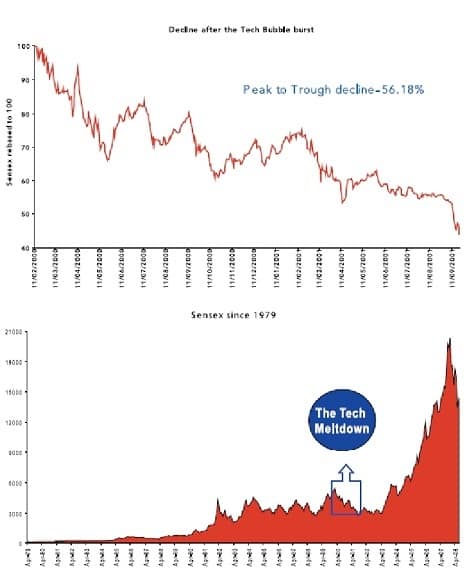
This is what most people miss: Sensex going from 21,000 to 75,000 is not the market becoming 3.5 times more expensive. It is largely because corporate earnings have grown 3x over that period. The combined EPS of Sensex companies was around 80 in 1992, around 860 in 2010, and approximately 3,200–3,400 today. Sensex growth tracks earnings growth over long horizons.

💡 The real engine of Sensex returns: India’s corporate earnings have compounded steadily since 1991. PE tells you whether you are paying a fair price for that compounding — or paying tomorrow’s price today.

Historical Sensex PE — 35 Years of Key Milestones

The same pattern repeats across every major market cycle: extreme low PE has preceded strong recoveries. Extreme high PE has preceded painful corrections.

Period / Event Sensex Level Approx. PE What Followed
1994 — Harshad Mehta aftermath ~4,500 ~50 Multi-year correction
Jan 2002 — post dot-com crash ~3,200 ~13 5-year bull run to 21,000
Jan 2008 — pre-global crisis peak ~21,000 ~28–29 Crashed to 8,000 by March 2009
March 2009 — global financial crisis low ~8,000 ~10–11 Doubled to 21,000 by 2010
March 2020 — COVID crash ~25,000 ~15.7 Doubled in 18 months to 60,000+
Feb 2021 — post-COVID rally peak ~50,000 36.2 (all-time high) Gradual normalisation, consolidation
2024 high — pre-correction ~85,000 ~24–26 Correction in 2025–26 on global fears
April 2026 — current ~73,000–76,000 ~20–22 Near fair value. 15-yr median: 22.5

Sources: BSE India, CEIC Data, Screener.in, Trendonify. PE figures are trailing 12-month. For live current PE, check Screener.in/Sensex.

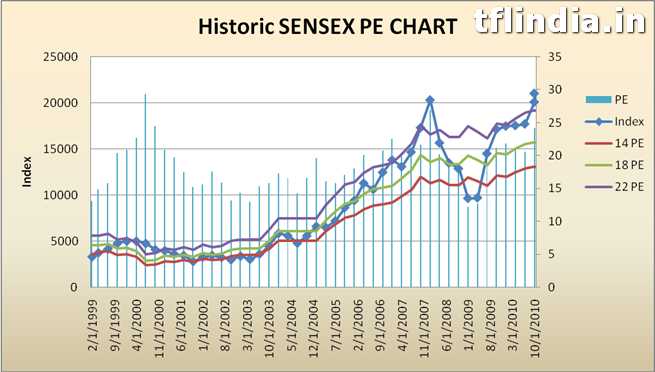
Sensex PE Ratio historical chart — India

The chart above covers 1999–2010 — containing the dot-com peak (PE 30 in 2000), the recovery lows (PE 13 in 2002), the bull market (PE 29 in 2007), and the crisis opportunity most investors missed (PE 10 in early 2009). Average PE through this period was close to 18.

One important update: since 2011 the median has risen to approximately 22.5, reflecting a structurally higher growth expectation in a faster-expanding India. The old “18 is fair value” benchmark needs updating. Today, 20–22 is the new fair value zone.

Forward PE — Useful, but Frequently Misused

Trailing PE uses the last 12 months of actual earnings. Forward PE uses analyst estimates of the next 12 months. If analysts expect Sensex EPS to grow 15% — from 3,400 to 3,910 — and Sensex is at 75,000, the forward PE is 75,000 ÷ 3,910 = 19.2. Cheaper-looking, more reassuring.

The problem: in bull markets, earnings estimates are consistently optimistic. The Feb 2021 peak at PE 36.2 was partly justified by analysts projecting rapid post-COVID recovery. Some recovery came — but not at the pace forward PE implied.

Use forward PE as one input among many. Never as a standalone buy signal.

Deploying a lump sum at retirement and unsure about timing?

At RetireWise, we help senior executives structure large lump sum deployments — using PE context, staggered entry, and bucket strategies to manage timing risk intelligently.

Explore RetireWise

The Distinction Nobody Makes: SIPs vs Lump Sums

This is what most PE ratio articles miss entirely — and what matters most to a RetireWise reader.

For SIP investors: PE ratio is largely irrelevant. When you invest a fixed amount every month, you automatically buy more units when markets are low (low PE) and fewer when markets are high (high PE). This is rupee cost averaging working for you. Stopping SIPs because PE looks high is one of the costliest mistakes Indian investors make — they stop precisely when they should continue.

For lump sum investors: PE matters significantly. If you have received gratuity, property sale proceeds, an inheritance, or PF withdrawal — and you are deploying it as a single large investment — the entry PE does affect your starting returns. Not because you can time the market precisely, but because starting at PE 36 versus PE 20 meaningfully changes the probability distribution of your 5-year returns.

⚠️ Practical rule for lump sums: PE above 28 — deploy in 3–4 tranches over 6–12 months. PE between 18–25 — single deployment or 2 tranches is reasonable. PE below 15 — deploy fully. History has rewarded every such entry point.

What PE Ratio Cannot Tell You

PE is a valuation tool, not a crystal ball. Three things it cannot do.

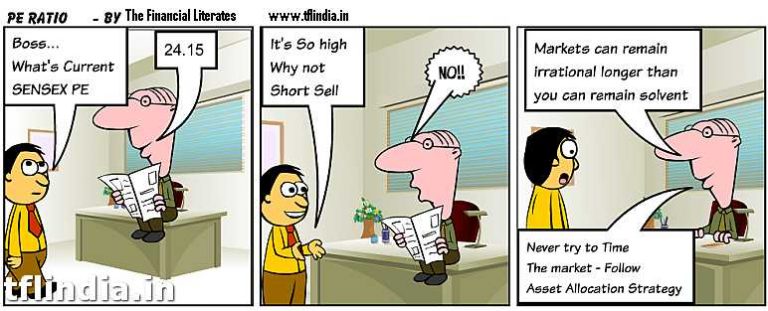
First, it cannot tell you when a correction will happen. In 1994 PE touched 50 before correcting. In 2007 PE stayed at 28–29 for over a year before the fall. Markets can stay expensive longer than rational analysis suggests.

Second, it cannot account for interest rate environments. When FD rates are low (4–5%), investors accept higher PE for equities. When rates rise (7–8%), PE tends to compress. The same PE number means different things in different rate environments.

Third, it works best for the broad market, not individual stocks. A fast-growing company may deserve PE 50. A slow-growing utility may be overpriced at PE 15. Sensex PE is an index-level gauge — it tells you about the market, not individual opportunities.

How to Use Sensex PE in Practice

In 25 years of advising, I have found PE most useful not as a buy/sell trigger but as a calibration tool. Here is a simple framework:

Sensex PE Zone What It Suggests SIP Action Lump Sum Action
Below 15 — Undervalued Rare opportunity. Fear is high. Continue. Consider stepping up. Deploy fully. History is on your side.
15–22 — Fair Value Normal market conditions. Continue as planned. Single or 2-tranche deployment.
22–28 — Moderately Stretched Optimism is priced in. Continue. Don’t increase risk. 3-tranche over 6 months.
Above 28–30 — Expensive Euphoria zone. History warns caution. Continue SIPs. Never stop. 4-tranche over 12 months. Or wait.

At the current PE of approximately 20–22, we are in the fair value zone. Markets have corrected meaningfully from the 2024 peak. For someone with a retirement lump sum to deploy, this is a more comfortable entry than 2024 was. For SIP investors — as always — continue without interruption.

For more on structuring a large lump sum received at retirement — from gratuity, PF, or property — read our guide on the best investment options for senior citizens in India. And for how market valuation connects to retirement withdrawal planning, see our post on NPS and building a retirement income strategy.

Nobody can time the market. But everybody can understand the price they are paying relative to the value they are getting.

That is all PE ratio asks you to do.

💬 Your Turn

At the current Sensex PE of 20–22, do you consider this a good time to deploy a lump sum — or are you waiting for a further correction? What PE level would make you feel confident? Share below.

The Great Indian IPO Mania: What Every Retail Investor Should Know Before Applying

“The stock market is the only market where the goods go on sale and all the customers run out of the store.” – Cullen Roche

Flip that and you get IPO investing: the goods are marked up to the highest price the promoter can get, and customers rush to the store.

IPO mania is not a 2010 phenomenon. It is not a 2021 phenomenon. It is a permanent feature of markets wherever retail participation meets bull market sentiment. And it recurs with predictable regularity in India – every time the Sensex sustains a rally for 18-24 months, IPO applications multiply, oversubscription numbers make headlines, and investors who have never looked at a balance sheet are filling out application forms.

⚡ Quick Answer

IPOs are not inherently good or bad investments. The problem is that most retail investors apply to IPOs for the wrong reasons: because the issue is oversubscribed, because a financial channel covered it, because a colleague applied, or because the allotment represents a quick listing gain. The promoter is selling at the highest price they can get, with the best lawyers and bankers working for them. As a retail applicant, you are the least-informed participant at the table. The three questions to ask before every IPO application are below.

IPO mania in India - why retail investors should be cautious about IPOs

Why IPOs Are Structurally Stacked Against Retail Investors

When a company goes public, the promoter hires investment bankers whose job is to price the issue as high as possible. The investment bankers market the issue to institutional investors first, gauge demand at different price points, and set the final price based on what the market will bear. By the time the retail window opens, the price has already been set by the people with the most information about the company.

The promoter is not doing charity. He is selling a part of his business at the highest price available. If he thought the business was worth more than the IPO price, he would not sell at that price. This asymmetry – the promoter knows more about the business than any retail investor can learn from a DRHP – is structural and permanent.

Historical data consistently supports this view. SEBI and various research studies have documented that a significant proportion of Indian IPOs – particularly those launched at the peak of bull markets – underperform the broader index over a 3-5 year horizon after listing. The listing pop that some IPOs provide benefits the investors who get allotment and sell immediately. Long-term investors in overpriced IPOs often wait years to recover their capital.

The Three Patterns That Repeat in Every IPO Cycle

IPOs cluster at market peaks. Companies go public when they can get the best price – which is when markets are optimistic. This means the IPO pipeline fills up precisely when valuations are highest. The investor rushing to apply to multiple IPOs in a bull market is buying at the point of maximum seller advantage and maximum valuation risk.

Herd mentality amplifies the rush. An oversubscribed IPO signals social proof – “all these people can’t be wrong.” But oversubscription measures demand, not value. An IPO can be oversubscribed 50 times and still list below its issue price if the fundamental valuation was stretched. The Coal India IPO in 2010 attracted applications worth more than the entire equity AUM of Indian mutual funds at that time. That level of enthusiasm is a sentiment indicator, not a quality indicator.

The grey market premium misleads. The grey market premium – the unofficial price at which IPO shares trade before listing – is frequently cited as a signal of listing performance. It is not a reliable one. It reflects speculative demand, not fundamental analysis. Investors who treat grey market premiums as investment signals are making decisions based on the opinions of other speculators, not on business quality or valuation.

IPO investing and retirement planning are fundamentally different activities.

Chasing IPO listing gains is speculation. Building a retirement corpus through systematic, diversified investing is planning. RetireWise helps senior executives do the second, not the first.

See How RetireWise Approaches Long-Term Wealth Building

Three Questions Before Every IPO Application

Do I understand the business? An IPO is not a lottery ticket. It is a fractional ownership stake in a business. If you cannot describe in one sentence what the company does, how it makes money, and why it will be worth more in 5 years than it is today, you do not have enough information to invest. This is not a high bar – it is the minimum bar.

Is the valuation reasonable compared to listed peers? The DRHP includes a comparable company analysis. Compare the IPO’s price-to-earnings, price-to-sales, or other relevant multiples with listed companies in the same sector. If the IPO is being priced at a premium to established, profitable peers, you are being asked to pay for growth that has not happened yet – and may not happen.

Is this IPO filling a gap in my existing portfolio? If you already hold equity through diversified mutual funds, a single IPO investment adds concentration, not diversification. A new-age startup IPO in your portfolio alongside equity mutual funds probably means you are doubling your exposure to the same broad market while taking on additional single-stock risk. The question is not whether the IPO is interesting – it is whether it serves your financial plan.

What “IPO = Probably Overpriced” Usually Means

The old quip that IPO stands for “It’s Probably Overpriced” is a useful heuristic, not an absolute rule. Some IPOs are reasonably priced – either because the promoter accepted a conservative valuation, or because market sentiment was subdued at the time of listing, or because the business genuinely had significant growth ahead of it that the market had not fully priced in.

But the heuristic captures an important truth: the average IPO at the average point in a market cycle will be priced to the advantage of the seller. To beat that average, a retail investor needs either better information than the institutional investors who set the price (unlikely) or a willingness to hold the stock for long enough that temporary overvaluation becomes irrelevant relative to business growth (possible, but then you are a long-term business investor, not an IPO investor).

Established mutual funds with 5-10 year track records, managed by teams with full access to company management and research, are a better vehicle for equity exposure for most investors than individual IPO applications. The fund manager sees the same IPO you do, has the resources to analyze it properly, and can choose whether to participate in the IPO, buy in the secondary market at a better price, or avoid the company entirely. That optionality is not available to the retail investor who must apply at the IPO price or not at all.

Read: 7 Things We All Hate About Mutual Funds (Honest Edition)

The promoter is selling at the best price he can get. The investment banker is paid to help him do that. As a retail applicant, you are the last person at the table with the least information. That does not mean never invest in IPOs. It means understand who you are and what you are doing.

Understand what you are buying. Buy what you understand.

Is IPO investing part of your retirement plan – or a distraction from it?

A RetireWise retirement plan includes a clear answer to this question – based on your goals, your time horizon, and the role different investments actually play in building your corpus.

Book a Free 30-Min Call

Your Turn

Have you applied to IPOs and held beyond the listing day? How did the long-term returns compare to what you would have got from a diversified equity fund over the same period? The honest answers from real investors are more useful than any analysis. Share in the comments.

The RetireWise Reading List: Best Investment Articles for Indian Investors

Most financial content online is either too basic to be useful or too technical to be readable. After 15 years of writing about personal finance for Indian investors, I have a clearer sense of what actually moves the needle when someone is trying to build wealth, avoid mistakes, and plan for retirement.

This is a curated reading list from RetireWise – organized by theme, not by date. Every article listed here has been updated for 2026 with current regulations, rates, and tax rules. If you are new here, start with the section most relevant to where you are today.

How to Use This List

If you are just starting: begin with the Foundations section. If you are in your 40s or 50s focused on retirement: go directly to the Retirement Planning section. If you have been mis-sold financial products and want to understand what happened: start with Mistakes and Mis-Selling. If you are an NRI: the NRI section covers your specific situation.

Best Investment Articles RetireWise

Foundations: Understanding How Money Works

These articles build the mental models that underpin every good financial decision. If you have gaps in any of these areas, the gaps compound – in the wrong direction.

How Mutual Funds Work – The mechanics of mutual funds explained without jargon. NAV, units, types of funds, how returns are generated. The starting point for anyone considering mutual fund investing.

Benefits of Mutual Funds in India – Why mutual funds remain one of the most practical investment vehicles for Indian investors across income levels and risk profiles.

What Is Insurance: Investment or Expense? – The most important mental reframe in financial planning. Once you understand insurance correctly, a whole class of bad decisions becomes impossible.

How to Set SMART Financial Goals – Without a specific, measurable goal attached to a number and a date, financial planning is just wishfulness. This article shows you how to set goals that can actually be planned for.

Retirement Planning: The Core Cluster

RetireWise is built around one conviction: most Indian investors focus entirely on accumulation and never seriously plan for the withdrawal phase. These articles address both.

Importance of Financial Planning – Why planning matters and what happens to people who skip it. Not a lecture. A look at the real cost of inaction.

SMART Financial Goals: A Complete Guide – How to translate retirement anxiety into a specific corpus number and a month-by-month plan to reach it.

15 Financial Resolutions Every Indian Should Make – Not January resolutions. Year-round commitments across loans, investing, insurance, and retirement that actually stick because they are tied to specific actions.

Mutual Funds: Going Deeper

ELSS Mutual Funds: Complete 2026 Guide – Everything you need to know about tax-saving mutual funds after the 2018, 2020, and 2024 rule changes. Corrects three widespread myths about ELSS that cost investors money.

FD vs FMP: What Changed in 2026 – The post-2023 tax landscape for debt instruments. Why the old argument for FMPs over FDs has changed – and what the remaining advantage is.

Insurance: Separating Need from Sales Pitch

Everything About Mediclaim Policy in India – How health insurance actually works, what to check before buying, and the clauses that trip most people up at claim time.

Health Insurance Portability: Complete 2026 Guide – How to switch insurers without losing waiting period credits. Updated with IRDAI 2024 Master Circular changes including the new 1-hour cashless approval mandate.

Mistakes and Mis-Selling

Mis-Selling in Mutual Funds and Insurance: How to Spot It – 8 mutual fund tricks and 9 insurance claims with the truth behind each one. Plus three newer patterns that have emerged since 2020. The most-read article on this site for good reason.

How to Choose a Financial Advisor in India – What questions to ask, what credentials to look for, and how to assess whether the advisor’s interests are aligned with yours.

Tax Planning

ELSS: The Tax-Saving Mutual Fund Guide – Section 80C, the 3-year lock-in, LTCG rules post-2018, and why new tax regime investors need to reconsider their ELSS allocation.

11 Unusual Ways of Saving Tax in India – Beyond 80C. Tax-saving strategies most investors overlook, explained in practical terms.

NRI Finance

Tax Planning for NRIs in India: Complete 2026 Guide – NRE vs NRO account tax treatment, DTAA with 90+ countries, TDS rates, capital gains rules after the July 2024 Budget changes, and the RNOR window for returning NRIs.

New to RetireWise?

RetireWise is built for Indian executives aged 45 to 60 who are serious about retirement planning. If you have been building wealth for 20 years but have never sat down and worked out exactly how much corpus you need, what withdrawal strategy you will use, or whether your current trajectory gets you there – that is the conversation we should have. The first call is free.

Ready to Go Beyond Articles?

Reading is the foundation. A personalized retirement plan is the structure built on it. If you are 45 to 60 and want to move from reading to planning, let us start with a free 30-minute conversation.

Book a Free 30-Min Call

Which of these articles was most useful to you? And which topic do you wish we covered in more depth? Let us know in the comments below.

Do You Really Understand SIP? The 5 Decisions Most Investors Never Make

Every mutual fund advertisement in India ends with the same four words: “Start your SIP today.”

Most people do. Very few understand what they have actually started.

SIP – Systematic Investment Plan – is one of the most powerful wealth-building tools available to Indian investors. It is also one of the most misunderstood. People confuse the vehicle with the destination, the method with the strategy, and the name with the substance.

Quick Answer

SIP is not an investment. It is a method of investing – like an EMI is a method of buying, not the house itself. A SIP simply automates regular investments into a mutual fund of your choice. The real decisions are which fund to invest in, how much, for how long, and for what goal. A SIP in the wrong fund, at the wrong amount, for the wrong duration, will not build the wealth you expect – regardless of how disciplined the investment habit is.

What SIP Actually Is

A SIP instructs your bank to debit a fixed amount on a fixed date every month and invest it in a specified mutual fund. That is it. Nothing more.

The mutual fund then buys units at the current NAV (Net Asset Value). When markets are low, your fixed amount buys more units. When markets are high, it buys fewer units. Over time, this averaging effect – called rupee cost averaging – smoothens the impact of market volatility.

SIP is not a product. It is not a guarantee. It is not a strategy. It is an automation mechanism. The strategy comes from the decisions you make before you set up the SIP.

The 5 Decisions That Actually Determine SIP Outcomes

Decision 1: Which fund?

A SIP in a large-cap index fund, a mid-cap active fund, and a debt fund will produce completely different outcomes over 10 years. The automation is identical. The results are not. Most people start a SIP in whatever fund their bank or agent recommends – often the fund with the highest recent returns – without understanding what they own or why.

Decision 2: How much?

The amount must be calibrated to the goal. A Rs 5,000 monthly SIP will not fund a Rs 50 lakh child education goal in 12 years. A savings rate of at least 20-25% of take-home income is the starting benchmark. Why regular investing beats trying to time the market.

Decision 3: For how long?

Equity SIPs need time – ideally 7 years minimum, and 15+ years for retirement goals. A SIP that is stopped after 3 years because the market fell is not a strategy; it is a failed experiment. The discipline of continuing through market downturns is where most of the wealth is actually built.

Decision 4: For which goal?

Every SIP should be linked to a specific goal with a specific timeline and amount. Child’s education at age 18: Rs 40 lakh. Retirement at 60: Rs 5 crore. House down payment in 5 years: Rs 25 lakh. Without goal linkage, you will not know when to stop, how much is enough, or what to do when markets fall. Setting SMART financial goals is the foundation of any investment strategy.

Decision 5: What to do in a crash?

The SIP’s greatest advantage is also its greatest test. When markets fall 30%, the correct action is to continue the SIP – or even increase it, since you are buying more units cheaply. Most investors stop or pause the SIP at exactly this moment, converting a paper loss into a permanent one. Having a pre-decided crash response plan before the crash happens is what separates successful SIP investors from unsuccessful ones.

Is your SIP actually aligned with your retirement and life goals?

A fee-only advisor maps your SIPs to specific goals, checks if the amounts are sufficient, and builds the crash-response plan before the crash arrives.

Talk to a RetireWise Advisor

The Most Common SIP Mistakes

Chasing past returns. The fund that returned 45% last year is the most popular SIP choice this year. It is usually the wrong choice. Past returns reflect market conditions that no longer exist. Select funds on process, philosophy, and risk-adjusted consistency – not last year’s return.

Too many funds. A SIP across 12 different mutual funds does not mean 12 times the diversification. Most equity funds own similar stocks. Three to five well-chosen funds covering large-cap, flexi-cap, and mid-cap is sufficient for most investors.

Ignoring fund type. A SIP in a small-cap fund for a 3-year goal is a mismatch. Small-cap funds need 7-10 year horizons to manage volatility. Matching fund type to goal timeline is fundamental – and frequently ignored.

Stopping during downturns. The worst SIP mistake. The rupee cost averaging benefit is largest when markets are falling – you are buying more units at lower prices. Stopping a SIP during a crash reverses this advantage entirely.

The SIP Amount Most People Never Calculate

Here is something I check for every client who starts a SIP – and something most people never do themselves.

“Does your current SIP amount, at a reasonable return assumption, actually reach your goal amount on the date you need it?”

Most people set a SIP amount based on what they can afford, not what the goal requires. The two are often very different numbers.

A 35-year-old who wants Rs 5 crore at 60 needs approximately Rs 19,000 per month at 12% CAGR. If they are investing Rs 10,000 per month, they will reach approximately Rs 2.6 crore – a gap of Rs 2.4 crore. That gap does not become visible until retirement, when it is too late to close.

The exercise of working backward from the goal amount to the required monthly SIP – and then checking whether you are actually investing that amount – is one of the most valuable things a financial plan does. It converts a vague hope into a specific number. And it does so early enough to act. An annual mutual fund portfolio review is the minimum maintenance a serious investor should do.

How to Review Your SIP Annually

Once a year – ideally in April at the start of the financial year – review each SIP against its goal. Has the goal amount changed? Has the fund underperformed its benchmark consistently over 3+ years? Has your income grown enough to increase the SIP amount?

The SIP you set up and never review is like a car you drive without ever checking the fuel level. It will likely get you somewhere – just not necessarily where you planned to go.

Frequently Asked Questions

How much should I invest in SIP per month for retirement?

Work backward from your retirement corpus target. A 35-year-old targeting Rs 5 crore at 60 needs approximately Rs 19,000 per month at 12% CAGR over 25 years. A 40-year-old targeting the same corpus needs approximately Rs 35,000 per month over 20 years. The starting point is always the goal amount and timeline – not what you can comfortably invest today. If there is a gap between what the goal requires and what you are investing, close it by increasing SIPs with every increment or annual review.

Should I stop my SIP when markets fall?

No – this is the most expensive mistake SIP investors make. When markets fall, your fixed monthly SIP amount buys more units at lower prices. This is rupee cost averaging working in your favour. Stopping the SIP converts a paper loss into a real one and eliminates the benefit of cheaper unit acquisition. The investors who continued SIPs through the 2008 crash, the 2020 COVID crash, and every correction in between consistently outperformed those who paused and re-entered. The right response to a market fall is to continue – and if possible, increase.

How many mutual funds should I have in my SIP portfolio?

Three to five funds is sufficient for most individual investors. A typical structure: one large-cap or index fund (stability and benchmark exposure), one flexi-cap fund (active management across market caps), and one mid-cap fund (growth exposure with higher volatility). Adding a fourth international or sectoral fund is optional based on goals. Beyond five funds, you are adding complexity without meaningful additional diversification – most equity funds in India hold overlapping stocks from the Nifty 500 universe.

What is the difference between SIP and lump sum investing?

SIP invests a fixed amount at regular intervals regardless of market levels – it removes the timing decision and benefits from rupee cost averaging. Lump sum investing puts a large amount into the market at once – it maximises returns if you invest at a market low, but carries significant risk if you invest near a peak. For most salaried investors who receive income monthly, SIP is the natural and appropriate approach. Lump sum investing makes sense when you receive a windfall (bonus, inheritance, maturity proceeds) and have a long investment horizon ahead. The two approaches are not mutually exclusive – SIP for regular income, lump sum for windfalls.

Starting a SIP is the easy part. The hard part is choosing the right funds, investing the right amounts, linking them to real goals, and staying the course when markets punish you for being disciplined. Most investors get the easy part right and the hard parts wrong.

A SIP without a goal is just a debit order. Turn it into a strategy – and it becomes one of the most powerful financial tools you have.

Your Turn

Do you know exactly which goal each of your SIPs is working toward – and whether the monthly amount is sufficient to reach it? If not, that is the most important question to answer this week. Share below.

Monthly Income Plan (MIP) — What SEBI Changed, What Remains, and Should You Still Invest?

54

Years ago, I met an investor — Suresh (name changed) — who had just moved all his equity mutual funds into Monthly Income Plans. Every single rupee. His agent had told him markets were “too high” and MIPs would “protect his capital while giving monthly income.”

I asked Suresh one question: “Do you actually need monthly income right now?”

He didn’t. He was 38, earning well, with no immediate need for regular payouts. His agent had moved him into MIPs not because it was right for Suresh — but because MIPs paid higher commissions to the agent than equity funds. That was the real reason.

Fifteen years later, the mutual fund industry has changed enormously. SEBI forced fund houses to drop the “Monthly Income Plan” name because it was misleading. What we used to call MIPs are now called Conservative Hybrid Funds. The name changed. The confusion hasn’t.

⚡ Quick Answer

Monthly Income Plans (MIPs) have been renamed to Conservative Hybrid Funds by SEBI. They invest 75-90% in debt and 10-25% in equity. They do NOT guarantee monthly income — the name was dropped precisely because it misled investors. The old tax advantages (DDT) are gone since 2020. For most investors seeking regular income, a Systematic Withdrawal Plan (SWP) from a balanced fund is now a better approach.

The Big Change: MIP is Now “Conservative Hybrid Fund”

After SEBI’s 2017 recategorization of mutual funds, the “Monthly Income Plan” label was officially retired. Here’s what changed and what stayed the same:

Feature Old MIP (Pre-2017) Conservative Hybrid Fund (Now)
SEBI Name Monthly Income Plan Conservative Hybrid Fund
Debt Allocation 70-95% 75-90% (standardised by SEBI)
Equity Allocation 5-30% 10-25%
Guaranteed Income? No (but name implied it) No (name no longer misleads)
Dividend Tax DDT paid by fund (appeared “tax-free”) Dividends taxed in investor’s hands at slab rate (since April 2020)

🚫 Critical Change — DDT Abolished

Before April 2020, MIP dividends appeared “tax-free” because the fund paid Dividend Distribution Tax (DDT) before distributing to you. Since April 2020, DDT is abolished. Dividends are now added to your income and taxed at your slab rate. If you’re in the 30% bracket, you lose 30% of every dividend payout to tax. This completely changes the math.

What Conservative Hybrid Funds Actually Do

Think of a conservative hybrid fund as a fixed deposit with a small engine attached. The FD part (75-90% debt) gives you stability and predictable returns. The engine (10-25% equity) gives you a chance to beat inflation — something pure FDs struggle to do over long periods.

The equity component is what gives these funds their edge over plain debt funds. But it’s also what makes returns unpredictable in the short term. In a bad year for equity markets, even the 10-25% equity allocation can pull down returns noticeably.

Benefits Worth Knowing

Stability with a growth kicker. Debt gives you the floor. Equity gives you the ceiling. For someone who can’t stomach pure equity but knows FDs are losing to inflation — this is the middle ground.

Better diversification than FDs. Your money spreads across government securities, corporate bonds, and a slice of blue-chip equity. One bad bond or one bad stock won’t sink the ship.

SWP-friendly. These funds work well with a Systematic Withdrawal Plan — where you withdraw a fixed amount monthly. This is far more tax-efficient than taking dividends.

Who Should Invest in Conservative Hybrid Funds?

Let me be direct. If you’re investing in conservative hybrid funds because your agent told you “markets are too high,” you’re investing for the wrong reason. That’s a market timing call, not an asset allocation decision.

Conservative hybrid funds make sense for three types of investors:

1 Retirees seeking regular income

If you need monthly cash flow and want better returns than FDs without taking on full equity risk. Use SWP — not the dividend option.

2 Conservative investors with a 3+ year horizon

You want to beat inflation but can’t handle the rollercoaster of pure equity funds. You accept that returns won’t match the Sensex but you’ll sleep better.

3 Short-term parking for large sums

You’ve received a bonus, inheritance, or retirement corpus and need to park it safely while you build a proper financial plan. Conservative hybrids beat savings accounts without taking on serious risk.

If you’re a salaried professional in your 30s or 40s with a 10-15 year horizon — these funds are too conservative for your primary investments. You need equity. Save conservative hybrids for the portion of your portfolio that needs stability.

Top Conservative Hybrid Funds — 2026 Performance

Fund Name 3-Year Return (CAGR, approx.) 5-Year Return (CAGR, approx.)
ICICI Prudential Regular Savings Fund ~11% ~8-10%
SBI Conservative Hybrid Fund ~10% ~9-10%
HDFC Hybrid Debt Fund ~10% ~9-10%
Kotak Debt Hybrid Fund ~10% ~9%

Source: Groww, Tickertape, Value Research (early 2026). Returns vary by platform and calculation date. Past performance is not indicative of future returns. Verify latest NAV before investing.

Compare this with a typical bank FD giving 7-7.5% and it’s clear — the small equity kicker in conservative hybrids has earned investors an extra 2-3% per year over the long term. That’s the difference between your Rs 50 lakh growing to Rs 85 lakh (FD) or Rs 97 lakh (conservative hybrid) over 10 years.

Taxation — The Rules Have Completely Changed

This is the section most old MIP articles get catastrophically wrong. The tax landscape has been overhauled multiple times since 2020. Here’s what applies now:

⚠️ Important — No LTCG Benefit Since April 2023

Conservative hybrid funds have less than 35% equity allocation. Under the Finance Act 2023, all gains from such funds — regardless of how long you hold them — are taxed as short-term capital gains at your income tax slab rate. There is no long-term capital gains benefit. No indexation. This applies to units purchased after April 1, 2023.

Tax Event Old Regime (Before 2020) Current Regime (2026)
Dividends “Tax-free” (DDT paid by fund at ~29%) Taxed at your income tax slab rate
Capital Gains (any holding period, units bought after Apr 2023) STCG at slab; LTCG at 20% with indexation (after 3 years) Always taxed at slab rate — no LTCG benefit for funds with <35% equity
Capital Gains (units bought before Apr 2023) LTCG at 12.5% if held >24 months (grandfathered). Consult your advisor.

“The tax advantage that made MIPs attractive for 15 years — DDT making dividends appear tax-free — is gone. If you’re still choosing dividends over SWP in 2026, you’re paying too much tax.”

The takeaway: Always use SWP (Systematic Withdrawal Plan) for regular income from conservative hybrid funds. Dividends are now the most tax-inefficient way to take money out. For a deeper dive, read our complete guide to SWP.

Need regular income from your investments after retirement?

The right combination of funds + SWP can give you monthly cash flow that’s tax-efficient and inflation-protected.

Talk to a SEBI-Registered Advisor

4 Myths About MIPs That Refuse to Die

MYTH 1 MIPs Guarantee Monthly Income

They never did. That’s exactly why SEBI made fund houses stop using the name. The “income” in MIP came from dividends — which were never guaranteed. Fund managers declared dividends when the fund had enough surplus. In bad quarters, dividends were skipped entirely. I’ve had clients who chose MIPs specifically for “guaranteed monthly income” and then received nothing for 3 months straight during the 2020 crash.

If you want predictable monthly cash flow, set up an SWP. You decide the amount, you decide the date. The fund doesn’t get to skip it.

MYTH 2 MIP Returns Are “Guaranteed” at 12-15%

No mutual fund in India can guarantee returns. SEBI explicitly prohibits it. Conservative hybrid funds have delivered 9-11% CAGR over 5 years historically — which is good, but not guaranteed. In a year where both debt and equity fall (rare but possible), you can see negative returns even from these “safe” funds.

Think of it as a realistic expectation: 2-3% above FDs over the long term. Not 12-15%. Anyone promising that is misleading you.

MYTH 3 MIP Dividends Are Tax-Free

This was true-ish before April 2020. The fund paid DDT, so dividends arrived in your hand without deduction. It felt tax-free. It wasn’t — the tax was just hidden inside the fund.

Now? Dividends are fully taxable at your slab rate. If you’re earning Rs 20 lakh+ per year, you’re losing 30%+ of every dividend to tax. Use smarter tax planning strategies instead.

MYTH 4 Your Principal is Always Safe

Nearly always? Yes. Always? No. Conservative hybrid funds have a small equity allocation. In a severe market downturn — like March 2020 — even these funds saw temporary NAV drops of 5-8%. The capital recovered within months, but if you had panicked and redeemed, you’d have locked in a loss on a “safe” product.

The lesson: even conservative funds need a minimum 2-3 year commitment. Anything shorter and you should be in liquid funds or FDs.

The Mis-Selling Problem — Still Alive in 2026

I wish I could say the agent who moved Suresh’s equity into MIPs was an outlier. He wasn’t.

When SEBI banned entry loads in 2009, MIPs suddenly became the most pushed product in the industry. Why? They paid higher trail commissions to distributors than equity funds. The product wasn’t better for investors — it was better for agents.

The pattern has evolved, but it hasn’t disappeared. Today, the mis-selling often takes the form of: “Markets are volatile, let’s move to conservative hybrid funds for safety.” That sounds reasonable — until you realise the client is 35 years old with a 20-year horizon, and what they actually need is more equity, not less.

If your advisor recommends conservative hybrid funds, ask one question: “Is this because I need regular income, or because you’re worried about the market?” Those are two very different reasons. Only the first one is valid.

Unsure if your mutual fund portfolio is right for your goals?

A fee-only advisor reviews what you have — not what earns them commission.

Get an Unbiased Portfolio Review

The name changed from MIP to Conservative Hybrid Fund. But the confusion didn’t change. The only thing that protects you is understanding what you own — and why you own it.

Don’t invest in a name. Invest in a plan.

💬 Your Turn

Were you investing in MIPs thinking the income was guaranteed? Or did an agent recommend them when markets got volatile? I’d love to hear your experience in the comments.