“The first principle is that you must not fool yourself – and you are the easiest person to fool.” – Richard Feynman
In 2009, I confessed on this blog that buying a Club Mahindra membership was my biggest financial mistake. The response surprised me. Several readers commented on the mistake itself – but almost nobody asked the more important question: why did it happen?
Why does a financial planner, someone who spends their professional life advising others to make rational money decisions, make an irrational one?
The honest answer is not “I was foolish.” The honest answer is Simon Sinek’s Golden Circle – and the fact that most of us, including me in that moment, start with WHAT instead of WHY.
⚡ Quick Answer
The biggest reason people make financial mistakes is not ignorance or greed – it is that they start with WHAT (which product, which scheme, which stock) instead of starting with WHY (what is this for in my overall financial plan?). A financial mistake is not defined by whether money was lost – it is defined by whether the decision was made on wrong principles. Correcting this requires reversing the decision process: start with WHY (your goal and its role in your plan), then HOW (the process and product type), then WHAT (the specific product).
What Is a Financial Mistake, Really?
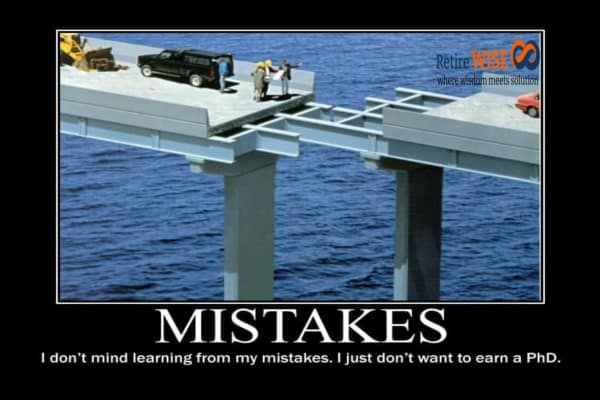
Most people define a financial mistake as a decision that lost money. By this definition, I have made relatively few mistakes in 25 years – because most decisions, even imperfect ones, have generated positive returns in a generally growing market.
But that is the wrong definition. A financial mistake is a decision made on wrong principles – regardless of outcome. An investor who puts all their savings in a single stock that happens to deliver 50% returns has not made a good decision. They made a risky one that happened to work out. Next time, or the time after, the same process will destroy their portfolio.
The Club Mahindra membership was not primarily a mistake because it generated poor financial returns – although it did. It was a mistake because I made the decision in isolation from my overall financial picture. I compared the membership to equity mutual funds and chose based on that narrow comparison, without asking whether holidays every year was the right priority within my overall goals at that stage of my financial life.
The Golden Circle Applied to Finance
Simon Sinek’s Golden Circle has three layers: WHAT (the outermost), HOW (the middle), and WHY (the core).
Most investors, most financial media, and most sales conversations operate from the outside in. They start with WHAT: which mutual fund, which insurance policy, which stock, which scheme. They sometimes move to HOW: how to open an account, how to do an SIP, how the product works. They almost never reach WHY: why this product exists in your overall financial plan, what specific goal it serves, how it fits with your other commitments, and what happens to your other priorities if this one is funded.
Well-designed financial products can be terrible decisions for specific individuals because the WHY was never asked. A ULIP is not inherently wrong – but if you need pure life insurance and have a 20-year investment horizon, you are paying insurance costs inside an investment wrapper that serves neither purpose as well as the standalone equivalents.
The best financial advice starts with WHY, not WHAT.
RetireWise starts every engagement with your goals, your timeline, and your overall financial picture – before any product recommendation is made. That is what separates planning from selling.
The ESOP Problem: Why Right Decisions Can Still Be Wrong
Consider the ESOP investor. Many senior employees at well-performing companies accumulate large positions in their employer’s stock. The stock has performed well. They feel emotionally connected to the company. They believe in the business. This sounds like a reasonable basis for a holding position.
But ask the WHY questions: Is this the best available equity investment in the market? Does holding a large concentration in a single stock serve my diversification goal? What happens to my financial position if this company faces the challenges that every company eventually faces? What would I do if this were a different company, not my employer?
The answers to these questions often reveal that the position is a mistake waiting to manifest – not because the company is bad, but because the decision was made on wrong principles: familiarity and loyalty rather than financial rationale.
Single Goal vs. Integrated Plan
My Club Mahindra decision had another flaw beyond the WHY problem. I was optimising for a single goal – holidays every year – without considering how that goal fit within my overall financial priorities. I had looked at it as “Club Mahindra membership vs. equity mutual funds.” I had not looked at it as “this Rs 30,000 per year membership vs. what else this Rs 30,000 per year could do across my full financial picture.”
This is the single-goal trap. Focusing intensely on one goal and solving for it often comes at the cost of other goals that were not brought into the analysis. The couple who aggressively pays down a home loan may be underfunding a child education corpus. The investor who maximises equity returns may have no liquidity for emergencies. The person who buys premium life insurance may have no health insurance.
Financial planning, done properly, takes all goals into view simultaneously. The priority order may require difficult trade-offs. But seeing all the goals together produces better decisions than optimising each one in isolation.
The Corrected Decision Framework
Start with WHY: what is the specific financial goal this decision is meant to serve, and how does it rank in priority among your other goals? This question often reveals that the product being considered does not fit the goal, or that the goal itself is not the right priority at this stage.
Move to HOW: what type of instrument serves this goal best, given your time horizon, risk capacity, and tax situation? Only after answering this question should you evaluate specific products.
End with WHAT: given the WHY and HOW, which specific product or fund best delivers the required outcome at the lowest cost?
This sequence is slower than most investment decisions are made. Most investment decisions take minutes: someone recommends a product, it sounds reasonable, you sign up. The WHY-first framework takes hours or days – and prevents years of regret.
Read: How to Set SMART Financial Goals
I know what I should have asked before buying that Club Mahindra membership: does this fit within my WHY? It did not. It fit within my immediate desire for holidays, but not within my overall financial plan.
Start with WHY. Everything else is easier from there.
What is the biggest financial decision you are currently making without a clear WHY?
A RetireWise planning engagement brings all your goals into view simultaneously – so each decision is made in the context of your complete financial picture, not in isolation.
Your Turn
What is your equivalent of my Club Mahindra mistake – a financial decision that seemed reasonable at the time but, in hindsight, was made without a clear WHY? Sharing honestly helps others avoid the same trap.