Home Blog Page 34

Should I Buy or Rent a House in India? The 2026 Answer

Your family is pressuring you to buy a house. Your friends all own one. Your colleague just posted photos of his new flat on Instagram. And you are still renting.

There is a question underneath all that pressure that nobody is asking: does buying actually make financial sense for you right now?

Full disclosure before we begin: I own a house, and I believe everyone should own one before retirement — the emotional and practical benefits are real. But buying at the wrong time, in the wrong city, at the wrong price, can set back a retirement plan by a decade. The question is never just “buy or rent.” It is “buy or rent, now, at this price, in this city, given my specific situation.”

⚡ Quick Answer — 2026

Home loan rates are 8.5–9.5%. Rental yields in most Indian cities are 2.5–3.5%. The numbers currently lean towards renting being cheaper in the short term in most metros, especially Mumbai. But if you plan to stay in one city for 10+ years, own no home approaching retirement, and can afford the EMI without stretching beyond 35–40% of take-home income, buying before retirement is the right long-term call. Use the Price-to-Rent ratio below to calibrate your specific situation.

Should I buy or rent a house in India 2026

The Warren Buffett vs Michael Jackson Test

Robert Kiyosaki — famously a real estate investor — calls your primary residence a liability. Not an asset. That sounds provocative until you understand his reasoning.

Buying Vs Renting — Warren Buffett vs Michael Jackson

The sprawling fairy-tale house above was Michael Jackson’s Neverland. The ordinary-looking house below it belongs to Warren Buffett — the same house he bought in Omaha in 1958 for $31,500 and still lives in today.

Michael Jackson’s house became his biggest financial liability — the maintenance, the debt, the running costs consumed him. Warren Buffett lives modestly, invests the rest, and became one of the wealthiest people in human history.

The lesson is not “don’t buy a house.” The lesson is: know your limit, and do not let the house become the goal in itself. A comfortable home you can maintain without financial stress is an asset. A showpiece that eats your retirement corpus is a liability.

When Buying a House Is an Easy Decision

There are conditions under which buying is clearly correct — and conditions where renting clearly wins. Let us be honest about both.

Buying is the obvious choice when property prices are low relative to your income, when home loan rates are well below 9%, when rents in your area are high (making renting expensive), when you are committed to staying in the same city for at least 10 years, and when the EMI will not exceed 35–40% of your take-home income.

In 2026, the first three conditions are only partially met in India. Home loan rates at 8.5–9.5% are not particularly cheap. Property prices in major metros have been on a sustained upward run. But the fourth and fifth conditions — long-term city commitment and EMI affordability — are within your control. That is where the real decision is made.

The Price-to-Rent Ratio — The One Number That Cuts Through the Noise

There is a simple rule that cuts through all the emotional noise: the Price-to-Rent ratio.

Calculate it: Take the total cost of the property. Divide it by the annual rent you would pay for a similar property. If the ratio is above 20, renting is likely the smarter financial decision. Below 15, buying is clearly better. Between 15 and 20, it depends on your specific situation.

Price-to-Rent Ratio What It Means Lean Towards
Below 15 Property is relatively cheap vs rent. Buying makes clear sense. Buy
15–20 Borderline. Depends on your city, time horizon, and rate outlook. Evaluate carefully
Above 20 Property is expensive relative to rent. Renting and investing the difference is likely better. Rent (or wait)

A quick example: You are considering a flat in Bengaluru priced at Rs 1.2 crore. The rent for a similar flat is Rs 35,000 per month, or Rs 4.2 lakh per year. Price-to-Rent ratio = 1.2 crore ÷ 4.2 lakh = 28.6. This ratio signals: property is expensive relative to rent. Renting and investing the difference may build more wealth in the medium term.

💡 Rental yield check: Flip the ratio. Annual rent ÷ property price = rental yield. In most Indian metros in 2026, residential rental yields are 2.5–3.5%. Mumbai is at the lower end (2–2.5%), Bengaluru and Hyderabad at the higher end (3–4%). A rental yield below 3% means the property is expensive for what it earns — which is exactly what the Price-to-Rent ratio above 20 tells you.

The Numbers — Buying vs Renting in 2026

Let us run a realistic scenario for a senior executive considering a Rs 1 crore flat with a 20% down payment (Rs 20 lakh) and an Rs 80 lakh home loan at 8.75% for 20 years.

Buying (Rs 1 Cr flat, 20% down) Renting (same flat)
Monthly outgo EMI ~Rs 70,000 + maintenance Rs 5,000 = Rs 75,000 Rent ~Rs 25,000–30,000
Tax benefit (home loan interest) Rs 2 lakh deduction/year under Section 24 (at 30% slab = ~Rs 5,000/month benefit) HRA exemption (if employer provides HRA)
Net monthly cost (approx) ~Rs 70,000 ~Rs 25,000–30,000
Monthly surplus available to invest Lower — EMI consumes more cash Higher by ~Rs 40,000–45,000
Wealth creation Property appreciation (~6–8% p.a.) + equity building Rent + invest surplus in equities (~12% CAGR)

Note: Section 24 home loan interest deduction is Rs 2 lakh per year for self-occupied property (updated Budget 2017). If you have a joint home loan with spouse, both co-borrowers can claim Rs 2 lakh each = Rs 4 lakh total, provided both have taxable income.

Over a 15–20 year horizon at reasonable property appreciation of 7% and equity returns of 12%, the two paths often converge. The renter-investor who invests the difference consistently builds a comparable net worth. The buyer builds real estate equity but sacrifices short-term investable surplus.

The winner depends on three factors: how disciplined the renter is in actually investing the difference, how long both stay on their respective paths, and what the actual property appreciation in that specific location turns out to be.

Trying to decide whether to buy or rent before retirement?

At RetireWise, we help senior executives run the numbers specific to their city, income, and retirement timeline — so the buy-or-rent decision fits into their complete retirement plan.

Explore RetireWise

The Retirement Lens — A Question Most Articles Miss

For a senior executive at 45–55, the buy-or-rent question has a specific dimension that generic articles ignore: do you want to be paying rent in retirement?

When you retire, your income stops. A rent of Rs 30,000/month that felt manageable on a Rs 3 lakh salary becomes a significant draw on a fixed retirement corpus. Owning your home outright at retirement eliminates this fixed obligation permanently — and that has real value beyond the financial calculation.

My position: every person approaching retirement who does not own a home should make owning one a priority — not necessarily in an expensive metro, but in the city where they plan to spend retirement. The location question matters more than the price question. A Rs 50 lakh flat in Jaipur or Coimbatore that you own outright at retirement is worth more to your retirement plan than a Rs 1.5 crore flat in Bangalore that you are still paying EMI on at 65.

The five questions that actually matter at retirement: Where will I live after retirement? Is there a city where I want to put permanent roots? Can I buy there now, comfortably, without stretching my EMI beyond 35% of take-home? Will the EMI be fully paid before I retire? If yes to all four — buy now. If not — buy in that city, not this one, and at a price that works.

For how property sale proceeds are taxed — especially relevant if you are selling one property to fund another — read our guide on capital gains tax on property sale in India.

The Rules That Still Hold After 12 Years

When I first wrote about this in 2012, a commenter named Srivatsan offered a framework that I still use with clients today. It remains sound.

If the property price is more than 25 times the annual rent you would pay for the same property — wait. Example: rent is Rs 30,000/month = Rs 3.6 lakh/year. 25 × 3.6 lakh = Rs 90 lakh. If the flat costs more than Rs 90 lakh, the ratio says: rent for now. At Rs 1.2 crore for a flat that rents at Rs 30,000, the ratio is 33 — firmly in “rent” territory by this rule.

Your total EMI (all loans combined) should not exceed 40% of your net monthly income. Your total home loan should not exceed 4–5 times your annual income. These rules protect you from buying a home that becomes a liability rather than an asset. The discomfort of social pressure is real. But the discomfort of an unaffordable EMI in your 50s — when retirement is approaching and your income may not keep growing — is far more expensive.

Buying a house is one of the largest financial decisions of your life. Take a cool-headed decision — not an Instagram-pressured one.

Run the Price-to-Rent ratio. Check the EMI-to-income ratio. Then decide with clarity — not because everyone else has.

💬 Your Turn

Are you renting right now? Have you run the Price-to-Rent ratio for your city? What number did you get — and did it change your decision? Share below.


Can I Afford a House at Current Prices? (The 2026 Calculation)

Ankit (name changed), a 36-year-old product manager in Bangalore, earning Rs 2.5 lakh per month after tax. His wife earns Rs 1.2 lakh. Together, Rs 3.7 lakh monthly. They wanted a 3BHK in Whitefield. Price tag: Rs 1.8 crore.

The EMI? Rs 1.42 lakh per month on a 20-year loan at 8.75%. That is 38% of their combined income — just on the home loan.

Then add maintenance, property tax, furnishing EMIs, and the insurance the bank pressured them into. Total housing cost: 48% of income.

I told them: “You can technically afford this house. But your retirement, your daughter’s education fund, and your emergency corpus will pay the price.”

They bought a Rs 1.1 crore apartment instead. Three years later, they thanked me.

⚡ Quick Answer

The global rule says your house should cost 2-3x your annual income. In India, the average is 7.5x — which is why housing feels unaffordable. The safe limit: keep your home EMI under 30% of net income, and total EMIs under 40%. If a property pushes you beyond this, it is not affordable — no matter how much you want it. Use the calculation table below to find your number.

Why “Can I Afford It?” Is the Wrong Question

The bank will tell you that you can afford a Rs 1.5 crore house. Of course they will — they make money on the loan.

The real question is: “Can I afford this house AND still fund everything else that matters?” That includes retirement, children’s education, emergency reserves, family holidays, and the ability to survive a job loss for 6 months without panic.

A house that eats 50%+ of your income is not a home. It is a financial prison with a nice balcony.

The Affordability Numbers in 2026

Indicator Global Standard India Average (2024-26) What It Means
Price-to-Income Ratio 2-3x annual income 7.5x annual income Indian housing is 2.5-3x more stretched than the global safe zone
EMI-to-Income Ratio Under 28-30% 61% (2024 average) Most Indian home buyers are dangerously over-leveraged
Avg Property Price (Top 7 Cities) Rs 7,550/sq ft (up 50% from 2019) Prices have outpaced income growth by 2x
Home Loan Rate 8.5-9.5% (April 2026) Rates up from 6.5% in 2021 — EMIs are 20%+ higher

The EMI-to-income ratio at 61% is alarming. It means the average Indian home buyer is spending more than half their income on housing. That leaves almost nothing for savings, investing, or emergencies.

The Thumb Rules That Protect Your Financial Life

Rule 1 — The 3x Rule (Global Standard): Your house should cost no more than 3 times your family’s annual after-tax income. If you and your spouse earn Rs 30 lakh combined, your house budget is Rs 90 lakh. At Rs 50 lakh combined, the budget is Rs 1.5 crore.

In India, almost nobody follows this. The average is 5-7.5x. But breaking this rule is exactly why so many high-income families are “asset rich, cash poor.”

Rule 2 — The 30% EMI Rule: Home loan EMI should not exceed 30% of your net monthly income. Total EMIs (home + car + personal loan) should not exceed 40%.

Rule 3 — The 20% Down Payment Rule: Put at least 20% down. Anything less means higher EMIs, longer tenure, and more total interest paid.

Your Affordability Calculator (2026 Numbers)

Here is what different income levels can realistically afford at current interest rates:

Monthly Income (After Tax) Max EMI (30%) Max Loan (20 yrs, 8.75%) House Budget (with 20% down)
Rs 1,00,000 Rs 30,000 Rs 34 lakh Rs 42 lakh
Rs 1,50,000 Rs 45,000 Rs 51 lakh Rs 64 lakh
Rs 2,00,000 Rs 60,000 Rs 68 lakh Rs 85 lakh
Rs 3,00,000 Rs 90,000 Rs 1.02 crore Rs 1.28 crore
Rs 5,00,000 Rs 1,50,000 Rs 1.70 crore Rs 2.13 crore

(Calculated at 8.75% interest, 20-year tenure, 20% down payment. Your actual eligibility depends on existing EMIs, credit score, and lender criteria.)

Look at these numbers honestly. If the house you want costs significantly more than what your income level shows, you are stretching — and something else in your financial life will break.

What Happens When You Stretch Too Far

I have seen it with dozens of clients over 25 years. Here is the pattern:

A couple earning Rs 3 lakh per month buys a Rs 2 crore apartment. EMI: Rs 1.6 lakh (53% of income). For the first 2-3 years, they manage — barely. Then one of three things happens: a job change with a gap, a medical emergency, or a child’s school fees jumping. Suddenly the EMI feels like a boulder on their chest.

They stop SIPs. They break FDs. They dip into their emergency fund. By year 5, they have a beautiful house and a devastated financial plan.

The house did not make them wealthy. It made them fragile.

Myth Busted: Property Prices Never Crash

They do. HDFC Ltd data showed that property prices corrected 50% between 1996 and 1999. Prices then stayed flat from 1999 to 2004 before the next bull run. Real estate in India moves in cycles — just like equities, but slower and with less liquidity.

Do not let FOMO drive your biggest financial decision.

Struggling with the buy-vs-rent decision?

A comprehensive financial plan considers the house in context of retirement, education, and all your other goals — not in isolation.

Talk to a SEBI-Registered Advisor

The Right Way to Think About Affordability

Before you sign that home loan, answer these five questions:

1. After the EMI, can I still save 20-30% of my income? If not, the house is too expensive.

2. Do I have 6 months of expenses (including the EMI) in an emergency fund? If not, build that first.

3. If one income stops for 6 months, can we still pay the EMI? If not, you are one job loss away from crisis.

4. Am I buying because I need a home or because “everyone is buying”? FOMO is not a financial plan. Read: Should I Buy or Rent a House in India?

5. Have I factored in the hidden costs? Stamp duty (5-7%), registration (1-2%), GST on under-construction (5%), interior fit-out (Rs 10-30 lakh for a decent 3BHK), maintenance, property tax, and society charges. Add 15-20% to the sticker price.

A house is not the biggest investment of your life. Your financial freedom is. The house should serve that goal — not destroy it.

The house you can afford is the one that leaves room for everything else.

💬 Your Turn

What percentage of your income goes towards housing? Did you stretch to buy — and was it worth it? Or did you hold back and invest the difference? Share your experience.

Indian Real Estate Bubble – Will it Ever Burst?

Every Diwali party, every family WhatsApp group, every cab ride with a chatty driver — the script is the same. “Property prices in my area have doubled.” “My cousin made 3x in Gurgaon.” “Real estate never goes down in India.”

And then there’s the other side. The young couple in Pune doing the math on a 2 BHK, realising they’d need a 30-year EMI that eats 60% of their income. The IT professional in Bangalore watching prices jump 13% in a single year and thinking — will I ever afford a home?

So the question still burns, years after I first wrote about it: will the Indian real estate bubble ever burst?

Let me be honest upfront — I don’t have a crystal ball. But I do have 20+ years of watching people make (and lose) fortunes in property. And the answer is more nuanced than either the bulls or the bears want to admit.

⚡ Quick Answer

A nationwide real estate crash in India is unlikely — RERA regulations, limited urban land supply, and rising construction costs provide a floor. But localised corrections of 10–25% in over-supplied pockets are very real. The bigger risk isn’t a dramatic crash — it’s buying at inflated prices in the wrong micro-market and watching your money sit dead for a decade. Don’t confuse a bull market with genius.

Bull Market Versus Genius — A Story That Repeats

Back in the 2005-2012 property boom, a friend bought plots at Rs 1,800 per square yard. Sold them in 2011 at Rs 13,000. From the sale proceeds, he bought another plot at Rs 6,000 per square yard — and within two years, that area was quoting Rs 15,000. His money grew 16-17 times. That’s 55-60% CAGR.

Do you think he’s a genius?

YES — if I don’t share this story.

One of my clients bought property for Rs 25X and it became 300X in about three years — 12 times, or 120% CAGR. Another relative bought agricultural land for 7X, and it was quoted at 100X in under two years. More than 250% CAGR.

You must be hearing similar stories from your own circles — friends, relatives, the property “expert” on news channels. But the question is — are they genius? Maybe…

It’s important to understand one thing: everyone makes money in a bull run if they participate in that asset class. My neighbour told me the value of his house tripled in four years. So did mine. So did almost everyone’s. That’s not skill — that’s the tide lifting all boats.

Something very similar happened with equity investors in 2007 — right before the crash wiped out portfolios.

When Confidence Becomes Delusion

Here’s what worried me then, and worries me now. People start feeling they know what will happen next.

The friend was saying, “A new road is coming to that colony — prices will hit Rs 20,000 per square yard.” The client was saying, “When I can earn 100% from property, why should I continue my business?” And the relative had already converted all his financial savings into real estate — and was planning to take a loan to buy more.

Are they genius? No.

This is textbook euphoria. The same pattern plays out in every asset bubble — from Dutch tulips to dot-com stocks to US housing in 2008. People extrapolate recent returns into the future and assume the party will never end.

Their predictability of price reminds me of those reports published in December 2007 — “close to budget, SENSEX will be 25,000.” Or that classic dialogue from the movie Border — the Pakistani soldier after arrest: “Humein to yah bataya gaya tha subah ka nashta Jaisalmer mein, lunch Jodhpur mein, aur dinner Delhi mein hoga.” 😊

Plans and predictions are easy. Reality is different.

Confused about whether to buy property or invest elsewhere?

A proper financial plan helps you see the full picture — not just one asset class.

Explore RetireWise

So Is It Actually a Bubble?

Warren Buffett once said, “For every bubble, a pin awaits.”

But here’s the uncomfortable truth — you can never know the size of a bubble while you’re inside it. Carl Richards illustrated this beautifully: the supposed ability to spot bubbles is just another way of talking about market timing. And market timing, while not impossible, has proven to be highly improbable.

Back in 2012, economists predicted the Indian property bubble would burst by November 2014. It didn’t. Then people said demonetisation in 2016 would crash it. Prices dipped briefly, then recovered. Then COVID was supposed to be the great equaliser. Instead, property prices went on a tear from 2021 to 2024 — one of the sharpest rallies in a decade.

Does that mean there’s no bubble? Not necessarily. It means predicting timing is a fool’s errand.

What the Data Actually Shows in 2025

Let me share what’s happening right now, without spin:

City Price Growth (YoY) Key Trend
Delhi NCR +18% to +34% Luxury segment driving growth; sharpest appreciation
Bangalore +13% IT hub demand; affordability strain emerging
Mumbai (MMR) +5% to +8% Luxury boom; mid-segment stabilising
Chennai +13% Strong growth; infrastructure-driven
Pune Stable Price plateau after sharp rally
Hyderabad +8% to +12% Pharma + IT corridor demand

Source: JLL India Residential Dynamics Report, Reuters property survey 2025

A Reuters survey of 20 property specialists forecasts average home prices rising 6.3% in 2025 and 7% in 2026. That’s growth — but a far cry from the 50-60% CAGR stories of the boom years.

And here’s the number that should make you pause: as of December 2024, India’s top 8 cities have over 1 million unsold residential units. Clearly, people are NOT buying at any price. Affordability has a ceiling.

Why a Full Crash Is Unlikely (But Corrections Are Real)

There are structural reasons why India won’t see a US-2008-style crash:

RERA changed the game. The Real Estate (Regulation and Development) Act — especially the 2025 RERA 2.0 updates — fundamentally altered the market. Builders must now deposit 70% of buyer money into project-specific escrow accounts. Standardised builder-buyer agreements are mandatory. Project delays attract heavy penalties. All advertisements must display RERA registration numbers with QR codes. This isn’t your 2012 Wild West real estate market anymore.

Land is finite, construction costs are rising. Urban land supply is genuinely constrained. Construction costs have risen 32% since 2019. These put a floor under prices — you can’t build cheap anymore.

India’s demographics support long-term demand. Urbanisation is still underway. The middle class is expanding. Nuclear families need more homes. This is real structural demand, not speculation.

But — and this is a big “but” — localised corrections of 10-25% are very much on the table in over-supplied micro-markets. If a suburb of Noida or outer Bangalore has 15 identical projects chasing the same buyers, oversupply will crush prices in that pocket. The market doesn’t crash uniformly — it corrects in pockets.

The Real Risk: Not a Crash, But Dead Money

Here’s what I’ve seen in 20+ years of advising families: the biggest risk in Indian real estate isn’t a dramatic crash. It’s your money sitting dead for 10-15 years in a property that barely keeps pace with inflation.

Ravi (name changed), a 45-year-old IT manager in Noida, bought a flat in 2013 for Rs 85 lakh. In 2025 — twelve years later — similar flats in that society are going for Rs 95-100 lakh. That’s roughly 1.3% annual appreciation. After maintenance charges, property tax, and opportunity cost, he’s actually lost money in real terms.

Compare that to a diversified equity portfolio over the same period — the Nifty 50 went from around 6,000 to 24,000+. Four times.

Not every property is a bad investment. Location, timing, and purpose matter enormously. But the blanket belief that “property never loses money in India” is dangerous — and mathematically wrong for millions of buyers.

Also read: Can I Afford a House at Current Prices?

The Bubble-Spotting Paradox

Carl Richards put it best — most bubble-spotting methods work perfectly, as long as you’re looking backwards. They rely on back-tested models that feel brilliant in hindsight but are useless in real time.

I’ve seen this play out repeatedly. In 2012, everyone was sure Indian property was in a bubble. It wasn’t — prices kept climbing for another decade. In 2021, everyone was sure the post-COVID rally was sustainable. In some cities it was; in others, the unsold inventory is now a quiet crisis.

The honest answer is: I can’t predict timing. Nobody can. And anyone who tells you they can — whether they’re selling you property or selling you fear — is guessing.

What I CAN tell you is how to make decisions that don’t depend on predictions.

What Should You Actually Do?

If you’re buying to live in: Buy when you can afford it without stretching beyond 35-40% of your take-home income on EMI. Don’t wait for a crash that may never come. Don’t rush because of FOMO either. Your home is a lifestyle decision, not an investment decision.

If you’re buying as “investment”: Be very careful. The days of 50-60% CAGR are gone. Realistic expectations should be 6-8% annual appreciation in good locations — roughly matching inflation. After accounting for maintenance, property tax, illiquidity, and transaction costs, the real return can be disappointing. Unless you have deep knowledge of a specific micro-market, diversified financial assets are a better bet for most people.

If you’re already over-invested in property: Don’t panic. But recognise the concentration risk. I’ve met families with 80-90% of their net worth in real estate — that’s not diversification, that’s a bet. Consider gradually rebalancing. Even selling one property and moving to diversified financial instruments can dramatically reduce your risk.

🚫 Common Trap

Don’t take a loan to buy “investment” property just because your friend made money. Leveraged speculation in an asset class you don’t deeply understand is how fortunes are destroyed — not built.

The Big Myth: “In India, Property Prices Never Fall”

This is the most dangerous sentence in Indian personal finance.

Property prices HAVE fallen in India — repeatedly. They fell in real terms (adjusted for inflation) across 11 of 15 major cities in 2012. They corrected sharply in Noida and Greater Noida after the builder defaults of 2015-2018. They stagnated for nearly a decade in parts of Mumbai’s suburbs. They cratered in the Amrapali and Jaypee debacles, where buyers lost both money and homes.

The survivors’ bias is what tricks us. We hear about the friend who made 10x. We don’t hear about the thousands who are still waiting for possession of flats they booked 12 years ago.

“Property never falls” is what people said about Japanese real estate in 1989. Tokyo property prices today — 35 years later — are still below their 1989 peak in inflation-adjusted terms.

India is not Japan. But the blind faith that “yahan aisa nahi hota” (it doesn’t happen here) is exactly the kind of thinking that precedes every correction.

Not sure if your finances are too concentrated in real estate?

A comprehensive financial plan reveals hidden risks in your asset allocation.

Start Your Financial Plan

A bull market makes everyone feel like a genius. But the real test of your financial decisions comes when the tide goes out — and you find out who was swimming without clothes.

Don’t confuse a rising tide with skill. Build wealth that doesn’t depend on one bet going right.

💬 Your Turn

What percentage of your total net worth is in real estate? And if property prices stagnated for the next 10 years — would your retirement plan still work?

Rule of 72: The Simple Calculation That Shows Why Starting Early Changes Everything

A client at 45 once told me he would “start seriously investing” in five years, when his home loan was paid off. He expected to retire at 60. That gave him a 10-year serious investing window.

I showed him a single calculation. If he invested Rs. 50,000 per month from 45 to 60 at 12% CAGR, he would accumulate approximately Rs. 2.5 crore. If he had started the same SIP at 35 and continued to 60, the corpus would be approximately Rs. 9.4 crore – nearly four times larger, from twice the investment period. The extra Rs. 3.4 crore in difference was not from investing more money. It was from giving the same money more time.

The Rule of 72 is the simplest tool for understanding why time matters more than amount in wealth building.

The Rule of 72 in One Line

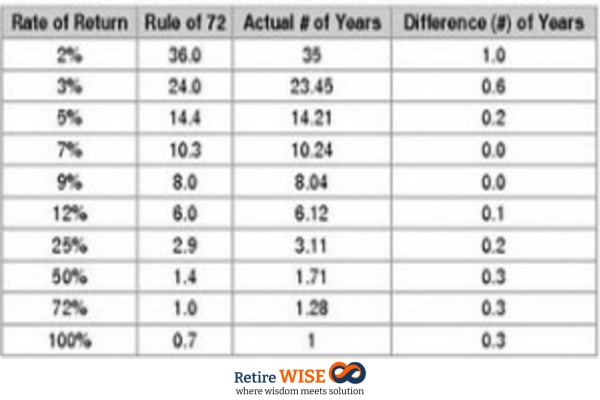
Divide 72 by your expected annual return rate. The result is approximately how many years it takes for your money to double. At 6%: 72/6 = 12 years to double. At 12%: 72/12 = 6 years to double. At 8%: 72/8 = 9 years to double. Simple. Powerful. Almost never used by the people who need it most.

Rule of 72 - How Long to Double Money at Different Return Rates

The Rule of 72 Applied to Your Retirement Corpus

Here is what the Rule of 72 tells you about common Indian investment instruments in 2026.

A bank FD at 7% doubles in approximately 10.3 years. A PPF account at 7.1% doubles in approximately 10.1 years. A balanced advantage fund averaging 10% doubles in approximately 7.2 years. An equity mutual fund averaging 12% doubles in approximately 6 years.

Now apply this to retirement planning. If you have 20 years to retirement and a Rs. 50 lakh corpus today:

In an FD at 7%, it doubles once in 10 years and would be approximately Rs. 1 crore at year 10 and Rs. 2 crore at year 20.

In equity at 12%, it doubles every 6 years – so it doubles approximately 3 times in 20 years: Rs. 1 crore at year 6, Rs. 2 crore at year 12, Rs. 4 crore at year 18, approximately Rs. 4.8 crore at year 20.

Same starting amount. Same 20-year period. The difference between 7% and 12% annual return is a Rs. 2.8 crore gap at retirement – not from any additional savings, purely from the difference in compounding rate.

The Reverse Rule of 72: What Return Do You Need?

The Rule of 72 works in reverse as well. If you want to double your money in a specific number of years, divide 72 by those years to find the required return rate.

Want to double your corpus in 10 years? You need approximately 7.2% annual return. In 8 years? Approximately 9% annual return. In 6 years? Approximately 12%. In 4 years? Approximately 18% – which means taking significant equity risk or being in a exceptional bull market.

This reverse calculation is useful for setting realistic expectations. The investor who wants to “double their money quickly” in 3 years needs 24% annual return – which requires taking enormous risk, not following a sensible investment plan.

The Rule of 72 and the Cost of Delay

The most powerful application of the Rule of 72 for retirement planning is understanding the cost of delaying the start of investment.

At 12% CAGR, money doubles every 6 years. If you start investing at 30 with a lump sum of Rs. 10 lakh, it doubles to Rs. 20 lakh by 36, Rs. 40 lakh by 42, Rs. 80 lakh by 48, Rs. 1.6 crore by 54, and Rs. 3.2 crore by 60. Five doublings over 30 years.

If you start the same Rs. 10 lakh at 36, you only get four doublings by age 60: Rs. 1.6 crore – exactly half the outcome of the person who started 6 years earlier. The 6-year delay cost Rs. 1.6 crore in final corpus from a Rs. 10 lakh starting investment.

That is the mathematical reality behind the advice to start early. It is not a platitude. It is the Rule of 72 in action.

Rules 114 and 144: Tripling and Quadrupling

The Rule of 72 has siblings. Divide 114 by the annual return rate to estimate how many years it takes for money to triple. Divide 144 to estimate the quadrupling time.

At 12% CAGR: money triples in approximately 9.5 years (114/12) and quadruples in approximately 12 years (144/12). Over a 30-year retirement horizon, a 12% return produces not 4x but approximately 29x the original investment – which is what makes starting early and maintaining equity exposure during the accumulation phase so critical for Indian retirement investors.

What the Rule of 72 Does Not Tell You

The Rule of 72 is an approximation tool for compounding mechanics. It assumes a constant annual return, which no investment actually delivers. In reality, equity returns vary significantly year to year – some years +40%, others -30%. The 12% average is the long-run result of those volatile years, not a smooth doubling machine.

This matters particularly for retirement investors near withdrawal: the sequence of returns risk (getting large negative returns early in retirement) can significantly impair the Rule of 72’s theoretical outcome. A 30% fall in year 1 of retirement combined with regular withdrawals produces a much worse outcome than the Rule of 72’s smooth doubling would suggest.

Use the Rule of 72 for goal-setting and motivation – to understand why starting early and maintaining equity exposure matters. Build the actual retirement plan around a proper bucket strategy and stress-tested withdrawal rates.

A Retirement Plan Built Around Your Compounding Timeline

RetireWise builds retirement plans that use the mathematics of compounding strategically – including goal-based asset allocation, equity exposure calibrated to your timeline, and withdrawal planning that protects the corpus from sequence risk. Explore how we work.

See Our Services

One question for you: At your current savings rate and expected return, approximately how many years does the Rule of 72 say it will take for your existing retirement corpus to double? Does that timeline match what your retirement plan requires?

Health Insurance for Parents in India: What Senior Executives Get Wrong (2026 Guide)

“In preparing for battle I have always found that plans are useless, but planning is indispensable.” — Dwight D. Eisenhower

Replace “battle” with “medical emergency at 68” and that quote lands differently, doesn’t it?

You’ve spent 25 years building a career. You’ve planned your retirement. You’ve reviewed your mutual fund portfolio more times than you’ve had family dinners. But your parents’ health insurance? You probably haven’t looked at it since 2017. Or maybe you bought a policy back when Apollo Munich was still Apollo Munich — and quietly assumed the problem was solved.

It wasn’t.

Ramesh (name changed), a 52-year-old VP at a Pune manufacturing company, called me last year. His mother, 71, had a cardiac episode. Hospital bill: Rs. 14.8 lakh. The insurance policy he’d bought four years ago had a sublimit on cardiac procedures. Claim settled: Rs. 3.2 lakh. He paid the rest from his retirement corpus. One medical emergency. One policy gap. Three years of savings — gone.

Health insurance for parents isn’t a box to tick. It’s one of the most consequential financial decisions you’ll make in your 40s and 50s.

⚡ Quick Answer

The best health insurance for senior citizen parents in India (2026) depends on their age, health conditions, and city. Top options include Niva Bupa Senior First, Star Health Senior Citizen Red Carpet, Care Health Advantage, and Aditya Birla Activ Care. New IRDAI rules (2025) have improved the landscape — no age-based rejection, 10% premium hike cap, and PED waiting period down to 3 years.

What IRDAI Changed in 2025

3 Rules Every Senior Citizen’s Family Needs to Know

No

Age-based rejection. Every insurer must cover any age.

10%

Maximum annual premium hike cap. No more 30-40% shocks.

3 Yrs

Maximum PED waiting period. Down from 4 years.

IRDAI Circular — January 30, 2025

What IRDAI’s 2025 Rules Changed for Your Parents

Before we look at plans, here’s what changed in 2025 that most people don’t yet know about.

Three significant IRDAI reforms came into effect. First, insurers must now offer at least one health insurance policy to applicants of any age — the age-based rejection that shut out many 70+ applicants is no longer legal. Second, annual premium hikes for senior citizens are capped at 10% — the days of 30-40% renewal shocks are over. Third, the pre-existing disease waiting period has been reduced from a maximum of 4 years to 3 years — your parents’ diabetes or hypertension must be covered a full year sooner than before.

These are genuine improvements. They don’t make the decision simple, but they do make it more manageable.

Why Health Insurance for Senior Citizen Parents Is Different

Think of health insurance as a bridge. For you at 45, it’s a narrow footbridge — you cross it occasionally. For your parents at 68, it’s a suspension bridge over a ravine. The loads are heavier, the crossings more frequent, and the cost of the bridge failing is catastrophic.

Here’s what still makes parents’ health insurance structurally different from a regular family floater:

Higher claim probability. Claim frequency for the 60-80 age group is significantly higher than for the 35-50 bracket. Insurers know this — it’s why they price it differently and structure products around it.

Pre-existing disease waiting periods. The maximum is now 3 years under new IRDAI rules. But your 70-year-old father with controlled BP may still not be covered for a hypertension-related event until Year 4 of the policy. Buy early — every year you delay, this clock restarts.

Co-payment clauses. Many senior citizen plans require you to bear 20-30% of every claim. On a Rs. 10 lakh surgery, that’s Rs. 2-3 lakh out of pocket. Not highlighted at the time of sale. Always surfaced at the time of claim.

Room rent sublimits. A policy may look like Rs. 5 lakh cover but cap room rent at Rs. 2,000 per day. In any tier-1 hospital in 2026, a standard single room costs Rs. 5,000-12,000 per day. The sublimit then proportionally reduces all other costs — medicines, nursing, doctor fees. A Rs. 5 lakh policy can effectively behave like a Rs. 1.5 lakh policy.

⚠️ The Room Rent Trap

Most policyholders discover room rent sublimits only at the time of claim — not at the time of purchase. Always ask explicitly: “Does this policy have room rent capping?” before signing.

The Section 80D Benefit You’re Probably Underutilising

If you’re paying health insurance premiums for your parents, you can claim a deduction of up to Rs. 50,000 per year under Section 80D for senior citizen parents. This is separate from the Rs. 25,000 deduction for your own family’s health insurance. At a 30% tax bracket, that’s Rs. 15,000 back in your pocket every year.

The premium must be paid by you — not your parents. Payment must be in digital mode. Cash payments don’t qualify.

If both you and your parents are above 60, the combined 80D benefit can reach Rs. 1,00,000 per year. Have this conversation with your CA during tax planning, not at the last minute in March.

Four Questions to Answer Before You Compare Plans

Most people jump straight to premium comparisons. That’s the wrong starting point. Answer these four questions first — they determine everything:

1. What is their current health status? Known conditions, recent surgeries, ongoing medications. This determines pricing and exclusions — not whether they can be covered, since IRDAI now mandates at least one product at any age.

2. What is their age? Below 65 opens significantly more options. Between 65-75, choices narrow. Above 75, at least one product must be offered per IRDAI rules — but premiums rise steeply and product features may be more restrictive. Buy before 70 if you can.

3. Where do they live? Hospital network coverage matters enormously. A policy with strong cashless empanelment in Bengaluru may have poor network in Coimbatore or Jaipur. Always check the hospital list in their specific city before buying.

4. What is their likely usage pattern? Frequent outpatient visits or primarily hospitalisation risk? Some plans now cover OPD — genuinely valuable for parents with chronic conditions who visit specialists monthly.

Best Health Insurance Plans for Senior Citizen Parents (2026)

There’s no single “best plan” — it depends on everything above. Here’s what matters about each credible option:

Niva Bupa Senior First (formerly Apollo Munich / Max Bupa): Consistent claims track record through multiple ownership changes. Good sum insured options up to Rs. 25 lakh, no sublimits on standard plans. Co-payment exists at 20% for some age brackets — verify the version you’re buying.

Star Health Senior Citizen Red Carpet: Designed for the 60-75 bracket. Accepts pre-existing conditions that many insurers reject. Trade-off: 30% co-payment on pre-existing disease claims in Year 1. For parents with cardiac history or diabetes who’ve been rejected elsewhere, this is often the viable path.

Care Health Advantage (formerly Religare Care): No sublimits, smooth renewal process. Unlimited restoration benefit — if your parents exhaust the sum insured in one hospitalisation, it resets for a second event in the same year. Meaningful for the 70+ age group.

Aditya Birla Activ Care: Good OPD coverage and wellness benefits — useful for parents with chronic conditions. More transparent policy document than most. Flexible sum insured options.

Star Health Cardiac Care: If your parent has a documented cardiac history, most general plans will reject or heavily load them. This specialised product was built specifically for that situation.

PSU insurers — National Insurance, Oriental Insurance, United India — remain options for parents with complex conditions private insurers won’t touch. Claims processing is slower. Acceptance criteria are often more flexible.

The Super Top-Up Strategy Most Families Miss

A comprehensive Rs. 20 lakh base policy for a 68-year-old with controlled diabetes costs Rs. 40,000-60,000 per year. That grows every renewal — capped at 10% now, but compounding. In 10 years, you could be paying Rs. 1 lakh+ annually just in premiums.

💡 The Smarter Architecture

Base plan: Rs. 5-10 lakh (lower premium) + Super top-up: Rs. 10 lakh with matching deductible. Combined premium is significantly lower than a standalone Rs. 15-20 lakh plan. The protection level is similar or better. This is the structure most agents won’t explain — because the base plan premium is what drives their commission.

The super top-up aggregate deductible works over the entire policy year, not per hospitalisation. Two Rs. 3 lakh hospitalisations in one year, with a Rs. 5 lakh deductible, means the super top-up pays Rs. 1 lakh. A Rs. 10 lakh super top-up with Rs. 5 lakh deductible costs roughly Rs. 8,000-12,000 per year at age 70.

The Clock Is Not on Your Side

Health insurance for senior citizens gets harder and more expensive every year you wait. A policy bought at 63 starts a 3-year waiting period that covers a condition by 66. The same policy bought at 67 covers it at 70. Four years matter enormously when you’re 68 and a cardiac event is not hypothetical.

The IRDAI changes make the market fairer. They don’t make delay cost-free.

Still uncertain about the right plan?

A 30-minute conversation often resolves what hours of online comparison doesn’t. We review your parents’ specific situation, shortlist 2-3 plans, and flag what to watch in the fine print.

Talk to a RetireWise Advisor

Frequently Asked Questions

Can I add my parents to my family floater health insurance?

Most family floaters allow parents, but the premium is calculated on the oldest member’s age. Adding a 68-year-old parent to your floater will roughly double your premium and often reduces overall coverage efficiency. Separate individual policies for parents are usually the better structure.

Can insurers now deny health insurance to senior citizens based on age?

No. As per current IRDAI guidelines, every insurer must offer at least one health insurance product regardless of the applicant’s age. However, premiums increase significantly with age, choices narrow considerably after 75, and product features may be more restrictive. The right to coverage is now protected — the cost and terms are not fixed.

What is the waiting period for pre-existing diseases in health insurance?

As per updated IRDAI guidelines, the maximum waiting period for pre-existing diseases is now 3 years, reduced from the earlier 4 years. The sooner you buy, the sooner this clock completes.

How much health insurance cover is enough for parents above 65?

In metro cities, a minimum of Rs. 10 lakh sum insured is recommended for parents above 65. Medical inflation in India runs at 10-15% annually — layer a super top-up plan on top to extend protection without a proportional premium increase.

Can I claim Section 80D deduction for parents’ health insurance if they are not dependents?

Yes. Section 80D allows the deduction for premiums paid for parents regardless of dependency. The limit is Rs. 50,000 for senior citizen parents above 60, separate from your own family’s Rs. 25,000 deduction. The only conditions: you pay the premium, and payment is in non-cash mode.

Don’t let your parents become a financial emergency. That’s not what they need from you. And it’s not the retirement you’ve spent 25 years building toward.

The best time to buy health insurance for your parents was five years ago. The second best time is today.

💬 Your Turn

What’s the current sum insured on your parents’ health insurance — and when did you last check whether it still makes sense? Share below, or mention the city they live in and I’ll tell you what the network coverage looks like.

Health Insurance Terms Explained: What Every Indian Should Know Before Retirement

“The time to understand your health insurance policy is before you need to use it. Not in the emergency ward at midnight.”

Most people buy health insurance and file the policy document away without reading it. They find out what their policy actually covers – and what it does not – when they submit a claim and discover a word they never understood: sublimit, co-payment, waiting period, room rent cap.

By then, it is too late to negotiate.

This is especially true for senior executives approaching retirement. Your employer’s group policy has been covering you for years. The day you retire, it stops. The personal health insurance you buy – or the coverage you already hold – becomes your only protection. And if you do not understand what the terms mean, you may discover the gaps at exactly the wrong moment.

⚡ Quick Answer

Health insurance policies are written to protect the insurer as much as the insured. Understanding terms like waiting periods, sublimits, co-payment, room rent caps, and restoration benefits is not optional – it is the difference between a policy that works when you need it and one that pays 40% of what you expected. This guide explains every key term in plain language, with specific retirement implications where they matter most.

Health insurance terms explained in plain language - India 2026

The Terms That Catch People Out Most Often

Waiting Period. Most health insurance policies have a waiting period for pre-existing diseases – typically 2-4 years from policy inception. During this period, any hospitalisation related to a condition you had before buying the policy is not covered. This is why buying health insurance in your 30s or early 40s – before conditions develop – is dramatically better than buying at 55. By the time you actually need to claim, the waiting period for pre-existing conditions is largely served.

There is also an initial waiting period of 30 days for most policies (except accidents), during which no claims are accepted at all. And specific waiting periods of 1-2 years apply for defined conditions like hernia, cataracts, joint replacement, and several other procedures.

Sum Insured. The maximum amount the insurer will pay for medical expenses in a policy year. This is the headline number most people focus on – Rs 5 lakh, Rs 10 lakh, Rs 50 lakh. What people miss: the sum insured is the ceiling, not the guarantee. Every other term in the policy constrains how much of that ceiling you can actually access.

Room Rent Cap. One of the most damaging hidden limitations in older policies. Many policies cap reimbursement for the hospital room at 1% or 2% of the sum insured per day. On a Rs 5 lakh policy, that is Rs 5,000 per day. If you are admitted to a room at Rs 8,000 per day, the insurer does not just deduct the Rs 3,000 difference – they proportionately reduce all other claim components (surgeon fees, ICU charges, diagnostics) based on the ratio of your actual room cost to the covered limit.

A Rs 10 lakh surgery claim on a policy with a room rent cap can settle at Rs 6-7 lakh because you chose a room Rs 2,000 per day above the limit. Read the room rent clause before buying. Prefer policies with no room rent cap, or at minimum a cap above standard single private room rates in your city.

Co-Payment. A percentage of every claim that you pay out of pocket, regardless of whether the claim is within the sum insured. Common in senior citizen policies – a 20% co-payment means you pay Rs 2 lakh on a Rs 10 lakh claim. Co-payment policies are cheaper to buy but more expensive to claim on. For retirees who may claim more frequently, evaluate whether the lower premium justifies the higher out-of-pocket cost at claim time.

Deductible. A fixed amount that you pay first before the insurer starts paying. A Rs 50,000 deductible means you bear the first Rs 50,000 of every hospitalisation. This is the basis of top-up and super top-up plans, which offer high sum insured at low premium precisely because they only activate above the deductible threshold.

“In 25 years of reviewing client finances, I have seen more retirement plans disrupted by medical costs than by market crashes. Not because the insurance was absent – but because it was misunderstood.”

– Hemant Beniwal, CFP, CTEP | Founder, RetireWise

Terms That Determine What Gets Covered

Sublimits. Caps on specific treatments within the overall sum insured. A policy with Rs 10 lakh sum insured might have a sublimit of Rs 2 lakh for cataract surgery, Rs 1 lakh for dental, or Rs 50,000 for specific procedures. Sublimits are the most common source of claim disputes. Always check the sublimit schedule before buying – especially for conditions most likely to affect you based on your age and family history.

Pre-existing Disease (PED). Any condition diagnosed or treated before the policy start date. Hypertension, diabetes, thyroid conditions, and orthopaedic issues are the most common PEDs for people in their 40s and 50s. These are covered only after the waiting period expires, and must be declared truthfully at the time of purchase. Non-disclosure of PEDs is the single most common reason insurers reject claims outright.

Day Care Procedures. Medical procedures that previously required 24-hour hospitalisation but can now be completed in a few hours due to medical advances. Cataract surgery, chemotherapy, dialysis, and over 500 other procedures now qualify as day care under IRDAI guidelines. Most modern policies cover day care procedures. Older policies from before 2013 may not – worth checking.

Domiciliary Hospitalisation. Treatment taken at home for conditions that would otherwise require hospitalisation, either because the patient’s condition makes movement inadvisable or hospital beds are unavailable. Some policies cover this; many do not. Particularly relevant for elderly parents who may prefer or require home-based treatment.

Is your health insurance actually adequate for retirement?

A RetireWise retirement plan reviews your health cover – sum insured, sublimits, waiting periods, and portability from group policy – and identifies gaps before they become problems.

Book a Free 30-Min Call

Terms That Affect Policy Value Over Time

No Claim Bonus (NCB). An increase in sum insured (or reduction in premium) for every claim-free year. Some policies increase the sum insured by 10-50% per year up to a cap. A Rs 5 lakh policy held for 10 claim-free years can grow to Rs 10 lakh sum insured at the same premium. This is one of the most valuable features of a long-held personal policy – and another reason never to lapse and restart coverage.

Restoration Benefit. If your sum insured is fully exhausted in a policy year, a restoration benefit replenishes it for subsequent hospitalisations in the same year. Critical for families where multiple members could claim in the same year, or for individuals with a serious illness requiring multiple admissions. Not all policies offer this – it is worth paying extra for if you have dependents on a floater policy.

Top-Up vs Super Top-Up. Both work on a deductible basis. The key difference: a top-up plan applies the deductible per hospitalisation (each event must separately exceed the deductible). A super top-up applies the deductible to aggregate claims across the year. If your deductible is Rs 5 lakh and you have two hospitalisations of Rs 4 lakh each in one year – neither triggers a standard top-up, but both aggregate to Rs 8 lakh under a super top-up, triggering Rs 3 lakh of cover. For retirees with chronic conditions or older family members who may have multiple smaller claims, super top-up is significantly more practical.

Portability. IRDAI rules allow you to port your health policy from one insurer to another without losing waiting period credits already served. Three years of waiting period on your current policy transfers to the new insurer on porting. Portability is most valuable when retiring and moving from a group to an individual policy, or when your current insurer increases premiums sharply at renewal.

The Retirement-Specific Angle: What Changes at 60

Three things happen to your health insurance situation at retirement that most people do not plan for.

First, your employer group policy stops on the day you retire. IRDAI rules give you the right to convert that group coverage to an individual policy within 90 days, with waiting period credits preserved. Most HR departments do not mention this proactively. If you are retiring soon, ask your HR team explicitly about this portability window.

Second, premiums increase significantly at age 60-65. Most insurers load premiums by 50-100% at renewal when you cross these thresholds. A premium of Rs 25,000 per year at 55 may become Rs 55,000-60,000 by 68. This is predictable and must be budgeted for explicitly in retirement income planning – not treated as a surprise.

Third, continuity benefits become even more valuable. The longer an uninterrupted policy has been running, the better the terms – higher NCB accumulated, all waiting periods served, no fresh underwriting. A policy lapse at 62 and restart at 63 means fresh waiting periods at an age when pre-existing conditions are most likely to require treatment. Never allow a health policy to lapse.

Read – How Much Health Insurance Do I Need in India?

Read – Critical Illness Insurance: Why Health Insurance Is Not Enough

Frequently Asked Questions

What is the difference between a top-up and a super top-up health plan?

A top-up plan applies the deductible separately to each hospitalisation – every single event must exceed the deductible before the top-up pays. A super top-up applies the deductible to your total claims across the policy year – multiple smaller hospitalisations aggregate toward the deductible. For anyone with a chronic condition or multiple family members likely to claim, super top-up is substantially more useful. A Rs 20 lakh super top-up with a Rs 5 lakh deductible (covered by your base policy) is an efficient way to build Rs 25 lakh total cover at a relatively low premium.

Can I keep employer health insurance after retirement?

Most employer group policies do not extend to retirees. However, IRDAI’s portability rules allow you to convert group coverage to an individual policy within 90 days of retirement, preserving waiting period credits. This is one of the most valuable rights a retiring employee has. Ask your HR team explicitly before your last working day – do not assume it will be handled automatically.

Does health insurance cover pre-existing conditions like diabetes or hypertension?

Yes, after the waiting period – typically 2-4 years from policy inception. Conditions that existed before the policy start date are covered once the waiting period is served, provided they were disclosed truthfully at inception. Always declare pre-existing conditions accurately. Non-disclosure is the most common reason claims are rejected, and the consequences – a denied claim plus potential policy cancellation – are far worse than a slightly higher premium or a condition-specific waiting period.

The health insurance policy that settles your claim smoothly and fully is almost always one the policyholder understood before buying. The one that pays 60 paise on the rupee is almost always one they did not. The difference is not luck. It is whether you read – and understood – the terms before the emergency arrived.

Your health insurance is only as good as your understanding of it. And understanding costs nothing except time.

Want your health insurance reviewed as part of your retirement plan?

RetireWise includes a health insurance adequacy review in every retirement plan – sum insured, gaps, portability from group policy, and senior citizen loading estimates.

See Our Retirement Planning Service

💬 Your Turn

Have you ever had a health insurance claim settled for less than you expected? Which term was the culprit – room rent cap, sublimit, co-payment? Share in the comments.

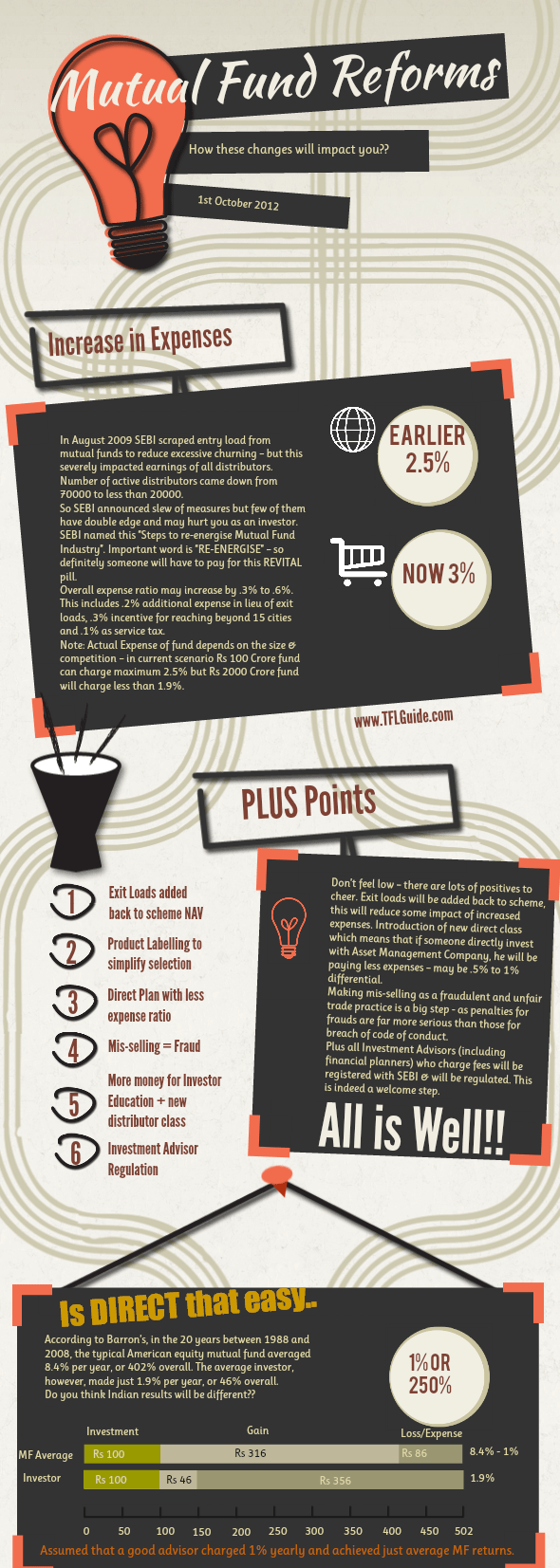
Mutual Fund Reforms India: A Historical Infographic (2012)

This infographic was created in 2012, when SEBI introduced several landmark mutual fund reforms – including the entry load ban (2009) and the introduction of direct plans (2013). It captures a pivotal moment when mutual fund investing became significantly more investor-friendly in India.

The reforms depicted here set the foundation for what is now a Rs. 67 lakh crore mutual fund industry in India (as of 2024). Many of the principles illustrated – cost transparency, investor protections, direct access – have since been strengthened further through the 2018 categorisation reforms and 2020 SEBI IA amendments.

Mutual Fund Reforms India - Historical Infographic

Understanding How Mutual Funds Work Today

For a current guide on how to evaluate and select mutual funds in the 2026 landscape, see our fund selection framework.

How to Select Mutual Funds in India

Asset Allocation: The One Formula That Actually Drives Investment Success

“Diversification is the only free lunch in investing.”
– Harry Markowitz, Nobel Laureate

Last week I met an old friend for dinner. He is a very sharp person – a senior executive at a large manufacturing company in Jaipur. Before we had even ordered, he leaned across the table and said: “Hemant, I have Rs 25 lakhs sitting in my savings account. Tell me which stocks to buy.”

I asked him how long he could stay invested. He said he wasn’t sure. I asked what the money was for. He said “just to grow it.” I asked how he would feel if it fell 40% in a year. He paused. Then he said: “I’d probably sell.”

That conversation told me everything I needed to know. Not which stocks to buy. But what his asset allocation should be – and why choosing stocks was the wrong starting question entirely.

This is the thing most investors skip. They ask “which fund?” before they ask “how much in equity?” They ask “when to buy?” before they ask “what kind of portfolio can I actually hold through a crash?” Asset allocation – the decision of how to divide your money across asset classes – is not a technical detail. It is the foundation that everything else rests on.

⚡ Quick Answer

Asset allocation means dividing your investments across equity, debt, and gold in proportions suited to your goals, timeline, and genuine risk tolerance. Research by Brinson, Hood & Beebower showed that over 90% of long-term portfolio returns come from asset allocation decisions – not stock picking or timing. Set the right allocation, rebalance annually, and let compounding do the work. This is both the simplest and the hardest thing in investing.

Asset allocation formula for investment success India

The Gujarati Thali Lesson

Here is how I explain asset allocation to new clients. Imagine a Gujarati thali. The moment you sit down, the aroma hits you. Fifteen small katoris arrive – dal, kadhi, shaak, rice, roti, farsan, pickle, papad, sweet. Everything at once.

If you don’t know what a thali is, you might fill your plate with farsan and pickle because they look appealing. Then you have no room for the main meal. And you paid for everything.

Now compare that to your everyday meal at home. You know exactly what the main course is. Roti or rice. Sabzi. Dal. The proportions are set. You don’t confuse pickle with rice. The meal is more satisfying because it is structured.

Your investment portfolio is the same. India offers hundreds of mutual funds, stocks, bonds, gold, real estate, NPS, PPF, FDs, and more. Without a clear asset allocation, investors fill their portfolio with whatever looks attractive at the moment – last year’s best-performing sector fund, a friend’s tip, a flashy NFO – and end up with something incoherent that they cannot hold through a downturn.

Asset allocation is the meal plan. Everything else is just choosing which dal to make.

The Four Types of Investors

Before deciding an asset allocation, it helps to know where you honestly stand. Here are four types, defined by two axes: whether you believe in selecting the best security, and whether you believe in timing the market.

Type 1 – The Optimist: Believes both stock picking AND market timing are possible. This is where almost all retail investors and their brokers/agents start. It is the most dangerous position because it leads to overtrading, excessive fees, and performance that trails a simple index over any 10-year period.

Type 2 – The Active Long-Term Investor: Believes good stock or fund selection is possible but market timing is not. Most professional fund managers fall here. They pick securities carefully but do not try to move in and out of the market. This is a defensible position if you have genuine edge in security selection – which most people do not.

Type 3 – The Trader: Does not care which security to buy but believes in timing the entry and exit. Day traders and technical analysts. Possible to profit short-term, but the long-term track record of pure market timers is very poor.

Type 4 – The Humble Allocator: Accepts that neither reliable security selection nor market timing is consistently possible for most people. Focuses on asset allocation and rebalancing. This is where over 90% of long-term investment returns actually come from – as multiple academic studies have confirmed.

If you fall in Type 4, you are not being defeatist. You are being accurate. And that accuracy is what enables you to build wealth systematically without needing to be right about individual stocks or market cycles.

What the Data Has Always Shown

The original Brinson, Hood and Beebower study (1986, updated 1991) analysed the returns of large pension funds and found that asset allocation policy explained over 90% of the variation in returns across funds and over time. Security selection and timing together explained less than 10%. This finding has been replicated in the Indian context – long-term equity mutual fund SIP investors who maintained their asset allocation through 2008, 2013, 2018, and 2020 corrections consistently outperformed those who tried to time the market by moving to cash or switching sectors.

The best investment decisions most people will ever make are: set an allocation, automate contributions, and rebalance once a year. That is not a simplified version of good investing. That IS good investing for most people.

How to Choose Your Asset Allocation

Think of it like planning a drive. Before deciding how fast to go, an experienced driver asks three questions. The same logic applies to investing.

Question 1: How far is the destination? If your goal is 20+ years away – a retirement corpus, a child’s higher education – you have time to ride out equity volatility. Higher equity allocation (60-80%) makes sense. If your goal is 3-5 years away, debt should dominate (60-70% in fixed income). The ground rule: longer the horizon, higher the equity exposure.

Question 2: What is your actual risk tolerance – not theoretical? The questionnaires that ask “how comfortable are you with a 30% drop?” are misleading. Everyone says they are comfortable until it actually happens. The real test is: have you been through a significant market fall before? How did you respond? If you have never experienced a 35-40% portfolio fall, assume your actual tolerance is lower than what you think.

At 45, you cannot have 100% equity even if your horizon is long. The mathematical argument for high equity is valid. The behavioural reality – that most investors will panic-sell after a 40% fall – means the theoretically optimal allocation is not the practically sustainable one.

Question 3: What is your income and expenditure stability? A government employee with a pension and low debt can hold more equity than a self-employed professional with variable income and high EMIs. Asset allocation must be stress-tested against your worst-case income scenario, not your average one.

The Magic of Annual Rebalancing

Here is a real example of what asset allocation with annual rebalancing can do. Take an investor who put Rs 10 lakhs in April 1999 across equity (Sensex) at 50%, debt at 30%, and gold at 20%. If they simply held without rebalancing, by 2010 they would have Rs 45 lakhs. If they rebalanced annually back to the original proportions, they would have Rs 53 lakhs – 18% more, with lower volatility along the way.

Rebalancing works by forcing you to do the psychologically difficult thing automatically: sell what has gone up and buy what has gone down. After equity markets ran up 80%+ in 2007, annual rebalancing would have moved money from equity to debt. After markets fell 50%+ in 2008, it would have moved money back into equity – exactly when most investors were fleeing. The discipline does the contrarian work without requiring any forecast.

Asset Allocation in Retirement

The asset allocation question becomes most critical – and most often ignored – at the point of retirement. Many investors spend 25 years building a corpus with a clear accumulation strategy and then arrive at retirement with no idea how to structure the drawdown.

In retirement, the focus shifts from growth to sustainability. You need an allocation that generates income, keeps pace with inflation (which runs at 6-7% in India for a typical household), and does not force you to sell equity at market lows to fund monthly expenses.

A common retirement structure is a bucket approach: a short-term bucket in liquid or ultra-short debt funds covering 2-3 years of expenses; a medium-term bucket in balanced or conservative hybrid funds covering years 3-7; and a long-term growth bucket in equity funds meant to compound over 8+ years. This structure means you never need to touch your equity when markets are down.

The equity allocation in retirement should not be zero. At 60, with a 25-30 year retirement ahead, having some equity exposure – 25-35% – is essential to keep pace with inflation. A completely debt-based portfolio will likely run out of money before you do.

The most important investment decision you will ever make is not which fund to pick.

It is how to divide your money across asset classes – and whether you have the discipline to hold that allocation through a 40% market fall.

See How RetireWise Builds Asset Allocations

Back to my friend at dinner. I told him his Rs 25 lakhs needed a different question than “which stocks?” He needed to ask: “What am I building toward? When will I need this money? What happens to my life if this portfolio falls 40%?”

Once he answered those, the asset allocation became clear. And once the allocation was clear, the specific instruments – which funds, which debt instruments, how much gold – were secondary decisions that almost made themselves.

Strategy first. Instruments second. In that order, always.

Investing is simple. Not easy. Asset allocation is the part that makes it work even when it is not easy.

Do the Right Thing and Sit Tight.

A retirement portfolio is not just an accumulation engine. It is a machine designed to fund a life for 25-30 years.

The asset allocation design is where that machine is built or broken. We help you get it right from the start.

Book a Free 30-Min Call

Your Turn

What does your current portfolio allocation actually look like – across equity, debt, and gold? And does it match your real risk tolerance, or the one you thought you had before the last market fall?