A client came to me in 2022 – 58 years old, senior VP at a pharma company, 32 years of service. He sat across the table and said something that stays with me: “My parents still live with us. My father is 84. I asked him last week if he needed anything and he said no. I wonder if I will be that lucky.”
Then he handed me a napkin with a number written on it. Rs.1.5 crore. “That’s what I think I need for retirement,” he said.
I pulled out my calculator. His current monthly household expense: Rs.1.5 lakh. Inflation at 6%. Life expectancy to 85. That Rs.1.5 crore would run out in under 7 years. He needed Rs.5.8 crore minimum – and closer to Rs.8 crore to retire with any margin.
He went quiet for a long time. “Why didn’t anyone tell me this earlier?”
Quick Answer
Most Indians underestimate their retirement corpus by 60 to 80%. The typical mistake: calculating corpus assuming a fixed return with no inflation adjustment. In reality, inflation erodes purchasing power, medical costs rise faster than general inflation, and most people live 20 to 30 years post-retirement. A 45-year-old spending Rs.1.5 lakh per month today may need Rs.8 to 12 crore to retire comfortably at 60.

The perception gap – what you think you need vs what you actually need
When I ask new clients “how much do you need for retirement?”, the answers cluster around Rs.1 to 2 crore. When I show them what that actually buys – adjusted for inflation, tax, and 25-year longevity – the mood in the room changes.
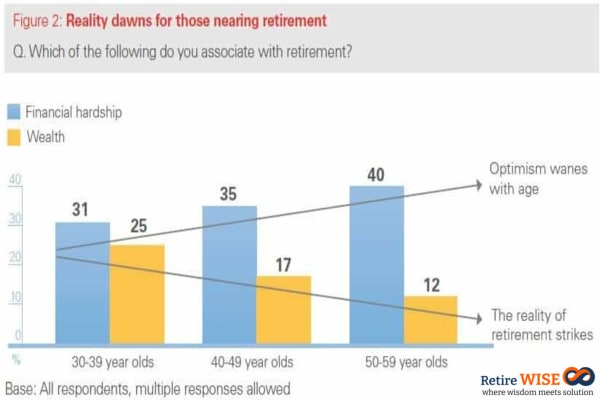
Pre-retirees are optimistic. Recent retirees are anxious. Those 5 to 10 years into retirement are the most worried. The older you get, the more you understand what the numbers mean when there is no salary coming in.
As Mark Twain said: “Plan for the future, because that’s where you are going to spend the rest of your life.”
Why the simple corpus calculation is dangerously wrong
The most common calculation I see: “I spend Rs.80,000 per month. At 8% return on corpus, I need 12.5x annual spend – Rs.1.2 crore.” Clean. Simple. Completely wrong.
Here is what it misses:
Inflation compounds silently. Rs.80,000 today is not Rs.80,000 at age 70. At 6% inflation over 10 years, that same lifestyle costs Rs.1.43 lakh per month. At 80, it costs Rs.2.57 lakh. Your corpus must grow faster than you withdraw – which becomes impossible unless you started with a much larger base.
Medical costs are a separate crisis. Healthcare inflation in India runs at 11 to 14% annually – nearly double general inflation. A hospitalisation costing Rs.5 lakh today will cost Rs.15 to 20 lakh in 15 years. Most people budget only for their current health insurance premium and assume that covers it. It does not.
Post-retirement returns are lower than you assume. Most people shift to “safe” FDs and debt funds as they age. An all-debt portfolio earns 6 to 7% gross. After tax at slab rate (all debt income post April 2023 is taxed at slab) and inflation, the real return is close to zero. The 8% assumption holds only if you stay partly in equity – which many retirees are uncomfortable doing.
You will live longer than you plan for. In urban, educated families with access to good healthcare, planning to age 85 to 90 is realistic. Plan for 25 to 30 years of retirement, not 15.
What the actual numbers look like in 2026
A realistic retirement corpus table for someone retiring at 60, planning 25 years of inflation-adjusted withdrawals at 6% inflation with a balanced portfolio at 9% post-tax:
| Current Monthly Expense | Corpus Needed (Retire Now) | Corpus Needed (Retire in 10 Yrs) |
|---|---|---|
| Rs.60,000/month | Rs.2.8 crore | Rs.5.0 crore |
| Rs.1 lakh/month | Rs.4.7 crore | Rs.8.4 crore |
| Rs.1.5 lakh/month | Rs.7.0 crore | Rs.12.6 crore |
| Rs.2 lakh/month | Rs.9.4 crore | Rs.16.8 crore |
Assumptions: 6% inflation, 9% portfolio return post-tax, 25 years post-retirement. Medical corpus not included – add Rs.1 to 2 crore separately. Treat as a floor, not a ceiling.
Find your current monthly expense and read across. The gap between what most people have accumulated and what they actually need is the retirement crisis hiding in plain sight.
The 5-step retirement readiness check
Step 1: Know your actual number. Use the table above as a starting point. Add Rs.1 to 2 crore for a dedicated medical corpus. This is your target.
Step 2: Know where you stand today. Total all investable assets – EPF, PPF, mutual funds, NPS, FDs, stocks. Exclude primary home and jewellery. This is your current corpus.
Step 3: Calculate the gap. Project your current corpus forward at realistic returns. At your current savings rate, will you reach the target by retirement? If not, the gap tells you exactly how much to increase monthly SIPs – or how many years to delay retirement.
Step 4: Check your insurance base. Adequate term cover (minimum 10x annual income), health cover (Rs.25 to 50 lakh family floater plus a super top-up), and critical illness cover if not already in place.
Step 5: Review annually. A retirement plan built in 2020 with 2020 assumptions may be significantly off by 2026. Salary, inflation, and tax rules have all changed. Review at minimum once a year.
Also read: How to Save for Retirement in India – The Complete Guide
Do you know your actual retirement number?
Most senior executives I meet have never calculated their corpus with inflation, medical costs, and longevity factored in. In a 30-minute clarity call, we build your number – and tell you honestly whether you are on track or how big the gap is.
Frequently asked questions
How much corpus do I need to retire in India in 2026?
A rough starting point: multiply your current monthly expense by 600 to 800 for a 25-year inflation-adjusted retirement. For someone spending Rs.1 lakh per month and retiring today, that means Rs.6 to 8 crore minimum – before adding a separate medical corpus. Add Rs.1 to 2 crore for healthcare costs. Most people underestimate by 50 to 80% because they ignore inflation compounding over 20-plus retirement years.
At what age should I start retirement planning in India?
The urgency genuinely intensifies at 40. Before 40, compounding does heavy lifting and modest SIPs build significant corpus. Between 40 and 50, there is still time to correct course but the monthly investment required increases sharply with every year of delay. After 50, the options narrow: increase savings dramatically, reduce retirement lifestyle expectations, or delay retirement. Starting at 35 vs 45 requires roughly 3x the monthly investment to reach the same corpus at 60.
What are the biggest retirement planning mistakes in India?
The five most common: (1) Ignoring inflation – calculating corpus at today’s expenses rather than future inflated costs. (2) Relying on EPF alone – it is a foundation, not a complete plan. (3) No separate medical corpus – healthcare inflation at 12% annually makes this mandatory. (4) Supporting adult children at the cost of retirement savings – the single biggest late-career threat. (5) Shifting entirely to FDs post-retirement – real returns after tax and inflation are close to zero, silently eroding purchasing power over 20-plus years.
What number do you have in mind for your retirement corpus? Does the table above change that number? Share in the comments.