🚫 Update: Speak Asia was confirmed as a Ponzi scheme
This article was written in May 2011. Speak Asia was subsequently investigated by the Enforcement Directorate and multiple state police agencies. The company collapsed in 2012, thousands of investors lost money, and its promoters faced criminal prosecution. The original article below is preserved as a historical record – it correctly identified the red flags before the collapse. The warning signs listed here remain relevant for any online investment scheme today.
Who will not like to earn a lot of money – the easier you can earn it, the better. What about paying Rs.10,000 to Rs.12,000 a year and getting Rs.52,000 back? And also getting huge passive income on top of that.
This was the plan marketed by Speak Asia – an online survey company, they claimed. You just had to fill surveys and the earnings would start. But my mind was not allowing me to think of them as anything other than a multilevel marketing company dressed up as a legitimate business.
I am writing this because my uncle – not a real uncle but a close family friend – is a “Speak Asian.” Yesterday a friend called me: “Your uncle is part of Speak Asia and doing wonderful work.” He shared his login and I could see the earnings: almost Rs.5 to 6 lakh in the last month on his “investment” of Rs.12,000. Even a new Skoda Laura was purchased on the back of these supposed earnings.
When something is too good to be true – avoid it. Always.
Why I believed this was a Ponzi scheme (written May 2011)
A few things that anyone willing to think clearly could see:
They were registered in Singapore but not in India. Filing a case in a Singapore court for Rs.12,000 is not a realistic option for most Indian investors.
They were technically “selling subscriptions to an online newsletter” (Ezine). If surveys stopped coming, you could not take them to court – you were still receiving the Ezine. This gave them legal cover.
The Ezines were copy-pasted from Wikipedia and other sources. There was no original content.
They had 7.5 lakh panelists at the time, growing to 1 crore. At 1 crore members each receiving Rs.52,000 annually, the total payout would be Rs.52,000 crore per year. Who was going to pay this?
The company had changed its name 3 to 4 times in a few years.
Three lakh of their members were from Uttar Pradesh. Amar Ujala reported that many couldn’t fill surveys due to lack of English or internet skills and were paying Rs.50 to others to do it for them.
As Warren Buffett said: “You only find out who is swimming naked when the tide goes out.” The music was loud in 2011. The party ended in 2012.
What actually happened (the 2026 update)
Speak Asia collapsed in mid-2012. The Enforcement Directorate, CBI, and multiple state police forces investigated. The company had collected hundreds of crores from Indian investors. Criminal cases were filed against its promoters. Investors who had made “returns” through the pyramid had actually been paid using the money of newer investors – the classic Ponzi structure.
The uncle who drove the Skoda Laura on his “earnings” did not keep those earnings. When the scheme collapsed, the money at the bottom of the pyramid – the actual cash invested by the last batch of members – was lost.
The pattern repeats
Speak Asia is gone. But the pattern never goes away. In 2024 and 2025, SEBI prosecuted dozens of online “investment platforms” operating on the same logic – promise high guaranteed returns, recruit new members, pay early members with new members’ money, collapse when recruitment slows.
The warning signs are always the same: returns too high to be real, recruitment required for maximum earnings, company registered abroad with no Indian regulatory oversight, urgency to invest before the “slots fill up.”
Every Ponzi scheme in history has exploited the same human desire: high returns, fast. The investors who build real wealth do it the boring way – consistent investing in diversified equity over long periods. It does not make a Skoda Laura story. It does make a retirement.
Speak Asia collapsed in 2012 after the Enforcement Directorate and multiple state police agencies launched investigations. The company had collected hundreds of crores from Indian investors. Its promoters faced criminal prosecution under the Prize Chits and Money Circulation Schemes (Banning) Act. Investors who had made apparent “returns” through the pyramid structure found that their earnings were unsustainable – the money came from new investors, not from any real business activity.
How do you identify a Ponzi or MLM scheme in India?
Key warning signs: returns that are disproportionately higher than market rates (above 15 to 20% annually with no market risk is a red flag); income that requires recruiting new members to sustain; company registered in a foreign jurisdiction with no Indian regulatory presence; pressure tactics and urgency to invest; no audited financial statements available; inability to explain clearly how the business actually generates the returns it promises. If in doubt, verify with SEBI and check if the entity is registered as an investment adviser or broker at sebi.gov.in.
Were you or someone you know affected by Speak Asia or a similar scheme? Share in the comments – your experience may help someone else recognise the pattern early.
Over 25 years of advising clients, I have been asked the same mutual fund questions hundreds of times. The questions never change much. The answers, however, need constant updating – because the tax rules, the product landscape, and the market data have all shifted significantly since I first wrote this post in 2011.
Here are the 8 most important mutual fund questions, with answers updated for 2026.
Quick Answer
The 8 questions most people ask about mutual funds: NAV myth (low NAV is not better), dividend vs growth (growth is better for most), mutual fund taxation (changed significantly in 2023 and 2024), charges (expense ratios now capped lower), timing the market (don’t try), infrastructure funds (avoid as a theme), equity vs real estate (equity wins long-term), MF vs direct equity (mutual funds for most people).
Question 1: Is a mutual fund with a low NAV better?
This is the most common myth in Indian mutual fund investing. Investors believe that a fund with a NAV of Rs.15 is “cheaper” than one with a NAV of Rs.500, and that they will get more units and therefore more returns.
This is completely wrong. NAV is simply the current value of the fund’s portfolio per unit. A higher NAV means the fund has delivered better returns historically – it is a sign of performance, not expensiveness.
Whether you invest Rs.1 lakh at Rs.15 NAV (getting 6,666 units) or at Rs.500 NAV (getting 200 units), your return depends entirely on how the underlying portfolio performs – not on how many units you hold. If the portfolio grows 20%, both investments give you 20% return.
Low NAV is a sales gimmick used to sell NFOs where agent commissions are higher. Always say no to NFOs.
Question 2: Dividend plan or growth plan – which is better?
Most mutual fund schemes come in two options – dividend (now called IDCW: Income Distribution cum Capital Withdrawal) and growth.
Under the growth option, your NAV compounds without interruption. Under the IDCW option, the fund periodically distributes money to you by reducing the NAV – you are essentially getting your own money back, not “income.”
From an investment perspective, growth is better for most investors because compounding works without interruption. The IDCW option makes sense only in specific situations – primarily for retirees who need regular cash flow and want the psychological comfort of periodic payouts.
The tax update for 2026: IDCW (formerly dividend) from mutual funds is now taxed as income in the hands of the investor at their slab rate. For someone in the 30% bracket, this makes IDCW significantly less efficient than growth. Under the growth option, you pay capital gains tax only when you redeem.
Question 3: What are the tax benefits in mutual funds? (2026 update)
This section has changed dramatically since the original post. The 2026 tax rules for mutual funds:
Equity funds (65%+ in equity):
Short-term capital gains (STCG, held under 1 year): 20% (changed from 15% in Budget 2024)
Long-term capital gains (LTCG, held over 1 year): 12.5% on gains above Rs.1.25 lakh per year (changed from 10% in Budget 2024)
IDCW (dividend): Taxed at your income slab rate
Debt funds (less than 65% in equity, purchased after April 1, 2023):
All capital gains (regardless of holding period): taxed at your income slab rate
The indexation benefit and 20% LTCG rate were removed for debt funds from April 2023
ELSS funds: Still qualify for 80C deduction of up to Rs.1.5 lakh under the old tax regime. Returns taxed as equity LTCG on redemption. 3-year lock-in applies. Under the new tax regime, 80C is not available.
Question 4: What are the charges in mutual funds?
The “No Entry Load era” that the original post referred to (after C.B. Bhave’s landmark 2009 reform) continues. SEBI has since further reduced maximum expense ratios:
Equity funds: Maximum 2.25% for smaller funds (previously 2.5%), declining with AUM size
Debt funds: Maximum 2% for smaller funds
Index funds and ETFs: Typically 0.1 to 0.5%
These charges are deducted from the NAV daily – you never see them as a line item, but they reduce your compounded returns over time. A 1% higher annual expense ratio on a Rs.50 lakh corpus compounded over 20 years costs approximately Rs.30 lakh in foregone returns. Expense ratios matter enormously in the long run.
Is your mutual fund portfolio structured for retirement, or just a collection of SIPs?
Most portfolios I review have too many funds, wrong allocation for the investor’s age and goals, and no withdrawal strategy. A structured review takes 30 minutes and changes the trajectory of the corpus significantly.
Question 5: Is it a good time to invest in mutual funds?
This question arrives in my inbox every time the Sensex hits a new high – and every time it falls sharply. Both are asking the same thing with opposite emotional intent.
Peter Lynch said it best: “Far more money has been lost by investors preparing for corrections, or trying to anticipate corrections, than has been lost in corrections themselves.”
In the last 38 years (1987 to 2025), the Sensex has delivered approximately 14 to 15% CAGR. In the worst any rolling 20-year period, equity has delivered over 10% CAGR – significantly better than FDs, gold, or real estate on a post-tax, post-inflation basis.
The right time to invest is when you have money to invest for 7-plus years. If you are nervous about the current level, use a Systematic Transfer Plan (STP) over 12 months to spread the timing risk. But never let “is this a good time?” become a reason not to start.
Question 6: Should I invest in infrastructure funds?
The original answer from 2011 still holds: no, not as a dedicated theme fund.
Infrastructure as a theme now appears in 60 to 70% of most diversified equity fund portfolios – banking, power, energy, construction, cement, metals. A dedicated infrastructure fund concentrates your risk in these sectors without meaningful diversification benefit.
Any good diversified equity fund can and does buy infrastructure stocks when the fund manager sees value. Buying a dedicated theme fund means taking a view that infrastructure will outperform – consistently, over your holding period. This is a speculative call, not an investment strategy.
Question 7: Equity vs real estate – which gives better long-term returns?
The data consistently shows equity outperforms real estate over any 15-plus year period in India. But investors often perceive the opposite – and for an interesting reason.
When you buy property, you hold it for 15 to 20 years and sell it. The illiquidity forces patience – you cannot panic-sell at a market correction. With equity, most investors trade actively, react to news, and end up earning less than the market delivers.
The advantage is not in the asset – it is in the behaviour the asset forces. A well-structured equity SIP held without interference for 20 years will outperform most real estate investments. The challenge is the behavioural discipline to hold without interference.
Real estate also has structural disadvantages: large minimum investment, illiquidity (takes months to sell), high transaction costs (stamp duty, registration, brokerage), ongoing maintenance costs, and title/legal risks.
Question 8: Mutual funds or direct equity investing?
A very small fraction of individual investors can consistently beat diversified equity mutual funds over 10-plus year periods. Most who believe they can are overestimating their skill and underestimating survivorship bias (they remember their winners, not their losers).
Direct equity demands: consistent research time, emotional discipline during corrections, ability to build and maintain a diversified portfolio of 15 to 25 stocks, and the expertise to separate permanent business deterioration from temporary market weakness. Most salaried professionals with careers and families cannot genuinely dedicate this to portfolio management.
Mutual funds offer professional management, instant diversification, and SEBI oversight – at a cost of 1 to 2% annually. For most investors, this is an excellent trade-off.
If you want some direct equity exposure without abandoning the discipline of mutual funds, a core-satellite approach works: 80% in diversified equity mutual funds, 20% in direct equity picks you have genuinely researched. This preserves the benefits of both without overcommitting to direct equity.
What is the LTCG tax on equity mutual funds in 2026?
Long-term capital gains (LTCG) on equity mutual funds held for more than 1 year are taxed at 12.5% on gains above Rs.1.25 lakh per financial year. This was changed from 10% in Budget 2024. Short-term capital gains (STCG) on equity mutual funds held for less than 1 year are taxed at 20% (changed from 15% in Budget 2024). IDCW (dividend) distributions are added to income and taxed at your slab rate.
Why is a low NAV mutual fund not better than a high NAV fund?
NAV is the current value of the fund’s portfolio per unit – it reflects past performance, not future potential. A fund with Rs.500 NAV has simply delivered better returns historically than one at Rs.15 NAV. The return on your investment depends on how the underlying portfolio performs, not on the number of units you hold. Investing Rs.1 lakh at Rs.15 (6,666 units) or at Rs.500 (200 units) gives you the same percentage return if the portfolio grows by the same amount. Low NAV is a gimmick used to sell new fund offerings (NFOs).
Should I choose the growth option or dividend (IDCW) option in mutual funds?
For most investors, the growth option is better. Under the growth option, returns compound without interruption and you pay capital gains tax only when you redeem. Under the IDCW (formerly dividend) option, distributions are taxed at your income slab rate – which is particularly inefficient for investors in the 20% or 30% bracket. The IDCW option makes sense primarily for retirees who need a regular cash flow source and prefer receiving periodic payouts rather than redeeming units.
What is the maximum expense ratio allowed in Indian mutual funds?
SEBI has set maximum Total Expense Ratio (TER) limits that vary by fund category and AUM size. For equity funds, the maximum is approximately 2.25% for smaller funds, declining as AUM grows. For debt funds, the maximum is approximately 2%. Index funds and ETFs typically charge 0.1 to 0.5%. These charges are deducted daily from the fund’s NAV and directly reduce your returns. Checking the TER before investing is important – especially for long-term investors where even 0.5% difference compounds significantly over 20 years.
Which of these 8 questions is most relevant to where you are right now? Drop it in the comments – along with any question I have not covered here.
“Home is where the heart is. But rent is where the heart breaks.” – Every Indian tenant ever
I have stayed in a rented house exactly once in my career. When I was posted to a city outside Jaipur for an assignment with HDFC Mutual Fund, I had to find accommodation quickly in an unfamiliar place. No contacts. No broker references. No time.
What followed was an education I did not expect. I learned more about rented housing in those few months than I had in the previous decade of helping clients with financial planning. Finding a place to live is not just a logistics problem. It is a financial decision with long-term consequences – for your budget, your commute, your family, and your peace of mind.
I wrote the first version of this post in 2011. The tips were true then. Some are still true. But the process of finding a rental house in India has changed completely – digital platforms have replaced newspaper classifieds, WhatsApp has replaced the local broker for most categories, and new tax and legal requirements apply to many rent transactions. This is the 2026 update.
⚡ Quick Answer
The biggest rental mistakes are: no written budget before searching, ignoring location fit for family members (not just commute), trusting verbal assurances over written agreements, and not calculating the real opportunity cost of a large security deposit. The 2026 additions: use NoBroker or Housing.com to benchmark prices before talking to anyone, understand TDS rules if rent exceeds Rs 50,000 per month, and always insist on a registered 11-month agreement.
Tip 1: Set a Budget Before You Set a Destination
Every extra feature in a rented house has a price attached. A second balcony, a covered parking spot, a modular kitchen – each one pushes the rent higher. When you search without a firm number in mind, the destination expands to fill whatever you are willing to spend.
A practical rule: your monthly rent should not exceed 25-30% of your take-home income. For a family on Rs 1.5 lakh per month, that means a rent ceiling of Rs 37,000-45,000. Set it before you open any app. Then stay there unless there is a specific, justified reason to stretch.
Also factor in the full cost of renting, not just the rent. Maintenance charges, electricity in common areas, parking, water charges, and society fees can add Rs 3,000-8,000 per month in a gated society. These are real costs that do not appear in the headline rent number.
Tip 2: The Location Decision Is a Family Decision
A close friend of mine rented a flat in one of the most prestigious localities in his city. He could barely afford it but felt it was worth the stretch. When I visited a few months later, his mother had a quiet complaint: the temple she visited every morning was a 35-minute auto ride away. She had gone from daily temple visits to weekly ones, and it bothered her more than anyone had anticipated.
His family was not happy in a “better” flat because the fit was wrong for them. The location that works for you is not always the location that works for everyone who lives there.
Before finalising any area, map out the requirements of everyone in the household: school distance for children, hospital proximity, parent-appropriate facilities, grocery access, public transport for household staff if any. Then score the shortlisted locations against this family checklist rather than just your own commute.
Tip 3: Know What You Actually Need
Sit with your family and be specific. Not “a good neighbourhood” but “within 3 km of X school and Y hospital.” Not “a spacious flat” but “3 BHK with at least one room that can be a study.” The more precise the requirement list, the less time you waste viewing properties that will not work regardless of how attractive they look online.
People often confuse wants and needs during a house search. The extra bedroom that becomes a storage room. The gym that nobody uses after month two. The club house that costs Rs 80,000 as a one-time fee for access to a pool nobody will swim in. Be honest about which requirements are genuinely necessary and which are aspirational.
Tip 4: Search Smart in 2026
The 2013 version of this tip was to call local agents and compare. That approach is now largely obsolete for most rental markets.
Start with NoBroker, Housing.com, and MagicBricks to benchmark the rental range for your target area and configuration. These platforms give you a market rate before you talk to anyone, which prevents you from being anchored to a landlord’s opening ask. For smaller cities and neighbourhoods, local Facebook groups and WhatsApp community groups often carry listings that never make it to the big platforms.
Brokers still have a role for premium or unusual properties, but for a standard 2 or 3 BHK in most Indian cities, you can conduct most of your search independently. If you do use a broker, the standard brokerage is one month’s rent, payable by the tenant. Negotiate this down for longer tenancies or multiple referrals.
Tip 5: View Carefully and Take Notes
When you visit a property, you will remember the overall impression and forget the details. Take photos. Note the condition of the water supply, the electricity connection (single phase or three phase), the state of plumbing and fixtures, and the natural light at different times of day.
Check the common areas – parking, stairwells, terrace access, building water storage. A beautiful flat in a poorly maintained building is a problem you will live with every day. The building condition tells you more about the landlord’s attitude to maintenance than anything they say in conversation.
Do not be discouraged if the first ten properties do not work. House hunting takes time. The right property exists; finding it is the job.
Tip 6: Understand the 11-Month Agreement
Most residential rentals in India are on 11-month leave and licence agreements rather than 12-month registered leases. The reason is practical: a lease of 12 months or more requires registration under the Registration Act, with stamp duty payable. An 11-month agreement avoids this requirement in most states.
This is standard practice and not inherently a problem. However, always insist on a written agreement even for 11-month rentals. Verbal assurances from landlords about repairs, maintenance, and renewal terms have no legal standing. Get everything in writing. The agreement should specify the rent, the escalation clause (typically 5-10% per year), the notice period for vacation (usually 2-3 months), the security deposit amount, and the conditions for its return.
In states that have adopted model tenancy laws, tenants have additional protections. Familiarise yourself with your state’s rules before signing anything.
Tip 7: The Security Deposit Trap
In many Indian cities – particularly Mumbai, Bengaluru, Pune, and Hyderabad – landlords ask for security deposits of 3-10 months of rent. On a Rs 35,000 per month flat, a 6-month deposit is Rs 2.1 lakh sitting with your landlord, earning you nothing.
The opportunity cost calculation is simple: Rs 2.1 lakh at 7% annually is Rs 14,700 per year, or Rs 1,225 per month. That is money you are effectively paying in addition to your rent by accepting a large deposit rather than negotiating it down. A higher monthly rent in exchange for a smaller deposit often makes better financial sense over a 2-3 year tenancy.
If you cannot avoid a large deposit – and in some markets you genuinely cannot – at least ensure the agreement specifies the return timeline (30 days after vacation is standard) and the conditions under which deductions can be made. Vague language about “wear and tear” has cost many tenants significant amounts.
TDS on Rent: The Rule Most Tenants Miss
If your monthly rent exceeds Rs 50,000, you are required under Section 194-IB of the Income Tax Act to deduct TDS at 2% and deposit it with the government. This applies to individual tenants. The TDS is deducted once a year (or at the end of the tenancy) and filed using Form 26QC. Failure to deduct and deposit TDS makes the tenant liable for interest and penalty. Most tenants are unaware of this rule until they get a notice. If your rent is above Rs 50,000 per month, set a reminder and comply.
The landlord claims credit for this TDS against their own tax liability. It is not an additional burden on them – just a compliance step that the tenant must handle.
Tip 8: Sign Thoughtfully and Shift With a Clear Mind
Before signing, discuss all payment terms in writing: rent, maintenance, deposit, escalation, and notice period. Read the agreement completely. If there is legal language you do not understand, spend Rs 1,000-2,000 to have a lawyer review it. That is a small price against the cost of a dispute later.
Check what work is needed before shifting. Apart from routine repairs and painting, identify any major changes you want – additional shelving, a different fixture, a repaired seepage issue – and get the landlord to commit to these in writing before signing. After the agreement is signed, the leverage shifts to the landlord.
Once the agreement is signed, shift with a peaceful mind. You have done the work. The house is yours for the term. Make it home.
Renting is a phase. But rent paid is not lost – it buys you flexibility, location, and time.
The question of rent vs buy is a financial planning conversation worth having properly. RetireWise helps senior executives make this decision with their full financial picture in view.
Finding the right house to rent is not about finding the best property. It is about finding the best fit – for your budget, your family, and your life at this point in time.
Search hard. Negotiate clearly. Sign carefully. Then stop worrying and live.
Your Turn
What is the one thing you wish you had known before renting your current or last house? Share in the comments – your experience might save someone else a costly mistake.
You earn Rs. 3 lakh a month. You have four bank accounts, two credit cards, three mutual fund portfolios, and an EPF account you have not checked since last April.
You have no idea what your actual net worth is right now. Not an estimate — the real number.
That is the problem personal finance software solves. And it has got significantly better since I first wrote about Perfios in 2011. Perfios itself has changed dramatically too — in ways most people do not know.
⚡ Quick Answer — 2026
Perfios has evolved from a consumer personal finance app into India’s largest B2B fintech platform serving banks and NBFCs — it became a unicorn in 2024. The consumer personal finance product still exists but is no longer the company’s primary focus. For individual tracking, the best options in 2026 are: INDmoney (best all-in-one for Indian investors), Perfios Finance Manager (still solid for detailed bank statement analysis), and the RBI’s Account Aggregator framework (the infrastructure behind most modern tools). Choose based on what you want to track.
Why You Need Personal Finance Software — Especially After 40
Think of your money like a large joint family. Every member — bank account, credit card, mutual fund, EPF, PPF, property, gold — is doing their own thing in their own corner. Nobody is talking to each other. Nobody knows what the total family wealth actually is.
Personal finance software is the family elder who sits everyone down and says: here is what we have, here is where it is going, and here is what we need to change.
For a senior executive approaching retirement, this visibility is not a nice-to-have. It is the foundation of everything else — your retirement projection, your asset allocation, your insurance adequacy, your tax planning. Without accurate net worth data, all of that planning is built on guesswork.
In 25 years of advising, I have found that most people underestimate their total assets by 15–25% and completely lose track of dormant accounts, old FDs, and inherited investments. Software forces the full picture into view.
What Happened to Perfios — The 2026 Reality
When I first wrote about Perfios in 2011, it was a free consumer tool that let individuals link bank accounts, track expenses, and generate reports. It was genuinely good for its time.
Perfios has since pivoted almost entirely to B2B. Today it is India’s largest SaaS fintech platform serving over 1,000 financial institutions — banks, NBFCs, insurance companies — with credit decisioning, bank statement analysis, digital KYC, and fraud detection. It raised $80 million in a Series D round in 2024 and is now valued as a unicorn.
The consumer personal finance product still exists at perfios.com as Perfios Finance Manager, and it remains one of the more powerful tools for detailed financial data analysis. But Perfios the company is no longer primarily thinking about you, the individual investor. Its engineers are focused on the HDFC Banks and Bajaj Finances of the world.
💡 The bigger change: Account Aggregator (AA) framework. In 2021, the RBI launched the Account Aggregator system — a regulated framework that lets you securely share your financial data across banks, mutual funds, insurance, and tax accounts with one consent. Most modern personal finance apps in India now use the AA framework as their data backbone. This is the infrastructure change that matters more than any single app.
Personal Finance Tracking Tools in India — 2026 Comparison
Here is where the landscape actually stands for a RetireWise reader — a senior executive with a complex financial picture:
Tool
Best For
What It Tracks Well
Cost
INDmoney
All-in-one: investments, credit, net worth
Mutual funds, stocks, EPF, US stocks, credit score
Free
Perfios Finance Manager
Deep bank statement analysis, tax computation
Bank accounts, credit cards, detailed categorisation
Free / Paid tiers
Fi Money
Younger professionals, spending analytics
Bank transactions, savings goals, connected accounts
Free
Smallcase / Scripbox
Investment portfolio tracking
Mutual funds, stocks — not full banking picture
Free
Manual (Excel / Google Sheets)
Full control, privacy, customisation
Whatever you build — requires discipline
Free
Note: Features and pricing change frequently. Verify on the tool’s website before signing up. All tools above use bank-level security and RBI-regulated frameworks where applicable.
What to Look for in Any Personal Finance Tool
Whatever tool you choose, these are the features that actually matter for a senior executive:
Net worth view — not just transactions. You want to see total assets minus total liabilities as one number, updated regularly. Tools that only show spending analytics miss the bigger picture.
Investment portfolio aggregation. Mutual funds from multiple AMCs, stocks across brokers, EPF, PPF — all in one place. If your tool cannot pull these, it is giving you a partial picture.
Account Aggregator integration. The RBI’s AA framework is now the gold standard for secure financial data sharing in India. Tools that use it give you consented, real-time data without storing your passwords. This is safer than older screen-scraping methods that required you to share banking credentials.
Capital gains reporting. Approaching retirement, you will be selling investments. A tool that tracks your cost of acquisition and automatically computes LTCG and STCG saves significant effort at tax time.
Retirement corpus projection. Most Indian personal finance apps still do not do this well. This is where working with a SEBI-registered advisor who runs your numbers properly adds value that software cannot replace.
Know your net worth — but do you know if it’s enough?
Tracking your money is the first step. Knowing whether you are on track to retire comfortably — and building a withdrawal plan that lasts 25+ years — is what RetireWise does.
In 2011, personal finance software worked by asking for your banking username and password and logging in on your behalf to scrape data. This is called screen scraping, and it was the only option available then. Perfios was transparent about this and used strong encryption.
In 2026, the Account Aggregator framework means you no longer need to share your password with anyone. You give explicit, revocable consent through your bank’s app for specific data to be shared with specific apps for a specific period. No passwords leave your control. This is a fundamental security improvement and the reason modern tools are meaningfully safer than 2011-era software.
For a senior executive concerned about data security — use tools that are AA-registered Financial Information Users (FIUs). This is now verifiable on the RBI website. For building your overall financial document discipline, read our guide on how to manage your financial documents.
The best personal finance software is the one you actually open and update. A sophisticated tool you ignore is worth less than a simple spreadsheet you maintain every month.
Start with net worth. Everything else in financial planning flows from that one honest number.
💬 Your Turn
Which personal finance tool are you using right now — or are you tracking manually? What is the biggest gap in your current financial picture? Share below.
“The investor’s chief problem — and even his worst enemy — is likely to be himself.”
– Benjamin Graham
In March 2020, my phone did not stop ringing for five days straight. Markets had fallen 38% in less than a month. The Covid crash was brutal, fast, and completely disorienting. And in those five days, every investor type I have ever encountered in 25 years of practice called me — the Window Shopper, the Seasonal Trader, the Scapegoat, Hi-tech Lalaji, and Mr. Cool.
Same characters. Different decade. Same script.
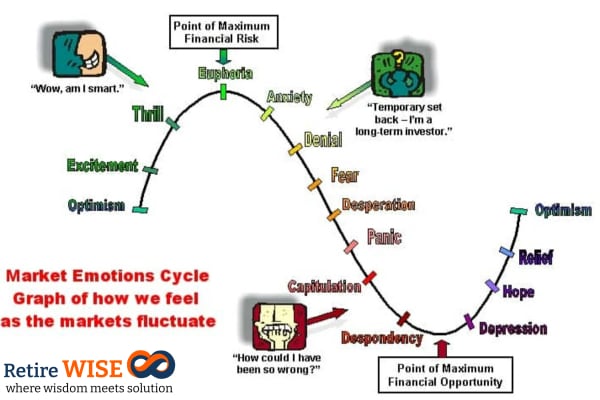
This is the most important insight in all of behavioural finance: the market’s cycles change, but human psychology does not. The 2007-08 crash, the 2013 rupee crisis, the 2020 Covid collapse, the 2024 mid-cap froth — the indices are different, the triggers are different, but the five investor types respond in exactly the same way every single time.
Knowing which type you are is not an academic exercise. It is the difference between compounding wealth and destroying it.
⚡ Quick Answer
Markets move in cycles driven by emotion — Euphoria, Anxiety, Fear, Optimism. Five investor types respond differently in each phase: the Window Shopper (chronic pessimist), the Seasonal Trader (perpetual gambler), the Scapegoat (advice-follower who always arrives late), Hi-tech Lalaji (overconfident speculator), and Mr. Cool (patient long-term investor). The goal is not to avoid having emotions. It is to know your pattern well enough that you don’t act on it impulsively.
The Four Phases of Every Market Cycle
Before looking at the investor types, it helps to understand the emotional cycle that markets follow. This pattern has repeated across every bull and bear market in Indian history.
The Sensex cycle from September 2007 to September 2010 was a textbook example — a 40% rally in four months, followed by a 66% crash, followed by a slow grind back up. But the 2020 Covid crash and recovery was even more compressed and dramatic: a 38% fall in five weeks (February to March 2020), followed by a 100%+ rally in the next 18 months. Different numbers, identical emotional journey.
The four phases are: Thrill and Euphoria (market peaks, confidence is maximum), Anxiety and Denial (first signs of trouble), Fear and Panic (the crash deepens, hope evaporates), and Relief and Optimism (the slow grind back up).
Now let us watch what each investor type does in each phase.
Phase 1: Thrill and Euphoria
2007-08 example: Sensex jumped from 15,300 to 21,000 in four months. 2024 example: Mid and small cap indices doubled in 18 months, attracting record SIP inflows and NFO launches.
Window Shopper: “Market has gone up too much. It will crash to 6,000. I’m waiting.” He has been saying this from 2005. He will still be saying it in 2030. The goalpost always moves.
Seasonal Trader: Drops his diversified mutual fund SIP to chase the hottest sector theme — infrastructure, defence, PSU, whatever TV channels are promoting. Invests in an NFO because it is “new and cheap.” Adds leverage to “maximise the opportunity.” Already planning what he will do with the profits.
Scapegoat: His agent told him to invest. Returns were good. Agent is now recommending a new infrastructure theme fund. He invests in lump sum because “the market is rising.” Does not ask why. Trusts the agent completely.
Hi-tech Lalaji: Has made good paper returns. Decides this is the time to get leveraged — funding over existing mutual fund investments, IPO funding, derivatives. Gets tips from “inside sources.” Dismisses the pink papers and journalists as slow.
Mr. Cool: Checks valuations. PE ratios are stretched. Reads news carefully — “1,000 stocks in upper circuit for seven days. Fundamentals haven’t changed.” Sells the holdings that are significantly ahead of fair value. Waits.
Phase 2: Anxiety and Denial
2007-08: Sensex fell 30% in 10 days, from 21,000 to 15,300. 2024: Mid and small caps corrected 25-30% from peak in Q4 2024 after SEBI’s stress test concerns and FII outflows.
Window Shopper: “I told you. This is just the beginning. Wait for 3,000.” He feels vindicated. He will not buy at any level because there will always be a lower level predicted.
Seasonal Trader: “Broker auctioned my leveraged positions without informing me.” Borrows money from friends to average down. “Market has to recover. I’ll repay when I recover my losses.” This is now an emotional decision, not an investment decision.
Scapegoat: Agent says “correction phase is over, invest more to average losses.” Invests in lump sum again — the worst possible entry into a falling market. Agent is motivated to transact; client is motivated by hope.
Hi-tech Lalaji: Portfolio is down significantly but “Mumbai contacts say recovery is coming.” Adds more leverage to recover earlier losses faster. This is doubling down on a losing bet.
Mr. Cool: Still cautious. Valuations are falling but not yet compelling. Waits for more positive signals. Does not try to call the bottom. Does not act yet.
Phase 3: Fear and Panic
2007-08: Sensex hit 7,697 — a 66% fall from peak. Midcaps down 80-90%. 2020: Sensex fell from 42,000 to 25,638 in five weeks. COVID-19 declared a global pandemic.
This is the phase where wealth is permanently destroyed. Not by the market — by decisions made in fear.
Window Shopper: “This is why I don’t invest in equity.” Forgets that he never actually invested — so he has not lost anything, but he also has not compounded anything for the past decade. The sour grapes response.
Seasonal Trader: “I should have short sold!” Reacts to TV commentary in real time. Each new decision compounds the earlier mistake. No plan. Only reaction.
Scapegoat: “Papa was right. Equity is gambling.” Calls the agent — who has disappeared. Stops all SIPs. Switches to post office RD. Swears never to invest in markets again. Exactly at the point when long-term investors are entering.
Hi-tech Lalaji: Leveraged positions are being called. Desperate for capital protection schemes. Asks a PMS manager who “made 100% in the bear phase” to manage money. Does not verify the claim. This is the phase when the most spectacular frauds occur, because desperate investors are easy targets.
Mr. Cool: Buys. Good companies whose prices have fallen as much as bad companies, regardless of fundamentals. “This is the time for value buying.” His cash held back from the euphoria phase now deploys systematically.
What I Saw in March 2020
In the five weeks of the Covid crash, I had one client who wanted to redeem everything “before it goes to zero.” Another who wanted to deploy his entire emergency fund into markets “because this is the bottom.” Both were wrong, and both were operating on pure emotion. The first was a Scapegoat in crisis. The second was a Seasonal Trader with a new angle. Neither was Mr. Cool. Mr. Cool was the client who called me, asked if the stress test numbers we had done on his plan still held, confirmed they did, and said “let’s keep the SIPs going then.” That client is in a very different position today than the other two.
The retirement corpus stress test — running scenarios at 30-40% market falls — is not just an exercise. It is the document that gives you the confidence to stay invested when everything feels catastrophic. Without it, every crash becomes an emotional crisis rather than a financial event.
Phase 4: Relief and Optimism
2009: Congress election majority surprise. May 18, 2009 — markets hit upper circuit, trading suspended. 2021: Vaccine announcements. Markets crossed pre-Covid highs. Record SIP flows from new retail investors.
The recovery is slow at first, then sudden. Most investors who exited in Phase 3 miss the early recovery entirely.
Window Shopper: “I bought at the bottom.” He did not. He was waiting for 3,000 when it was at 25,000. But he convinces himself he “never cared about market direction.”
Seasonal Trader: “Markets taught me a lesson. I won’t repeat this mistake.” He will. “Which is the next IPO? What about gold? Which sector is hot?” Already moving to the next thing.
Scapegoat: His agent’s son is now selling ULIPs. “Highest NAV guaranteed plan — concept looks good.” He invests. The cycle is about to restart.
Hi-tech Lalaji: “Do you have products for HNIs? I heard there’s money in private equity, venture capital. Mutual funds are slow.” Has not learned the core lesson. Looking for complexity to replace the simplicity that would have served him well.
Mr. Cool: Nothing changed. Calm market day. Enjoying a family holiday. His portfolio has recovered and is at new highs. His returns are not from genius — they are from not making the mistakes others made in phases 1, 2, and 3.
Which Type Are You — Honestly?
Most people reading this will identify with Mr. Cool in theory and with one of the other four in practice. That gap between self-perception and actual behaviour is where wealth gets destroyed.
A few diagnostic questions worth sitting with:
When markets fell in 2020, did you reduce your SIPs or stop them? If yes, you are not Mr. Cool yet. When markets recovered, did you feel relieved and start more SIPs at higher valuations? That is Seasonal Trader behaviour. Do you make financial decisions based on agent recommendations without understanding the underlying instrument? That is the Scapegoat pattern. Do you feel certain about market direction based on information others do not have? That is Hi-tech Lalaji.
None of these types are stupid. They are human. The instincts that make us anxious during crashes and excited during rallies are the same instincts that kept our ancestors alive. They are just not well-suited to financial markets, where the counterintuitive action — buying when things feel terrible, not selling when things feel wonderful — is usually the right one.
The Retirement Implication
For investors approaching retirement, the stakes of getting this wrong are highest. A 55-year-old Seasonal Trader who exits equity in a panic at 60 and switches to FDs permanently may permanently impair the corpus he spent 30 years building. The sequence of returns in the five years around retirement is the most critical period in the entire investment journey.
The structural solution — not the psychological one — is to have a plan that is stress-tested before the crash happens. If you know your portfolio can sustain a 35% fall without requiring you to sell anything, the crash is less likely to trigger a panic response. You are not relying on willpower. You are relying on structure.
Willpower fails in a crash. Structure doesn’t.
A retirement plan stress-tested against market crashes is what separates Mr. Cool from everyone else during a crisis. That is what we build at RetireWise.
A mentally relaxed investor generally holds long-term positions, waits patiently for opportunities, and does not make investment decisions in a hurry. The overconfident investor makes decisions in seconds, assumes access to exclusive information, changes his mind moments later, incurs a loss, and feels confident he will recover it immediately.
The market rewards the first type. It taxes the second repeatedly.
The next market crash is not a question of if. It is a question of when — and who you will be when it arrives.
Keep your head cool. Think wise. Know which type you are before the crash tells you.
Retirement planning is not just about building a corpus. It is about building an investor who can hold it through a crash.
Which of these five investor types do you recognise in yourself — not in theory, but in how you actually behaved in March 2020 or during the mid-cap correction of late 2024? Be honest in the comments. The diagnosis is the first step.
A client’s wife called me in 2019. Her husband had died suddenly at 52 – a heart attack. He had a term insurance policy of Rs.75 lakh that they had taken jointly in 2014. She was calling with one question: “Will the claim be settled?”
I told her to gather the documents and we would work through it together. The claim was settled within 22 days. The insurer was HDFC Life.
But I have also seen the other side. A client who had hidden a pre-existing diabetes diagnosis in 2011. His nominee received a rejection letter three months after filing. The rejection was legally sound – material non-disclosure.
Life insurance claim rejection is almost always preventable. And the most important work happens not at the time of the claim, but at the time of buying the policy.
Quick Answer
Most life insurance claim rejections happen for two reasons: material non-disclosure at the time of buying the policy, or submission of incorrect/incomplete documents at the time of the claim. India’s overall claim settlement ratio improved to 96.82% in FY2023-24 (IRDAI data). The 3.18% that gets rejected is almost entirely avoidable if you fill the proposal form correctly and maintain proper documentation.
The real state of life insurance claims in India – 2024 data
The picture in 2026 is significantly better than it was in 2011. According to IRDAI’s Handbook on Indian Insurance Statistics 2023-24:
Overall CSR (individual death claims within 30 days): 96.82% – both LIC and private insurers combined
Private insurers’ CSR: 99% – the private sector has improved dramatically
LIC settled 7,99,612 policies with a 96.42% CSR
Top performers: Axis Max Life (99.79%), HDFC Life (99.97%), Bandhan Life (99.66%)
Note for context: The Aegon Religare that featured in the original 2011 version of this article – with a 48% settlement ratio – no longer exists. The company has been rebranded as Bandhan Life Insurance and its CSR is now 99.66%. This is a testament to how much regulatory pressure and competition have improved the industry.
But 96 to 99% settlement ratios mean 1 to 4% still gets rejected. On millions of policies, that is tens of thousands of families who do not receive the money they were counting on. The reasons are largely the same as they were in 2011.
Why life insurance claims get rejected
1. Material non-disclosure in the proposal form
This is the most common reason. The proposal form asks about pre-existing medical conditions, family history, smoking and drinking habits, travel plans, and other risk factors. Many buyers – guided by agents who want the sale to go through – underreport or omit these details.
When a claim is filed, the insurer investigates. If they find that a material fact was concealed at the time of purchase – diabetes, hypertension, a previous surgery, a previous policy rejection – they can and do repudiate the claim.
The rule is simple: disclose everything, even if you think it might increase your premium or lead to rejection. A slightly higher premium is far better than a rejected claim. And if one insurer refuses to cover you at standard rates, another may offer coverage at a higher premium or with exclusions – which is still better than no payout.
2. Fraudulent or incorrect documents
Fake age proofs, altered medical records, incorrect income documents – these are straightforward fraud and are rightly rejected. Always submit genuine documents and keep copies of everything you submit at the proposal stage.
3. Policy lapse due to non-payment
A policy that has lapsed because premiums were not paid on time has no claim value. Set up an auto-debit mandate for term insurance premiums. Missing a payment on a term plan is far more damaging than missing it on a mutual fund SIP – you lose coverage entirely.
4. Death during the exclusion period for specific causes
Some policies exclude certain causes of death for the first 1 to 3 years – suicide is the most common. Some riders may have waiting periods. Read the policy document carefully.
What happens when a claim is filed – IRDAI’s 2024 rules
IRDAI has significantly tightened claim settlement timelines. Under IRDAI (Settlement of Claims) Regulations 2024:
Claim settlement within 30 days of receipt of all documents is mandatory
If the claim requires investigation, it must be completed within 90 days
If the insurer delays beyond these timelines, they must pay interest on the claim amount
For claims under Rs.50 lakh, no investigation is required if the policy has been in force for more than 3 years (presumption of no fraud)
The 3-year rule is significant. If your term plan has been running for more than 3 years and your premium is under a certain threshold, the claim process is substantially faster and less likely to be challenged.
The checklist – before you buy and after
At the time of buying the policy:
Fill the proposal form yourself – never let the agent fill it on your behalf. Read every question carefully.
Disclose all medical conditions – diabetes, hypertension, thyroid issues, previous surgeries, ongoing medications. Even if you think it’s minor.
Declare all existing policies – if you have other insurance, mention it.
Use correct income details – the sum assured you buy should match your income declaration.
Do not sign blank forms – insist on reviewing the complete form before signing.
Keep a copy of your signed proposal form – this is your most important document if there is ever a dispute.
After receiving the policy document:
Read the policy document within the free-look period (15 to 30 days). You can return it for a full refund if anything is wrong.
Verify all your details in the policy – name, date of birth, address, nominee details.
If there is any discrepancy, report it immediately – do not wait until claim time.
Ensure your nominee knows about the policy – and knows where the documents are.
Keep the policy active – set up auto-debit and monitor it annually.
I want to say something that the insurance industry will not say: the incentive structure at the point of sale is partly responsible for claim rejections.
An agent who fills the form on your behalf and skips the pre-existing conditions section earns a commission. The rejection, if it comes, happens 5 to 10 years later – long after the agent has moved on. The regulatory improvements since 2020 have reduced this, but it still happens.
A friend who is a CFP once told me about a client who came to him furious – he had been sold a term plan by an agent who had told him not to mention his diabetes “because everyone has it and it just increases the premium.” Two years later, his wife filed a claim. Rejected. Material non-disclosure.
The lesson is not just to fill the form correctly. It is to work with advisors who have no incentive to compromise your disclosure – and to take personal ownership of what you sign.
Is your family’s term insurance actually claim-proof?
We review existing insurance portfolios as part of our financial planning process – checking for disclosure gaps, coverage adequacy, nominee setup, and policy lapses. A 30-minute insurance audit has saved clients from learning these lessons the hard way.
What is the main reason life insurance claims get rejected in India?
Material non-disclosure is the primary reason – the policyholder did not disclose a pre-existing medical condition, incorrect income details, or other material facts at the time of buying the policy. The second most common reason is submission of incomplete or incorrect documents at the time of the claim. Both are largely avoidable with careful disclosure and documentation.
What is the current life insurance claim settlement ratio in India?
As per IRDAI’s 2023-24 report, the overall claim settlement ratio for individual death claims within 30 days is 96.82% (combining LIC and private insurers). Private insurers as a group achieved 99% CSR. Top performers include HDFC Life (99.97%), Axis Max Life (99.79%), and Bandhan Life (99.66%). This is a significant improvement from 2011 levels when some insurers had ratios below 50%.
How long does an insurer have to settle a life insurance claim?
Under IRDAI regulations, life insurance claims must be settled within 30 days of receiving all required documents. If an investigation is needed, the insurer must complete it within 90 days. If settlement is delayed beyond these timelines, the insurer must pay interest on the claim amount. For policies active for over 3 years with claims below certain thresholds, no investigation is required.
Can I appeal if my life insurance claim is rejected?
Yes. If your claim is rejected, you can file a complaint with the IRDAI’s Bima Bharosa portal or approach the Insurance Ombudsman in your region. The ombudsman can handle claims up to Rs.50 lakh. If the rejection was for non-disclosure and you believe it was not material to the risk, present your case with medical evidence. However, if there was genuine non-disclosure, the rejection is usually upheld.
Have you or someone you know faced a life insurance claim rejection? What happened? Share your experience in the comments – it helps others avoid the same situation.
In 2011, Franklin Templeton launched a product called “Family Solutions” – a software tool that helped investors plan for multiple financial goals simultaneously. The product itself no longer exists. Franklin Templeton’s debt funds had a far more dramatic chapter in India – six schemes were wound up in 2020, in what became one of the industry’s most controversial events.
But the idea behind Family Solutions was genuinely good: link every investment to a specific goal. This principle has only become more important in the years since. And the limitations I identified in 2011 are still the limitations of any goal-based planning system that ties you to a single product house.
Quick Answer
Goal-based investing works. Investors who link money to specific goals – child’s college, retirement corpus, home purchase – stay invested longer, panic less, and achieve better outcomes than those chasing returns. The principle is sound regardless of which platform or product you use. The mistake is letting one fund house’s tool become your entire plan.
Why goal-based investing works – and why most investors avoid it
When you link an investment to a specific goal, something changes in your psychology. The Rs.15,000 SIP is no longer an abstract number in a portfolio. It is your daughter’s engineering college seat in 2031. The Rs.25,000 SIP is not a mutual fund – it is the retirement that lets you leave employment on your terms at 58, not 65.
When the market falls 20%, the investor chasing returns panics and redeems. The investor with a goal does the math: “My daughter’s college is 8 years away. The Sensex has recovered from every correction in 8-year periods. I should stay invested or add more.”
This is not theory. The DALBAR study I have cited elsewhere showed that average US equity market returns from 1991 to 2010 were 9.14% per year – but what investors actually received was 3.27%. The gap between market returns and investor returns is almost entirely explained by behavioural decisions – panic selling, chasing last year’s best fund, market timing. Goal-based investing reduces all three.
The four components of a proper financial goal
A financial goal is not just a number. It has four components:
1. Purpose: What is this money for? Education, retirement income, home purchase, medical corpus, family travel. Be specific – not “child’s future” but “Priya’s undergraduate degree in 2031.”
2. Present cost: What does it cost today in rupees? Rs.20 lakh for a top engineering college today.
3. Inflation-adjusted future cost: How much will it cost when you need it? Education inflation runs at 10 to 12%. Rs.20 lakh today becomes Rs.62 to 75 lakh in 10 years. That is the number you are actually saving for, not Rs.20 lakh.
4. Required monthly investment: How much do you need to invest each month to reach that future cost, assuming a realistic return? At 12% for equity-oriented investments and 10 years, you need approximately Rs.27,000 per month. This tells you whether the goal is feasible with your current savings rate.
The power of this calculation is that it answers “how much do I need to save?” definitively – not “as much as possible” but a specific number derived from your specific goal.
The limitations of single-AMC goal planning (still valid in 2026)
Franklin Templeton’s Family Solutions tied goal planning to Franklin Templeton funds. The same limitation applies to any goal-planning tool offered by a single mutual fund house, bank, or insurance company.
The core problem: a well-constructed financial plan should not concentrate all your investments in one fund house. The basic principle of mutual fund portfolio construction says you should not have more than one fund per category from a single AMC. Putting your retirement, education, and home corpus all with one AMC increases institutional risk – as Franklin’s 2020 events demonstrated.
A genuine goal-based plan uses the best funds available for each goal type – regardless of which AMC manages them. And it should grow with you: as your salary increases, your goal investments should increase proportionally, not remain static.
List your top 3 to 5 goals with timelines and current costs. Inflation-adjust each to its future cost. Calculate the required monthly SIP for each. Map each goal to the appropriate asset class (equity for 7+ years, debt for under 3 years, hybrid for 3 to 7). Choose the best funds across AMCs for each goal. Review annually and step up SIPs when income increases. This is goal-based investing – no proprietary software required.
Do your investments have goals attached to them – or are they just a collection of products?
Most portfolios I review are a mix of LIC policies, FDs, and mutual funds with no connection to specific life goals. A goal-based financial plan maps every rupee to an outcome and a timeline. We build this as part of our planning process.
Goal-based investing means linking every investment to a specific financial outcome – child’s education, retirement corpus, home purchase, or medical fund. Each goal has a timeline, a current cost, an inflation-adjusted future cost, and a required monthly investment. This approach replaces “invest as much as possible and hope” with a concrete plan driven by specific needs and timelines.
Why do investors who follow goal-based plans do better?
Goal-based investors stay invested through market corrections because they have a long-term anchor. When the market falls 20%, a goal-based investor thinks “my daughter’s college is 8 years away, this is a buying opportunity.” A return-chasing investor panics and redeems. Studies consistently show that investor returns are significantly below market returns – and the gap is almost entirely explained by poor behavioural decisions that goal-based frameworks help avoid.
How many goals should I plan for simultaneously?
Start with your 3 to 5 most important goals. Common priorities: emergency fund (1 to 3 months expenses in a liquid fund – already done before investing), term and health insurance (protection floor), then financial goals in order of urgency. As your income grows, add or increase goal contributions. Trying to fund 10 goals simultaneously with limited savings often means none get adequately funded.
How many of your current investments are explicitly linked to a specific goal? Or are most of them just “savings”? Tell me in the comments.
There is a conversation I have with almost every new client who comes to me in their late 40s or early 50s.
They have been meaning to “get serious about finances” for years. Life got in the way. The kids’ school fees. The home loan. The company stock options they kept meaning to sort out. And now, with retirement 10-15 years away, they are sitting across from me asking whether they can still make it.
The honest answer is: sometimes yes, sometimes no. But always — always — it would have been better if they had started earlier.
⚡ Quick Answer
Every year you delay investing, you lose not just that year’s returns — you lose the compounding on those returns for every subsequent year. A 5-year delay in starting a Rs 20,000 monthly SIP costs approximately Rs 1.5-2 crore in final corpus over a 25-year investment horizon. The cost of delay accelerates as you get closer to retirement, because you have fewer years to recover. Start now, even if the amount is small.
The Compounding Math Nobody Really Internalises
Most people understand compounding intellectually. Very few feel its consequences viscerally enough to change their behaviour.
Let me make it concrete.
Arjun starts investing Rs 15,000 per month at age 30. He continues for 30 years at 12% CAGR. At 60, he has approximately Rs 5.2 crore.
Priya starts the same Rs 15,000 per month — but at age 35. She also invests for 25 years at 12% CAGR. At 60, she has approximately Rs 2.8 crore.
Same monthly investment. Same return rate. Same retirement age. The only difference: Priya started 5 years later.
The 5-year delay cost Priya Rs 2.4 crore. That is 16 times her total 5-year contribution of Rs 9 lakh. She did not just lose Rs 9 lakh of compounding — she lost Rs 2.4 crore of final wealth.
This is what compound interest actually means. Not that your money grows. That the growth of your growth of your growth compounds over time. The earlier years are the most valuable — because those rupees have the most time to compound.
The Three Types of Delay
Not all delays are the same, but all of them are costly.
Type 1 — “I’ll start when I earn more.” This is the most common. The logic seems reasonable: wait until the increment, then invest the extra money. The problem: lifestyle inflation reliably consumes each increment before it reaches an investment account. The person earning Rs 60,000 per month who could not invest Rs 5,000 finds that when they earn Rs 1 lakh per month, they still cannot invest Rs 5,000 — because expenses have grown with income. Start with whatever you can today. Increase as income grows. The habit of investing regularly matters more than the amount.
Type 2 — “I’ll invest after I clear this loan.” Sometimes this makes sense — for very high-interest debt (above 15%), paying it off first is mathematically sound. For home loans at 8-9%, or education loans with tax benefits, the delay cost of not investing alongside the loan is almost always larger than the interest saved. Both can and should run in parallel.
Type 3 — “I’m waiting for the right time to invest.” Market is too high. Market is too low. Elections are coming. Budget is around the corner. There is always a reason to wait. The research on market timing is definitive: for long-term investors, time in the market consistently outperforms timing the market.
How much has your delay already cost you?
A fee-only advisor calculates your actual gap and builds a catch-up plan — with no products to sell.
A 25-year-old delaying by one year loses the compounding on that year’s investment for 35 years. Expensive, but recoverable.
A 50-year-old delaying by one year loses the compounding on that year’s investment for only 10 years — but they also have far less time to compensate through higher savings rates or adjusting retirement timelines. At 50, the options are: save more, retire later, or retire with less. None of these are comfortable.
This is why I tell clients in their 30s: the best financial decision you can make right now is to start investing — anything — today. Not the perfect amount. Not after sorting out every other financial loose end. Today.
What to Do If You Have Already Delayed
The answer is not regret. Regret is not financially productive.
The answer is a structured catch-up plan that is honest about what is achievable. This means: calculating the actual retirement corpus needed (adjusted for inflation), calculating what your current savings rate will produce, and closing the gap through higher savings rates, realistic return expectations, and if necessary, adjusting retirement timelines.
The worst outcome is discovering the gap at 58 with no time to act. The best outcome — even if you start late — is discovering it at 45 with 15 years to close it. A retirement savings plan built on accurate numbers is the starting point.
The One Decision That Changes Everything
Every day you delay costs money you cannot get back. Every day you act recovers some of the ground that was lost.
The decision to start — today, with whatever amount is available — is the highest-return financial decision most people can make. Not a stock pick. Not a new fund. Not a tax strategy. The decision to start.
Frequently Asked Questions
How much does delaying an SIP by 5 years actually cost in retirement corpus?
The cost depends on the amount, assumed returns, and time horizon — but the number is almost always larger than people expect. A Rs 15,000 monthly SIP starting at 30 builds approximately Rs 5.2 crore by 60 at 12% CAGR. The same SIP starting at 35 builds approximately Rs 2.8 crore — a difference of Rs 2.4 crore for just a 5-year delay. The multiplier effect occurs because early rupees have the longest time to compound. A rupee invested at 30 has 30 years of compounding; a rupee invested at 35 has only 25. That 5-year difference in compounding is disproportionately large at the end.
I am 45 and have not saved enough for retirement. Is it too late?
It is not too late, but the math requires honesty. A 45-year-old with 15 years to retirement at 60 can still build a meaningful corpus — but needs a higher savings rate than someone who started at 30. The three levers: save more (increase SIP aggressively), adjust the retirement target (reduce expected monthly expenses), or retire later (even 2-3 years makes a significant difference). A fee-only advisor can calculate the exact gap and the minimum monthly investment needed to close it. The worst response to a late start is paralysis — starting at 45 with an honest plan is far better than waiting further.
Why does lifestyle inflation prevent people from investing even as their income grows?
Lifestyle inflation is the tendency for expenses to expand to fill available income. When a professional gets a 20% salary increase, they typically upgrade their car, home, or lifestyle within 12-18 months — leaving no more investable surplus than before the raise. The only reliable defence is automating investments before the income arrives: a standing instruction to transfer a fixed amount to an SIP on salary credit day, before lifestyle spending can absorb it. “Invest first, spend what’s left” consistently produces better outcomes than “spend first, invest what’s left.”
Should I wait for a market correction before starting an SIP?
No. This is the “Type 3 delay” — waiting for the right market conditions before starting. The problem: there is always a reason the market does not look right. Too high. Too volatile. Elections upcoming. A correction always seems to be just around the corner. Research on SIP investments consistently shows that an investor who starts immediately and invests through market cycles outperforms one who waits for a correction — because the correction may be smaller or later than expected, and the delay cost is paid in compounding years that cannot be recovered.
The best time to start investing was 10 years ago. The second best time is today. Not next month when you get the increment. Not after you clear the loan. Not when the market is “right.” Today.
Every year of delay is a decision — made by inaction — to have less at retirement. Make a different decision.
💬 Your Turn
What has been your biggest reason for delaying investing? And when did you finally start — what made you do it? Share below.