
Home Blog Page 42

Best Mutual Fund for SIP in India (2026): Why That Question Has No Right Answer

This article was first written in July 2011. The most common question then: “Which is the best mutual fund for SIP?”

The most common question now, in 2026: “Which is the best mutual fund for SIP?”

Fifteen years. 1,500+ schemes. Entirely new SEBI categorisation. Several market cycles. Same question.

And my honest answer in 2026 is the same as it was in 2011: That question doesn’t have a useful answer.

⚡ Quick Answer

There is no universally “best” mutual fund for SIP. The right fund depends on your goal, timeline, and risk tolerance — not on last year’s return rankings. For most investors with a 10+ year retirement horizon, a Flexi-cap fund as the core SIP holding, with a mid-cap fund as a satellite, is a reasonable starting structure. This guide explains the process for choosing — not a list that will be outdated by the time you finish reading.

Why “Best” Is the Wrong Question

Here’s the fundamental problem with “best fund for SIP” rankings.

The fund that topped the Flexi-cap category in 2022 was not the top fund in 2023. The fund that topped in 2018 had mediocre performance in 2021. Every return ranking you read is backward-looking. Every SIP you start is forward-looking. These two things are not the same.

More specifically: a fund’s 1-year or 3-year return tells you what happened when markets were doing what they were doing in that period. It tells you almost nothing about what that fund will do in the next market cycle — which will be different.

In 25 years of advising, I’ve seen investors chase top-performing funds every year, switching from “hot” fund to “hot” fund, and ending up with below-average returns. Not because they picked bad funds. Because they picked yesterday’s winners and paid the switching cost — financial and psychological.

The Right Framework: Process Over Rankings

Instead of asking “which fund is best?”, ask these questions in sequence:

1. What is this SIP for? Retirement in 15 years? Child’s education in 10 years? Emergency corpus in 2 years? The goal determines the category — equity for long-term growth, hybrid for medium-term, debt for short-term. Starting with category selection before fund selection saves most people from their worst mistakes.

2. How long can I leave this untouched? Equity mutual funds need at least 5-7 years to reliably demonstrate their risk-return profile. If you’re starting an SIP that you might stop in 2 years, equity is likely the wrong category regardless of which fund you choose.

3. Can I hold through a 30-40% drawdown? An honest answer to this question determines whether you belong in large-cap equity, balanced advantage, or conservative hybrid. The fund that earns 16% CAGR but drops 40% in crashes will produce worse investor returns than a fund earning 13% CAGR that drops only 25% — because most investors will stop the first SIP and not the second.

Category First: A Practical Guide for 2026

Which Category for Your SIP? — A Simple Guide

HORIZON

10+ Years

Category: Flexi-cap or Large-cap
Add-on: Mid-cap (optional)
For: Retirement, long-term wealth

HORIZON

5-10 Years

Category: Balanced Advantage or Aggressive Hybrid
For: Education goal, medium-term wealth

HORIZON

Under 5 Years

Category: Short Duration Debt or Conservative Hybrid
For: Near-term goals, capital preservation

Within Category: What to Actually Look For

Once you’ve chosen the right category, here’s what matters when comparing funds within it:

Consistency across market cycles — not peak performance. Look at how the fund performed in 2020 (COVID crash and recovery), in 2022 (inflation-driven correction), and across the 5-year period. A fund that’s consistently in the top half of its category across both bull and bear markets is more valuable than one that’s first in a bull market and last in a crash.

Expense ratio. The lower the annual fund expense, the more of the fund’s return stays with you. This compounds meaningfully over a 20-year retirement SIP. Expense ratio is one of the few factors that predicts better net returns reliably — always factor it in.

Fund house stability. A fund is only as good as the team managing it. Check: has the fund house seen major fund manager departures recently? Have they had compliance or SEBI investigation issues? Are they a well-established AMC with a long track record? Exposure to 3-4 different fund houses reduces fund manager risk.

Fit with your overall portfolio. The right fund isn’t just the best fund in its category — it’s the one that complements what you already hold. A fund your advisor selects after reviewing your full picture will almost always serve you better than one you pick from a magazine ranking.

💡 The Core + Satellite Structure

Core (60-70% of equity SIP): One Flexi-cap fund. Stable, diversified, low-maintenance.
Satellite (30-40%): One mid-cap fund for higher growth potential over long horizons.
Tax saving add-on: ELSS fund for Section 80C benefit — same equity exposure with a lock-in that enforces discipline.
Total funds: 2-3 maximum. Beyond this, you’re creating complexity without diversification benefit.

The Active vs Passive Debate — Where It Stands in 2026

In the large-cap category, the data has become harder to ignore. Since SEBI’s 2017 categorisation required large-cap funds to hold minimum 80% in the top 100 stocks, most large-cap active funds have found it increasingly difficult to justify their cost over index funds after expenses. This makes expense ratio and fund consistency even more critical selection criteria in the large-cap space.

In the mid-cap and small-cap categories, the case for active management remains stronger — less analyst coverage, more pricing inefficiency, more scope for a skilled manager to add value. The same logic that makes cost efficiency critical in large-caps makes skilled active management more valuable in smaller caps.

A practical 2026 approach: a well-selected large-cap or Flexi-cap fund as the core, an active mid-cap fund for the satellite. Your advisor can help identify the specific funds within each category that fit your risk profile and existing portfolio.

How Many Funds Is Too Many?

Most investors I review have 8-12 mutual funds. When we map them against SEBI categories, they often have 3 Flexi-cap funds from different houses, 2 large-cap funds, and a few others. Effectively, they have one diversified equity portfolio held through 8 wrappers — paying 8 expense ratios for one unit of diversification.

The optimal number for most retirement investors is 2-4 funds across different categories and different fund houses. Beyond this, you’re adding administrative complexity without meaningful risk reduction.

⚠️ The Portfolio Review That Reveals the Truth

Log into MFCentral and pull your Consolidated Account Statement. Map each fund to its SEBI category. Count how many categories you actually have. Most people discover they hold 10 funds in 3 effective categories. Consolidation almost always improves outcomes.

One Principle That Overrides Fund Selection

Whatever fund you choose, the single most important variable in your SIP outcome is not which fund you chose. It’s whether you continued investing when markets fell 30-40%.

The investors I’ve seen build the most wealth from SIPs are not the ones who found the optimal fund in 2010. They’re the ones who kept investing through 2011, 2013, 2015, 2018, 2020, and 2022. A decent fund held through every downturn beats an excellent fund stopped at the first major correction.

Do the Right Thing and Sit Tight.

Not sure which SIP structure fits your retirement plan?

A 30-minute portfolio review maps your existing SIPs against your retirement date and shows what to keep, what to consolidate, and what to change.

Talk to a RetireWise Advisor

Frequently Asked Questions

Which is the best mutual fund for SIP in India in 2026?

There is no universally best fund — it depends on your timeline, risk tolerance, and existing portfolio. For a 10+ year retirement horizon, a Flexi-cap fund as core SIP + a mid-cap fund as satellite is a robust starting structure. Specific fund selection within these categories should be based on consistency, expense ratio, and fund house stability — not last year’s returns.

How do I choose a mutual fund for SIP?

Step 1: Define goal and timeline. Step 2: Choose category based on timeline (equity for 10+ years, hybrid for 5-10, debt for under 5). Step 3: Within category, filter for consistency across multiple market cycles. Step 4: Choose 2-3 funds from different fund houses. Working with an advisor ensures the selected funds fit your complete financial picture — not just isolated rankings.

How many funds should I hold in my SIP portfolio?

2-4 funds is optimal for most retail investors. More than 4-5 funds in overlapping categories creates pseudo-diversification — you pay multiple expense ratios for essentially the same exposure. One core equity fund + one mid-cap + ELSS for tax saving is a complete structure for most people.

Is a Nifty 50 index fund better than an active large-cap fund for SIP?

Post SEBI’s 2017 categorisation, large-cap active funds face a tougher benchmark — making expense ratio and fund consistency more important than ever in this category. The right choice for your portfolio depends on your overall structure and what your advisor recommends after reviewing your full picture. In mid-cap and small-cap, skilled active management still has a stronger case for adding value.

The best mutual fund for SIP is the one you’ll keep running through a 30% market crash without stopping. Start there — and then worry about which specific fund to put in that discipline.

It’s not a Numbers Game. It’s a Mind Game.

💬 Your Turn

How many funds are in your current SIP portfolio — and do you know which SEBI categories they fall into? Share below. The most common pattern: 8-12 funds that effectively behave like 2-3 categories.
Saving Is Not Enough: Why You Must Invest Your Money

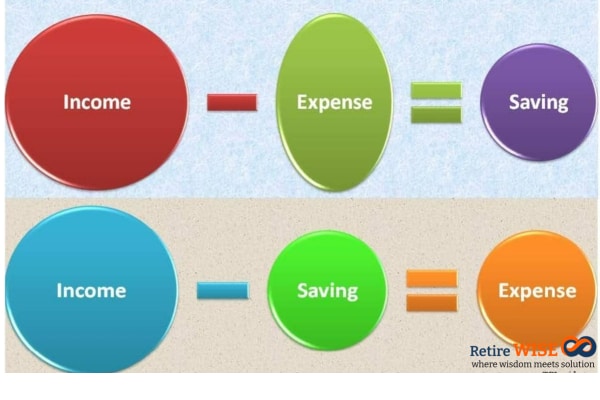
“Do not save what is left after spending; instead spend what is left after saving.” – Warren Buffett

My father was a government employee. He saved diligently his entire career – provident fund, a small recurring deposit, whatever he could set aside each month. By any measure, he was disciplined. By Indian middle-class standards, he was a good saver.

When he retired in the late 1990s, his savings were intact. But they had not grown in real terms. Inflation had quietly eroded their purchasing power over 30 years. The corpus that felt substantial when he built it felt modest when he needed to live on it. He was a diligent saver who had not been an investor.

I have seen this pattern in client after client over 25 years. India’s household savings rate is among the highest in the world – averaging 30-33% of income. Yet a large proportion of Indian households approach retirement without adequate financial security. The gap between saving and investing explains everything.

⚡ Quick Answer

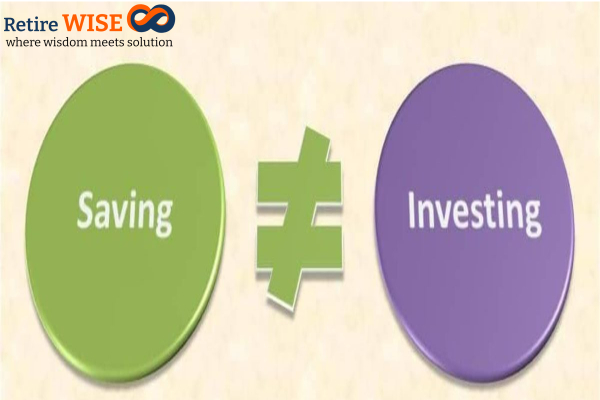
Saving means setting money aside. Investing means putting that money to work to generate returns that beat inflation. In India, the average inflation rate over the past 20 years has been approximately 6-7% annually. Any savings sitting in instruments earning less than inflation – traditional savings accounts at 3-4%, or under the mattress – are losing real value every year. Saving is the prerequisite. Investing is what actually builds wealth for retirement.

Saving vs investing - why saving alone is not enough for retirement in India

Why Saving Alone Fails in Retirement Planning

Consider a simple illustration. Suppose you save Rs 5,000 per month from age 30 to 60. Over 30 years, your total savings in cash terms: Rs 18 lakh. Impressive discipline.

Now consider inflation at 6% annually. What Rs 18 lakh buys today, by the time you are 60, will require approximately Rs 1.03 crore to purchase. Your Rs 18 lakh in nominal savings has roughly 17 paise of real purchasing power for every rupee you saved in today’s terms.

Now consider the same Rs 5,000 per month invested in equity mutual funds through SIPs at a conservative 12% annual return. At 60, that corpus: approximately Rs 1.77 crore. The same disciplined behaviour, redirected from saving to investing, produces nearly 10 times the nominal outcome and actually beats inflation.

This is not magic. It is compound growth – the mechanism Einstein reportedly called the eighth wonder of the world. But it requires one thing saving does not: putting money into instruments that generate returns above inflation.

“My father taught me the discipline of saving. My 25 years of financial planning taught me that the discipline of saving, without the intelligence of investing, is necessary but not sufficient. You need both.”

– Hemant Beniwal, CFP, CTEP | Founder, RetireWise

The Three Failure Modes of Indian Savers

Keeping everything in savings accounts and FDs. A savings account at 3-4% and an FD at 6.5-7% both fail to beat post-tax inflation for investors in higher tax brackets. The FD interest is fully taxable at your slab rate. At 30% tax, a 7% FD yields a post-tax 4.9% – below the long-run inflation rate. Your money is preserved in nominal terms and eroded in real terms.

Investing only in gold and real estate. These are legitimate asset classes, but they are illiquid, carry significant transaction costs, and generate no regular income stream. Real estate is also undiversified – typically one large property that concentrates risk. Gold provides a hedge but generates no cash flow and has historically delivered returns close to inflation over very long periods, not significantly above it.

Treating insurance as investment. Endowment plans and traditional LIC policies combine insurance and investment at high cost. Post-charge returns over 20-year periods are typically 4-5% – below post-tax FD rates and well below inflation for investors in higher brackets. The insurance cover is also inadequate compared to a pure term policy. This is the most expensive and most common savings trap in India.

Are your savings actually keeping pace with inflation?

A RetireWise retirement plan maps your current savings and investments against the inflation-adjusted corpus you actually need – so you can see the gap clearly and close it while you still have time.

Book a Free 30-Min Call

The Investing Mindset: From Preservation to Growth

The shift from saving to investing requires a change in mental model. Saving is about preservation – not losing what you have. Investing is about growth – making what you have work harder than you do.

This shift is difficult for many Indians because our relationship with money is shaped by lived experience of scarcity, volatility, and the cultural weight of security. Parents who grew up with limited financial safety nets instilled caution. That caution served previous generations well. In today’s environment, with longer retirements, higher medical costs, and no guaranteed pension for most private-sector workers, caution without growth is a slow-moving financial crisis.

The investing mindset does not mean taking reckless risks. It means accepting calibrated, time-appropriate risk in exchange for the returns needed to build a retirement corpus that actually provides security.

Where to Start: A Simple Framework

For someone moving from pure saving to active investing, the transition does not have to be complex. Three instruments cover most of what is needed:

Term insurance: Before investing, protect what you are building. A Rs 1-2 crore term policy for a 35-40 year old costs Rs 15,000-30,000 per year. This is the foundation – without it, one unforeseen event can undo decades of saving and investing.

PPF or EPF: The guaranteed, tax-free debt component of your investment portfolio. EPF happens automatically for salaried employees. PPF is available to anyone. Both currently offer approximately 7-8% returns with full tax exemption. This is not savings in the inflationary trap sense – it is long-horizon, government-backed investing.

Equity mutual funds via SIP: The growth engine. A diversified equity fund SIP, started early and maintained through market cycles, has historically delivered 11-14% annualised returns over 15-20 year periods in India. This is the instrument that does the heavy lifting in retirement corpus building.

Read – Budgeting: The First Step to Financial Success

Read – Income vs Wealth: The Distinction That Determines Your Retirement

Frequently Asked Questions

How much of my income should I save vs invest?

The right saving rate depends on your age, goals, and income level. A general principle: save first (set aside the target amount before discretionary spending), then allocate those savings across instruments based on your time horizon and risk capacity. For someone in their 30s-40s targeting retirement at 60, a common allocation is 60-70% in equity (ELSS, diversified equity SIPs), 20-30% in debt (EPF, PPF), and a small allocation to gold (5-10%). The exact numbers matter less than the discipline of starting and the direction of equity-dominated growth allocation for long horizons.

I am 50 and have mostly kept money in FDs and savings accounts. Is it too late?

It is not too late, but the approach changes. At 50 with a 60-year retirement target, you have 10 years of accumulation and potentially 25-30 years of retirement to plan for. At this stage: evaluate all existing savings for post-tax, post-inflation real returns and shift underperforming instruments into better ones where possible. Start SIPs immediately – even 10 years of consistent equity SIP investment at 12% can generate meaningful corpus from regular contributions. Accept that you may need to extend your working years slightly or reduce lifestyle expectations in retirement – and build a plan around that reality rather than optimistic projections.

Are mutual funds safe? I have heard stories of losses.

Equity mutual funds carry market risk – their value goes up and down with equity markets. Over short periods (1-3 years), they can lose value. Over long periods (15-20 years), every major Indian equity index has delivered positive real returns historically. The risk management approach is: use SIPs rather than lump sums (which averages purchase cost across market cycles), invest only money you do not need within the next 5 years in equity funds, and do not exit during corrections. The losses people experience are almost always the result of timing mistakes – investing a lump sum at market peaks and withdrawing during corrections – not of equity funds being inherently dangerous for long-horizon investors.

India produces diligent savers. The financial planning challenge is not saving more – it is converting disciplined saving behaviour into disciplined investing behaviour. The difference in retirement outcome between a saver and an investor who puts away the same amount is not marginal. Over 30 years, it can be the difference between dependence and security.

Save first. Then make your savings work harder than you do.

Want to know exactly how much your current savings will be worth at retirement?

RetireWise builds retirement plans that show you the real, inflation-adjusted value of your current portfolio – and maps the investment strategy needed to close the gap.

See Our Retirement Planning Service

💬 Your Turn

When did you make the mental shift from saving to investing? What triggered it? Share in the comments – your experience may help someone still sitting on the fence.

Budget for your savings and not spending!

Warren Buffett said it simply: “Do not save what is left after spending. Spend what is left after saving.”

Most people do the opposite. The salary arrives. The EMIs go out. The household expenses follow. The school fees, the fuel, the groceries, the dining out. At the end of the month, whatever remains – if anything – is “savings.”

That is not saving. That is financial leftover management. And it is the reason most people reach 55 with far less than they expected.

Quick Answer

Savings must be a fixed, non-negotiable outflow – like your EMI – not a residual after expenses. The moment your salary arrives, your SIP, PPF, and insurance premium should go out automatically. What remains is your spending budget. This single structural change – paying yourself first – has more impact on long-term wealth than any investment selection decision.

Budget for savings not spending India

Why expense-first saving always fails

There is a behavioural economics principle called Parkinson’s Law of Money: expenses expand to fill available income. It applies universally – to the person earning Rs.50,000 per month and the person earning Rs.5 lakh per month.

When you save what remains after spending, you are implicitly allowing lifestyle to determine your savings rate. And lifestyle, left to its own devices, always expands. The salary increment becomes a new EMI. The bonus becomes a vacation. The annual raise becomes a better apartment.

None of these are wrong choices in isolation. The problem is that they crowd out savings in a way that is invisible in the moment but catastrophic over 20 years.

A client I met in 2021 – 52 years old, earning Rs.4 lakh per month – had been doing this for 25 years. His income had grown 8x over that period. His savings rate had stayed at roughly 5 to 8% throughout. He had approximately Rs.85 lakh in investable assets. He needed Rs.8 to 10 crore to retire at 58. The gap was not created by bad investments. It was created by 25 years of saving what was left.

How to build a savings-first system

The savings-first approach requires one structural change: automate savings to leave your account before your discretionary spending begins.

Step 1: Calculate your savings target, not your savings residual. Your savings rate should be derived from your goals, not from what remains after expenses. Work backwards: what corpus do you need by retirement age? How much do you need to save monthly to get there? That number is your savings target – not whatever happens to be left.

A rough starting benchmark for wealth creation: save at minimum 20 to 30% of gross income if you are between 30 and 40, and 30 to 40% if you are between 40 and 50. These are not arbitrary – they are derived from the compounding math of reaching a Rs.5 to 10 crore retirement corpus over 15 to 25 years.

Step 2: Automate everything on the 1st or 2nd of the month. EPF goes automatically. Set your SIP to debit on salary credit day. Set PPF transfer as a standing instruction. Set your term and health insurance premiums on auto-pay. By the time you consciously think about money, the savings are already gone.

Step 3: Build your expense budget from what remains. This is the reversal. You are not saving from your income – you are spending from your post-savings income. The psychological shift is significant: lifestyle decisions are now constrained by what is left after commitments, not by what you earn.

Step 4: Build an emergency buffer first. Before aggressive long-term investing, you need 4 to 6 months of household expenses in a liquid fund or savings account. Without this buffer, any unexpected expense – medical, car breakdown, home repair – forces you to redeem long-term investments at possibly the wrong time. The emergency fund is what allows the long-term investments to stay invested.

Step 5: Step up savings with every income increase. When your salary rises by 20%, do not let lifestyle absorb the entire increase. A rule: at minimum 50% of every increment goes to increased SIP or investment. The other 50% can go to improved lifestyle. Done consistently over 10 years, this rule doubles your savings rate while still allowing meaningful lifestyle improvement.

Tax-saving investments – the forced savings trap

For most salaried Indians, the only deliberate savings decision made in the year is in January and February: the tax-saving rush to fill Section 80C. ELSS, PPF, insurance premiums – all purchased under deadline pressure to avoid tax.

This is better than nothing. But it has a structural problem: the motivation is tax avoidance, not goal achievement. The amount invested is determined by the 80C limit (Rs.1.5 lakh per year) rather than by what your retirement corpus calculation requires. And it happens in a rush, at possibly the worst time of year to invest (February is often not a market low).

A better approach: start ELSS SIPs in April. Spread the Rs.1.5 lakh over 12 months. Treat the 80C limit as the floor on savings, not the ceiling. And determine the total savings amount based on your goals, not on the tax code.

Also read: ELSS: Why It Is the Only Tax-Saving Instrument Worth Choosing for Equity Investors

The solid base before you invest for goals

Before any goal-based investing begins, there is a non-negotiable foundation:

  • Emergency fund: 4 to 6 months of household expenses in a liquid fund. Non-negotiable.
  • Term insurance: Minimum 10x annual income, preferably 15 to 20x if you have significant liabilities. Not negotiable.
  • Health insurance: Rs.25 to 50 lakh family floater plus a super top-up plan. The base is not negotiable; the amount can be calibrated.

Only after this foundation is in place does long-term goal investing begin. Investing for retirement while having no emergency fund is building the second floor without a first.

Also read: Are You Ready for Your Retirement? The Corpus Calculation Most Indians Get Wrong

What is your current savings rate as a percentage of gross income?

Most people I ask cannot answer this question immediately. If you do not know your savings rate, you cannot manage it. A financial plan starts with knowing this number – and then building a system to make it non-negotiable.

Explore RetireWise

Frequently asked questions

What is the right savings rate for retirement planning in India?

A general benchmark: 20 to 30% of gross income if you are in your 30s, and 30 to 40% if you are in your 40s. These rates are derived from the compounding math of reaching a Rs.5 to 10 crore retirement corpus over 15 to 25 years at typical equity mutual fund returns. The exact required savings rate depends on your current corpus, target retirement age, expected lifestyle cost, and investment return assumptions. Calculate your specific number rather than relying on general benchmarks.

How do I start saving more when expenses already consume my salary?

The most effective change is structural, not motivational. Set up a SIP that debits on salary credit day – before you see the money in your account. Start small if necessary (even Rs.5,000 per month) and step up by Rs.2,000 to Rs.5,000 every 6 months. Separately, allocate at least 50% of every salary increment to increased savings before lifestyle captures it. The key insight: you will not miss money you never see. Once the system is automated, the behaviour change is automatic.

Should I build an emergency fund before investing for long-term goals?

Yes, always. An emergency fund of 4 to 6 months of household expenses in a liquid fund is the first financial priority – before SIPs, before PPF, before ELSS. Without it, any unexpected expense forces redemption of long-term investments at possibly the wrong time – disrupting compounding and potentially triggering capital gains tax. The emergency fund is what allows long-term investments to stay invested through market corrections and personal setbacks.

What is your current savings rate? And do you save deliberately at the start of the month, or from what is left at the end? Share in the comments – there is no judgement, only useful comparison.

Stop Fooling Investors: Why Financial Media Cannot Help You Build Wealth

“The market is a device for transferring money from the impatient to the patient.” – Warren Buffett

In 2009, I sat across from a client who had just lost a significant amount following stock tips from a popular business TV channel. He had watched every morning. He had followed the recommendations. He had traded accordingly. The channel’s “expert” had been wrong most of the time – but confidently, photographically wrong, with charts and targets and authoritative language.

The client was not unsophisticated. He was a senior engineer with a science degree and two decades of professional experience. He had simply been told what he wanted to hear: that there were people who knew where the market was going, and that they were willing to share that knowledge for free on national television.

They were not. They are not. The TV pundit problem has not changed in 15 years – it has simply migrated platforms.

⚡ Quick Answer

Financial media – whether TV channels, YouTube experts, Telegram groups, or social media influencers – optimises for attention and engagement, not for investment accuracy. Their incentive is to be interesting, not to be right. Research consistently shows that financial media predictions have no predictive value beyond random chance. The investors who build the most wealth are those who consume the least financial media and follow the most systematic, boring investment processes.

Financial media experts TV pundits and investor harm

Why Financial Media Cannot Help You Invest

A business news channel needs to fill 18 hours of airtime every day. The stock market, on most days, does nothing interesting. Stocks trade sideways. Volumes are unremarkable. There is no obvious news hook. But the channel still needs to fill 18 hours.

The result is that normal, uninteresting market behaviour is relentlessly transformed into narrative. “Markets nervous ahead of Fed decision.” “Nifty consolidating at key support.” “This stock set to break out.” The language implies knowledge, insight, and predictive power. It implies that the analyst on screen knows something you do not.

They do not. The direction of markets on any given day is not knowable in advance. The specific breakout point of any individual stock is not knowable. Studies across multiple markets consistently show that the aggregate of analyst predictions does not outperform random chance over time. The famous 1987 study by Philip Tetlock, extended across 20 years and involving thousands of predictions from political and economic “experts,” found that the average expert’s predictions were barely better than a dart-throwing chimpanzee.

The problem is worse with social media. TV channels at least have regulatory oversight and reputational consequences. Telegram channels and Instagram accounts have neither. A person with 50,000 followers, attractive charts, and confident language has no accountability for the recommendations they make. When a tip fails, they simply move on to the next one.

The investors who win are those who make fewer decisions, not more.

RetireWise builds investment plans that run systematically – SIPs, annual rebalancing, goal tracking – with minimal need for market commentary or reaction to financial media.

See How RetireWise Builds Systematic Portfolios

The Incentive Structure Explains Everything

A business TV channel earns revenue from advertising. Advertising rates are linked to viewership. Viewership is linked to how engaging the content is. Engaging content means dramatic calls: “Buy this stock – 40% upside.” “Market crash coming.” “This sector about to explode.” Boring content means lower viewership: “Stay in your SIPs, do nothing, review annually.”

The channel’s financial incentive directly opposes your financial interest. They make money when you watch. You make money when you do not watch and do not trade. Every trading decision triggered by media commentary generates transaction costs and tax liabilities for you – and produces no additional advertising revenue for the channel regardless of whether you make or lose money.

This is not a conspiracy. It is simple incentive alignment – or rather, misalignment. The channel is doing exactly what its incentives require. The problem is that investors often mistake entertainment designed to keep them watching for advice designed to help them invest.

What Actually Predicts Investment Outcomes

Decades of research in finance have identified the factors that actually predict long-term investment outcomes. They are not the factors discussed on financial TV:

Savings rate matters more than investment selection. An investor who saves 20% of income in index funds will vastly outperform an investor who saves 5% in carefully selected stocks. The savings rate is the primary driver of wealth accumulation, not asset selection skill.

Time in the market matters more than timing. Missing the best 10 trading days in any decade typically halves long-term returns. Those best days come unpredictably, often immediately after the worst days. Market timers – those who move in and out based on predictions – statistically miss more good days than they avoid bad ones.

Cost matters enormously over time. The difference between a 1.5% TER and a 0.3% TER on a Rs 50 lakh portfolio is Rs 75,000 per year in costs – which compounds against you. The financial media rarely discusses this because it is not exciting content.

Behaviour matters most of all. The investor who earns average returns but stays invested through every market cycle will outperform the investor who earns higher average returns but sells during corrections. The “behaviour gap” – the difference between what markets return and what the average investor actually receives – is documented at 1-3% annually in most studies.

How to Use Financial Media (If At All)

Financial news is useful for one thing: understanding macroeconomic context. Knowing that interest rates are rising, that a specific sector faces regulatory headwinds, or that a company has filed for bankruptcy is useful background for a long-term investor. It informs asset allocation thinking without requiring immediate action.

Financial news is useless – and actively harmful – as a source of specific buy/sell recommendations. Every market call, price target, or “don’t miss this stock” segment should be treated as entertainment, not advice. The analyst making the call has no accountability for the outcome and no knowledge of your specific financial situation.

A practical rule: consume financial news to understand context, not to trigger action. If you find yourself wanting to buy or sell something immediately after watching a segment, that is the correct moment to stop, wait 48 hours, and ask whether this decision fits your existing financial plan.

Read: Behavioural Finance: How Your Mind Sabotages Your Money Decisions

The TV channel expert is not losing anything from your financial decisions. You are. That asymmetry should inform every moment you spend consuming financial media.

Turn off the noise. Trust the process.

Have you ever made an investment decision based on a TV tip or Telegram recommendation?

A RetireWise financial plan replaces media-triggered decisions with a systematic process – SIPs, rebalancing, annual review – that runs on autopilot and ignores the noise.

Book a Free 30-Min Call

Your Turn

Have you ever followed a TV or social media tip – and how did it actually turn out over 2-3 years? The honest retrospective is usually more instructive than any analysis. Share in the comments.

Should You Buy Health Insurance Even If Your Employer Covers You? (2026 Guide)

I ask every new client one question before we start their financial plan: “What’s your health insurance cover?”

The most common answer from senior executives: “My company provides me Rs. 5-10 lakh group cover.”

And my response: “That’s your employer’s health insurance. What’s yours?”

This distinction — between employer group cover and personal health insurance — is one of the most consequential gaps in the financial plans of Indian professionals. Let me explain why.

⚡ Quick Answer

Yes — buy personal health insurance even if your employer covers you. Group cover vanishes the moment your employment ends. Buying your own policy while young and healthy (before 40-45) builds a claim-free track record, avoids pre-existing disease exclusions, and ensures you enter retirement with uninterrupted coverage. In 2026, with medical inflation at 14-15% per year, the minimum cover for a senior executive family should be Rs. 15-25 lakh — not Rs. 3-5 lakh.

Why Your Employer’s Cover Is Not Your Cover

Group health insurance is purchased by your employer for the benefit of employees. The employer is the policyholder. You are a beneficiary — but not a party to the contract.

This creates a fundamental vulnerability: the moment your employment relationship ends — by your choice or theirs — your coverage ends with it. No portability. No extension. No grace period. Day 1 of unemployment is Day 1 of no health cover.

In 2024-25, India saw large-scale layoffs across technology, manufacturing, and financial services — including at companies that were considered safe employers. For the affected executives, many discovered they had no personal health policy. Some were between jobs for 6-18 months. A hospitalisation during that period would have been entirely out of pocket.

The Five Risks of Relying Only on Employer Cover

Risk 1 — Job loss or resignation. You leave the job, the cover ends. This is true even if you are changing to a better role. Between the exit date and the new employer’s cover kick-in (which typically takes 30-60 days of joining formalities), you are uncovered.

Risk 2 — Employer changes the policy. Companies are free to change the sum insured, the insurer, the family members covered, and the terms — every year at renewal. What was a comprehensive Rs. 10 lakh cover this year may be a Rs. 5 lakh cover with more exclusions next year. You have no say in this.

Risk 3 — Pre-existing disease waiting periods don’t accumulate. Under your personal policy, once you’ve served the waiting period for a pre-existing condition (typically 2-4 years), that condition is covered permanently. Under a group policy, waiting periods may not accumulate the same way — and every time you change employers, you effectively restart the clock on any new employer’s policy. Get your own policy young, serve the waiting period once, and the condition is covered for life.

Risk 4 — Retirement.** Group cover ends at retirement. The day you retire from corporate life, the Rs. 10 lakh group cover you’ve relied on for 25 years disappears. Buying health insurance at 60 with a list of conditions is expensive and comes with significant exclusions. The time to build your personal health insurance track record is in your 30s and 40s — not at 58.

Risk 5 — Insufficient cover amount. Employer group policies are often benchmarked at Rs. 3-10 lakh per family — figures set years ago and rarely updated for medical inflation. A 5-day ICU stay at a reputed private hospital in Mumbai, Delhi, or Bangalore in 2026 can easily cost Rs. 8-15 lakh. A cardiac event or cancer treatment can run Rs. 20-50 lakh. Rs. 5 lakh group cover is catastrophically inadequate for a senior executive’s family today.

⚠️ The Medical Inflation Reality

Medical inflation in India has been running at 14-15% per year — far above general inflation. Rs. 10 lakh today buys what Rs. 3.5 lakh bought in 2015. In 10 years, Rs. 10 lakh will cover what Rs. 2.5 lakh covers today. A cover you buy today needs to be large enough for the healthcare costs of 15-20 years from now. This is why top-up plans exist.

What Cover to Buy — The 2026 Framework

For a senior executive aged 35-50, with family (spouse and children), in a Tier 1 city:

Base individual/floater policy: Rs. 10-15 lakh minimum. This builds your no-claim bonus track record, keeps the policy active, and covers smaller hospitalisations. From reputed insurers with good claim settlement ratios — Star Health, Niva Bupa, Care, HDFC Ergo.

Super top-up plan: Rs. 50 lakh to Rs. 1 crore on a Rs. 10 lakh deductible. This is the most cost-efficient way to add very high coverage. The premium for a Rs. 1 crore super top-up on a Rs. 10 lakh deductible is significantly lower than a Rs. 1 crore standalone policy — because the deductible (covered by your base policy or employer cover) absorbs most claims. For a 40-year-old, a Rs. 1 crore super top-up can cost Rs. 15,000-25,000 annually.

Combined effective cover: Rs. 1 crore+ at a very manageable premium. This is the structure most senior executive families should be working towards.

Recommended Health Insurance Structure — Senior Executive (2026)

LAYER 1

Employer Group Cover

Use it while employed. Do NOT rely on it alone. Covers day-to-day hospitalisations if you remain employed.

LAYER 2 — ESSENTIAL

Personal Base Policy: Rs. 10-15L

Buy now, while healthy. Builds NCB track record. Covers you at job loss, between jobs, and at retirement.

LAYER 3 — CRITICAL

Super Top-Up: Rs. 50L-1Cr

Low premium, very high coverage. Activates after base policy/employer cover is exhausted. Essential for catastrophic hospitalisation.

When to Buy — The Urgency Is Real

Health insurance underwriting gets stricter with age. If you are 45 and develop Type 2 diabetes, hypertension, or a thyroid condition — all extremely common in senior executives under stress — your health insurance application at 55 will likely come with: premium loading of 25-50%, permanent exclusion of the pre-existing condition, and possibly outright rejection.

The right time to buy personal health insurance was 5 years ago. The second right time is today.

Buy before a health event forces you to disclose conditions that make coverage difficult. Serve the waiting period in your 30s and 40s when you are (hopefully) healthy. By the time you actually need major hospitalisation cover in your 50s and 60s, the waiting periods are behind you and the coverage is in full force.

The No-Claim Bonus Advantage

Most individual health policies accumulate a no-claim bonus — the sum insured increases by 10-50% for each claim-free year, up to a specified maximum (often 100-200% of original sum insured). Some policies also convert this bonus into a premium discount.

A senior executive who starts a Rs. 10 lakh personal policy at age 40 and makes no claims for 10 years could have Rs. 20-30 lakh cover at 50 — for the same or lower premium than the original policy. This is the compounding of health insurance — and it only works if you start early and stay claim-free through the years when you’re healthier.

💡 One Rule About Employer Group Cover

Use your employer’s group cover for hospitalisation whenever you are employed — let it pay the claims so your personal policy preserves its no-claim bonus and waiting period clock. But never let the employer cover be your only cover. Think of it as a bonus layer, not your primary protection.

Want help structuring the right health cover for your family?

The base policy + super top-up combination requires careful coordination with your existing employer cover and financial plan. 30 minutes with an advisor gets you clarity on the structure, cover amount, and the right insurer for your age and health profile.

Talk to a RetireWise Advisor

Frequently Asked Questions

Should I buy health insurance if my employer covers me?

Always. Your employer’s group cover vanishes the moment employment ends. Buy your own personal policy while young and healthy — ideally before 45 — to build coverage continuity, serve pre-existing condition waiting periods, and accumulate no-claim bonus. Relying solely on employer cover is one of the most common and costly financial mistakes Indian executives make.

How much health insurance should I buy in 2026?

Minimum Rs. 10-15 lakh base individual/floater policy, plus a Rs. 50 lakh-Rs. 1 crore super top-up on a Rs. 10 lakh deductible. Effective total cover: Rs. 60 lakh to Rs. 1.1 crore. With medical inflation at 14-15% per year, anything below Rs. 15 lakh total cover for a Tier 1 city executive family is inadequate.

What are the risks of relying only on employer health insurance?

Cover ends the day employment ends. Employer can reduce cover without notice. Pre-existing condition waiting periods don’t accumulate across employers. Group cover cannot be ported to personal policy. Buying personal cover at 55-60 with health conditions is expensive or impossible. All five risks materialise at the worst possible time — just when you most need the cover.

What is a super top-up health insurance plan?

A super top-up pays hospitalisation costs that exceed a deductible amount in any year. A Rs. 1 crore super top-up on a Rs. 10 lakh deductible means: your base policy covers the first Rs. 10 lakh; the super top-up covers everything above that, up to Rs. 1 crore. This combination gives crore-level coverage at a fraction of the cost of a standalone Rs. 1 crore policy.

Your employer’s health insurance is their investment in your employment. Your health insurance is your investment in your family’s financial security. One ends when the job ends. The other is yours forever — if you build it while you still can.

Build it before you need it. Because when you need it, it’s too late to build it right.

💬 Your Turn

Do you have a personal health policy separate from your employer cover? What’s your total effective cover (base + top-up + group)? Share below — you might be surprised how many of your peers in the same income bracket are underinsured.

Asset Allocation: The Real Secret Behind High Investment Returns

“Markets are efficient enough that most people can’t beat them after costs. But they are inefficient enough that the wrong behaviour can destroy even the best portfolio.”

Every week someone asks me: which fund should I invest in right now? What is the best high-return investment in India? Is this a good time to enter the market?

These are not bad questions. They are just the wrong questions.

In 25 years of advising investors, I have seen people hold the right funds and still earn poor returns – because they bought at market highs and sold at lows. I have seen people hold mediocre funds and still build substantial wealth – because they stayed invested through every correction for 15 years without panicking.

The secret of high investment returns is not about finding the best fund. It never was.

⚡ Quick Answer

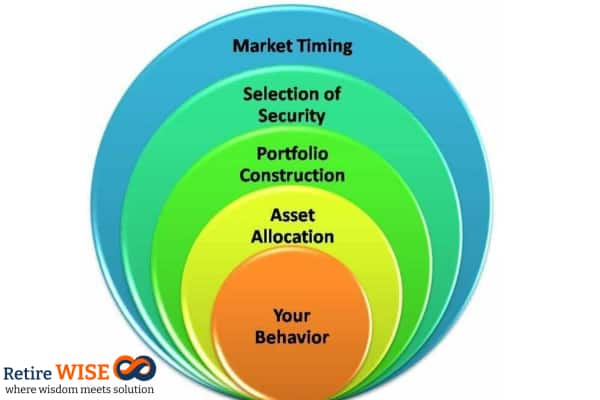
Research consistently shows that market timing contributes roughly 3% to total investment returns. Fund selection contributes 7%. Asset allocation – how you divide your money between equity, debt, and other asset classes – contributes approximately 90%. Yet most investors spend 90% of their energy on timing and fund selection. This is the fundamental mismatch. High returns come from getting asset allocation right and staying in it – not from finding the right fund at the right time.

Asset allocation is the real driver of investment returns - not market timing or fund selection

The 80:20 Rule Most Investors Get Backwards

The 80:20 principle – that 80% of results come from 20% of causes – applies directly to investing. But most investors have it exactly backwards.

They spend 80% of their time and energy on the things that contribute 20% or less to their outcomes: watching market movements daily, asking whether now is a good time to enter, switching between funds based on last year’s returns, reading tips in financial WhatsApp groups.

And they spend almost no time on the thing that drives 80-90% of their long-term returns: deciding the right split between equity, debt, and other asset classes – and then maintaining that split through market cycles.

This is not an opinion. It is one of the most well-replicated findings in investment research, first established by Brinson, Hood, and Beebower in 1986 and consistently confirmed since: asset allocation policy explains the vast majority of portfolio return variability over time.

Why Market Timing Fails Almost Everyone

The most common question I receive during a market correction: “Should I stop my SIP and wait for the market to stabilise?”

The second most common: “The market is near all-time highs. Should I wait for a correction before investing?”

Both questions reveal the same misunderstanding. Market timing requires being right twice – once when you exit and once when you re-enter. Being right once, by luck, is possible. Being right both times, consistently, over a lifetime of investing is essentially impossible for retail investors – and difficult even for professionals.

The data on SIP pausing is instructive. An investor who paused SIPs during the March 2020 COVID crash and re-entered when “the market stabilised” – which was already November 2020, by which time markets had recovered 60% from their lows – missed the best buying opportunity of the decade. The investor who did nothing bought units every month through the crash and doubled their money on those units within 18 months.

Market timing research consistently shows that missing the 10 best trading days in any 10-year period cuts long-term equity returns roughly in half. Those 10 best days almost always occur in the middle of or immediately after market crashes – when most timing investors are out of the market waiting for “stability.”

“The investor’s chief problem – and even his worst enemy – is likely to be himself. It’s not the market that destroys returns. It is the investor’s reaction to the market.”

– Benjamin Graham, adapted

Why Fund Selection Is Less Important Than You Think

Fund selection matters – but far less than the industry wants you to believe.

Consider: the difference in long-term returns between a top-quartile actively managed large-cap fund and a bottom-quartile fund in the same category is typically 1-2% per year over 10 years. That difference is real but not life-changing. The difference between being 100% in equity at 30 versus 100% in FDs at 30 is 6-8% per year for 30 years – a compounding gap that produces completely different retirement outcomes.

Category selection – which type of fund you invest in based on your goals and timeline – matters far more than individual fund selection within a category. A mediocre flexi-cap fund held for 15 years will almost certainly outperform an excellent short-duration debt fund for a 20-year retirement goal. The asset class decision dwarfs the fund selection decision.

There is also a mean-reversion problem with fund rankings. Funds that topped the charts in one 3-year period routinely underperform in the next. Chasing last year’s best performer is a reliable way to buy high and switch just as performance regresses toward the mean.

Asset Allocation: The Decision That Actually Matters

Asset allocation is the deliberate division of your investment portfolio across asset classes – primarily equity and debt in India, with some investors adding gold, international equity, or real estate.

The core principle: different asset classes have different risk-return profiles and low correlation with each other. When equity falls sharply, debt typically holds or rises. When inflation runs high, gold and real assets tend to do well. A portfolio that combines asset classes in the right proportion for your goals and timeline earns better risk-adjusted returns than any single asset class.

The right allocation is not a fixed number. It depends on three things: your investment horizon (how many years until you need the money), your risk capacity (how much of a drawdown your financial situation can absorb), and your risk tolerance (how much of a drawdown you can emotionally handle without making decisions you will regret).

A common framework: subtract your age from 100 to get your equity allocation percentage. At 35, 65% equity, 35% debt. At 50, 50% equity, 50% debt. At 65, 35% equity, 65% debt. This is a starting point, not a rule – individual circumstances vary significantly.

Do you know your current asset allocation – and whether it matches your retirement timeline?

A RetireWise retirement plan starts with asset allocation analysis – mapping your current portfolio against your actual goals and timeline.

Book a Free 30-Min Call

Rebalancing: The Discipline That Captures the Asset Allocation Benefit

Knowing your target asset allocation is not enough. Markets move, and they move your allocation with them. After a strong equity rally, an investor who started at 60% equity may find themselves at 75% equity – with more risk than their original plan intended.

Rebalancing means periodically selling the outperforming asset class and buying the underperforming one to restore the target allocation. This is the financial equivalent of “buy low, sell high” – systematically and without emotional decision-making.

Rebalancing half-yearly or annually is sufficient for most investors. Daily monitoring and rebalancing creates transaction costs and tax events without proportionate benefit. The goal is to prevent significant drift from your target allocation, not to micro-manage every fluctuation.

The Retirement Asset Allocation: The Most Critical 10 Years

The five years before and five years after retirement are the most important for asset allocation – and the most often mismanaged.

The risk of maintaining 80% equity at 58, with retirement at 60, is called sequence-of-returns risk: a market crash in those final years before retirement can permanently reduce your corpus even if markets recover later, because you have less time to rebuild. The famous “glide path” approach gradually reduces equity as you approach retirement, not to zero, but to a level where a 30-40% market crash does not derail your retirement income plan.

The risk of moving to 0% equity at retirement is the other extreme: a 25-year retirement requires your corpus to keep growing in real terms. A portfolio entirely in FDs earning 7% against 6% inflation has almost no real growth. Retirees need 30-40% equity in their long-term bucket to sustain the corpus across a 25-year retirement – even after they stop earning.

The right asset allocation at retirement is not safety through debt. It is balance – enough debt stability to fund 3-5 years of expenses without touching equity, and enough equity to ensure the corpus grows in real terms over the full retirement horizon.

Read – Systematic Withdrawal Plan (SWP): The Right Way to Take Income in Retirement

Read – The Law of the Farm: Why Patient Investors Always Win

Frequently Asked Questions

What is the ideal asset allocation for someone 10 years from retirement?

A starting framework: 60-65% equity, 35-40% debt, with the equity portion in diversified mutual funds across large-cap and multi-cap categories. As retirement approaches, gradually reduce equity to 45-50% by retirement date, ensuring the first 3-5 years of retirement expenses are in stable debt instruments. The exact allocation depends on your existing corpus, expected retirement expenses, and other income sources like rental income or pension.

Should I stop SIPs when the market is at all-time highs?

No. SIPs work precisely because you do not try to time entry points. When markets are high, you buy fewer units. When markets correct, you buy more. The averaging effect over 10-15 years is what makes SIPs powerful – not the ability to time any individual entry. Stopping SIPs at market highs means missing both the continued upside (which often persists for 1-2 more years) and the correction buying opportunity.

How often should I rebalance my portfolio?

Half-yearly is sufficient for most investors. The trigger for rebalancing can be either time-based (every April and October) or threshold-based (whenever equity drifts more than 5-10% from target allocation). Time-based rebalancing is simpler and works well for SIP investors. Threshold-based rebalancing is more precise but requires more active monitoring. Either approach is far better than no rebalancing at all.

The secret of high returns is not a secret. It has been documented in academic research for 40 years. Get your asset allocation right for your timeline. Automate your investments. Rebalance without emotion. Stay invested through corrections. The investors who do these four things consistently are the ones who look back at 65 and find that the corpus built itself.

It’s not a numbers game. It’s a mind game. And the mind game is won by the investor who stops trying to be clever and starts being consistent.

Want a retirement portfolio built on the right asset allocation – not fund chasing?

RetireWise builds retirement plans starting from asset allocation analysis – your timeline, your risk capacity, and a portfolio structure that compounds quietly for 20 years.

See Our Retirement Planning Service

💬 Your Turn

Do you know your current equity-debt split – and does it match your retirement timeline? Have you ever stopped a SIP because the market felt risky? Share what you learned. The most useful comments here are always the honest ones.

Fuel Prices and Your Household Budget: The Financial Planning Perspective

Every few months, the headline arrives: “Petrol price hiked by Rs X per litre.” Or: “LPG cylinder price raised again.”

And every time, there is the same cycle — political outrage, social media noise, a week of dinner-table complaints — followed by silence as everyone adapts and moves on.

But for a household trying to build wealth, fuel prices are not just a political story. They are an inflation story, a budgeting story, and a financial planning story.

⚡ Quick Answer

Fuel price increases in India affect household budgets both directly (transport, cooking gas) and indirectly (food inflation, goods prices). India imports over 85% of its crude oil — making fuel prices structurally linked to global oil markets and the rupee-dollar exchange rate. The personal finance response is not outrage — it is building a financial buffer, investing in inflation-beating assets, and ensuring your budget has room for cost-of-living shocks.

Why Fuel Prices in India Are What They Are

India imports approximately 85% of its crude oil requirements. This creates a structural vulnerability: every time global crude prices rise, or the rupee weakens against the dollar, the cost of fuel in India increases.

The price you pay at the petrol pump is not just crude oil. It includes central excise duty, state VAT, dealer commission, and freight charges. Together, taxes typically account for 45-55% of the retail price of petrol in most Indian states. This is both a revenue tool for governments and — controversially — a buffer that can be used to cushion price shocks when needed.

Diesel, LPG, and kerosene have historically been subsidised — meaning the government absorbs part of the market price and charges consumers less. The subsidy burden runs into lakhs of crore annually. When global oil prices spike, the government faces a choice: absorb the subsidy cost (increasing fiscal deficit) or pass the cost to consumers (increasing inflation).

Neither option is comfortable. That tension is what creates the fuel price political drama that repeats every few years.

The Real Household Impact

The direct impact of a fuel price increase is visible: more spent on petrol and diesel, higher LPG cylinder costs. But the indirect impact is larger and less visible.

When diesel prices rise, freight costs increase. When freight costs increase, everything transported by truck becomes more expensive — vegetables, grains, consumer goods. This is why fuel inflation bleeds into food inflation and general inflation within weeks.

For a household spending Rs 15,000 per month on petrol and LPG (common for urban families with one car and three LPG cylinders per month), a 10% fuel price increase costs Rs 1,500 per month directly — Rs 18,000 per year. The indirect cost through higher food and goods prices adds another Rs 10,000-20,000 depending on consumption patterns.

Together, a fuel price shock of 10% can increase a middle-class household’s annual expenses by Rs 25,000-35,000 — without any lifestyle change.

Is your financial plan built to absorb inflation shocks?

Most household budgets assume stable costs. A plan that accounts for inflation — including fuel and food shocks — is far more resilient.

Talk to a RetireWise Advisor

Why Indians Cannot Afford to Ignore Inflation

India’s general inflation rate has historically averaged 6-7% annually — higher than most developed countries. Food inflation runs at 7-10% in normal years. Fuel inflation spikes unpredictably.

This means a household that keeps its savings in a savings account (earning 3-4%) or in a bank FD (earning 7-7.5% before tax) is at best breaking even against inflation — and often losing real purchasing power.

The financial mathematics are stark. Rs 1 lakh invested in a savings account for 10 years at 4% becomes Rs 1.48 lakh. At 7% general inflation over the same 10 years, Rs 1 lakh of goods today cost Rs 1.97 lakh. You are behind by Rs 49,000 even though your money grew.

This is why equity investment — despite its volatility — is not optional for anyone with a multi-decade financial horizon. It is the only instrument class that has consistently delivered real returns (returns above inflation) over long periods in India. Regular investing in equity instruments is the only reliable defence against inflation over a career.

What to Actually Do With Fuel Price Increases

Complaining about fuel prices is understandable. Adjusting your finances to handle them is more useful.

Review your emergency fund: An emergency fund of 6 months of expenses must be recalculated after a significant fuel/inflation shock. If your expenses have risen 10%, your emergency fund target has risen 10% too.

Check your SIP amounts: Most people set a SIP amount once and forget it. But if your expenses are rising with inflation, and your investments are not increasing, your savings rate is declining in real terms. Consider a step-up SIP that increases annually by 10%.

Track household inflation personally: CPI (Consumer Price Index) is a national average. Your personal inflation may be higher or lower depending on where you live, what you spend on, and how much you drive. Track your own household expenses annually — not just to cut them, but to understand your real cost of living. A financial plan built on accurate personal data is far more useful than one built on national averages.

Consider the transition to EVs: Electric vehicles have reached price parity with petrol cars in several segments. For high-mileage urban drivers, the running cost of an EV (Rs 1-1.5 per km) versus a petrol car (Rs 8-10 per km) is a meaningful long-term financial consideration — not just an environmental one.

The Political Economy Question You Should Ask

Each time fuel prices are in the news, there is worth asking one clarifying question: is this a temporary spike driven by global crude prices, or a structural realignment where subsidies are being reduced?

These have very different implications. A temporary spike passes. A structural reduction in subsidies means fuel prices will trend higher permanently — which changes household budget planning, the relative advantage of EVs, and how much inflation buffer your retirement corpus needs.

Frequently Asked Questions

How do fuel price increases affect household savings and investments in India?

Directly, higher fuel prices increase transport and cooking gas costs by 10-15% per hike. Indirectly, they push up food and goods prices within 4-6 weeks as freight costs rise. For a typical urban household, a 10% fuel price increase can add Rs 25,000-35,000 to annual expenses without any lifestyle change. This reduces the investable surplus unless income rises proportionately. The practical response: review emergency fund targets upward and consider step-up SIPs that increase annually to maintain real savings rates.

What is the best investment to beat inflation in India?

Over long periods, diversified equity mutual funds have been the most reliable inflation-beating asset in India — delivering historical CAGRs of 12-15% against a 6-7% average inflation rate. Real estate can also beat inflation but is illiquid and lumpy. Gold historically preserves purchasing power but does not grow significantly in real terms. FDs and savings accounts typically lag inflation after tax, especially during high-inflation periods.

How should I adjust my SIP amount when inflation rises?

Use a step-up SIP — an instruction to increase your SIP by a fixed percentage (typically 10%) every year on your annual review date. This ensures your investment keeps pace with both your rising income and rising expenses. Without a step-up, your real savings rate declines every year as inflation erodes purchasing power. Most fund platforms allow automatic step-up SIPs with a single instruction change.

How does the rupee’s depreciation against the dollar affect petrol prices in India?

India prices crude oil imports in US dollars. When the rupee weakens against the dollar, each barrel of crude costs more in rupees — even if the dollar price of crude stays the same. A 5% rupee depreciation can add Rs 4-6 per litre to domestic fuel costs at current crude prices. This is why fuel inflation in India has two drivers: global crude prices and the rupee-dollar rate — both of which are outside any Indian household’s control.

Fuel prices are not in your control. Your response to them is. The households that build financial resilience — inflation-beating investments, adequate emergency funds, step-up savings — absorb cost shocks without panic. The ones who do not feel every price hike as a crisis.

It is not where fuel prices are today that matters. It is whether your financial plan is designed to handle wherever they go next.

💬 Your Turn

How has rising fuel and general inflation changed your household budget in the last 2-3 years? And have you adjusted your savings or investment plan in response? Share below.

The Retirement Shortfall Reality Check: What to Do When You Are Behind

“It’s not the plan that matters. It’s the planning – and whether you started in time.”

Last year a prospective client called me from South Asia. Mid-40s, earning Rs 25 lakh a year, and planning to retire as soon as possible. He was sounding very positive about his finances on the phone.

We enrolled him for a financial plan. When we started filling in his data, he kept stopping us – certain there was an error in our spreadsheet. His net monthly cashflow was showing negative 10%, despite a Rs 25 lakh income. He could not believe it.

The picture, once complete, was stark. He had taken loans on multiple properties. Ninety percent of his assets were in real estate, leveraged to 80-90% of market value. Several endowment policies were eating Rs 1.5 lakh a year in premiums. His solvency ratio – net assets divided by gross assets – was below 15%.

He had been measuring his wealth by what he owned. Not by what he actually had after what he owed.

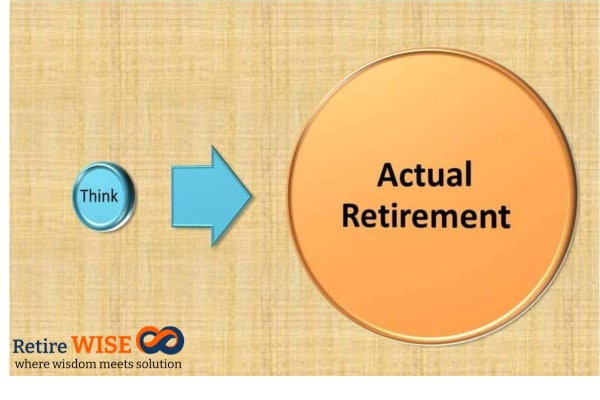
He was not ready for retirement. But he was also not too late. What he needed was not optimism. He needed a plan.

⚡ Quick Answer

A retirement shortfall – not saving enough, starting too late, or carrying too much debt into your 40s – is more common than most people admit. The corrective actions available depend on how early you identify the problem. Those who find the shortfall at 45 have real options. Those who find it at 58 have fewer. This post explains both – what causes the gap, and what you can actually do about it.

What to do when you are not ready for retirement - corrective actions and real client story

Why the Gap Exists: Four Reasons People Reach 50 Underprepared

In 25 years of practice, the retirement shortfall almost always traces back to one or more of these four patterns.

Not saving enough, consistently. Most people save what is left after spending, rather than spending what is left after saving. The result is that savings fluctuate with lifestyle – growing expenses absorb every salary increment, and the retirement corpus grows slowly or not at all. The problem compounds when people overestimate what their EPF and gratuity will provide. These help, but they are rarely sufficient for a 25-year retirement at a comfortable lifestyle.

Too conservative a portfolio for too long. Many Indian investors keep 80-100% of their long-term savings in fixed deposits, endowment policies, and PPF throughout their 30s and 40s. These instruments preserve capital but do not grow it. After tax and inflation, real returns on FDs are near zero or negative for investors in the 30% bracket. A retirement corpus built entirely on debt instruments is systematically underpowered from the start.

Real estate as a proxy for wealth. Property feels like wealth. But property that is leveraged 80% is not wealth – it is a liability with an asset attached. I regularly meet clients in their late 40s who believe they are wealthy because they own three properties, without accounting for the loans against them or the illiquidity that makes those properties useless for retirement income generation.

Life happened. Illness, job loss, a family crisis, children’s education costs that ran higher than planned. These are real. They are not failures of character – they are the reasons a financial plan needs buffers and insurance, not just a savings target.

“Most people realise they have a retirement shortfall when retirement is a year away. At that point, the options are limited. The same realisation at 45 is a solvable problem. The difference is not money – it is time.”

– Hemant Beniwal, CFP, CTEP | Founder, RetireWise

If You Are in Your 40s: You Have Real Options

A shortfall identified at 45-50 is genuinely correctable. Here is what the correction looks like in practice.

Calculate the actual gap first. Before any corrective action, you need a number. What corpus do you need at retirement (monthly expenses at retirement multiplied by 25 is a rough starting point for a 25-year retirement)? What are you on track to accumulate at current savings rates? The gap between those two numbers is what you are solving for. Without this, every action is a guess. A proper retirement needs analysis starts here.

Increase savings aggressively – and automate it. At 45, every additional Rs 10,000 per month invested in equity mutual funds has roughly 15 years to compound before retirement at 60. At 12% CAGR, Rs 10,000 per month for 15 years becomes approximately Rs 50 lakh. This is why even a 10-15% increase in monthly savings at 45 meaningfully changes the retirement outcome. The mechanism matters: automate the increase via SIP top-up so it happens before you have the opportunity to spend the money.

Shift the portfolio toward equity – appropriately. If you are 45 with 15 years to retirement and 80% of your portfolio is in FDs and endowment policies, the portfolio is positioned for preservation, not growth. A gradual shift toward equity – even to 50-60% equity over 3-4 years – changes the compounding trajectory significantly. The key word is gradual: do not liquidate FDs to invest a lump sum in equity at market highs. Increase SIPs, redirect maturing FDs, and build equity allocation methodically.

Exit policies that are costing more than they are earning. Endowment policies earning 4-5% effective returns are a drag on a retirement portfolio. If you have policies more than 5 years old that you intend to hold for another 10 years, model the surrender value against the opportunity cost of redirecting those premiums to equity. In many cases, the correct financial decision is to exit and reinvest – even at a surrender loss – because the ongoing premium redirection over 10-15 years more than compensates.

Reduce high-cost debt. Home loans at 8.5-9% are a guaranteed negative 8.5-9% on that portion of your capital. Paying down the home loan faster is a risk-free 8.5-9% return. For clients in the shortfall scenario, a systematic plan to clear the home loan by 58-60 removes both the EMI burden and the interest cost from retirement calculations.

Have you calculated what you are actually on track for?

A RetireWise retirement needs analysis shows the gap, the options, and what each option costs in terms of lifestyle or timeline. One conversation can change the trajectory.

Book a Free 30-Min Call

If You Are in Your 50s: Harder Choices, Still Solvable

Finding the shortfall at 55 means fewer compounding years and less room to manoeuvre. But it is not the end of the conversation.

Recalibrate the retirement date. Working three to five years longer than planned is the single most powerful lever available to a late-stage shortfall. It does three things simultaneously: adds years of savings, extends the compounding runway on the existing corpus, and reduces the number of years the corpus needs to sustain. A person who planned to retire at 58 and pushes to 62 changes the retirement equation dramatically.

Reduce expected retirement expenses. Not dramatically – but honestly. The difference between planning for Rs 1.5 lakh per month in retirement versus Rs 1.2 lakh per month reduces the required corpus by approximately Rs 75 lakh (at 25x). Some of this reduction happens naturally: by 60, the home loan is typically paid, children are financially independent, and many of the large expenses of the 40s simply disappear.

Consider moving to a lower-cost city. A retired couple in Tier 2 India – Jaipur, Pune outskirts, Coimbatore, Mysuru – can live well on 30-40% less than an equivalent lifestyle in Mumbai or Bengaluru. This is not a compromise. For many clients, it is an upgrade: more space, less traffic, proximity to family, better air quality. The financial benefit is that the same corpus lasts significantly longer.

Monetise illiquid assets thoughtfully. If significant wealth is locked in real estate – especially a second or third property held for appreciation – a structured exit over 3-5 years can materially change the retirement picture. Property that generates 2-3% rental yield against a cost of 8-9% on leverage is actively destroying wealth. Selling and deploying proceeds into income-generating instruments is often the right call.

What the Client Did

The mid-40s client I mentioned at the opening did four things over the next 18 months. We made two endowment policies paid-up, stopping the premium drain. He rented out one of his properties, converting a non-producing asset into income. We restructured his portfolio to increase equity allocation from near zero to 40%. And he set up an automatic SIP top-up tied to each annual increment.

He did not retire early. But by 58 – on his own revised timeline – he had a retirement corpus that was functional, a home loan that was cleared, and a monthly surplus that surprised even him.

The shortfall at 45 was real. The correction was also real. The only thing that made it possible was starting before the options ran out.

Read – Retirement Planning vs Child Future Planning: Why You Must Choose One First

Read – Is Rs 1 Crore Enough to Retire in India?

Frequently Asked Questions

How do I know if I have a retirement shortfall?

Calculate your target retirement corpus: estimate your monthly expenses at retirement (in today’s money, inflated to retirement date), multiply by 25 for a 25-year retirement, and that is your rough target. Then project your current savings forward at a realistic return. If the projection falls short of the target, you have a gap. The size of the gap and the years remaining to retirement determine which corrective actions are available.

I am 52 with Rs 50 lakh saved and a Rs 60 lakh home loan. What should I focus on?

Both simultaneously, but weighted toward the loan in the short term. The home loan interest (typically 8.5-9%) is a guaranteed cost; prepaying it is a guaranteed return at that rate. At the same time, increase SIPs to the maximum you can sustain – equity returns over 8-10 years can still meaningfully grow the corpus. The priority order: build a 6-month emergency fund first, then split surplus between loan prepayment and SIP increase.

Should I delay retirement to fix a shortfall?

If the shortfall is significant and you have the option, yes – working 3-5 years longer is the most powerful corrective action available. It adds savings, extends compounding, and reduces the retirement period the corpus needs to cover. Framing it as “retiring from one phase to another” – moving from a full-time corporate role to consulting, advisory, or a passion project – makes the extension psychologically and practically easier.

The retirement shortfall is not a verdict. It is a diagnosis. And like most diagnoses, what matters is not how you got here. It is what you do next – and how quickly you start.

The best time to fix a retirement shortfall was five years ago. The second best time is today.

Want to know exactly where you stand – and what it will take to get on track?

RetireWise builds retirement plans for senior executives who are behind schedule – with specific, actionable steps rather than generic advice.

See Our Retirement Planning Service

💬 Your Turn

Have you done a honest calculation of your retirement gap? What did you find – and what corrective action did you take or are you considering? Share in the comments.