
Home Blog Page 41

Beta in Mutual Funds: What It Means for Your Retirement Portfolio

20

“Risk comes from not knowing what you’re doing.” – Warren Buffett

A client once asked me to look at two mutual funds. Both were large-cap funds tracking similar mandates. Fund A had returned 14% over 3 years. Fund B had returned 16% over the same period.

“Should I switch to Fund B?” he asked.

I showed him the beta of each. Fund A had a beta of 0.85. Fund B had a beta of 1.25. Fund B was generating its higher returns by amplifying market moves – it rose more than the market in rallies, which looked great in a bull run. But in a correction, it would also fall more steeply.

For a client 4 years from retirement, Fund B’s higher beta was not a feature. It was a risk he could not afford.

⚡ Quick Answer

Beta measures how much a mutual fund moves relative to its benchmark index. A beta of 1.0 means the fund moves exactly with the market. Beta above 1.0 means it amplifies market moves (higher returns in rallies, deeper falls in corrections). Beta below 1.0 means it is less sensitive to market movements – more defensive. Beta is most useful when comparing two funds within the same category, to understand whether higher returns came from better stock selection or simply from taking more market risk.

Beta in mutual funds - what it measures and how to use it in retirement portfolio planning

What Beta Actually Measures

Beta measures systematic risk – the portion of a fund’s volatility that comes from its exposure to the overall market. It does not measure the fund’s own specific risk (that is standard deviation). It measures specifically how sensitive the fund is to market movements.

Mathematically, beta is calculated by regressing the fund’s returns against the benchmark index returns over a period. The result tells you: for every 1% move in the benchmark, how much does this fund typically move?

A beta of 1.0: the fund moves in line with the index. If Nifty rises 10%, this fund rises approximately 10%. If Nifty falls 15%, this fund falls approximately 15%.

A beta of 1.3: the fund amplifies market moves by 30%. A 10% market rise produces approximately a 13% fund rise. A 15% market fall produces approximately a 19.5% fund fall.

A beta of 0.8: the fund dampens market moves. A 10% market rise produces approximately an 8% fund rise. A 15% market fall produces approximately a 12% fund fall.

Beta below 1.0 is generally associated with more defensive portfolios – funds holding lower-volatility sectors, quality stocks, or funds that carry some cash or debt. Beta above 1.0 is associated with more aggressive portfolios – small/mid-cap tilts, momentum strategies, or sector concentrations in cyclical sectors.

Beta vs Standard Deviation: What Each Tells You

Standard deviation and beta both measure risk, but they measure different things.

Standard deviation measures the total volatility of a fund – how much its monthly returns vary from its own average. This captures both market-related volatility and fund-specific volatility (from the fund manager’s particular stock picks).

Beta measures only the market-related portion of that volatility. It is a relative measure – relative to the benchmark. A fund with very concentrated sector bets may have high standard deviation but moderate beta (if the sector moves independently of the market). A fund that closely mirrors the index may have lower standard deviation but a beta close to 1.0.

Both are needed to understand a fund’s risk profile. Standard deviation tells you how bumpy the ride will be. Beta tells you how much of that bumpiness is driven by market direction.

“When I review a client’s portfolio, a fund with beta significantly above 1.0 near their retirement date gets my immediate attention. Higher returns through higher beta is not alpha – it is just more market risk dressed up as skill.”

– Hemant Beniwal, CFP, CTEP | Founder, RetireWise

Beta Across Fund Categories

Beta varies predictably across fund categories, which helps calibrate expectations:

Large-cap index funds: beta very close to 1.0 by design – they track the index almost exactly.

Actively managed large-cap funds: beta typically 0.85-1.10. Good active managers may maintain a beta slightly below 1.0 while still generating returns above the benchmark (indicating genuine alpha rather than just market amplification).

Mid-cap funds: beta typically 1.0-1.3. Mid-cap stocks tend to be more sensitive to market cycles than large-caps.

Small-cap funds: beta typically 1.1-1.5 or higher. Small-caps amplify market moves substantially, both upward and downward.

Balanced advantage / dynamic allocation funds: beta typically 0.5-0.8, because the debt component reduces overall market sensitivity.

Sector funds: beta varies widely by sector. Consumer staples sector funds may have beta below 1.0 (defensive). Infrastructure or metals sector funds may have beta above 1.5 (highly cyclical).

Is your retirement portfolio’s beta matched to your timeline?

A RetireWise retirement plan evaluates your portfolio’s overall beta and ensures market sensitivity is appropriate for your years to retirement.

Book a Free 30-Min Call

How to Use Beta in Retirement Portfolio Planning

For retirement planning, beta has three practical applications.

First, accumulation phase (more than 10 years to retirement): a higher-beta portfolio – with exposure to mid-cap and small-cap funds – is appropriate because the investment horizon is long enough to absorb market cycles. The higher market sensitivity works in your favour during bull phases, and corrections have time to recover.

Second, transition phase (5-10 years to retirement): begin reducing overall portfolio beta systematically. This is not about avoiding equity – it is about shifting from high-beta equity (small and mid-cap) to lower-beta equity (large-cap, balanced advantage). The goal is to reduce the magnitude of potential drawdowns as the retirement date approaches.

Third, retirement phase: overall portfolio beta should be meaningfully below 1.0 for the equity portion. Balanced advantage funds, conservative hybrid funds, and quality large-cap funds with beta around 0.7-0.9 provide equity participation without the amplified drawdown risk of high-beta funds.

Read – Standard Deviation in Mutual Funds: What It Means for Your Retirement Portfolio

Read – Hybrid Mutual Funds Explained: The Right Way to Use Them in Retirement Planning

Frequently Asked Questions

Where do I find a fund’s beta?

Beta is published in every mutual fund’s monthly factsheet, which AMCs are required to release. It is also available on fund research platforms like Value Research Online, Morningstar India, and AMFI. Most platforms show 3-year beta as the standard measure. When comparing betas, always compare funds within the same category and against the same benchmark – a large-cap fund’s beta is measured against the Nifty 50, while a mid-cap fund’s beta should be measured against the Nifty Midcap 150. Comparing betas across different benchmarks is not meaningful.

Should I always prefer low-beta funds?

Not necessarily. A fund with lower beta will underperform in strong bull markets – you will give up upside. The appropriate beta depends on your investment timeline and where you are in the retirement journey. A 35-year-old building a retirement corpus over 25 years may reasonably want higher-beta equity funds to maximise long-term compounding. A 58-year-old with 2 years to retirement should actively reduce portfolio beta. The “right” beta is the one appropriate for your specific situation, not universally the lowest available.

What is the difference between beta and alpha?

Beta measures how much market risk the fund is taking. Alpha measures the return generated above (or below) what beta would predict. A fund with beta 1.2 and 20% returns when the market returned 15% has generated alpha: it earned 2% more than the 18% its beta would predict (1.2 x 15%). A fund with beta 1.2 and 18% returns when the market returned 15% has zero alpha: its returns are exactly explained by its market exposure. Alpha is the measure of genuine active management value. A fund generating returns purely by taking on higher beta (higher market risk) is not adding alpha – it is just amplifying market returns.

A fund’s returns tell you what happened. A fund’s beta tells you why it happened. Returns without understanding risk context are incomplete – and potentially misleading. In retirement planning, where the consequences of being wrong near the withdrawal date are severe, understanding beta is not optional.

Higher returns through higher beta is not skill. It is risk – with a good outcome so far.

Want a retirement portfolio where risk is measured, not just returns?

RetireWise evaluates your portfolio on multiple risk metrics including beta, standard deviation, and Sharpe ratio – not just trailing returns.

See Our Retirement Planning Service

💬 Your Turn

Do you look at beta when selecting mutual funds, or have you primarily focused on returns? Has understanding beta changed how you think about any funds in your portfolio? Share in the comments.
Investment Vehicles and Gears: Matching Your Investments to Your Goals

“An investment in knowledge pays the best interest.” – Benjamin Franklin

My daughter was two years old when I first made a financial plan for her wedding.

Not because I was in a hurry. But because the math is simple: a wedding planned for 20 years away requires a very different investment approach than one planned for 3 years away. Same destination. Same amount needed. Completely different journey.

This is the gear analogy – and it is the clearest framework I know for explaining why investment selection is not about finding the “best” product, but about matching the right instrument to the right timeline.

⚡ Quick Answer

Investment products are vehicles that carry you from your current financial position to your goal. Like gears in a car, different instruments suit different speeds and distances. Equity is the high gear for long distances (7-plus years) – it moves fast but needs road to accelerate. Debt is the low gear for short distances (under 3 years) – slower but stable. Most Indian investors damage their wealth by using the wrong gear: equity for short-term goals (too volatile) and debt for long-term goals (too slow to beat inflation).

Investment vehicle gears analogy - equity for long term goals, debt for short term

The Vehicle Analogy: Where Are You Going?

Investment products are called “vehicles” because they carry you from Point A to Point B financially. Point A is your current position – your savings today. Point B is your goal – the corpus needed for retirement, your daughter’s wedding, your son’s education, or a second home.

The question is not “which vehicle is best?” The question is “which vehicle is right for this particular journey?”

Nobody drives to the corner shop in a plane. Nobody walks from Jaipur to Delhi. The mode of transport is determined by the distance, the urgency, and what you can afford to risk. Financial instruments work exactly the same way.

Low Gear: Debt for Short-Distance Goals

When your destination is nearby – under 3 years – you need a vehicle that is stable, predictable, and will not break down. You cannot afford a sudden 30% drop in value when you need the money in 18 months.

Debt instruments – FDs, liquid funds, short-duration debt funds, PPF for accessible portions, RBI bonds – are the first and second gear. Slow. Steady. Reliable. The returns are modest (6-8%), but the capital is protected for near-term withdrawal.

The tragedy in Indian investing is not that debt exists. It is that debt is used for everything. A 30-year-old investing for retirement in FDs is driving from Mumbai to Delhi in first gear. Technically possible. Practically ruinous – by the time they arrive, inflation will have eaten most of the journey’s value.

“The biggest wealth-destruction in India happens silently: people parking long-term money in FDs and endowment plans while inflation quietly erodes its real value every year. They feel safe. They are not building wealth.”

– Hemant Beniwal, CFP, CTEP | Founder, RetireWise

High Gear: Equity for Long-Distance Goals

When your destination is far – 7 years or more – you need a vehicle built for distance. Equity is the highway gear. It moves fast. It has volatility on the short-term road. But over long distances, it reliably outpaces inflation and creates real wealth.

The Sensex has delivered approximately 14-15% CAGR over the last 30 years. Rs 1 lakh invested in 1994 is worth approximately Rs 25-30 lakh today at those rates. The road was never smooth – crashes in 2000, 2008, 2011, 2015, 2020 – but the direction was consistently upward over decades.

However: equity in the short term is dangerous. It is like taking a highway vehicle off-road. The vehicle that excels at 120 km/h on the expressway is not designed for a potholed village road. A client who needs money in 18 months should not be in equity – a sudden 40% correction at the wrong time can be financially catastrophic when the need is near.

Are your investments in the right gear for each of your goals?

A RetireWise retirement plan maps each financial goal to the correct instrument – matching distance, timeline, and risk capacity to the right investment vehicle.

Book a Free 30-Min Call

The Reverse Gear: Insurance Endowment Plans and Savings Accounts

The most underappreciated gear in the analogy is reverse. Some financial products do not just fail to move you forward – they actively move you backward.

A savings account for long-term money at 3-4% interest, with inflation at 5-6%, produces negative real returns. Every year you park retirement money in a savings account, you are moving backward in real purchasing power terms.

Insurance endowment plans and ULIPs sold as “investment-cum-insurance” are similarly destructive. The mortality charges and administrative costs reduce investment returns so significantly that after 20 years, the real return often barely matches inflation. You feel like you are moving forward because the nominal balance is growing. In real terms, you have been in reverse gear.

The solution is the one Hemant has been recommending for 25 years: buy term insurance for protection at the lowest cost. Invest separately for wealth building. Keep the two completely apart.

The Gear Change: Shifting as Goals Approach

A vehicle does not stay in the same gear for the entire journey. As you approach your destination, you slow down and shift to a lower gear. The same principle applies to investments.

A 35-year-old planning for retirement at 60 should be predominantly in equity – high gear for a 25-year journey. By age 50, with 10 years left, a gradual shift begins: some equity moved to hybrid funds, some to short-duration debt. By 58, two years from retirement, most of the corpus that will be needed in the first 3-5 years of retirement should be in safer instruments – not because equity is bad, but because the journey is almost over and it is time to shift gears.

This is asset allocation glide path – the systematic reduction of equity exposure as retirement approaches – and it is one of the most important principles in retirement portfolio management.

Read – Low Risk High Return Investment: Why It Does Not Exist and What to Do Instead

Read – Timing the Market vs Time in the Market: Why Staying Invested Wins

Frequently Asked Questions

What is the right equity-debt split for retirement planning?

A common starting point: 100 minus your age in equity. At 35: 65% equity, 35% debt. At 50: 50% equity, 50% debt. At 60: 30-40% equity for the corpus that will not be needed for 7-plus years, with 60-70% in debt and liquid instruments for near-term withdrawals. These are guidelines, not rules – the exact split depends on your retirement corpus size, monthly withdrawal needs, other income sources, and risk tolerance. The principle is directionally correct: reduce equity exposure progressively as retirement approaches.

My goal is 7 years away. Should I use equity or debt?

Seven years is at the border. For equity to work, you generally need a full market cycle (5-7 years minimum) to smooth out volatility. For a 7-year goal, a 60-70% equity and 30-40% debt allocation is reasonable – more equity than debt, but with a meaningful debt buffer. Start shifting progressively toward debt from year 4 or 5 so that by year 6-7 the majority is in lower-risk instruments. This prevents a bad market year just before your deadline from damaging the corpus significantly.

What about hybrid mutual funds? Where do they fit in the gear analogy?

Hybrid funds – balanced advantage funds, aggressive hybrid funds, conservative hybrid funds – are the 3rd gear. They participate in equity growth but with lower volatility than pure equity funds. They are appropriate for medium-term goals (4-7 years), for investors who want equity exposure with somewhat lower drawdown risk, and for the transition phase of a retirement portfolio as you approach withdrawal. They are not a substitute for pure equity in early accumulation, nor a substitute for debt when capital preservation is the priority – but they serve an important middle role.

Wealth is not destroyed by choosing wrong investments. It is destroyed by choosing right investments for the wrong goal. Equity in the right gear creates retirement wealth. Equity in the wrong gear – for a goal two years away – creates anxiety and loss. Match the gear to the journey. That is the whole framework.

Get in the right gear before it is too late.

Want a retirement plan where every rupee is in the right gear?

RetireWise builds retirement plans that map each goal to the correct instrument, with a systematic gear-change schedule as retirement approaches.

See Our Retirement Planning Service

💬 Your Turn

Which gear are your long-term investments in today – highway gear (equity) or slow gear (FDs and endowment)? Has this analogy changed how you think about your current portfolio? Share in the comments.
Ask Readers: Your views on Gold Prices

A client called me in early 2026. Gold had just crossed Rs.1.5 lakh per 10 grams. His neighbour had made “tremendous returns” on gold in the last five years and was now suggesting he shift 40% of his retirement corpus into gold funds.

“Hemant, is this the right time to buy gold? Will it keep going up?”

My answer was the same as it was in 2011 when gold had crossed Rs.26,000 per 10 grams and people were asking me the same question. I have no idea what gold prices will do next. And neither does anyone else.

Quick Answer

Nobody can consistently predict gold prices. The right answer to “should I invest in gold now?” depends on your current asset allocation, not on anyone’s gold price forecast. 5 to 10% of investable portfolio in gold is a reasonable hedge. More than that is a speculative position that requires you to be right about timing – something even the world’s best investors cannot do consistently.

Gold prices India 2026 - should you invest?

Gold at Rs.1,52,000 per 10 grams – what the bulls say

The bull case for gold in 2026 is the same as it has always been:

  • Weakening US dollar relative to other currencies
  • Central bank gold purchases globally at multi-decade highs
  • Geopolitical uncertainty – wars, trade conflicts, supply chain fragility
  • Inflation concerns, particularly in India where the rupee has depreciated
  • Global debt levels at historic highs, making hard assets attractive

Each of these arguments has genuine merit. And some of the world’s most respected investors hold significant gold positions. John Paulson rode gold from 2009 to 2011. Ray Dalio allocates 5 to 10% to gold in his All Weather portfolio. Jim Rogers has been a commodities bull for decades.

But notice what all of them have in common: they hold gold as part of a diversified portfolio, not as the dominant position.

What the bears say – and why this matters

Gold does not produce earnings, pay dividends, or generate cash flow. Its price is entirely driven by what the next buyer is willing to pay. This makes it an inherently speculative asset – even when the speculation is well-reasoned.

Gold fell approximately 70% from its 1980 peak and spent the next 20 years recovering. An investor who bought gold at the 1980 peak waited until 2005 to break even. That is 25 years of zero real return.

In 2011, gold touched $1,900 per ounce and fell sharply. It took until 2020 to recover that level. Investors who bought at the 2011 peak experienced almost a decade of flat to negative real returns.

The question to ask yourself is not “will gold go up?” The question is: “Am I ready to hold for 10 to 25 years if it doesn’t?”

The framework that actually matters – asset allocation

Gold prices cannot be valued using any standard financial model. There is no P/E ratio, no discounted cash flow, no earnings growth. The only way to answer “is gold worth it at this price?” is to decide how it fits into your overall asset allocation.

Here is a simple framework I use with clients:

Under 5% in gold: Consider adding systematically via a gold ETF SIP. Not because gold will go up, but because low gold allocation creates portfolio fragility during currency or geopolitical shocks.

5 to 10% in gold: This is the target range for most investors. Review annually. Rebalance if the price rise has pushed your allocation above 10%.

Above 10% in gold: You are making a directional bet on gold, not a hedging allocation. Be honest with yourself about whether you are investing or speculating. If the latter, size it appropriately and have an exit plan.

Above 20% in gold: This is concentration risk. The neighbour who made “tremendous returns” in the last five years has taken a concentrated bet that happened to pay off. Past five-year gold returns are not a guide to the next five.

The Google Trends lesson – investors search when it’s already too late

When gold prices were at their lowest relative to equities in 2018 to 2019, almost no one was searching for gold investment advice. When gold crossed Rs.50,000 per 10 grams in 2020, search volumes exploded. When it crossed Rs.1 lakh per 10 grams in 2024, the phones rang again.

Investors search for an asset after it has risen, not before. This is the same pattern we see in equity – mutual fund SIP volumes peak near market tops, not near bottoms. It is human nature, but it is the most reliable way to consistently buy high and sell low.

The best time to add gold to your portfolio is when nobody is talking about it. That time is clearly not April 2026.

My view – trees do not grow to heaven

I cannot tell you that gold will fall. It may well continue to rise in 2026 and beyond. But I know that every asset that goes up a lot eventually corrects – and gold is no exception. What I can tell you is that your financial future should not depend on being right about which way gold moves next.

If you do not own any gold, add a small systematic allocation as a hedge. If you already own 5 to 10%, rebalance to maintain that allocation. If someone is telling you to put 30 to 40% of your retirement corpus in gold, ask them where they were when gold was at Rs.26,000 per 10 grams and nobody was excited about it.

Also read: Should You Invest in Gold Funds? The Case Against NFOs and How to Allocate Correctly

Not sure how much gold is right for your retirement portfolio?

Asset allocation in retirement is not about chasing what’s hot. It is about building a portfolio that survives 25 to 30 years of withdrawals, inflation, and market cycles. We help clients build and rebalance portfolios as part of our retirement planning process.

Book a Clarity Call

Frequently asked questions

Will gold prices continue to rise in 2026?

Nobody can answer this with confidence, including professional gold analysts, central banks, or commodity traders. The factors that support gold – dollar weakness, geopolitical risk, inflation, central bank buying – are real. But they were also real in 2012 when gold fell from $1,900 to $1,100. The only honest answer is: nobody knows, so make your decision based on your allocation target, not price predictions.

What percentage of my portfolio should be in gold?

Most financial planning frameworks suggest 5 to 10% of investable assets in gold as a portfolio hedge. This is not a growth allocation – it is insurance against currency devaluation, geopolitical shocks, and extreme inflation scenarios. More than 10% crosses from hedging into directional speculation. For most Indian investors building retirement wealth, equity and debt are the primary wealth builders; gold is the shock absorber.

Is gold a good investment for retirement in India?

Gold plays a supporting role in a retirement portfolio, not a leading one. It does not generate income (unless held as SGB, which is no longer issuing new tranches). It does not compound like equity. Over any 15 to 20 year period in India, a diversified equity portfolio has significantly outperformed gold. Gold earns its place as a hedge and diversifier – not as the primary retirement wealth builder.

Should I sell gold and invest in equity now?

If gold has risen significantly and now represents more than 10 to 15% of your portfolio, systematic rebalancing into equity makes sense. Not because gold will fall, but because you are accepting concentration risk in a non-income-generating asset. Use the STP (Systematic Transfer Plan) approach – do not exit all at once. Discuss the tax implications with your advisor before making large redemptions, especially for physical gold sold as capital assets.

What is your current gold allocation – as a percentage of total investable assets? Are you comfortable with that number? Share your view in the comments.

SIP with Free Life Insurance: Why It Was a Bad Idea in 2011 and Still Is in 2026

“There ain’t no such thing as a free lunch.” – Milton Friedman

In 2019, Nippon India Mutual Fund (then called Reliance Mutual Fund after the Nippon Japan acquisition) quietly discontinued the SIP Insure feature on its equity schemes. The product that had been aggressively sold for nearly a decade – free life insurance with your SIP – simply vanished.

Thousands of investors who had bought SIPs specifically for the insurance cover suddenly had no insurance. And those who had already redeemed early had paid the 2% exit load. Both groups lost.

The product is dead. But the sales pitch is not. Today, multiple fund houses offer bundled SIP-plus-insurance schemes with different names and slightly different structures. Same logic. Same problems. And one new problem: most investors have already forgotten what happened to Reliance SIP Insure and are walking into the same trap with fresh confidence.

⚡ Quick Answer

SIP-with-free-insurance is not free. The “free” insurance comes with a 2% exit load if you redeem early, forces you to stay in one fund house (which prevents switching underperformers), and provides decreasing coverage that reduces every month. Current equivalents – HDFC SIP with insurance, Mirae Asset SIP Plus – have the same structural problems. Buy term insurance separately. Invest in SIPs separately. Never mix the two.

📋 FACTCHECK NOTE – April 2026

Reliance Mutual Fund became Nippon India Mutual Fund in 2019 following the Nippon AMC acquisition. The original “Reliance SIP Insure” product as described in the original 2011 post no longer exists. All specific fund names referenced in the original post have been renamed or merged. The investor dilemma story structure is kept for illustrative purposes – the analysis applies equally to current SIP-insurance products. Birla Sunlife is now ABSL (Aditya Birla Sun Life).

How SIP-with-Insurance Actually Works

Here is the structure that current SIP-insurance products follow (with minor variations by fund house). When you start a SIP of a minimum amount (typically Rs 1,000-2,000/month) for a minimum tenure (typically 3-10 years), you are enrolled in a group term insurance cover. The fund house pays the insurance premium from their own pocket. You pay nothing extra.

The sum assured is calculated as: SIP amount x remaining months of tenure. So a Rs 5,000/month SIP for 10 years starts with Rs 6,00,000 coverage (5,000 x 12 x 10). But this coverage decreases every month as the remaining tenure shortens. By year 5, the same SIP gives only Rs 3,00,000 coverage.

If you die during the tenure, the insurance amount is added to your existing fund units in the name of your nominee. The nominee then has the choice to hold or redeem – but here is the catch: if they redeem before the original tenure ends, they pay the 2% exit load.

Yes. Even on death claims, the exit load applies in most of these products.

A Real Investor’s Dilemma

Here is the kind of situation I see regularly. An investor started four SIPs in 2022 – two in Nippon India funds and two in ABSL funds – partly for the insurance cover. By 2024, two of the four funds are significantly underperforming their category. He wants to switch to better funds.

He cannot – not without losing the insurance cover and paying the 2% exit load on accumulated corpus. His Rs 8 lakh corpus faces a Rs 16,000 exit charge if he switches to better funds.

His choices: stay invested in underperforming funds to protect a declining insurance cover he probably does not need in the first place, or pay Rs 16,000 to exit and invest freely.

This is not a theoretical problem. It is the problem the original post described in 2011, and it is still happening today.

The Real Cost Nobody Calculates

The cost of bundled SIP insurance is not the exit load alone. It is the compounding cost of being locked in an underperformer.

Scenario: Rs 5,000/month SIP, 10-year tenure. Fund A (your SIP-insured fund) returns 11% CAGR. Fund B (where you would have switched) returns 14% CAGR. This is not an unusual gap – many actively managed funds differ by 3-4% from their category average.

After 10 years: Fund A at 11% = approximately Rs 10.5L. Fund B at 14% = approximately Rs 12.5L. Difference: Rs 2 lakh. Exit load you saved by not switching: Rs 16,000-30,000 depending on timing.

The “free” insurance cost you Rs 2 lakh in opportunity cost. Plus: the cover was declining all 10 years and by year 8 was worth about Rs 1.2L – not Rs 6L as you thought when you signed up. A Rs 1 crore term plan costs Rs 10,000-12,000/year for a 30-year-old. The bundled insurance “saved” you Rs 1.2L but cost you Rs 2L. Net loss: Rs 80,000-plus.

Insurance is protection. Investment is growth. They work differently – and they should never share an account.

At RetireWise, we review your SIP and insurance portfolio together – to make sure neither is undermining the other. SEBI Registered. Fee-only.

See How RetireWise Works

Why “Free” Makes Us Do Stupid Things

Behavioural economist Dan Ariely’s research shows that “FREE” triggers a disproportionate emotional response that overrides rational calculation. People will stand in line for 45 minutes to save Rs 100 on a Rs 5,000 item at a “free gift” sale. The zero price creates a positive emotion that short-circuits cost-benefit analysis.

This is exactly what happens with bundled SIP insurance. Investors hear “free Rs 10 lakh insurance with your SIP” and their brain stops calculating. They do not ask: is this cover adequate for my family? What is the exit load trap? What happens if this fund underperforms? Can I switch funds without losing the cover?

Zero Price Effect (Ariely, 2008) combined with Status Quo Bias (Samuelson & Zeckhauser, 1988) explains why investors stay in underperforming SIP-insurance products for years: the “free” label made the entry feel like a win, and inertia makes the exit feel like a loss.

AMFI 2024 data puts this in sharp numbers: SIP discontinuation rate in India remains at 60-65% within the first 3 years. Most of these exits trigger exit loads. For SIP-insurance bundled products, that exit load creates additional friction that delays switching even from chronically underperforming funds – potentially costing investors 2-4% in additional underperformance per year of delay. And to put the “free” cover in perspective: a pure term plan of Rs 1 crore for a 35-year-old non-smoker costs approximately Rs 10,000-14,000 annually in 2026 – giving 10x more coverage than most SIP-bundled schemes at a fraction of the flexibility cost.

Why Rs 10 Lakh Is Almost Never Enough

Here is the other problem with bundled SIP insurance that never gets mentioned in the sales pitch: the maximum cover is Rs 10 lakh in most of these products, regardless of how large your SIP is or how many folios you have.

If your family needs Rs 10 lakh in insurance, you have a much larger financial planning problem than which SIP to choose. The standard life insurance requirement for a 35-year-old with home loan, dependent spouse, and two school-age children is Rs 1-2 crore. Rs 10 lakh is 5-10% of what you actually need. The bundled insurance gives you the feeling of coverage while leaving 90-95% of your risk unprotected.

What You Should Do Instead

If you currently have a bundled SIP-insurance product: calculate your actual exit load cost and compare it against the opportunity cost of staying in an underperformer. If the fund is performing adequately, staying is fine. If it is chronically underperforming (3%+ below category benchmark over 3 years), pay the exit load and move.

If you are evaluating a new SIP: choose funds on the merit of the fund manager, consistent track record, and fit with your asset allocation. Then buy a Rs 1 crore+ term plan separately. The two decisions should have nothing to do with each other.

“2 + 1 (free) is never equal to 3 in personal finance. The free thing always comes with a cost. Find the cost first. Then decide if the product is worth it.”

– Hemant Beniwal, CFP, CTEP | Founder, RetireWise

Read next: Term Insurance – Why It Is the Only Life Insurance You Actually Need

A Rs 10L bundled insurance cover is not a financial plan. It is a distraction from one.

At RetireWise, we help senior executives build proper insurance and investment structures – separately and correctly. SEBI Registered. Fee-only.

See the RetireWise Service

Reliance SIP Insure disappeared in 2019. The investors caught in it paid exit loads, lost insurance mid-stream, and learned an expensive lesson. The current products will likely evolve, rebrand, or disappear too. What will not change is the fundamental principle: any product that bundles insurance with investment is making a trade-off on your behalf – and the trade-off almost always favours the product manufacturer, not you.

Buy the best SIP for your goals. Buy the best term plan for your family’s protection. Keep them completely separate. Always.

💬 Your Turn

Do you have a bundled SIP-insurance product? Have you calculated whether your fund is outperforming its benchmark – and what it would cost to exit and switch? Share your situation below.

SBI Gold Fund Review – Think before you Invest

Every time gold rises sharply, fund houses launch gold products. Every time. It happened in 2011. It happened again around 2020. And when gold crosses Rs.1,52,000 per 10 grams – as it has today in April 2026 – the phones start ringing again.

In 2011, when SBI Mutual Fund launched its Gold Fund NFO, 24-karat gold was trading around Rs.26,000 per 10 grams. People were rushing to participate in the “gold rush.” The question I asked then is the same one I am asking now: Is it because gold prices will rise further, or because they have already risen in the past?

Those are two very different reasons to invest. And confusing them is how investors lose money.

Quick Answer

Never invest in a Mutual Fund NFO – gold or otherwise. The same fund in its existing form works just as well after the NFO closes. For gold specifically: keep 5 to 10% of your portfolio in gold as a hedge, not as a growth investment. At Rs.1.52 lakh per 10 grams in 2026, gold is at historic highs. The question is not “should I invest in gold” but “what percentage is appropriate given my overall asset allocation.”

Gold fund investment India

Never invest in a Mutual Fund NFO – the rule holds for gold too

On a distribution house Facebook group in 2011, I saw this exchange:

Relationship Manager: “Now invest in Real 24 Carat Gold in Monthly SIP. SBI presents SBI GOLD FUND.”

Boss: “Let’s create history this time.”

Relationship Manager: “We are ready to rock.”

They were not going to rock. They were going to sell you a product because gold had already gone up – not because it would continue to do so. Fancy of Gold, craze of SIP, advertising campaign, supporting views from media, and a big push from agents may drive you to the wrong decision.

The case against NFOs has nothing to do with the underlying asset. It applies to every NFO – equity, gold, debt, sector.

  • An NFO gives you no return history to evaluate.
  • The same strategy is available in an existing fund with a track record.
  • NFOs are launched when the AMC believes it can raise the most money – which is when the underlying asset is hot. Hot assets are often overpriced assets.
  • Every day you wait for allotment is a day your money earns nothing.

If you want exposure to gold, Nippon India Gold ETF (formerly Reliance Gold Savings Fund), HDFC Gold Fund, SBI Gold Fund – they all track the same underlying commodity. Choose an existing fund with history and start a SIP. Do not wait for an NFO.

The investor psychology pattern – it repeats every cycle

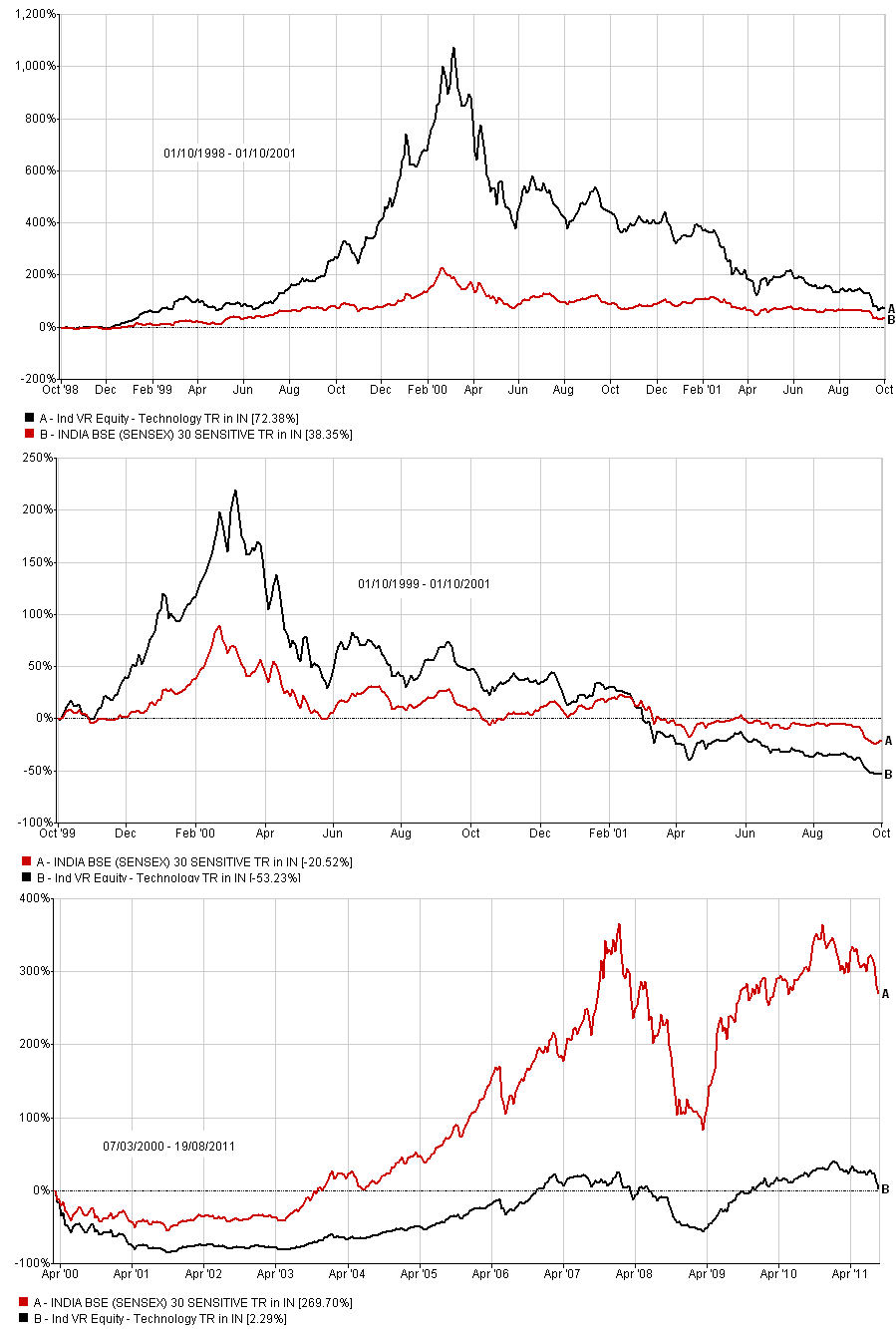
Look at what happened with IT sector funds between 1998 and 2003. Funds launched at the peak of the dot-com bubble. Investors who poured money in at the height lost 70 to 80% of their investment. The sector itself recovered – but the investors who bought at peak prices took a decade just to break even.

IT Sector Fund performance India

The same logic applied to infrastructure funds in 2007. Real estate stocks in 2007. And it applies to gold whenever prices have run sharply.

Manufacturers and distributors sell the trend of the season. When gold is in demand, they launch gold products. When equity is in demand, they launch sectoral equity funds. Whether or not the product is useful for you is not their primary concern. Their commission is earned on the transaction, not on your outcome.

Warren Buffett said it best: “When all the people are thinking in the same direction, no one is thinking.”

Gold at Rs.1,52,000 per 10 grams – does it make sense to buy now?

In 2011, I wrote that gold had already risen 587% in the preceding decade. In 2026, gold has risen nearly 6x again from those 2011 levels. Both times, the argument for more gold was the same: uncertainty, dollar weakness, inflation, geopolitical risk.

I have one consistent view on gold as an investment: trees do not grow to heaven.

I cannot tell you whether gold will be Rs.2 lakh or Rs.1 lakh per 10 grams in five years. Nobody can. But I can tell you this: if you are buying gold because it has already gone up, you are the one who is likely to be left holding it when it eventually corrects – as it always does. Gold went down 70% from its 1980 peak and stayed depressed for two decades.

The right question is not “will gold go up?” The right question is: what percentage of my portfolio should be in gold based on my goals, horizon, and existing allocation?

🚫 Note on Sovereign Gold Bonds (SGBs)

SGBs were India’s best gold investment option for nearly a decade – 2.5% annual interest, tax-free capital gains on maturity, no storage risk. But the government stopped issuing new SGB tranches after February 2024. No new issues have been announced for FY 2026-27. Existing SGBs can be bought in the secondary market on NSE/BSE, but check the premium over face value carefully before buying.

How to invest in gold correctly

Gold is insurance, not wealth creation. It hedges against currency devaluation, inflation spikes, and geopolitical shocks. For most Indian investors, 5 to 10% in gold as part of a diversified portfolio is appropriate. More than that is speculation, not investing.

The right instruments for gold in 2026:

  • Gold ETFs: Nippon India Gold ETF, HDFC Gold ETF, SBI Gold ETF. Require a demat account. Lowest cost, tracks price closely.
  • Gold Savings Funds (Fund of Funds): SBI Gold Fund, HDFC Gold Fund. No demat needed. Slightly higher expense ratio than ETFs. Allows SIP without demat account.
  • SGBs (secondary market): Available on NSE/BSE. Still carry the 2.5% interest and tax-free redemption at maturity. Buy at reasonable premiums only.
  • Physical gold: Making charges, storage cost, purity risk. Appropriate for jewellery with cultural/sentimental purpose. Not ideal for investment.

Also read: Sovereign Gold Bonds: Complete Guide for Indian Investors (2026 Update)

Is your portfolio over-exposed to gold or under-exposed to equity?

Most Indian portfolios I review have too much in physical gold and FDs, and too little in equity. The Comfort Asset Trap – gold, property, FDs – feels safe but quietly underperforms inflation over 20 years. We review and restructure portfolios as part of our financial planning process.

View Our Services

Frequently asked questions

Should I invest in gold now with prices at Rs.1.52 lakh per 10 grams?

The right question is not “will gold go higher” but “what is my current gold allocation and does it need adjustment.” If you have less than 5 to 10% of your investable portfolio in gold, adding some as a hedge makes sense regardless of price – through a SIP in a gold ETF or gold savings fund. If you are already at 10% or above, adding more at record prices is speculation, not investing.

Why should you never invest in a Mutual Fund NFO?

NFOs offer no track record, no historical NAV data, and are typically launched when the AMC can raise the most money – which means when the underlying asset is already hot. An existing fund with the same strategy, the same portfolio, and the same fund manager gives you all the same exposure with the added benefit of performance history. There is no advantage to buying an NFO over an existing equivalent fund.

What is the difference between a Gold ETF and a Gold Savings Fund?

A Gold ETF trades on the stock exchange like a share – you need a demat account to buy it and it has the lowest expense ratio. A Gold Savings Fund (Fund of Funds) invests in a Gold ETF but does not require a demat account – you can invest through the AMC directly or via SIP like any other mutual fund. The additional layer adds slightly to the expense ratio (typically 0.1 to 0.3% extra). For investors without a demat account, Gold Savings Funds are the more convenient option.

How are gold fund returns taxed in India?

Gold ETFs and Gold Savings Funds are treated as non-equity funds for taxation. For units purchased after April 1, 2023, all capital gains are taxed at your income slab rate regardless of holding period. For units purchased before April 2023 and held over 24 months, LTCG is taxed at 12.5% without indexation. SGB redemption at maturity (after 8 years) is fully tax-exempt – this remains a key tax advantage of SGBs for existing holders.

What percentage of your portfolio is currently in gold? Are you thinking about adding more at current prices? Drop your situation in the comments.

The Typical Indian Portfolio (And What Is Missing From It)

“The individual investor should act consistently as an investor and not as a speculator.” – Benjamin Graham

In 2011, when President Pratibha Patil made her assets public, I was asked by Money Mantra Magazine to review her portfolio. She held Rs 2.49 crores in total – roughly 34% real estate, 54% fixed deposits and bonds, 13% gold and silver, and almost zero equity.

I remember thinking: this is the most typical portfolio I have ever seen. Not because she was the President of India, but because her allocation mirrored almost exactly what I see across thousands of Indian middle-class and upper-middle-class families – heavy on property and FDs, meaningful gold, and equity so small it is effectively zero.

Fourteen years later, that pattern has not changed much. High-income Indian families still systematically underweight equity and overweight the three “comfort” assets: property, fixed income, and gold. The reasons are understandable. The consequences for retirement are serious.

⚡ Quick Answer

The average Indian executive portfolio is roughly 35-40% real estate, 35-40% fixed deposits and bonds, 10-15% gold, and under 10% equity. This allocation feels safe but systematically underperforms over long periods. Real estate is illiquid and concentration risk is high. FDs lose value in real terms against inflation. Gold has no income and high volatility. Equity – the asset class with the best long-term wealth creation record – is the most underrepresented. Correcting this imbalance is one of the highest-value financial planning interventions available to most Indian families.

The average Indian investment portfolio - asset allocation analysis

The Typical Indian Portfolio: What It Looks Like

After reviewing thousands of client portfolios over 25 years, the pattern is remarkably consistent across income levels. A senior executive at 50 typically holds: a primary residence worth Rs 60-150 lakh (often more in metro cities), one or two FDs totalling Rs 30-80 lakh, PPF and other government instruments, gold jewellery and sometimes SGB worth Rs 15-40 lakh, and equity mutual funds or stocks of Rs 5-20 lakh at most – often much less.

In percentage terms: property 50-60% of net worth, fixed income 25-35%, gold 10-15%, equity under 10%. Sometimes under 5%.

This is not a coincidence or a random outcome. It reflects how Indian families have traditionally built wealth: property purchase first, then FD for emergencies, then gold for family occasions, then equity – if at all, usually in the form of random stock tips or an LIC policy masquerading as investment.

“A client came to me at 52 with Rs 3.5 crore in net worth – Rs 2 crore in property, Rs 1 crore in FDs, Rs 40 lakh in gold, and Rs 10 lakh in mutual funds. On paper, wealthy. In retirement terms, underprepared. The property could not generate income without being sold, FD returns were barely matching inflation after tax, and the equity allocation was far too small to grow the corpus over the next 15 years.”

– Hemant Beniwal, CFP, CTEP | Founder, RetireWise

The Problem With Each “Comfort” Asset

Real estate: concentration and illiquidity. Property as a primary residence is not an investment – it is a consumption good that happens to appreciate. Investment property (second home, commercial property) can generate rental yield, but that yield is typically 2-3% annually in Indian metros – below inflation after maintenance costs and vacancy periods. The bigger risk is concentration: when 50-60% of your net worth is in one asset class (and often a single property), a correction in that market has an outsized impact on your retirement security.

Fixed deposits: the inflation trap. FDs feel safe because the nominal return is visible and guaranteed. But after tax (at your marginal rate, which for senior executives is 30%), the post-tax return on a 7% FD is approximately 4.9%. Against an inflation rate of 5-6% for the expenses that matter – healthcare, education, lifestyle – the real return is negative to zero. Money kept in FDs over long periods does not grow in real terms. It maintains its nominal value while silently losing purchasing power.

Gold: no income, high volatility. Gold is a legitimate hedge against currency debasement and extreme systemic risk. A 5-10% allocation in gold is defensible. Above that level, gold introduces significant return drag – it generates no income, has storage and insurance costs, and can be volatile over long periods. The 10-15% gold allocation common in Indian portfolios is above the level where it adds diversification value and starts to drag on total returns.

Does your portfolio look like the typical Indian executive portfolio?

A RetireWise retirement plan starts with a full asset allocation review – identifying the gaps and imbalances before mapping the path to your retirement goal.

Book a Free 30-Min Call

What Is Missing: The Case for Equity

Equity – ownership in businesses through stocks or mutual funds – is the asset class that has created the most long-term wealth in India over the past 30 years. The Sensex has compounded at approximately 15% annually since 1979. Even accounting for corrections, crashes, and extended bear markets, long-term equity investors have consistently built more wealth than those who stayed in FDs or property.

Yet equity is the most underrepresented asset class in the typical Indian executive portfolio. The reasons are psychological as much as financial: equity is visible in its short-term volatility (your FD never shows a 20% decline on the screen), behavioural (buying at peaks and selling at lows is common), and experiential (most people know someone who “lost money in the stock market”).

The 10% equity allocation that is typical for a 50-year-old Indian executive is far below what their retirement plan typically requires. A portfolio growing toward a corpus that needs to last 25-30 years of retirement needs meaningful equity exposure – typically 40-60% for someone 10-15 years from retirement, gradually reducing as retirement approaches.

What a Well-Structured Portfolio Looks Like

For a senior executive in their late 40s or early 50s with a 10-15 year retirement horizon, a well-structured portfolio typically looks like: 40-60% equity (through diversified mutual funds), 20-30% fixed income (bonds, PPF, debt funds), 5-10% gold (ideally SGB for tax efficiency), and real estate capped at 20-25% of total net worth – with the primary residence often excluded from the “investment portfolio” calculation entirely.

This is a significant departure from the typical Indian portfolio. Building toward this allocation requires selling some assets (unlocking idle FDs, potentially trimming excess property exposure), systematic SIP commitments over the remaining earning years, and the discipline to hold through equity market corrections without abandoning the allocation.

Read – Portfolio Rebalancing: When and How to Do It

Read – Should Indians Invest in Gold? A Practitioner’s View

Frequently Asked Questions

My property has appreciated significantly. Isn’t that a good return on investment?

Property appreciation is real, but there are important caveats. First, the appreciation is on paper until you sell – you cannot deploy it for retirement income without selling or mortgaging the property. Second, the total return calculation needs to include purchase costs (stamp duty, registration), holding costs (maintenance, property tax, vacancy if rented), and the opportunity cost of the capital. When all of these are properly accounted for, the long-term return on residential property in most Indian cities has been 8-10% annually – similar to fixed income, not equity. Third, concentration risk is real – a significant portion of your net worth in a single illiquid asset is not a comfortable retirement position.

How do I reduce my FD allocation without taking unnecessary risk?

Gradually, systematically, and in a tax-aware way. As each FD matures, evaluate whether it should be renewed or redirected. For amounts you genuinely need as an emergency fund (3-6 months of expenses), keep in FDs or liquid funds. Beyond that, debt mutual funds or bond funds offer similar safety with better tax efficiency (long-term gains taxed at lower rates). And for the portion meant for long-term wealth building, systematic SIPs into equity mutual funds over 12-24 months can reduce the psychological impact of moving a large sum from “safe” FDs into equity.

I am 55 years old. Is it too late to correct my asset allocation?

No – but the correction needs to be sized appropriately for your timeline. At 55, with a potential 30-year retirement horizon (if you retire at 60 and live to 90), you still have significant time for equity to work. The correction should be gradual rather than sudden, and the equity allocation should be sized for the portion of your corpus that you will not need for the first 10-15 years of retirement. A well-designed withdrawal strategy (SWP from equity for late retirement, income instruments for early retirement) can allow a meaningful equity allocation even after retirement begins.

The typical Indian portfolio is built around assets that feel safe and familiar. The assets missing from it are the ones that actually build retirement wealth at the pace required. Identifying that gap and bridging it – systematically, patiently, and with the right professional guidance – is one of the most valuable things any Indian family can do for their financial future.

Property, FDs, and gold feel safe. Equity builds retirement wealth. You need both in the right proportion.

Want a complete review of your current asset allocation against your retirement goal?

RetireWise builds retirement plans that map your current portfolio against what your retirement actually requires – identifying the gaps before they become shortfalls.

See Our Retirement Planning Service

💬 Your Turn

What does your current portfolio look like in percentage terms across property, FDs, gold, and equity? How close or far is it from where it needs to be for retirement? Share in the comments.

Income vs Wealth: The Distinction That Determines Your Retirement

“Wealth is not about having a lot of money; it is about having a lot of options.” – Chris Rock

A client came to me frustrated. He was earning Rs 4 lakh per month – a salary many would envy. But he had no savings. No investments of significance. No retirement corpus. And a nagging sense that despite 15 years of good income, he had nothing to show for it.

“Where does it all go?” he asked.

It went on lifestyle. On maintaining, and gradually upgrading, his standard of living. On a larger car when his income grew. On a bigger flat. On private schools, annual holidays, and an expanding set of monthly expenses that grew almost exactly as fast as his salary.

He had excellent income. He had no wealth.

Understanding the difference between these two things is the foundation of any serious retirement plan.

⚡ Quick Answer

Income is the flow of money that maintains your current lifestyle. Wealth is the stock of assets that can sustain your lifestyle without ongoing income. A high earner who spends everything is income-rich but wealth-poor. A modest earner who consistently saves and invests can build genuine wealth over time. Retirement requires wealth, not income – because at retirement, the income stops but the expenses do not.

Income vs wealth - understanding the difference for retirement planning in India

Income vs Wealth: The Core Distinction

Income is a flow. It arrives regularly – monthly salary, business profit, rental income – and supports your current standard of living. Stop the income and the lifestyle becomes unsustainable, typically within months.

Wealth is a stock. It is the accumulated value of assets – a retirement corpus, property, business equity, financial investments – that can generate income independently. With sufficient wealth, you can maintain your lifestyle even when you stop working.

The confusion between income and wealth is one of the most expensive mistakes in Indian personal finance. A family earning Rs 5 lakh per month and spending Rs 4.8 lakh per month is income-rich and wealth-poor. A family earning Rs 1.5 lakh per month and consistently investing Rs 40,000 per month over 25 years is building genuine wealth.

The metric that matters for retirement is not how much you earn. It is how much of what you earn is being converted into assets that will produce income when you can no longer work.

Why Wealth Creation Feels Boring

Here is a truth that most financial content avoids: genuine wealth creation is deeply boring.

The process is repetitive. Invest every month. Don’t look at it daily. Don’t try to time the market. Don’t switch funds based on last year’s performance. Let compound interest do its work over 15-20 years. Review twice a year. Rebalance once a year. That is it.

This feels deeply unsatisfying in a world of fintech apps showing real-time portfolio value, WhatsApp groups with stock tips, and business channels with daily market commentary. The investor who checks their portfolio daily is treating equity as an income tool – something to buy and sell, react to, optimise constantly.

The investor who treats equity as a wealth tool does the opposite: invest systematically, ignore short-term movements, and stay focused on the 20-year destination rather than the daily journey.

Think of India’s genuinely wealthy families. Their wealth typically came from long-term business ownership, land held for decades, or equity stakes in companies held through multiple market cycles – not from trading in and out of positions.

“The investor who checks their portfolio every day is not building wealth – they are managing anxiety. Wealth is built in the boring spaces between decisions, not during them.”

– Hemant Beniwal, CFP, CTEP | Founder, RetireWise

The Retirement Implication: You Need Wealth, Not Income

This distinction becomes existential at retirement.

On the day you retire, your salary stops. If your retirement plan is “my salary will be replaced by pension,” you have income-based thinking: you are planning for a flow, not a stock. Pensions cover basic expenses in India if you work for the government – but for private sector executives, there is typically no pension. The retirement income must come from accumulated wealth.

The retirement corpus – your wealth – must be large enough to generate income indefinitely. For a couple needing Rs 1.5 lakh per month in retirement expenses (in today’s money), accounting for 6% inflation over 25 years of retirement, the required corpus at retirement is approximately Rs 5-6 crore. That is the stock of wealth needed to support the flow of expenses.

Building that corpus requires decades of disciplined conversion of income into wealth – not spending everything that comes in, but systematically setting aside enough each month that compound interest does the heavy lifting over time.

Are you building income or building wealth?

A RetireWise retirement plan calculates exactly how much wealth you need to build for a financially secure retirement – and what monthly investment is required to get there.

Book a Free 30-Min Call

The Wealth-Building Formula

The wealth-building process is simple to describe, difficult to sustain emotionally:

First, spend less than you earn – consistently, every month, for decades. The gap between income and spending is the raw material of wealth.

Second, invest that gap in ownership assets – equity, primarily – that generate returns above inflation over long periods. Keeping the gap in a savings account or FD preserves it; investing it in equity compounds it.

Third, protect the process – with adequate term insurance, health insurance, and an emergency fund – so that one bad event does not force you to liquidate long-term investments at the wrong time.

Fourth, leave it alone. This is the hardest step. The wealth-building process is destroyed by frequent intervention: switching funds, timing markets, reacting to news. The patient investor who does less usually builds more wealth than the active investor who does more.

Read – The Real Key to Wealth Creation: Why Starting Early Beats Everything Else

Read – 7 Financial Planning Mistakes That Are Costing You Retirement Security

Frequently Asked Questions

I earn well but have very little saved. Is it too late to start building wealth?

It is never too late, but the strategy changes with age. For a 45-year-old with Rs 15-20 lakh in investments and a good income, the priority is aggressive savings rate – 30-40% of take-home pay directed into investments – combined with a hard look at current expenses to identify what can be cut. The compounding window is shorter, so the monthly investment amount must be larger to compensate. A 45-year-old who systematically invests Rs 80,000-1 lakh per month for 15 years can still build a meaningful retirement corpus. But it requires a genuine shift from income-thinking to wealth-thinking immediately.

How much of income should go toward wealth-building?

A useful benchmark by age: in your 30s, aim to invest at least 20-25% of gross income; in your 40s, 25-35%; in your 50s, 35-40%. These are not fixed rules – they depend on your specific retirement target, existing corpus, and family obligations. The key principle is that wealth-building investment should be treated as a non-negotiable expense, not as whatever is left after spending. Pay yourself first – SIPs on salary day, before discretionary spending begins.

What counts as wealth for retirement purposes?

Liquid or easily liquidatable assets that will generate income in retirement: equity mutual funds, direct equity portfolios, NPS corpus, PPF, Sovereign Gold Bonds, and investment-grade fixed income holdings. Property can count, but with caveats – it generates income only if rented, carries maintenance costs, and is far less liquid than financial assets. The retirement corpus conversation should focus on financial assets that can be systematically withdrawn to fund expenses, not property that requires sale to realise value.

Income pays for today. Wealth pays for tomorrow. The retirement crisis that most Indian executives face is not an income problem – they earned well. It is a wealth problem. The income came, the income went, and not enough was converted into assets that could sustain them when the income stopped.

Stop managing income. Start building wealth. The difference is your retirement.

Ready to build retirement wealth systematically?

RetireWise builds retirement plans that calculate your wealth target, define the monthly investment required, and create a structure that converts income into wealth month after month.

See Our Retirement Planning Service

💬 Your Turn

On reflection, has your financial life so far been about building income or building wealth? What would it take to shift the balance? Share in the comments.

ETF and Index Funds India: The 2026 Guide for Retirement Investors

“The most successful investors are often the ones who set up a system and get out of the way.”

In 2011, I wrote a post declaring that ETFs had failed in India. The ETF market was tiny, illiquid, largely unknown, and expensive relative to the international benchmark. Fund managers were easily beating index funds. Most advisors had never recommended an ETF. I stood by that assessment at the time.

In 2026, that post is wrong in almost every important way. ETF and index fund AUM in India crossed Rs 10 lakh crore, representing approximately 20% of the entire mutual fund industry. Nifty 50 index funds and ETFs are now among the most widely held investment products in India. The EPFO (Employees Provident Fund Organisation) invests a portion of its corpus in ETFs. The case for passive investing in India has been transformed in 15 years.

This is the 2026 update on what ETFs are, why they matter for retirement investors, and what the evidence now says about passive versus active investing in India.

⚡ Quick Answer

An ETF (Exchange Traded Fund) is a mutual fund listed and traded on a stock exchange like NSE or BSE. Most Indian ETFs are index funds that replicate a specific index (Nifty 50, Sensex, Nifty Next 50, etc.). Nifty 50 ETFs and index funds now have expense ratios as low as 0.1%, making them the lowest-cost way to invest in Indian large-cap equity. For retirement investors who want simple, low-cost equity exposure without fund manager risk, a Nifty 50 index fund or ETF is worth serious consideration.

ETF Exchange Traded Funds India - explained for retirement investors

What Changed: The ETF Transformation in India

The original post cited three reasons ETFs had failed: poor liquidity, high expense ratios relative to international benchmarks, and the consistent outperformance of active funds over index funds in India. All three have changed substantially.

Liquidity. The Nifty BeES ETF (now the Nippon India Nifty 50 BeES ETF) trades hundreds of crores of rupees daily on NSE. The SBI Nifty 50 ETF, HDFC Nifty 50 ETF, and ICICI Prudential Nifty 50 ETF all have substantial daily volumes. Large, mainstream ETFs now have liquidity that is not a material concern for retail investors.

Expense ratios. The largest Nifty 50 index funds now charge expense ratios of 0.1-0.2%, and some direct plan index ETFs charge as little as 0.04-0.10%. This approaches international benchmarks. For a Rs 50 lakh retirement portfolio, the difference between a 1.5% actively managed fund and a 0.1% index fund is Rs 70,000 per year in fees alone.

Active vs passive outperformance. The evidence on this has shifted. SPIVA India data for 2024-25 showed that over a 10-year horizon, approximately 70-75% of large-cap actively managed funds underperformed the Nifty 100 TRI (Total Returns Index) net of costs. This is a significant change from 2011-2015, when active funds more consistently beat the index in India.

“In 2011 I said ETFs had failed in India and were not worth recommending. By 2026, the evidence has substantially changed. For large-cap equity, the case for a Nifty 50 index fund is genuinely strong. I was wrong about the trajectory of passive investing in India.”

– Hemant Beniwal, CFP, CTEP | Founder, RetireWise

How ETFs Work

An ETF is structured identically to a mutual fund – it pools investor money to buy a basket of securities. The key difference is that ETF units are listed on a stock exchange and trade throughout the day at market prices, while conventional mutual fund units are bought and sold at the end-of-day NAV.

Most Indian ETFs are passive index funds: they hold exactly the same stocks as a specific index (e.g., Nifty 50) in the same proportions, with the goal of matching index returns rather than beating them. The fund manager’s role is minimal – primarily rebalancing to match index changes.

To invest in an ETF, you need a demat account (with CDSL or NSDL) and a trading account. You buy and sell ETF units through your broker during market hours, exactly as you would buy shares of a company. An index fund (like an ETF but not exchange-listed) can be purchased directly through the fund house or mutual fund platforms without a demat account, at end-of-day NAV.

Should your retirement portfolio include index funds?

A RetireWise retirement plan evaluates whether index funds, actively managed funds, or a combination best serves your specific timeline and corpus target.

Book a Free 30-Min Call

ETF vs Index Fund: Which Is Better for Retirement Investors?

Both ETFs and index funds can track the Nifty 50. The differences are primarily operational.

An ETF trades at real-time prices during market hours. This can be an advantage (you can set limit orders) or a disadvantage (intraday price fluctuations may tempt unnecessary trading). An index fund transacts at end-of-day NAV, which removes this temptation.

Index funds can be set up for SIP without a demat account. ETF SIPs exist but are slightly more complex operationally. For a retirement investor building corpus through monthly SIPs over 15-20 years, an index fund is simpler and functionally equivalent to an ETF tracking the same index.

For lump sum investments, ETFs offer more flexibility and potentially slightly better pricing during intraday market moves. For most retirement investors, the operational simplicity of a direct plan index fund through a mutual fund platform outweighs the marginal flexibility advantage of an ETF.

Where ETFs and Index Funds Work Best for Retirement

The evidence for passive investing is strongest in the large-cap category. Large-cap Indian equities are among the most efficiently priced in the market – many institutional investors are tracking the same companies, and persistent active outperformance is harder to generate and sustain. A Nifty 50 or Nifty 100 index fund is a well-supported choice for the large-cap portion of a retirement portfolio.

The case is weaker for mid-cap and small-cap. The Indian mid and small-cap universe remains less efficiently priced, information asymmetries are larger, and skilled active managers have historically added more value in these segments relative to their benchmarks. This may change as the passive investing ecosystem deepens, but as of 2026, the evidence for mid/small-cap index funds over well-run active funds is less conclusive.

Read – 5 Reasons Not to Invest in a Mutual Fund NFO (2026 Update)

Read – Sensex and Nifty Explained: What the 80,000 Milestone Means for Your Retirement

Frequently Asked Questions

Should I replace all my actively managed funds with index funds?

Not necessarily. A nuanced portfolio might use index funds for the large-cap portion (where the evidence for passive is strongest) and retain well-run active funds for mid-cap and flexi-cap exposure (where skilled managers have historically added value). The appropriate blend depends on your view on active management and your cost sensitivity. For investors who prefer simplicity and are willing to accept market returns net of a very low expense ratio, a predominantly index fund portfolio is a valid and evidence-supported approach.

I don’t have a demat account. Can I still invest in Nifty 50 index funds?

Yes. Nifty 50 index funds (as opposed to ETFs) can be purchased directly through fund house websites, MFU, CAMS, KFintech, or mutual fund platforms like Groww and Zerodha Coin. No demat account is required. You invest at end-of-day NAV and set up SIPs through the same platforms. This is the simplest route to index fund exposure for most retail investors.

With the Sensex at 80,000, is it still a good time to start a Nifty 50 index fund?

This question assumes that market timing is possible and relevant for a 15-20 year retirement investment. The evidence says otherwise. A Nifty 50 SIP started at any point in the Sensex’s history and held for 15-20 years has produced positive real returns. The investors who waited for the “right time” in 2004, 2014, and 2020 all missed significant compounding. The right time to start a Nifty 50 SIP for retirement is when you have investable income – which is now.

I was wrong in 2011 about ETFs in India. The passive investing revolution has arrived, driven by lower costs, larger AUM, better liquidity, and compelling evidence on active fund underperformance in the large-cap segment. The retirement investor who builds their large-cap equity exposure through a low-cost Nifty 50 index fund is making a well-supported, evidence-based decision in 2026.

Low cost. Simple. Evidence-based. That is what a Nifty 50 index fund is in 2026.

Want a retirement portfolio built on evidence, not trends?

RetireWise builds retirement plans that evaluate active and passive options rigorously for each part of your portfolio – based on what the evidence actually supports.

See Our Retirement Planning Service

💬 Your Turn

Do you use index funds or ETFs in your retirement portfolio? What made you choose them over or alongside actively managed funds? Share in the comments.