
Home Blog Page 16

Financial Planning for Families with Special Needs Children: A Book Review and Practical Guide

0

In my 25 years of financial planning, some client conversations stay with me longer than others.

A father who came to me in 2012. His son was 9 years old, had cerebral palsy, and would need lifelong care. The father was 44. His question was simple: “If something happens to me and my wife, what happens to him?”

He did not have an answer. Neither did his lawyer. Neither did his CA. Nobody had thought about it in a structured way.

That conversation shaped how I think about financial planning for families with special needs dependents. This is not normal family planning with a few extra line items. It is a fundamentally different challenge — planning across two generations, with a level of emotional and financial complexity that most advisors are not equipped to handle.

⚡ Quick Answer

Financial planning for families with special needs children involves planning for the child’s lifelong care beyond the parents’ lifetime — covering corpus creation, trust structures, guardianship, government scheme benefits (like NHFDC), and estate planning. Jitendra Solanki’s book “Financial Planning for Families Having Children with Special Needs” is the first comprehensive Indian guide on this topic and is essential reading for any such family or advisor serving them.

Why This Is a Different Planning Problem

In standard family financial planning, the life map looks predictable: save for education, support career launch, fund your own retirement, leave an estate. Once children are independent, the parents’ planning focuses on themselves.

For a family with a special needs dependent, this map does not apply. The dependent will need care for their entire lifetime — which will likely outlast the parents. That creates a planning problem with two simultaneous horizons:

Horizon 1: The parents’ lifetime — earning, saving, building the corpus, managing current care costs, maintaining insurance, planning for income shocks.

Horizon 2: After the parents — who provides care, who manages funds, how are funds protected from misuse, what legal structures ensure the dependent’s security.

Most financial advisors in India are equipped to plan Horizon 1. Very few have the knowledge, sensitivity, and specialisation to address Horizon 2.

The Book: A Review

Special Need Children Financial Planning Book

Jitendra P.S. Solanki wrote “Financial Planning for Families Having Children with Special Needs” — the first book published in India on this specific subject. Jitendra runs a niche financial planning practice at PlanSpecialNeeds.com exclusively for these families. His wife Dr. Shweta is an occupational therapist who works with special needs children — which means the book reflects both the financial and the lived reality of these families.

I have worked with special needs families directly, so I can say with confidence: this book fills a genuine gap. It is not a theoretical text. It is a practical guide that answers the question every such family eventually asks — “Where do we even start?”

The book is structured around the life stages of a special needs child — from diagnosis, through childhood care, into adulthood, and ultimately addressing what happens after the parents are no longer present. Each stage brings specific financial, legal, and emotional challenges that the book addresses clearly.
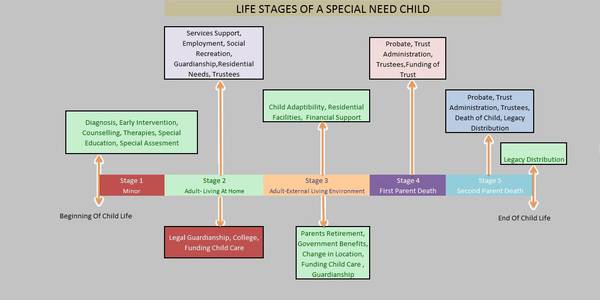
Special need Child Life Stages

The chapters on estate planning — Will, Trust, Guardianship — are particularly valuable. These are areas where most families have enormous anxiety and very little clarity. The book explains them accessibly, without legal jargon, in the Indian context.

The real-life family case studies are what elevate this book above a standard financial planning text. The emotional reality of these families — the grief, the hope, the daily uncertainty — is documented honestly alongside the financial frameworks.

Are you planning for a family with a special needs dependent?

This requires specialised financial planning that most advisors do not provide. We can help you think through the two-generation planning challenge.

Talk to a RetireWise Advisor

Key Planning Principles for Special Needs Families

For families navigating this situation, here are the foundational planning principles that every advisor and family should understand:

1. Build a “Special Needs Trust” (or equivalent structure)

A direct bequest to a special needs dependent can inadvertently disqualify them from government benefits they are entitled to. A trust structure ensures the funds are available for the dependent’s care without affecting their eligibility for social welfare schemes. The trust must be professionally drafted with a clear mandate for the trustee.

2. Appoint a guardian explicitly

The guardian is the person who will make care decisions for the dependent after the parents are unable to. This person must be identified, willing, and legally appointed — not assumed. The legal process for guardianship under the National Trust Act (1999) must be followed for families with dependents who have autism, cerebral palsy, mental retardation, or multiple disabilities.

3. Know your government entitlements

India has a range of schemes for families with special needs dependents that are significantly underutilised: National Handicapped Finance and Development Corporation (NHFDC) loans, Niramaya health insurance scheme, ADIP (Assistance to Disabled Persons) scheme, and various state-level benefits. The National Trust Act provides for registration and guardianship. These are legal entitlements — not charity.

4. Separate the “care corpus” from retirement savings

The corpus required for the dependent’s lifelong care must be built separately from your retirement savings. Mixing them creates a situation where drawing down one impairs the other. Goal-based financial planning is the only framework that handles this correctly.

5. Plan for income interruption

Parents of special needs children are statistically more likely to face career interruptions — one parent may reduce working hours or stop entirely to manage caregiving. Disability insurance, term insurance with higher covers, and emergency fund discipline are not optional in these families. They are existential.

Where to Get the Book

The book is available on Amazon India and leading bookstores. If you know a family navigating this situation, this is one of the most genuinely useful gifts you can give them. If you are a financial advisor, this is required reading.

Special Needs Children Book

The financial planning challenge for families with special needs dependents is one of the most complex and emotionally charged problems in personal finance. It deserves specialised attention — not a standard financial plan with a few adjustments. If you are in this situation, please do not face it alone.

Planning for 2 generations requires a different kind of advisor, a different kind of plan, and a different kind of urgency. Start now.

💬 Your Turn

If you are a parent of a special needs child, or a financial advisor who has worked with such families, please share your experience in the comments. What was the hardest planning question to answer? What resources did you find most useful? This conversation can help families who are just starting this journey.


LTCG Tax on Equity in India: What Changed in Budget 2024 and What It Means for Your Portfolio

10

“In this world nothing can be said to be certain, except death and taxes.”
– Benjamin Franklin

In February 2018, when the government first introduced 10% LTCG tax on equity, I wrote a short post asking: is this really so bad? The reaction was dramatic. Clients called. Messages flooded in. The market fell sharply on Budget day. “God, why us?” was the sentiment everywhere.

The answer then was: no, it is not that bad. Stay invested.

Budget 2024 raised LTCG on equity again – from 10% to 12.5%. STCG went from 15% to 20%. The exemption limit rose slightly from Rs 1 lakh to Rs 1.25 lakh. And again, the same question: is this really so bad?

The answer is still the same. Let me explain why – and more importantly, what actually changed and what you need to know.

⚡ Quick Answer

Effective July 23, 2024: LTCG on equity and equity mutual funds is 12.5% (up from 10%) on gains above Rs 1.25 lakh per year (up from Rs 1 lakh). STCG is 20% (up from 15%). The holding period to qualify as long-term remains 12 months for listed equity. Dividend distribution tax was abolished in 2020 – dividends are now taxable in your hands at your slab rate. Long-term equity investors still benefit significantly from the 12.5% rate versus slab rates of 20-30%+.

LTCG tax on equity mutual funds India Budget 2024

What Budget 2024 Actually Changed

The Union Budget 2024, presented on July 23, 2024, made the following specific changes to capital gains taxation on equity:

Tax Type Before Budget 2024 After Budget 2024
LTCG on equity (holding > 12 months) 10% above Rs 1 lakh 12.5% above Rs 1.25 lakh
STCG on equity (holding < 12 months) 15% 20%
LTCG exemption limit Rs 1 lakh per year Rs 1.25 lakh per year
Holding period for equity LTCG 12 months 12 months (unchanged)
Dividends from equity mutual funds Taxable in investor hands (since April 2020) Same – taxable at slab rate

These changes are effective for transactions on or after July 23, 2024. Gains realised before that date are governed by the old rates.

Why Long-Term Investors Should Stay Calm

Let me put this in numbers that matter.

A senior executive who has been running SIPs for 15 years has accumulated a corpus of, say, Rs 2 crore. A significant portion of this is unrealised LTCG – gains built over many years of compounding. Under the new regime, gains above Rs 1.25 lakh in any financial year are taxed at 12.5%.

At 12.5%, Rs 10 lakh of long-term capital gain costs Rs 1.25 lakh in tax. Compare that to the same Rs 10 lakh earned as salary or fixed deposit interest – taxed at 30%+ for most senior executives. The LTCG rate, even at 12.5%, represents a substantial concession compared to what the same money would cost if earned as income.

The argument that “equity has lost its tax advantage” deserves scrutiny. Before 2018, equity gains were completely tax-free after one year. That zero-tax regime was exceptional by any global standard. At 12.5%, India still taxes equity LTCG below the US (20%), UK (18-24%), and most other major economies. The advantage relative to other asset classes and income types remains large.

The Real Cost of the 2024 Change

On Rs 10 lakh of LTCG, the additional tax from the 2024 change (from 10% to 12.5%) is exactly Rs 25,000. On Rs 5 lakh of LTCG above the exemption, it is Rs 12,500. For a long-term SIP investor with a 20-year horizon, this incremental cost is small relative to the compounding that continues to work on the remaining corpus.

What costs far more than the 2.5% tax increase is the habit of exiting equity to “avoid tax” – and missing the next 3-5 years of compounding. I have seen clients lose 40-50% of potential returns trying to minimise 2.5% of additional tax.

What About Dividend Mutual Funds?

The dividend distribution tax (DDT) that existed until March 2020 has been abolished. Since April 2020, dividends from all mutual funds – equity or debt – are taxable directly in the investor’s hands at their applicable income tax slab rate.

This is an important change that many investors still haven’t fully absorbed. If you are in the 30% tax bracket and hold a dividend-option equity mutual fund, every dividend you receive is taxed at 30% – far worse than the 12.5% LTCG you would pay if you held the growth option and redeemed selectively.

My view from 2018 stands and is now stronger: growth option in equity mutual funds is almost always better than dividend option for anyone in a tax-paying bracket. Dividends are just forced redemptions with a higher tax cost.

What Has Not Changed

For long-term investors, several things remain true. Equity continues to be the most tax-efficient wealth-building asset class in India for those who stay invested. ELSS funds still qualify for Section 80C deduction up to Rs 1.5 lakh, with a 3-year lock-in. The compounding engine inside an equity mutual fund – which works on pre-tax returns for decades – is unaffected by any tax rate on gains at redemption.

The strategic implication is unchanged: hold quality equity funds for 10-20 years, use the Rs 1.25 lakh annual LTCG exemption systematically to harvest gains tax-free, and let compounding do most of the work.

Tax Harvesting: Using the Rs 1.25 Lakh Exemption Wisely

One strategy worth knowing: at the end of every financial year, if your unrealised LTCG is within Rs 1.25 lakh, consider redeeming and immediately reinvesting. This resets your cost basis to the current price. Over 15-20 years of doing this annually, you can eliminate a significant portion of your eventual tax liability – completely legally, using the exemption the government has provided.

This is especially relevant for investors approaching retirement with large accumulated equity positions. Working with an advisor to sequence redemptions across financial years – keeping LTCG under Rs 1.25 lakh per year wherever possible – can save meaningful amounts in tax without disrupting the portfolio’s overall structure.

Tax saving should be part of your investment planning. Not the other way around.

The best tax strategy for equity investors is still: stay invested, compound long, and use the annual exemption wisely.

See How RetireWise Builds Tax-Efficient Plans

My view from 2018 has not changed. 10% was reasonable. 12.5% is also reasonable. India taxes equity LTCG far more leniently than most countries. The government will almost certainly raise it further over time. That is not a reason to exit equity. It is a reason to plan well.

Equity still compounds. Taxes don’t change that. They just take a slightly larger slice of a significantly larger pie.

Focus on things under your control. Tax rates are not one of them. Staying invested is.

You cannot control what the government taxes. You can control how long you stay invested.

Retirement planning means building a tax-efficient withdrawal strategy, not just a corpus.

We help clients sequence redemptions and structure their portfolio to minimise tax across a 25-year retirement.

Book a Free 30-Min Call

Your Turn

Did the 2024 LTCG change affect how you think about your equity investments – or have you kept your strategy unchanged? Share your thinking in the comments.

Action Bias in Investing: Why Doing Nothing Is Often the Smartest Move

Have you ever opened your investment app during a market crash and felt an overwhelming urge to do something – anything – just to feel less helpless?

That urge has a name. It is called action bias. And it has quietly destroyed more wealth than any market crash ever has.

⚡ Quick Answer

Action bias is the human tendency to act even when inaction would produce better results. In investing, it leads to panic selling, frequent portfolio churning, and chasing hot tips – all of which reduce long-term returns. The most underrated investment skill is knowing when to do nothing.

Action Bias in Investing

The Goalkeeper Problem – And Why It Applies to Your Portfolio

There is a famous study on penalty kicks in football. Researchers analysed hundreds of penalties and found something remarkable. When a goalkeeper dives – left or right – they save about 25% of shots. When they stay in the centre, they save 33%.

So why do goalkeepers almost always dive? Because diving looks like effort. Standing still looks passive. Even if standing still gives a better outcome, it feels wrong.

You do the exact same thing with your investments.

When the Sensex falls 2,000 points in a week – as it did multiple times in 2024-25 – your brain screams: do something. Sell. Switch funds. Move to gold. Call your advisor. The idea of sitting still and watching your portfolio fall feels irresponsible.

But in most cases? That is exactly the right move.

What Action Bias Actually Costs Indian Investors

I have been advising investors for 25 years. The people who came to me in panic during the 2020 COVID crash, the 2022 correction, and the mid-cap selloff of late 2024 – they all wanted to take action. Most of them wanted to exit equity entirely.

The ones who acted paid a steep price. Not just in the returns they missed during the recovery. But in the transaction costs, tax events, and psychological damage of watching markets recover without them.

SEBI’s own research shows that the average Indian retail investor underperforms the index by 3-5% annually. Not because they pick bad funds. But because they trade too often, exit at the wrong time, and re-enter too late.

Action bias is not stupidity. It is biology.

Why Your Brain Is Wired for Action Bias

Think of it like this: your brain is still running software designed for the African savannah 50,000 years ago. Back then, if you heard a rustle in the bushes, the correct response was immediate action – run, fight, or freeze. The ones who paused to analyse were eaten by lions.

That threat-response system is still active. When your portfolio drops 15%, your amygdala fires the same alarm. The rustling bushes are now red numbers on a screen. The lion is now market volatility.

Two forces make this worse:

Loss aversion: Losing Rs 1 lakh hurts your brain roughly twice as much as gaining Rs 1 lakh feels good. So when markets fall, the emotional pressure to “stop the bleeding” is enormous.

Illusion of control: Taking action feels like control. Watching and waiting feels like helplessness. We prefer the illusion of control over the reality of good outcomes.

The result: we act. We sell. We switch. We churn. And we lose.

Action Bias - Doing Nothing is the Smart Move

Is your portfolio suffering from action bias?

A fee-only advisor acts as your behavioural coach – helping you stay the course when every instinct says run.

Talk to a RetireWise Advisor

Four Ways to Beat Action Bias in Your Investments

Knowing about action bias does not automatically fix it. If knowledge were enough, every economist would be a billionaire investor. Here is what actually works.

1. Build a pre-decided investment policy statement

A system beats willpower every time. Before the next crash, write down your rules: “I will not sell equity if the market falls less than 20% in any single year.” “I will rebalance every April regardless of how I feel.” “I will not check my portfolio more than once a month.”

Then follow the rules even when your instincts say otherwise. The rules were written by a calm version of you. Trust that version more than the panicking version.

2. Stop tracking your portfolio daily

Every time you check your portfolio and see a red number, you feel the urge to act. It is a dopamine loop – check, feel bad, act to relieve the feeling. The more you check, the more you trade. The more you trade, the worse your returns.

A long-term investor does not care about daily price movements. Check quarterly. Set annual review meetings with your advisor. The rest is noise. Read more about medium maximisation – another trap that feeds action bias.

3. Match your investment to your actual risk profile

Action bias is loudest when you are outside your comfort zone. If you have a conservative risk profile but 70% of your money in small-cap funds, every 5% correction will feel like a catastrophe.

Before investing, genuinely assess what you can stomach. Not what you think you should be able to stomach. What you actually can. An honest risk profile eliminates most of the emotional noise that drives bad decisions. Learn more about how behavioural biases affect your financial decisions.

4. Be sceptical of investment “urgency”

We all know someone who made a killing in some stock or crypto or real estate. Those stories create FOMO – the fear of missing out. They make you feel that if you do not act now, you will miss the boat forever.

But for every person who made money on a hot tip, there are dozens who lost money following the same advice too late. The urgency you feel is almost always manufactured – by media, by social comparison, by your own overconfidence. Investment gurus thrive on your action bias. Do not feed it.

When Action Is Actually the Right Move

To be fair – not all action is bad. There are times when you should act:

When your life circumstances change significantly – job loss, inheritance, major illness, retirement approaching. When your asset allocation has drifted far from your target due to a prolonged bull or bear run. When you have genuinely found a better option after careful research – not in response to a WhatsApp forward.

The difference between good action and action bias: good action is deliberate, planned, and emotion-free. Action bias is reactive, impulsive, and emotion-driven.

Frequently Asked Questions on Action Bias

What is action bias in investing?

Action bias is the tendency to act during uncertainty even when doing nothing would produce better results. In investing, this shows up as panic selling during corrections, switching funds after short-term underperformance, or chasing hot tips — all driven by the discomfort of feeling passive rather than by rational analysis.

Why do investors keep making the same mistake of selling during a crash?

Because loss aversion makes falling markets feel like a physical threat. The brain’s threat-response system — designed for survival, not investing — fires the same alarm for a 15% portfolio drop as it does for genuine danger. The result is an overwhelming urge to “do something.” Pre-deciding your rules before a crash is the only reliable defence.

How do I stop panic selling in a stock market crash?

Write your investment rules when markets are calm — and commit to following them when they are not. Set rules like: “I will not exit equity unless my financial goals have fundamentally changed.” Stop checking your portfolio daily. Work with a fee-only advisor who can act as a rational voice when yours is drowned out by fear.

Does checking your portfolio frequently reduce returns?

Yes. Research consistently shows that the more frequently investors check their portfolios, the more likely they are to react to short-term noise — and the worse their long-term returns. Quarterly reviews are sufficient for most long-term investors. Daily tracking is a habit that feeds action bias, not a discipline that improves it.

The best investors I have worked with in 25 years are not the most active ones. They are the most disciplined. They built a system when they were calm, and they followed it when they were not.

It is not a Numbers Game. It is a Mind Game. And the hardest move in investing is sometimes the most powerful one – doing absolutely nothing.

💬 Your Turn

Have you ever acted on action bias – sold in panic, switched funds impulsively, or chased a hot tip – and regretted it later? Share your experience in the comments. Your story might save someone else from making the same mistake.

Gold Monetization Scheme: Make Your Idle Gold Earn Interest

“Gold is the money of kings, silver is the money of gentlemen, barter is the money of peasants – but debt is the money of slaves.” – Norm Franz

India holds somewhere between 25,000 and 30,000 tonnes of gold. That is roughly 11% of all the gold ever mined in human history, sitting in lockers, safes, cupboards, and bank vaults across the country. A large portion of it earns nothing. It does not grow. It just sits there – a store of value that incurs storage cost and risk with no active return.

The Gold Monetization Scheme (GMS) was launched in 2015 to change this. The government’s idea was straightforward: let households deposit their idle gold with banks, earn interest on it, and get the same gold (or its cash equivalent) back at the end of the term.

⚡ Quick Answer

The Gold Monetization Scheme lets you deposit physical gold with banks (minimum 10 grams after purity testing) and earn interest of 0.5-2.5% p.a. depending on the tenure, along with the full benefit of any appreciation in gold prices. Available in short-term (1-3 years), medium-term (5-7 years), and long-term (12-15 years) variants. Capital gains on maturity are exempt from tax. The main practical constraint: gold is melted during the purity testing process – jewellery with sentimental value is not recoverable in its original form. GMS is most suited for bulk inherited gold or bars/coins with no sentimental attachment.

Gold Monetization Scheme features and benefits

How the Gold Monetization Scheme Works

The process begins at a Purity Testing Centre (PTC) – there are government-certified centres across major cities. You bring your gold, and it is first scanned to estimate purity. If you agree to proceed, it is then melted to determine exact weight and purity. At this point, the gold has lost its original form permanently. You receive a purity certificate.

With this certificate, you open a Gold Savings Account at a participating bank. The account is credited with the exact weight of pure gold you deposited. You earn interest on this balance, credited semi-annually, and calculated on the gold quantity (not the rupee value). At maturity, you receive back either gold (as bars or coins – not in original jewellery form if that is what you deposited) or the cash equivalent at prevailing gold prices.

The minimum deposit is 10 grams after purity testing. There is no upper limit. You can deposit gold in any form – bars, coins, or jewellery – though jewellery studded with gems is not accepted (stones are removed and returned to you).

The Five Real Benefits

Interest income on an otherwise idle asset. Physical gold sitting in a locker earns nothing. GMS converts it into an interest-bearing instrument. At 2.5% per annum on a medium-term deposit, you earn roughly 2.5% of the gold price each year – at current prices (gold at Rs 9,000-9,500/gram as of 2026), that is approximately Rs 225-240 per gram per year, in addition to any appreciation in gold price.

Elimination of storage cost and theft risk. A bank locker costs Rs 3,000-6,000 annually and carries residual theft risk. GMS eliminates both costs. Your gold is held in the banking system with sovereign guarantee.

Full capital appreciation benefit. Unlike a fixed deposit where your principal is fixed in rupee terms, GMS principal is denominated in gold grams. If gold price rises from Rs 9,000 to Rs 12,000/gram during your deposit, you benefit fully from that appreciation – plus your interest.

Tax-free gains at maturity. Capital gains on gold deposited and redeemed through GMS at maturity are exempt from tax. The interest income is taxable as per your slab rate, but the capital appreciation component is tax-free. This is a significant advantage over physical gold sales (which attract capital gains tax) and over SGBs sold before maturity in the secondary market.

Potential use as loan collateral. GMS deposits can be pledged as collateral for loans at participating banks, giving you liquidity options without selling your gold position.

Idle gold is a missed opportunity cost.

RetireWise reviews your complete asset picture – including physical gold – and identifies where idle assets can be put to work within your overall retirement plan.

See How RetireWise Optimises Your Complete Portfolio

The Practical Constraints Worth Knowing

The melting process is the most significant practical barrier. If the gold has sentimental value – ancestral jewellery, a piece made for a wedding – GMS is not appropriate. The purity testing process is irreversible once the gold is melted. Many Indian families find this emotionally difficult, even when the economics make sense.

Participation has been limited since the scheme’s launch, partly because of this barrier and partly because the interest rates, while better than nothing, are not dramatic. A 2.5% return on gold when gold is already expected to appreciate is incrementally attractive, but it does not transform gold into an income-generating asset the way equity does.

The practical population for GMS is families who have inherited bulk gold in bar or coin form (not jewellery), or those who have purchased investment gold that they are willing to hold in paper form for an extended period.

GMS vs Sovereign Gold Bonds vs Gold ETFs

Since new SGB issuances were discontinued in February 2024, the comparison landscape has shifted. For new gold investment, the choice is primarily between GMS (for physical gold you already own), Gold ETFs (for new investment without physical gold), and secondary market SGBs (for those willing to navigate thin liquidity).

GMS is for holders of existing physical gold who want to earn returns on it without selling. Gold ETFs are for those who want to add gold exposure without holding physical gold. These are different problems with different solutions.

Read: Sovereign Gold Bonds: Complete Guide for Indian Investors

If you have inherited gold or investment gold sitting idle in a locker – and you have no sentimental attachment to its physical form – GMS is a genuinely good scheme. You earn interest, keep full gold price exposure, and get tax-free capital gains at maturity. The barrier is psychological, not financial.

Let your gold work as hard as you did to acquire it.

How much of your net worth is sitting in idle physical gold?

RetireWise includes physical gold in your complete net worth analysis and retirement planning – so you can see exactly what each asset class is contributing (or not contributing) to your goals.

Book a Free 30-Min Call

Your Turn

Have you considered GMS for idle gold you hold? What is stopping you – the melting process, the lock-in, or something else? Share in the comments.

What Does Wealth Mean to You? Why Your Answer Changes Everything

“Wealth consists not in having great possessions, but in having few wants.” – Epictetus

I have been asking this question to clients, friends, and audiences for over 25 years. The answers are always more varied than people expect.

“When I have Rs 5 crore in the bank.”

“When I don’t have to work anymore.”

“When my children are settled.”

“When I can take a trip without checking my account first.”

Each of these is a different definition of wealth – and each of them leads to a different financial plan. The investor who wants Rs 5 crore in the bank needs a corpus target. The investor who wants to not work needs passive income streams. The investor who wants to travel without checking accounts needs liquidity and a certain relationship with money that is about psychology as much as numbers.

What does wealth mean to you? It is not a rhetorical question. Your answer will determine almost every significant financial decision you make for the next 20 years.

⚡ Quick Answer

Wealth is not simply a number. It is the condition of having enough money, health, time, and purpose to live the life you want – now and in the future. Most people approach financial planning as a numbers problem when it is actually a values problem. Until you define what wealth means to you specifically – what it would let you do, stop doing, or become – no number in a retirement calculator is meaningful. The definition drives the plan.

What does wealth mean - defining wealth for your financial plan

Money Is Not the Same as Wealth

Money is a medium of exchange. It has value because we collectively agree it does. You can use it to buy things, access services, and resolve financial obligations. But money in itself is not wealth.

Wealth is the condition of having enough. Enough money to fund your goals. Enough health to enjoy what you have built. Enough time to spend on what matters. Enough purpose to want to wake up in the morning.

A person with Rs 5 crore who is chronically stressed, working 14-hour days, estranged from their family, and with no clear sense of what they are building toward – are they wealthy? By most conventional measures, yes. By the definition that matters, probably not.

A person with Rs 80 lakh who has a stable income from a job they find meaningful, good health, close relationships, and a clear plan to retire comfortably in 12 years – that person may be experiencing a form of wealth that the first person is not.

This is not an argument against money. More money genuinely expands options – it funds children’s education, supports ageing parents, provides health security, and creates freedom. But money is the means, not the end. The investor who cannot articulate what the money is for will never feel wealthy no matter how much they accumulate.

Money can fund a purpose. It cannot find one.

RetireWise starts every client engagement by defining what a good retirement looks like for that specific person – before running any numbers. The definition drives the plan.

See How RetireWise Defines Your Retirement Vision

The Four Components of Wealth

After 25 years of working with clients, I have come to define personal wealth as the balance of four things:

Financial capital – the money you have accumulated: savings, investments, retirement corpus, property. This is what most people think of when they think of wealth. It is necessary but not sufficient.

Human capital – your income-earning ability, skills, relationships, and reputation. For most working professionals under 50, human capital is their largest asset. The decisions you make about your career, your skills, and your professional relationships are wealth decisions, even if they don’t show up on a balance sheet.

Health capital – your physical and mental wellbeing. A person with Rs 3 crore and a serious health condition may have less real wealth than a person with Rs 1 crore and excellent health. Healthcare inflation in India is running at 11-14% annually. Every rupee you do not spend maintaining your health today becomes a larger burden in retirement.

Time capital – the freedom to choose how you spend your hours. Many high-income professionals are chronically time-poor. They earn well but cannot convert that earning into experiences, relationships, or rest. Time poverty is a real form of poverty, even when it comes packaged in a high salary.

True wealth is balance across all four. An accumulation strategy that destroys your health, your relationships, or your time in pursuit of financial capital is not a wealth strategy – it is a trade that may not be worth making.

Long-Term Satisfaction Is the Right Test

Winning a lottery and having Rs 5 crore for three months before spending it all is not wealth. It is a temporary cash surplus. Wealth implies sustainability – the ability to fund your goals over an extended period, to absorb shocks, and to leave something for the next generation if that matters to you.

This is why the question “when will you consider yourself wealthy?” is more useful than “how much money do you need?” The first forces you to think about conditions – what kind of life, what kind of security, what kind of freedom. The second invites you to pick a number that is often arbitrary and frequently insufficient even when reached.

I have met clients who reached their “number” and discovered they were not done – because the number was not connected to a clear vision of what it was for. And I have met clients who, by any financial measure, had “enough” but could not feel it because they had never defined what enough looked like.

Read: The Difference Between Income and Wealth

Wealth is personal. It is the condition of having enough across money, health, time, and purpose to live the life you want. Define yours before you build a financial plan to reach it. The plan without the definition is just a number.

What does enough look like for you?

Have you defined what wealth means to you specifically – not as a number, but as a condition?

RetireWise builds retirement plans that start with your vision of a good life – and work backward to the financial plan that funds it.

Book a Free 30-Min Call

Your Turn

When would you consider yourself wealthy – and has that definition changed as you have gotten older? Share in the comments. This is one of the most interesting questions in personal finance, and there is no wrong answer.

Lessons from the Mistakes of Geniuses — What Newton, Einstein and Buffett Teach Investors

What do Albert Einstein, Isaac Newton, and Warren Buffett have in common — apart from being extraordinarily intelligent?

All three made catastrophic mistakes. And all three are proof that brilliance does not protect you from human error.

⚡ Quick Answer

The most valuable lessons in investing and personal finance do not come from textbooks — they come from studying the mistakes of brilliant people who got things badly wrong. Understanding what went wrong, and why, is far more useful than memorising what went right. This post draws on history’s greatest minds to give you the financial lessons most advisors never teach.

Isaac Newton and the South Sea Bubble

In 1720, Isaac Newton — the man who discovered gravity, invented calculus, and defined the laws of motion — invested in the South Sea Company, a British trading enterprise whose stock was rising spectacularly.

Newton sold early, made a tidy profit, and walked away. Then he watched the stock keep rising. FOMO took over. He bought back in at a much higher price. Shortly after, the South Sea Bubble burst. Newton lost the equivalent of millions of pounds in today’s money.

His famous line afterward: “I can calculate the motion of heavenly bodies, but not the madness of people.”

The lesson: Intelligence and investing skill are different things. The same cognitive biases that affect ordinary people affect Nobel laureates and mathematical geniuses. The market is not a physics problem — it is a psychology problem. And psychology does not care about your IQ.

Albert Einstein and the German Hyperinflation

Einstein won the Nobel Prize in 1921 and received a substantial cash prize. Rather than convert it to a hard asset or invest it internationally, he kept a significant portion in German marks. Within two years, the Weimar Republic’s hyperinflation had made the German mark virtually worthless.

Einstein lost most of his Nobel prize money to one of history’s most destructive monetary events — an event many economists had warned about for years.

The lesson: Concentration kills. Even a genius can be wiped out by keeping too much wealth in a single currency, asset class, or instrument. Diversification is not a theoretical principle — it is the defence mechanism that Newton and Einstein both failed to deploy.

Are you making mistakes that geniuses already made for you?

A financial plan built on evidence — not emotion — is the best protection against repeating history.

Talk to a RetireWise Advisor

Warren Buffett and the Dexter Shoe Mistake

Warren Buffett is widely regarded as the greatest investor of the 20th century. He has also, by his own admission, made some of the most expensive mistakes in investment history.

His acquisition of Dexter Shoe Company in 1993 — paid for with Berkshire Hathaway stock — cost investors an estimated USD 3.5 billion once the business collapsed due to cheap international competition. The stock used to pay for it appreciated enormously after the acquisition, making the opportunity cost astronomical.

Buffett calls it one of his worst deals ever. Not because he could not identify a good shoe company — but because he paid with Berkshire stock at a time when that stock was set to compound significantly.

The lesson: Even the best investors make errors of judgement. The difference between Buffett and most investors is not that he never makes mistakes — it is that he acknowledges them openly, learns from them, and has built a portfolio resilient enough to absorb individual blunders. Diversification and humility matter more than conviction.

John Maynard Keynes and Early Speculation

Keynes, the economist who effectively invented modern macroeconomics, was also a speculator — and an early, painful failure at it. In the 1920s, he tried to time currency markets using macro forecasts. He was spectacularly wrong, lost most of his own money and that of his college fund, and nearly ruined himself.

He then completely changed his approach. He shifted to long-term, concentrated positions in undervalued companies — essentially value investing before it had a name. He recovered and went on to build significant wealth.

The lesson: Being right about the big picture does not mean you can time markets. Keynes, the man who understood economies better than anyone alive, still got wiped out trying to predict short-term market movements. Market timing is a trap that even the most brilliant macro thinkers fall into.

Mark Twain and the Typesetting Machine

Mark Twain was one of the most financially reckless geniuses in history. He lost nearly all his money — and a great deal of borrowed money — on a typesetting machine he was convinced would revolutionise publishing. He invested obsessively, repeatedly doubled down, and eventually had to declare bankruptcy.

Meanwhile, he rejected an early investment opportunity in Alexander Graham Bell’s telephone — which would have made him extraordinarily wealthy — because he did not understand it.

The lesson: Overconfidence in what you know, and excessive scepticism about what you do not, are mirror-image mistakes. Twain poured money into what he understood (publishing technology) while dismissing what he did not (telecommunications). For most investors, this translates to over-investing in your employer’s sector or your own industry while ignoring diversification.

What These Geniuses Teach Indian Investors in 2026

These stories are not ancient curiosities. The same mistakes happen in India every market cycle.

The Newtons of India bought small-cap funds at their 2018 peak after watching returns. The Einsteins concentrated their savings in a single employer’s ESOP. The Buffetts made large bets on sectors they understood while ignoring the stock used to pay for it — time they could have been investing elsewhere.

The three universal lessons from history’s smartest losers:

1. Emotion always beats intelligence in a market panic. Build systems before the panic arrives — pre-decided rules for when to buy, hold, and rebalance. Read more about why doing nothing is often the smartest investment move.

2. Concentration kills, diversification survives. No single stock, sector, currency, or asset class deserves more than 10-15% of your investable wealth. Protect yourself from your own conviction.

3. The best investors learn from everyone’s mistakes — not just their own. History is full of expensive lessons that are free to study. Use them. The most common investment mistakes in India have been made by brilliant people before you.

Frequently Asked Questions

Why do intelligent people make bad investment decisions?

Because intelligence and emotional discipline are different skills. Investing well requires controlling fear, greed, and overconfidence under pressure — not analytical ability alone. Newton could calculate planetary motion but not crowd psychology. Einstein could restructure physics but could not diversify his cash. The cognitive biases that cause bad investment decisions are neurological, not intellectual — they affect everyone equally regardless of IQ.

What is the most common financial mistake that smart Indians make?

Concentration risk — putting too much into a single asset. The most common form: over-investing in employer ESOPs, over-allocating to real estate in one city, or concentrating an entire retirement corpus in a single asset class after reading about its recent returns. The second most common: market timing based on macro views, which even professional economists consistently get wrong.

How can I learn from investing mistakes without making them myself?

Study history actively. Every major financial crisis — 1929, 1992 Harshad Mehta, 2000 dot-com, 2008 global financial crisis, 2018 Indian mid-cap crash — followed the same psychological pattern. Reading about what went wrong, why investors ignored the warning signs, and how they rationalised their decisions is the cheapest form of financial education available. Work with an advisor who has lived through at least one full market cycle.

What did Warren Buffett learn from his biggest mistakes?

Primarily: the hidden cost of what you give up to make an investment. The Dexter Shoe error cost billions not because the shoe business failed — but because the Berkshire stock used to buy it compounded enormously afterward. Every investment decision has an opportunity cost. Buffett now evaluates acquisitions against what else the same capital could earn. The lesson for individual investors: evaluate not just what an investment might return, but what you are giving up to make it.

Newton could not calculate the madness of crowds. Einstein could not protect his prize money from monetary collapse. Twain could not tell a good bet from a great one. If they could not, you are not immune either. The question is not whether you will make mistakes. It is how expensive you will allow them to be.

It is not a Numbers Game. It is a Mind Game. And the best minds in history lost it — until they built systems that protected them from themselves.

💬 Your Turn

Which of these lessons resonates most with a mistake you have made or nearly made? Share your experience in the comments — your story could save someone else from a very expensive lesson.

Beware of the Retirement Rules of Thumb

Every WhatsApp forward about retirement comes with a rule of thumb attached. Save 25 times your expenses. Withdraw 4% per year. Keep equity equal to 100 minus your age.

They sound so neat. So clean. So… easy.

And that is exactly the problem. In 25 years of retirement planning, I have seen more damage done by blindly following rules of thumb than by having no plan at all. Because a bad shortcut gives you false confidence — and false confidence in retirement is the most expensive mistake you can make.

Let me put 8 popular retirement rules of thumb on trial. Each one gets a verdict: Useful, Dangerous, or Outdated.

⚡ Quick Answer

Most retirement rules of thumb were created in the US with American inflation, American interest rates, and American life expectancy. Applied blindly in India, some will protect you, some will mislead you, and some will actively destroy your retirement. Read the verdicts below before building your plan on a WhatsApp forward.

The 8 Rules — On Trial

Rule 1: The 4% Withdrawal Rule

⚠️ VERDICT: OUTDATED

Withdraw 4% of your corpus in Year 1, then adjust for inflation every year

This rule was born from the 1998 Trinity Study using US market data. India’s higher inflation (6-7% vs 2-3% in the US) and longer retirement horizons (25-30 years) make 4% too aggressive. For India, 3-3.5% is safer. Using 4% with Indian inflation could deplete your corpus 5-7 years early.

The 4% rule is a starting point — not a prescription. Think of it like a recipe from a different country. The technique may be sound but the ingredients need to change.

For an Indian retiree with a ₹2 crore corpus, 4% means ₹8 lakh per year. Sounds comfortable. But factor in 6% inflation over 25 years, and by Year 15, you are withdrawing ₹19 lakh — from a corpus that has been shrinking. A Systematic Withdrawal Plan with a 3% starting rate is far safer.

Rule 2: Save 25x Your Annual Expenses

⚠️ VERDICT: OUTDATED

Multiply your annual expenses by 25 to get your retirement corpus target

25x assumes a 4% withdrawal rate and 30 years of retirement. For India, with higher inflation and longer retirements (an urban professional retiring at 58 could live to 85), 30-35x is more realistic. 25x gives false comfort. Is ₹1 crore enough? This rule would say yes for someone spending ₹4 lakh/year. Reality says no.

The math behind 25x is tied directly to the 4% rule. If the 4% rule needs adjustment for India, then 25x does too. I tell my clients: aim for 30-35x your annual expenses, and use your expenses at retirement age (not today’s expenses). That difference alone can be ₹50 lakh to ₹1 crore.

Rule 3: 100 Minus Your Age = Equity Allocation

✅ VERDICT: USEFUL (with modifications)

At age 60, keep 40% in equity. At 70, keep 30%.

The direction is right — reduce equity as you age. But the formula is too conservative for Indian retirees facing 25-30 year retirements. Many financial planners now use 110 or even 120 minus age. A 60-year-old with a 25-year horizon needs more than 40% in equity to beat inflation.

This is the one rule that is directionally correct. The idea that your equity allocation should decrease with age makes perfect sense. But the specific number — 100 minus age — was designed for an era when people retired at 65 and died at 75.

If you retire at 58 and live to 85, you need equity to work for you for 27 years. Zero equity at retirement is one of the biggest mistakes I see in retirement portfolios.

Rule 4: “You Will Need 70-80% of Pre-Retirement Income”

❌ VERDICT: DANGEROUS

Your retirement expenses will be 70-80% of your working-life income

This rule ignores healthcare costs (which rise dramatically after 60), travel aspirations, family obligations, and inflation. Many retirees find expenses INCREASE in the first 5-10 years of retirement. Using 70-80% gives a false sense of adequacy. Use actual expense budgeting instead.

This is the rule that gets the most people in trouble. It sounds reasonable — after retirement, commute costs drop, work clothes are unnecessary, EMIs may be done. But it ignores three realities: medical expenses explode after 65, lifestyle aspirations (travel, hobbies, grandchildren) cost real money, and inflation does not retire when you do.

Meena (name changed), a retired teacher from Chennai, budgeted for 70% of her pre-retirement income. By Year 5, healthcare alone was consuming 25% of her total budget. The 70% rule had left no room for the reality of ageing.

Rules of thumb are not retirement plans. They are starting points.

A real plan accounts for YOUR inflation, YOUR health, YOUR goals — not a formula from a WhatsApp forward.

Get a Real Retirement Plan

Rule 5: “Pay Off ALL Debt Before Retirement”

✅ VERDICT: USEFUL

Enter retirement with zero EMIs and zero credit card debt

This is one rule that is almost universally correct. Debt in retirement means fixed outflows eating into a shrinking corpus. The only exception: a low-interest home loan where prepaying would mean breaking better-yielding investments. But as a general principle — retire debt-free.

Carrying an EMI into retirement is like starting a marathon with a backpack full of bricks. You might still finish — but you will suffer.

The one exception: if you have a home loan at 8.5% and investments earning 12-14% over the long term, the math may favour keeping the loan. But this requires discipline most retirees do not have. My advice? Clear it. The peace of mind of zero EMIs in retirement is worth more than the 3-4% mathematical advantage.

Rule 6: “Relocate to a Smaller City After Retirement”

❌ VERDICT: DANGEROUS

Sell your city apartment and move to a smaller town for cheaper living

This destroys three things at once: access to quality healthcare, your social network, and your property’s appreciation potential. Many retirees who relocate return within 2-3 years — having sold a rising asset to buy a depreciating one. Stay where your doctors, friends, and children can reach you.

I have watched this play out too many times. The fantasy: a peaceful bungalow in your native village, morning walks by the river, fresh air. The reality: the nearest hospital with a cardiologist is 45 minutes away. Your friends are in Mumbai. Your grandchildren visit once a year because there is “nothing to do there.”

Selling a Mumbai or Bangalore apartment (which appreciates at 5-8% annually) to buy a house in a Tier 3 town (which may not appreciate at all) is a financial and emotional mistake. Happy retirement needs community, healthcare access, and stimulation. All three are harder to find in small towns.

Rule 7: “Save 10% of Your Income for Retirement”

⚠️ VERDICT: OUTDATED

Set aside 10% of your gross income toward retirement from the start of your career

10% was adequate when retirement lasted 10-15 years. With 25-30 year retirements now common, 15-20% is the minimum — and if you start after 35, you may need 25-30%. Starting early at 10% beats starting late at 25%, but the rule needs updating. “I’m too young” is the costliest myth.

If you start at 25, 10% with compounding might get you there. If you start at 40, 10% is a recipe for working until 70. The rule ignores the single most important variable: WHEN you start. Two people saving 10% of the same salary will have wildly different outcomes depending on whether they started at 25 or 40.

Rule 8: “Health Insurance Is Enough for Medical Costs”

❌ VERDICT: DANGEROUS

Just buy a good health insurance policy and you are covered

Health insurance is essential — but it is NOT enough alone. Most policies have sub-limits, co-payments, waiting periods for pre-existing conditions, and room rent caps. A serious illness at 70 can cost ₹15-25 lakh, of which insurance may cover only ₹8-10 lakh. You need a separate medical corpus of ₹15-25 lakh on top of insurance.

Health insurance is the foundation. The medical corpus is the roof. You need both.

I always tell clients: buy the best health insurance you can in your 40s, never let it lapse, and build a separate liquid medical fund. This is not negotiable. It is the difference between managing a health crisis and being financially destroyed by one.

“It’s not a Numbers Game… It’s a Mind Game.”

— Hemant Beniwal

The Real Rule of Thumb

If I had to give you just one rule of thumb for retirement, it would be this: there is no rule of thumb that replaces a plan built for YOU.

Rules of thumb were designed for averages. You are not average. Your health is not average. Your city is not average. Your family situation is not average. Retirement expectations vs reality are always different — and the gap is where the rules of thumb fail.

Build a plan based on your real expenses, your real health, your real goals, and your real inflation — not a formula someone forwarded on a group chat.

Your retirement is too important for a rule of thumb.

We build retirement plans based on your actual life — not formulas from another country, another era, or another WhatsApp group.

Build Your Real Retirement Plan

Rules of thumb are like street signs. They point you in the right direction — but they cannot drive the car for you.

Your retirement deserves a plan, not a shortcut.

💬 Your Turn

Which retirement rule of thumb have YOU been following without questioning it? And which verdict surprised you the most?

Bitcoin and Cryptocurrency for Indian Investors: The 2026 Honest Assessment

“The four most dangerous words in investing are: ‘this time it’s different.'” – Sir John Templeton

A friend who works in tech asked me about Bitcoin in 2017. My answer then was “I don’t understand it well enough to recommend it.” That answer has not changed – but the context around it has changed enormously.

Bitcoin is now over Rs 80 lakh per coin. The Indian government taxes crypto gains at 30% with no deduction for losses from other assets. SEBI has issued warnings. RBI has changed its position multiple times. And the conversation about whether crypto belongs in an Indian investor’s portfolio has become more complex than it was in 2017.

Here is my honest assessment.

⚡ Quick Answer

Cryptocurrency in India is legal to hold and trade but is taxed at 30% on gains with no offset for losses from other assets (Budget 2022). It has no intrinsic value in the traditional sense – no underlying earnings, no dividend, no coupon. Its price is driven entirely by supply and demand expectations. For most Indian investors building retirement wealth, it has no place in a core portfolio. If you choose to allocate, it should be a small speculative allocation (below 5%) from funds you are prepared to lose entirely, not from retirement savings.

Bitcoin cryptocurrency India - honest financial advisor assessment 2026

What Is Cryptocurrency, Really?

Bitcoin is a decentralised digital asset. It exists as cryptographic code on a distributed ledger called a blockchain. There is no central issuer, no government backing, and no underlying asset. Bitcoin’s value is determined entirely by what the next buyer is willing to pay for it.

This is not necessarily a disqualifying feature – gold also has no earnings, no dividend, and derives its value from collective belief in its store-of-value properties. But gold has 5,000 years of human consensus behind it. Bitcoin has 15 years and a price history that has seen 70-80% drawdowns on multiple occasions.

The Indian Regulatory Reality

The regulatory environment for cryptocurrency in India has shifted significantly since the early days. In 2018, RBI tried to ban banks from servicing crypto exchanges; the Supreme Court overturned that in 2020. In Budget 2022, the government took a practical stance: crypto is legal but taxed punitively.

The current tax treatment: gains from virtual digital assets (VDAs) are taxed at a flat 30% with no deduction for expenses other than acquisition cost. Losses from crypto cannot be set off against other income – not even against gains from other crypto assets. A 1% TDS applies on transactions above Rs 10,000. This regime makes crypto trading in India expensive and creates a significant drag on any active trading strategy.

At 30% flat tax with no loss offset, crypto’s effective return hurdle is much higher than most investors realise.

RetireWise advises on building core retirement wealth through regulated, tax-efficient investment structures – with a clear view of what belongs in a retirement portfolio and what does not.

See How RetireWise Builds Tax-Efficient Portfolios

The Volatility Problem

Bitcoin has experienced drawdowns of 70-85% on at least four occasions since 2010. Each time, it eventually recovered and reached new highs. This history has created a generation of investors who believe that holding through any drawdown will eventually be rewarded.

That belief may be correct. But it requires holding through periods where the asset falls to Rs 20 lakh from Rs 80 lakh, and staying invested for the years or decades it takes to recover. Most investors who claim they can do this find, in practice, that they cannot. The psychological reality of watching a Rs 10 lakh position become Rs 2 lakh is different from the theoretical confidence expressed before it happens.

The standard metric for investment risk assessment is volatility relative to expected return. By this measure, crypto has among the highest risk profiles of any mainstream asset – comparable to highly leveraged venture capital positions, not to equity mutual funds or gold.

The Greater Fool Problem

Warren Buffett’s critique of Bitcoin has not changed: an asset with no underlying earnings stream can only be valued by what someone else will pay for it in the future. This is the “greater fool theory” – profit depends on finding a buyer willing to pay more than you paid.

This does not mean Bitcoin cannot go higher. It can and has. But it means that the analytical tools used to value a business – earnings, cash flows, asset value – do not apply. You are making a bet on collective sentiment, which is inherently harder to evaluate and inherently more vulnerable to sudden reversals.

The Small Allocation Question

The most thoughtful argument for including Bitcoin in a portfolio is the asymmetric return profile: the potential upside is multiples of the current price; the downside is capped at 100%. Some portfolio allocation models suggest that a 1-3% allocation improves the Sharpe ratio of a diversified portfolio if you hold through cycles.

This is an intellectually honest argument. If you have a diversified core portfolio of equity and debt mutual funds that are on track to meet your goals, and you want to allocate a small amount to Bitcoin as a speculative position, that is a legitimate personal choice. The conditions are: the amount must be genuinely affordable to lose entirely, it should not come from retirement savings or goal-specific funds, and you must be honest about why you are doing it (speculation, not investment).

What is not defensible: allocating significant retirement savings to crypto, taking loans to invest in crypto, or treating past returns as evidence of future reliability.

The Lessons From Financial Bubbles

Every major asset bubble has shared certain characteristics: a genuinely new technology or narrative, early adopters who made extraordinary gains, widespread media coverage, retail participation near the peak, and eventually a repricing that destroyed latecomers while rewarding early holders.

Dutch tulip bulbs. South Sea Company shares. Dot-com stocks. Real estate in 2006-07. These are not identical to Bitcoin – Bitcoin has demonstrated more staying power than any of them. But the pattern of narrative-driven price appreciation decoupled from any underlying value generation is worth noting.

The honest answer for most Indian retirement investors is: crypto does not belong in a retirement portfolio. The evidence base for its long-term role as a store of value is 15 years old. The equity markets have 100+ years of positive real return data. The risk profiles are not comparable.

Read: The Greater Fool Theory and Indian Real Estate

When something is too good to be true, proceed very carefully. When you do not fully understand something, allocate only what you can lose. When it is retirement money, apply the strictest standard – because there is no second chance at retirement.

Speculation is not investment. Know which one you are doing.

Is your core retirement plan fully in place before you consider any speculative allocation?

RetireWise ensures the core is solid first – adequate insurance, clear goals, properly allocated corpus – before any discussion of speculative asset classes.

Book a Free 30-Min Call

Your Turn

Have you allocated to crypto – and if so, is it from your core savings or a ring-fenced speculative amount? The answer matters more than the allocation size. Share in the comments.