Home Blog Page 37

Banks are Mis-Selling or Bankers are Mis-Selling

We have always brought to your notice that insurance is grossly Mis-sold in India, specially through banks. Last week received a comment on LIC Jeevan Vriddhi Article – which was shocking, as bankers are clearly fooling their clients with support of their bancassurance tie-ups.

Go through the Message from reader & Mail from HDFC. Also read what others have to say on Bancassureance Nexus including IRDA Committee.

Must Read – Exit Strategies for mis-sold insurance policies

Message that I got from the reader:

I appreciate the time and energy you spend in the financial education. Two weeks of going through the site encouraged me to walk into banks to open SIPs.

When I walked into HDFC for the last two SIPs, the Relationship manager tried to convince me for ULIPs. I wasn’t convinced then so I asked him to send me some explanation. The reply is appended below. At the outset, for long term the ULIP capital left after charges seen to be a lot compared to MF. Not sure what I am missing here. Basically the contention was that for ulips, the 1st, 2nd and 3rd year charges are 40 %, 15 % and 10 %. Thereafter it remains at 2 % of annual premiums where as in MF it si 2.25 % of the total corpus every year as maintenance charges. So if you were to invest Rs 100 every year for 30 years, for ulips you pay Rs. 119 as total maintenance charges and for MF you pay Rs.1046.25 at the end of 30 years. He said something about the fund charges for ULIPs being capped at 3 %. Has the ULIP policies changed since your articles on ULIPs ? Hope you could provide guidance

Banks are Mis-Selling or Bankers are Mis-Selling

Read – Mis-Selling Tricks by Mutual Fund & Insurance Agents

Mail that he got from HDFC

It is Shocking that he got this mail from HDFC Life Insurance but he is client of HDFC Bank. (CC in this mail was marked to HDFC Bank employee)

[ss_click_to_tweet tweet=”Banks are Mis-Selling or Bankers are Mis-Selling” content=”” style=”default”]

HDFC Email

Further to our discussion please find the bullet points .

1. Long Term Perspective: The Fund Manager cannot have a long term perspective as MF are highly liquid. Whereas ULIPs are long Term in nature with a mandatory 5 year lock in period. Hence they have the better probability of generating better returns in the long term. Longer the money is invested more the returns.

2. Liquidity pressure: MF being highly liquid in nature AMC has to set aside a significant portion of money in liquid assets which are low generating Income avenues. Whereas ULIPs strictly invests as per the Fund opted and can afford to invest in Long Term Investment Avenues.

3. Retail Participation: In MF Institutional Investors also participate in the same fund. They always have the edge over any retail investor in terms research and analysis. Hence can influence the NAV as they invest in huge amount.

4. Fund Manager: The investment for AMC is being managed by individual Fund Managers ,Hence it solely depends on one person thinking who also happens to earn his reputation and earnings from the Fund Performance. Whereas in ULIPs there is a Committee comprising of Deepak S Parekh ,Chairman, Keki M Mistry and AK T Chari -Independent Director, Amitabh Choudhury-MD and CEO, Paresh Parasnis-Executive Director and COO,Vibha Padalkar- Chief Financial Officer,Srinivas-Appointed Actuary, Prasun Gajri- Chief investment Officer. The entry of exit of one person doesn’t effect the long term strategy of Fund Management unlike AMC.

Check – 10 investment mistakes to Avoid

5. Fund Management Charges: The charge is deducted while calculating the NAV .The average FMC ranges from 1.5-2.25% of the fund. The newer funds have higher fmc and the older funds have relatively less. Please find the impact of such charges over a long period of time. Also comparison with the charges deducted from the premium .Currently the Initial Allocation Charge is 4%,3%,3%,2%,2% for CREST- Free Asset Allocation and 1st and 2nd year -7.5% 3rd to 5th year is 5% and 6+ year is 0%.

Whereas in ULIP the charges are highly regulated and is capped at 3% over a 10 years and 2.75% for a period more than 10 years excluding the mortality charges.

6. Fund Options and Tax implications: The flexibility to invest in 5 fund options ranging from -100% Money Market Instruments to 100% Equity and various combinations of Debt and Equity .Fund switches can be easily done online .The maturity amount in ULIP is tax free irrespective of Debt+Equity Composition whereas in MF only equity investments for more than one year is tax free.

7. Fund Performance HDFC LIFE ULIP Products lease find the fund performance of all funds launched since inception of the company against the benchmark . Also attached in the zip file of the oldest 100% Equity Fund -Growth Fund with the portfolio details .(16% over a period of 7 years till year end 31st Jan 2012)

8. MF Fund performance over a period of 5 years till year end 13th Feb 2012. -Refer to OLM-50(Out look Money -7th march 2012).

Equity large Cap:
Min : Franklin India Index Nifty 5.65%
Max: UTI Opportunities 15.09%

SATELLITE:
Min : IDFC Imperial Equity -A 8.53%
Max: UTI Dividend Yield 14.95%

Equity- Mid Cap and Small Cap
Min: GS Junior BeES 8.16%
Max: Birla Sun Life Dividen Yield Plus 15.17%

9. Insurance Charges: Insurance Charges in the Term Assurance is paid in equivalent instalments over the entire period ie higher charges are recovered in the earlier part of the year and lesser is recovered in the later period of the contract period. Whereas in ULIPs risk charges increases with age and you pay as and when risk increases. A 10 times coverage also ensure ur financial objective is achieved even in case of any unfortunate event -A small protection against the targeted maturity amount.

Read- Club Mahindra Membership is my biggest Financial Mistake

Sky is not the limit in mis-selling…

Can someone write such a long message to sell one insurance policy or this is a copy paste which is going to lot of people??

I would not like to comment on the mail but would like to share – what others have to say:

Monika Halan, Editor Mint Money (Hindustan Times) recently wrote an article – Should Banks sell Insurance at all?

She wrote “With banks mis-selling and not taking responsibility, and RBI unwilling to take the brokerage route, why sell insurance at all?”

Article also quotes one point from published report – bancassurance draft guidelines by IRDA committee.

The committee worries about the unequal relationship between banks and insurance companies and it says: “The insurer ends up paying a fat upfront fee running into tens of crores, at least one-fourth of the prospective business, training costs, infrastructure costs to the bank brochures, expenses towards the transactions, incentives, travel, entertainment for the bank staff are some of the heads under which the insurer is fleeced. The accounts at both ends are opaque and the payouts exceed the prescribed commission by a large measure.”

It is interesting to note that what Deepak Satwalekar(retired CEO of HDFC Standard Life Insurance Co.) have to say.

“…as stated by the IBA (Indian Banks’ Association) representative, the banks are unwilling to assume any responsibility, or risk, of the result of their mis-selling. RBI is also wary of banks taking on the role of a ‘broker’ as it would mean that they assume the role of a ‘principal’ in the sales process with the consequential responsibility and potential risk. Possibly the banks are better aware of the deficiency in the sales process practices by them and hence their reluctance to assume any risk.”

Recently an article from employee of Goldman Sachs is making buzz – this shows conflict of interest between bankers & client is same across the globe. You can read that article here – Why I am leaving Goldman Sachs

To put the problem in the simplest terms, the interests of the client continue to be sidelined in the way the firm operates and thinks about making money. Goldman Sachs is one of the world’s largest and most important investment banks and it is too integral to global finance to continue to act this way. The firm has veered so far from the place I joined right out of college that I can no longer in good conscience say that I identify with what it stands for.

He further adds – What are three quick ways to become a leader in Goldman Sachs?

a) Execute on the firm’s “axes,” which is Goldman-speak for persuading your clients to invest in the stocks or other products that we are trying to get rid of because they are not seen as having a lot of potential profit.

b) “Hunt Elephants.” In English: get your clients — some of whom are sophisticated, and some of whom aren’t — to trade whatever will bring the biggest profit to Goldman. Call me old-fashioned, but I don’t like selling my clients a product that is wrong for them.

c) Find yourself sitting in a seat where your job is to trade any illiquid, opaque product with a three-letter acronym.

But we can’t always blame the seller. Bemoneyaware wrote an interesting article – It’s Mis-Selling or Mis-Buying: It’s My Money, My Responsibility

There is a quote in Hindi Chahe chakko tarbooz pe pade ya tarbooz chaooke pein par katda to tarbooz hi hai (If knife falls on water-melon or water-melon falls on knife it’s the water-melon that will get cut).  As it is your hard-earned money you have to take responsibility for a fool and his money is soon parted. Do you think products are mis-sold or mis bought? Is it only insurance products or ULIPS but others too? Do you think we need to take responsibility for our actions ?

Also read our earlier articles on the same issue:

If you have ever faced a similar situation– must share it in comment section, it may be of great help to other readers.

Hybrid Mutual Funds Explained: The Right Way to Use Them in Retirement Planning

“Asset allocation is the only free lunch in investing.” – Harry Markowitz

For years I recommended balanced mutual funds to clients who wanted equity exposure without pure equity volatility. They were useful products. A client nearing retirement, a first-time equity investor, someone with a 5-7 year horizon who could not stomach 40% drawdowns: balanced funds served all of them reasonably well.

Then in 2018, SEBI reorganised the entire mutual fund universe. The “Balanced Mutual Fund” category was replaced by a more structured set of hybrid fund categories. The old names disappeared. Old funds were renamed and recategorised. What replaced them is actually better structured and more useful – but the terminology still confuses investors a decade later.

This post explains what hybrid funds are in 2026, which subcategory suits which investor, and how they fit into a retirement portfolio.

⚡ Quick Answer

The old “Balanced Mutual Fund” category no longer exists. SEBI replaced it in 2018 with structured hybrid fund subcategories. The most important ones for retirement investors are: Aggressive Hybrid Funds (65-80% equity, rest debt), Balanced Advantage Funds/Dynamic Asset Allocation Funds (equity allocation varies dynamically based on valuations), and Conservative Hybrid Funds (10-25% equity, rest debt). Each serves a different purpose and risk profile. Choosing the right one depends on your retirement timeline and equity tolerance.

Hybrid mutual funds explained for retirement investors in India

What Happened to “Balanced Mutual Funds”?

Before 2018, fund houses had considerable freedom in how they classified and structured funds. A “balanced fund” from one AMC might hold 70% equity while another held only 55%. Investors comparing “balanced funds” across AMCs were comparing products with very different risk profiles under the same name.

SEBI’s 2018 categorisation circular imposed strict definitions. Each fund house could now offer one fund per category, with precise allocation rules for each category. The Balanced Fund category was replaced by multiple hybrid subcategories with defined equity-debt ranges.

The familiar names changed too. HDFC Prudence Fund, one of India’s most celebrated equity-oriented hybrid funds managed by Prashant Jain from inception in 1994, became HDFC Balanced Advantage Fund and shifted to the dynamic asset allocation category. Investors who were in HDFC Prudence for its track record found their fund in a new category with a different mandate.

“The 2018 SEBI recategorisation was genuinely investor-friendly. It forced transparency about what each fund actually holds. Before that, a ‘balanced fund’ could mean many different things from different fund houses. Now the ranges are defined and you know what you are buying.”

– Hemant Beniwal, CFP, CTEP | Founder, RetireWise

The Hybrid Fund Categories That Matter for Retirement Investors

Aggressive Hybrid Funds (formerly Equity-Oriented Balanced Funds). These hold 65-80% in equity and 20-35% in debt. The equity portion is treated as equity for taxation purposes: holdings over 12 months qualify for long-term capital gains at 12.5% beyond Rs 1.25 lakh. The debt allocation provides a cushion during equity drawdowns without fundamentally changing the fund’s equity character. Suitable for investors with a 7-10 year horizon who want equity exposure with slightly lower volatility than a pure equity fund.

Balanced Advantage Funds / Dynamic Asset Allocation Funds. These dynamically change their equity allocation based on market valuation indicators (typically P/E or P/B ratio of the index). When markets are expensive, equity allocation drops; when markets are cheap, equity allocation rises. In practice, equity allocation typically ranges between 30-80% depending on market conditions. These are suitable for investors who want the fund manager to handle market timing on their behalf and for those with a moderate risk profile approaching retirement.

Conservative Hybrid Funds. These hold 10-25% in equity and 75-90% in debt. They are taxed as debt funds. Suitable for retirees or near-retirees who want a small equity kicker over fixed income but whose primary need is capital preservation and regular income.

Multi-Asset Allocation Funds. These hold at least three asset classes with a minimum 10% in each. Typically equity, debt, and gold. They provide broader diversification and suit investors who want a single-fund portfolio with genuine multi-asset exposure.

Not sure which hybrid fund category fits your retirement timeline?

A RetireWise retirement plan maps the right fund category to your specific equity tolerance, timeline, and income needs.

Book a Free 30-Min Call

When Hybrid Funds Make Sense for Retirement Investors

When you cannot manage asset allocation yourself. A properly structured retirement portfolio requires rebalancing: when equity has run up, trim and add to debt; when equity has corrected, add equity. Most investors find this emotionally impossible – they add equity when they feel confident (high markets) and reduce equity when they feel afraid (low markets). A hybrid fund does this mechanically, removing the emotional component. This is the single most compelling reason to use a hybrid or balanced advantage fund.

When you are approaching retirement and need to reduce volatility gradually. An investor 5-7 years from retirement typically should not be in 100% equity. A Balanced Advantage Fund or Aggressive Hybrid Fund provides a natural middle position between the growth orientation of a pure equity fund and the stability of a debt fund.

When you are in the initial stage of equity investing. The smoother return profile of a hybrid fund makes it psychologically easier to stay invested through a market correction. A first-time equity investor who experiences a 50% drawdown in a pure equity fund often panics and exits at the worst possible time. A 25-30% drawdown in a hybrid fund, while still painful, is more manageable.

When Hybrid Funds Are Not the Right Answer

If you have a 15-20 year retirement horizon and high equity tolerance, a pure diversified equity fund will almost certainly produce more wealth than a hybrid fund over that period. The equity component of a hybrid fund earns equity returns; the debt component earns debt returns. The blend reduces both volatility and long-term returns. For a 35-year-old building retirement corpus, the volatility reduction comes at a long-term cost that is often not worth paying.

If you already hold separate equity and debt instruments in well-designed proportions, adding a hybrid fund creates redundancy and makes asset allocation harder to track. The advantage of a hybrid fund is precisely that it handles allocation mechanically; if you are already doing that yourself, you do not need it.

Read – 5 Reasons Not to Invest in a Mutual Fund NFO (2026 Update)

Read – ELSS vs PPF: Which Tax-Saving Investment Actually Builds More Retirement Wealth?

Frequently Asked Questions

What happened to HDFC Prudence Fund?

HDFC Prudence Fund was renamed and recategorised as HDFC Balanced Advantage Fund following SEBI’s 2018 categorisation circular. It moved from the equity-oriented balanced category to the balanced advantage/dynamic asset allocation category. The fund’s mandate shifted from a relatively static equity allocation to a dynamic allocation that adjusts based on market valuations. Investors in the fund before 2018 should review whether the new mandate matches their original investment objective.

Is an Aggressive Hybrid Fund or a Balanced Advantage Fund better for a 50-year-old?

It depends on equity tolerance and retirement timeline. For a 50-year-old planning to retire at 60 with reasonable equity tolerance, an Aggressive Hybrid Fund provides consistent 65-80% equity exposure and has produced solid 10-year returns in several established funds. For a 50-year-old who is uncomfortable with large equity drawdowns or who expects to use the corpus within 5-7 years, a Balanced Advantage Fund’s dynamic allocation provides better downside protection at the cost of some upside. Both are valid; the choice is based on the specific investor’s risk profile and timeline.

Are hybrid funds tax-efficient?

Aggressive Hybrid Funds (minimum 65% equity) qualify as equity funds for taxation: gains on units held over 12 months are taxed at 12.5% (above Rs 1.25 lakh per year). Conservative Hybrid Funds are taxed as debt funds: gains are added to income and taxed at the slab rate, regardless of holding period. Balanced Advantage Funds manage their gross equity exposure (including derivatives) to stay above 65% in most cases and qualify for equity taxation, but verify the specific fund’s strategy before assuming this.

Hybrid funds are not a shortcut to returns. They are a structural solution for investors who need disciplined asset allocation without managing it themselves. For retirement investors who know their risk tolerance and timeline, choosing the right hybrid category can make the investment journey significantly smoother than either pure equity or pure debt alone.

The right allocation is the one you will stay with through every market cycle.

Want a retirement portfolio with the right equity-debt mix for your specific situation?

RetireWise builds retirement plans that select the right fund categories based on your timeline, income needs, and equity tolerance – not on which fund has the most recent buzz.

See Our Retirement Planning Service

💬 Your Turn

Do you use a hybrid or balanced advantage fund in your retirement portfolio? What made you choose it over a pure equity fund? Share in the comments.

LIC Jeevan Vriddhi: A Complete Review (Plan Now Discontinued)

📌 Important Update — April 2026

LIC Jeevan Vriddhi was discontinued in May 2012. This plan is no longer available for purchase. This review is preserved for existing policyholders who bought in 2012 and are approaching or have reached maturity. If you’re looking for current LIC pension products, read our guide to the LIC Jeevan Akshay annuity plan.

This review was written in March 2012 by Manikaran Singal, CFP — when LIC Jeevan Vriddhi was being heavily marketed as a limited-period single-premium plan. The core verdict then: the guaranteed returns (6-7% annualised) barely beat fixed deposit rates, and the insurance cover at 5x premium was inadequate as pure life cover.

Fourteen years later, that verdict stands. But if you bought this plan — and thousands did in that March-May 2012 window — the relevant questions are different now. You’re either approaching maturity or have already received your maturity amount. Here’s what matters.

⚡ Quick Answer

LIC Jeevan Vriddhi was a 10-year single premium plan offering guaranteed maturity amount plus loyalty additions. It closed in May 2012. The maturity is typically tax-free under Section 10(10)D. If you’ve received or are about to receive the corpus, do not reinvest in another endowment plan — explore SCSS, FDs, or equity mutual funds via STP based on your age and needs.

What LIC Jeevan Vriddhi Was

LIC Jeevan Vriddhi was a single premium, 10-year endowment plan launched in March 2012 and closed before May 31, 2012. Key features at the time:

Minimum single premium: Rs. 30,000 (sum assured: Rs. 1,50,000 — 5x the premium). No cap on maximum premium.

Policy term: 10 years. Surrender allowed after 1 year.

What it paid: A guaranteed maturity amount (based on your entry age and premium) plus loyalty additions — a variable component declared by LIC at maturity based on corporate experience.

Tax benefit: The single premium qualified for Section 80C deduction. Since sum assured was at least 5x the premium, the maturity amount was tax-free under Section 10(10)D — valid under the tax law at the time of purchase and at maturity.

The Original Verdict — and Why It Still Holds

The original analysis by Manikaran Singal showed that the guaranteed annualised return on this plan was approximately 6.77% to 6.85% depending on premium size — after including the service tax applicable in 2012. With the variable loyalty addition, estimated returns were in the 8% range.

The problem in 2012 was the same problem all endowment plans face: you could have put the same money into a combination of term insurance + fixed deposit and done better on both counts. A 5x insurance cover on Rs. 30,000 premium is Rs. 1.5 lakh — meaningless as life insurance for a breadwinner. And a 6.77% guaranteed return over 10 years is roughly what a bank FD was offering at the time, with far more liquidity.

⚠️ The Endowment Trap

The appeal of “guaranteed” returns from LIC products is real — but the guarantee comes at a cost. The cost is an inflation-lagging return locked in an illiquid, 10-year structure. In 2012, we said: don’t mix investment and insurance. In 2026, that advice is unchanged.

For Existing Policyholders: What Matters Now

If you purchased Jeevan Vriddhi in 2012, your policy has matured (10-year term ended by 2022). Or if you purchased later in the window, you’re close to maturity. Here’s what to focus on:

Tax-free maturity: The maturity proceeds — guaranteed amount plus any loyalty additions — are tax-free under Section 10(10)D, as the sum assured was at least 5x the annual premium. This remains the case even under current tax law. You don’t pay tax on the maturity amount. Verify your specific policy with LIC’s customer portal at licindia.in or your policy document.

Loyalty additions: LIC declared loyalty additions at maturity based on the experience of the Jeevan Vriddhi portfolio. The exact amount varies by premium and entry age. If you haven’t received a clear maturity statement, contact LIC with your policy number.

What to do with the corpus: This is the most important question. A typical Jeevan Vriddhi purchaser in 2012 was between 25-50 years old — which means they’re now between 39-64. The right deployment depends heavily on age and existing portfolio:

If you’re above 60: a portion in SCSS (up to Rs. 30 lakh) for 8.2% guaranteed income, and the balance in a balanced advantage fund via STP for continued growth. Don’t deploy the full amount into another insurance product.

If you’re below 55: equity mutual fund via STP over 12-18 months is likely the right destination for a significant portion, depending on your existing equity allocation.

Don’t reinvest in a new LIC endowment plan. The agent who sold you Jeevan Vriddhi in 2012 will often suggest a new guaranteed plan today. The economics haven’t changed. A well-structured combination of insurance + investment separately will almost always serve you better.

💡 What to Do With a Maturing Endowment Policy

The maturity of any endowment plan is a significant financial event — often Rs. 5-15 lakh or more arriving as a lump sum. The wrong move is automatic reinvestment in a similar product. The right move is a brief financial review: where does this fit in your overall retirement plan? Do you need income now, or growth over the next 10 years? The answer to that question should drive the deployment — not the nearest agent with a new “guaranteed” offer.

Received your Jeevan Vriddhi maturity amount?

A lump sum at 55-60 is a retirement planning opportunity. How you deploy it in the next 5 years will shape the next 25.

Talk to a RetireWise Advisor

Frequently Asked Questions

Is LIC Jeevan Vriddhi still available?

No. LIC Jeevan Vriddhi was a limited-period plan that closed before May 31, 2012. It is no longer available for purchase. Existing policyholders can check maturity status at licindia.in.

Is LIC Jeevan Vriddhi maturity amount tax free?

Yes, in most cases. The maturity amount is exempt under Section 10(10)D since the sum assured is at least 5x the single premium. Verify with your CA and policy document for your specific case.

What loyalty additions were declared for LIC Jeevan Vriddhi?

Loyalty additions are declared by LIC at maturity based on corporate experience. For the exact amount applicable to your policy, contact LIC customer service or log into licindia.in with your policy number and date of birth.

What should I do with LIC Jeevan Vriddhi maturity proceeds?

Don’t automatically reinvest in another endowment plan. For those above 60, a combination of SCSS (for regular income) and balanced funds (for growth) works well. For those below 55, equity mutual funds via STP over 12-18 months is typically appropriate for the growth portion. The key is matching the deployment to your retirement timeline — not your agent’s next product.

In 2012, we said: think twice before buying this plan. In 2026, the message for those who bought it is: think carefully before reinvesting the proceeds in the same category of product.

The principle hasn’t changed. Don’t mix insurance and investment.

💬 Your Turn

Did you buy LIC Jeevan Vriddhi in 2012? Have you received the maturity amount? Tell us what you’re doing with the proceeds — or ask if you’re unsure about the best next step.

This post was originally written by Manikaran Singal, CFP in March 2012 and has been updated by the RetireWise editorial team in April 2026 to reflect the current status of the plan and relevant guidance for existing policyholders.

When is the Right time to send money to India?

23

An NRI client called me from Dubai last year. He had ₹40 lakh sitting in his UAE savings account, waiting. “Hemant, the rupee is at 83 to the dollar right now. Should I wait for 86? That extra spread could mean ₹1.2 lakh more.”

I asked him one question: “How long have you been waiting?”

“About seven months,” he said.

In those seven months, the money he was trying to optimise had earned almost nothing sitting in a UAE savings account. Meanwhile, an NRE fixed deposit in India would have given him 6.75% – tax-free. The ₹1.2 lakh he was chasing had already cost him more than ₹2 lakh in lost interest. Not counting the equity opportunity he missed entirely.

This is the remittance timing trap. And almost every NRI I have worked with has fallen into it at least once.

Quick Answer

There is no “right time” to send money to India based on exchange rates. The right time is when you have a plan for where the money goes after it lands. Systematic, goal-linked remittances always outperform rate-timing over a 3-5 year horizon.

Why NRIs obsess over exchange rates – and why that is the wrong obsession

India received a record $129.4 billion in remittances in 2024 – the highest ever by any country in a single year, according to RBI data. India is now the world’s largest recipient of remittances, more than double second-placed Mexico at $68 billion. This is not a small economic footnote. It is 18.5 million Indians working abroad, each one making financial decisions that will shape their family’s future.

And the most common question all of them ask is: “Is this a good time to send money?”

I understand the instinct. When you earn in dollars or dirhams and your family spends in rupees, every move in the exchange rate feels personal. At 83 to the dollar, sending $10,000 gives you ₹8.3 lakh. At 86, it gives you ₹8.6 lakh. That ₹30,000 difference feels real.

But here is what the calculation misses: nobody – not the best forex traders, not RBI economists – can consistently predict short-term currency movements. The rupee has moved between 75 and 87 against the dollar in the last five years. If you waited every time for a “better rate,” you would have been waiting for five years.

Timing currency is as futile as timing the stock market. The evidence is the same. The lesson is the same.

The real question to ask before sending money

Instead of “when should I send?” the question that actually matters is: “what will this money do after it reaches India?”

That single shift in thinking changes everything.

If the money is for family expenses – parents’ healthcare, household costs, children’s school fees – send it regularly and predictably. Set up a standing instruction. Stop thinking about it. The emotional cost of waiting, worrying, and watching rates is not worth the marginal gain even in the best case.

If the money is for investment – building a corpus in India, buying property, funding your retirement here – then the right time depends on your investment timeline, not today’s exchange rate. Rupee at 83 or 87 matters very little when your investment horizon is 10-15 years and you are earning 10-12% annually in equity.

If the money is for an NRE fixed deposit – which is where most NRIs park short-to-medium term funds – current NRE FD rates at major banks range from 6.5% to 7.5%, fully tax-free in India and repatriable. That is a strong real return. Waiting six months for a slightly better exchange rate while earning near-zero overseas is rarely worth it.

Key point on NRE accounts

NRE fixed deposits are rupee-denominated, fully tax-free in India, and both principal and interest are freely repatriable. NRO accounts are for income earned in India (rental income, dividends) – interest is taxable. FCNR(B) deposits are in foreign currency – no exchange rate risk on principal. Choose based on your purpose, not the rate alone.

Systematic remittance: the SIP logic applied to money transfers

You already know that SIPs work better than lump-sum investing because rupee-cost averaging removes the need to time the market. The same logic applies to remittances.

If you need to send ₹10 lakh to India over the next year, sending ₹80,000-85,000 every month is almost always better than waiting for the “perfect rate” and sending ₹10 lakh at once. Some months the rupee will be weaker, some months stronger. Over 12 months, your average rate will be better than most single-point timing attempts – and you will never have the regret of having sent at the worst possible moment.

This is not a compromise. It is a strategy. The goal of a remittance plan is not to maximise every rupee on every transfer. It is to ensure your money reaches India consistently and gets put to work without emotional interference.

What actually moves the rupee – and why you cannot predict it

The INR/USD rate is influenced by: India’s current account deficit, oil prices (India imports roughly 85% of its oil), US Federal Reserve rate decisions, global risk sentiment, RBI interventions, and capital flows into Indian equity and debt markets. Any one of these can shift the rate by 2-3% in a week.

Nobody can predict all of these simultaneously. The RBI itself does not try to hold any specific rate – it intervenes to reduce volatility, not to hit a target. When the RBI’s own objective is just to smooth the curve, what chance do the rest of us have picking the peak?

The rupee has depreciated against the dollar at roughly 2-3% per year on average over the last two decades. This is a structural trend driven by inflation differentials between India and the US. It does not mean the rupee only falls – there are multi-year periods of stability or appreciation. But it does mean that “waiting for the rupee to strengthen” has historically been a losing strategy for most NRIs.

Common mistake to avoid

Parking large sums in overseas savings accounts “until the rate improves” is one of the costliest NRI financial habits. A UAE savings account earns 0.5-2%. An NRE FD in India earns 6.75-7.5%, tax-free. Over 12 months on ₹50 lakh, that gap is ₹2.5-3.5 lakh in lost earnings – far more than any realistic exchange rate improvement.

The cheapest way to actually send the money

Exchange rate aside, the transfer cost itself varies significantly. Traditional banks often charge 2-3% in hidden spread plus flat fees. Wire transfer fees can add another ₹1,000-3,000 per transaction. Over a year of monthly transfers, this adds up.

Dedicated remittance services – Wise (formerly TransferWise), Remitly, and similar platforms – typically offer rates 1-2% closer to the mid-market rate with lower fees. For larger transfers above ₹25 lakh, it is worth comparing quotes from your bank and at least one specialist service. The difference on a ₹50 lakh transfer can be ₹50,000-1 lakh.

One thing to confirm: ensure the service you use complies with FEMA regulations and that inflows are properly categorised as NRE or NRO depending on your purpose. Misclassification can create tax complications.

A simple framework for NRI remittance decisions

Before any transfer, answer three questions:

1. What is this money for? Family expenses, investment corpus, property purchase, NRE FD, or emergency fund? Each has a different urgency and time horizon.

2. What is the opportunity cost of waiting? Calculate what the money would earn if sent today versus held abroad for 3-6 more months. Put a rupee number on the wait.

3. Is there a plan for after it lands? Money sitting in an NRO savings account earning 3-4% is not a strategy. Have the next step ready before you send.

If you cannot answer question 3, that is the real problem – not the exchange rate.

Thinking about building your India corpus more systematically?

NRI financial planning involves more than remittances – tax treatment of NRE/NRO accounts, FEMA compliance, repatriation planning, and coordinating India investments with your overseas portfolio. We work with NRIs across the US, UK, UAE, and Singapore.

Schedule a Conversation

The taxes your home country will charge – do not overlook this

NRE and FCNR income is tax-free in India. But most countries where NRIs work will tax this income as per their domestic rules. In the US, interest earned on NRE accounts may be taxable. In the UK, it depends on your tax residency status. In the UAE, there is currently no personal income tax – but this can change.

India has DTAA (Double Tax Avoidance Agreements) with over 90 countries, which prevents double taxation on most income types. But DTAA does not make the income tax-free everywhere – it just prevents paying the same tax twice. Before remitting large sums for investment, understand the tax treatment in both countries. This is not optional planning – it is the difference between a good return and a mediocre one after taxes.

One more thing – the NRI who returned

I have seen NRIs spend 10-15 years sending money home in dribs and drabs, always waiting for the right moment. Then they return to India at 55 with no real corpus because the money was never invested with a plan – it just covered expenses and sat in savings accounts.

The right time to send money to India is when you have a plan for that money. Not when the rupee hits 87. Not when the US Fed cuts rates. Not after the next Indian election. When you have a plan.

That plan does not have to be complicated. A simple allocation between NRE FDs for short-term needs and a diversified equity portfolio for long-term goals will beat currency-timing every time.

Want a second opinion on your India financial plan?

We offer a 45-minute clarity call for NRIs to review their current India holdings, identify gaps, and map out a goal-linked remittance and investment strategy. No sales pitch – just a structured conversation.

Book Your Clarity Call

Frequently asked questions

Is it better to send a large lump sum or smaller amounts regularly?

For investment purposes, smaller regular amounts (monthly or quarterly) give you currency-cost averaging and reduce timing risk. For a specific purpose like a property purchase or FD at a target amount, a lump sum may make more sense. The deciding factor is purpose, not the exchange rate on the day.

What is the difference between NRE and NRO accounts for receiving remittances?

NRE accounts hold money remitted from abroad – both principal and interest are fully repatriable and tax-free in India. NRO accounts hold income earned in India (rent, dividends, pension) – interest is taxable at 30% plus surcharge, and repatriation of principal above $1 million per year requires CA certificate. For remittances from overseas income, NRE is usually the right choice.

Will the rupee get stronger against the dollar in the next few years?

Nobody can predict this with confidence. The structural trend over the last 20 years has been gradual depreciation at 2-3% per year, driven by inflation differentials. There can be periods of stability or appreciation – especially if India’s current account deficit narrows or foreign investment inflows are strong. But building a remittance strategy around rupee appreciation is speculation, not planning.

Are there tax implications in India on remittances I receive?

Remittances deposited into NRE accounts are not taxable in India – the money originated abroad and is coming home. Interest earned on NRE deposits is also tax-free. However, if the money is subsequently invested in India (mutual funds, stocks, property), the returns from those investments are subject to normal Indian tax rules. And if you eventually return to India and become a tax resident, your worldwide income becomes taxable.

How much money can I transfer to India in a year?

As an NRI, there is no RBI limit on how much you can remit to India from your overseas income. You can transfer any amount into your NRE or NRO account. The Liberalised Remittance Scheme (LRS) limits apply to resident Indians sending money out of India, not to NRIs bringing money in. Your country of residence may have its own reporting requirements for large outbound transfers – check with a tax advisor there.

Have a question about NRI remittances or managing your India finances from abroad? Drop it in the comments below – I read every one.

Your Chartered Accountant is Not a Financial Planner — Here’s Why It Matters

Your CA knows your taxes better than you ever will.

But last month, I sat across from a client whose CA had guided his investments for 8 years. Wrong mutual fund category. Wrong asset allocation. No goal-based planning whatsoever. By the time the client came to me, he had left approximately ₹47 lakh in potential returns on the table.

The CA meant well. He had no vested interest. He was not trying to cheat anyone. He simply was not equipped to give investment advice — and nobody had told the client that.

This is not a post criticising CAs. It is a post about using the right expert for the right job. Your cardiologist is not the person to call when you have a skin rash. And your CA is not the person to call when you need a financial plan.

⚡ Quick Answer

A Chartered Accountant is an expert in audit, taxation, and compliance. A SEBI-registered Investment Adviser (RIA) is legally authorised to give investment advice and is bound by a fiduciary duty to act in your interest. These are different qualifications, different expertise, different legal obligations. Using your CA for investment decisions is like using the same key for two different locks — it may appear to fit, but it will not open the right door. Under SEBI regulations updated in December 2024, a CA providing structured investment advice without SEBI registration is potentially operating outside legal boundaries.

Your Chartered Accountant is not a Financial Planner or Advisor

Why This Confusion Happens — and Why It Is Costly

In Indian business families, the CA has a special status. He knows the business accounts. He files the returns. He has been coming to the house for 15 years. He knows grandfather’s balance sheet and the son’s salary slip. Naturally, when an investment question arises, the family turns to him.

The CA, not wanting to lose this relationship, offers an opinion. Sometimes the opinion is sound. Often it is not — because investment management requires a completely different knowledge base that most CAs simply do not have.

I have seen this specific failure happen repeatedly in 25 years of advising. A CA recommends a PSU bank FD over a Fixed Maturity Plan — not understanding the post-tax return difference. A CA recommends buying individual large-cap stocks — not understanding risk concentration. A CA suggests “safe” endowment plans for retirement — not understanding that a 5% IRR over 20 years is not retirement planning.

In each case, the CA was not dishonest. He was simply operating outside his domain.

What SEBI Says — The Legal Line Your CA Is Crossing

This is not just a matter of competence. It is also a matter of law.

Under SEBI’s updated Investment Adviser regulations (December 2024), any person providing structured investment advice for consideration must be registered as a SEBI Investment Adviser or Research Analyst. A CA providing general market commentary or incidental tax-related advice is exempt. But a CA who routinely recommends which mutual funds to buy, which stocks to hold, or how to structure a portfolio — without SEBI registration — is potentially operating in a legally grey zone.

💡 The SEBI distinction: A CA’s role ends at calculating your tax liability. What to invest in — to save that tax or grow that surplus — falls squarely under the purview of a SEBI-registered Investment Adviser. These are not overlapping roles. They are sequential ones.

Five Differences That Define the Gap

A Chartered Accountant and a SEBI-registered Financial Planner both work in finance. That is where the overlap ends.

Area Chartered Accountant (CA) SEBI-Registered RIA / CFP
Core expertise Audit, taxation, compliance, accounting standards Investment planning, asset allocation, goal-based planning, risk assessment
Legal authority to advise Not authorised for systematic investment advice without SEBI registration Authorised and regulated by SEBI. Legally bound by fiduciary duty.
Fiduciary obligation To the company/individual’s financial statements — not to investment outcomes Legally required to act in the client’s interest. Fee-only model; no commissions.
Asset knowledge Limited — typically FDs, basic tax-saving instruments Deep knowledge across equity, debt, gold, real estate, insurance, NPS, EPF
Goal-based planning Not part of CA training or practice Core function — retirement, education, succession, emergency planning

What Your CA Is Genuinely Good At — and Where to Let Him Stop

A good CA is indispensable. His job, done well, saves you enormous money and legal trouble.

Let your CA handle: income tax return filing, tax optimisation and advance tax planning, GST compliance, audit, company accounts, TDS calculations, and representation before the tax department. These are areas where his training is deep and his expertise is real.

Ask your CA to stop at: which mutual fund to buy, how much equity exposure is right for you, whether your insurance portfolio is adequate, how to plan your retirement income, what to do with your gratuity or PF corpus on retirement. These questions need a SEBI-registered investment adviser with knowledge of your complete financial picture.

Have been relying on your CA for investment decisions?

At RetireWise, we work with senior executives who have spent years with a CA as their de-facto financial planner. A proper portfolio audit often reveals significant gaps — and significant opportunity.

Explore RetireWise

The Three Financial Professionals — What Each One Does

India’s financial ecosystem has three distinct professionals. Knowing which one you need for which purpose is itself a form of financial literacy.

Chartered Accountant (CA) — Expert in audit, taxation, financial statements, and compliance. Regulated by ICAI. Your first call for tax, GST, accounts, and legal representation before the Income Tax Department.

SEBI-Registered Investment Adviser (RIA) — Legally authorised to give investment advice. Operates under a fiduciary obligation — must act in your interest, not earn commissions. Your first call for investment planning, asset allocation, retirement planning, and portfolio construction. Fee-only model — no product conflicts.

Certified Financial Planner (CFP) — A comprehensive planning professional qualified to handle cash flow management, goal planning, investment planning, insurance planning, retirement planning, tax planning, and estate planning. Often overlaps with the RIA role. The CFP designation from FPSB India is internationally recognised.

For a senior executive with a complex financial life — business income, multiple investment accounts, insurance policies, real estate, approaching retirement — you need all three, each in their lane. The mistake is asking one to do all three jobs. For how to evaluate whether your financial advisor is truly independent, read our post on how to choose your financial advisor. And for the full picture of what financial planning for retirement actually involves, see our retirement planning guide.

Your CA’s expertise is not in question. What is in question is whether you are asking him to do a job that requires a completely different set of skills, a different legal registration, and a different fiduciary obligation.

Give your CA the work he was trained for. Then hire the right person for the rest.

💬 Your Turn

Has your CA ever given you investment advice — and how did it work out? Or have you made a conscious decision to keep the two roles separate? Share your experience below.

Why Your Annual Health Check-Up Is Your Most Important Financial Decision

“Prevention is not just better than cure. It is several crore rupees cheaper.”

When Yuvraj Singh was told he had cancer, he was 29 years old. Man of the Series in the 2011 World Cup. At the peak of his powers. And the word that changed everything arrived not in a crisis – but in a routine test result.

That story is from 2012. But the lesson has not aged at all.

Most of my clients are senior executives earning well, investing carefully, and planning for retirement. They insure their car every year without thinking twice. And many of them have not had a comprehensive health check-up in three to five years.

This is not laziness. It is a very specific psychological trap – and it is quietly costing some of them everything.

⚡ Quick Answer

An annual comprehensive health check-up is not a medical expense. It is maintenance on your most valuable financial asset – your ability to earn. At 12-15% annual medical inflation, a condition caught at Stage 1 versus Stage 3 can mean the difference between Rs 3 lakh and Rs 60 lakh in treatment costs. The Rs 5,000-15,000 you spend on prevention is not a cost. It is the highest-return investment in your portfolio.

Why annual health checkup is essential for financial planning

Your Health Is Your Biggest Financial Asset – And It Has No Insurance By Default

Here is a calculation most financial planners never show you. If you are 40 years old and earning Rs 30 lakh per year, with 20 more working years ahead, the present value of your future earnings – your human capital – is roughly Rs 3.5-5 crore. This is your biggest financial asset by far. It dwarfs your mutual fund portfolio, your property, and your EPF.

Now ask yourself: how much time and money do you spend maintaining and protecting this Rs 5 crore asset?

Most people spend more on annual car servicing than on their own annual health check-up. The car gets a full diagnostic every year. The asset that funds everything – career, family, retirement corpus – gets ignored until something breaks.

According to WHO data, chronic diseases account for over 53% of all deaths in India. Cancer alone causes over 10 lakh deaths annually, with diagnosis often arriving at advanced stages because early symptoms were ignored or never investigated. At 12-15% annual medical inflation – the highest in Asia – a condition that costs Rs 5 lakh to treat today will cost Rs 40-50 lakh in 15 years. The financial case for prevention is overwhelming.

“A Rs 5,000 annual health check-up is not a medical expense. It is maintenance on a Rs 5 crore asset. The maths is not even close.”

– Hemant Beniwal, CFP, CTEP | Founder, RetireWise

Why Smart People Skip Health Check-Ups: The Psychology

It is not laziness. In 25 years of advising highly accomplished professionals, I have seen the same pattern: the people who are most diligent about financial planning are sometimes the worst about health maintenance.

Two psychological forces are at work.

Status quo bias: If you feel fine, there is no obvious trigger to act. Unlike a market correction – which is visible and urgent – deteriorating health is silent in its early stages. The brain defaults to “I feel okay, so I am okay.” This works well for healthy people. It is catastrophic for people developing conditions that are entirely asymptomatic until they are advanced.

Fear of finding out: Paradoxically, some people avoid check-ups specifically because they are afraid of bad news. This is emotionally understandable and financially disastrous. A cancer detected at Stage 1 has a 90%+ survival rate and costs Rs 3-5 lakh to treat. The same cancer at Stage 3 has a 30-40% survival rate and costs Rs 30-60 lakh. Avoiding the check-up does not prevent the disease. It just ensures that when you find out, the situation is far worse than it needed to be.

What a Complete Annual Health Check-Up Should Include

A basic “preventive health check” at most corporate hospitals covers blood pressure, blood sugar, and lipids. That is a starting point – not a comprehensive review. For a 40+ professional, a complete annual assessment should include:

Metabolic and cardiovascular: Full lipid profile, blood glucose (fasting and HbA1c), liver function, kidney function, thyroid (TSH), complete blood count, blood pressure, BMI and waist circumference.

Cancer screening (age and risk appropriate): PSA for men above 50, mammography for women above 40, Pap smear, colonoscopy from 45. If there is a family history of specific cancers – lung, colon, breast, prostate – earlier and more frequent screening is advisable. Discuss timing with an oncologist, not just your general physician.

Cardiac: Resting ECG, treadmill test (TMT) for anyone above 40 or with risk factors, echocardiogram if indicated. Heart disease is the leading cause of death in India, and many cardiac events happen to people who “never had symptoms.”

Vision and dental: Annual eye examination including intraocular pressure (glaucoma screening). Dental check-up – poor oral health is strongly correlated with cardiovascular disease, a link that is poorly understood but well established in research.

Mental health check-in: A brief conversation with your doctor about sleep quality, stress levels, and mood changes. India’s urban professional class has alarming rates of clinical depression and anxiety that go unrecognised because the presenting symptoms look like “being busy.”

Is your health protection plan as carefully built as your investment plan?

A complete financial plan covers health insurance, critical illness cover, and the corpus to bridge what insurance doesn’t. A 30-minute call can identify what is missing.

Book a Free 30-Min Call

The Financial Side of Health Maintenance

What your health insurance actually covers: Most health insurance reimburses hospitalisation costs. It does not cover lost income if you cannot work for 6 months. It does not cover non-hospitalisation treatment costs – many cancer therapies are administered outpatient. It does not cover the lifestyle changes, home care, and family support costs that accompany a serious illness. This is why a health check-up, a comprehensive health insurance policy, and a separate critical illness policy are three separate layers – not one.

Many health policies offer free check-ups: Most comprehensive health insurance policies provide a free preventive health check-up after a claim-free year. Check your policy document. If this benefit exists and you have not used it, you are leaving money on the table while also missing the health data you need.

The heredity factor matters: If a parent or sibling had diabetes, hypertension, cancer, or cardiac disease, your risk is meaningfully higher than the general population. This is not speculation – it is genetics. Your screening frequency and coverage requirements should reflect this. A 38-year-old with a family history of early heart disease needs a different health plan than a peer with no such history.

The Real Retirement Risk Nobody Talks About

Most retirement plans model investment returns and withdrawal rates. Very few model the probability of a major health event between 45 and 65 – the exact years when you need your human capital to be performing at its highest. A heart attack at 52 does not just create a medical bill. It can end a career, derail a retirement timeline, force a premature EPF withdrawal, and leave a family financially exposed for years. The people who retire comfortably are not just the ones who invested well. They are the ones who maintained the asset – their health – that generated the investments in the first place.

Schedule your check-up for this quarter. Not when you feel unwell. Now, while you feel fine – which is exactly the right time.

Read – Critical Illness Insurance: Why Your Health Insurance Is Not Enough

Read – How Much Health Insurance Do I Need in India?

Frequently Asked Questions

How often should I get a complete health check-up?

Once a year for anyone above 35. Every two years for healthy individuals in their late 20s and early 30s. If you have a chronic condition (diabetes, hypertension, thyroid) or a significant family history, your doctor may recommend more frequent testing for specific parameters. The annual check-up is the baseline; your doctor tailors the frequency and scope to your specific risk profile.

Is a health check-up covered under Section 80D?

Yes. Preventive health check-up expenses up to Rs 5,000 per year are deductible under Section 80D of the Income Tax Act, within the overall 80D limits. This deduction is available only under the Old Tax Regime. Unlike health insurance premiums, the preventive check-up amount can be paid in cash and still qualify for the deduction.

What is the difference between a health insurance check-up and a comprehensive check-up?

A health insurance-sponsored check-up typically covers basic blood parameters and body measurements – enough to identify obvious risk factors. A comprehensive check-up adds cancer screening, cardiac assessment, imaging, specialist consultations, and a full review of family history and lifestyle risks. For a 40+ professional, the comprehensive version is worth the incremental cost – which ranges from Rs 5,000 for a basic panel to Rs 25,000-50,000 for a thorough executive health screening.

You service your car every year without question. You review your investments every six months. The asset that funds everything – your health, your energy, your ability to earn – deserves at least one hour and Rs 10,000 per year. That is the most asymmetric investment in your entire financial plan.

Do the Right Thing and Sit Tight. But first, make sure you are around to sit tight.

Is your retirement plan built to handle a serious health event?

RetireWise builds retirement plans that cover health corpus, critical illness cover, and withdrawal strategy – not just equity SIPs.

See Our Retirement Planning Service

💬 Your Turn

When did you last have a complete health check-up? And if it has been more than a year – what is the honest reason you have been putting it off? Share in the comments. This might be the nudge someone else needs.

SIP Investment — SIP is Not an Investment. Here Are 11 Myths That Prove It.

212

A few years ago, a CTO earning Rs 45 lakh a year sat across from me and said, “Hemant, my SIP returns are negative. Should I stop my SIP investment?”

I asked him one question: “Which mutual fund are you invested in?”

He blinked. “SIP. I’m invested in SIP.”

That moment told me everything. One of the sharpest minds in his company — a man who managed 200-person engineering teams — genuinely believed SIP was a product you could buy. Not a method. Not a way of investing. A product.

He isn’t alone. After 25 years of advising senior executives, I can tell you: the SIP confusion runs deeper than most people realise. And the mutual fund industry’s marketing hasn’t helped.

So let me say this clearly: SIP is not an investment. It is a way of investing. The same way an EMI is not a house — it’s a way of paying for a house.

⚡ Quick Answer

SIP (Systematic Investment Plan) is a method of investing a fixed amount regularly — not an investment product itself. You can do a SIP in mutual funds, NPS, even gold. India now has 10.45 crore SIP accounts investing Rs 29,845 crore every month (Feb 2026). Most myths around SIP stem from confusing the method with the product. This post busts 11 of the most common ones.

SIP in India — 2026 Snapshot

Metric Data (Feb 2026)
Monthly SIP Inflow Rs 29,845 crore (up 15% YoY)
Active SIP Accounts 10.45 crore
SIP AUM Rs 16.64 lakh crore
Minimum SIP Amount Rs 100 (at most AMCs)
SEBI Regulations New SEBI (Mutual Funds) Regulations 2026 — replacing 1996 rules

Source: AMFI India, SEBI

11 SIP Myths — Exposed

MYTH 1 SIP in Direct Stocks is a Smart Strategy

This is one of the most dangerous myths out there. Apps now let you set up “stock SIPs” with one tap, and people think they’re doing what mutual fund SIP investors do. They’re not.

When you buy a stock, you’re making a bet on one company. If that company’s fundamentals deteriorate — and you keep buying through a SIP — you’re not averaging down. You’re throwing good money after bad.

SIP works because it averages across a portfolio of 40-80 stocks, managed by a professional who exits bad positions. A stock SIP has no such safety net. Remember Jaiprakash Associates? It was a Sensex stock till 2012. Investors running “SIPs” in it watched their money disappear.

Former Index Stock What Happened
Zenith Ltd (Sensex: 1982–1992) Delisted. Value zero.
Hindustan Motors Once made the Ambassador. Now penny stock.
MTNL Government telecom giant. 95%+ value eroded.
Jaiprakash Associates Exited Sensex 2012. Under NCLT proceedings.

“In the business world, the rear-view mirror is always clearer than the windshield.” — Warren Buffett

SIP in a diversified mutual fund? Smart. SIP in a single stock? That’s speculation dressed up as discipline.

MYTH 2 SIP is Only for Small Investors

I’ll never forget this conversation. An HNI client, someone managing a Rs 15 crore portfolio, was grinning while I explained SIP to him. Finally he said, “Hemant, do mutual funds even allow SIP of Rs 5 lakh per month?”

Yes. Absolutely yes.

The mutual fund industry’s marketing has boxed SIP into a “Rs 500 per month” starter kit. That’s a tragedy. SIP is a concept, not an amount. Whether you invest Rs 500 or Rs 5 lakh, the principle is identical — you’re removing the timing decision from your investment process.

The returns you earn are in percentages. They don’t care whether your SIP is Rs 1,000 or Rs 10 lakh. I’ve set up SIPs of Rs 25 lakh per month for senior executives. It works the same way. The only difference? The zeros on the wealth created at the end.

MYTH 3 SIP is a Fund or a Scheme

When I was working at HDFC Mutual Fund years ago, investors would call and ask: “What’s the NAV of HDFC Top 200 SIP Fund?”

There is no such thing as a “SIP Fund.” SIP is a vehicle — a way of investing. Like an EMI is a way of repaying a loan. You wouldn’t call your home loan an “EMI house,” would you?

Almost all open-ended types of mutual funds — equity, debt, hybrid — offer a SIP option. You can also do a SIP-like investment in NPS, PPF (monthly deposits), and even gold savings schemes. The moment you invest a fixed amount at a fixed interval — that’s a SIP.

PRO TIP Where Can You Do a SIP?

Mutual funds (equity, debt, hybrid), NPS, gold ETFs, PPF (monthly deposit), ULIP premiums, and even recurring deposits. SIP is not limited to mutual funds alone.

MYTH 4 Start SIP When Markets Are High, Stop When They’re Low

If you know when markets will be high or low, why are you doing a SIP in the first place?

The whole point of a SIP is to remove the timing decision. You invest the same amount every month. When markets fall, you get more units. When markets rise, your existing units grow. Over time, this averaging — called rupee cost averaging — works in your favour. But only if you stay invested through both sunshine and storms.

I’ve seen this pattern repeat for 25 years. Markets fall 20%. Clients panic and stop SIPs. Markets recover 40%. Clients restart SIPs — at higher NAVs. They buy high, sell low, and then blame SIP for poor returns.

SIP works when you give it time — whether the weather is smooth, breezy, or cyclonic. That’s not just a line. That’s what separates the investors who build wealth from those who don’t.

MYTH 5 I Can Withdraw All My ELSS Money After 3 Years of SIP

This trips up even experienced investors. Yes, ELSS has a 3-year lock-in. But each SIP installment is a separate purchase — and each one is locked for 3 years from its own investment date.

So if you run a SIP for 3 years, your first instalment unlocks after 3 years. Your last instalment? It unlocks after 6 years. The lock-in follows FIFO (First In, First Out).

SIP Month Invested Unlocks
Jan 2024 (Month 1) Rs 10,000 Jan 2027
Jun 2024 (Month 6) Rs 10,000 Jun 2027
Dec 2024 (Month 12) Rs 10,000 Dec 2027
Dec 2026 (Month 36) Rs 10,000 Dec 2029

Plan your tax-saving SIPs accordingly. If you need the money at a specific date, a lumpsum in ELSS gives you a cleaner exit timeline.

Confused about SIPs, lumpsum, or which fund to pick?

A structured financial plan removes the guesswork from your investment decisions.

Talk to a SEBI-Registered Advisor

MYTH 6 SIP is a Magical Formula That Always Works

SIP is powerful. But it’s not magic.

No investing strategy — not SIP, not lumpsum, not value investing — is immune to prolonged market downturns. If you start a SIP and the market keeps falling for 2-3 years, your investment will show a loss. That’s just maths.

What SIP does is reduce the damage. By buying at different price points, you avoid the catastrophe of putting all your money in at the peak. But the choice of fund matters enormously. A SIP in a poorly managed fund will still give you poor returns. A SIP in a sectoral fund when that sector is in a multi-year downturn will test your patience beyond reason.

SIP removes the timing risk. It doesn’t remove the fund selection risk. That’s where a good advisor earns their fee.

MYTH 7 SIP Always Gives Better Returns Than Lumpsum

This one surprises people. In a consistently rising market, lumpsum will almost always outperform SIP. Why? Because the lumpsum money is fully deployed from day one. SIP money trickles in — and the later installments miss the earlier gains.

Over the long run, in a growing economy like India, studies show lumpsum investing outperforms SIP roughly 65-70% of the time.

Then why do SIP at all? Because it solves a different problem. Most people don’t have Rs 10 lakh sitting idle to invest. They earn monthly, and investing monthly makes sense. More importantly, SIP removes the emotional burden of timing. “Should I invest now? What if markets crash next week?” — SIP silences that voice.

“Don’t compare SIP vs lumpsum returns. Compare SIP vs not investing at all. That’s the real comparison for most people.”

MYTH 8 There is a Right Time to Start a SIP

It’s time in the market, not timing the market.

I hear this question at least once a week: “Markets seem high right now. Should I wait for a correction before starting my SIP?” The irony is beautiful. The whole point of SIP is that you don’t need to decide whether markets are high or low. You invest every month regardless.

A client of mine — Priya (name changed) — kept waiting for “the right dip” to start her SIP back in 2019. The Sensex was at 40,000 and she thought it was too high. She waited through COVID. She waited through the recovery. She finally started in 2023 — when the Sensex was at 65,000. She lost four years of compounding waiting for a dip that would have been irrelevant over a 15-year SIP horizon.

If you wait for the “right time,” you will wait forever. Every month looks like the wrong month for one reason or another. The best time to start a SIP was 10 years ago. The second-best time is today.

MYTH 9 Missing a SIP Date is a Disaster

It’s not. Relax.

If your bank account doesn’t have sufficient balance on the SIP date, that month’s instalment simply gets skipped. The AMC doesn’t penalise you. Your SIP continues from the next month as scheduled.

I once had a client — Arvind (name changed) — who panicked because he was travelling abroad and his salary got delayed by 3 days. He was worried the “missed SIP” would somehow reset his returns. It doesn’t work that way. One missed instalment in a 15-year SIP journey is like skipping one gym session in a year. It won’t ruin your fitness.

However — and this is important — if you miss 3 consecutive SIP dates, most AMCs will cancel your SIP mandate. You’ll need to set up a new one. So an occasional miss is fine. Three in a row? That’s a problem you should fix.

⚠️ Watch Out

Your bank may charge a bounce fee (Rs 150-500) if the SIP auto-debit fails due to insufficient balance. The AMC won’t charge you, but your bank will. Set up a salary account auto-transfer to avoid this.

MYTH 10 I Need a Separate Account for SIP and Lumpsum in the Same Fund

No. Absolutely not.

Your SIP and lumpsum investments in the same fund sit in the same folio. You can have a running SIP of Rs 10,000 per month in a fund and also invest Rs 2 lakh lumpsum into the same fund whenever you want. No separate account needed. No separate folio needed. It all adds up in the same place.

Think of it like your savings account. Your salary comes in monthly (that’s your SIP). You also deposit a Diwali bonus once a year (that’s your lumpsum). Both go into the same account. Same principle with mutual funds.

In fact, this is a smart strategy. Run your regular SIP for discipline, and top it up with lumpsum investments during market corrections or when you get bonuses. Your financial goals will thank you.

MYTH 11 SIP Date Matters for Returns

Every few months, someone shares a “study” claiming that the 7th of the month gives better SIP returns than the 1st, or that the 15th outperforms the 25th.

I ran the numbers once for a client who was obsessing over this. We compared SIPs on the 1st, 10th, and 25th of each month in the same fund over 10 years. The difference? Less than 0.15% annually. He had spent more time researching the “best SIP date” than he’d spent choosing the fund itself.

Over any meaningful period — say 10 years — the difference in returns between SIP dates is negligible. Your choice of fund matters 100x more than your choice of date.

Pick a date that’s convenient. Ideally 2-3 days after your salary credit date, so the money is always there. That’s the only rule worth following.

How to Start a SIP — 3 Simple Steps

If you’ve read this far and don’t have a SIP running yet, here’s how to start one today:

Step 1: Decide the Amount

Use the 50-30-20 rule — invest at least 20% of your take-home income. If you earn Rs 1 lakh per month, start with Rs 20,000. You can always increase later.

Step 2: Choose the Fund (Not the SIP Date)

Pick a diversified equity fund for long-term goals (7+ years) or a hybrid fund for medium-term goals (3-5 years). If you’re unsure, a Flexi Cap or Large Cap index fund is a solid starting point.

Step 3: Set It Up and Forget It

Register through your AMC’s website, a platform like MFCentral, or through your advisor. Link your bank account, choose a date 2-3 days after salary day, and let it run. Review once a year — not once a week.

What Changed in 2026 — SEBI’s New Rules

SEBI has introduced entirely new Mutual Fund Regulations in 2026 — the first overhaul since 1996. Key changes that affect SIP investors:

Change What It Means for You
New Life Cycle Funds Goal-based funds (5-30 year maturity) that automatically shift from equity to debt as you approach your goal. Great for SIP investors with a specific target date.
Solution-Oriented Schemes Discontinued Children’s funds and retirement funds are being merged into other schemes. If you have SIPs in these, they’ll be redirected.
Lower Expense Ratios Brokerage costs cut in half. More of your SIP money actually works for you.
Revised Fund Categories Multi Cap, Flexi Cap, and other categories refined. Check if your SIP fund’s mandate has changed.

These are significant changes. If you haven’t reviewed your SIP portfolio after SEBI’s 2026 regulations, now is the time. Don’t just start SIPs and forget them forever — review annually.

Not sure if your SIPs are aligned with SEBI’s 2026 changes?

A portfolio review can ensure your investments are in the right funds, right categories, and right allocation for your goals.

Get a Portfolio Review

SIP didn’t make India a nation of investors. Discipline did. SIP is just the vehicle that makes discipline easy.

Don’t worship the vehicle. Worship the journey.

💬 Your Turn

Which of these 11 myths did you believe was true before reading this? And honestly — has anyone ever tried to sell you a “SIP Fund”? Share your story in the comments.

LIC Jeevan Ankur – Returns are just 1.53%

🚫 Plan Discontinued

LIC Jeevan Ankur is no longer available for purchase. LIC has withdrawn this plan. If you are researching whether to buy it – you cannot. If you already own this policy, read on. The surrender decision section below is what you actually need.

A client came to me three years ago with a thick file of LIC policies. One of them was Jeevan Ankur – bought in 2013 for his daughter’s education. He had been paying Rs.9,000 a year for a decade. He wanted to know if he should keep paying.

I asked him one question: “What do you think this policy is earning for you?”

“Maybe 6 to 7 percent?” he said.

The actual number was 1.53%.

That conversation is why I wrote this review originally in 2012. And it is why I am updating it in 2026 – because thousands of people still hold this policy and deserve to know what their money is actually doing.

Quick Answer

LIC Jeevan Ankur is discontinued and cannot be purchased today. For existing policyholders: the plan’s IRR works out to approximately 1.53% – well below a savings bank account. Whether to surrender depends on how many years of premiums you have paid and what you will do with the freed-up money. The framework is below.

LIC Jeevan Ankur – Returns are just 1.53%

LIC Jeevan Ankur – what it was

In LIC’s own words, Jeevan Ankur was “a conventional with profit plan, specially designed to meet the educational and other needs of your child.” That description tells you everything – and nothing.

The key features worth understanding:

  • It was an endowment plan – which means it combined insurance with savings, and did both poorly.
  • The life assured was the parent, not the child. This is actually logical – the economic loss happens when the breadwinner dies, not the child. Some child plans bizarrely cover the child’s life, which protects no income.
  • Riders for Accidental and Critical Illness cover were available at additional premium.
  • No loan facility was available against the policy.

Also read: What is Insurance – Investment or Expense?

The curious case of endowment plans

My question in 2012 was the same as today: why would anybody invest in an endowment plan?

The basic problem with any endowment plan is that it offers very little return – and forget return, it barely covers inflation. Education inflation in India runs at 10 to 12% per year. If a college course costs Rs.4.5 lakh today, it will cost approximately Rs.30 lakh in 20 years. To accumulate Rs.30 lakh in 20 years, you need to invest around Rs.4,200 per month at 12% per annum returns. Do you think it is possible to get even double-digit returns from any endowment plan? I do not think so.

If you look at what endowment plans actually deliver, it is 5 to 6% if you are lucky. I have seen policies giving less than 5%. And in the case of LIC Jeevan Ankur, the IRR works out to 1.53% – as I will show below.

I am not cursing LIC for the returns. The product by nature is low on returns due to rigid fund management. But the problem is the combination of low returns and heavy agent commissions – 15 to 35% in the first year, and 5 to 7.5% in renewal years. The agent gets paid well. The policyholder does not.

Is it not a mis-selling case when you use emotionally loaded words like “Child Future” and offer a product that generates less than a savings bank account? The manufacturer and the agent both benefit. The child does not.

The commission structure behind the sale

Have you ever wondered why agents are ready to pay your first cheque in a quarterly premium policy? Endowment plans offer the highest and most consistent commissions in the entire financial product category – higher than equity, mutual funds, small savings, or banking products. The incentive to sell you an endowment plan over a term plan and mutual fund combination is enormous. Keep that in mind every time someone recommends a “child plan.”

The illustration – what Jeevan Ankur actually promised

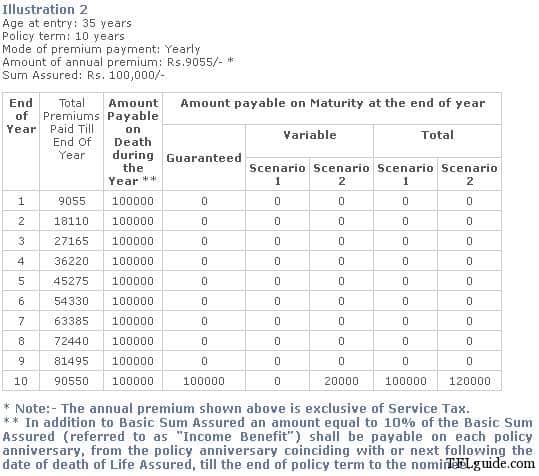
LIC Jeevan Ankur policy illustration

Death benefits under this policy (based on the illustration above, assuming the policyholder passes away after paying 5 premiums):

  • Sum Assured paid immediately: Rs.1 lakh
  • 10% of Sum Assured paid every year till maturity: Rs.10,000 x 5 years = Rs.50,000
  • Maturity benefit at end of term (Sum Assured + Loyalty Additions*): Rs.1 lakh (*loyalty additions not guaranteed)

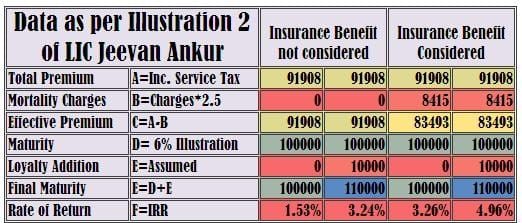
Mortality charges comparison: To get equivalent death cover via LIC’s own term plan (LIC Amulya Jeevan, now replaced by LIC Tech Term), you would pay approximately Rs.841 per year for Rs.2.5 lakh Sum Assured. This becomes important in the IRR calculation below.

LIC Jeevan Ankur returns are just 1.53%

Would you like to buy a product that gives returns lower than a savings bank account? If yes, LIC Jeevan Ankur would have been a no-brainer.

From the illustration: yearly premium is Rs.9,055. Add GST (which replaced service tax from July 2017), and the effective premium is approximately Rs.9,192 per year. Total premium paid over the policy term: Rs.91,908. Final maturity amount under scenario 1 (6% projected return – the only logical assumption for a traditional plan): Rs.1 lakh.

The Internal Rate of Return (IRR) on this works out to 1.53%.

LIC Jeevan Ankur Returns IRR calculation

A savings bank account gives 3 to 3.5%. A PPF gives 7.1%. An ELSS fund has historically delivered 12 to 14% over 10-year periods. And Jeevan Ankur was giving 1.53%.

This is not an anomaly. It is the structural reality of endowment plans – a point Moneylife Magazine made bluntly: traditional plans typically deliver 2 to 4%, and most policyholders have no idea.

Also read: 7 Financial Planning Mistakes That Are Costing You Retirement Security

If you already hold this policy – what should you do?

This is the question that actually matters in 2026. The plan cannot be purchased anymore. But many people still hold it, still paying premiums, wondering whether to continue or cut their losses.

The most dangerous trap here is the Sunk Cost Fallacy – “I have already paid 8 years of premiums, might as well complete the full term.” This reasoning keeps millions of Indians locked in bad financial products for decades. The money already paid is gone regardless of what you do next. The only question is: what is the best decision from this point forward?

Here is the three-question framework I use with clients:

Question 1: How many years of premiums have you paid?

The surrender value you receive depends on how long the policy has been running. Under the old guaranteed surrender value formula (which applies to existing Jeevan Ankur policies – IRDAI’s improved surrender norms from October 2024 apply only to new policies), you typically receive 30% of total premiums paid from year 2, rising with policy duration. The longer you have paid, the more you recover on surrender.

Question 2: What is the gap between your current surrender value and what you have paid?

Get an actual surrender value quote from LIC – visit your nearest branch or check the LIC website. Then calculate: what is the actual loss if you surrender today? Compare that loss against 5 to 10 more years of paying into a 1.53% product. In most cases, surrendering and redeploying into equity mutual funds recovers the loss within 3 to 4 years.

Question 3: What will you do with the freed-up premium money?

Surrendering a bad policy only makes financial sense if you redirect the freed-up annual premium into something better. If the Rs.9,000 per year simply gets spent, nothing is gained. If it goes into an ELSS SIP or a PPF, the long-term difference is substantial. The decision is not just about exiting – it is about what comes next.

✅ A better alternative for child education planning

Separate your insurance and investment. A term plan (Rs.1 crore cover costs roughly Rs.10,000 to 15,000 per year for a 35-year-old) handles the protection need. An ELSS or index fund SIP handles the wealth creation. The two together will outperform any child endowment plan over a 15-year horizon – by a significant margin.

Also read: Sukanya Samriddhi Yojana 2026: Is It Worth It for Your Daughter’s Education?

My verdict – then and now

In 2012, I called LIC Jeevan Ankur a “Compulsory Miss.” In 2026, the plan is gone – so the purchase decision is moot. But the lesson it teaches is not.

Any product that mixes insurance with investment is designed for the agent’s benefit, not yours. The endowment plan structure – opaque returns, heavy first-year commissions, emotional naming – has not changed. New versions of the same product are still being sold under different names.

If you own Jeevan Ankur, get a surrender value quote today. Run the numbers honestly. Do not let the sunk cost fallacy keep you paying for another decade into a product returning 1.53%.

Not sure whether to surrender your LIC policy?

We review existing insurance portfolios as part of our financial planning process. If you have a mix of LIC policies and want an honest assessment of what to keep, what to surrender, and how to restructure your protection and investment strategy, let’s talk.

Book a Clarity Call

Frequently asked questions

Is LIC Jeevan Ankur still available?

No. LIC Jeevan Ankur has been discontinued and is not available for new purchase. Existing policyholders can continue paying premiums until maturity or surrender the policy at the current surrender value.

What is the actual return on LIC Jeevan Ankur?

Based on the plan’s own illustration – Rs.9,055 annual premium for a Rs.1 lakh Sum Assured – the Internal Rate of Return (IRR) works out to approximately 1.53%. This is lower than a savings bank account and far below inflation. The calculation is shown in the illustration table above.

Should I surrender my LIC Jeevan Ankur policy?

It depends on how many years you have paid and what you will do with the freed-up money. First, get an actual surrender value quote from LIC. Second, calculate how many more years of premiums remain and what total amount you will receive at maturity. Third, compare that against redirecting the annual premium into equity mutual funds for the remaining years. In most cases where 5 or fewer years of premiums remain, completing the policy is reasonable. Where 8 or more years remain, surrender often makes mathematical sense – if the freed premium is reinvested properly.

Do IRDAI’s new October 2024 surrender value rules apply to my existing Jeevan Ankur policy?

No. IRDAI’s improved surrender value norms effective October 2024 apply only to policies issued on or after that date. For existing Jeevan Ankur policyholders, the original policy surrender terms apply. The surrender value you receive is governed by the original policy document – typically 30% of premiums paid (excluding year 1) rising with years of premium payment.

What is a better alternative to LIC Jeevan Ankur for child education planning?

Separate your insurance from your investment. A pure term insurance plan provides Rs.1 crore cover for Rs.10,000 to 15,000 per year (for a healthy 35-year-old). A separate ELSS or index fund SIP handles wealth creation for the education goal. This combination delivers far better outcomes over a 15-year horizon than any endowment-based child plan. For daughters, Sukanya Samriddhi Yojana at 8.2% tax-free is also worth considering for the conservative portion.

Do you hold a LIC Jeevan Ankur policy? Have you already surrendered it or are you thinking about it? Share your situation in the comments – it may help others facing the same decision.