Home Blog Page 8

Investment Strategies for Young Investors in India: 7 Steps to Start Right

A 27-year-old software engineer came to me a few years ago. He had been working for three years, earning well, and had absolutely nothing to show for it financially. Not by accident. By design – the design of a lifestyle that consumed everything he earned before the month ended.

He was not irresponsible. He was just never taught the basics. Nobody told him that the decisions made between 25 and 35 determine more about retirement wealth than anything that happens between 45 and 55. The math of compounding is ruthless in one direction and generous in the other. Start early and it works for you. Start late and you spend decades trying to outrun it.

If you are between 25 and 35, this is the most important financial article you will read this year. Not because it is complicated. Because the steps are simple and the window to act on them is finite.

Quick Answer

The 7 investment steps for young Indians: build a financial plan first, buy term insurance and health insurance immediately, create a 6-month emergency fund, start a SIP of at least 10% of income, open a PPF account even with a small amount, begin saving for retirement now (not later), and borrow only for assets that appreciate. The biggest mistake young investors make is treating these as future tasks. Every year of delay costs more than a year’s worth of contributions.

Investment Strategies for Young Investors India

Table of Contents

Step 1: Build a Financial Plan Before Buying Any Product

Most young people start investing by buying a product. Someone recommends a mutual fund. An uncle suggests a ULIP. A colleague mentions crypto. So they buy something. Then something else. Then something else. By 32, they have a collection of financial products with no strategy connecting any of them to any goal.

A financial plan starts with goals, not products. Write down what you want your money to do: build an emergency fund, buy a home in 8 years, fund your child’s education in 18 years, retire at 55. Each goal needs a number and a date. Once you have the goals, the right products become obvious. Without the goals, every product recommendation is just noise.

You do not need a paid advisor at 25 to do this. You need a notebook and an honest conversation with yourself about what you actually want from your financial life. The paid advisor becomes valuable later when the stakes are higher and the decisions are more complex.

“Construction of a house without a blueprint is dangerous. No wind is right unless you know which harbour you are sailing to. Finance is no different. Build the plan first.”

Step 2: Get the Right Insurance – And Only the Right Insurance

Insurance for young people has two genuine needs and one enormous trap.

The genuine needs: term life insurance and health insurance.

Term insurance is necessary only if you have financial dependents – parents relying on your income, a spouse, young children. If you have no dependents, you do not need life insurance yet. When you do need it, buy a pure term plan for at least 10 to 15 times your annual income. A 26-year-old earning Rs. 8 lakh annually needs Rs. 80 lakh to Rs. 1.2 crore in term cover. The premium for this will typically be Rs. 8,000 to Rs. 12,000 per year. That is the correct cost of life insurance.

Health insurance is non-negotiable regardless of dependents. Your employer’s group cover lapses the day you leave. A personal health policy with a minimum Rs. 10 lakh individual cover gives you continuity, waiting period accumulation, and independence from any employer. Start young when premiums are low and pre-existing condition exclusions are minimal.

The enormous trap: any insurance product that also promises investment returns. ULIPs, endowment plans, money-back policies. These are expensive, opaque, and consistently underperform the combination of a term plan plus a mutual fund SIP. Avoid all of them. See our detailed guide on what insurance actually is before any agent gets near you.

Step 3: Build an Emergency Fund First

Before any investment, before any SIP, before any financial goal – build a 6-month emergency fund. This is not negotiable.

Six months of your actual monthly expenses, sitting in a liquid fund or a savings account you will not touch unless the sky falls. Job loss, medical emergency, urgent family need – whatever it is, the emergency fund absorbs the shock without forcing you to break investments, take loans, or max out credit cards.

Many young professionals in India live paycheck to paycheck not because they earn too little but because they have never separated emergency money from spending money. The emergency fund creates that separation.

Credit Cards Are Not an Emergency Fund

A credit card gives you emergency access to borrowed money at 36 to 48% annual interest. An emergency fund gives you access to your own money at zero cost. Use credit cards for convenience and rewards on planned purchases. Never as a financial safety net. The habit of treating credit as emergency backup is how young people end up with debt they cannot escape.

Step 4: Start a SIP – This Month, Not Next Month

Once the emergency fund is in place, start a SIP. The minimum should be 10% of your monthly take-home income. If you earn Rs. 60,000 per month, Rs. 6,000 goes into a diversified equity mutual fund via SIP every month without exception.

Why equity? Because you have time. A 26-year-old investing in equity has 30 or more years for the market to work. Over any 15-year period in Indian equity market history, the probability of loss is extremely low. Volatility is real but manageable through time. Parking everything in FDs at 25 because “equity is risky” is the kind of caution that guarantees a mediocre retirement.

Why a SIP specifically? Because it removes the decision from the equation. The money leaves your account on the 5th of every month before you spend it. You never have to decide to invest because the system does it for you. This is the most important behavioral design choice you can make.

The SIP Increment Rule

Every April when your salary increment takes effect, increase your SIP by at least 50% of the increment. If your salary goes up by Rs. 8,000 per month, your SIP goes up by Rs. 4,000. This single habit, followed consistently, is the difference between arriving at 50 with a strong corpus and arriving at 50 with regret.

Step 5: Open a PPF Account Today

Public Provident Fund earns 7.1% currently, compounds tax-free, and has a 15-year lock-in from the year of opening. That lock-in is the reason to open it now even with a minimal amount.

You do not need to put the full Rs. 1.5 lakh per year. Put Rs. 500 today to open the account and start the 15-year clock. At 25, your PPF account matures at 40. At 30, it matures at 45. At 35, it matures at 50. Every year you delay opening the account is a year later you can access a fully matured, tax-free debt corpus during peak wealth-building years.

PPF is not a replacement for equity SIPs. It is the debt anchor of your portfolio – guaranteed returns, sovereign backing, tax-free maturity, and a forced long-term saving habit. Both matter.

Step 6: Start Saving for Retirement Now

The most common response from young professionals to retirement planning is: “I am 27. I will think about retirement at 45.”

Here is what that delay actually costs. Rs. 5,000 per month invested in equity at 12% annual returns from age 25 reaches approximately Rs. 1.76 crore by age 55. The same Rs. 5,000 per month started at 35 reaches only Rs. 50 lakh by age 55. The 10-year head start generated Rs. 1.26 crore more on the same monthly investment. Time cannot be bought back with money.

You do not need a separate “retirement account” at 25. Your SIP in a diversified equity fund, held for 30 years, is your retirement savings. The EPF your employer contributes is your retirement savings. The PPF you just opened is your retirement savings. What you need is the conscious intention to not touch these during wealth accumulation. Every EPF withdrawal on a job change is retirement money consumed early.

For a fuller view of how retirement planning works across different life stages, see the complete retirement planning guide.

Step 7: Borrow Smart – Assets Yes, Liabilities No

Some debt is constructive. Education loans for skills that increase earning power. Home loans for a property you will live in for at least 10 years, at an EMI that stays within 40% of take-home income. These are debts with a productive end.

Some debt is destructive. Personal loans for vacations, consumer electronics, or lifestyle upgrades. Credit card debt carried month to month at 36 to 48% annual interest. Car loans for premium vehicles far beyond practical need at your current stage.

The test is simple: does this debt fund something that will be worth more (in financial or human capital terms) than the total interest paid? Home – usually yes. Education – often yes. iPhone on EMI – no. Goa trip on credit card – no.

Young professionals who keep their debt clean through their 20s arrive in their 30s with vastly more financial flexibility. Those who accumulate consumer debt spend their 30s trying to clear it instead of building.

Something Worth Noticing

The biggest financial advantage young investors have is not knowledge, not income, and not access to products. It is time. Every year of early investing is worth more than any year of late investing, regardless of the amount. The window where time works maximally in your favor is exactly the window you are in right now. This does not come back.

6 Mistakes Young Investors Should Avoid

1. Buying investment-linked insurance (ULIPs). The combination of insurance and investment serves neither purpose well. A term plan costs Rs. 8,000 to 12,000 per year for Rs. 1 crore cover. A ULIP charges 15 to 40% of early premiums in commissions and fees. Separate the two always.

2. Spending on wants before securing needs. Health insurance, emergency fund, and term insurance (if you have dependents) are needs. A new phone, a vacation, or a premium car upgrade are wants. Needs come first, every time, before any want – no matter how affordable the EMI looks.

3. Investing in liabilities instead of assets. An asset puts money in your pocket or appreciates over time. A liability takes money out. A rented home you occupy is a need. A second property bought on a stretched loan “for investment” before your finances are stable is a liability masquerading as an asset. Be honest about the difference.

4. Copying your parents’ portfolio. Your parents invested in a world of 9% FD rates, no equity mutual fund access, and pension-based retirement. You invest in a world of 7% FD rates, excellent equity mutual fund access, and no pension. The instruments that worked for them may not be the best tools for you.

5. Ignoring financial literacy. The cost of financial ignorance is paid slowly, invisibly, over decades. A bad insurance product bought at 26 costs Rs. 15 to 20 lakh in foregone corpus by 50. Reading one good book and one reliable financial resource per year compounds into decisions that save and earn multiples of the time invested.

6. Being too conservative too early. The only time equity risk is truly manageable is when you have 20 to 30 years ahead of you. At 25, being 80% in equity and 20% in debt is not aggressive. It is appropriate. Parking everything in FDs and RDs at 25 “because equity is risky” guarantees mediocre long-term outcomes. Risk tolerance should match time horizon, not comfort zone.

Just Starting Out? Learn More About RetireWise.

RetireWise works primarily with executives aged 45 to 60 on retirement planning. But the decisions made at 25 to 35 determine what options exist at 50. If you want to understand how financial planning actually works before you need it urgently, explore what we do.

Explore RetireWise

Frequently Asked Questions

How much should a young investor save each month?
A minimum of 20% of take-home income – 10% in equity SIPs for long-term goals, 10% in shorter-term instruments for medium-term goals and emergency fund top-ups. If you cannot reach 20% immediately, start at 10% and increase by 2 to 3% each year as your income grows.

Is it better to invest in FDs or mutual funds at 25?
For a 30-year goal like retirement, equity mutual funds via SIP are significantly better than FDs. Equity returns over long periods in India have historically beaten FD rates by 5 to 7 percentage points annually. On Rs. 5,000 per month over 30 years, that compounding difference translates to crores. FDs are appropriate for short-term goals (under 3 years) and the debt portion of your portfolio.

Do I need a financial advisor at 25?
Not necessarily for the basics. The seven steps in this article can be implemented independently. An advisor becomes genuinely valuable when your finances get complex – multiple income sources, tax planning, home purchase, insurance review, and eventually retirement planning. At 25, focus on building the habits. Get an advisor when the stakes are high enough to justify the fee.

Should I buy a house in my 20s?
Only if you plan to live in it for at least 10 years, the EMI stays within 40% of take-home income, and buying does not prevent you from maintaining your SIP and insurance. A rushed home purchase on a stretched loan that kills your SIP and emergency fund is financially destructive even if the property appreciates. There is no hurry. Build your financial foundation first.

How much term insurance do I need?
10 to 15 times your annual income if you have financial dependents. If your annual income is Rs. 8 lakh, you need Rs. 80 lakh to Rs. 1.2 crore in pure term cover. If you have no dependents, you do not need life insurance yet. Never buy a ULIP or endowment plan thinking it covers both insurance and investment. It does neither well.

Before You Go

Related reading: 10 Investment Mistakes That Cost Indian Investors Lakhs and How to Set SMART Financial Goals.

What is the one financial step you have been putting off that you know you should start? Share in the comments below.

One question for you: If you had to start one of these seven steps today – not this week, today – which one would it be?


Cost of Higher Education in India 2026: Why It’s Your Retirement’s Biggest Risk

My elder daughter is appearing for her second-year exams at a reputed private management institute this month. She is doing a 5-year integrated BBA-MBA programme.

When her first-year fees arrived — tuition plus hostel — I did a quiet calculation. Her one year cost more than everything I spent on education from Class 1 through my own graduation. Combined.

I am a financial planner. I have been advising clients on education inflation for over 25 years. I knew the numbers. I still wasn’t ready for that number when it was my own daughter.

My younger daughter sits for entrance tests and interviews this year. I am not writing this as someone who studied education inflation from a distance. I am living it, right now, in 2026.

⚡ Quick Answer — 2026 Education Costs at a Glance

Stream Govt College Private College Abroad
Engineering (4 yrs) Rs.6–14L (IIT/NIT) Rs.8–25L Rs.40–80L
Medical MBBS (5 yrs) Rs.50K–10L (AIIMS: Rs.7,600) Rs.50L–1.3Cr Rs.25–60L
MBA (2 yrs) IIM: Rs.25–28L Rs.8–15L Rs.75L–1.5Cr
Commerce/Arts (3 yrs) Rs.5K–25K/yr Rs.2–6L Rs.25–50L

All figures are 2026 current costs. These will be significantly higher when your child reaches college age — see the inflation section below.

The Uncomfortable Reframe: Education Is Not a Goal. It Is a Risk.

Many of the clients RetireWise works with have decent assets. Some have numerically achieved what we call financial freedom. Their corpus is sufficient. Their retirement, on paper, is funded.

But they won’t retire. Not yet.

Ask them why, and the answer is almost always the same: “My daughter’s college is in two years.” Or: “My son just got into a private medical college.” Or: “We are thinking of sending him abroad for his Master’s.”

For these clients, their child’s college education is not just another financial goal alongside vacation planning or home renovation. It is a financial risk. An unplanned or under-planned education expense can wipe out 3–5 years of retirement corpus in a single year.

That is the conversation this article is really about. Not just what education costs. But what it costs your retirement if you don’t plan for it now.

The Education Inflation Rate in India: The Number That Changes Everything

India’s general consumer price inflation runs at 5–6% annually. Education inflation runs at 10–12% annually. That gap is not temporary — it has persisted for over two decades and shows no signs of narrowing.

At 10% annual inflation, education costs double every 7.2 years. At 12%, they double every 6 years.

What Rs.15 Lakh Today Becomes (at 10% Education Inflation)

Years From Now Cost Then What That Means
5 years Rs.24.2 L 60% more expensive
8 years Rs.32.2 L More than doubled
10 years Rs.38.9 L 2.6x today’s cost
15 years Rs.62.6 L 4.2x today’s cost

⚠️ The Delay Penalty

For a child aged 8 targeting IIT (projected Rs.36 lakh at age 18), starting today requires approximately Rs.11,000/month SIP. Wait 3 years — the monthly SIP jumps to approximately Rs.19,000. Three years of delay costs you Rs.8,000 every single month for the remaining 7 years. Time is the most expensive thing you waste in financial planning.

2026 Education Cost: Stream-by-Stream Breakdown

Engineering Education Costs in India 2026

Institute Type Examples Total Cost (4 yrs)
IIT IIT Bombay, Delhi, Madras Rs.10–14 Lakh
NIT / Govt College NIT Trichy, COEP, VJTI Rs.6–8 Lakh
Top Private BITS Pilani, Manipal, VIT Rs.20–25 Lakh
Average Private Most private engineering colleges Rs.8–16 Lakh
Abroad (US/UK) Including living costs Rs.40–80 Lakh

Plan for the private college. If the government seat comes through, it is a bonus — not the plan.

Medical Education Costs in India 2026

College Type Total Cost (5-yr MBBS) Note
AIIMS New Delhi Rs.7,600 (entire course!) Cutoff: top 50 in India
Good Govt Medical Rs.2–10 Lakh Competitive NEET rank
Private (Merit Quota) Rs.25–50 Lakh
Private (Mgmt Quota) Rs.50L – Rs.1.3 Crore Varies enormously by college
MBBS Abroad Rs.25–60 Lakh Russia, Philippines — NMC-recognised

If your child wants medicine, plan for Rs.75 lakh. If they crack AIIMS or a good government seat, invest the saved corpus back into your retirement. Never plan for Rs.10 lakh and hope for the best.

MBA — The IIM Premium in 2026

IIM top 6 now charges Rs.25–28 lakh for a 2-year programme. ISB Hyderabad charges over Rs.40 lakh. Good private MBA programmes — XLRI, MDI, SP Jain, SIBM — cost Rs.12–22 lakh. Abroad for MBA means Rs.75 lakh to Rs.1.5 crore all-in. This is more than most Indian senior executives spent on their first home.

💡 The BMW Analogy — Still True in 2026

You can buy a good car for Rs.15–25 lakh. Or you can send your child to a decent private engineering college. The same money. The car depreciates the moment you drive it out of the showroom. Your child’s education compounds in ways that cannot be put on a balance sheet. The difference is: you can plan the education. You don’t plan the car purchase 15 years in advance. Start planning the education now.

Calculate Your Education Corpus

The calculator below gives you the corpus target, monthly SIP (with step-up SIP option), and the cost of waiting 3 years.

🎓 Education Corpus Calculator 2026

Includes step-up SIP · 2026 fee data pre-loaded · No login required


Target Corpus

When child turns 18

Monthly SIP Today

With step-up SIP

If You Wait 3 Yrs

Higher monthly SIP

[embedCalcScript]

The Retirement Trap Nobody Plans For

Here is the scenario I see most often in my practice.

A senior executive at 52. Corpus of Rs.2.5 crore. Retirement target at 55. Everything looks fine on paper.

Then the son gets into a private medical college. Management quota. Rs.80 lakh total. Rs.15–20 lakh per year.

Where does the money come from? If it comes from the retirement corpus, Rs.2.5 crore becomes Rs.1.7 crore. The retirement plan breaks. The executive is back to working until 60 or 62 — not because they failed financially, but because they failed to plan one goal separately from another.

The solution is not to choose between your child’s education and your retirement. It is to plan both simultaneously, with completely separate dedicated corpuses — from the day the child is born, not the day the admit card arrives.

Is your education plan threatening your retirement?

A RetireWise planning session maps both goals together — education corpus and retirement corpus — and shows you where they conflict and exactly what to do. 30 minutes. No obligation.

Book a Free Planning Session

How to Actually Invest for Your Child’s Education

If the goal is 10+ years away: Equity mutual funds via SIP. Time horizon is long enough to ride out market cycles and compound aggressively. A step-up SIP — increasing your investment 10% every year — is the most practical approach for salaried executives.

If the goal is 5–10 years away: Balanced approach — 60% equity, 40% debt. Reduces volatility risk as the goal approaches.

If the goal is less than 3 years away: Primarily debt — arbitrage funds, short-duration debt funds, or liquid funds. Preservation mode. The corpus-building window is closed; protect what you have built.

On education loans: A partial loan covering 20–40% of cost is a financial lever, not a failure. Section 80E allows full interest deduction for up to 8 years with no cap. If your child’s corpus is still invested and compounding during the course, the net math often works out better than liquidating early.

💡 The 3-Year Glide Path — Non-Negotiable

Three years before your child starts college, begin shifting the education corpus from equity to debt — 30% in Year -3, another 30% in Year -2, the final 40% in Year -1. A market correction in the year before college should not destroy what you spent 15 years building. This is one of the most common — and most costly — education planning mistakes I have seen.

Infographic: What Education Actually Costs — Visual Guide

📊 [INFOGRAPHIC — BEING UPDATED FOR 2026]

Visual guide showing 2026 education costs across all streams, 10-year inflation projections, and the SIP required to fund each goal. Updated infographic coming shortly.

Get Your Free Personalised Education Corpus Report

📋 Your Numbers + 2-Page Planning Guide — Free

Enter your details and we will generate your personalised report: corpus target, year-by-year projection, investment checklist, common mistakes to avoid, and the retirement impact section. Sent to your inbox instantly.


✓ Corpus target
✓ Year-by-year table
✓ SIP strategy guide
✓ Investment checklist
✓ Retirement impact
✓ Mistakes to avoid

No spam. Unsubscribe anytime. By RetireWise · Ark Primary Advisors Pvt. Ltd.

[submitRptFormScript]

My elder daughter’s fees rewrote my understanding of a number I thought I already knew. My younger daughter will do the same this year. Every parent reading this will have their own version of that moment. The difference between the ones who absorb the shock and the ones who are derailed is simple: one started a SIP when the child was 8. The other started thinking about it when the admit card arrived.

Start now. The best time was the day they were born. The second best time is today.

💬 Your Turn

What stream is your child targeting — and have you calculated the corpus at today’s inflation rate? Share below. The most common reaction when parents see the number for the first time: “I had no idea it was this much.”

Do You Need a Financial Planner? 7 Honest Reasons – and When You Don’t

“Everyone has a plan until they get punched in the mouth.” – Mike Tyson

Naveen (name changed) was a 52-year-old Director at a pharma company in Hyderabad. Well-read, analytically sharp, earning Rs 60 lakh a year. He had managed his own finances for two decades. SIPs running, PPF active, home loan almost paid off.

Then COVID hit. His company restructured. His role was eliminated in June 2020.

His portfolio had no emergency fund. His SIPs were in mid-cap funds that had dropped 40%. He had no income protection plan. Within 8 months he was dipping into his retirement corpus – at depressed market prices.

He called me after he had already done the damage. “I thought I had a plan,” he said. He had investments. That is not the same thing.

⚡ Quick Answer

You need a financial planner when the cost of mistakes exceeds the cost of advice – which happens sooner than most people think. A good planner does not just pick investments. They build a system: goals, insurance, tax efficiency, emergency preparedness, and a retirement withdrawal strategy. The value is not in the returns they generate – it is in the mistakes they prevent.

7 Honest Reasons to Hire a Financial Planner

1. One Size Never Fits All

Every financial article you read gives generic advice – “invest 20% of income,” “keep 6 months emergency fund,” “buy term insurance.” But your situation is specific. You have a specific risk tolerance, specific goals, specific family obligations, specific tax situation. Generic advice applied to specific circumstances produces mediocre results at best and real harm at worst. A financial planner translates general principles into a plan that fits your actual life.

2. You Have Received a Large Sum of Money

A bonus, an inheritance, a property sale, ESOP proceeds. A large lump sum is a decision of permanent consequence. Invest it wrong and the cost compounds for decades. The temptation to time the market, chase recent performers, or make emotional decisions is highest with large amounts. A planner provides the architecture and the discipline.

3. Retirement is Within 10 Years

The closer you are to retirement, the more expensive each mistake becomes. You have less time to recover. The decisions around corpus sizing, asset allocation shift, withdrawal strategy, and insurance transition are complex – and most people face them once in a lifetime, with no practice run. A specialist who has navigated these decisions with hundreds of clients is worth far more than their fee at this stage.

Retirement within 10 years? This is when a plan matters most.

At RetireWise, we specialise in the transition period – corpus sizing, withdrawal strategy, and risk management for the last decade before retirement. SEBI Registered. Fee-only.

See How RetireWise Works

4. Wrong Financial Moves Are Expensive – and Irreversible

When you are 28, a bad investment decision costs you Rs 50,000 and a few years of growth. When you are 52, the same bad decision costs you Rs 15 lakh and the option to retire at the age you planned. Time cannot be bought back. A planner’s value is not just in what they add – it is in what they stop you from doing. The mistakes prevented are invisible. The fees paid are visible. This asymmetry makes people undervalue good advice.

5. A Major Life Change Has Just Happened

Marriage, divorce, a new child, a job change, losing a parent, moving cities, selling a business. Each of these events has direct financial implications that most people handle reactively rather than proactively. A financial plan built for your previous life situation does not fit your current one. A planner helps you recalibrate before the gaps become crises.

6. You Have Financial Dependents with Specific Needs

Aging parents who need healthcare funding. A child with special needs. A spouse who has never managed money independently. These situations require planning that goes beyond standard investment advice – insurance structuring, estate planning, trust creation, succession planning. Getting these wrong has consequences that outlast your own lifetime.

7. Emotions Are Driving Decisions

Every investor believes they are rational. Almost none are – when it counts. In March 2020, Sensex dropped 38% in 40 days. Millions of investors redeemed equity funds at the bottom – locking in permanent losses. A financial planner is not just an advisor. They are a circuit breaker between your emotions and your investments. The behavioural coaching is worth as much as the portfolio management.

The Advice-Taker’s Paradox – When DIY Feels Right But Costs More

Here is the uncomfortable truth about the “I’ll manage it myself” decision.

Research on individual investors consistently shows that the average investor earns significantly less than the average fund – not because of fees, but because of behaviour. They buy high, sell low, chase performance, and exit at exactly the wrong moments. The gap between fund returns and investor returns is often 3-5% per year – far more than any reasonable advisory fee.

The DIY investor who reads financial articles, runs spreadsheets, and considers themselves informed is often the most susceptible to this gap. They are confident enough to make decisions quickly, but not experienced enough to know which decisions are the dangerous ones.

📌 When You Probably Don’t Need a Planner

You are early in your career with simple finances. You have very low income and are focused on clearing debt. You have a genuine interest in finance and the discipline to stick to a written plan through market cycles. You have already retired with a stable, simple portfolio. In these cases, basic financial literacy may be sufficient – though a one-time plan review still has value.

“In 25 years of advising, I have never met a client who regretted getting a written financial plan. I have met hundreds who regretted not having one – at the moment when it was too late to make it matter.”

– Hemant Beniwal, CFP, CTEP | Founder, RetireWise

Choosing the Right Financial Planner

Not all financial planners are equal – and in India, the word “planner” is used by everyone from commission-based agents to fee-only fiduciaries. The difference matters enormously.

Look for SEBI registration as an Investment Adviser (RIA). This means the planner is legally required to act in your interest and disclose all conflicts. Combined with a CFP designation, this is the minimum credentialing bar for someone you are trusting with your retirement.

Ask specifically: “Are you SEBI registered as an RIA?” and “How are you paid?” A fee-only RIA charges you directly. A commission-based advisor is paid by the products they sell you. The incentive structures are completely different.

Read next: 5 Important Questions to Ask Your Financial Advisor Before Hiring

Ready to talk to a SEBI-registered, fee-only advisor?

RetireWise works with senior executives planning for retirement. No products. No commissions. A written plan built around your life. SEBI Registered. Fee-only.

See the RetireWise Service

Naveen eventually rebuilt. It took him 3 years. He now has a written plan, an emergency fund, and a retirement date he can actually trust. “I wish I had done this at 40,” he said. You still can.

A financial plan is not a luxury. At the point when you need it most, it is the only thing standing between you and a crisis you cannot undo.

💬 Your Turn

Are you managing your finances yourself – or working with a planner? What has been the single most expensive financial mistake you have made or avoided? Share below.

Behavioural Finance – How Your Mind Sabotages Your Money Decisions

“The investor’s chief problem — and even his worst enemy — is likely to be himself.” — Benjamin Graham

Have you ever wondered why the smartest people you know — engineers, doctors, CXOs — make the dumbest money decisions?

I have. For 25 years, I’ve sat across from highly educated professionals who can run billion-dollar divisions but can’t stop themselves from panic-selling when markets drop 10%. It’s not about intelligence. It’s not about information. It’s about something far more powerful — your own mind working against you.

Think of it like cricket. There are 3 stages to master any sport: training, practice, and the match itself.

Training is boring. Nobody posts Instagram stories from the nets. But as Muhammad Ali once said — “I train so that I can dance well in the boxing ring.” Now ask yourself: you spend years building your career, but how much time have you spent training your investment mind?

Practice feels great. You play with friends, there’s no pressure, you hit glorious cover drives and think you should’ve been a cricketer. But then comes the tournament. Suddenly, with thousands watching and every point counting, those beautiful shots disappear. You become cautious. Tentative. Afraid.

This is exactly what happens with your money. You research stocks calmly on a Sunday morning. You build a strategy. Then the market crashes 800 points on a Monday, and everything you planned goes out the window. Your fingers hover over the “sell” button — not because the fundamentals changed, but because your emotions hijacked the controls.

⚡ Quick Answer

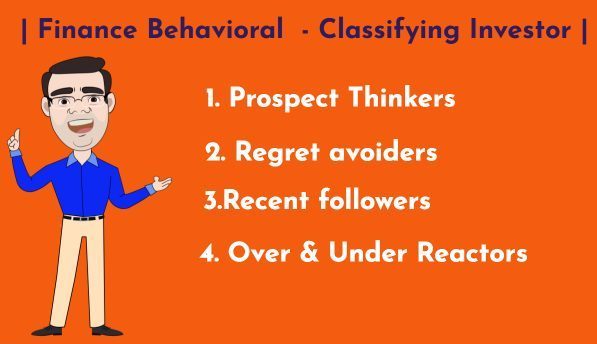
Behavioral finance studies why investors make irrational decisions driven by emotions and cognitive biases — not logic. Understanding your investor personality type (prospect thinker, regret avoider, recency follower, or over-reactor) is the first step to making smarter financial decisions. The real risk in investing isn’t the market — it’s your own behaviour.

Behavioral Finance – Make Smarter Financial Decisions

What Is Behavioural Finance — And Why Should You Care?

Traditional economics assumes you’re a rational human being. That you weigh all options, calculate probabilities, and make the optimal choice.

Let me be direct. That’s nonsense.

Behavioural finance is the study of how psychology — your fears, your greed, your ego, your past experiences — shapes every financial decision you make. It combines insights from psychology and neuroscience with the reality of how people actually invest, save, and spend.

Financial planning isn’t just about numbers and spreadsheets. It involves decision-making — and every decision passes through the filter of your personality, your childhood relationship with money, and the emotional scratches life has left on your subconscious.

In my experience, the biggest gap in most investors’ knowledge isn’t about which mutual fund to buy. It’s about understanding why they do what they do with money.

The Four Investor Personalities — Which One Are You?

Over 25 years of sitting across the table from investors, I’ve observed that financial behaviour broadly falls into four patterns. See if you recognise yourself.

1. The Prospect Thinker

Imagine this: I tell you a product has an 80% chance of giving 12% returns, but a 20% chance of losing some capital. What do you hear?

If you’re a prospect thinker, you heard only one thing — “20% chance of losing money.” The 80% upside doesn’t exist for you. You want 100% capital protection, or you won’t invest at all.

Suresh (name changed), a 54-year-old VP at an IT company in Pune, kept ₹2.3 crore in bank FDs earning 6% because he couldn’t stomach even a theoretical possibility of loss. After inflation and tax, his money was actually shrinking every year. The “safe” choice was the most dangerous one.

2. The Regret Avoider

These investors don’t want to feel regret — so they simply don’t decide. They won’t sell a stock that’s hit their target because “what if it goes higher?” They won’t sell a losing stock because selling makes the loss real.

They follow the herd. If everyone is buying, they buy. If everyone is panicking, they panic. It feels safer to be wrong with the crowd than right alone.

3. The Recency Follower

Whatever happened last week is the only reality for this investor. If small-caps gave 40% returns last year, small-caps are the greatest thing ever. If they crashed this month, they’re terrible forever.

Recency bias is particularly dangerous in India right now. With lakhs of new Demat accounts opened post-COVID and social media amplifying every market move, this bias has become an epidemic. A 2025 SEBI investor survey found that only about 9.5% of Indian households actively invest in securities despite much higher awareness — the gap is partly driven by recency-biased investors who enter during bull runs and exit after the first correction.

Finance Behavioral

4. The Over-Reactor (and the Under-Reactor)

The overconfident investor exaggerates his own talent and forgets the role of luck and factors beyond his control. Here’s the irony — the more successful someone has been in their career, the more likely they are to be overconfident about investing. Running a business well doesn’t automatically make you a good investor.

Then there’s the pessimist — the under-reactor. This person avoids all financial decisions. Won’t meet an advisor. Won’t open a statement. Won’t even discuss retirement planning with their spouse. Avoidance feels like safety, but it’s just slow financial erosion.

The biggest threat to your portfolio isn’t a market crash. It’s the person looking back at you in the mirror.

Struggling to figure out which investor personality is costing you money?

A structured financial plan built around your behaviour — not just your goals — changes everything.

Talk to a Financial Planner

The 5 Costly Mistakes These Biases Cause

Every investor personality type listed above leads to predictable mistakes. Here are the five I see most often:

  • Imagining losses that may never happen — and letting that fear paralyse you into inaction or FD-only portfolios.
  • Believing you need expert-level knowledge to invest — so you delay for years while inflation eats your savings.
  • Investing without a time horizon — putting retirement money into instruments meant for 2-year goals, or vice versa.
  • Confirmation bias on steroids — reading only what supports your existing view, ignoring anything that challenges it. WhatsApp groups and Twitter echo chambers have made this worse than ever.
  • Underestimating small, timely decisions — dismissing a ₹10,000/month SIP because it “won’t make a difference,” while that same SIP at 12% CAGR over 20 years builds ₹1 crore.

What Nobody Tells You About Investor Behaviour

Here’s something most financial advisors won’t say out loud — and most articles on behavioural finance completely miss.

Losing ₹1 lakh hurts your brain roughly twice as much as gaining ₹1 lakh makes it happy. This isn’t a personality flaw. It’s how human brains are wired — the pain of loss is literally more intense than the pleasure of an equal gain. Psychologists call this loss aversion, but I call it the reason most Indian families sit on ₹15-20 lakh in savings accounts earning less than inflation.

They think they’re being safe. They’re actually losing money every single year — just slowly enough that it doesn’t feel like a loss.

And here’s the part that should worry you: being financially literate doesn’t protect you from this. Even people who know the maths — who can calculate compound interest in their sleep — make the same emotional mistakes when markets get volatile. Knowledge helps in calm times. In a crash, your amygdala takes over and your spreadsheet becomes useless.

The only thing that actually works? Building a decision-making system before the crisis hits. Pre-decided rules for when to buy, when to sell, when to rebalance — written down, not just in your head. Because in the middle of a 30% market fall, “I’ll stay calm” is not a plan. It’s a wish.

This is why the best investors in the world aren’t the smartest. They’re the most disciplined. They’ve built systems that protect them from their own instincts.

How to Actually Improve Your Financial Behaviour

You may not like this, but here’s the truth — knowing about biases doesn’t automatically fix them. If it did, every psychology professor would be a billionaire investor.

Here’s what actually works, based on what I’ve seen with clients over two decades.

1. Start with humility

Accept that you — yes, you with your IIT degree and corner office — are not immune to irrational behaviour with money. The market doesn’t care about your designation.

2. Build a system, not a strategy

A system is a set of pre-decided rules you follow regardless of how you feel. “I will rebalance my portfolio every April” is a system. “I’ll sell when I feel the market is too high” is a disaster waiting to happen.

3. Diversify — not because textbooks say so

Diversification is the only free lunch in investing. It protects you from your own overconfidence in any single bet.

4. Follow the business, not the ticker

Stop watching stock prices every day. Check the fundamentals every quarter. The price of your investment on a random Tuesday in March tells you nothing about its 10-year trajectory.

5. Minimise noise

Unfollow the market pundits on Twitter. Leave the WhatsApp investment groups. Every piece of noise is a trigger for one of the biases we just discussed.

6. Get a trusted partner

If you aren’t sure of your decisions — and you shouldn’t be, because nobody should be fully confident about the future — work with a fee-only financial planner who has no incentive except your wellbeing.

7. Admit mistakes fast, but learn the right lessons

Selling a stock that fell 50% isn’t always a mistake — sometimes the mistake was buying it. Don’t confuse bad outcomes with bad decisions, or good outcomes with good decisions.

Must Read — WHY Do We Make Financial Mistakes?

Your investments reflect your behaviour, not your intelligence

A financial plan that accounts for your psychology — not just your numbers — is the difference between retiring well and just retiring.

Start Your Financial Plan

Frequently Asked Questions on Behavioural Finance

What is behavioural finance in simple words?

Behavioural finance is the study of how your emotions, biases, and psychology affect your financial decisions. Instead of assuming investors are always rational, it acknowledges that fear, greed, overconfidence, and herd mentality drive most money decisions — often leading to costly mistakes.

What are the most common behavioural biases in investing?

The five most common biases are: loss aversion (fearing losses more than valuing gains), confirmation bias (seeking information that supports your existing views), recency bias (overweighting recent events), overconfidence bias (overestimating your own ability), and herd mentality (following the crowd). The pain of losing money is felt roughly twice as strongly as equivalent gains — which is why most investors hold losers too long and sell winners too early.

How can I overcome behavioural biases in my investments?

Build a rules-based system for your investments — pre-decide when to buy, sell, and rebalance. Reduce noise by limiting financial news consumption. Diversify to protect against overconfidence. Most importantly, work with a fee-only financial advisor who acts as a behavioural coach, keeping you from your own worst impulses during market volatility.

Is behavioural finance relevant for Indian investors?

Extremely. With the post-COVID explosion in retail Demat accounts, social media-driven investment advice, and WhatsApp forward culture, Indian investors are more exposed to behavioural traps than ever before. A 2025 SEBI survey showed only 9.5% of Indian households actively invest in securities despite high awareness — this participation gap is largely a behavioural problem, not a knowledge one.

You won’t get another life to get this right. The market will test your discipline a hundred times. Your job isn’t to be smarter than the market — it’s to be smarter than your own instincts.

It’s not a Numbers Game… It’s a Mind Game.

💬 Your Turn

Which of the four investor personalities do you see in yourself — prospect thinker, regret avoider, recency follower, or over-reactor? And has it ever cost you money? Share your story in the comments.

9 Smart Ways to Save Money in India (For Senior Executives)

Most money-saving advice is written for someone who is struggling to make ends meet.

You are not struggling. You are earning Rs. 3 lakh or more every month. You are saving something. And yet, when you do the maths on what your retirement corpus should look like — the number is not where it should be.

That is a different problem from “I can’t afford to save.” It needs different advice.

The leaks in a senior executive’s financial life are not cappuccinos and impulse Amazon purchases. They are unreviewed insurance policies that have been running for 15 years. SIPs that were set up in 2018 and never stepped up. A second car no one drives. A family loan that turned into a quiet drain. These are not small problems.

⚡ Quick Answer

The highest-leverage saving moves for a senior executive are not about cutting expenses — they are about eliminating financial dead weight: legacy insurance policies with poor IRR, SIPs that haven’t been stepped up, idle money in savings accounts, and financial complexity that nobody is reviewing. Fix those first. Then optimise.

Smart ways to save money in India — for high earners

1. Track Your Net Worth, Not Just Your Expenses

Most personal finance advice tells you to track every coffee and grocery receipt. At your income level, that is not where the leverage is.

What actually matters: your net worth statement, updated once a year. Assets on one side — EPF, PPF, mutual funds, property, gold, fixed deposits. Liabilities on the other — home loan outstanding, any personal loans, family obligations. The gap between the two, growing each year, tells you whether you are on track for retirement.

If your net worth is not growing by at least 15–20% per year at your income level, something is leaking. Finding what it is requires this annual exercise — not tracking your daily expenses.

2. Step Up Your SIPs Every Single Year

A stitch in time saves nine — and a SIP stepped up by 10% every year builds three times the corpus of a flat SIP over 20 years.

Most people set up a SIP in 2015, set it and forget it, and wonder why their corpus is lagging. The problem is not the SIP — it is the flat contribution while their salary doubled.

The rule is simple: every time your income increases, increase your SIP by at least the same percentage. If your salary went up 15% this year, step up your SIP 15%. Better: step it up by 20% and absorb the small reduction in take-home. You will not notice the difference in lifestyle. You will notice the difference in your retirement corpus in 10 years.

💡 The compounding math that changes minds: Rs. 50,000/month SIP for 20 years at 12% CAGR = Rs. 4.99 crore. The same Rs. 50,000 stepped up 10% every year = Rs. 9.2 crore. Same fund, same return — nearly double the corpus. Simply because you stepped up.

3. Automate Before You Spend — Reverse Budgeting

The traditional budget approach: earn, spend, save what’s left. The problem: what’s left is usually much less than planned.

Reverse budgeting: earn, auto-invest your target amount on salary day, live on what remains. Your SIPs, PPF contributions, and loan EMIs go out on the 1st of every month — before you have spent a rupee on lifestyle.

This is not discipline. It is architecture. You are not relying on willpower every month. You are making the right decision once and automating it forever. Every wealthy investor I know operates this way.

4. Audit Your Financial Portfolio Annually — Kill the Dead Weight

The biggest money leak for senior executives is not spending — it is existing financial products that are quietly underperforming.

Every year, sit down with your statements and ask three questions about each product: What is it earning? What could this money be earning in the best alternative? Why am I still holding it?

Common culprits at every annual audit: endowment plans from 2008 that are yielding 5% while delivering inadequate insurance cover. ULIPs with charges that have been running for 12 years. Fixed deposits that have been auto-renewed at falling interest rates. Duplicate mutual funds in the same category. A second property that earns 2% rental yield and is costing you property tax, maintenance, and mental bandwidth.

None of these feel like obvious leaks. Together, they can represent 20–30% of your net worth sitting in suboptimal places. Auditing once a year and making one correction can be worth more than three years of disciplined saving. For a complete review of which insurance products are worth holding and which should be exited, read our guide on 9 insurance questions every Indian gets wrong.

5. Separate Family Obligations from Your Retirement Corpus

This is the conversation most financial advisors avoid. Family money — parents’ medical expenses, a sibling’s business, a child’s wedding fund — can quietly consume retirement savings if there is no clear boundary.

The solution is not to stop supporting family. It is to make the support explicit. Decide an annual amount you are willing to contribute to family obligations. Put it in a separate account. What goes from that account, goes. What stays in your retirement account, stays — and is not available for family.

This boundary protects both your retirement and your relationships. When there is no boundary, every family financial request becomes a negotiation against your own retirement security. When there is a boundary, the answer is clear: “I have allocated this much for family. Beyond that, I cannot.” This is not selfishness. It is the only way to reach retirement without depending on your children.

Earning well but retirement corpus is not where it should be?

At RetireWise, we specialise in helping senior executives find the leaks — and build a retirement income plan that actually works.

Explore RetireWise

6. Invest in Preventive Healthcare — Before It Is Expensive

Healthcare is wealth in the truest sense. A senior executive at 52 who ignores annual health checkups is making the most expensive financial decision of his career — he just does not know it yet.

A single major health event — cardiac surgery, cancer treatment, a serious accident — can cost Rs. 20 to 50 lakh and derail a retirement plan built over 20 years. The solution is twofold: buy and maintain adequate health insurance well before retirement (group cover from your employer ends the day you retire), and invest in preventive care that reduces the probability of that event occurring.

Budget for annual health checkups, medication compliance, and fitness. These are not personal expenses — they are retirement corpus protection.

7. Increase Your Earning Power, Not Just Your Savings Rate

For a senior executive, the highest return on capital is often not in the market — it is in yourself. A skill upgrade, a strategic career move, or a consulting engagement on the side can add more to your net worth in a year than any investment return.

Your earning years are finite. Between 45 and 60, every additional rupee of income that can be saved and invested compounds into your retirement. A Rs. 10 lakh increase in annual income, fully invested for 15 years at 12%, becomes Rs. 1.7 crore in retirement corpus. No stock pick does that reliably.

Invest in skills that extend your earning power. Take on work that compounds your expertise. Consider what you know that others will pay well to learn. The ceiling on savings from cutting costs is bounded. The ceiling on savings from earning more is not.

8. The 50-30-20 Rule — But Adapted for Your Income

The 50-30-20 rule — 50% on needs, 30% on wants, 20% on savings — is designed for someone building savings from scratch. At Rs. 3–5 lakh monthly income, the target should be different.

A better framework for a senior executive in the 10–15 years before retirement:

Category Target % What It Covers
Savings & Investments 35–40% SIPs, PPF, NPS, direct equity, EPF contribution
Needs (fixed obligations) 35–40% Home loan EMI, school fees, insurance premiums, household
Wants (discretionary lifestyle) 20–25% Dining, travel, entertainment, shopping

If you are saving less than 30% of your take-home at this income level, something is structurally wrong — either lifestyle inflation has outpaced income growth, or there are hidden financial obligations that need to be identified and addressed.

9. Work With a Fee-Only SEBI-Registered Financial Advisor

The ninth tip requires no budget — it requires a decision.

A fee-only SEBI-registered advisor charges you a flat fee for advice. They earn nothing from products they recommend. This means their only incentive is to give you the right advice — not to sell you what earns them the highest commission.

For a senior executive managing a growing corpus, the cost of sub-optimal financial decisions over 10 years — wrong insurance products, under-diversified portfolios, missed tax optimisation, poor retirement income planning — can easily exceed Rs. 50–75 lakh. A good advisor costs a fraction of that and more than pays for themselves in avoided mistakes.

The question is not whether you can afford one. It is whether you can afford not to have one. For more on how retirement-focused financial planning works for senior executives, see our guide on the best investment options for senior citizens in India.

Saving money at your income level is not about spending less. It is about making sure every rupee you already earn is working as hard as possible — and stopping the quiet leaks that nobody talks about.

Find the leaks. Step up the SIPs. Let the compound interest do the rest.

💬 Your Turn

Which of these nine is the one you know you should fix — but haven’t yet? The annual portfolio audit? Stepping up SIPs? Share below. You may find others in the same spot.

Child Future Planning: The Complete 2026 Guide for Indian Parents

A client called me from Bengaluru three years ago. His daughter had just been born. He was calling not to celebrate – he had been reading about education costs and was genuinely worried. “IIM fees are Rs.25 lakh now, Hemant. What will they be in 18 years?”

I told him: at 10% education inflation (which has been conservative for top institutions), Rs.25 lakh becomes approximately Rs.1.4 crore in 18 years. He went quiet for a moment. Then he asked: “So what do I do right now?”

That is exactly the right question. And the answer is not a child insurance plan – it is a proper financial plan for your child’s future.

Quick Answer: Child Future Planning

The right instruments for a child’s education goal: equity mutual fund SIP (primary vehicle for goals 10+ years away), PPF in child’s name (safe, tax-free, complements equity), Sukanya Samriddhi Yojana for daughters (8.2% tax-free, government-backed, best safe instrument for girl child). Never buy child insurance ULIPs or endowment plans – they cost more and deliver less than term insurance plus equity SIP separately. Education inflation in India: 10 to 12% per year for premium institutions. A Rs.25 lakh goal today becomes Rs.1.4 to 2 crore in 18 years.

The first mistake: confusing insurance with investment for children

Every year, thousands of Indian parents are sold “child plans” by insurance companies. These are typically ULIPs or endowment policies marketed with emotional advertising featuring children’s milestones and parents’ anxiety about the future.

The return on most child insurance ULIPs: 5 to 7% over 15 to 20 years, net of all charges. The return on an equity mutual fund SIP over the same period: 11 to 13% historically. The difference on Rs.5,000 per month over 15 years: approximately Rs.12 lakh versus Rs.35 lakh.

What to do instead: Buy a pure term insurance policy for yourself (to protect your child’s financial future if you are not around). Invest separately in equity mutual funds for the child’s education goal. This gives you better returns, better cover, and full flexibility – at lower total cost.

Planning before the child is born

The window between marriage and a child’s arrival is a valuable planning period. Three things to address:

Health insurance with maternity cover: Many employer policies include maternity benefits, but the cover is often low. If you are planning a family, verify the maternity benefit limit and waiting period. Some policies require 24 to 36 months of holding before maternity claims are valid – so start the policy early.

Build a baby fund: The first two years have significant unplanned expenses – vaccinations, medical visits, equipment, childcare. Set aside Rs.1,000 to Rs.3,000 per month from marriage into a liquid fund or savings account earmarked for this. Do not let baby expenses derail your regular investments.

Assess your debt position: Before a child arrives, your EMIs (home loan, car loan, any personal loans) should ideally be under 30% of take-home income. A new child adds Rs.20,000 to Rs.50,000 or more in monthly expenses. If your EMI burden is already high, address it before conception if possible.

Instruments for the child’s education goal

Equity mutual fund SIP (primary vehicle): For goals 10 or more years away, equity SIPs are the right instrument. Rs.5,000 per month at 12% CAGR for 18 years grows to approximately Rs.40 lakh. Increase the SIP with every salary hike. Link the SIP to the specific goal – “daughter’s engineering college 2041” – so you never stop it impulsively during market corrections.

PPF in the child’s name: Any Indian resident can open a PPF account for a minor child. The parent manages it as guardian. Current PPF rate: 7.1% per annum, compounding annually, tax-free on maturity. The minor’s PPF account matures when they turn 15 (PPF has a 15-year lock-in from account opening). Excellent safe component alongside equity SIP.

Sukanya Samriddhi Yojana (SSY) for daughters: SSY is the best dedicated instrument for a daughter’s financial future. The 2026 rate is 8.2% per annum, fully tax-free, government-backed. Maximum deposit: Rs.1.5 lakh per year. The account matures when the daughter turns 21 (or earlier for marriage at 18+). SSY qualifies for Section 80C deduction under the old tax regime. For any parent with a daughter under 10, SSY should be part of the plan.

Avoid child ULIPs and endowment plans: High charges, low flexibility, returns that rarely justify the cost. A term plan for yourself plus equity SIP separately delivers more value at lower cost.

Have you calculated how much your child’s education will cost?

Education inflation in India runs at 10 to 12% for premium institutions. Most parents significantly underestimate the corpus needed. A RetireWise clarity call includes a goal calculation for your child’s education, alongside your retirement and other priorities.

Book a Clarity Call

Education loan: a tool, not a failure

Education loans serve an important purpose and should not be seen as a fallback for inadequate planning. They serve as:

A commitment mechanism for the child – when they have skin in the game, they approach education more seriously. The interest on education loans qualifies for deduction under Section 80E (for up to 8 years of repayment) under both old and new tax regimes. And a well-managed education loan does not have to burden the child for long if they enter a good career.

That said, education loans should be a supplement to savings, not a substitute. The goal should be to save enough to cover 50 to 75% of education costs, with the remaining 25 to 50% potentially covered by the child’s scholarship, education loan, or their own part-time income. A plan that assumes 100% education loan is exposed to interest rate and income risk.

The right insurance approach for your child’s goals

Never buy insurance in a child’s name for investment purposes. The child has no income – insuring their life has no financial logic. What you need to insure is your own life, since you are the income source that funds their future.

A term insurance policy covering 15 to 20 times your annual income, with your children as beneficiaries, protects their future better than any child insurance plan. The cost comparison is stark: a Rs.1 crore term plan for a 30-year-old costs Rs.8,000 to Rs.12,000 per year. A child ULIP of Rs.5 lakh cover might cost Rs.50,000 per year with inferior returns.

Retirement planning is also child planning

Here is the most important and most counterintuitive point about planning for your child’s future: the best thing you can do for your children’s long-term happiness is to retire financially independent.

A parent who is financially secure does not become a burden when they age. They do not create pressure on their children’s careers or marriages. They can help grandchildren without drawing down their savings. And they model the financial discipline they want their children to develop.

Never raid your retirement corpus for a child’s education. Education can be partly funded by loans. Retirement cannot.

Estate planning and documenting your wishes

If you have children, write a will. This is non-negotiable. A will ensures that if something happens to you, your assets go to your intended beneficiaries – not to distant relatives by intestate succession rules. It should specify who manages the assets until your children reach adulthood, how insurance proceeds should be used, and how education goals should be funded.

Consider a trust structure if your estate is significant – this provides professional management and protection against the assets being dissipated before the children can use them wisely.

Also read: Cost of Higher Education in India 2026: Why It Is Your Retirement’s Biggest Risk

Frequently asked questions

What is the best investment for a child’s education in India?

For goals 10 or more years away, equity mutual fund SIPs are the primary vehicle – historically delivering 11 to 13% CAGR over long periods. Complement this with PPF in the child’s name (7.1% tax-free, government-backed) for the safe component. For daughters, Sukanya Samriddhi Yojana (SSY) at 8.2% tax-free (2026 rate) is the best safe instrument. Avoid child insurance ULIPs – they deliver 5 to 7% net of charges, which is significantly below equity SIPs, while costing more.

What is Sukanya Samriddhi Yojana and should I invest in it?

Sukanya Samriddhi Yojana (SSY) is a government savings scheme specifically for girl children. The 2026 interest rate is 8.2% per annum, compounding annually, fully tax-free. You can deposit between Rs.250 and Rs.1.5 lakh per year. The account can be opened for girls up to age 10 and matures when the daughter turns 21. SSY qualifies for Section 80C deduction under the old tax regime. It is the best guaranteed-return instrument for a daughter’s long-term financial goals and should be part of every plan that includes a daughter.

Should I take an education loan for my child or save for education?

Ideally, save to cover 50 to 75% of expected education costs and use education loan for the remainder. Saving entirely provides maximum flexibility. Education loan provides Section 80E tax deduction (for up to 8 years of repayment) and creates financial accountability for the child. Never deploy your retirement savings for education – retirement cannot be funded with loans, but education can. The worst scenario is fully depleting retirement savings for education and becoming financially dependent on the child in old age.

What instrument are you currently using for your child’s future – and at what age did you start? Share in the comments – early starters can inspire those who are just beginning.

The 6-Step Financial Planning Process: What a Genuine Advisor Does (vs What a Product Seller Does)

A client came to me recently – a 47-year-old VP at a manufacturing company in Pune. He had been “managing his finances” for 20 years. He had 6 insurance policies, 11 mutual funds, 2 PPF accounts, an NPS he had forgotten about, and a home loan. He had not reviewed any of it in 3 years.

When I asked him whether he was on track to retire at 58 with the lifestyle he wanted, he could not answer. He had never run the numbers. He was investing, not planning.

Investment without planning is like driving without a destination. You are moving but you do not know if you are moving in the right direction. The financial planning process is the framework that connects your actions to your goals.

Quick Answer: The 6-Step Financial Planning Process

The FPSB (Financial Planning Standards Board) defines 6 steps: establish the client-planner relationship, gather data and define goals, analyse the current financial situation, develop and present the financial plan, implement the recommendations, and review and monitor the plan. SEBI-registered Investment Advisers (RIAs) in India are required by regulation to follow a structured advisory process. A genuine planner follows all 6 steps. A product seller jumps directly to step 5.

Why the process matters – and how to tell a real planner from a fake one

Financial planning is one of the most misused terms in the Indian finance industry. A person who sells LIC policies calls himself a Financial Planner. A banker who sells ULIPs calls himself a Financial Advisor. A mutual fund distributor who recommends funds based on commission calls himself a Wealth Manager.

None of these is wrong as a profession. The problem is the term “financial planner” implies a process – a structured, client-centric approach to understanding your entire financial situation and building a plan that addresses it comprehensively. The FPSB requires Certified Financial Planners (CFPs) to follow a documented 6-step process. SEBI requires registered Investment Advisers (RIAs) to follow a structured advisory process under the Investment Adviser Regulations.

The simplest test to distinguish a genuine planner from a product seller: does this person ask extensively about your situation before recommending anything? A real planner cannot recommend a product without first understanding your goals, income, liabilities, family situation, and risk profile. A product seller starts with the product and works backward to make it fit you.

Step 1: Establishing the client-planner relationship

Before any advice is given, a genuine financial planner explains the entire engagement – what services will be provided, who is responsible for what, how the planner is compensated, and whether there are any conflicts of interest.

SEBI RIA regulations require this disclosure in writing. Your advisor must give you a document called the Investment Advisory Agreement that specifies their fees, their registration details, and their scope of services. If you are starting a relationship with a financial advisor and they have not given you this document, ask for it. If they cannot produce it, they are likely not a registered advisor.

The relationship should have a defined scope and a timeline. Are they managing your entire financial plan? Only your investments? Only tax planning? Clarity at this stage prevents confusion and misaligned expectations later.

Step 2: Data gathering and goal definition

A planner who does not collect detailed information about your financial situation cannot give you appropriate advice. The data gathering phase covers income (all sources), expenses (actual, not estimated), assets (all investments, property, EPF, PPF, NPS, gold), liabilities (all loans), insurance (all policies, cover amounts), tax situation (old or new regime, deductions), and family situation (dependants, special needs).

Alongside data collection, goals are defined and quantified. Not “I want to retire comfortably” but “I want to retire at 58 with Rs.1.5 lakh per month in today’s value, fund my daughter’s education at Rs.25 lakh in 8 years, and pay off my home loan by 55.” Every goal gets a timeline and a current-value amount. The inflation-adjusted future value of each goal becomes the planning target.

Step 3: Analysis of your current financial situation

With data and goals in hand, the planner analyses where you stand. This includes calculating your net worth (total assets minus total liabilities), your savings rate (what percentage of income is being invested), your insurance adequacy (is your term cover sufficient, is your health cover adequate), your asset allocation (is the split between equity, debt, and other assets appropriate for your age and goals), and your liability structure (which debts are expensive and should be prioritised).

The analysis also identifies gaps – the difference between where you are heading with current behaviour and where you need to be to meet your goals. A gap of Rs.50 lakh in your retirement corpus target is quantifiable and addressable. A vague sense that “I should save more” is not.

Have you ever had a full financial plan done – not just product recommendations?

A genuine financial plan starts with your goals and works backward to what investments, insurance, and tax structure you need. Most people have never had one. A RetireWise clarity call covers all 6 steps in a single structured conversation.

Book a Clarity Call

Step 4: Developing and presenting the financial plan

The financial plan translates the analysis into specific recommendations. This is where the planner tells you exactly what to do – which insurance policies to keep, surrender, or add, what asset allocation to target, how to structure your SIPs, how to optimise your tax situation (old regime vs new regime for your specific numbers), which loans to repay first, and how to sequence all of this over time.

A good plan is written, not verbal. It should document your goals, the current analysis, and the specific recommendations with rationale. The planner should walk you through it, explain the reasoning, and listen to your concerns. The plan should be revised until it reflects what you actually want to do – not what the planner thinks is theoretically optimal.

Step 5: Implementing the recommendations

Implementation is where most plans die. A plan that exists as a document but is never acted upon has zero value. The planner and client agree on who executes what – whether the planner assists in implementing (placing SIPs, arranging term insurance, restructuring loans) or simply advises while the client executes.

Under SEBI RIA regulations, a registered Investment Adviser can only advise – they cannot also be a distributor for the same client. This means the advisor gives you advice and you execute through your broker or mutual fund platform. This separation protects you from advice driven by distribution commissions.

Step 6: Review and monitoring

A financial plan is not a one-time event. Life changes – income grows, a child is born, a parent needs care, a job changes. Markets move, creating portfolio drift. Tax rules change. Each change potentially requires a plan adjustment.

A genuine planner schedules half-yearly reviews with clients. In each review, they check whether you are on track for your goals, whether your asset allocation needs rebalancing, whether any new life events have changed the plan, and whether any regulatory or tax changes affect your situation. This ongoing relationship is what distinguishes financial planning from one-time advice.

Also read: What is Financial Planning? The 6-Step Process That Actually Works

Frequently asked questions

What are the 6 steps of the financial planning process?

The FPSB’s 6-step financial planning process is: (1) establish the client-planner relationship and document the scope and compensation, (2) gather data and define quantified financial goals with timelines, (3) analyse the current financial situation including net worth, savings rate, insurance adequacy, and asset allocation, (4) develop and present a written financial plan with specific recommendations and rationale, (5) implement the recommendations with agreed roles for the planner and client, and (6) review and monitor the plan on a regular basis, adjusting for life changes and market movements.

How do I verify if my financial advisor is genuinely registered with SEBI?

You can verify any Investment Adviser’s registration at sebi.gov.in under the Intermediary/Market Infrastructure Institutions section. A registered advisor has a registration number beginning with “INA” (individual) or “INA” (non-individual). They are required to provide you with a written Investment Advisory Agreement before providing any advice. They are also required to disclose their fees, any conflicts of interest, and their registration details. If an advisor cannot provide these documents, they are likely not registered.

What is the difference between a financial planner and a mutual fund distributor?

A financial planner (SEBI-registered Investment Adviser or CFP) provides comprehensive advice covering your entire financial situation – insurance, investments, tax planning, retirement, estate planning – and is paid a fee by the client. A mutual fund distributor recommends mutual funds and earns a commission from the AMC. Under SEBI regulations, the same person cannot be both a registered Investment Adviser and a mutual fund distributor for the same client – this separation protects you from advice driven by commission incentives.

Have you ever experienced all 6 steps of the financial planning process with your advisor? What was the step that made the biggest difference? Share in the comments.

What is Insurance? Investment or Expense – The Answer That Changes Everything

“The man who is prepared has his battle half fought.” – Miguel de Cervantes

A client came to me a few years ago. Retired government officer, mid-60s, proud of his financial planning. He pulled out a thick file. Twelve LIC policies. Endowment plans, money-back plans, a ULIP from the 2000s.

He had paid premiums for 25 years. His total insurance cover? Rs 18 lakh. His annual household expense? Rs 6 lakh. In case of death, his family would have survived exactly 3 years.

He thought he had insurance. He had savings vehicles with an insurance label.

⚡ Quick Answer

Insurance is an expense – not an investment. It is the cost you pay to transfer financial risk to an insurance company. Pure term insurance is the only life insurance product worth buying. Mixing insurance with investment (endowment, ULIP, money-back) makes you poorer on both counts – insufficient cover and inferior returns. Separate the two, always.

What is Insurance, Actually?

Insurance is a contract. You pay a premium. In exchange, the insurance company bears a defined financial risk on your behalf – death, hospitalisation, accident, property damage.

That is it. That is the whole product.

The insurer charges you less than the expected value of the risk because they pool thousands of policyholders. Most of you will not claim. The premiums from the many pay for the claims of the few. This is why term insurance for a healthy 35-year-old costs Rs 12,000 a year for Rs 1 crore cover. The math works because most 35-year-olds will not die in the next 20 years.

“Think of insurance like the foundation of the Burj Khalifa – 320 metres underground, invisible, never appreciated, but holding everything else up. Without it, the tower falls. With it, you never think about it.”

– Hemant Beniwal, CFP, CTEP | Founder, RetireWise

What Happens in Real Life

Less than 5% of Indians are adequately insured. Of those who have life insurance, the average cover is under Rs 1 lakh. This is not ignorance – it is misdirection.

For 50 years, LIC taught Indians to think of insurance as an investment. Agents earn commissions of 25-35% on endowment policies in Year 1. They earn 3-5% on term plans. The incentive structure is clear – push products that pay agents well, not products that protect customers well.

When you buy an endowment or money-back plan, you are buying two broken products bundled together: inadequate insurance plus a low-returning savings vehicle. The agent gets paid. The company profits. You get neither real protection nor real returns.

🚫 The Commission Math

A Rs 1 lakh annual premium endowment policy earns an agent Rs 25,000-35,000 in Year 1. The same cover via term insurance costs Rs 12,000 total premium – earning the agent Rs 600-900. Whose interest is your agent serving when he recommends endowment?

Why Mixing Insurance and Investment Is a Financial Mistake

This is the core problem. And it plays out in three ways:

You are underinsured. An endowment plan giving Rs 50 lakh cover requires a premium of Rs 1.5-2 lakh per year. A term plan giving the same Rs 50 lakh cover costs Rs 8,000-12,000. Most people who buy endowment plans buy less cover than they need because the premium feels too high. They end up with Rs 10-15 lakh cover when they need Rs 1 crore.

You earn poor returns. The investment component of an endowment plan returns 4-5% over 20-25 years. A simple PPF gives 7.1%. A diversified equity mutual fund over the same period has historically given 12-14%. The insurance company earns the difference – and keeps it.

You cannot exit easily. Surrender an endowment policy in Year 3 and you lose 50-70% of premiums paid. You are locked in to a product that serves you poorly on both fronts.

THE RIGHT STRUCTURE – SIMPLE AND POWERFUL

Life Insurance = Pure Term Plan (10-15x annual income cover)

Health Insurance = Comprehensive indemnity policy (Rs 10-25 lakh + super top-up)

Wealth Creation = Equity mutual funds via SIP

Tax Saving = PPF, NPS, ELSS

Never combine these. Each product does one job. Make it do that job well.

How Much Life Insurance Do You Actually Need?

The thumb rule is 10-15 times your annual income. But that is a starting point, not a finish line.

A more accurate approach: calculate how much corpus your family would need to replace your income for the years until your youngest financial dependent becomes self-sufficient. Add outstanding loans (home loan, car loan). Add any large future obligations (children’s education, marriage). Subtract existing liquid assets and investments.

The number is usually much higher than people expect. A person earning Rs 20 lakh a year with a Rs 40 lakh home loan, a 5-year-old child, and Rs 15 lakh in investments typically needs Rs 1.5-2 crore in term cover. Most of them have Rs 25-50 lakh.

✅ When to Review Your Insurance Cover

Review after every major life event: marriage, birth of a child, new home loan, significant salary increase, or approaching retirement. Your cover needs change as your life changes. A 35-year-old needs different cover than a 50-year-old with grown children and a paid-off home.

Insurance and Retirement – The Gap Nobody Plans For

Here is the part most financial planning articles miss: your employer’s group health insurance ends the day you retire. Your group life cover also ends. On Day 1 of retirement, you are on your own for insurance – at precisely the age when insurers are least willing to offer coverage at reasonable rates.

The solution is to buy individual health insurance before you retire – ideally by age 55, while you are still healthy enough to get a clean underwriting. Waiting until retirement often means exclusions, loadings, or outright rejection.

Retirement planning and insurance planning must be done together. They cannot be treated as separate decisions.

Read next: Healthcare Planning for Retirement – The 2026 Guide Most Senior Executives Skip

Is your insurance stack ready for retirement?

At RetireWise, we review insurance coverage as part of every retirement blueprint – identifying gaps before they become crises. SEBI Registered. Fee-only.

See the RetireWise Service

The foundation of Burj Khalifa is underground. You never see it. You never think about it. But remove it and everything collapses. Term insurance is your financial foundation. It is an expense – a necessary, deliberate, non-negotiable expense.

Buy insurance as insurance. Invest as investment. Never mix the two.

💬 Your Turn

Do you have pure term insurance? Or are most of your “insurance” premiums going into endowment or money-back plans? What made you buy what you bought – and would you do it differently today?