
Home Blog Page 50

What Are Mutual Funds in India ?

Every few months, someone sends me a message saying they finally want to start investing but do not know where to begin. When I ask what is stopping them, the answer is almost always the same: “I do not understand mutual funds.”

This surprises me every time. Because mutual funds are genuinely simple. They were invented precisely so that ordinary people, without expert knowledge or large sums of money, could participate in wealth creation. Somewhere along the way, the financial industry managed to make the simplest investment vehicle sound complicated.

Let me fix that.

Quick Answer

A mutual fund pools money from thousands of investors and invests it in stocks, bonds, or other assets on their behalf. A professional fund manager makes the investment decisions. Each investor owns units proportional to their investment, and the value of those units changes daily based on the performance of the underlying assets. SEBI regulates all mutual funds in India. As of early 2026, the Indian mutual fund industry manages over Rs. 60 lakh crore in assets.

The Village That Invented Mutual Funds

Picture a village where everyone earns a modest income. No one has enough money individually to invest in stocks or bonds, which require larger sums. No one has the knowledge to pick the right companies to invest in. And no one has the time to track markets every day.

One day, the villagers decide to pool their savings together. They hire a wise and experienced person from the city to manage this combined money professionally. They agree that each villager will own a share of the total pool proportional to what they put in. The wise person invests the combined money, and each day they announce the current value of the pool so everyone knows exactly where they stand.

That is a mutual fund. The villagers are investors. The combined pool is the fund. The wise person is the fund manager. And the daily announced value of each share is the NAV or Net Asset Value.

India has simply scaled this up. Instead of one village, there are crores of investors. Instead of one wise person, there are professional fund houses regulated by SEBI. But the core logic has not changed at all.

How a Mutual Fund Actually Works

When you invest Rs. 5,000 in a mutual fund, your money is combined with money from thousands of other investors. The fund manager uses this combined corpus to buy a diversified portfolio of stocks, bonds, or other instruments depending on the fund’s stated objective.

The total value of all the assets the fund holds, divided by the number of units outstanding, gives you the NAV. If the NAV today is Rs. 50 and you invest Rs. 5,000, you receive 100 units. If the NAV rises to Rs. 55 next month, your 100 units are worth Rs. 5,500. If it falls to Rs. 45, your holding is worth Rs. 4,500.

This is the entire mechanism. Everything else, the scheme names, the category labels, the SIP dates, the redemption process, is just the operational layer on top of this simple idea.

The Key Players in Any Mutual Fund

Understanding who does what makes the whole structure less mysterious.

The Asset Management Company or AMC is the organization that runs the fund. Names you recognize: HDFC Mutual Fund, SBI Mutual Fund, Mirae Asset, Parag Parikh. Each AMC can run dozens of different schemes targeting different investment objectives.

The Fund Manager is the professional who decides what to buy, hold, and sell within the fund. Their track record across market cycles matters more than any single year’s performance.

SEBI is the regulator. It sets the rules for how funds can be named, categorized, and marketed. It protects investors from being misled. The 2018 SEBI recategorization exercise, which forced every fund into a clearly defined box, was a significant step toward investor protection.

The Registrar and Transfer Agent, typically CAMS or KFintech, handles investor records, transactions, and statements. When you check your folio or get a statement, it comes from here.

The Custodian holds the actual securities that the fund owns. Your money cannot be misappropriated because the assets sit with a separate custodian, not with the AMC.

Types of Mutual Funds You Actually Need to Know

SEBI has categorized mutual funds into well-defined buckets. For most investors, the relevant ones are:

Equity funds invest primarily in stocks. They carry higher risk but have historically delivered the highest long-term returns. For goals 7 or more years away, equity funds are the engine of wealth creation. Sub-types include large cap, mid cap, flexi cap, and sector funds.

Debt funds invest in bonds, government securities, and money market instruments. Lower risk than equity, lower long-term return. Suitable for short to medium-term goals or as the stable portion of a retirement portfolio.

Hybrid funds invest in a mix of equity and debt. Balanced advantage funds and aggressive hybrid funds are common choices for moderate risk profiles. They are particularly useful for investors who want equity exposure but cannot stomach pure equity volatility.

Index funds and ETFs simply replicate a market index like the Nifty 50 or Sensex. No active stock picking, very low cost. For most retail investors, a simple index fund does better over time than most actively managed funds after accounting for costs.

SIP: Why It Is the Most Powerful Feature of Mutual Funds

A Systematic Investment Plan or SIP allows you to invest a fixed amount every month automatically. Rs. 5,000 per month. Every month. Regardless of whether markets are up or down.

The beauty of SIP is that it removes the biggest enemy of investment returns: your own judgment about market timing. When markets fall and everyone is panicking, your SIP keeps buying more units at lower prices. When markets rise, your existing units are worth more. Over long periods, this averaging effect is enormously powerful.

India’s SIP culture has matured significantly. Monthly SIP inflows crossed Rs. 25,000 crore in recent months, reflecting that crores of ordinary Indians have internalized this discipline. This steady domestic money is also why Indian markets no longer collapse every time FPIs sell, as they did a decade ago.

Something Worth Noticing

The most dangerous mutual fund investor is the one who starts a SIP, watches it fall in the first year, and stops. In 25 years of advising I have not met a single investor who lost money in a diversified equity mutual fund held for 10 or more years through a SIP. Not one. The losses happen to those who start and stop, start and stop, always exiting at the wrong time. Consistency is the strategy.

The Costs You Must Understand

Mutual funds charge an annual fee called the Expense Ratio. This is deducted from the fund’s assets daily, so the NAV you see is already net of this cost. You do not receive a bill for it.

Direct plans have a lower expense ratio because you invest directly without a distributor. Regular plans have a higher expense ratio because part of the fee goes to the distributor as commission.

Over long periods, the difference in expense ratio compounds significantly. A 0.5% annual difference in expense ratio on a Rs. 50 lakh corpus over 20 years is a substantial sum. For this reason, investors who are comfortable managing their own investments should consider direct plans. Those who need advice and guidance are better served through a good advisor even if it means slightly higher costs, because the behavioral coaching a good advisor provides is worth far more than the cost difference.

What Mutual Funds Are Not

Mutual funds do not guarantee returns. Any fund promising guaranteed or fixed returns is either lying or is not a mutual fund. Returns depend entirely on the performance of the underlying assets.

Mutual funds are not the same as stocks. Buying a mutual fund unit does not mean you are trading in the stock market directly. You are buying a managed, diversified portfolio.

Mutual funds are not opaque. Every fund publishes its portfolio monthly. You can see exactly what it holds. SEBI mandates full transparency.

And mutual funds are not just for the wealthy. The minimum SIP amount in many funds is Rs. 100 or Rs. 500. This is what makes them uniquely democratic as a wealth-building tool.

The One Mistake That Destroys Most Mutual Fund Journeys

People treat mutual funds like fixed deposits. They check the value every week. They feel sick when the NAV falls. They redeem when the news is worst and reinvest when markets are at highs.

This is the behavior gap that Morgan Housel and Carl Richards have written about extensively. The fund returns 12% per year. The investor earns 6% because of the timing of their entries and exits.

The solution is deceptively simple: invest regularly through SIP, review annually, do not check daily, and do not let short-term market noise interrupt long-term plans. The stock market is the only market where people run away when things go on sale.

Want Help Building a Mutual Fund Portfolio for Retirement?

Choosing the right fund is less than half the job. The harder half is staying invested through the corrections, the noise, and the temptation to do something. If you are 45 to 60 and want a retirement-focused portfolio built and managed with discipline, let us talk.

Book a Free 30-Min Call

Before You Go

Related reading: Benefits of Mutual Funds in India and Mutual Fund Taxation in India.

What stopped you from starting your first mutual fund investment? Or if you are already investing, what was the moment things clicked for you? Share in the comments below.

One question for you: If a mutual fund you hold falls 30% over the next six months, what will you do? Your honest answer to that question tells you more about your investing future than any fund selection ever will.

KISS: Why Simplicity Is the Most Underrated Investment Strategy

“Any intelligent fool can make things bigger and more complex. It takes a touch of genius – and a lot of courage – to move in the opposite direction.” – E.F. Schumacher

A client came to me with a spreadsheet. Eleven mutual funds across seven different categories. Three insurance-linked investment plans. Two PMS accounts. A real estate investment. Two fixed deposits. A PPF account. And an NPS account he had forgotten about for four years.

He was an engineer with a postgraduate degree. He had done extensive research before every purchase. His logic for each investment was defensible in isolation.

But as a system, it was completely unmanageable. He could not tell me his total equity exposure. He did not know his effective debt allocation. He had no idea what his overall portfolio return was. He had duplicated several holdings across multiple funds. And he had paid entry loads, advisory fees, and insurance charges across multiple products that a simpler portfolio would never have incurred.

Complexity looked like sophistication. It was actually noise.

⚡ Quick Answer

The KISS principle – Keep It Simple – applied to personal finance means: fewer products, cleaner structure, lower costs, and better understanding of what you own. A portfolio with 3-5 well-chosen funds that you understand and monitor is more effective than a complex portfolio of 15 funds you cannot track. Simplicity reduces behavioural errors, cuts costs, and makes it easier to stay the course during market corrections.

Keep it simple investing strategy - KISS principle in personal finance

Why Investors Overcomplicate

The drive to complicate financial portfolios comes from three sources.

First, the illusion of diversification. Owning 12 mutual funds feels more diversified than owning 3. But if 8 of those 12 funds are large-cap equity funds tracking similar portfolios, you have not diversified – you have duplicated. Real diversification comes from investing across meaningfully different asset classes (equity, debt, gold), geographies, and market cap segments. Owning multiple funds within the same category adds cost and complexity without adding diversification.

Second, chasing the best. Every year, different funds top the performance charts. Last year’s small-cap leader. This year’s sector fund. Next year’s international fund. Investors who chase performance end up owning a museum of past winners – none of which are currently performing and all of which are generating costs. As Warren Buffett observed, “An investor needs to do very few things right, as long as he or she avoids big mistakes.” Chasing complexity is the big mistake.

Third, advice from multiple sources. A colleague recommends a fund. A relative suggests an insurance policy. An advisor adds a PMS. A bank relationship manager pushes a structured product. Each individual recommendation may not be wrong. But 10 different advisors optimising for 10 different goals produces an incoherent portfolio that no one is accountable for as a whole.

“The investor who owns 3 well-chosen funds and never touches them will, over 20 years, beat the investor who owns 17 funds and tinkers constantly. Simplicity is not laziness. It is discipline.”

– Hemant Beniwal, CFP, CTEP | Founder, RetireWise

What a Simple Portfolio Actually Looks Like

A simple retirement portfolio does not mean a sparse one. It means every component has a clear role and nothing is held for unclear reasons.

A practical simple structure for a 40-year-old accumulating toward retirement at 60: one large-cap index fund (Nifty 50 or Nifty 100) for core equity exposure; one mid-cap fund for growth potential; one balanced advantage or hybrid fund as a stability buffer; one short-duration debt fund for the debt allocation; and Sovereign Gold Bonds or a Gold ETF for the gold allocation. Five instruments. Clear roles. Easy to monitor. Simple to rebalance.

This portfolio covers all major asset classes, provides genuine diversification, and can be reviewed in 30 minutes twice a year. Compare that to a portfolio with 15 funds, three insurance plans, two PMS accounts, and a real estate investment – which requires days of work to review and produces analysis paralysis when any single component underperforms.

The simple portfolio is not optimal by theoretical measures. But it is far more likely to be held through market corrections, maintained consistently, and reviewed rationally. The best portfolio is not the theoretically optimal one – it is the one you can actually stick with.

Is your portfolio simpler or more complex than it should be?

A RetireWise retirement plan audits your current portfolio and consolidates it into a structure you can actually understand, monitor, and hold through market cycles.

Book a Free 30-Min Call

The Cost of Complexity

Complex portfolios cost more in three ways that are easy to overlook.

Direct costs: each additional fund carries an expense ratio. An investor with 12 equity funds averaging 1.5% TER is paying significantly more than one with 3 funds averaging 0.8% TER. Over 20 years, this expense ratio difference compounds into a substantial gap in corpus.

Transaction costs: each fund switch, each rebalancing, each new purchase generates transaction costs and potentially short-term capital gains tax. A simpler portfolio with fewer components requires less active management and generates fewer taxable events.

Behavioural costs: the most significant cost of complexity is invisible. When a complex portfolio falls, it is hard to know which component to hold and which to trim. This uncertainty leads to panic selling, wrong decisions, and inconsistent behaviour – which research consistently shows accounts for the largest gap between market returns and investor returns in India. Simplicity makes the right behaviour easier.

How to Simplify: A Practical Approach

If you have accumulated a complex portfolio over years, simplification is a process, not an event. A practical approach: first, list every instrument you hold, its current value, and its role in the portfolio. For each one, ask: can I describe in one sentence why I own this and what purpose it serves? If the answer is no, that is a candidate for exit. Second, identify true duplicates – funds in the same category tracking similar portfolios – and consolidate to the strongest performer. Third, identify instruments held for unclear reasons (a ULIP from 10 years ago, a PMS account that underperformed for 5 years) and make deliberate exit decisions.

Simplification should be done gradually to manage capital gains tax implications. But the direction should be clear: fewer, better-understood instruments with defined roles.

Read – Long Term vs Short Term Investments: The Only Framework You Need

Read – 7 Financial Planning Mistakes That Are Costing You Retirement Security

Frequently Asked Questions

How many mutual funds should I hold in my portfolio?

For most investors, 4-6 equity funds covering different market-cap segments and strategies is sufficient. A core large-cap or flexi-cap fund plus a mid-cap fund covers most equity needs. Adding a focused or international fund as a satellite is optional. Beyond 6-8 equity funds, you are adding complexity without adding meaningful diversification. For debt, 1-2 funds (a short-duration fund and possibly a liquid fund for the emergency corpus) are adequate. Total portfolio: 6-10 instruments including equity, debt, and gold.

I have 15 funds. Should I exit them all at once?

No. Exit systematically over 12-18 months to manage capital gains tax. Start by identifying funds that are clearly redundant (multiple large-cap funds doing the same thing) and switch those first. For funds with significant long-term capital gains, exit strategically near financial year end to optimise the tax timing. Funds held in tax-saving ELSS schemes have lock-in requirements that constrain exit timing. The goal is a 2-3 year simplification roadmap, not an immediate portfolio liquidation.

What about PMS and alternative investments?

PMS (Portfolio Management Services) and alternative investment funds (AIFs) require minimum investments of Rs 50 lakh and Rs 1 crore respectively. They can be legitimate additions for very large portfolios (Rs 5 crore and above) where the additional sophistication justifies the complexity and cost. For most retail investors with retirement corpus under Rs 3-4 crore, a well-structured mutual fund portfolio delivers comparable or better risk-adjusted returns at a fraction of the cost and complexity of PMS.

The most dangerous illusion in personal finance is that complexity signals sophistication. It usually signals the opposite: an accumulation of reactive decisions made without a coherent plan. The simplest portfolios, held consistently over the longest periods, produce the best retirement outcomes.

Simplicity is a strategy. Treat it like one.

Want a retirement portfolio that is simple, structured, and built to be held?

RetireWise builds focused retirement portfolios – typically 5-7 instruments – where every component has a clear role and purpose.

See Our Retirement Planning Service

💬 Your Turn

How many financial instruments do you currently hold? Do you know the purpose of every single one? Share in the comments.

Key Financial Changes at the Start of Every New Financial Year

Every April, something interesting happens. The financial year changes. New rules kick in. Tax slabs shift. Interest rates get revised. And most Indians do absolutely nothing about it.

They go back to work on April 2nd as if nothing changed. Their investments stay as they were. Their insurance cover has not been reviewed. Their nominee details are whatever they entered in 2015. And somewhere in a file, there is a PPF passbook that has not been opened in eight months.

The start of a new financial year is the single best moment to do a quick review of your financial life. Not because everything will change. But because a few things always do, and catching them early costs nothing while missing them can cost a lot.

Quick Answer

Every April brings regulatory changes, revised interest rates, updated tax slabs, and new investment limits that affect your financial plan. A 30-minute review at the start of the financial year covering your insurance, investments, tax planning, and nominations can prevent costly surprises through the year. This post outlines what to check and why it matters.

Why April Is the Right Month for a Financial Review

Most people do their financial review in February or March, driven by the panic of tax-saving deadlines. That is the worst time to make good decisions. You are rushed, you are reacting, and you are buying products to save tax rather than to build wealth.

April is different. The pressure is off. You have the full year ahead. Any changes you make now have twelve months to work. And you can act from a position of calm planning rather than deadline anxiety.

Think of it like a vehicle service before a long road trip. You check the tyres, the oil, the brakes. Not because something is broken, but because you want the journey to go smoothly. Your financial life is the vehicle. April is the service checkpoint.

Check 1: Have Tax Rules Changed?

Every Union Budget announces changes that take effect from April 1st. These can include revised tax slabs, new deduction limits, changes to capital gains tax, or modifications to specific investment rules.

The most important thing to check: are you in the right tax regime? India currently offers the old regime and the new regime. The new regime offers lower rates but removes most deductions including Section 80C, 80D, and HRA. The old regime has higher rates but allows all deductions.

Which one works better for you depends on your income level and how much you can legitimately claim in deductions. This calculation changes every year as slabs and deduction limits get revised. Doing this calculation in April, not in January, means you can structure your investments for the full year in line with whichever regime you choose.

Check 2: Have Interest Rates on Small Savings Changed?

The government revises interest rates on PPF, SCSS, Sukanya Samriddhi Yojana, and other small savings schemes quarterly. The April revision is particularly important as it sets the tone for the first quarter.

Current rates as of early 2026 that matter for retirement planning:

  • PPF: 7.1% per annum, compounded annually, tax-free returns
  • Senior Citizens Savings Scheme (SCSS): 8.2% per annum, quarterly payout
  • Sukanya Samriddhi: 8.2% per annum for the girl child scheme
  • Post Office Monthly Income Scheme: 7.4% per annum, monthly payout

These rates directly affect whether debt instruments in your portfolio are earning what you expect. If the PPF rate has been revised down, the return projection on that part of your corpus needs updating.

Check 3: Review Your Insurance Cover

Insurance cover does not automatically keep pace with your life. Your income has probably grown since you took your term plan. Your lifestyle has changed. Your liabilities may have increased. Yet your sum assured is exactly what it was when you bought the policy years ago.

April is a good time to ask three questions about your insurance:

Is my term insurance sum assured still adequate? A rough guide: your cover should be at least 10 to 15 times your annual income. If your income has grown significantly, your cover should too.

Is my health insurance sum assured keeping pace with medical inflation? Medical costs in India rise at roughly 14% per year. A Rs. 5 lakh policy from 2015 has the purchasing power of roughly Rs. 2 to 2.5 lakh today in real healthcare terms. Review and increase if needed.

Are my nominees up to date? This sounds mundane until it is not. Nominees on EPF, PPF, insurance policies, and mutual funds should reflect your current family situation. A person who got married in 2018 and has two children today should not still have their parents listed as nominees on everything.

Check 4: Set Your SIP Increases for the Year

Most people set a SIP amount and never touch it. Meanwhile, their income grows, their expenses increase with inflation, and their SIP contribution stays frozen at whatever felt manageable three years ago.

April is the right month to increase your SIP. If your income grew by 8 to 10%, consider increasing your SIP by at least that much. Over a 20-year period, the difference between a static SIP and one that grows by even 5% per year is enormous.

This is also the month to review whether your existing funds are still aligned with your goals. Not to churn, but to check. Has the fund’s objective changed? Has the fund manager been replaced? Has a fund significantly underperformed its category peers for three or more years? These are reasons to investigate, not panic.

Something Worth Noticing

The clients who build the most wealth are not the ones who pick the best funds. They are the ones who consistently increase their investments as their income grows. A SIP of Rs. 10,000 that never increases over 20 years will always be smaller than a SIP of Rs. 7,000 that grows by 10% every year. Small annual increases compound into massive differences over time.

Check 5: Review Your Asset Allocation

Over the course of a year, markets move. Equity might have done well and now represents 70% of your portfolio when your target was 60%. Or debt has grown because you parked some money in FDs and equity has been flat.

April is the time to rebalance toward your target allocation. Rebalancing is not about predicting what will do well next. It is about maintaining a risk level that matches your goals and sleep quotient. A 55-year-old with a retirement target of 60 should not wake up in April with 80% equity because the market ran up. Bringing it back to the target allocation is prudent portfolio hygiene.

Check 6: Have Your Financial Goals Changed?

Life does not hold still. A promotion changes your income. A child’s college timeline has shifted. An ageing parent now needs more financial support. You have decided to retire at 58 instead of 60.

Goals change. Plans should change with them. April is a structured moment to ask: is my financial plan still aligned with my actual life, or am I running an old map on new terrain?

This does not require a complete overhaul every year. It requires 30 minutes of honest reflection and, if needed, a conversation with your advisor about what needs adjusting.

The Two-Page Annual Financial Checklist

Every April, go through these in order:

  • Review last year’s tax returns and identify missed deductions
  • Choose old vs new tax regime for the current year and inform your employer for TDS purposes
  • Check PPF, SCSS, and small savings rates and update return projections
  • Review term insurance sum assured against current income
  • Review health insurance sum assured for self and parents
  • Update nominees on all instruments: EPF, PPF, mutual funds, insurance policies, bank accounts
  • Increase SIP amounts in line with income growth
  • Rebalance portfolio to target asset allocation
  • Review financial goals and check if any life changes require plan modifications
  • File a will update if any significant assets or family circumstances have changed

Ten items. Two hours once a year. The price of not doing this is paid quietly, in missed opportunities and unpleasant surprises that could have been avoided.

Want a Structured Annual Financial Review?

Our clients get a formal half-yearly review built into their engagement. If you are 45 to 60 and want a retirement plan that is actively maintained rather than set and forgotten, let us talk about what that looks like.

Book a Free 30-Min Call

Before You Go

Related reading: How to Set SMART Financial Goals and Importance of Financial Planning in Your Life.

Which of these checks do you find hardest to actually do every year? Share in the comments below.

One question for you: When did you last update your nominees across all your financial instruments? If you cannot answer that in under 30 seconds, that is where to start this April.

Why SEBI Tried to Ban ULIPs in 2010 — And What Changed for Investors

In April 2010, something unprecedented happened in Indian financial history. SEBI ordered insurance companies to stop selling ULIPs.

Not regulate them. Not modify them. Stop selling them entirely.

The order lasted just ten days before the two regulators — SEBI and IRDAI — reached a truce. But those ten days permanently changed how India thought about the intersection of insurance and investments.

⚡ Quick Answer

SEBI’s 2010 attempt to ban ULIPs was triggered by a fundamental regulatory conflict: ULIPs collect premiums and invest them in market-linked instruments — which SEBI argued made them securities, not insurance. IRDAI disagreed. The dispute was resolved by Supreme Court intervention, and ULIPs were regulated under insurance. However, the episode led to significant IRDAI reforms that drastically reduced ULIP charges and improved the product. In 2025, Budget changes altered ULIP taxation for high-premium policies. Here is what you need to know.

What Triggered the SEBI Ban in 2010

The conflict had been building for years. ULIPs — Unit Linked Insurance Plans — were India’s most popular financial product in the mid-2000s. They collected enormous premiums, invested much of it in equity markets, and paid distributors commissions of 40-60% of the first year’s premium.

SEBI’s argument was straightforward: if an instrument collects money from the public and invests it in securities markets, it is a securities product — and therefore falls under SEBI’s jurisdiction. IRDAI insisted ULIPs were insurance products because they had a life cover component.

The real issue, which SEBI identified clearly, was the massive conflict of interest in distribution. Insurance agents were earning Rs 40,000-60,000 as commission on a single Rs 1 lakh annual premium ULIP — incentivising aggressive and often misleading sales.

What IRDAI Reformed After the Controversy

The Supreme Court ultimately upheld IRDAI’s jurisdiction over ULIPs. But SEBI’s challenge forced significant reforms. In September 2010, IRDAI issued new ULIP guidelines that transformed the product:

Commission caps: Agent commissions were capped significantly, reducing the incentive for mis-selling.

Charge limits: Total charges in a ULIP were capped at 2.25% per annum over the policy term — a massive reduction from the earlier structure where charges could consume 50-60% of the first year’s premium.

Minimum lock-in: The lock-in period was increased from 3 years to 5 years, reducing churning.

Disclosure requirements: Insurers were required to clearly disclose charges, reducing the opacity that had enabled mis-selling.

These reforms made ULIPs significantly more investor-friendly than they were before 2010. The product today is genuinely better than it was then.

Have you been sold a ULIP and are unsure if it is right for you?

A fee-only advisor reviews your existing products with no conflict of interest and helps you make the right decision.

Talk to a RetireWise Advisor

ULIPs in 2026: What Has Changed

The 2010 reforms improved ULIPs structurally. But there have been further significant changes since, especially on taxation.

Budget 2021: For ULIPs with annual premiums above Rs 2.5 lakh (per policy), maturity proceeds became taxable as capital gains — removing the tax-free benefit that had been a major ULIP selling point. Only policies with aggregate annual premiums up to Rs 2.5 lakh remain tax-free at maturity.

Budget 2023-25: The government continued tightening the tax treatment of high-value insurance policies, further reducing the tax advantage that had driven high-net-worth ULIP sales.

For most people earning Rs 2 lakh or less in annual premium, ULIPs can still be tax-efficient. For larger investments, the tax advantage has largely disappeared.

Should You Buy a ULIP Today?

My view after 25 years: for most investors, a term insurance plan plus a direct mutual fund is still a better combination than a ULIP.

The reasons: ULIPs still have internal charges (though much lower than pre-2010). The combination of insurance and investment in one product is structurally inefficient compared to keeping them separate. A term plan gives you far more life cover for the same premium. A direct mutual fund gives you full transparency, no lock-in beyond ELSS, and no charges.

However, ULIPs make sense in specific situations: for investors who need the discipline of a lock-in, for those who are unable to manage separate investments, and for policies where the premium is within the Rs 2.5 lakh tax-free limit and the primary goal is long-term equity exposure with insurance.

The key question to ask your agent: what are the total charges over the policy term? What is the IRR at maturity assuming the same market returns as a comparable mutual fund? If they cannot answer these questions clearly, that is your answer.

The Broader Lesson From the SEBI-IRDAI Battle

The 2010 controversy was about jurisdiction. But the deeper issue it exposed — and partially solved — was the danger of combining investment with insurance in a structure that paid distributors more than anyone else in the value chain.

The same conflict exists today in different forms. Banks selling insurance products. Relationship managers recommending structured products. Advisors who earn trail commissions recommending regular plan mutual funds over direct.

The only complete solution is working with an advisor whose income does not depend on what you buy. A fee-only financial planner has no incentive to recommend a ULIP over a term plan — or any product over any other product. That structural neutrality is worth far more than the “free advice” you get from commission-based distributors.

Frequently Asked Questions on ULIPs

Is ULIP better than mutual fund for long-term investment in India?

For most investors, no. A direct mutual fund combined with a pure term insurance plan typically outperforms a ULIP over the long term for three reasons: lower costs, full transparency, and no lock-in beyond 3 years for ELSS. ULIPs still carry internal charges of 1-2.25% annually and a 5-year lock-in. The exception: investors who need the forced discipline of the lock-in, or those with premiums below Rs 2.5 lakh annually who value the tax-free maturity benefit.

What charges does a ULIP have after the 2010 IRDAI reforms?

Post-2010 IRDAI guidelines capped total charges at 2.25% per annum over the full policy term. Charges include premium allocation charge, policy administration charge, fund management charge, and mortality charge. While significantly lower than pre-2010 ULIPs (where charges could consume 50-60% of the first year’s premium), the total cost over a 20-year ULIP is still meaningful compared to a direct mutual fund with an expense ratio of 0.1-0.5%.

Can I surrender my ULIP after 5 years without tax penalty?

After the 5-year lock-in, you can surrender a ULIP. For policies with annual premiums up to Rs 2.5 lakh, the maturity or surrender proceeds are tax-free under Section 10(10D). For policies above this threshold issued after February 2021, gains are taxable as capital gains. Always consult your CA before surrendering, as the tax treatment depends on the specific policy details and when it was issued.

What should I do with an old ULIP I bought before 2010?

First, calculate the IRR from inception — what has the policy actually returned compared to a diversified equity fund over the same period? Pre-2010 ULIPs had very high early charges that permanently impaired returns. If you are past year 10 and the policy has significant surrender value, the decision depends on whether the remaining insurance need is better met separately and whether the surrender proceeds can be reinvested more productively. This is a decision worth reviewing with a fee-only advisor who can calculate the actual numbers for your specific policy.

The SEBI ban lasted 10 days. The reforms it triggered lasted years and genuinely improved the product. But the fundamental conflict of interest in financial product distribution — the reason the ban was needed in the first place — has never fully been resolved. Stay alert.

Separation of insurance and investment is not a rule. It is a principle. And principles protect you long after regulatory battles are settled.

💬 Your Turn

Do you have a ULIP? Was it sold to you clearly — or did you only understand the charges and structure later? Share your experience below.

New Avatar of The Financial Literates

New Avatar of The Financial LiteratesWe have been in the financial industry from a long time. We saw many innocent investors being taken for a ride by Greedy Agents, Bankers and Financial Product Manufacturer. All of them, instead of working for the investors, are working against the investors just to grab more and more money from them. Though at our individual levels, we were trying to educate people about personal financial matters, but it was not enough. Then, in May 2009, we got an idea to take this literacy campaign to all parts of the country and that was the birth of THE FINANCIAL LITERATES (TFL)

Through TFL, our aim is to create difference in the lives of as many people as possible so that they can have healthy financial lives.  The blog www.tflindia.in was another major step towards our long term goals and through electronic medium we actually reach to masses. Initially, the blog was made on Blogspot, but for improve its efficiency, our communication to end user and to make it more interactive, we have now moved our blog to wordpress & also made many changes in it.

Moving to WordPress will give us & our readers following benefits:

  • Better interaction with readers.
  • More Reach as it will bring more traffic through search engine.
  • More subscribe features. You can join us at Facebook & Twitter
  • Better navigation & Search features.
  • Special Tabs for Hindi & Media Articles. (We will be adding more number of articles in Hindi in Future)
  • Video Tutorials on Personal Finance
  • You can check personal finance presentations.
  • Polls & surveys can be conducted.
  • And definitely much better feel & look.

Reading articles will enhance your theoretical knowledge but adding comments & interacting on blog will develop practical knowledge. So start adding your comments on articles which are of your interest.

We would like to request all our readers all that if you like our articles please share it with your friends & Family members. ज्ञान बांटने से बढ़ता है. And by this way you will also be helping us to take this projects to whole india.

# In next 15 days we will me making many changes in existing post to adjust them to new platform. So bear us if older posts start raining again.

Go and have a Look at All New The Financial Literates www.tflindia.in

Some Screen Shots of New The Financial Literates


TFL Second Screen & Usage of buttons

Fixed Deposit vs Fixed Maturity Plan (FMP): What Changed in 2026

For most of the 2010s, one question had a clear answer: Fixed Deposit or Fixed Maturity Plan?

Financial advisors almost universally said FMP. The tax advantage was significant. FMPs enjoyed indexation benefits and lower long-term capital gains rates. For investors in the 30% tax bracket, the post-tax difference between an FMP and a bank FD was substantial, sometimes 2 to 3 percentage points on the same pre-tax yield.

Then came April 2023. And the FD vs FMP comparison changed completely.

Quick Answer

Since April 2023, FMP (Fixed Maturity Plan) gains on units purchased after that date are taxed at your income tax slab rate, just like FD interest. The old indexation and LTCG advantage no longer applies. However, FMPs still have one meaningful edge: FD interest is taxed annually on accrual, while FMP gains are taxed only when you redeem. For long-term investors in higher tax brackets, this deferral can still make a difference.

Fixed Deposit vs Fixed Maturity Plan India 2026

Table of Contents

What Is a Fixed Maturity Plan?

A Fixed Maturity Plan is a closed-end debt mutual fund scheme with a pre-determined tenure, typically ranging from a few months to 3 to 5 years. The fund manager invests in bonds and debt instruments that mature at roughly the same time as the FMP itself. Returns are therefore largely predictable at the time of investment, though not guaranteed the way FD interest is.

Unlike open-ended debt funds where you can enter and exit any day, FMPs lock you in for the tenure. You cannot redeem before maturity except by selling on a stock exchange, where liquidity is typically poor.

The portfolio is passively managed. The fund manager is not trading to generate returns. The goal is to hold instruments to maturity, collect interest, and return proceeds to investors at the end of the tenure.

The April 2023 Tax Change That Changed Everything

Before April 2023, FMPs held for more than 3 years qualified for long-term capital gains treatment with indexation benefit. This was a major advantage. Indexation adjusted the purchase cost upward for inflation, dramatically reducing the taxable gain. For a 30% tax bracket investor, the effective post-tax return on a 3-year FMP was sometimes 200 to 300 basis points higher than an equivalent FD.

The Union Budget 2023 eliminated this advantage entirely. For FMP units purchased on or after April 1, 2023, all gains are now classified as short-term capital gains regardless of how long you hold them. They are taxed at your applicable income tax slab rate.

This means for an investor in the 30% tax bracket, an FMP earning 7.5% pre-tax now delivers roughly the same after-tax return as an FD earning 7.5%. The old moat is gone.

Old FMP Tax Advice Is Dangerously Wrong in 2026

Much of what you read online about FMP tax benefits, including older articles on this website, was written before April 2023. Indexation benefits and lower LTCG rates for FMPs no longer apply to new investments. If someone is recommending an FMP to you based on pre-2023 tax calculations, that advice is outdated.

FD vs FMP: A 2026 Comparison

Parameter Bank FD Fixed Maturity Plan
Returns Guaranteed, fixed at booking Indicative, not guaranteed
Taxation (post April 2023) Slab rate, taxed on accrual annually Slab rate, taxed only on redemption
Liquidity Premature break allowed with penalty Lock-in; exchange liquidity is poor
Safety DICGC insured up to Rs. 5 lakh per bank No deposit insurance; credit risk on underlying bonds
TDS 10% TDS on interest above Rs. 40,000/year (Rs. 50,000 for senior citizens) No TDS during holding period
Transparency Simple, well understood Portfolio disclosed monthly by SEBI mandate

The One Advantage FMPs Still Have

Even after the 2023 tax change, FMPs retain one meaningful structural advantage over FDs: the timing of taxation.

FD interest is taxed on accrual. Every year, whether or not you withdraw a rupee, the interest credited to your FD is added to your income and taxed that year. For a 3-year FD, you pay tax in Year 1, Year 2, and Year 3.

FMP gains are taxed only when you redeem at maturity. For a 3-year FMP, you pay no tax for Year 1 or Year 2. The entire gain is taxed only in Year 3 when you actually receive the money. This deferral means the untaxed portion keeps compounding throughout the holding period.

The practical impact of this deferral depends on your tax bracket and the holding period. For a 30% bracket investor in a 3-year instrument, the tax deferral advantage of an FMP can add roughly 0.3 to 0.5 percentage points to the effective post-tax yield compared to an FD of identical pre-tax return. Not as large as the old indexation advantage, but still meaningful.

“FD interest is taxed every year whether or not you need the money. FMP gains are taxed only when you redeem. Over 3 to 5 years, that compounding of untaxed returns makes a real difference for investors in higher tax brackets.”

Something Worth Noticing

Most investors think about investment returns in pre-tax terms. What matters is what you keep after tax. For a person in the 30% tax bracket, a 7.5% FD and a 7.5% FMP deliver the same gross return but the FMP’s tax deferral means more of that return compounds uninterrupted. Over 3 to 5 years, the difference is not dramatic but it is real. This is the kind of calculation that separates thoughtful retirement planning from guesswork.

Who Should Consider FMPs Today?

After the 2023 tax changes, FMPs make most sense for a specific type of investor. Not for everyone.

FMPs make sense if you are in the 30% tax bracket and have a clear fixed holding period of 1 to 3 years, you do not need liquidity during the tenure, and the FMP’s underlying credit quality is high (AAA or sovereign-rated instruments). The tax deferral benefit is most valuable for high-income investors over longer tenures.

FMPs do not make sense if you might need the money before maturity since breaking an FMP is difficult and exchange liquidity is poor. They also do not make sense for investors in lower tax brackets where the deferral advantage is minimal. And they are not appropriate as a substitute for your emergency fund or for goals with uncertain timelines.

For most conservative investors building a retirement portfolio, the combination of open-ended debt mutual funds for flexibility and bank FDs for guaranteed returns and DICGC insurance is simpler and often more practical than FMPs.

Senior Citizens: SCSS Beats Both for Safety and Returns

For investors above 60, the Senior Citizens Savings Scheme (SCSS) currently offers 8.2% per annum with quarterly payouts and government backing. While the interest is taxable at slab rate like an FD, the combination of high guaranteed return, safety, and regular income makes it one of the best debt instruments for retirees. FMPs cannot compete on safety. Bank FDs struggle to match the rate.

What This Means for Retirement Planning

For someone building a retirement corpus at 45 to 55, the FD vs FMP choice is part of a larger debt allocation question. The more important questions are: What is the right proportion of debt in my portfolio? Which debt instruments give me the best risk-adjusted return? How do I structure debt allocations to ensure the money I need in Year 1 of retirement is not at risk?

For the debt portion of a retirement portfolio, a thoughtful mix typically includes SCSS for the senior citizen phase, short-duration debt funds for 1 to 3 year requirements, and possibly target maturity funds or FMPs for defined future expenses like a child’s wedding or a planned international trip. Each instrument has its role. None is universally better.

The mistake many investors make is treating all fixed income as interchangeable, parking everything in FDs because they are simple and familiar. Understanding the full range, including open-ended debt mutual fund options and their relative merits, is part of building a retirement portfolio that actually holds up over 25 to 30 years of retirement.

Not Sure How to Structure Your Debt Allocation for Retirement?

The right mix of FDs, debt funds, SCSS, and other instruments depends on your retirement timeline, tax bracket, and income needs. If you are 45 to 60 and want a debt allocation that is actually built for retirement rather than just “safe-feeling,” let us think through it together.

Book a Free 30-Min Call

Frequently Asked Questions

Are FMPs still tax-efficient compared to FDs in 2026?
Not in the way they used to be. Since April 2023, FMP gains are taxed at slab rate, the same as FD interest. The old indexation and LTCG advantage is gone. FMPs retain one smaller advantage: FD interest is taxed annually on accrual, while FMP gains are taxed only at redemption.

Can I withdraw from an FMP before maturity?
Not easily. FMPs are closed-end schemes. You can sell units on a stock exchange, but liquidity is typically very poor. Plan to hold FMPs to their stated maturity date.

Are FMPs safer than bank FDs?
No. Bank FDs are insured by DICGC up to Rs. 5 lakh per depositor per bank. FMPs carry credit risk on the underlying bonds they hold. If a bond in the portfolio defaults, your returns are affected. FDs from scheduled commercial banks carry effectively zero credit risk for amounts within the insurance limit.

What is the current FD rate for senior citizens in 2026?
Senior citizen FD rates vary by bank and tenure, typically 0.25 to 0.5% higher than general rates. As of early 2026, several banks are offering 7.5 to 8% for senior citizens on 1 to 3 year FDs. The Senior Citizens Savings Scheme at 8.2% remains competitive and is government-backed.

Should I break my existing FMP bought before April 2023?
FMP units purchased before April 2023 and held for more than 36 months still qualify for the earlier tax treatment at redemption, subject to specific rules applicable at that time. Do not exit old FMPs prematurely based on the new tax rules without consulting your advisor on the specific applicable rates.

What are the alternatives to FMPs for fixed income investing?
Open-ended debt mutual funds offer similar underlying exposure with much better liquidity. Target maturity index funds provide predictability similar to FMPs while being open-ended. For guaranteed returns, bank FDs and government schemes like SCSS, PPF, and NSC remain reliable anchors for the conservative part of a portfolio.

Before You Go

Related reading: Mutual Fund Taxation in India: Complete Guide and What Are the Benefits of Mutual Funds in India?

Do you currently hold FMPs or FDs? Has the 2023 tax change affected your debt investment strategy? Share in the comments below.

One question for you: Is the fixed income portion of your retirement portfolio structured for what the tax rules are today, or for what they were five years ago?

LIC Wealth Plus: The ULIP Mis-Selling Case Study Every Indian Should Read

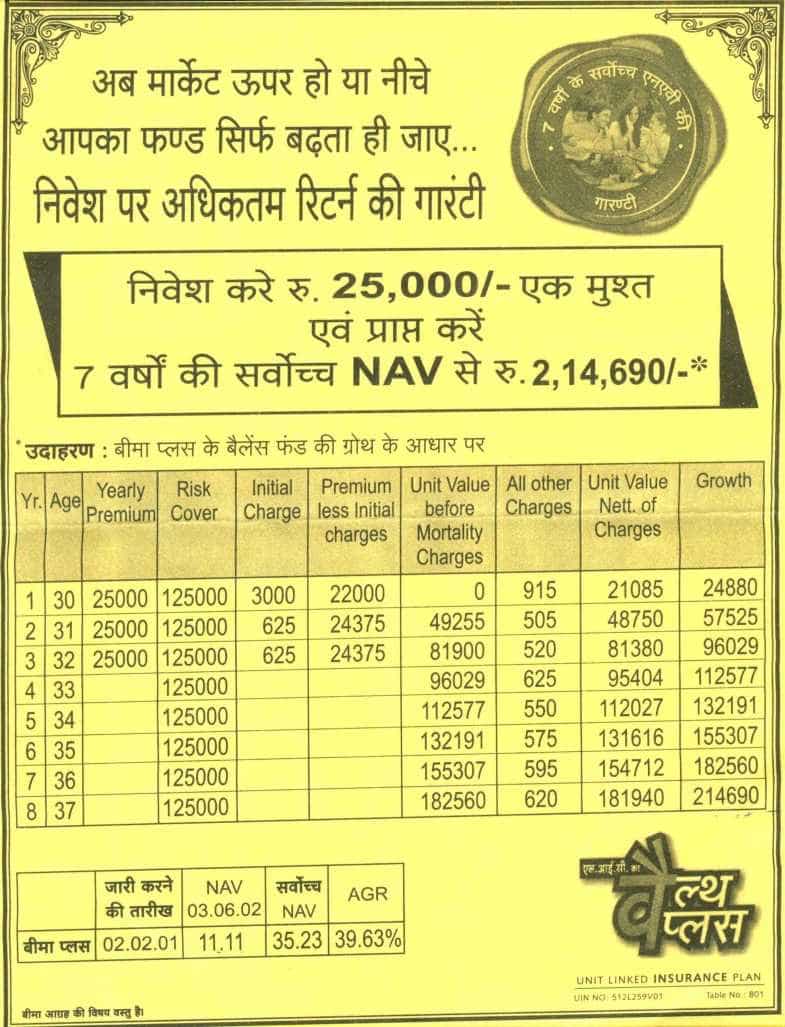
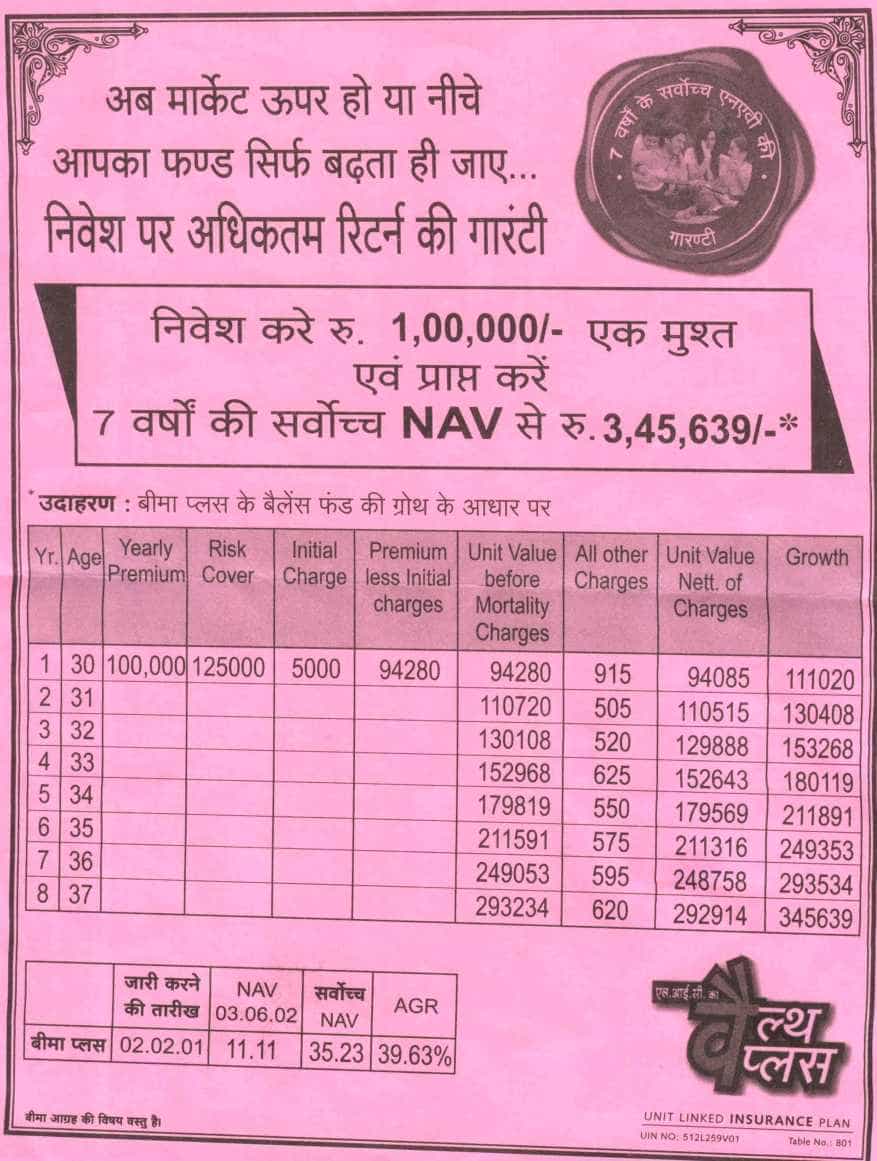
In 2010, a client came to our office with a pamphlet. It said his Rs. 1 lakh would become Rs. 3.45 lakh in 8 years. LIC had guaranteed it, the agent told him. We told him not to invest. He did anyway — because his brother-in-law was the agent.

Eight years later, his Rs. 1 lakh had become Rs. 1.44 lakh. A return of 6.27% compounded annually. The Sensex in those same 8 years had gone from 16,000 to 38,000 — a return of 137%.

He was not foolish. He was trusting. And a system designed to extract commissions used that trust against him.

This is the complete story of LIC Wealth Plus — why it was sold, what it actually was, and what it teaches about insurance mis-selling that is still happening in India today.

⚡ The Verdict — What LIC Wealth Plus Actually Delivered

LIC Wealth Plus (Table 801) was launched February 9, 2010 and matured in 2018 after its 8-year term. Final NAV: approximately Rs. 14.44 — a return of 6.27% per annum since launch. Agents had promised 17–18% returns. The Sensex delivered 137% absolute returns in the same period (16,000 to 38,000). By 2024, the Sensex had crossed 85,000 — over 400% from the launch date. This product is now matured and closed. The lesson it leaves is permanent.

LIC Wealth Plus — aapki ya aapke agent ki

The Setup: How the Mis-Selling Began

Every year in the last quarter of the financial year, insurance agents across India face targets. In 2007, LIC launched a policy called “Money Plus.” Agents distributed pamphlets claiming Rs. 1 lakh invested for 3 years would become Rs. 3.38 crore after 20 years — at an implied return of 25% per annum.

People did not just invest their savings. Smaller households sold jewellery. Others borrowed money. The pamphlets spread across India — from villages in Bihar to offices in Mumbai. All promising returns “guaranteed by LIC.”

LIC’s own Managing Director, Mr. Mathur, saw what was happening. On February 12, 2007, he wrote to all Zonal Managers:

LIC Zonal officer letter on mis-selling in LIC Wealth Plus ULIP policy

The letter called out “unethical practice of circulating such pamphlets to misguide the public.” The MD of LIC himself acknowledged the betrayal. And yet, three years later, LIC launched Wealth Plus — and the same cycle began again.

What LIC Wealth Plus Actually Was

LIC Wealth Plus (Table 801) was a ULIP — a Unit Linked Insurance Plan — launched February 9, 2010. Here is what the product actually said in its official documentation:

LIC would guarantee the highest NAV recorded in the first 7 years, with the product maturing after 8 years. There was a minimum NAV guarantee of Rs. 10 (the starting NAV). That is all. No return guarantee. No equity allocation guarantee. No promise of 17% returns.

In almost all ULIPs, the allocation to equity vs debt is clearly stated. Wealth Plus was deliberately silent on this. The fund manager had full discretion — which meant the money could stay largely in debt instruments, generating endowment-like returns of 6–7%, while agents told investors they would get equity-like returns of 17–18%.

What Agents Were Actually Telling Investors

The gap between what the product said and what agents told investors was extraordinary. Here is what agents were claiming:

That LIC was guaranteeing the highest return (LIC said highest NAV — a critical difference). That based on the performance of LIC’s earlier ULIP Bima Gold, investors would get 17–18% per annum. That Rs. 1 lakh invested would become Rs. 3.45 lakh in 8 years. That they should switch existing policies into Wealth Plus immediately.

The Bima Gold comparison was particularly cynical. That ULIP was launched in 2001 when the Sensex was at 3,000 — and ran through one of the greatest bull markets India had seen, with the Sensex reaching 21,000. Using that bull-market return to promise future performance was not just misleading — it was a manipulation of trust.

Below are the actual pamphlets distributed across India:

Pamphlet: Regular Premium — Rs. 25,000 for 3 years

LIC Wealth Plus mis-selling pamphlet in Hindi

Pamphlet: Single Premium — Rs. 1,00,000

LIC Wealth Plus mis-selling pamphlet returns

What the Regulator Said — and What Actually Happened

IRDAI (then called IRDA) mandated that agents show returns at only 6% or 10% in official illustrations. No pamphlet had any regard for this. The gap between what agents promised and what the regulation required tells you everything:

Regular Premium (Rs. 25,000 × 3 yrs) Single Premium (Rs. 1,00,000)
Pamphlet promise Rs. 2,14,690 Rs. 3,45,639
IRDA projection at 6% Rs. 87,549 Rs. 1,18,442
IRDA projection at 10% Rs. 1,14,306 Rs. 1,61,697
Actual NAV at maturity (2018) ~Rs. 14.44 (6.27% CAGR) ~Rs. 1,44,000 (6.27% CAGR)

The product landed almost exactly at the IRDA’s 6% illustration — the lowest scenario regulators mandate. The agents had promised 17–18%. The reality: 6.27%. Not a slight underperformance. A systematic betrayal of trust.

💡 As D. Swaroop (PFRDA Chairman at the time) stated on record: the chief cause of mis-selling is the incentive structure that induces agents to look after their own interests rather than those of the customer. The average sum assured of the insured Indian was less than Rs. 90,000 — because agents sold investment products, not insurance. That problem has not disappeared.

Holding insurance products you don’t fully understand?

At RetireWise, we conduct annual portfolio audits to identify underperforming products — ULIPs, endowment plans, and money-back policies that are quietly dragging your retirement corpus down.

Explore RetireWise

Why This Keeps Happening — The Incentive Problem

The agent who sold LIC Wealth Plus was not necessarily evil. He was responding rationally to a commission structure that rewarded selling over advising.

High-commission products — ULIPs, endowment plans, money-back policies — pay agents 25–40% of the first year’s premium. A term plan, which gives the customer far more insurance cover for far less money, pays almost nothing. So agents sell what pays them, not what protects the customer.

Insurance agents in India have sold to Indians everything other than insurance.

The solution is structural: work with an advisor who earns a fee from you, not a commission from the product. A SEBI-registered RIA has no incentive to sell you any product — their only income is your advisory fee. That changes everything. For a full guide on what to look for in insurance and what to avoid, read our post on 9 insurance questions every Indian gets wrong.

The Lesson That Does Not Go Stale

LIC Wealth Plus has matured. The product is gone. But the lesson is permanent.

Every quarter-end in India, agents still face targets. Endowment plans are still sold as “safe investments.” Guaranteed return products still promise returns that are not guaranteed. The pitch has evolved — it is digital now, it comes on WhatsApp — but the structure is identical.

Before accepting any financial product: ask the agent to show you the IRDAI-mandated illustration at 6% and at 10%. That is the worst and moderate scenario. Make your decision based on those numbers, not the pamphlet. If the product does not make sense at 6%, it does not make sense.

And if you are currently holding a ULIP, endowment plan, or money-back policy that has been running for more than 5 years — get the IRR calculated. The true internal rate of return on most such policies is between 4% and 7%. Your EPF earns 8.15%. A simple index fund earns 12–15% over the long term. This is the comparison that matters. For how to audit your portfolio and exit products that are working against you, read our post on 9 smart ways to save money in India — specifically the annual portfolio audit section.

The man who came to our office in 2010 with that pamphlet was not foolish. He was human. He trusted a relationship. He trusted an institution. Both let him down.

The best way to honour that trust now is to never let it happen again — to you or anyone you care about.

💬 Your Turn

Did you or someone you know invest in LIC Wealth Plus in 2010? How did the final returns compare to what was promised? Share below — your experience helps others recognise the same pattern today.

Exit Strategies for Mis-Sold Insurance Policies (2026 Decision Guide)

You were sold a policy you did not need. Maybe it was a ULIP your banker pushed while opening an FD. Maybe it was an endowment plan your uncle’s friend — “who is in LIC” — sold at your wedding. Maybe it was a money back plan you bought for tax saving without understanding what you were signing.

Whatever it was, every year that premium reminder lands in your inbox — and every year, you feel the same mix of regret, frustration, and paralysis.

I have helped hundreds of clients exit mis-sold insurance policies over 25 years. The decision is never easy. But it is almost always the right one.

⚡ Quick Answer

If you hold a mis-sold insurance policy (endowment, money back, ULIP, or pension plan), you have three options: surrender it, make it paid-up, or let it lapse. The right choice depends on how many years of premium you have paid and the type of policy. Use the decision table below to find your best exit. In most cases, stopping premium payments and redeploying into term insurance + mutual funds is the better path.

Two Terms You Must Understand First

Paid-Up: You stop paying the premium but keep the policy alive. The insurance company reduces your benefits proportionally. If your policy was for Rs 10 lakh sum assured over 20 years and you paid premiums for 10 years, your paid-up sum assured becomes approximately Rs 5 lakh. You do not withdraw anything — the policy continues at reduced benefits until maturity.

Surrender Value: You terminate the policy and take whatever the insurance company gives you based on their pre-set calculation. For the first 3 years, this is usually zero or very low. After 3 years, the surrender value gradually increases. It is almost always lower than the total premiums you paid — that is the cost of exit.

The Exit Decision Matrix

Endowment and Money Back Policies (Traditional Plans)

Years of Premium Paid Recommended Action Why
1 year Stop immediately. Accept the loss. You lose year 1 premium, but stop the bleeding. Better to lose Rs 30K than Rs 6 lakh over 20 years.
2 years Pay one more year to reach 3 years, then make it paid-up. At 3 years, you get a surrender value. Without it, you get nothing.
3+ years Stop premium. Make it paid-up. Wait for a reasonable surrender value before redeeming. You now have a surrender value. Hold until it grows to a reasonable level, then surrender and redeploy.
Near maturity (1-2 years left) Hold to maturity. Surrendering now loses the bonus accumulated over years. Complete the term.

Tax: Surrender value of traditional plans is added to your income in the year of receipt and taxed at your slab rate. Exception: if the annual premium is less than 10% of the sum assured and the policy runs for 5+ years, maturity is tax-free under Section 10(10D). Note: Budget 2023 made maturity proceeds taxable for policies with total annual premium exceeding Rs 5 lakh (excluding term plans).

ULIPs (Unit Linked Insurance Plans)

Years of Premium Paid Recommended Action Why
1 year Stop premium. Funds move to Discontinuance Fund for 5 years. IRDAI mandates a 5-year lock-in. You cannot withdraw before that. But you CAN stop paying.
2-4 years Pay until 5 years to complete lock-in, then withdraw. Completing the lock-in gives you the full fund value. Stopping earlier means discontinuance charges + Discontinuance Fund returns (4% only).
5+ years (lock-in over) Withdraw and redeploy into direct mutual funds + term plan. Post lock-in, you get full fund value. Compare: would this money grow faster in a 0.5% expense mutual fund or a 2-3% expense ULIP? The answer is obvious.

Tax: ULIPs withdrawn after 5 years are tax-free under Section 10(10D) — BUT only if annual premium is Rs 2.5 lakh or less (Budget 2021 amendment). If your annual ULIP premium exceeds Rs 2.5 lakh, maturity proceeds are taxable as capital gains.

Pension Plans

These are the trickiest to exit. Surrender proceeds from pension plans are ALWAYS added to your income and taxed at your slab rate — whether you exit before maturity or at maturity. There is no tax-free exit from a pension plan.

If the charges are high and you are stuck, make it paid-up and let it sit until maturity. At maturity, you can use up to one-third of the corpus tax-free (commutation). The remaining two-thirds must be used to buy an annuity — and that annuity income is taxable.

The “tension policy” — as I still call it — earns its name every year.

After You Exit — What to Do With the Money

Step 1: Buy a term insurance plan — pure life cover at a fraction of the cost. This replaces the insurance component of your old policy.

Step 2: Invest the freed-up premium into direct mutual funds — equity for long-term goals, debt for short-term. This replaces the investment component. Read: ULIP vs Mutual Fund — Which is Better?

Step 3: Do not fall for the sunk cost fallacy. “I have already paid so much” is not a reason to keep paying into a bad product. The money already paid is gone. The money you can save from here is real.

Step 4: Consider a fee-only financial advisor to evaluate your entire insurance portfolio. Often, clients come with 5-7 bad policies. A comprehensive cleanup can free up Rs 1-3 lakh per year in wasted premiums.

Stuck with multiple mis-sold policies?

An insurance portfolio cleanup can save Rs 1-3 lakh per year. A fee-only advisor evaluates every policy — hold, paid-up, or surrender — based on math, not emotion.

Get an Insurance Portfolio Review

The illiterates of the 21st century will not be those who cannot read and write, but those who cannot learn, unlearn, and relearn. — Alvin Toffler

Insurance and investment are best when they are not served as a cocktail. Separate them — and your financial life gets simpler, cheaper, and better.

💬 Your Turn

How many insurance policies do you hold right now? How many of them were mis-sold? And have you exited any — what was the experience like? Share your story below.