Home Blog Page 49

Mis-Selling in Mutual Funds and Insurance: How to Spot It Before It Costs You

A client came to me after losing nearly Rs. 8 lakh. He had not lost it in a market crash. He had lost it across a ULIP he did not need, three NFOs his banker had recommended in a single year, and an endowment plan sold to him as a “retirement product.” Each sale had been perfectly legal. None of it had been in his interest.

This is mis-selling. Not fraud. Not illegal. Just the systematic practice of recommending products that serve the seller’s interest over the buyer’s. It is the most common and most expensive financial mistake Indian investors make.

After 25 years of reviewing client portfolios, I have seen the same tricks used repeatedly. They look different on the surface each time. The underlying motive is always the same.

Quick Answer

Mis-selling is when a financial product is sold using misleading claims, selective information, or emotional pressure in a way that serves the seller’s commission more than your financial goals. Common in mutual funds: NFO pushing, dividend traps, churning, low NAV myths. Common in insurance: ULIPs sold as investments, guaranteed return claims, “pay for 3 years” tricks. Knowing the specific patterns is your best protection.

Mis-Selling in Mutual Funds and Insurance India

Table of Contents

Mutual Fund Mis-Selling: 8 Tricks to Know

1. The NFO Push. A New Fund Offer is almost never a reason to invest. A new fund has no track record. The only thing new about it is the opportunity for the distributor to earn a higher upfront commission. If an advisor is excited about an NFO, ask why they are not equally excited about an established fund with a 10-year track record holding similar securities. The answer reveals the motive.

2. Buying After Dividend Announcement. “The fund just declared a dividend, now is a great time to invest.” This is backwards. When a mutual fund declares a dividend under its IDCW option, the NAV falls by exactly the dividend amount on the ex-dividend date. You are not receiving extra money. You are receiving your own money back, and then paying tax on it at your slab rate.

3. Churning. Moving your money from one fund to another every 12 to 18 months generates a fresh commission for the distributor on every transaction. For you, it generates exit load charges, capital gains tax, and a portfolio that never gets the benefit of long-term compounding. If your advisor recommends switching funds frequently, ask for a written rationale tied specifically to your goals.

4. Market Timing Claims. “Markets are about to correct, you should wait.” If a distributor could reliably time markets, they would not need to sell mutual funds for commissions. Any advisor claiming market timing ability is either deluded or manipulating you into a transaction that suits them.

5. STP Through a Monthly Income Plan. Setting up a Systematic Transfer Plan from an MIP to an equity fund creates two transactions where one would do and generates two rounds of commissions. There is rarely a genuine financial reason to do this when a direct SIP into the equity fund achieves the same result more simply.

6. ELSS When No Tax Saving Is Needed. Pushing ELSS to someone already in the new tax regime (where 80C deductions are unavailable), or to someone who has exhausted their 80C limit through EPF and home loan principal, is pointless for the investor and profitable for the distributor. ELSS is a good product in the right context. In the wrong context it just creates a 3-year lock-in you did not need.

7. Low NAV as a Buying Signal. “This fund has a NAV of Rs. 12, that is much cheaper than the Rs. 180 NAV fund.” NAV has no bearing on future returns. A Rs. 12 NAV fund and a Rs. 180 NAV fund with identical portfolios deliver identical returns. The number of units is irrelevant. Total value and return percentage are what matter.

8. Multiple Applications in the Same Fund. Some distributors split a single investment into multiple applications to earn per-application incentives. You end up with several folios in the same fund with no diversification benefit, just extra confusion managing multiple statements.

“If you do not understand why you are being asked to do something with your money, that is a signal to stop. Not to trust the advisor more. To understand more. Complexity in financial advice is almost always the product of someone’s commission structure, not your financial needs.”

Insurance Mis-Selling: 9 Claims and the Truth

Claim: “Pay for just 3 years and you are covered for life.”
Truth: This applies to ULIPs. After the 3-year mandatory premium period, the policy continues only as long as units remain to pay monthly mortality charges. As you age, those charges increase. If your fund underperforms, units get exhausted and the policy lapses. You are not covered for life. You are covered until the fund runs out.

Claim: “Pay for 3 years and the product will double your money.”
Truth: After agent commissions of 15 to 40% in early years, annual fund management charges, policy administration charges, and mortality charges, achieving double-digit returns in a ULIP is extremely difficult. The illustrated returns are almost always calculated at a pre-charge level that does not represent what reaches your account.

Claim: “Last date is tomorrow, this offer closes forever.”
Truth: Artificial urgency is a manipulation technique. Insurance products do not disappear. The only thing that expires with the deadline is the agent’s sales target. Never make a financial decision under manufactured time pressure.

Claim: “There are no allocation charges in this policy.”
Truth: There is no free lunch in financial products. If it does not charge an “allocation charge,” look for Policy Administration Charges, Premium Allocation Charges, Fund Management Charges, Mortality Charges, and Surrender Charges. The names change. The extraction of your money does not stop.

Claim: “Past performance of this policy has been excellent.”
Truth: There is a critical difference between the fund’s investment performance and what the policyholder actually received. After all charges are applied, policyholder IRR on traditional and ULIP policies has historically been far lower than the headline fund return shown in illustrations.

Claim: “This is a child education plan / retirement plan.”
Truth: Naming a product after an emotion is a sales technique, not a product differentiator. A diversified equity mutual fund SIP with a matching timeline almost always outperforms a “child education plan” on actual corpus delivered, at lower cost and with more flexibility.

Claim: “Guaranteed minimum return of X%.”
Truth: If it is not written in the policy document, it does not exist. Verbal assurances of returns are not legally binding. The “guaranteed” portion in most traditional policies is a modest sum assured that grows at a rate lower than inflation. Read the benefit illustration, not the sales pitch.

Claim: “Insurance is free in this plan.”
Truth: Mortality charges are embedded in every insurance policy. In a ULIP, they are deducted monthly by cancelling units from your fund. In a traditional plan, they are priced into the premium structure. Insurance is never free.

Claim: “The guaranteed returns are very good.”
Truth: Ask what the guaranteed return is in rupee terms at maturity, then calculate the IRR on your actual premiums paid. For most traditional endowment and money-back policies sold in India, the IRR works out to between 4% and 6%. A savings bank account offers better liquidity on similar capital. Guaranteed does not mean good.

The One Rule That Stops Almost All Mis-Selling

Never mix insurance and investment in a single product. Buy term insurance for pure life cover. Buy mutual funds for investment growth. Keep them completely separate. Every product that combines the two is optimized for the seller’s commission, not your financial outcome. This single principle, followed consistently, eliminates 80% of the mis-selling that happens in India.

New-Era Mis-Selling: What Has Changed Since 2020

The classic tricks above have been around for decades. Three newer patterns worth knowing in 2026:

Guaranteed income plans sold as retirement solutions. These products promise a fixed annual income from a future date. The illustration looks attractive. The IRR, when calculated correctly including the opportunity cost of locking premiums for 10 to 20 years, typically underperforms an equivalent SIP by 3 to 5 percentage points annually. For a retirement-focused investor in their 40s, that compounding gap is devastating.

Index funds with high expense ratios. The genuine passive investing revolution has been accompanied by products labeled “index” or “passive” that charge 0.5 to 1% expense ratios when true index funds charge 0.1 to 0.2%. Always verify the Total Expense Ratio before investing in any fund marketed as passive.

PMS with undisclosed fee structures. Portfolio Management Services marketed to HNI investors sometimes present performance figures gross of fees while downplaying annual management fees, performance fees, and exit loads. Always ask for net-of-fees performance across multiple market cycles before committing.

Why Smart People Fall for Mis-Selling

The investors I have seen most damaged by mis-selling are often the most educated and financially successful. They fell for it because of specific behavioral vulnerabilities, not ignorance.

Trust in authority is one. A large bank’s relationship manager carries institutional credibility. The assumption is that a large bank would not recommend something harmful. This assumption is wrong. Relationship managers have sales targets and earn incentives on products sold, just like independent agents.

Social proof is another. When a colleague says “my banker got me into this scheme and the returns are great,” the investment feels validated. What they rarely share is the full IRR over 7 years after all charges.

And complexity intimidation. When a product is explained with enough jargon and charts, many intelligent people assume their confusion is their own limitation rather than a feature of the product design. In financial products, unnecessary complexity almost always hides cost. If you cannot explain the product in two sentences, do not buy it.

Something Worth Noticing

Mis-selling does not require a dishonest advisor. Many agents genuinely believe in the products they sell. They have been trained on those products, they earn their livelihood from those commissions, and their incentive structure naturally produces recommendations that favor high-commission products. The solution is not to find an “honest” advisor. It is to understand the incentive structure of the people advising you, and to get independent advice where the incentives are aligned with yours.

How to Protect Yourself

Ask one question before every financial product purchase: “How does the person recommending this get paid, and how does that affect what they recommend?” A commission-based advisor recommending a regular mutual fund plan earns trail commission on your AUM. That is a legitimate disclosed model. A banker recommending a ULIP earns significantly higher upfront commission than they would on a term plan plus mutual fund SIP. That is a conflict of interest worth understanding.

Calculate the IRR before buying any insurance product that doubles as an investment. Take the premiums, the maturity value, and the timeline. Use any online IRR calculator. If the result is below 8% over 15 or more years, the product is almost certainly not competitive with alternative uses of the same capital.

Read the benefit illustration for insurance products. These are regulated documents. The illustration must show returns at 4% and 8% assumed fund growth. The 4% scenario often tells you everything you need to know about downside risk.

For any product you are unsure about, get a second opinion from an advisor who does not earn a commission on the recommendation. The right financial advisor makes all the difference between a portfolio built for your goals and one built for someone else’s incentives.

Think You May Have Been Mis-Sold?

If you have insurance policies, ULIPs, or mutual fund investments you do not fully understand, a portfolio review can reveal exactly what you own, what it is costing you, and what it would realistically deliver. If you are 45 to 60 and preparing for retirement, this review could be the most valuable thing you do this year.

Book a Free 30-Min Call

Frequently Asked Questions

What is the difference between mis-selling and fraud?
Fraud involves deliberate deception or falsification. Mis-selling is typically legal but unethical, involving selective disclosure, misleading emphasis, or recommendations driven by commission rather than client interest. You can approach SEBI, IRDAI, or AMFI’s grievance channels if you believe you were misled.

Can I get my money back if I was mis-sold an insurance policy?
IRDAI mandates a 15-day free-look period for all life insurance policies. If you cancel within 15 days of receiving the policy document, you get a refund of premium paid minus proportionate risk charges. Beyond the free-look period, surrendering a ULIP or endowment plan typically involves significant surrender charges in the first 5 years.

How do I calculate if an insurance product’s returns are fair?
Ask for the benefit illustration document. Take the total premiums you would pay, the maturity value at 8% projected fund growth, and calculate the IRR using an online calculator. If the IRR is below 8% over 10 or more years, the product is unlikely to be competitive with a pure term plan plus equity mutual fund combination.

Is it safe to invest through a bank’s relationship manager?
Banks are regulated distributors and must follow SEBI and IRDAI guidelines. However, relationship managers have sales targets and earn product-specific incentives. Their recommendations are not independent advice. Always ask to see the commission disclosure before investing.

What should I do if I suspect mis-selling?
Document everything: original policy documents, written communication, notes of verbal claims. Approach the insurance company’s grievance cell first. If unresolved within 30 days, escalate to IRDAI’s Bima Bharosa portal (for insurance) or SEBI SCORES (for mutual funds). The Insurance Ombudsman handles disputes up to Rs. 30 lakh.

Before You Go

Related reading: How to Choose a Financial Advisor in India and What Is Insurance: Investment or Expense?

Have you experienced mis-selling personally? Which product or tactic was used? Share in the comments – your experience could protect someone else.

One question for you: If you reviewed every financial product you currently hold and asked “who benefited most when this was sold to me?”, what would you find?


Infrastructure Bonds for Tax Saving: What Happened, What Still Works in 2026

“The tax tail should not wag the investment dog.” – Nick Murray

In 2010-11, infrastructure bonds under Section 80CCF were the hottest topic in personal finance. Every advisor, every blog, every newspaper was writing about them. IFCI, IDBI, IDFC were issuing bonds. The additional Rs 20,000 deduction beyond the Rs 1 lakh 80C limit felt like a windfall.

And then, quietly, in the Finance Act 2012-13, Section 80CCF was discontinued. No fanfare. No announcement on the front page. The deduction just stopped.

Those who had bought 10-year lock-in bonds – the longer tenure option – found themselves holding an instrument that no longer gave a tax benefit and yielded 7.95% in a market where FDs were paying more. Thousands of investors had made a permanent financial decision based on a government policy that lasted exactly two years.

This is the story of tax-saving bonds in India. And the lesson is more relevant in 2026 than it was in 2010.

⚡ Quick Answer

Section 80CCF infrastructure bonds were discontinued after FY 2011-12. They no longer exist as a tax-saving option. The only bonds with current tax relevance in India are Section 54EC bonds (NHAI, REC, PFC, IRFC) which exempt long-term capital gains on property sales – but only for that specific purpose. For general tax saving, better alternatives exist. This post explains what happened, what replaced it, and what bonds make sense for retirement planning in 2026.

Infrastructure bonds tax saving India 2026

📋 Important Update – April 2026

Section 80CCF infrastructure bonds were discontinued from FY 2012-13. All original product details, bond rates, and calculations in the original 2010 version of this post are obsolete. This updated post covers the current bond landscape for Indian investors in 2026.

What Happened to Section 80CCF Bonds

The Section 80CCF deduction allowed an additional Rs 20,000 tax deduction for investments in “Long Term Infrastructure Bonds” notified by the government. Issuers included IFCI, IDBI, IDFC, and LIC. The bonds had a 5-10 year tenure with 7.85-8% returns.

The government introduced this benefit in the Union Budget 2010-11 to channel household savings into infrastructure funding. It was always explicitly a policy tool, not a permanent tax benefit.

By FY 2012-13, the government decided the policy goal was not being met effectively and discontinued Section 80CCF. Investors who had bought 10-year bonds were stuck with them at below-market rates. No secondary market existed for these bonds at a fair price. The lesson: never make a 10-year financial commitment based on a government policy that could change in two years.

The Bond Landscape in 2026: What Still Works

Bonds have not disappeared from the Indian tax landscape. But their role has narrowed significantly. Here is what actually exists and matters for a senior executive doing retirement planning:

1. Section 54EC Bonds – Capital Gains Exemption

These are the most relevant bonds for HNI investors in 2026. If you sell a long-term capital asset (property, land) and make a capital gain, you can invest up to Rs 50 lakh in Section 54EC bonds within 6 months of the sale to claim full capital gains exemption.

Issuers: NHAI (National Highways Authority of India), REC (Rural Electrification Corporation), PFC (Power Finance Corporation), IRFC (Indian Railway Finance Corporation). Current yield: approximately 5.25-5.75% per year, taxable. Lock-in: 5 years.

The key question: is the 5.25% yield worth it? At the 30% tax bracket, 5.25% after tax = approximately 3.67% real return. However, the capital gains tax you avoid is 12.5% (LTCG above Rs 1.25L) on the sale amount. If you sell property worth Rs 1 crore with Rs 60L gain, you save approximately Rs 7.5L in LTCG tax by investing Rs 50L in 54EC bonds. That Rs 7.5L tax saving in Year 1 dramatically improves the effective return, even with the low coupon rate.

2. RBI Floating Rate Savings Bonds (FRSB)

Not a tax-saving instrument, but an important safe debt option. Currently yielding 8.05% (as of April 2026), taxable. 7-year lock-in. No secondary market. Suitable for the ultra-conservative portion of a retirement portfolio – but not for tax saving.

3. Sovereign Gold Bonds (SGB)

Gold investment with 2.5% annual interest (tax-free if held to 8-year maturity) plus capital gains linked to gold price (capital gains also tax-free on maturity). The best way to hold gold for a retirement portfolio – far superior to physical gold or gold ETFs for long-term holders. The government has paused new SGB issuances as of 2024 – existing SGBs can still be bought on secondary markets at NSE/BSE.

The Tax-Saving Bond Trap – What the Math Shows

Tax saving and good investing are not the same thing. Confusing them is expensive.

Take a 54EC bond at 5.5% coupon for a 30% taxpayer. After tax, the yield is 3.85%. Inflation in India runs at 5-6%. Real return: negative. The only rational reason to buy these bonds is to avoid a specific capital gains liability that is larger than the foregone return. If there is no capital gains event, these bonds serve no purpose in a retirement portfolio.

Contrast with equity LTCG: hold a diversified equity mutual fund for 1+ year, gains above Rs 1.25L taxed at 12.5%. Even after this tax, the historical 10-12% CAGR from Indian equity leaves you far ahead of bond returns. The only valid use of debt instruments in a retirement portfolio is for stability (not growth) in the 3-5 years before and after retirement, and for specific exemption purposes like 54EC.

The worst financial decisions I have seen come from people who allocate money based on tax saving first and investment merit second. Tax is a cost of making returns – not a reason to avoid making them.

Tax planning is a support activity. Not the main event.

At RetireWise, we build tax-efficient retirement portfolios – where tax saving enhances returns, not replaces them. SEBI Registered. Fee-only.

See How RetireWise Works

Why New Tax Instruments Create Investor Frenzy

When Section 80CCF bonds launched in 2010, there was a rush. Newspapers ran features. Advisors called clients. The bonds sold out quickly. And then the same thing happened with SGBs in 2015, with certain REITS in 2019, with NPS after the 80CCD(1B) benefit was announced.

Psychologists call this pattern Availability Bias combined with the Recency Effect. When something is heavily covered in news and conversation, our brain assigns it disproportionate importance – regardless of its actual merit. The news coverage makes the instrument “feel” significant. The fact that everyone around you is buying it triggers social validation. Both effects override rational analysis of the actual returns.

The investors who rushed into 80CCF bonds in 2010 were not foolish. They were human. They responded to high availability of information about the product, combined with recent government action (the budget announcement). The same cognitive shortcuts that drove that decision in 2010 drive investor behavior every time a new tax instrument launches.

The antidote is not cynicism. It is a framework. Every tax-saving instrument should answer one question before you invest: “If the tax benefit did not exist, would I still want this return at this risk for this tenure?” If yes, buy it. If no, look harder for something that passes the test on investment merit first.

“A good investment that happens to save tax is excellent. A bad investment that saves tax is still a bad investment.”

– Hemant Beniwal, CFP, CTEP | Founder, RetireWise

Read next: How to Save for Retirement in India – The Complete Guide

Planning to sell property before retirement? Section 54EC strategy could save you Rs 7-10L in one transaction.

RetireWise builds tax-efficient retirement transition plans for senior executives. SEBI Registered. Fee-only.

See the RetireWise Service

Section 80CCF lasted two years. The investors who locked in for 10 years based on that two-year policy are a cautionary tale the personal finance world has largely forgotten. As we approach India’s next Union Budget season, new tax instruments will be announced. New sections. New notified bonds. New “limited time” opportunities. Apply the same question every time: does this investment make sense on its own merits, completely separate from the tax benefit? The answer will tell you everything you need to know.

Never make a permanent financial decision based on a temporary tax policy.

💬 Your Turn

Are you planning to sell a property or land in the next few years before retirement? Have you looked at your capital gains exposure and whether 54EC bonds could reduce it? Share your situation below.

Understanding Mutual Funds: A Plain-Language Guide for Indian Investors

A friend once told me: “I keep hearing about mutual funds but I do not really understand what I am actually investing in. It feels like giving money to someone and hoping for the best.”

He is a VP at a Fortune 500 company. He manages teams of 200 people. And he did not understand mutual funds.

He is not unusual. Most Indians who invest in mutual funds do so without clearly understanding the structure. This matters — because you manage risk better when you understand what you own.

⚡ Quick Answer

A mutual fund pools money from thousands of investors and invests it in a diversified portfolio of stocks, bonds, or other securities, managed by a professional fund manager. You own units of the fund — each unit represents a proportional share of the entire portfolio. The value of your units changes daily based on the NAV (Net Asset Value). SEBI regulates all mutual funds in India. This post explains the complete structure — in plain language.

The Outsourcing Analogy

Think of a mutual fund as an outsourcing arrangement. You and thousands of other investors give your money to a professional fund management team. They pool it together and manage it as a single large portfolio.

The advantages of pooling are significant. Individually, Rs 10,000 cannot buy even one share of some quality companies. Pooled with thousands of other investors, Rs 10,000 buys proportional exposure to a portfolio of 50-100 companies. Diversification that was previously available only to wealthy investors is now accessible to anyone.

In return for this service, the fund charges an expense ratio — typically 0.5% to 2% per year depending on the fund type and whether you use a direct or regular plan.

How the Structure Works

An Asset Management Company (AMC) — like HDFC Mutual Fund, SBI Mutual Fund, or Mirae Asset — launches and manages mutual fund schemes. SEBI (Securities and Exchange Board of India) regulates all AMCs and funds.

When you invest Rs 10,000 in a mutual fund, you are allocated units at the current NAV (Net Asset Value). If the NAV is Rs 50, you receive 200 units. As the underlying portfolio grows, the NAV increases — if it reaches Rs 60, your 200 units are now worth Rs 12,000.

The fund manager invests the pooled money according to the fund’s stated mandate. An equity fund invests in stocks. A debt fund invests in bonds. A hybrid fund invests in both.

SEBI’s 36 Categories — What You Actually Need to Know

After SEBI’s 2017 categorisation circular, there are 36 defined mutual fund categories. For most investors, you only need to understand 6-8.

Large Cap Funds: Invest in the top 100 companies by market capitalisation. More stable, lower return potential than mid and small caps. Core of most portfolios.

Mid Cap Funds: Invest in companies ranked 101-250 by market cap. Higher growth potential, higher volatility.

Small Cap Funds: Companies ranked 251 and below. Highest growth potential, highest risk. Not appropriate as a core holding for most investors.

Flexi Cap / Multi Cap Funds: Can invest across large, mid, and small caps. Fund manager decides allocation. Good all-weather option.

ELSS (Equity Linked Savings Scheme): Equity fund with 3-year lock-in and Section 80C tax benefit. Best way to invest for tax saving with wealth creation potential. Learn more about ELSS funds and how they compare to other 80C options.

Debt Funds: Invest in government securities, corporate bonds, money market instruments. Lower risk, more stable returns. Suitable for short to medium-term goals.

Balanced/Hybrid Funds: Mix of equity and debt. Aggressive hybrid (65-80% equity) for long-term goals with slightly lower volatility. Conservative hybrid for capital preservation with some growth.

Not sure which mutual fund category is right for your goal?

A fee-only advisor matches your goals, risk profile, and time horizon to the right fund structure — without any conflict of interest.

Talk to a RetireWise Advisor

Direct vs Regular: The Difference Nobody Tells You About Upfront

When you invest in a mutual fund, you can choose between two plans: Direct and Regular.

Regular plan: You invest through a distributor or agent. The fund pays the distributor a commission from the fund’s assets. This commission shows up as a higher expense ratio — typically 0.5-1% more than the direct plan.

Direct plan: You invest directly with the AMC or through a SEBI-registered advisor. No distributor commission. Lower expense ratio. Higher NAV over time.

The difference sounds small. Over 20 years, it compounds dramatically. On a Rs 1 crore corpus, 0.75% more in annual charges means approximately Rs 35-40 lakh less at maturity. That is real money.

If you have investments in regular plans with no ongoing advice, consider switching to direct plans. The process is simple and the long-term benefit is significant. A complete guide to types of mutual funds in India can help you understand which categories suit different goals.

SIP: The Simplest Way to Invest Regularly

A SIP (Systematic Investment Plan) is simply an automated instruction to invest a fixed amount in a mutual fund on a specific date every month. It is not a separate product — it is an investment mode.

SIPs work because they enforce the habit of investing regularly, they average out your purchase cost over market cycles (rupee cost averaging), and they remove the need to time the market. A Rs 10,000 SIP in a diversified equity fund started at age 30 and maintained until 60 — at 12% CAGR — builds approximately Rs 3.5 crore.

The magic is not the SIP. It is the discipline of not stopping the SIP when markets fall.

What Mutual Funds Are Not

They are not guaranteed. Every mutual fund carries market risk. Your investment can fall in value — sometimes significantly, over extended periods.

They are not the same as fixed deposits. They do not offer guaranteed returns. The NAV on the day you redeem is what you get — not a promised maturity value.

They are not get-rich-quick instruments. The wealth creation potential is real — but it requires time, discipline, and the willingness to stay invested through market volatility.

Frequently Asked Questions on Mutual Funds

Is it safe to invest in mutual funds in India?

Mutual funds are regulated by SEBI and the underlying assets are held in a separate trust — the AMC cannot use investor money for its own purposes. This structural protection means mutual fund investors are protected from AMC insolvency. However, the investments themselves carry market risk — equity funds can lose value in market downturns. “Safe” in mutual funds means structurally protected, not return-guaranteed. Debt funds carry credit risk and interest rate risk. Equity funds carry market risk. Understanding which type you own is the first step to managing it.

What is the minimum amount to start investing in mutual funds?

Most equity mutual funds allow SIPs starting at Rs 100-500 per month and lump sum investments from Rs 500-1,000. ELSS funds typically start at Rs 500. There is no upper limit. The low minimum makes mutual funds genuinely accessible — a 22-year-old starting work can begin with Rs 500 per month and build the discipline that matters far more than the amount.

What is the difference between NAV and market price for mutual funds?

NAV (Net Asset Value) is the per-unit value of the mutual fund — calculated daily by dividing the total value of all assets in the fund by the number of units outstanding. Unlike stocks, mutual fund units are not traded on an exchange — you buy and sell directly from the AMC at the day’s NAV. A higher NAV does not mean a fund is expensive; it simply means the fund has been running longer or has performed better. A fund with NAV Rs 500 is not more expensive than one with NAV Rs 10.

How are mutual fund returns taxed in India?

For equity mutual funds: gains on units held less than 12 months are taxed as Short Term Capital Gains (STCG) at 20%. Gains on units held more than 12 months are Long Term Capital Gains (LTCG) — gains up to Rs 1.25 lakh per year are exempt; gains above this are taxed at 12.5%. For debt funds: all gains (regardless of holding period) are now added to income and taxed at your slab rate. ELSS funds follow equity taxation with the 3-year lock-in ensuring all gains qualify as LTCG.

Understanding what you own is the foundation of good investing. You do not need to know everything. You need to know enough to make good decisions and ask the right questions. Mutual funds, understood properly, are one of the most powerful wealth-building tools available to Indian investors.

Simplicity is underrated in finance. A diversified equity mutual fund, held for 20 years through a SIP, is simpler than most strategies — and better than almost all of them.

💬 Your Turn

What was the one thing about mutual funds that confused you the longest? Or what is still unclear? Ask in the comments — a simple question might help dozens of other investors who have the same doubt but never asked.

Base Rate, MCLR, and Repo Rate: Which System Is Your Home Loan On?

When you take a home loan, the interest rate your bank charges is not invented out of thin air. It is built on a foundation — a benchmark rate that the bank uses as its starting point.

In India, that benchmark has changed twice in the last 15 years. Understanding how it works — and how it affects your loan — is one of the most practically useful things a borrower can know.

⚡ Quick Answer

India has moved through three benchmark rate systems for bank loans: PLR (Prime Lending Rate) until 2003, Base Rate from 2010, and MCLR (Marginal Cost of Funds based Lending Rate) from 2016. Since 2019, all new floating rate retail loans are linked to external benchmarks like the RBI Repo Rate. If you took a home loan before 2019, you may still be on MCLR. Understanding which system your loan is on — and whether to switch — can save you significant money.

Why the Base Rate System Was Introduced in 2010

Before 2010, Indian banks used the PLR — Prime Lending Rate — as their benchmark. The PLR system had a fundamental problem: banks were not required to follow any transparent methodology in setting it. Two banks could have very different PLRs even when borrowing from the same market at the same cost. Borrowers had no way to compare rates meaningfully.

In July 2010, RBI mandated the Base Rate system. The Base Rate was defined as the minimum below which banks could not lend (with limited exceptions). Crucially, banks had to disclose the methodology for calculating their Base Rate — making the system more transparent than PLR.

The Base Rate was supposed to ensure that when RBI cut rates, borrowers actually benefited. In practice, banks were slow to pass on cuts. A repo rate cut of 25 basis points might result in a Base Rate cut of 10 basis points — or nothing at all.

MCLR: The 2016 Upgrade

In 2016, RBI replaced the Base Rate with MCLR — Marginal Cost of Funds based Lending Rate. The key difference: MCLR is calculated based on the bank’s marginal (most recent) cost of funds, not the average cost. This was designed to make rate transmission faster.

MCLR is reset at defined intervals — monthly, quarterly, six-monthly, or annually depending on the loan. Your loan’s effective rate changes only on the next reset date after a benchmark change.

If you took a home loan between 2016 and 2019, it is likely on MCLR. Your reset date matters — if RBI cuts rates in January but your loan resets in July, you will not see the benefit until July.

Is your home loan on the best available rate?

A financial review can check if you should switch benchmarks or refinance — potentially saving lakhs over your loan tenure.

Talk to a RetireWise Advisor

The Current System: External Benchmark Linked Rates (EBLR)

Since October 2019, RBI mandated that all new floating rate retail loans — home loans, personal loans, auto loans — must be linked to an external benchmark. Banks can choose from: RBI Repo Rate, Government of India 91-day Treasury Bill yield, Government of India 182-day Treasury Bill yield, or any other benchmark published by FBIL.

Most banks chose the RBI Repo Rate. This means your home loan rate is now: Repo Rate + Spread. The spread is fixed for the life of the loan (unless you renegotiate).

The advantage of EBLR over MCLR: rate changes happen faster. When RBI cuts the Repo Rate, your loan rate typically adjusts within the same quarter.

In 2022-23, when RBI raised the Repo Rate by 250 basis points to fight inflation, home loan rates across India rose sharply and quickly — demonstrating exactly how fast this system transmits changes.

What This Means for Your Home Loan

If your loan was taken before October 2019, it may still be on Base Rate or MCLR. You have the option to switch to EBLR — most banks allow this for a small administrative fee (typically Rs 5,000-10,000).

Whether you should switch depends on the current rate differential. If your MCLR-linked rate is 9.2% and the equivalent EBLR-linked rate would be 8.75%, the switch saves you 0.45% per year — which on a Rs 50 lakh loan over 15 years is a meaningful amount.

The calculation is simple: get your current effective rate from your bank. Ask what EBLR-linked rate they would offer. Calculate the interest saving over your remaining tenure. Compare against the switching cost.

One Thing Many Borrowers Miss

Many borrowers focus only on the EMI when taking a home loan. The more important questions are: what is the benchmark? When does it reset? Can I switch benchmarks if rates fall? Can I prepay without penalty?

The answers to these questions determine your flexibility over a 20-year loan tenure — and the total interest you pay. There are several ways to reduce your total home loan interest cost that go beyond just negotiating the rate at origination.

Understanding your benchmark system is the foundation. It is not exciting. But it is the difference between automatically benefiting from every RBI rate cut — or waiting months while your bank’s cost of funds catches up.

Frequently Asked Questions on Home Loan Benchmark Rates

What is the difference between MCLR and repo rate-linked home loans?

MCLR (Marginal Cost of Funds based Lending Rate) is set internally by each bank based on its cost of deposits and borrowings, and resets at fixed intervals (typically every 6-12 months for home loans). A repo rate-linked loan (EBLR) moves directly with RBI’s benchmark repo rate, usually within the same quarter. EBLR transmits rate cuts faster to borrowers — but also transmits rate hikes faster, as borrowers discovered in 2022-23 when the Repo Rate rose 250 basis points.

Should I switch my existing home loan from MCLR to repo rate linked?

Compare your current effective rate (MCLR + spread) against what the bank would offer on an EBLR loan (Repo Rate + spread). If the EBLR rate is at least 0.25-0.3% lower and you have 10+ years of loan tenure remaining, the switch typically pays off within 12-18 months. Most banks charge Rs 5,000-10,000 for the conversion. Request a written comparison of both rates from your bank before deciding.

How often does a repo rate-linked home loan interest rate change?

Under RBI guidelines, EBLR-linked loans must be reset at least once every 3 months. In practice, most banks reset monthly or quarterly. When RBI changes the repo rate, your bank typically passes on the change within the next reset cycle. This means if RBI cuts rates in February, your loan rate may adjust by April or May depending on your bank’s reset schedule.

Can I negotiate a lower spread on my home loan?

The spread on a repo rate-linked loan is fixed at the time of origination — banks are not supposed to change it unilaterally. However, borrowers with excellent credit scores (750+), significant prepayment history, or long relationships with the bank sometimes successfully negotiate a lower spread when refinancing or switching benchmarks. Always ask — the worst answer is no. A 0.1% reduction in spread over a 20-year, Rs 50 lakh loan saves approximately Rs 1.5-2 lakh in total interest.

Your bank does not send you a reminder when it is time to review your loan structure. That responsibility is yours. And the cost of not doing it — over a 20-year loan at the wrong rate — can be lakhs.

Do the Right Thing. Then Sit Tight. But first — make sure you understand what rate your loan is actually sitting on.

💬 Your Turn

Do you know what benchmark your home loan is linked to? Have you ever switched from MCLR to EBLR, or from Base Rate to MCLR? Share what you found — and whether the switch was worth it.

Should Indians Buy Gold Now? The Honest Answer for 2026

The last time every expert told you to buy gold, it was at Rs. 18,800 per 10 grams. That was 2010.

It’s now Rs. 1.52 lakh. The same experts are saying buy again.

Before you do — understand what gold actually is. Not what your jeweller tells you. Not what the WhatsApp forward says. What it actually is, in your financial plan.

We first wrote about this in 2010 when the “should I buy gold?” question was everywhere. Fifteen years later, the question is identical. The price is eight times higher. And the core answer hasn’t changed — though it has some important new nuances.

⚡ Quick Answer

Gold at Rs. 1.52 lakh per 10g (April 2026) isn’t a reason to buy more — or to sell what you have. Gold is insurance, not an investment. Hold 5–15% of your portfolio in gold as an asset allocation anchor. If you’re below that, buy gradually. If you’re above that, stop adding. Don’t chase the rally. For new gold purchases, prefer Sovereign Gold Bonds (SGBs) or Gold ETFs over physical gold — lower cost, no purity risk, and SGBs held to maturity are tax-free.

Should Indians buy gold now 2026 — honest answer

What Gold Actually Is — and Why That Changes Everything

To understand gold, you have to understand what it’s not. It’s not a business. It doesn’t earn revenue, pay dividends, or create jobs. It doesn’t compound. It sits there, holding value — and sometimes holding it spectacularly well.

Gold is a currency. The oldest one. When paper currencies lose credibility — due to inflation, war, geopolitical panic, or central bank excess — people flee to gold because it can’t be printed. No government can manufacture more of it overnight.

Think of gold the way you think of fire insurance on your house. You don’t buy fire insurance hoping your house burns down. You buy it because if it does, you’re not destroyed. Gold is the fire insurance on your financial plan. When everything else is on fire — equities crashing, currency collapsing, bonds yielding nothing — gold holds. That’s its job. That’s all its job.

The mistake most Indians make is treating gold as a wealth-creation vehicle. It’s not. Over the last 30 years, the Sensex has risen approximately 140 times. Gold has risen approximately 80 times in rupee terms over the same period — impressive, but far behind equities and much of that gain was driven by rupee depreciation against the dollar, not gold’s intrinsic wealth creation.

Why Gold Is at Rs. 1.52 Lakh — and What That Tells Us

Gold crossed Rs. 1.52 lakh per 10 grams in April 2026, an all-time high. Internationally it’s trading at approximately $4,800 per ounce. The rally has been driven by three forces running simultaneously.

First, a weakening US dollar. Gold is priced in dollars globally. When the dollar weakens, gold rises in dollar terms — and since the rupee has also weakened to approximately Rs. 84 per dollar (from Rs. 46 in 2010), the price rise in rupee terms is even more dramatic.

Second, central bank buying. Central banks globally — including India’s RBI — have been accumulating gold aggressively since 2022, reducing dependence on dollar reserves. This structural demand has put a floor under prices.

Third, geopolitical anxiety. US tariff wars, global trade uncertainty, and persistent inflation fears have pushed investors toward safe-haven assets. Gold benefits every time the world feels unstable.

💡 The rupee-dollar factor: In 1980, $1 = Rs. 8. Today, $1 ≈ Rs. 84. Gold was Rs. 1,450 in 1980. Today it’s Rs. 1,52,000. Much of that 105x rise in rupee terms is rupee depreciation, not gold appreciation. In dollar terms, gold has risen from $400/oz in 1990 to $4,800/oz today — about 12x in 35 years. The equity market has done far more over the same period. Gold’s rupee returns look impressive partly because India’s currency has weakened significantly over decades.

Gold’s Price History — What the Long View Shows

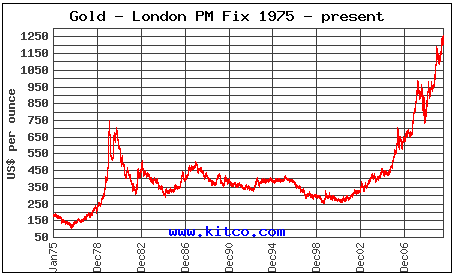
Gold price history 1975-2010

The chart above covers 1975–2010 — a period containing one of gold’s most instructive lessons. Gold ran from $100/oz in 1976 to $850/oz in 1980 on fears of US economic collapse, the Vietnam war hangover, and Iranian revolution-driven inflation. Everyone said buy gold.

Then peace came, inflation eased, and gold crashed. By 1990 it was at $400/oz. By 2000 it was at $250/oz. It took 28 years to recover its 1980 peak price. The people who bought at the top in 1980 had to wait nearly three decades to break even.

Today’s gold at $4,800/oz is driven by similar forces — dollar weakness, geopolitical anxiety, central bank buying. The rally may continue. JP Morgan projects prices could reach $5,000/oz by end of 2026. But nobody can predict when the forces reverse. And when they do, gold corrects — sometimes for decades.

🚨 The expert problem: In 2010, experts were saying buy gold when it was at Rs. 18,800. At Rs. 1.52 lakh, the same experts are saying buy gold. In 1980, experts were saying buy gold at $850/oz. By 2000 it was at $250/oz. Experts don’t know when gold peaks. Neither do we. That’s why the answer isn’t “buy now” or “sell now” — it’s “hold the right allocation and don’t chase.”

How Much Gold Should You Actually Hold?

The right gold allocation for a senior executive building a retirement plan is between 5% and 15% of total investible assets. Where you fall in that range depends on your situation:

Your Situation Suggested Gold Allocation Rationale
Predominantly equity portfolio, approaching retirement 10–15% Gold hedges equity volatility — useful as you near withdrawal phase
Already holding significant physical gold (jewellery included) 5% financial gold only Count jewellery in total allocation — most Indian families already exceed 15%
Large equity corpus, stable income, low anxiety about markets 5–10% Insurance allocation — enough to provide a floor, not enough to drag returns
Inherited gold or gold-heavy portfolio (>20%) Rebalance gradually toward 15% Too much gold drags long-term wealth. Don’t concentrate in any single asset class.

The most important number in the table above: most Indian families already hold more gold than they think when jewellery is counted. If your household has Rs. 30 lakh in jewellery and Rs. 1 crore in financial assets — you’re already at 30% gold allocation. You don’t need more.

How to Buy Gold in 2026 — Physical vs Sovereign Gold Bonds vs Gold ETFs

If you’ve decided your gold allocation is below target and you want to add, here’s the updated hierarchy of options:

Option Pros Cons Tax on Gains
Sovereign Gold Bonds (SGBs) 2.5% p.a. interest + gold price gain. Tax-free on maturity (8 years). RBI-backed. 8-year lock-in. New issuances paused — buy from secondary market on NSE/BSE. Tax-free if held to maturity
Gold ETFs Liquid, low cost, no storage risk, exact gold price tracking. No interest income. Demat account needed. 12.5% LTCG (held >24 months)
Physical gold (coins/bars) Tangible. No counterparty risk. Making charges lost. Storage risk. Purity uncertainty. 3% GST at purchase. 12.5% LTCG (held >24 months)
Physical jewellery Cultural value. Wearable. Making charges (5–35%) are sunk cost. Resale value always below purchase price. 12.5% LTCG + making charges lost

Note: Budget 2024 changed LTCG on gold to 12.5% without indexation for sales after July 23, 2024. SGBs held to maturity (8 years) remain capital gains tax-free. Interest on SGBs is taxable at slab rate.

The verdict is clear: if you’re adding gold to your portfolio for investment purposes, SGBs from the secondary market are the most tax-efficient option. Gold ETFs are the most liquid. Physical gold carries the highest cost and should be bought only for cultural or jewellery purposes — not as an investment vehicle.

Unsure how much gold fits your retirement plan?

At RetireWise, we help senior executives build balanced retirement portfolios — gold, equity, debt, and income all in the right proportions for your specific situation.

Explore RetireWise

Gold vs Equity — The 30-Year Scorecard

Indians love gold. The data suggests they should love equities more.

Gold in rupees went from Rs. 1,450 per 10 grams in 1980 to Rs. 1,52,000 today — approximately 105 times in 45 years, or around 11% per annum. Sensex went from 100 in 1979 to 73,000+ today — approximately 730 times, or around 15% per annum compounded.

The difference between 11% and 15% compounded over 40 years isn’t small. It’s the difference between Rs. 1 lakh becoming Rs. 72 lakh (gold) versus Rs. 2.6 crore (Sensex). Three and a half times more wealth — simply by being in equities instead of gold.

This isn’t an argument against gold. It’s an argument for the right allocation. Gold as 5–15% of your portfolio does its insurance job. Gold as 50% of your portfolio is a drag on your retirement corpus that compounds over decades.

As Warren Buffett said: “We live in a world where 80 years out of 100 will be good. But we don’t know which 20 will be bad.” Gold is for those 20 bad years. Equities are for the other 80.

For more on building a long-term retirement portfolio that gets the equity-gold-debt balance right, read our guide on the best investment options for senior citizens in India. And for how to use your Sensex PE reading alongside gold allocation decisions, see our post on Sensex PE ratio and market valuation.

Frequently Asked Questions

Should I buy gold now at Rs. 1.52 lakh per 10 grams?

Not necessarily. The question isn’t whether to buy — it’s whether your portfolio is at the right allocation. Hold 5 to 15% of total investible assets in gold. If you’re below that, buy gradually. If you’re already at or above that — including jewellery — stop adding. Don’t chase the rally.

How much gold should I hold in my retirement portfolio?

Between 5% and 15% of total investible assets. Most Indian families already hold more than they think when jewellery is counted. If your household has Rs. 30 lakh in jewellery and Rs. 1 crore in financial assets, you’re already at 30% gold allocation — you don’t need more financial gold.

Are Sovereign Gold Bonds (SGBs) still available in 2026?

New SGB issuances by the RBI are currently paused. However, existing SGBs trade on the secondary market (NSE and BSE) — you can buy them through your broker. SGBs held to maturity (8 years) are capital gains tax-free, making them the most tax-efficient way to hold gold.

Gold ETF vs Sovereign Gold Bond — which is better?

If you can hold for 8 years, SGBs are better — they pay 2.5% annual interest and are capital gains tax-free on maturity. If you need liquidity, Gold ETFs are better — they trade daily with low costs and no storage risk. Both are far better than physical gold for investment purposes.

Is gold a good investment for retirement in India?

Gold is insurance, not a wealth-creation vehicle. Over 45 years, gold has returned approximately 11% per annum in rupees — impressive, but well behind equities at around 15% compounded. The right role for gold in a retirement portfolio is as a hedge. Hold the right allocation and let equities do the compounding.

What is the tax on selling gold in India in 2026?

Budget 2024 changed LTCG on gold to 12.5% without indexation for assets held more than 24 months, effective July 23, 2024. SGBs held to maturity (8 years) are exempt from capital gains tax. Interest income from SGBs is taxable at your applicable slab rate.

Gold at Rs. 1.52 lakh isn’t a reason to panic or to celebrate. It’s simply doing what good insurance does — being there when the world feels unstable.

Keep the right amount. Don’t chase the rally. Let equities build your wealth.

💬 Your Turn

What percentage of your portfolio is in gold right now — including jewellery? Are you feeling the pressure to buy more at these record levels? Share below.

Long Term vs Short Term Investments: The Only Framework You Need

“The investor’s chief problem – and even his worst enemy – is likely to be himself.” – Benjamin Graham

A client came to me years ago with what he thought was a simple question. He had Rs 8 lakh saved and wanted to know where to invest it. His daughter’s engineering college fees were due in 18 months. He had also just started thinking about retirement, which was 20 years away.

When I asked him what he was currently doing with the money, he said: “Both are in a mid-cap mutual fund. I heard mid-caps give the best returns.”

The mid-cap fund was fine for his retirement money. It was completely wrong for his daughter’s fees. In 18 months, that fund could easily be down 30-40% if markets corrected. He was using a high-speed vehicle for a short journey – and risking arriving with a fraction of what he started with.

The single most important investment decision most people make is not which specific fund or stock to pick. It is matching the investment vehicle to the time horizon of the goal.

⚡ Quick Answer

Use equity for goals that are 7 or more years away. Use debt for goals within 3 years. Goals between 3-7 years warrant a mix. This is not a complicated rule – it is the foundation of all sound financial planning. Violating it – equity for short goals, debt for long goals – is the most common and most expensive investment mistake Indian investors make.

Long term and short term investments framework - equity for long term, debt for short term

The Vehicle Analogy: Why the Right Tool Matters

Imagine you need to go to a grocery shop 500 metres away. You would not take an airplane – it is too slow to warm up, too expensive to operate, and completely wrong for the distance. You walk or take a scooter.

Now imagine you need to fly to Canada. You would not walk or cycle – the journey would take years and you would never arrive.

Investment vehicles work the same way. The right vehicle depends entirely on how far you need to travel – meaning, how much time you have before the money is needed.

Short distance (under 3 years): use slow, stable vehicles – debt instruments. Fixed deposits, liquid funds, short-duration debt funds, money market funds. These do not grow spectacularly, but they also do not lose 40% of their value in a correction. For short goals, capital preservation is more important than capital growth.

Long distance (7 years or more): use high-speed vehicles – equity. Equity mutual funds, index funds, direct equity for those with knowledge. These are volatile in the short term – they go up and down every month, sometimes dramatically. But over 10-15 years, equity in India has consistently beaten inflation and created real wealth. The journey is rough but the destination is worth it.

Medium distance (3-7 years): use a hybrid approach. Balanced advantage funds, aggressive hybrid funds, or a manual combination of equity and debt. The equity component provides growth potential; the debt component provides stability if markets are weak at the time you need the money.

Ownership Assets vs Lending Assets: The Core Distinction

Behind the equity vs debt distinction is a deeper concept that every serious investor should understand.

When you invest in equity – whether directly in shares or through equity mutual funds – you become a partial owner of businesses. Ownership is inherently uncertain in the short run: businesses face competition, economic cycles, management decisions, and market sentiment. In the short term, ownership can produce losses. Over the long run, well-run businesses grow, earn more, and become more valuable. Ownership assets create wealth over time because they participate in economic growth.

When you invest in debt – FDs, bonds, debt funds – you are a lender. You give money to someone (a bank, a company, the government) and they pay you a fixed interest rate in return. Lending produces predictable, steady returns. But because the returns are pre-agreed, lending assets do not participate in upside. They preserve your capital and provide a return roughly in line with inflation plus a small premium. Lending does not create wealth; it protects it.

“In 25 years of practice, the most expensive mistake I have seen clients make consistently is using equity for short-term goals. Not bad fund selection. Not wrong timing. Wrong vehicle for the journey. When the correction comes – and it always comes – the money they needed in 18 months is worth 60% of what it was.”

– Hemant Beniwal, CFP, CTEP | Founder, RetireWise

Why Most Indian Investors Get This Backwards

The pattern I see repeatedly in client portfolios is this: short-term goals funded with equity, long-term retirement corpus sitting in fixed deposits.

The equity in short-term goals makes sense psychologically – equity seems exciting, it has recently delivered good returns, and “why keep money idle in a fixed deposit?” But the Rs 5 lakh needed for a child’s admission fee in 14 months cannot wait for equity markets to recover from a 35% drawdown. When markets fall, the timeline does not extend. The fees are due when they are due.

The FDs for retirement make sense emotionally – “safety” feels responsible. But a 30-year-old putting retirement money in FDs at 7% (pre-tax) earning 0% real return after inflation and tax will arrive at retirement with a corpus that has not grown in real terms. The journey to retirement takes 30 years. Debt cannot cover that distance.

Are your investments matched to your actual goals and timelines?

A RetireWise retirement plan maps every rupee you are investing to the goal it is meant to fund, with the right vehicle for each timeline.

Book a Free 30-Min Call

Applying the Framework to Retirement Planning Specifically

For someone at age 40 with a retirement target at 60, the retirement corpus goal is 20 years away. This is firmly long-term territory – equity should be the primary vehicle, with debt providing a stability buffer.

At age 55, with 5 years to retirement, the goal has moved to medium-term. The equity allocation should begin reducing, and the portfolio should be transitioning toward a more conservative mix. This is not about fear of markets – it is about the math of time horizons. At 55, there is not enough time to recover from a 40% drawdown before the corpus is needed.

At age 60, in retirement, the picture splits again by timeline. Monthly living expenses needed in the next 1-2 years belong in short-term debt instruments. A corpus providing income for years 5-15 can retain meaningful equity exposure. A corpus providing for years 15-30 should be predominantly equity. Retirement itself is a long journey – not all the money is short-term just because you have retired.

Read – ETF and Index Funds India: The 2026 Guide for Retirement Investors

Read – Why Fixed Deposit Returns Are Always Negative in Real Terms

Frequently Asked Questions

I am 55. Is it too late to benefit from equity?

No, but the allocation needs to reflect your proximity to retirement. At 55 with retirement at 60, you have 5 years to accumulation – the medium-term range. A 40-50% equity allocation with the rest in debt is reasonable for this stage, depending on your risk tolerance and existing corpus. What you should not do is either extreme: all equity (too much sequence-of-returns risk near retirement) or all debt (too conservative for a 25-30 year retirement horizon after you stop working). In retirement, equity remains relevant for the portion of corpus not needed for 10 or more years.

My child’s education is 8 years away. Should I use equity?

With an 8-year horizon, equity is appropriate. An 8-year period gives sufficient time for equity to recover from most market cycles. A reasonable approach: start with a higher equity allocation (70-80%) and gradually shift toward debt as the goal approaches, reaching 60-70% debt by the time you are 2 years out. This “glide path” approach reduces risk as the timeline shrinks without abandoning equity entirely during the growth phase.

What debt instruments are best for short-term goals?

For goals under 1 year: liquid funds or money market funds (better post-tax returns than savings accounts for most investors). For goals 1-3 years: short-duration debt funds, FDs (for simplicity), or arbitrage funds (taxed as equity, useful for investors in higher brackets). For goals 3-5 years: medium-duration debt funds or a mix of FDs with some equity in an aggressive hybrid fund. The right choice also depends on your tax bracket – for investors in the 30% slab, debt mutual funds (with indexation benefits where applicable) have historically been more tax-efficient than plain FDs for 3-year-plus horizons.

Every investment goal has a natural home. Short goals belong in debt. Long goals belong in equity. Mixing them up – putting short-term money in volatile assets or long-term retirement savings in zero-real-return debt – is not caution or aggression. It is just the wrong vehicle for the journey.

Match the vehicle to the distance. Everything else follows from there.

Want a retirement plan that maps your investments correctly to your goals?

RetireWise builds plans where every goal has the right vehicle and the right timeline – not just a generic allocation.

See Our Retirement Planning Service

💬 Your Turn

Look at your current portfolio. Are your short-term goals funded with debt and your long-term goals funded with equity – or is it the other way around? Share in the comments.

Term Insurance: Why It Is the Only Life Insurance You Actually Need

“The first responsibility of a leader is to define reality.” – Max DePree

A 39-year-old software architect came to me for a financial review. He had Rs 45 lakh in mutual funds, a home loan, two children aged 8 and 11, and a wife who did not work outside the home. By any measure, he was financially active and reasonably organised.

When I asked about his life insurance, he proudly produced four policies. Total cover: Rs 32 lakh.

His annual household expense was Rs 12 lakh. Outstanding home loan: Rs 38 lakh. Combined: Rs 50 lakh of financial obligations against Rs 32 lakh of cover. His family would have been financially devastated if he had died that week.

He was not negligent. He was misinformed. For years, nobody had told him the difference between insurance as protection and insurance as an investment product.

⚡ Quick Answer

Term insurance is the only life insurance product you actually need. It provides a large death benefit for a low premium – because there is no savings or investment component. Everything else (endowment, money-back, ULIP) mixes insurance with investment, delivers poor results on both counts, and earns the agent far more commission than the buyer realises. Buy term. Invest separately.

What is Life Insurance, Actually?

Life insurance exists to replace the income of a breadwinner if they die prematurely. That is its purpose. Not to create an investment corpus. Not to save tax. Not to “get something back” at maturity.

Think about how you buy your car insurance. You pay a premium every year. If nothing happens to your car, you get nothing back. You do not expect to. The insurance was protection – not investment. You bought it to cover a risk, not to create returns.

Life insurance should work exactly the same way. But for 50 years in India, agents have sold it as investment and tax saving – because those policies pay them 25-35% commission in Year 1, versus 3-5% on term plans. The incentive to mis-sell has been enormous.

Why India Is Chronically Underinsured

Less than 5% of Indians have adequate life insurance coverage. Of those who have any life insurance, the average cover is a fraction of what is actually needed. This is not because people do not care. It is because most “insurance buyers” have bought endowment and money-back policies that provide coverage of Rs 10-25 lakh while paying Rs 50,000-1,00,000 in annual premium.

For that same Rs 50,000-1,00,000 annual premium, a term plan would give Rs 1-2 crore in coverage. The family is protected ten times better, for the same cost. The agent earns far less. Guess which product gets recommended.

🚫 The “I Get Something Back” Trap

The most common objection to term insurance: “I pay premiums for 25 years and get nothing back if I survive?” Yes. That is exactly how all insurance should work. Your car insurance gave you “nothing back” every year you drove safely. Your health insurance gives you “nothing back” in years you do not fall ill. The “getting something back” in endowment plans is your own money returned with poor interest – minus decades of premium cost.

Why Term Insurance Is the Right Answer

A term plan is pure insurance. You pay a premium for a defined period (the “term”). If you die during that period, your family receives the sum assured. If you survive the term, nothing is paid – and that is by design. The premium is low precisely because it only covers mortality risk, with no savings element.

2026 PREMIUM COMPARISON – APPROXIMATE ONLINE RATES

Rs 1 crore term plan, 30-year-old male, 30-year term, non-smoker:

Annual premium: approximately Rs 9,000-14,000

Endowment for similar cover: Rs 3-5 lakh annual premium

That is a 20-30x premium difference for equivalent coverage. The “return” from an endowment plan does not come close to compensating for this gap.

Premiums rise with age. A 30-year-old gets Rs 1 crore cover for Rs 10,000-12,000 per year online. At 40, the same cover costs Rs 18,000-25,000. At 45, it approaches Rs 30,000-40,000. Buy term insurance as early as possible. Health conditions that develop in your 40s can result in loading or rejection.

Is your life insurance cover adequate for your actual liabilities?

At RetireWise, insurance review is part of every retirement blueprint. We check what you have, what you need, and what to change. SEBI Registered. Fee-only.

See How RetireWise Works

How Much Term Cover Do You Need?

The standard rule – 10-15 times annual income – is a starting point, not a formula. A more precise calculation: add your outstanding loans (home loan, car loan), add the amount your family would need to maintain their standard of living until financial independence (typically until children are self-supporting), add any large future commitments (children’s education, spouse’s retirement), and subtract your current liquid investments.

For most 35-45 year old professionals with a home loan, two school-age children, and a non-working or lower-income spouse, the number is typically Rs 1-2 crore. Most of them have Rs 25-50 lakh. The gap is the risk.

What to Do With Existing Endowment Policies

If you already have endowment or money-back plans, the question is what to do with them. Surrendering early years typically means significant losses – surrender values in the first 3-5 years are very low. For policies that are 10+ years old and approaching maturity, holding them to term may be the right call. For mid-stage policies (5-10 years in), the decision requires case-by-case analysis comparing the opportunity cost of continuing premiums against the surrender value and future maturity benefit.

The more important action is this: regardless of what you do with old policies, get adequate term cover immediately. Your family’s protection cannot wait for the old policy math to resolve itself.

“Insurance is not for you. It is for the people who depend on you. The day it gets used, you will not be there to see if it was adequate. Buy it with their needs in mind, not your own comfort.”

– Hemant Beniwal, CFP, CTEP | Founder, RetireWise

Read next: What is Insurance? Investment or Expense – The Answer That Changes Everything

The most important financial decision you make for your family is not an investment. It is a term plan.

RetireWise reviews insurance coverage as part of every engagement – making sure the foundation is right before building on top of it. SEBI Registered. Fee-only.

See the RetireWise Service

That 39-year-old bought a Rs 1.5 crore term plan the following week. Premium: Rs 18,000 per year. Less than he was paying for one of his endowment policies. His family was finally adequately protected. It took one conversation to fix a gap that had existed for a decade.

Buy term. Invest separately. Never mix the two. It has never worked – and it never will.

💬 Your Turn

What is your current life insurance structure? Do you have adequate term cover – or mostly endowment and money-back policies? Be honest in the comments. You might help someone else take the right action.

All you want to know about Mediclaim Policy

A client of mine went through a medical emergency last year. His father, 68 years old, needed bypass surgery. The total cost came to Rs. 9.5 lakh. He had a family floater policy for Rs. 5 lakh, which he had not upgraded in eight years despite his father crossing 60.

The remaining Rs. 4.5 lakh came from his retirement savings. Eight years of SIP contributions, wiped out in one hospitalization.

This is the story of health insurance in India. Most people have it. Very few have enough of it.

Quick Answer

A mediclaim or health insurance policy covers hospitalization costs including room rent, surgery, medicines, and pre and post hospitalization expenses. Medical inflation in India runs at roughly 14% per year. The right policy, the right sum assured, and understanding what is and is not covered can be the difference between a medical emergency and a financial catastrophe.

Why Health Insurance Has Become Non-Negotiable

Medical costs in India are rising at roughly 14% per year, which means they double every five years. A surgery that cost Rs. 3 lakh in 2015 costs Rs. 8 to 10 lakh today. A week in a private ICU in a metro city can easily cross Rs. 5 lakh before surgery or specialist fees.

Yet most people still carry health cover that was adequate in 2010. Their Rs. 3 lakh family floater made sense at 30. At 50, with ageing parents and a teenager heading to college, it is dangerously inadequate.

One serious hospitalization without adequate cover can destroy a decade of savings. Health insurance premiums, even for Rs. 10 to 15 lakh cover, are a small fraction of what a single unplanned hospitalization costs.

What a Mediclaim Policy Actually Covers

A standard health insurance policy covers costs during hospitalization, provided you are admitted for more than 24 hours. Main expenses covered: room rent, ICU charges, surgeon and doctor fees, medicines, nursing charges, and ambulance costs.

Most policies also cover:

  • Pre-hospitalization expenses: typically 30 to 60 days before admission, for the same illness
  • Post-hospitalization expenses: typically 60 to 90 days after discharge, for the same illness
  • Day care procedures: treatments that do not require 24-hour admission due to medical advances

What is typically NOT covered: pre-existing diseases during the waiting period (usually 2 to 4 years), cosmetic procedures, dental treatment unless due to an accident, and self-inflicted injuries.

The waiting period is the detail most people discover too late. If you buy health insurance at 52 and are diagnosed with diabetes at 53, that condition will likely not be covered for 2 to 4 years. This is why buying health insurance early matters enormously.

Individual Policy vs Family Floater

An individual policy gives each family member their own sum assured. One person falling ill does not reduce another member’s cover.

A family floater gives one shared sum assured for the entire family. Cost-efficient for younger healthy families, but risky when elderly parents are included. If your father uses Rs. 10 lakh of a Rs. 15 lakh floater for surgery, only Rs. 5 lakh remains for the rest of the family for that year.

One important rule: do not include parents above 60 in a family floater that also covers younger members. Their higher risk profile drives up the premium and their claim can exhaust cover for everyone else. Get a separate senior citizen policy for parents.

Something Worth Noticing

The biggest mistake I see in client portfolios is not the absence of health insurance but the absence of adequate health insurance. A Rs. 3 lakh policy in 2026 is like wearing a raincoat with holes. You feel protected. You are not. Review your sum assured every three years and increase it as medical costs rise around you.

How Much Cover Is Actually Enough?

In a metro city with private hospital preference, the minimum sum assured for an individual today should be Rs. 10 lakh. For a family of four, a floater of Rs. 15 to 20 lakh is a realistic starting point. Parents above 60 need at least Rs. 10 lakh cover separately.

A super top-up policy is the most efficient way to increase total cover without paying high premiums on the base policy. Keep a base policy of Rs. 5 lakh and add a Rs. 20 lakh super top-up with a Rs. 5 lakh deductible. The super top-up activates once hospitalization costs exceed Rs. 5 lakh in a year. The premium for this structure is significantly lower than a Rs. 25 lakh standalone base policy.

The Cashless vs Reimbursement Claim Process

Most health insurers work through a Third Party Administrator or TPA for claims processing. When you take a policy, you receive a TPA card. Present this at the time of admission.

For cashless claims, you must be admitted to a hospital on the insurer’s network list. The TPA pre-authorizes treatment and pays the hospital directly. You do not need to arrange cash upfront.

For reimbursement claims, you pay hospital bills yourself and apply to the insurer with original documents afterward. This applies at non-network hospitals or in emergencies where cashless was not arranged in time.

Common reasons claims get rejected: non-network hospital, treatment falls under a policy exclusion, insurer not informed within required timeframe after admission, or incomplete documentation. Keep the insurer helpline number saved before you ever need it.

Section 80D: The Tax Benefit Most People Under-Claim

Health insurance premiums qualify for deduction under Section 80D of the Income Tax Act. Current limits for FY 2025-26 under the old tax regime:

  • Up to Rs. 25,000 for yourself, spouse, and dependent children
  • Up to Rs. 50,000 if any insured member in this group is a senior citizen (60 or above)
  • Up to Rs. 25,000 additionally for parents below 60, or Rs. 50,000 if parents are senior citizens
  • Maximum combined deduction of Rs. 1 lakh if both self and parents qualify as senior citizens
  • Up to Rs. 5,000 within these limits for preventive health check-ups

Important: these benefits are only available under the old tax regime. Under the new regime, Section 80D deductions do not apply.

What to Check Before Buying Any Policy

  • Room rent sub-limit: some policies cap room rent at 1% of sum assured per day, leaving you to pay the difference at premium hospitals
  • Disease-specific sub-limits: some older policies cap certain surgeries at fixed amounts far below actual costs today
  • Restoration benefit: refills the sum assured for subsequent claims in the same year after one claim exhausts it
  • No Claim Bonus: increases sum assured for claim-free years, typically 5 to 50% cumulatively
  • Lifelong renewability: always choose a policy that guarantees renewal for life, not just up to age 65 or 70

The Retirement Planning Connection Most People Miss

When you retire at 60, your employer’s group health cover disappears on your last working day. Getting a new individual policy at 60 with pre-existing conditions is expensive and difficult. The solution is to maintain a continuous personal health policy throughout your working years, building continuity benefit, so that by retirement you have adequate cover that cannot be refused.

Medical expenses are the single biggest destroyer of retirement corpora in India. Not market crashes. Not inflation. Medical costs without adequate cover.

Buying adequate health insurance at 40 costs a fraction of what it costs at 60. The continuity benefit that covers pre-existing conditions after a waiting period only builds if you hold the policy without a break. Every year you delay is a hidden cost you will only see when you actually need the cover.

Is Your Health Cover Retirement-Ready?

Most people approaching 55 or 60 discover their health insurance has not kept pace with medical costs or their changing family needs. We review health cover as part of every retirement plan we build. If you want an honest look at whether your current cover will hold up, let us talk.

Book a Free 30-Min Call

Before You Go

Related reading: Health Insurance Portability in India and What Is a Family Floater Health Insurance Policy?

Have you ever had a health insurance claim rejected or a gap in cover that cost you? Share what happened in the comments below.

One question for you: When did you last review your health insurance sum assured? If the answer is more than three years ago, this is a good week to fix that.