Home Blog Page 20

Do NOT Opt for Home Loan Protection Insurance Plans

You are sitting in the bank. The home loan is almost approved. And then the relationship manager slides a form across the table — “Sir, you also need to take this insurance to protect your loan.”

Your heart sinks a little. You have already stretched your budget. But you are desperate for the loan, and the banker is making it sound compulsory.

I am going to be blunt: that insurance is one of the worst financial products sold in India today.

When I first wrote about this years ago, I wanted to title it “Home Loan Insurance — Daylight Robbery.” The core truth has not changed. But the tactics have gotten smoother.

⚡ Quick Answer

Home loan protection insurance is NOT mandatory — neither RBI nor IRDAI requires it. Banks push it because it earns them commission. A simple term insurance plan gives better coverage at a fraction of the cost, and it stays with you even if you switch lenders.

Do NOT opt for Home Loan Protection Insurance Plans

Why Home Loan Insurance Is a Raw Deal

Think of it this way. You buy a pressure cooker. It comes with a 5-year warranty. But the shopkeeper says — “Sir, you also need to buy our special protection plan.” That plan costs five times more than a regular extended warranty from the same brand. And the coverage actually shrinks every year.

That is exactly what home loan protection insurance does.

It Costs Several Times More Than Term Insurance

The math is devastating. For the same Rs 50 lakh cover, a home loan protection plan from any major insurer will charge you 5x to 7x more than a straightforward term insurance plan.

Here is a general comparison that holds true across insurers:

Parameter Home Loan Protection Plan Term Insurance Plan
Annual Premium (Rs 50L cover, age 35) Rs 30,000 – Rs 50,000+ per year Rs 5,000 – Rs 8,000 per year
Cover Over Time Reduces as loan outstanding decreases Stays at Rs 50 lakh throughout
Tied to Loan? Yes — if you port or close the loan, insurance is gone No — stays with you regardless of any loan
Benefit Paid To Directly to the bank Your family — they decide how to use it
Additional Benefits Usually just death cover Death + terminal illness + disability waiver + optional critical illness
Flexibility Locked to the loan tenure You choose tenure, can stop anytime

A client came to me in 2023 — Sunil (name changed), a 38-year-old IT manager from Pune. His bank had bundled a loan protection plan into his Rs 75 lakh home loan EMI. He was paying Rs 42,000 per year for reducing cover. We replaced it with a term plan at Rs 7,200 per year for a flat Rs 1 crore cover. He saved over Rs 34,000 annually — and got better protection.

You End Up Paying Interest on the Premium

This is the part that makes my blood boil.

If you do not pay the loan protection premium upfront, many banks bundle it into your EMI. Which means you are now paying interest on the insurance premium — at your home loan rate. So that Rs 40,000 premium actually costs you Rs 55,000-60,000 over the loan tenure.

And you lose out on the tax benefits you would get under Section 80C with a separate term plan.

The Cover Shrinks, But Your Family’s Needs Do Not

Most home loan protection plans are “reducing cover” policies. The sum assured drops as your loan outstanding reduces. By year 15 of a 20-year loan, the cover might be just Rs 10-12 lakh.

But here is the thing — if something happens to you in year 15, your family does not just need the remaining loan amount. They need money to live. They need funds for children’s education, for daily expenses, for rebuilding their financial life. A term plan pays the full sum assured regardless of when the claim happens.

It Locks You to Your Lender

Home loan rates change. A smarter borrower ports their loan to a lower-rate lender every few years. But if your insurance is tied to the loan, porting becomes messy. Some banks will not transfer the insurance. Some will cancel it and make you buy a new one from the new lender.

With a term plan, your insurance has nothing to do with your loan. Port freely, prepay freely, close the loan early — your cover stays intact.

Paying too much for the wrong insurance?

A proper term plan costs 80% less and covers far more. Let us help you get the right protection.

Talk to a SEBI-Registered Advisor

Do Not Confuse Home Loan Insurance with Property Insurance

These are completely different products, and many borrowers mix them up.

Property insurance (also called home insurance) protects the physical structure of your house against fire, earthquake, floods, and burglary. This is genuinely useful and reasonably priced.

Home loan protection insurance pays off the remaining loan if the borrower dies. This is what banks push — and this is the product you should replace with term insurance.

If your bank mentions “home insurance” during the loan process, make sure you understand which one they are selling. Property insurance is worth considering. Loan protection insurance is not.

What to Do When the Banker Pressures You

I have seen bankers use every trick — from emotional guilt (“What if something happens to you?”) to outright lies (“It is mandatory, sir”). Here is exactly what to say:

Script 1 — The Awareness Card: “I know that RBI and IRDAI have confirmed that home loan insurance is not mandatory. I would like to proceed with just the loan.”

Script 2 — The Written Proof Request: “Could you give me a written statement that says home loan insurance is compulsory for this loan? I will wait.” (They will not — because it is not.)

Script 3 — The Existing Cover Card: “I already have a term insurance plan that covers more than the loan amount. I do not need additional cover.”

Script 4 — The Escalation Card: “If you insist on making insurance mandatory, I will need to escalate this to your branch manager. And if that does not resolve it, I will file a complaint with the RBI Integrated Ombudsman.”

The RBI’s Integrated Ombudsman Scheme handles complaints against banks. If a bank forces you to buy insurance, you can file a complaint online at cms.rbi.org.in. The ombudsman can award compensation of up to Rs 30 lakh for financial loss.

Most banks back down at Script 2. The ones that do not will definitely back down at Script 4.

The Right Way to Protect Your Home Loan

Instead of a home loan protection plan, do this:

Buy a term insurance plan with a sum assured that covers your total loan amount plus 3-5 years of family expenses. This way, if something happens to you, your family can pay off the loan and still have money to live on.

The premium will be a fraction of what the bank charges for loan protection. And the cover will not reduce over time.

If you already have a term plan with adequate cover, you do not need any additional loan insurance. Tell the bank exactly that.

Not sure if your current term plan is enough?

We review your insurance needs as part of comprehensive financial planning.

Get a Free Insurance Review

A home is the biggest purchase most families will ever make. The insurance that protects it should be chosen with the same care — not picked up as a side dish because the banker said so.

Your family deserves protection that works for them, not for the bank.

💬 Your Turn

Has your bank ever pressured you into buying home loan insurance? What did you say to them? Share your experience — it might help someone else in the same situation.


A Dynamic Life Cannot Have a Static Financial Plan

“Life is what happens to you while you’re busy making other plans.” – John Lennon

A client came to me a few years ago with a financial plan he had made in 2011. He was proud of it. It was detailed, well-thought-out, and completely irrelevant by 2016. His income had tripled. He had two children he had not planned for. His parents had moved in with him. His risk profile had shifted from aggressive to cautious after watching a colleague lose everything in the 2008 crash.

The plan was not wrong when it was written. It just had not been updated. Life had moved. The plan had not.

⚡ Quick Answer

A financial plan is not a one-time document. It is a living framework that must be reviewed every time something significant changes in your life: income, family, health, career, financial setback, or windfall. A plan reviewed annually for 25 years is worth ten times a plan written once and filed away. The seven triggers that demand an immediate review are covered below.

A dynamic life cannot have a static financial plan - when to review your financial plan

1. Your First Job or a Major Income Change

When you start earning, money appears in your hands for the first time in meaningful amounts. Without a plan, it leaves just as fast – through lifestyle inflation, impulsive purchases, and idle savings accounts earning 2.5%.

The same logic applies every time income changes significantly. A promotion that doubles your take-home. A job change that comes with ESOPs. A business that starts generating real profit. Each of these is a trigger to revisit asset allocation, savings rate, and insurance adequacy – not just to celebrate.

The rule of thumb: every time your income grows by more than 20%, your financial plan should be reviewed before the lifestyle catches up with the income.

2. Marriage, Children, and Family Changes

Marriage is perhaps the largest single financial disruption in a person’s life. Suddenly you have a second person’s goals, risk tolerance, and spending patterns to integrate with your own. Joint home loan? Combined tax planning? Insurance to cover a dependent spouse? Each of these requires an updated plan, not just goodwill and optimism.

When children arrive, the stakes go up further. Education costs in India are inflating at 10-12% annually. A child born today will need 15-18 years of planning before they walk into a college. Starting a dedicated education SIP within the first 6 months of a child’s birth is not excessive – it is the minimum required lead time.

Family changes also include parents becoming financially dependent, siblings needing support, or a spouse taking a career break. Each of these alters the financial picture and requires the plan to adapt.

3. Financial Setbacks

Job loss. Business downturn. A medical emergency that drains the emergency fund. These events do not announce themselves. But a financial plan that only works in good times is not really a plan – it is a forecast.

The right response to a financial setback is not panic. It is a structured review: what expenses can be deferred, which SIPs can be temporarily reduced rather than stopped entirely, which assets can be liquidated with minimal tax impact, and how long the emergency fund can sustain the household before income resumes.

A plan that answers these questions before the setback happens gives you clarity at the worst possible moment. A plan that has never addressed these scenarios leaves you making decisions under maximum stress with minimum information.

Has your financial plan been reviewed in the last 12 months?

If something significant has changed in your life since the last review, the plan may no longer reflect your actual situation. RetireWise builds plans designed to evolve with you.

See How RetireWise Approaches Financial Planning

4. Financial Windfalls

A fat annual bonus. A property sale. An inheritance. A business exit. These events create a very specific and underappreciated problem: a sudden large amount of unallocated capital with no clear direction.

The instinctive response is to either spend it or park it in a savings account “while deciding what to do.” Both are suboptimal. The spending one is obvious. The parking one is less so – but money sitting in a savings account at 2.5-3% for 6 months while “deciding” loses Rs 12,000-15,000 per lakh in foregone returns.

A windfall is the best time to re-examine your financial plan. Does this change the timeline for your retirement? Does it make sense to prepay the home loan? Can this accelerate your children’s education corpus? Should the asset allocation shift given the new corpus size? These are planning conversations, not investment decisions.

5. Changes in Risk Appetite

Risk tolerance is not static. A 35-year-old with no dependents, no liabilities, and 25 years to retirement can afford to be aggressive in equity. The same person at 50, with a child in college, ageing parents, and 8 years to retirement, cannot and should not hold the same allocation.

The mistake I see most often: investors who built their portfolio at 35 and never rebalanced it as their life situation changed. By 52, they have a portfolio that is either still too aggressive (creating unnecessary anxiety during market falls) or still too conservative (having switched everything to FDs after the 2020 crash and never returned).

Your risk profile should be reviewed every 3-5 years as a matter of course, and immediately after any major life event that changes your financial safety floor or time horizon.

6. Approaching Retirement

The five years before retirement are arguably the most important planning period in your financial life. This is when the transition happens – from accumulation to distribution. The questions change entirely: how much corpus do I actually need, how will I generate monthly income, how do I protect against sequence-of-returns risk, what happens to health insurance when the employer policy lapses?

Most people arrive at retirement having done excellent accumulation planning and almost no distribution planning. The result is a corpus of Rs 3-5 crore with no systematic income structure – so they default to breaking FDs as needed, which is one of the most tax-inefficient and capital-depleting approaches available.

The pre-retirement review is not optional. It is the moment the entire plan either comes together or falls apart.

7. Investment World Changes

The investment environment itself changes – sometimes quietly, sometimes dramatically. Budget 2023 changed the tax treatment of debt funds entirely. The PMVVY scheme closed in March 2023. SCSS rate moved from 7.4% to 8.2%. LTCG tax changed in Budget 2024.

A plan built on specific tax assumptions, specific product features, or specific rate assumptions needs to be checked every time those assumptions change. This is not about chasing the latest product. It is about ensuring the instruments you chose still serve the purpose they were chosen for under current rules.

Read: Behave Yourself Financially: 5 Patterns That Cost Indian Investors the Most

A financial plan made once is a snapshot of who you were on the day you made it. Life does not stay still. Neither should your plan.

Plan once. Review always. Update when life demands it.

Your life has changed since you last reviewed your plan. Has your plan caught up?

RetireWise works with senior executives to build financial plans that adapt to life – not plans that get filed and forgotten.

Book a Free 30-Min Call

Your Turn

Which life event forced the biggest change in your financial plan? And was the plan ready for it, or did you have to scramble? Share in the comments – real experiences help others prepare.

E-Insurance Account: Why Every Indian Family Needs One (and How to Open It)

“A well-organised financial life is a safer financial life.” – Anonymous

A client called me two years ago. His father had just passed away and the family was trying to trace all the insurance policies he held. They knew he had multiple policies – LIC, a private term plan, health insurance – but could not find the policy documents for several of them. The insurers were willing to settle claims, but without policy numbers, the process stretched for months and required multiple visits and paperwork rounds.

This is one of the most common and most preventable problems in Indian family finance. Scattered insurance documents, policies across multiple companies, renewals missed, and nominees who have no idea what covers exist or how to claim them.

The e-insurance account (eIA) was created precisely to solve this – and IRDAI has made it increasingly central to how insurance policies are issued and managed in India.

⚡ Quick Answer

An e-insurance account (eIA) is a digital repository for all your insurance policies – life, health, motor, and general – held with any insurer. It works like a demat account for insurance. Most new policies above defined thresholds are issued in electronic format and linked to an eIA. Benefits: all policies visible in one place, easy renewal, no risk of lost documents, and your family can access policy details when needed. Opening an eIA is free and takes a few days.

E-insurance account India - digital insurance repository guide

What Is an E-Insurance Account?

An e-insurance account is a digital repository for all your insurance policies. Think of it as a demat account – but for insurance instead of shares. Just as your shares are held in electronic form in a demat account maintained by NSDL or CDSL, your insurance policies are held in electronic form in an eIA maintained by an Insurance Repository.

IRDAI has authorised the following insurance repositories to maintain eIAs: CAMS Repository Services, Karvy Insurance Repository, NSDL Database Management, and CDSL Insurance Repository. Each holds your policies electronically and provides a single dashboard view of all your insurance across all insurers.

From IRDAI’s mandates, new policies meeting defined criteria (sum assured above Rs 1 lakh for life, Rs 5 lakh for health; premiums above Rs 10,000 annually) must be issued in electronic format and linked to an eIA. Since 2016, the threshold for mandatory e-issuance has been progressively expanded and IRDAI’s BIMA CENTRAL initiative has further integrated digital policy management.

“The family that spends a weekend organizing their insurance – mapping every policy, updating nominees, linking everything to an eIA – has done one of the most important financial planning tasks available to them. Your family should never have to hunt for insurance documents at the worst possible moment.”

– Hemant Beniwal, CFP, CTEP | Founder, RetireWise

Why an E-Insurance Account Matters for Retirement Planning

By the time most people reach 50-60, they have accumulated insurance from multiple sources over decades: an LIC policy bought in their 20s, a term plan from 2010, a health policy from the current employer, a private health floater, motor insurance, perhaps a critical illness rider. These policies sit across multiple companies, different renewal dates, different nominees (some outdated), and paper documents scattered across files and cupboards.

An eIA consolidates all of this into a single view. When you retire, knowing exactly what cover you carry and what lapse dates apply is part of retirement income planning. When you pass away, your family should not need to be financial investigators to identify your covers.

There is also a more immediate benefit: the eIA system automatically sends renewal reminders before each policy lapses. In the fog of daily life, this alone can prevent the catastrophic mistake of a term insurance lapse.

Is your insurance organised well enough that your family could access everything they need if something happened to you?

A RetireWise retirement plan includes an insurance audit – mapping every policy, checking nominees, verifying cover levels, and ensuring your protection structure is complete and accessible.

Book a Free 30-Min Call

How to Open an E-Insurance Account

Opening an eIA is free of charge and takes approximately 5-7 working days. You can open one through any of the four IRDAI-authorised Insurance Repositories: CAMS Repository (camsrepository.com), Karvy Insurance Repository (kinrep.com), NSDL Database Management, or CDSL Insurance Repository.

The process: visit the repository’s website, download and complete the account opening form (or fill it online), and submit it with KYC documents (PAN card or Aadhaar), bank details, and a cancelled cheque. You will also be asked to name an Authorised Representative – a person who can manage the account on your behalf if you are unable to. This is not the same as your nominee; it is someone who manages the account administratively.

Once your KYC is verified and the account is open, you receive login credentials. Existing policies can then be converted to electronic format by informing your insurer of your eIA number. New policies above the defined thresholds will automatically be linked at issuance.

What Happens to Existing Paper Policies?

Once a policy is converted to electronic format and held in your eIA, the original paper policy document may be destroyed by the insurer. This is important to know: once digital, the eIA is the primary record. Keep your login credentials secure and ensure your Authorised Representative knows how to access the account if needed.

For existing policies not yet converted, check with your insurer whether they have linked to the eIA system. Most major life and health insurers now support eIA integration.

Read – How to Choose Health Insurance in India: The Features That Actually Matter

Read – How Banks Mis-Sell Insurance – and How to Protect Yourself

Frequently Asked Questions

Can I hold policies from different insurers in one eIA?

Yes – this is the primary purpose of the eIA. A single eIA can hold policies from multiple life, health, motor, and general insurance companies. You do not need a separate account for each insurer. The repository acts as a central custodian for all your policies across the market.

What if I need to make a claim? Does the eIA complicate or simplify the process?

The eIA simplifies claims significantly. The policy is stored electronically with complete terms and details. Your family can access the policy information from the eIA dashboard rather than searching for paper documents. The repository also maintains contact information for each insurer, making it easier to initiate claims. The claim itself is still processed by the insurer, not the repository – but having the policy details immediately accessible removes a major source of delay and difficulty.

What is the difference between buying a policy online and having an e-insurance account?

These are completely different things. Buying a policy online means purchasing directly from an insurer’s website or an aggregator – this is about the purchase channel. An eIA is about where and how the policy is stored and managed after purchase. You can buy a policy online and have it stored in your eIA. You can also buy through an agent and still have the policy stored in your eIA. The eIA is a repository, not a purchase platform.

The insurance you buy is only as useful as it is accessible and up to date. An e-insurance account is the infrastructure that makes your insurance actually work – for you while you are alive and for your family when they need to access it most. If you have not opened one and linked your policies yet, this is the weekend’s financial planning task.

One account. All policies. Accessible when it matters most.

Want a complete insurance review as part of your retirement plan?

RetireWise reviews every insurance policy you hold – life, health, critical illness, disability – and ensures your cover is adequate, nominees are current, and everything is organised for your family.

See Our Retirement Planning Service

💬 Your Turn

Do you have an eIA? Have you linked all your policies? Or are your insurance documents still scattered in multiple places? Share your experience in the comments.

7 Career Mistakes That Are Quietly Sabotaging Your Retirement

“The two most important days in your life are the day you are born and the day you find out why.” – Mark Twain

I have been reviewing financial plans for 25 years. In that time, I have noticed something that very few financial advisors talk about: the biggest differences in retirement outcomes among clients at the same age and income level are not primarily driven by investment decisions. They are driven by career decisions made 10-15 years earlier.

The client who built a strong professional reputation, invested in the right skills at the right time, and navigated salary negotiations well arrives at 55 with a corpus 2-3 times larger than the one who coasted, avoided difficult conversations, and stayed in the wrong job too long. Both may have had similar starting salaries. The compounding divergence came from income growth, which came from career growth.

These are the 7 career mistakes that most consistently derail financial planning.

⚡ Quick Answer

The 7 career mistakes that damage retirement planning: not investing in skills that increase earning power, staying in the wrong job too long out of comfort, avoiding salary negotiations, neglecting professional relationships, building no expertise depth, failing to manage upward effectively, and treating career and financial planning as separate exercises. Career growth and retirement security are inseparable – your income trajectory determines how much you can save, not just how much you earn today.

Career mistakes that affect retirement planning and financial security

Mistake 1: Not Investing in Skills That Increase Earning Power

The most expensive career mistake is treating learning as an obligation to be minimised rather than an investment to be maximised. The professional who stops growing their skills after the first 5 years of their career typically sees their real earning power plateau – and often decline in purchasing power terms as their skills become less valuable relative to the market.

Contrast this with the professional who deliberately identifies skills with high market value in their industry and systematically acquires them. A finance professional who develops data analytics skills in their 30s, or a marketing professional who builds digital expertise, typically sees salary growth that compounds significantly over a 20-year career horizon.

The financial planning implication: each additional Rs 2-3 lakh in annual income generated by skill investment, when invested from age 40 to 60, generates Rs 1.5-2 crore in additional retirement corpus at 12% returns. The return on a Rs 50,000 skill development course can exceed any investment you will ever make.

Mistake 2: Staying in the Wrong Job Too Long Out of Comfort

Comfort is the enemy of career growth. The professional who stays in a role that stopped challenging them 3 years ago – because they know the work, like the colleagues, and fear the uncertainty of change – is making a compounding financial mistake.

Job changes, done judiciously, are the most reliable mechanism for salary jumps in the Indian corporate market. Lateral moves between companies at the right career stage routinely generate 20-30% salary increases that are difficult to achieve through internal promotions on the same timeline.

This does not mean changing jobs frequently for marginal gains. It means being honest about whether your current role is still developing you and compensating you fairly – and having the courage to act when the answer is no.

“I have reviewed financial plans where two 50-year-olds with identical starting salaries had a Rs 2 crore difference in net worth. In most cases, the difference traces back not to investment choices but to 3-4 decisive career moves one made in their 30s and 40s that the other avoided out of caution.”

– Hemant Beniwal, CFP, CTEP | Founder, RetireWise

Mistake 3: Never Negotiating Salary

The default in most Indian corporate cultures is to accept what is offered. The professional who consistently accepts without negotiating – at every job offer, every performance cycle, every promotion – leaves significant money on the table over a 25-year career.

A Rs 50,000 annual salary difference at age 30, compounded through merit increments and bonuses over 25 years, can represent Rs 30-50 lakh in cumulative income difference – and proportionately more in the retirement corpus that income difference could have funded.

Negotiation is a learnable skill. It requires knowing your market value (which means regularly reviewing compensation benchmarks for your role and experience), having a clear and calm rationale for your ask, and being willing to have the conversation despite the discomfort.

Is your income trajectory on track for your retirement goal?

A RetireWise retirement plan starts with your current income and projected income growth – building a plan that accounts for your career trajectory, not just your current salary.

Book a Free 30-Min Call

Mistake 4: Neglecting Professional Relationships

Professional relationships – mentors, sponsors, peers, direct reports – are the invisible infrastructure of a career. They determine which opportunities you hear about, who advocates for you in rooms you are not in, and who refers you when you need a role or a client.

The professional who invests only in technical competence and neglects relationship building typically hits a ceiling in their late 30s or early 40s. At that career stage, technical skills are expected – what differentiates the people who move up is their ability to build trust, communicate effectively, and be the kind of professional others want to work with and for.

This is not about networking events and business cards. It is about genuinely investing in people – being helpful without immediate agenda, staying in touch consistently, and building a reputation as someone whose word means something.

Mistake 5: No Depth of Expertise in Any Area

The professional who spreads their knowledge broadly across many domains, without going deep in any, is difficult to differentiate. In a competitive job market, breadth without depth reads as average – and average earns average compensation.

The most financially successful professionals I know all have at least one area of genuine depth – a specific domain, skill, or capability where they are among the best available in their organisation or market. That depth is what creates negotiating leverage, consulting value, and career resilience when the job market gets difficult.

The depth does not have to be narrow. But it has to be real. And it takes years of deliberate focus to build.

Mistake 6: Poor Relationship with Your Direct Reporting Manager

Your immediate manager controls your performance rating, your bonus, your promotion timeline, and in many cases your allocation to high-visibility projects that accelerate your career. The quality of this relationship – not your technical performance alone – is the primary driver of near-term career outcomes.

Managing upward effectively is not sycophancy. It is understanding what your manager needs to succeed, communicating your work in terms they value, flagging problems before they become surprises, and making their job easier. Professionals who do this consistently – regardless of whether they like or agree with their manager – advance faster than equally talented professionals who do not.

Mistake 7: Treating Career and Financial Planning as Separate Exercises

Most people think about their career and their finances in separate compartments. Career decisions are made based on role, learning, and lifestyle factors. Financial decisions are made based on what is affordable now. The two rarely speak to each other.

This is a mistake. Every major career decision has a significant financial dimension that should be explicitly evaluated. Taking a lower-paying role for a better title at a startup: what is the real salary sacrifice over 3 years if the equity does not materialise? Turning down a foreign posting: what is the compensation foregone over 4 years? Staying in a comfortable role: what is the opportunity cost of the salary ceiling you are accepting?

Career decisions and financial planning should be integrated. The retirement target informs what income trajectory you need, which informs what career decisions you need to make now to achieve it.

Read – Income vs Wealth: The Distinction That Determines Your Retirement

Read – 7 Financial Planning Mistakes That Are Costing You Retirement Security

Frequently Asked Questions

How does career growth connect to retirement planning specifically?

Every additional Rs 1 lakh in annual income that is saved and invested from age 40, compounded at 12% for 20 years, generates approximately Rs 9.6 lakh in retirement corpus. Career decisions that increase your income trajectory by Rs 5-10 lakh annually – achievable through strategic role moves, skill investments, and negotiation – can generate Rs 50-100 lakh in additional retirement corpus. The career is the highest-return investment available to most working professionals, more impactful than any market investment of equivalent effort.

I am 48 and feel my career has plateaued. Is it too late to make meaningful changes?

It is rarely too late, but the nature of the change that is viable shifts with age. At 48, large salary jumps are harder. But there are still high-impact moves: transitioning to a consulting or advisory role that monetises 25 years of expertise, moving to a smaller organisation where you can have disproportionate impact (often with equity upside), or building a second income stream from your professional knowledge. The key question is: what specific expertise have you built that is genuinely valuable and under-monetised? That is the asset to build on.

How do I know if I am being fairly compensated in my current role?

Benchmark regularly. Use platforms like LinkedIn Salary, Glassdoor, and Naukri to understand the market range for your role, experience level, and industry. Talk to recruiters – even when you are not actively looking – to understand what the market would offer you. If the number you hear from recruiters is significantly higher than what you earn, that is information worth acting on. If you are within 10-15% of market, focus on non-salary dimensions. If you are more than 20% below market, the conversation with your current employer or the decision to move is overdue.

Your career is your most productive financial asset for the 30-35 years you are working. The return on career investment – through deliberate skill building, courageous job moves, effective negotiation, and strong professional relationships – exceeds the return on any financial instrument available to you. Managing it well is not optional for those who want to retire with genuine security.

Your career is not separate from your financial plan. It is the foundation of it.

Want a retirement plan that accounts for your income trajectory, not just your current salary?

RetireWise builds retirement plans that integrate career growth assumptions with investment planning – so the plan is realistic for where you are actually headed, not just where you are today.

See Our Retirement Planning Service

💬 Your Turn

Which of these 7 career mistakes have you seen most in your own experience – yours or colleagues’? Share in the comments.

Sovereign Gold Bonds in 2026: What Changed and What You Should Do Now

In 2016, when I first wrote about Sovereign Gold Bonds, my inbox filled with the same question from readers: “Should I buy?”

In 2026, the same question arrives – but with a twist. The government discontinued fresh SGB issuances in the FY 2024-25 Union Budget. No new tranches have been announced since. The secondary market on stock exchanges still exists, but the primary subscription window that allowed buying at the RBI issue price – often with a Rs. 50 discount for online subscribers – is gone for now.

This changes the calculus for new investors significantly. The SGB as a product remains one of the best ways to hold gold in India. How you can access it has changed.

Quick Answer (2026 Update)

Sovereign Gold Bonds (SGBs) are government securities that track gold prices and pay 2.5% annual interest on the initial investment, with capital gains tax exemption on maturity (held to full 8-year term). Fresh SGB issuances have been discontinued as of FY 2024-25. Existing SGBs can be bought on the secondary market (BSE/NSE) at prevailing market prices. For new investors, Sovereign Gold Bond ETFs or Gold ETFs are the practical alternatives. SGBs remain superior to physical gold and gold ETFs for long-term investors who can access them at a reasonable premium.

Sovereign Gold Bonds India 2026 Guide

Table of Contents

What Is a Sovereign Gold Bond?

A Sovereign Gold Bond is a government security denominated in grams of gold, issued by the Reserve Bank of India on behalf of the Government of India. You are not buying physical gold. You are buying a bond whose value is linked to gold prices and which carries the full sovereign guarantee of the Indian government.

When you invest in an SGB, you receive 2.5% interest annually (paid semi-annually) on the original investment amount in rupee terms, and at maturity after 8 years, you receive the current gold price in rupees for the number of grams you invested. If gold has appreciated, you benefit from that appreciation. If it has fallen, you still received 2.5% interest throughout. Importantly, the capital gain at maturity is fully exempt from capital gains tax – which is the most significant tax advantage SGBs offer over any other gold investment format.

“Gold in a retirement portfolio is not a growth investment. It is insurance – against inflation, currency depreciation, and systemic financial stress. The question is not whether to own gold. It is which format provides the best combination of returns, tax efficiency, and access.”

The 2024 Change: Fresh Issuances Discontinued

In the Union Budget 2024-25, the government quietly discontinued fresh SGB issuances. No new tranches have been offered since FY 2023-24. The stated reason was the high interest cost – the government was paying 2.5% annual interest on gold-linked securities while gold prices rose sharply, making SGBs expensive relative to the fiscal benefit.

This is a significant change for investors who had relied on fresh primary issuances, which allowed buying at the RBI issue price (typically close to current gold price, with a Rs. 50 discount for online applications). That window is currently closed.

What remains: all previously issued SGBs continue to trade on the secondary market. Investors can buy and sell these on BSE and NSE like any listed security, at market prices determined by supply, demand, and the prevailing gold price. The secondary market is liquid for most SGB series.

Whether fresh issuances will resume is unknown. The government has not committed to restarting them. For now, investors interested in SGBs must work through the secondary market or use alternative gold instruments.

Key Features of SGBs

Tenor: 8 years, with early exit option from the 5th, 6th, and 7th year anniversary dates (on the next interest payment date). Early exit in years 1 to 4 is only possible by selling on the secondary market.

Interest rate: 2.5% per annum on the initial investment value, paid semi-annually. Note: this is the current rate on existing bonds. The 2016-era bonds had 2.75% – the rate was revised downward.

Denomination: Minimum 1 gram of gold, maximum 4 kg per individual per financial year (500 g for trusts and similar entities).

Form: Demat or paper certificate. Demat is strongly recommended for ease of trading and nomination.

Loan collateral: SGBs can be used as collateral for loans from banks, making them more liquid than physical gold for emergency purposes.

Capital gains at maturity: Fully exempt if held to the full 8-year term. This is the biggest advantage over Gold ETFs and physical gold.

SGB vs Physical Gold vs Gold ETF vs Gold MF

Feature SGB Physical Gold Gold ETF
Interest/yield 2.5% p.a. Nil Nil
Storage cost/risk None High None
Maturity capital gains tax Nil (held to maturity) 12.5% LTCG (24+ months) 12.5% LTCG (24+ months)
Liquidity Secondary market (limited) High (can sell anywhere) Very high (exchange)
Making charges/premium None (primary); premium on secondary 5-25% making charges 0.5-1% expense ratio
Purity guarantee Sovereign guarantee Variable SEBI-regulated

For a long-term investor who can commit to the 8-year term, SGBs on the secondary market at a small premium are still usually better than Gold ETFs due to the 2.5% interest advantage and capital gains tax exemption at maturity. If liquidity is important or the secondary market premium is too high, Gold ETFs are the cleaner alternative.

Buying SGBs on the Secondary Market in 2026

With fresh issuances discontinued, the secondary market is the only access point for new SGB investors. A few practical points.

SGBs trade on BSE and NSE like shares. You need a demat account and trading account to buy them. They are listed under their series name (e.g., SGBMAR29 for a bond maturing in March 2029).

Secondary market prices typically trade at a small premium to the current gold price, because buyers are also acquiring the remaining interest income for the holding period. This premium needs to be factored into the effective cost. If the premium is more than the present value of remaining interest income, you are overpaying relative to simply buying a Gold ETF.

Check the maturity date carefully. An SGB with 2 years to maturity does not give you the same tax-free maturity benefit as one with 6 years left. For the capital gains exemption to apply, you must hold to the original maturity date – intermediate sales on the secondary market attract capital gains tax as normal.

Tax Treatment: Where SGBs Win Clearly

The most compelling argument for SGBs over other gold formats is tax efficiency for long-term holders.

Capital gains at maturity (held full 8-year term): fully exempt. No LTCG tax regardless of the appreciation.

Interest income: taxable as income at your slab rate. This is the only tax cost of holding an SGB to maturity.

Early redemption via secondary market: capital gains taxed as LTCG at 12.5% if held more than 24 months, or STCG at slab rate if held less than 24 months. Same as Gold ETF.

For a 30% tax bracket investor holding gold for 8 years: SGB saves 12.5% capital gains tax on the entire appreciation. On an investment that doubles (which gold has historically done over 8-year periods), that is a significant absolute saving.

How Much Gold Should Be in a Retirement Portfolio?

Gold in a retirement portfolio serves as a hedge, not a growth engine. It has low correlation with equity markets and performs well during periods of currency stress, inflationary spikes, and financial system uncertainty. It underperforms equity over long periods in most market cycles.

A reasonable allocation for most retirement portfolios in India: 5 to 10% of total portfolio value. Below 5% and gold has no meaningful impact on portfolio stability. Above 15% and you are making a speculative bet on gold outperforming equity, which is historically not justified over 15 to 20 year horizons.

For the gold allocation, SGBs (via secondary market) or Gold ETFs are both appropriate. Physical gold jewellery is not an investment – the making charges, purity variations, and high buy-sell spread make it a poor financial instrument regardless of sentimental value.

Gold in Your Retirement Plan

RetireWise builds retirement portfolios with appropriate asset allocation across equity, debt, and gold – structured around your specific retirement timeline and goals. Explore how we approach retirement planning.

See Our Services

Frequently Asked Questions

Are Sovereign Gold Bonds still available in 2026?
Fresh SGB issuances have been discontinued as of FY 2024-25. No new tranches have been announced since then. Existing SGBs continue to trade on BSE and NSE on the secondary market. New investors can buy them there at prevailing market prices, typically at a small premium to current gold prices.

What happens to my existing SGB at maturity?
At the end of the 8-year term, the RBI will credit the current gold price (based on the previous week’s average) in rupees directly to your registered bank account. The capital gain from this maturity payment is fully exempt from tax. No action is needed from your side if the bank account and demat/nominee details are current.

Can I sell my SGB before maturity?
Yes, either through the early exit window (from the 5th year anniversary, on interest payment dates) with RBI, or by selling on BSE/NSE on the secondary market. Secondary market sales at any time are possible but attract capital gains tax. LTCG at 12.5% applies if held more than 24 months. Only RBI-mediated maturity redemption (8-year term) is tax-free.

Is Gold ETF better than SGB now that SGBs are discontinued?
For existing SGB holders: continue holding to maturity for the tax-free maturity benefit. For new investors: if you find SGBs on the secondary market at a small premium, they can still be better than Gold ETFs for long-term (8-year+) holding due to the 2.5% interest and tax-free maturity. If the secondary market premium is high or you need more liquidity, Gold ETFs are the cleaner choice.

Before You Go

Related reading: 10 Investment Mistakes That Cost Indian Investors Lakhs and Mutual Fund Pollution: Why Too Many Schemes Is Costing You Money.

Do you currently hold SGBs, Gold ETFs, or physical gold? What has worked best for you? Share in the comments below.

One question for you: Given that fresh SGBs are no longer available, what is your current preferred format for gold allocation – secondary market SGBs, Gold ETFs, or something else?

Professional Indemnity Insurance for Doctors in India (2026 Guide)

A surgeon in Mumbai — let us call him Dr. Anand (name changed) — performed a routine knee replacement. The patient developed a post-operative infection. Within weeks, a medical negligence case was filed in the consumer court. The claim: Rs 75 lakh.

Dr. Anand is one of the best orthopaedic surgeons I know. But the case dragged on for 3 years. Legal fees alone crossed Rs 8 lakh. His reputation took a hit. And during the entire period, the stress was crushing.

He did not have professional indemnity insurance. He paid everything out of pocket.

This is not a rare story. Medical negligence cases in India have risen by over 400% in consumer courts over the past two decades. If you are a doctor practising in India without indemnity cover, you are one lawsuit away from a financial crisis.

⚡ Quick Answer

Professional indemnity insurance protects doctors against financial liability arising from medical negligence claims, errors, and omissions. It covers legal defense costs, compensation to patients, and court-awarded damages. While not legally mandatory in India, it is increasingly required by hospitals and essential for private practitioners. Premiums start from Rs 2,000-5,000 per year for basic cover. Every practising doctor — from a GP to a cardiac surgeon — should have this.

Professional Indemnity Insurance for Doctors in India

What Is Professional Indemnity Insurance?

Professional indemnity insurance — also called medical malpractice insurance or medical liability cover — is a policy that protects doctors when patients or their families file legal claims for negligence, errors, or omissions during treatment.

It covers three critical things: the compensation amount awarded by the court (up to the policy limit), the cost of legal defense (lawyers, court fees, expert witnesses), and costs related to breach of confidentiality or loss of medical documents.

Think of it as a term plan for your practice. You hope you never need it. But if you do, it is the difference between a legal setback and a financial disaster.

What Does It Cover?

A standard professional indemnity policy for doctors covers unintentional errors and omissions during diagnosis or treatment, financial damages awarded by the court to the patient, legal defense costs including lawyer fees and court expenses, liability of insured employees (nurses, staff) acting under your supervision, and claims arising from breach of professional confidentiality.

It does NOT cover: criminal acts, intentional negligence, penalties or punitive damages, treatments related to plastic surgery/cosmetic procedures (in most policies), genetic damages, conditions related to HIV/AIDS treatment, or procedures performed under the influence of drugs or alcohol.

How the Coverage Works — AOA and AOY Limits

Indemnity policies use two limits that every doctor must understand:

Any One Accident (AOA) limit: The maximum the insurer will pay for a single claim. Typically 25% of the total annual limit.

Any One Year (AOY) limit: The maximum the insurer will pay across all claims in a single policy year.

For example, if you buy a policy with Rs 50 lakh AOY and a 1:4 AOA:AOY ratio, the maximum payout for any single incident would be Rs 12.5 lakh — even if the court awards Rs 25 lakh. Choose your AOA:AOY ratio carefully based on the nature of claims in your speciality.

What Does It Cost?

Premiums for professional indemnity insurance range from 0.2% to 1% of the sum insured, depending on your speciality, risk group, and claims history.

Doctor’s Risk Profile Examples Approx Premium (Rs 50L cover)
Low Risk General physician, dermatologist, psychiatrist Rs 3,000-6,000/year
Medium Risk Paediatrician, ENT, ophthalmologist Rs 6,000-12,000/year
High Risk Surgeon, obstetrician, anaesthesiologist, orthopaedic Rs 12,000-25,000/year

For a doctor earning Rs 50 lakh or more per year, this is a negligible cost. Not having it is a gamble with your entire net worth.

Who Provides Indemnity Insurance in India?

Major insurers offering professional indemnity policies for doctors include New India Assurance, ICICI Lombard, Bajaj Allianz, HDFC ERGO, Reliance General Insurance, and Oriental Insurance. National Insurance Company also has a specialised product for medical practitioners.

Each insurer has different risk group classifications, AOA:AOY ratios, and premium structures. Compare at least 3 quotes before buying. Use the IRDAI-regulated comparison platforms if available.

What Every Doctor Should Actually Do

Based on my experience advising several doctors through their financial planning, here is the action plan:

Step 1: Buy indemnity cover immediately if you do not have one. Even if your hospital has a blanket policy, it may not cover you adequately — especially in private claims.

Step 2: Choose the right sum insured. For most specialists, Rs 50 lakh to Rs 1 crore AOY is the minimum. For surgeons and obstetricians, consider Rs 1 crore or more.

Step 3: Understand the AOA:AOY ratio. A 1:1 ratio gives you maximum cover per incident but costs more. A 1:4 ratio is cheaper but limits your per-incident payout. Choose based on your speciality’s claim patterns.

Step 4: Ask about run-off cover. If you change insurers, claims from incidents that happened during your previous policy period might not be covered by the new insurer. A run-off cover (also called tail cover) closes this gap.

Step 5: Renew on time. A lapsed policy means zero cover. Set a reminder 30 days before expiry. If a claim arises during a lapse period, you bear the full cost.

Step 6: Keep records meticulously. Detailed patient records, consent forms, and treatment logs are your strongest defense in any negligence claim. Indemnity insurance covers the financial cost — but good documentation prevents the claim from succeeding in the first place.

Professional indemnity insurance is also available for lawyers, architects, chartered accountants, and other professionals. The principles are similar — check with an insurer for a policy tailored to your profession.

Doctor or medical professional? Your financial plan is different.

Indemnity cover is just one piece. A fee-only advisor can build a financial plan designed for the unique challenges doctors face — late career start, high earnings with no guaranteed pension, and significant liability risk.

Financial Planning for Doctors

You spent a decade learning to protect lives. Spending Rs 10,000 a year to protect your livelihood is not optional — it is common sense.

The best doctors heal patients. The wise ones also protect themselves.

💬 Your Turn

Are you a doctor with professional indemnity insurance? Which insurer do you use and what has your experience been? Or have you faced a negligence claim without cover? Share your experience — it could help a fellow practitioner.

Pet Insurance in India: What It Covers, What It Costs, and Why It Belongs in Your Retirement Plan

A client mentioned something in passing during our retirement review last year: he had two Labrador retrievers. Both were 7 years old. He had been spending Rs. 40,000 to Rs. 60,000 per year on their veterinary care and expected that to increase significantly as they aged.

He had not accounted for this in his retirement budget. When I asked him to estimate what pet care would cost over the next 5 to 7 years, including potential surgeries and specialist consultations, he looked uncomfortable. “I hadn’t thought about that separately,” he said.

This is a real and frequently overlooked retirement planning issue in India. Pet ownership is growing rapidly in urban India – particularly among the 45 to 65 age group. Dogs and cats have become companions for empty-nest couples and retirees. But the financial dimension of responsible pet ownership – including insurance and end-of-life care costs – almost never appears in retirement plans.

Quick Answer

Pet insurance in India covers dogs and cats against death, illness, accident, and third-party liability. Premium is typically 2 to 6% of sum assured annually, depending on breed, age, and coverage type. Key providers in 2026: New India Assurance, Oriental Insurance, Bajaj Allianz, and several newer insurtech players. For retirement planning, the more important question is whether your retirement budget accounts for rising veterinary costs as your pet ages – not just insurance premiums, but specialist care, surgeries, and medication for older animals.

Pet Insurance India 2026 - Should You Insure Your Pet?

Table of Contents

Why Pet Insurance Matters More in Retirement

In the working years, an unexpected Rs. 50,000 veterinary bill is uncomfortable but manageable. In retirement, the same bill comes from a fixed corpus that needs to last 25 to 30 years. The emotional dimension is also real – a retiree who has had a dog as their daily companion for 8 years will not be able to make a clinical financial decision about withholding treatment, even when the costs are high.

Veterinary costs in India have risen sharply, particularly in metro cities. An orthopedic surgery for a large breed dog now costs Rs. 40,000 to Rs. 1.5 lakh at a good veterinary hospital in Delhi, Mumbai, or Bangalore. A cancer diagnosis – increasingly common in purebred dogs above age 8 – can involve chemotherapy costing Rs. 20,000 to Rs. 60,000 per cycle. Cardiac conditions, hip dysplasia, and eye conditions in breed-specific dogs add further costs as animals age.

The Indian pet insurance market is still underdeveloped compared to the US and UK, where pet insurance penetration is 10 to 40% of pet-owning households. In India, awareness is low and products are relatively basic. But the availability is improving, particularly from newer insurtech companies alongside established public sector insurers.

“Most retirees budget for healthcare, travel, and family gifting. Very few budget for the Rs. 3 to 5 lakh that a beloved large-breed dog might require in veterinary care over the last 3 to 4 years of its life. Plan for it or be surprised by it.”

What Pet Insurance in India Covers

Indian pet insurance products typically offer several coverage types, which can be combined or purchased separately.

Death coverage. Covers the financial value of the pet in case of death due to accident or illness during the policy period. The sum assured is based on the purchase price or market value of the breed. The insurer bears 80% of the claim; the owner bears 20% as a co-pay in most policies.

Veterinary expense coverage. Covers medical treatment costs for illness or injury – hospitalisation, surgery, medication, and specialist fees. This is the most financially valuable coverage for pet owners. The coverage limits vary significantly across insurers and products.

Third-party liability coverage. Covers legal liability if your pet injures a third person or damages their property. Given that dog bite incidents can result in claims for medical costs and legal compensation, this is worth including for dog owners especially of large breeds.

Theft coverage. Covers the value of the pet if stolen. Relevant for expensive purebred animals.

What Most Pet Insurance Does Not Cover

Pre-existing conditions, routine vaccinations and checkups (in most standard policies), elective procedures, dental care (in many policies), breeding-related costs, and costs during a waiting period (typically 15 to 30 days from policy start). Read the exclusions carefully – particularly the disease exclusion list, which varies by insurer. Many standard policies exclude common breed-specific conditions that are precisely what large-breed dog owners need coverage for.

How Much Does Pet Insurance Cost?

Indian pet insurance premiums are typically 2 to 6% of the sum assured annually. For a Labrador retriever insured for Rs. 50,000, the annual premium might be Rs. 2,500 to Rs. 3,000 for basic death coverage. For a comprehensive plan including veterinary expenses for the same dog, the premium could be Rs. 8,000 to Rs. 15,000 per year.

Premiums increase with age – most policies cover dogs from 8 weeks to 8 years of age. Getting coverage when the animal is young and before breed-specific conditions develop is the right time to buy. Waiting until age 5 or 6 to consider insurance often means the animal is approaching the age limit, premiums are higher, and any conditions already present will be excluded.

Most public sector insurers (New India, Oriental) only cover death, not medical expenses. Private and insurtech players are more likely to offer medical expense coverage, which is what most pet owners actually need. Compare carefully based on what each policy actually reimburses.

Providers in India in 2026

The pet insurance landscape has expanded beyond the public sector players that dominated a decade ago. The main options available in 2026 include New India Assurance (dog insurance, death coverage, basic structure), Oriental Insurance (dog insurance with optional extension covers), Bajaj Allianz (general pet insurance with broader coverage options), and several insurtech platforms that bundle pet insurance with wellness plans and offer veterinary consultation services alongside coverage.

Before purchasing, verify that the insurer has a network of empanelled veterinary hospitals for cashless claims in your city. Reimbursement-only policies require you to pay upfront and claim later – for large hospitalisation amounts, this can be a cash flow challenge. Cashless at a known hospital is the preferred structure.

Is Pet Insurance Worth Buying?

The honest answer depends on two factors: the breed of your pet and your financial buffer for unexpected expenses.

For large breed dogs (Labradors, Golden Retrievers, German Shepherds, Great Danes), the statistical probability of at least one significant veterinary event during the dog’s life is high. These breeds are prone to hip dysplasia, joint problems, cardiac conditions, and certain cancers. The expected veterinary cost over a 10-12 year lifespan for a large breed dog at a quality vet in a metro is Rs. 3 to 8 lakh – significantly higher than a generation ago. Insurance makes sense if you can find a product that covers medical expenses and is not exclusion-heavy for your specific breed.

For smaller breeds or cats, the expected veterinary cost is lower, and many owners find self-insuring (keeping a dedicated veterinary emergency fund) more practical than paying premiums for products with limited coverage in India.

The third-party liability cover is worth including regardless of your pet’s size and your financial situation – legal liability for dog bites or property damage is not a cost you want to bear uninsured.

Planning Pet Costs in Your Retirement Budget

Whether or not you buy pet insurance, the more important planning step is to explicitly budget for pet costs in your retirement plan.

A practical approach: if you currently have a dog aged 3 to 5 years and you are 3 to 5 years from retirement, build a dedicated pet care reserve of Rs. 3 to 5 lakh for large breeds or Rs. 1 to 2 lakh for small breeds and cats. Keep this in a liquid fund or short-duration debt fund – accessible but not mixed with your emergency fund.

Factor in annual veterinary costs (routine checkups, vaccinations, preventive care) at Rs. 15,000 to Rs. 40,000 per year for a large dog in a metro, scaling up as the animal ages. This should appear as a line item in your retirement monthly expenses alongside groceries, utilities, and healthcare.

The emotional reality: many retirees will make financial decisions about their pets that override rational cost considerations. Planning for this in advance – with a dedicated buffer – is better than discovering the gap when a crisis arrives.

Is Your Retirement Budget Complete?

A retirement plan that misses recurring costs – whether healthcare, pet care, or family support – will fall short in practice even if the corpus looks right on paper. RetireWise builds retirement budgets that account for the life you actually live. Explore how we approach retirement planning.

See Our Services

Frequently Asked Questions

Is pet insurance available for cats in India?
Some insurers offer cat insurance, though the product range is more limited than for dogs. Most public sector policies are dog-specific. Bajaj Allianz and some insurtech players offer coverage for cats. Check current availability with individual insurers as the product landscape evolves.

At what age should I buy pet insurance for my dog?
As early as possible – ideally when the dog is under 2 years old and before any breed-specific conditions develop. Most policies cover dogs from 8 weeks to 8 years. Getting coverage early ensures pre-existing conditions are less likely to be excluded, and premiums are lower for younger animals.

Does pet insurance cover surgery costs in India?
It depends on the policy. Standard public sector policies from New India and Oriental primarily cover death from accident or illness, with the insurer bearing 80% of the claim. Medical expense coverage (hospitalisation, surgery, treatment costs) is available from some private insurers and insurtech platforms. Read the policy document carefully – the type of coverage varies significantly between providers.

What happens if my dog bites someone?
Third-party liability is a real financial risk for dog owners. If your dog bites a person, you are liable for medical costs and potentially legal compensation. Some pet insurance policies include third-party liability coverage as an add-on or rider. This cover is worth including regardless of your dog’s breed or temperament.

Before You Go

Related reading: Family Floater Health Insurance: When It Works and When It Does Not and How Much Health Insurance Do You Need in India?

Do you have a pet and have you factored the care costs into your retirement plan? Share in the comments.

One question for you: Have you separately estimated and budgeted for pet care costs in your retirement plan, or is it currently bundled into a general “miscellaneous” category?

LTA (Leave Travel Allowance) Rules 2026 — How to Claim, Exclusions, and the New Tax Regime Trap

In 2019, my client Preeti (name changed) — a 42-year-old senior manager at a multinational — came to me with a simple question: “Hemant, my company gives me Rs 80,000 LTA every year. Can I claim it tax-free every year?” I told her no — only twice in a four-year block. She looked stunned. She had been receiving LTA for seven years without claiming the exemption. Seven years of paying tax on an allowance that was designed to be tax-free.

Preeti’s story is painfully common. LTA (Leave Travel Allowance) is one of the most underutilised tax-saving components in Indian salaries. Not because it’s complicated — but because HR doesn’t explain it, and most employees don’t ask.

And here’s what’s new in 2026: the entire LTA exemption is gone if you’re on the New Tax Regime. That’s right. The regime that became default from FY 2023-24 removes the LTA exemption entirely. So the first question isn’t “how do I claim LTA?” — it’s “am I even eligible to claim it anymore?”

⚡ Quick Answer

LTA (Leave Travel Allowance) is a salary component that can be claimed tax-free under the Old Tax Regime — twice in a block of four calendar years. The current block is 2022-2025. LTA exemption is NOT available under the New Tax Regime (the default from FY 2023-24). You can claim LTA for domestic travel only, by shortest route, with actual bills. Accommodation and food are not covered. If both spouses are salaried, only one can claim per journey.

What is LTA?

Leave Travel Allowance is a component of your gross salary that employers provide to cover the cost of your travel when you take leave. If you actually use it for travel and submit bills, that portion of your salary becomes tax-free under Section 10(5) of the Income Tax Act. If you don’t claim it, the amount gets added to your taxable income.

Think of LTA as a “use it or lose it” benefit. You earn it every year as part of your CTC. Whether it stays tax-free or gets taxed depends on whether you travel and claim it correctly.

The Big 2026 Change — Old Regime vs New Regime

Tax Regime LTA Exemption Available?
Old Tax Regime Yes — twice per block of 4 calendar years under Section 10(5)
New Tax Regime (default from FY 2023-24) No — LTA is fully taxable

🚫 Critical for Senior Executives

If your employer has moved you to the New Tax Regime (now the default), you’ve already lost the LTA exemption. Along with HRA, Section 80C, 80D, standard deduction (still available), home loan interest on let-out property, and most other exemptions. For high-income earners with home loans, health insurance, and tax-saving investments — the Old Regime often still wins. Run the math before accepting the default.

The Current Block — 2022 to 2025

LTA is claimed in “blocks” of four calendar years. The block years are fixed by the government — not by your calendar or your employer’s financial year. Here’s the history and current status:

Block Calendar Years Status
Previous Block 2018-2021 Closed (COVID-affected)
Current Block 2022-2025 Ended Dec 2025. Carry-forward claim possible in 2026.
Next Block 2026-2029 Active now

Carry-forward rule: If you couldn’t claim both LTA exemptions in the 2022-2025 block, you can carry forward ONE claim to the first year of the next block (2026). But only one. Not both. And only if you avail it in 2026, not later.

LTA Rules — What You Can and Cannot Claim

What Qualifies

Domestic travel only. You can travel anywhere in India — Goa, Kerala, Sikkim, Ladakh, Andamans. The shortest route from your residence to the destination is what’s reimbursable. If you took a longer scenic route, only the shortest route portion is covered.

Family includes: Spouse, up to two children (born after October 1998), dependent parents, and dependent siblings. If you have three children and two were born before October 1998, all three qualify. If all three were born after, only two.

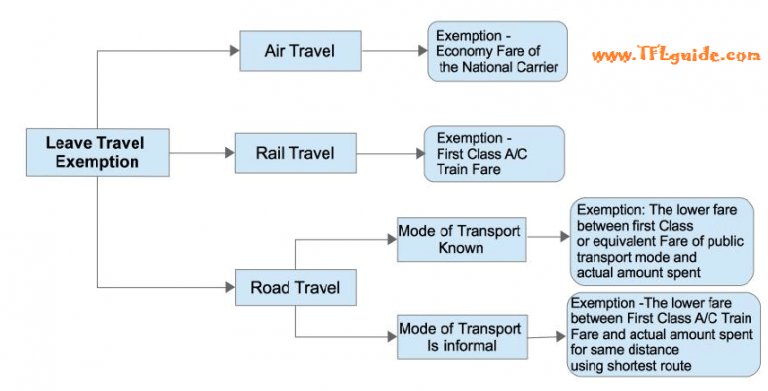
Modes of travel: Air (economy class only on the national carrier’s fare), train (AC first class on fastest route), or road (AC bus where available, or first-class taxi/hired vehicle fare). Private cars — only fuel and toll expenses are generally not allowed; most employers accept deluxe bus or hired car receipts.

What Does NOT Qualify

🚫 Common Exclusions

International travel (even if the ticket passes through India), hotel accommodation, food and beverages, local sightseeing, taxi fares at destination, visa fees, travel insurance, and shopping. Only the point-to-point journey cost is claimable. If your family travels without you, you cannot claim. You yourself must be on the trip.

How to Claim LTA — The Process

STEP 1 Take actual leave and travel

You must have an official leave record with your employer for the travel dates. Work-from-holiday-destination does not qualify.

STEP 2 Collect original documents

Air tickets + boarding passes, train tickets, or bus tickets. Keep both soft copies and hard copies. Your employer may forward these to the IT department for scrutiny.

STEP 3 Submit to HR/Payroll with declaration

Most companies have a specific LTA claim form. Attach bills and submit before the financial year closes (typically by January-February). Your LTA component will be treated as exempt in that year’s Form 16.

STEP 4 Retain copies for 6 years

The Income Tax Department can call for verification up to 6 years after the claim. Keep originals or clear copies safe.

The Dual-Income Household Trap

If both spouses are salaried and both get LTA, you can both claim — but not for the same journey. Here’s how smart dual-income couples structure it:

Wrong way: Both spouses try to claim LTA for the same family trip. Both claims get rejected because only one can claim per journey.

Right way: Husband claims LTA in year 1 for the Goa trip. Wife claims LTA in year 3 for the Kerala trip. Both trips are claimed using the “twice per block” rule, just distributed between the two earners. Effectively, the family gets four tax-free trips in a block instead of two.

This is the kind of thing a good tax planning strategy should handle automatically. Most employees don’t think of it.

Not sure if the Old or New Tax Regime is better for your salary?

The choice depends on your deductions, salary structure, and investments. A wrong choice can cost you Rs 50,000-2 lakh per year in taxes.

Talk to a SEBI-Registered Advisor

Mistakes That Invalidate Your LTA Claim

1. International itineraries. A Singapore trip with a Delhi layover does not qualify. Only strictly within-India travel counts.

2. Submitting photocopies without originals. If the IT department asks to verify, you’ll need originals. Scanned PDFs are usually acceptable for initial submission.

3. Travel without leave record. Weekend trips with no official leave are usually rejected — the rule requires that you’ve actually taken leave.

4. Claiming for family-only travel. If you’re at work in Mumbai while your family is in Goa, that trip does not qualify for your LTA claim.

5. Multiple claims in one year. Even if you’ve taken two trips in one calendar year, you can only claim LTA for one trip per year. The “twice per block” limit is across four years, not two trips per year.

LTA vs HRA vs Other Allowances — Don’t Confuse Them

One pattern I see repeatedly: employees conflate LTA with HRA (House Rent Allowance) or standard deduction. They’re entirely separate components of your salary with separate rules.

Component Old Regime New Regime
LTA Exempt (twice in 4 years) Fully taxable
HRA Exempt (formula-based) Fully taxable
Standard Deduction Rs 50,000 Rs 75,000 (enhanced in Budget 2024)
Section 80C (PPF, ELSS, etc.) Up to Rs 1.5 lakh Not available

If you’re on the Old Regime and you have significant 80C investments + HRA claim + LTA + home loan interest, stick with it. If you have few deductions and prefer simplicity, the New Regime might save you tax. Do the math — don’t guess.

LTA is not complicated — but it is one of the most overlooked tax benefits in Indian salaries. Plan your travel. Keep the receipts. Claim it correctly. Or choose the regime that actually serves your salary structure.

Travel smart. Claim smarter.

💬 Your Turn

Are you on the Old or New Tax Regime in 2026? Have you claimed LTA this block — or did you miss out? Share your experience in the comments. Your story might help another reader.