
Home Blog Page 33

How Banks Mis-Sell Insurance – and How to Protect Yourself

“The first duty of a financial advisor is to the client – not to the product manufacturer.” – Fiduciary principle

A few years ago, a client came to me after visiting his private bank branch to renew an FD. He walked out with a ULIP instead. The relationship manager had explained it as a “better FD” – same investment, higher returns, tax benefits. The client signed without reading the fine print.

It was only when he needed the money two years later that he discovered the truth: there was a 5-year lock-in, surrender charges of 25%, and his “investment” had not generated a rupee of return after charges in the first two years.

This is not an isolated incident. Insurance mis-selling through bank branches – formally called bancassurance – is one of the most persistent financial abuses in India. It has been documented by the Cobrapost sting of 2013, investigated by SEBI and IRDAI multiple times, and written about extensively. Yet it continues, because the incentive structure that drives it remains intact.

⚡ Quick Answer

Banks earn some of their highest commissions on insurance products – particularly ULIPs and traditional endowment plans. This creates a structural incentive for bank staff to push insurance to customers who come in for FDs, loans, or other banking needs. The result is widespread mis-selling. Protect yourself: never buy insurance inside a bank branch visit, never sign anything without reading the full policy document, and always evaluate insurance and investment products separately from banking services.

Bancassurance mis-selling in India - how banks push insurance products

Why Banks Push Insurance So Hard

Banks earn commissions on third-party products they distribute – mutual funds, insurance, credit cards. Of all these products, insurance generates the highest upfront commission. A ULIP or traditional endowment plan sold through a bank can generate 25-40% of the first year premium as commission for the bank. A mutual fund SIP generates perhaps 0.5-1% annually. The economics are not comparable.

This is why the January-March quarter is peak insurance season in bank branches. It is the financial year closing period for most insurance companies. Branch staff face explicit sales targets for insurance. Those who hit targets are recognised; those who do not face pressure. Some private banks have had internal cultures where relationship managers used openly manipulative sales language to secure sign-ups.

The product most commonly mis-sold is the ULIP (Unit Linked Insurance Plan) – positioned as a superior FD or as a tax-saving investment. It is neither. A ULIP is an insurance product with an investment component, carrying high charges and long lock-ins. When evaluated honestly against a combination of term insurance and a mutual fund, it almost always underperforms.

“In 25 years of advising, some of my most difficult conversations have been with clients who came to me carrying ULIPs they did not understand. Not because they were unintelligent – but because a trusted bank official had described them in ways that obscured what they actually were.”

– Hemant Beniwal, CFP, CTEP | Founder, RetireWise

How Mis-Selling Actually Happens

Insurance mis-selling in banks typically follows predictable patterns that are easy to recognise once you know them.

The FD alternative pitch. “Our new product gives better returns than FD, and it is also life insurance. One product doing two jobs.” The product is a ULIP or endowment plan. The returns are neither guaranteed nor clearly disclosed. The “FD-like safety” does not exist.

The tax-saving pitch near March. “Under Section 80C, this product saves you Rs 46,800 in tax.” Technically true – but the same deduction applies to ELSS mutual funds which have a 3-year lock-in versus 5-year for ULIPs, no surrender charges, and significantly better historical returns. The tax saving is the same; the product quality is not.

The relationship pressure pitch. “Sir, I have been serving you for three years. This is my target for the month. Please just help me this once.” This is emotional manipulation. A financial decision made to help a bank employee’s target is never made in your best interest.

The bundling pitch. “For this home loan, we need you to take our credit life insurance.” Some bundling of insurance with loans is required by regulation and legitimate. Mandatory ULIP purchase as a loan condition is not – but it happens. SEBI and RBI regulations prohibit coercive bundling; if you feel pressured, you can refuse and escalate to the bank’s grievance cell.

Have you been sold insurance products you did not fully understand?

A RetireWise retirement plan review includes an audit of existing insurance products – separating genuine protection needs from investment products that may be serving the advisor’s interests more than yours.

Book a Free 30-Min Call

IRDAI’s Freelook Period: Your Protection Window

Every insurance policy in India comes with a freelook period – 15 days for regular policies, 30 days for policies sold through distance channels (phone, online). During this period, you can return the policy and receive a full refund minus proportionate risk premium and administrative charges.

If you have recently bought an insurance policy you do not understand or did not intend to buy, check the date it was issued. If you are within the freelook period, write to the insurance company immediately requesting cancellation under the freelook clause. Keep a copy of the letter and ensure you receive written acknowledgement.

After the freelook period, your options are more limited – surrender charges apply in most products for the first 5 years. But even surrendering a mis-sold ULIP at a loss is sometimes better than continuing to pay premiums into a product that does not serve your goals.

How to Protect Yourself

A few simple rules protect you from insurance mis-selling in bank branches.

Never make a financial product decision in the branch itself. When you visit your bank, you are in a selling environment. Take any product information home, read it independently, and make the decision outside the branch.

Evaluate insurance and investment separately. Ask one question: “What does this product cost me if I want to exit in year 3?” If the answer involves surrender charges above 10-15%, the product is restrictive.

Check commission disclosure. IRDAI requires insurers to disclose the commission paid on any policy. You can ask for this information. A product with 35% first-year commission is structurally designed to benefit the distributor more than you.

Use a fee-based financial advisor for any significant investment or insurance decision. An advisor who earns a flat advisory fee rather than a product commission has no incentive to recommend a specific product over another.

Read – 5 Insurance Policies That You May Not Need

Read – 7 Financial Planning Mistakes That Are Costing You Retirement Security

Frequently Asked Questions

Is bancassurance always wrong? Are there good insurance products sold through banks?

Bancassurance is not inherently wrong – banks are legitimate insurance distributors and many offer genuine products. The issue is the conflict of interest when high commissions drive product recommendations. Term insurance sold through a bank at competitive premiums, with no investment component, is perfectly legitimate. The products to be cautious about are those that mix insurance and investment (ULIPs, endowment plans) and are sold without adequate disclosure of charges and lock-ins.

I bought a ULIP at my bank three years ago. What should I do?

First, understand exactly what you own: get the policy document, understand the fund value, the mortality charges being deducted, the premium allocation charges, and the surrender charges schedule. Compare your current fund value to total premiums paid. If the effective return is significantly negative and the product does not serve a genuine insurance need, evaluate whether surrendering (despite charges) and reinvesting in a more appropriate product makes sense over your remaining investment horizon. A financial advisor can help you run this calculation objectively.

How do I report insurance mis-selling?

You can file a complaint with IRDAI through the Bima Bharosa portal (formerly IGMS – Integrated Grievance Management System). Complaints about bancassurance can also be filed with the bank’s internal grievance cell and, if unresolved within 30 days, escalated to the Banking Ombudsman under RBI. For complaints about misselling specifically, keep all documentation – the policy illustration shown at time of sale, any written representations made, and the actual policy document. The gap between what was shown and what was issued is the basis of a mis-selling complaint.

Your bank branch is not a financial planning office. The person across the counter is a bank employee with sales targets – not a fiduciary advisor whose first duty is to your interests. That does not make every product they offer wrong. But it makes every product they offer worthy of independent evaluation before you sign.

Never buy a financial product in the branch. Take the brochure home. Read it. Decide independently.

Want an objective review of your existing insurance and investment products?

RetireWise provides an independent audit of your current financial products – identifying what serves your goals and what was sold for someone else’s benefit.

See Our Retirement Planning Service

💬 Your Turn

Have you or someone you know been mis-sold an insurance product through a bank branch? What was the product and how did you discover the mis-selling? Share in the comments – your experience may protect another reader.


Are You a Shopaholic? 11 Ways to Stop Impulse Spending Before It Derails Your Retirement

“Too many people spend money they haven’t earned to buy things they don’t want to impress people they don’t like.” – Will Rogers

“Yaar bore ho raha hun… chal shopping ko chaltey hain.” I am bored. Let’s go shopping.

“Salary aayi hai. Time to celebrate at the mall.”

“My heart is sad today. Retail therapy will help.”

I have heard versions of this from clients more times than I can count. The occasion hardly matters – a promotion, a breakup, a bonus, a bad day, a good day, a weekend. Shopping has become the default emotional response for a large section of urban India.

As a financial planner, I do not judge the desire to spend. I understand it. What I have seen, though, is the financial damage that unexamined impulse spending causes over a decade – the retirement corpus that never got built, the credit card debt that compounded quietly, the investment that was cancelled to pay for something bought on an impulse and never used.

⚡ Quick Answer

Impulse spending is purchasing triggered by emotion or environment rather than need or plan. The signs: shopping as a mood response, credit card balances that carry forward monthly, wardrobes full of unworn items, and regular purchases that feel justified in the moment but regretted later. The fix is not willpower alone – it is systems: a monthly discretionary budget, a 30-day pause rule for non-essential purchases, cash instead of cards, and the habit of calculating the retirement cost of every significant impulse purchase.

Shopaholic habits and impulse spending - how it affects your retirement savings

How Do You Know If You Are an Impulse Buyer?

It is all in the behaviour pattern. Some questions worth asking honestly:

Does the word “sale” create a physical sense of urgency? Do you know exactly when your favourite brands hold their annual discounts? Is your wardrobe full of items still carrying price tags? Do you hide purchases from your spouse or family to avoid a conversation? Does your credit card statement show mall visits as a regular weekly expense?

If three or more of these resonate, you have a pattern worth addressing – not because shopping is inherently wrong, but because the pattern is working against your financial goals.

“It pains me when I see a client transfer money from their SIP to settle a credit card bill. The impulse buying happened three months ago. The SIP cancellation happens today. But the real cost is the Rs 50 lakh in retirement corpus that those SIP units would have become in 20 years.”

– Hemant Beniwal, CFP, CTEP | Founder, RetireWise

The Retirement Cost of Impulse Spending

Every Rs 5,000 spent on an impulse purchase by someone aged 40 is approximately Rs 48,000 of retirement corpus foregone at 12% returns over 20 years. That is the exchange rate. Every casual Saturday “retail therapy” session that costs Rs 3,000-8,000 is a future retirement payment.

Most impulse buyers are not unaware of this intellectually. The awareness does not stop the behaviour because impulse buying is not a knowledge problem – it is a systems problem. When the right systems are not in place, willpower alone rarely wins against a well-designed retail environment, a 70% off sale sign, and an emotional mood that shopping has always soothed.

11 Practical Ways to Curtail Impulse Spending

1. Pay by cash for all discretionary spending. Credit cards remove the physical sensation of spending. When you hand over cash, your brain registers the transaction more viscerally. Leave your credit card at home for shopping trips unless there is a specific planned purchase.

2. Shop with a list and a purpose. Never enter a mall, retail store, or online shopping site without a specific reason and a specific item in mind. If you cannot name what you are looking for before you enter, you are not shopping – you are browsing for impulse triggers.

3. Apply the 30-day pause rule. Any non-essential purchase that costs more than Rs 2,000-3,000 goes on a 30-day waiting list. If you still want it in 30 days, buy it. Most impulse desires evaporate within a week. For smaller amounts, use a 48-hour version of the same rule.

4. Do not develop expensive collector habits. A “collection” of handbags, watches, shoes, or gadgets sounds like a hobby. It is usually a pattern of impulse spending with a rationalisation attached. Set clear limits on any collecting habit before you start.

5. Set a monthly discretionary spending budget. Allocate a fixed amount per month for all non-essential purchases – clothing, accessories, gadgets, eating out, everything. When it is gone, it is gone. The discipline of a budget creates natural limits without requiring constant willpower decisions.

6. Remove yourself from temptation environments. Unsubscribe from promotional emails and shopping app notifications. Delete apps that make impulse purchases frictionless. Do not visit malls as entertainment. Reduce exposure to the triggers, and you reduce the demand for willpower to resist them.

7. Do not shop when emotionally activated. Neither celebration nor sadness is a good shopping mood. Both impair the judgment needed for rational purchase decisions. Set a rule: purchasing decisions are made in a neutral emotional state, not in response to how you are feeling.

8. Shop with a responsible partner. If you know you struggle with impulse buying, take someone who will ask “do you really need this?” before you check out. An external voice can interrupt the impulse cycle before the purchase completes.

9. Calculate the retirement cost before every non-essential purchase. Before buying something you do not need, calculate: Rs [purchase amount] x 10 = approximate retirement corpus cost at current compound rates over 20 years. Rs 4,000 pair of shoes that sits unworn = Rs 40,000 in retirement. This is not to make you miserable – it is to make the trade-off visible.

10. Review your credit card statement monthly. The statement is a mirror of your actual spending behaviour, not your perceived behaviour. Most impulse buyers are genuinely surprised by how their spending looks in aggregate. The monthly review makes the pattern visible and creates an opportunity to correct it before it compounds.

11. Reconnect with your financial goals regularly. The most effective antidote to impulse spending is a vivid, specific picture of what the money is for instead. A retirement at 58 instead of 65. A foreign education fund for your daughter. Freedom from financial anxiety. When the long-term goal is concrete and present in your mind, the short-term impulse purchase loses some of its pull.

Read – Budgeting: The First Step to Financial Success

Read – The Diderot Effect: Why One Purchase Leads to Many

Is impulse spending quietly delaying your retirement?

A RetireWise retirement plan includes a cash flow analysis that makes the real cost of spending patterns visible – so you can make deliberate choices about how you use your income.

Book a Free 30-Min Call

Frequently Asked Questions

I know I overspend but I cannot seem to stop. Is this a real problem or just a habit?

Both, in most cases. Compulsive shopping shares characteristics with other impulse control challenges – it provides temporary emotional relief and becomes a learned response to certain emotional triggers. The distinction between “bad habit” and “compulsive behaviour” matters in terms of the intervention needed. Most people with problematic shopping habits can address them through the systems described above: budgets, friction, environmental changes, and awareness. If the shopping is causing significant financial damage, serious emotional distress, or relationship problems and you cannot stop despite wanting to, speaking to a counsellor alongside the financial planning work is appropriate.

My spouse is the one with impulse spending issues, not me. How do I address this without a fight?

This is one of the most common financial planning conversations I have with couples. The approach that works: make it about the shared goal, not about blame. Sit down together and calculate what your combined retirement corpus will look like under current spending patterns versus a more deliberate version. Make the retirement goal vivid and specific – “we want to retire at 60 and travel every year” rather than “we should save more.” Then build the budget together as a shared commitment toward a shared goal. People are far more receptive to spending discipline when it is framed as pursuing something they want, rather than being asked to give something up.

What is the difference between enjoying life today and reckless spending?

The right question. Spending on experiences, relationships, and things that genuinely enrich your life is not reckless – it is part of the point of earning. The line is crossed when: spending is driven by emotion or environment rather than intention, purchases are regularly regretted, spending undermines financial goals you have explicitly committed to, or debt is accumulating to fund consumption. Planned, intentional discretionary spending that fits within your budget is healthy. Unplanned, emotionally-driven spending that undermines long-term security is the problem worth addressing.

We all have impulses. The question is who is in charge – you or the impulse. Building systems that make intentional spending the default and impulsive spending more difficult is not about deprivation. It is about ensuring that your money goes where you actually want it to go, rather than where the mall, the app, or the mood of the moment directs it.

Spend deliberately. Save consistently. Retire with security.

Want to see the real retirement impact of your current spending patterns?

RetireWise builds retirement plans that map your current cash flow against your retirement goal – making the cost of today’s spending decisions visible before they compound into retirement shortfalls.

See Our Retirement Planning Service

💬 Your Turn

Do you have an impulse buying story – a purchase you regretted, or a habit you successfully broke? Share in the comments. Others in the same situation will find it useful.

RGESS Is Gone — But the Lesson It Teaches Is Permanent

24

“The investor’s chief problem — and even his worst enemy — is likely to be himself.”
– Benjamin Graham

In January 2013, a scheme called the Rajiv Gandhi Equity Savings Scheme (RGESS) was launched with much fanfare. It offered first-time equity investors a Section 80CCG tax deduction if they invested Rs 50,000 in specified securities. The industry rushed to launch RGESS-compliant mutual funds. Investors rushed to evaluate them.

The scheme was abolished in Budget 2017-18 — less than five years after launch. Section 80CCG no longer exists. The RGESS mutual funds were wound up or merged. Investors who had structured their tax planning around RGESS had to restructure entirely.

But the deeper lesson from RGESS has nothing to do with the scheme itself. It is about the pattern it represents — a pattern that repeats every year in Indian personal finance, every time a new government scheme or new product is launched.

⚡ Quick Answer

RGESS (Section 80CCG) was abolished in Budget 2017-18. It no longer exists and cannot be used for tax saving. If you are reading this because you are researching RGESS, stop — there is nothing to research. The broader lesson from RGESS is about product-chasing in personal finance: evaluating new schemes based on excitement and news coverage rather than whether they actually serve your financial need. This pattern wastes time, creates suboptimal decisions, and recurs every financial year with a new product as the protagonist.

🚫 RGESS — Scheme Abolished April 2017

The Rajiv Gandhi Equity Savings Scheme and Section 80CCG were discontinued in Budget 2017-18 (effective April 1, 2017). No new investments qualify under this section. No tax deduction is available. If you hold existing RGESS investments made before April 2017, consult your advisor for the current status of those specific instruments.

Product chasing in personal finance - the tail wagging the dog

The Tail Wagging the Dog

When RGESS launched in 2013, my colleague Manshu wrote in the original version of this post: “As soon as a new product is launched — news stories start appearing about it, people start inquiring about it, bloggers start blogging about it, and very soon the focus is on the product instead of your financial need.”

He was right. And he would be right today, writing the same observation about any number of newer products and schemes.

In 2021-22, it was Sovereign Gold Bonds — everyone suddenly needed to decide about SGBs because they were in the news. In 2022-23, it was I-Bonds and inflation-indexed instruments. In 2023-24, it was the new tax regime versus old tax regime — a valid decision, but one that consumed disproportionate mental bandwidth relative to more impactful financial choices. In 2024-25, it was passive index funds and factor funds, which dominated personal finance discourse while most investors still had inadequate term insurance and outdated beneficiary nominations.

The product becomes the conversation. Your financial need gets forgotten.

Why We Chase New Products

The psychology is straightforward. New products offer the hope of a better solution than what you currently have. The marketing around a new scheme is fresh and enthusiastic — it presents the product in its best light, in the context of current market conditions, with testimonials from early adopters and analysis from experts who have already positioned themselves as authorities on it.

Your existing portfolio, by contrast, is familiar and therefore somewhat boring. No one is marketing it to you. No one is writing excited analysis about your existing PPF account or your 5-year-old diversified equity fund. The new thing has a narrative. The old thing just sits there working quietly.

This is what the original RGESS post called “the tail wagging the dog.” The tail — the new product — is driving the dog — your financial planning. You start with the product and work backwards to justify why you need it, instead of starting with your financial need and working forwards to find the right instrument.

The Pattern in 2026: Three Current Examples

New Fund Offerings (NFOs): In every bull market phase, mutual fund companies launch NFOs targeting hot sectors. Defence funds. Green energy funds. AI and technology funds. The marketing is compelling. The track record is zero. The investors who rushed into infrastructure NFOs in 2007 spent years underwater. The investors who rushed into FMCG and pharma NFOs in various cycles have had similar experiences. The thousands of existing schemes — with actual track records — receive none of this excitement.

The question to ask before any NFO: does any existing fund not already serve this need? In most cases, the answer is yes. A diversified equity fund already has exposure to whatever sector the NFO is targeting. The NFO offers concentration, not diversification.

Small Finance Bank FDs at 9%+: When new small finance banks launch or raise FD rates above the market, there is often a rush to deposit. The DICGC insurance covers only Rs 5 lakh per bank per depositor. Investors who concentrated large deposits at smaller institutions have occasionally found themselves in uncomfortable situations when those institutions faced stress. The high rate is the product. Your financial safety is the need. They are not always the same thing.

NPS (National Pension System) every January-March: NPS gets intense discussion every tax-saving season. Section 80CCD(1B) allows an additional Rs 50,000 deduction. That is a real and valuable benefit. But investors often evaluate NPS entirely through the tax-saving lens — without examining the lock-in until age 60, the mandatory annuity requirement at retirement, the equity allocation restrictions, or how it fits into their overall retirement architecture. The tax benefit is the tail. The retirement plan is the dog.

The Two Questions That End Product-Chasing

Before evaluating any new financial product or scheme, ask these two questions in sequence. First: what is the financial need this is supposed to serve? Name it specifically — retirement income, education corpus, tax saving, emergency buffer, inflation hedge. Second: do I already have an instrument serving this need? If yes, the question becomes not “should I invest in this new product” but “is this demonstrably better than what I already have, accounting for switching costs, tax implications, and learning curve?” In most cases, the answer is no. The existing instrument is sufficient. The new product is just new.

Simplicity is underrated in finance. The investor with six instruments that are well understood and consistently funded will almost always outperform the investor with twenty instruments optimised to every new opportunity.

What the RGESS Story Actually Teaches

RGESS was abolished five years after it was launched. Investors who had planned around it had to replan. The scheme existed for a short window, served a limited purpose, and vanished.

This is the nature of government schemes: they are policy instruments, not permanent financial infrastructure. They can be modified, restructured, or withdrawn based on political and fiscal considerations that have nothing to do with your financial plan. PMVVY closed in 2023. SGBs have not had new tranches since February 2024. Tax treatment of debt funds changed in 2023. Each of these required investors to adjust.

The investors who had to adjust the least were those whose plans were built around permanent principles — asset allocation, diversification, insurance adequacy, consistent savings — rather than around specific scheme features. The principles don’t get abolished in a Budget. The scheme can be.

Benjamin Graham’s insight about the investor being their own worst enemy was written in the 1940s. It applies perfectly to a 2013 Indian government scheme that no longer exists — and to whatever new scheme or product will dominate personal finance headlines in the year this is being read.

Your financial plan should not change every time the government launches a new scheme.

A retirement plan built on principles survives budget changes, scheme closures, and product cycles. That’s what RetireWise builds.

See How RetireWise Builds Principle-Based Plans

The RGESS no longer exists. The lesson it teaches is permanent. Start with your financial need. Let the product follow — not the other way around.

Don’t let the tail wag the dog.

Good financial plans survive budget sessions.

Poor ones need to be rebuilt every February when the Finance Minister speaks. RetireWise helps senior executives build the kind that lasts.

Book a Free 30-Min Call

Your Turn

What is the most recent new financial product or scheme you evaluated — and did you start with the product or with the financial need it was supposed to serve? Share your experience. The pattern of starting with the product is so common it deserves an honest conversation.

LIC New Jeevan Nidhi Review: Plan Discontinued — What Existing Policyholders Should Know

📢 Editorial Note — April 2026

LIC New Jeevan Nidhi has been discontinued and is no longer available for new subscriptions. This review is retained for the benefit of existing policyholders who hold this plan and need guidance on their options. If you are researching retirement plans to purchase today, please see our guide on Best Retirement Plan Options in India (2026).

This review was originally written when LIC New Jeevan Nidhi launched in early 2013. The plan promised to combine life cover with pension accumulation — and the honest assessment then was the same as it would be now: the returns were not worth the complexity, and the compulsory annuity tie-in created long-term inflexibility.

The plan has since been withdrawn from sale. But thousands of policyholders still hold Jeevan Nidhi policies purchased between 2013 and the withdrawal date. If you’re one of them, this article is for you.

⚡ Quick Answer for Existing Policyholders

If you’re within 7 years of your vesting age: Continue the policy to maturity. Surrender values at this stage rarely make sense.
If you’re 10+ years from vesting: Get your current surrender value, calculate the IRR if you continue, and compare against alternatives. In most cases, the conversation with your advisor will surprise you.
Never stop paying premiums mid-way without checking the paid-up value first — lapsing a policy is usually worse than both surrendering and continuing.

What LIC New Jeevan Nidhi Was

LIC New Jeevan Nidhi was a traditional deferred pension plan — a participating endowment-style plan that accumulated a corpus over the policy term, then mandated conversion of that corpus into an annuity at vesting. The key parameters at the time of launch were: entry age 20-60 years, vesting age 55-65 years, policy terms of 5-35 years, and a minimum Sum Assured of Rs. 10,000 (regular premium) or Rs. 15,000 (single premium).

On vesting, the policyholder received Sum Assured plus Guaranteed Additions (Rs. 50 per thousand Sum Assured, for the first 5 years only) plus any Revisionary Bonus and Final Bonus declared by LIC. This corpus then had to be used to purchase an annuity from LIC itself — a condition that was mandated by IRDAI’s 2012 pension plan guidelines.

The Problem That Was Clear Even in 2013

When this plan launched, the core critique was simple: the projected IRR from the policy illustrations was in the range of 5-6% — at or below inflation, and significantly below what equity mutual funds or even NPS could generate over the same 15-25 year period.

Traditional pension plans compound this problem with two additional layers:

Mortality charge drag: The life cover component of these plans — however small — extracts a mortality charge every year. For a senior executive who already has adequate term insurance, this is a cost with no benefit. Every rupee going to mortality charges reduces the corpus available at vesting.

Compulsory annuity from the same insurer: IRDAI’s 2012 guidelines required that the annuity be purchased from the same company. This removed competitive negotiation from the equation. LIC’s annuity rates at vesting might not be the best in the market — but the policyholder had no choice.

💡 What Has Changed Since 2013

IRDAI has since revised some pension plan norms. One-third of the maturity corpus can now be taken as a tax-free lump sum at vesting — the policyholder need not annuitise everything. Up to one-third lump sum is permitted. This is a meaningful improvement for flexibility, but the core issue — low accumulation phase returns — remains unresolved for traditional pension plans.

If You Hold This Policy: Your Options

Option 1 — Continue to vesting. The cleanest choice if you are within 5-7 years of your vesting date. The corpus has already been accumulating for years. Surrendering now typically yields 30-50% of premiums paid — a significant loss. Continuing ensures you at least receive the Sum Assured, accumulated bonuses, and guaranteed additions in full.

Option 2 — Make it paid-up. If you no longer wish to pay premiums but are many years from vesting, you can convert the policy to paid-up status. The Sum Assured reduces proportionally to premiums paid, but the policy continues and you receive a (reduced) corpus at the original vesting age. No further premium outgo. Compare the projected paid-up value against the surrender value to decide.

Option 3 — Surrender. Only sensible if you are very early in the policy (within 2-3 years of purchase), your surrender value is close to premiums paid (rare), and you have a clearly superior alternative use for the money. The guaranteed surrender value is 30% of all premiums paid — meaning you lose 70% in the early years. Surrender is a last resort, not a default recommendation.

⚠️ Never Lapse This Policy

Letting a life insurance or pension policy lapse by missing premiums — without formally surrendering or making it paid-up — is almost always the worst outcome. The policy lapses with zero or minimal value, and you lose all premiums paid without even getting the surrender value. If you are struggling to pay premiums, call LIC and explore the paid-up option first.

What to Consider for Retirement Planning Going Forward

If you hold a Jeevan Nidhi policy, it likely represents only a portion of your retirement plan. Here’s how to think about what else to build alongside it:

NPS (National Pension System): For equity-linked retirement accumulation with professional fund management, NPS remains the most tax-efficient structured pension product in India. Section 80CCD(1B) gives you an additional Rs. 50,000 deduction beyond Section 80C. The annuity at vesting can be purchased from any IRDAI-approved annuity provider — giving you competitive pricing. NPS does what traditional pension plans were supposed to do, but better.

Equity mutual funds via SIP: For a 15+ year accumulation horizon, a structured SIP in diversified equity funds has historically generated returns well above what any traditional pension plan offers. Combine with a balanced advantage fund as you approach retirement for a smoother glide path.

PPF: Tax-free at 7.1% p.a., full flexibility on withdrawal after 15 years, sovereign guarantee. For the debt portion of a retirement portfolio, PPF is more transparent and predictable than any traditional endowment or pension plan.

Not sure whether to surrender, make paid-up, or continue your Jeevan Nidhi?

A structured review of your existing policies alongside your retirement corpus takes 30 minutes — and usually reveals decisions that can meaningfully improve your retirement outcome.

Talk to a RetireWise Advisor

Frequently Asked Questions

Is LIC New Jeevan Nidhi still available?

No. LIC New Jeevan Nidhi has been discontinued. Existing policies continue with their original terms. No new policies can be purchased.

Should I surrender my LIC New Jeevan Nidhi policy?

Depends on how many years remain to vesting. If you are within 5-7 years of vesting, continue. If you are 10+ years away and the surrender value is close to premiums paid, a detailed comparison with your advisor can help. The guaranteed surrender value is only 30% of premiums — so early surrender is almost always a loss. Paid-up is often a better middle path than surrendering.

What happens at vesting in LIC New Jeevan Nidhi?

You receive Sum Assured plus Guaranteed Additions plus Revisionary and Final Bonus. Up to one-third can be taken as a tax-free lump sum. The remaining corpus must be used to purchase an annuity from LIC. The annuity provides lifelong income.

What are better alternatives for retirement planning?

NPS for structured equity-linked retirement accumulation with additional Section 80CCD(1B) deduction. PPF for tax-free guaranteed debt returns. Equity mutual funds via SIP for long-horizon growth. A combination of all three, structured around your retirement date, typically outperforms any single traditional pension plan.

Traditional pension plans were sold on trust and brand name. The numbers, if you look carefully, rarely justified the investment. LIC’s brand is real. The Jeevan Nidhi’s returns were not.

If you hold it — manage it wisely. Don’t compound the original decision with a worse one.

💬 Your Turn

Do you hold LIC New Jeevan Nidhi? How many years are you from your vesting date? Share below — or ask whether surrender, paid-up, or continuation makes more sense for your specific situation.

This review was originally contributed by Jitendra PS Solanki, CFP in January 2013, and has been updated editorially in April 2026 to reflect the plan’s discontinuation and current guidance for existing policyholders.

LIC Flexi Plus ULIP Review – Not So Flexible (Discontinued)

🚫 Plan Withdrawn

LIC Flexi Plus (Table 811) was discontinued on 16 November 2013 — just 10 months after launch. You cannot buy this plan today. If you already hold this policy, read on for your options.

You bought it because someone you trusted — maybe your LIC agent uncle, maybe a colleague in the office canteen — told you, “ULIP mein daal do, insurance bhi milega, returns bhi.” You signed the form. Paid the premium. And then one day LIC quietly pulled the plug on the plan itself.

Now you’re stuck wondering: Is my money safe? Should I continue paying? Can I even exit?

You’re not alone. I’ve sat across the table from dozens of clients holding discontinued LIC ULIPs, and the confusion on their faces is always the same. Let me walk you through what LIC Flexi Plus actually was, why it was withdrawn, and — most importantly — what you should do if you’re still holding it.

⚡ Quick Answer

LIC Flexi Plus (Table 811) was a Unit Linked Insurance Plan launched in January 2013 and withdrawn by November 2013. It offered only two fund options (Debt and Mixed), with a maximum equity exposure of just 25%. If you still hold this policy and have completed the 5-year lock-in, you can surrender it and move your money to better-performing, more flexible instruments like index mutual funds.

LIC Flexi Plus ULIP Review - Discontinued plan analysis and exit options

What Was LIC Flexi Plus?

LIC Flexi Plus (Plan No. 811) was a Unit Linked Insurance Plan launched on 2 January 2013 under the post-2010 IRDAI ULIP guidelines. These were the “new generation” ULIPs with lower charges — LIC’s attempt at making ULIPs competitive after the IRDAI-SEBI regulatory tussle.

Here’s what it offered on paper:

  • Minimum premium paying term: 5 years
  • Sum assured: Higher of 10 times annual premium or 105% of total premiums paid
  • Two investment fund options: Debt Fund and Mixed Fund
  • Mandatory 5-year lock-in period (per IRDAI guidelines)

Think of it like buying a car that can only drive in first and second gear. Yes, technically it moves. But would you choose it for a 15-year road trip?

The Charge Structure — What LIC Took Before Your Money Got Invested

One thing LIC did right with Flexi Plus was reducing charges compared to older ULIPs. But “lower than terrible” isn’t the same as “good.”

Discontinuation Charges

If you stopped paying premiums before completing 5 years, here’s what LIC deducted:

Policy Year of Exit Premium up to ₹25,000/year Premium above ₹25,000/year
Year 1 15% of AP or FV (max ₹2,500) 6% of AP or FV (max ₹6,000)
Year 2 7.5% of AP or FV (max ₹1,750) 4% of AP or FV (max ₹4,000)
Year 3 5% of AP or FV (max ₹1,250) 3% of AP or FV (max ₹3,000)
Year 4 3% of AP or FV (max ₹750) 2% of AP or FV (max ₹2,000)
Year 5 onwards NIL NIL

AP = Annual Premium, FV = Fund Value. The discontinued fund earned SBI savings account interest (currently around 2.7% — barely beating a mattress).

Also note: the discontinued fund itself carried a 0.5% p.a. fund management charge. So even your parked money wasn’t free.

Investment Funds — Only Two Choices

Fund Govt/Corporate Debt Money Market Listed Equity Risk Profile
Debt Fund Minimum 60% Up to 40% Nil Low
Mixed Fund Minimum 45% Up to 40% 15%–25% Low to Medium

Notice what’s missing? A pure equity fund. The maximum equity exposure was just 25% — through the Mixed Fund. For anyone investing with a 10–20 year horizon, this was like running a marathon in bathroom slippers.

Why LIC Pulled the Plug So Quickly

LIC Flexi Plus lasted barely 10 months — launched January 2013, withdrawn November 2013. LIC doesn’t publicly explain why it withdraws plans, but the pattern is clear: plans that don’t gather enough business get quietly shelved.

With only two fund options, no pure equity choice, and competing against a market full of private insurer ULIPs offering 4-7 fund options, Flexi Plus simply couldn’t attract buyers. The “flexibility” in the name was, to put it charitably, aspirational.

ULIP Taxation — What Changed Since This Plan Launched

This is where most online reviews of LIC Flexi Plus fail you. The tax landscape for ULIPs has fundamentally changed since 2013:

Tax Aspect When Flexi Plus Launched (2013) Current Rules (2026)
Section 80C Deduction Available (if SA ≥ 10× premium) Only under old tax regime. New regime (default from FY 2024-25) has no 80C.
Maturity Tax-Free? Yes, under Section 10(10D) Only if annual premium ≤ ₹2.5 lakh (for policies bought after 1 Feb 2021)
Capital Gains Tax Not applicable LTCG at 12.5% (held >1 year) if premium >₹2.5L. STCG at 20%.
GST on Premium Service tax applied NIL GST on individual life insurance premiums (from 22 Sep 2025)
Death Benefit Tax-free Still completely tax-free — no conditions, no threshold

For existing Flexi Plus holders: Since this plan was purchased before February 2021, the old Section 10(10D) rules apply. Your maturity proceeds should be tax-free regardless of premium amount — but confirm with your tax advisor based on your specific policy terms.

Stuck with a ULIP you don’t understand?

A fee-only financial planner can evaluate your policy and map an exit strategy — without selling you another product.

Talk to a Fee-Only Planner →

What Should You Do If You Still Hold LIC Flexi Plus?

If you’re reading this in 2026, your Flexi Plus policy has long crossed the 5-year lock-in. Here are your real options:

Option 1: Surrender and redeploy. Since you’ve crossed the lock-in, there are no discontinuation charges. Take the fund value and invest it in instruments that actually match your goals — whether that’s an index fund for long-term wealth, a balanced advantage fund for moderate risk, or even a simple PPF if you want guaranteed returns. I’ve written in detail about exit strategies for mis-sold insurance policies — the framework applies here.

Option 2: Make it paid-up and wait. If your policy term hasn’t ended, you can stop paying premiums. The existing fund value stays invested (in whichever fund you chose) until maturity. But ask yourself honestly — would you voluntarily invest new money in a fund capped at 25% equity with no pure equity option? If the answer is no, why let old money suffer the same fate?

Option 3: Continue if maturity is very close. If your policy is maturing in the next 12-18 months, the switching cost and hassle may not be worth it. Let it run, collect the maturity amount, and deploy wisely.

The Bigger Lesson — Why ULIPs Keep Disappointing

Let me be clear about something people often misunderstand: financial planners are not “against” ULIPs. We’re against inflexibility disguised as investment.

Suresh (name changed), a client from Jaipur, came to me in 2019 holding three different LIC ULIPs — including a Flexi Plus. His total investment was ₹8.5 lakh over 6 years. The fund value? ₹7.2 lakh. He had actually lost money because the Debt Fund barely kept pace with charges, and the Mixed Fund’s 25% equity cap meant he missed the entire 2014-2017 bull run.

Compare this to someone who invested ₹8.5 lakh in a Nifty 50 index fund over the same period. Even with market ups and downs, they’d have been significantly ahead.

The fundamental problem with products like LIC Flexi Plus wasn’t the charges (those were actually reasonable post-2010). It was the structural inflexibility:

  • Only 2 fund choices vs. thousands of mutual fund options
  • Maximum 25% equity — useless for long-term wealth creation
  • 5-year lock-in with penalty for early exit
  • No option to switch to a pure equity fund when markets dipped
  • Bundled insurance you probably didn’t need (if you already had adequate term insurance)

As the saying goes in Hindi — “Doodh ka doodh, paani ka paani” — keep insurance and investment separate. That old wisdom still holds.

LIC Flexi Plus vs. Today’s Alternatives — A Quick Comparison

Parameter LIC Flexi Plus (Discontinued) Nifty 50 Index Fund + Term Plan
Max Equity Exposure 25% (Mixed Fund) 100% (your choice)
Fund Options 2 Thousands
Lock-in 5 years None (ELSS: 3 years)
Exit Penalty Yes (Years 1-4) None (exit load: 0-1%)
Transparency Limited NAV disclosure Daily NAV, full portfolio disclosure
Insurance Cover Bundled (10× premium) Separate ₹1 Cr term plan for ₹700-1000/month
Total Cost (Annual) 1.35%+ (FMC + mortality + admin) 0.1-0.2% (index fund) + term premium

The math speaks for itself. When you separate insurance from investment, both work better — and you control the steering wheel.

Original Guest Review Note

The original 2013 review of LIC Flexi Plus was contributed by Manikaran Singal, CFPCM. This 2026 update includes current regulatory changes, tax rules, and exit guidance for existing policyholders — reflecting the latest IRDAI and Income Tax frameworks.

The best insurance products are the ones you never have to Google “how do I exit” for.

Keep insurance and investment separate. Your future self will thank you.

Still holding a mis-sold ULIP or endowment policy?

Don’t let sunk cost fallacy keep your money trapped. A proper review can save you lakhs over the next decade.

Get a Free Portfolio Review →

💬 Your Turn

Are you still holding an LIC ULIP you bought years ago? What’s your biggest confusion — should you surrender, continue, or just let it be? Share your situation below and I’ll try to help.

How to Select Mutual Funds in India: The Framework That Doesn’t Go Stale

224

Every January, personal finance media publishes the same thing: the best mutual funds for this year. Every January, advisors like me get calls from investors who want to reshuffle their portfolio based on last year’s top performers. And every year, the same mistake gets made.

The funds that topped the return tables in 2021 underperformed in 2022. The mid-cap darlings of 2017 lagged badly in 2018 and 2019. The “consistent performer” recommended in 2019 wound up its debt scheme in 2020. Past returns predict future returns with remarkable unreliability – and yet fund selection based on recent returns remains the dominant approach.

This post is not about which funds to pick today. It is about the selection framework that remains valid regardless of what year it is.

The Core Principle

Fund selection accounts for roughly 10% of your long-term investment outcome. Asset allocation – the proportion you hold in equity, debt, and other asset classes – accounts for approximately 90%. Most investors spend 90% of their time on fund selection and 10% on asset allocation. This is precisely backwards. Get the asset allocation right first. Then select funds using the framework below.

How to Select Mutual Funds India 2026

Step 1: Start With SEBI’s Category Framework

In 2018, SEBI mandated that all mutual fund schemes must fit into one of 36 defined categories for equity, debt, and hybrid funds. This was a significant consumer-protection move. It prevents AMCs from creating multiple overlapping schemes and makes comparison between funds in the same category meaningful.

Before selecting any fund, understand which SEBI category it belongs to – and whether that category is appropriate for your goal and timeline. A large-cap fund (at least 80% in the top 100 companies by market cap) is appropriate for stable equity exposure. A small-cap fund (at least 65% in companies ranked 251st and below by market cap) is appropriate only for money you will not need for 7 to 10 years and can absorb 50%+ drawdowns. A flexi-cap fund gives the manager full flexibility across market caps.

The selection discipline: match the category to the goal first. A 3-year goal should not be funded from a small-cap fund regardless of how well that fund has performed recently.

Step 2: Evaluate on Rolling Returns, Not Point-to-Point Returns

The most commonly misused metric in fund selection is the 1-year or 3-year return as of a specific date. This is a point-to-point return – it tells you what happened between two specific dates, which is largely a function of market timing rather than fund quality.

Rolling returns are more meaningful. A 3-year rolling return measures the fund’s performance across all 3-year periods in its history – not just one specific 3-year window. A fund that generates 12%+ CAGR in 85% of all 3-year rolling periods is demonstrably more consistent than a fund that generated 18% CAGR in the last 3 years but was negative in 40% of all 3-year windows historically.

Value Research and Morningstar India publish rolling return data. Use it. A fund that looks mediocre on a recent point-to-point comparison may show exceptional consistency on rolling returns – and vice versa.

Step 3: Check the Fund Manager’s Track Record – at This Specific Fund

Fund manager reputation is portable only to a degree. A fund manager who built an excellent track record at Fund House A, then moved to Fund House B, brings their skill – but not their previous track record. The fund they now manage at Fund House B has its own, separate history under different conditions.

Two things to check: how long has the current manager managed this specific scheme? And what is the fund’s performance history under this manager specifically, not just the fund’s total history? Many funds have a 15-year track record of which only 4 years are under the current manager. The 15-year chart tells you about the fund’s history, not about the person now running it.

A second concern: how many funds does the manager run? A manager overseeing 12 to 15 different schemes simultaneously is splitting their attention in ways that matter for active stock-picking mandates. This information is in the fund’s SID and on the AMC’s website.

Step 4: Assess the AMC’s Institutional Quality

The AMC (Asset Management Company) matters as much as the specific fund in many cases. An AMC with strong research infrastructure, low fund manager turnover, robust risk management, and no significant regulatory violations provides a more reliable environment for long-term investing than one with high turnover, recent SEBI penalties, or a history of mis-categorised products.

In India, the major AMCs with strong institutional track records include SBI Mutual Fund, HDFC Mutual Fund, ICICI Prudential Mutual Fund, Nippon India (earlier Reliance), Axis Mutual Fund, Mirae Asset, and DSP Mutual Fund. This list is not exhaustive and not a recommendation – it reflects AMCs with significant history and institutional depth.

Always check whether the AMC has faced any significant regulatory actions from SEBI, particularly penalties for mis-selling, mis-categorisation, or portfolio-level violations. SEBI publishes enforcement orders publicly.

Step 5: Look at Expense Ratio Relative to Category

The expense ratio is the annual fee charged by the fund as a percentage of AUM. For regular plans (purchased through distributors), equity fund expense ratios in India range from approximately 1.2% to 2.2% depending on fund size and category. For direct plans, they are 0.5 to 0.8% lower.

Within a category, expense ratio differences compound significantly over time. A 0.5% lower annual expense on a Rs. 50 lakh corpus over 20 years at 12% base return means approximately Rs. 15 to 20 lakh more in corpus – just from the fee difference.

Compare expense ratios within the same category. A large-cap fund charging 2.1% when the category average is 1.6% needs to demonstrate consistent outperformance to justify the premium. If it cannot, a lower-expense fund in the same category serving the same goal is almost always preferable.

Step 6: Apply a Simple Quantitative Checklist

After the qualitative assessment, apply a quantitative filter. A reasonable starting checklist for equity funds:

Fund size above Rs. 500 crore (ensures adequate liquidity for redemption and institutional-grade portfolio management). Consistent alpha generation over 5 years relative to the category benchmark – positive Jensen’s Alpha indicates the manager has added value beyond what the market return alone explains. Standard deviation (volatility) within a reasonable range for the category – a fund taking significantly more risk than peers to generate slightly higher returns is a poor trade. Sharpe ratio above category median – this measures return per unit of risk and is more meaningful than raw return alone.

These metrics are published on Value Research, Morningstar India, and most fund aggregators. The goal is not to find the fund with the best number on every metric – it is to eliminate funds that are outliers on negative metrics (too high expense, too high volatility, negative alpha) and select from the remainder based on qualitative factors.

How Many Funds Are Enough?

For most investors, 3 to 5 equity funds are sufficient for meaningful diversification. Beyond 5 to 6 equity funds, the additional diversification is marginal and the portfolio becomes difficult to monitor and rebalance. Many retail investors hold 12 to 15 funds accumulated over years of responding to “best fund” recommendations – with significant overlap across funds in the same category.

A simple portfolio for a 45-year-old retirement investor: 1 large-cap or Nifty 50 index fund, 1 flexi-cap fund, 1 mid-cap fund (if timeline allows), 1 hybrid fund (balanced advantage or aggressive hybrid) for the more conservative portion. That is 3 to 4 funds covering the equity spectrum adequately. Add a debt portion in NPS, PPF, and short-duration debt funds as appropriate.

Building a Retirement Portfolio That Goes Beyond Fund Selection

RetireWise builds retirement portfolios starting with asset allocation and goal mapping – not with fund recommendations. Explore how we approach retirement investment planning.

See Our Services

One question for you: When you last added or changed a mutual fund in your portfolio, what was the primary reason – recent performance, a recommendation, or a change in your own goals or timeline? Share in the comments.

The 7 Habits of Financially Successful People (Covey Applied to Your Money)

“Habits are the compound interest of self-improvement.” – James Clear

Stephen Covey passed away in July 2012. His book “The 7 Habits of Highly Effective People,” published in 1989, had by then sold over 25 million copies in 38 languages. It remains one of the most influential business books ever written.

I first read it in the early years of my career. What struck me then – and still strikes me now after 25 years of financial planning – is how precisely Covey’s seven habits describe what separates financially successful people from those who struggle despite adequate income. The habits were never about productivity. They were about character and systems. And character and systems are exactly what determine financial outcomes.

⚡ Quick Answer

Covey’s 7 habits map directly onto financial success: being proactive (owning your financial decisions), beginning with the end in mind (defining specific financial goals), putting first things first (saving before spending), thinking win-win (building mutually beneficial financial relationships), seeking first to understand (knowing your own financial situation before acting), synergising (coordinating finances with your partner), and sharpening the saw (continuously updating financial knowledge). The habits do not require large incomes – they require consistent behaviour.

7 habits of financial success - Covey applied to personal finance India

Habit 1: Be Proactive – Own Your Financial Decisions

Reactive people blame external circumstances for their financial situation: the market crashed, the employer did not give a raise, the economy is bad, the government taxes too much. Proactive people acknowledge external constraints and then ask what they can control: their savings rate, their investment choices, their insurance adequacy, their tax planning.

In 25 years of financial planning, I have met investors in identical income brackets with wildly different financial positions. The difference is almost never luck or circumstance. It is proactivity – the habit of taking ownership of financial decisions rather than waiting for circumstances to improve.

Proactive financial behaviour means starting your SIP before you feel ready. It means buying term insurance at 32 instead of waiting until 45. It means reviewing your portfolio annually instead of only when the market crashes.

Habit 2: Begin With the End in Mind – Define Specific Goals

Covey’s second habit is about starting every project with a clear vision of the desired outcome. In finance, this means knowing your specific goals: not “a comfortable retirement” but “Rs 3 crore corpus by age 60 to generate Rs 1.2 lakh per month in retirement income.”

The specificity matters because it determines everything else: how much you need to save monthly, what asset allocation is required, what insurance cover is necessary, and what the progress milestones look like. A vague goal cannot be planned for. A specific goal can.

Most investors I meet have vague goals. They want to “be set” or “have enough.” When I ask them to put a number and a date to “enough,” the exercise often reveals that they are either significantly underfunded – or that they have more margin than they think. Either way, the number is more useful than the vague aspiration.

Habits without goals drift. Goals without habits stall.

RetireWise helps clients define specific financial goals with numbers and timelines, then builds the systems to reach them – combining Covey’s habits with the discipline of financial planning.

See How RetireWise Structures Financial Plans

Habit 3: Put First Things First – Save Before You Spend

Covey’s third habit distinguishes between urgency and importance. Most people structure their finances around urgency: pay the bills, handle the emergencies, spend on current needs, and save whatever is left. Whatever is left is usually nothing.

Financially successful people reverse this sequence: they save and invest first – automatically, on salary day – and then spend from what remains. This is the “pay yourself first” principle, and it is one of the most powerful shifts in personal finance behaviour. An automated SIP that debits on the 5th of the month before discretionary spending has begun is Habit 3 in action.

The practical rule: your savings rate should be locked before your lifestyle expands. Every time income increases, increase your SIP first. Your lifestyle can expand with what remains.

Habit 4: Think Win-Win – Build Mutually Beneficial Financial Relationships

Win-win in finance means structuring your financial relationships – with your advisor, your bank, your employer, your family – so that incentives are aligned rather than opposed. An advisor who earns only when you trade more is not aligned with you. An insurance agent whose commission is higher on ULIPs than term plans is not aligned with you.

Win-win also applies within families. A couple that makes financial decisions together, with both partners understanding the full financial picture, is more resilient than one where finances are managed unilaterally. Shared financial decisions are more likely to be maintained through difficult periods.

Habit 5: Seek First to Understand – Know Your Own Situation Before Acting

Most financial mistakes happen because people act before understanding. They invest in a product they do not understand. They take insurance without calculating the cover they need. They borrow without modelling the repayment impact on cash flow.

Seeking first to understand means doing your own analysis before accepting anyone else’s recommendation. What is your current net worth? What is your savings rate? What is your actual asset allocation? What are your real financial goals? These questions have answers. Knowing them puts you in a position to make informed decisions – and to evaluate advice you receive from others.

Habit 6: Synergise – Coordinate Your Financial Life

Synergy in Covey’s framework means the whole is greater than the sum of parts. In financial terms, this means your insurance, investments, tax planning, and estate planning work together as an integrated system – not as separately managed buckets that pull in different directions.

A common failure of synergy: an investor who maximises 80C through ELSS in the old tax regime while simultaneously having the wrong LTCG planning structure, resulting in more tax than necessary overall. Or someone who has an excellent equity portfolio but inadequate term insurance, leaving the portfolio’s entire value exposed to a single life risk event.

Integration is the habit that turns good individual decisions into a coherent financial plan.

Habit 7: Sharpen the Saw – Continuously Update Your Financial Knowledge

Covey’s final habit is about continuous renewal: keeping yourself capable of effective action by regularly updating your skills and knowledge. In finance, this means reading about tax changes every year, understanding new product categories as they emerge, reviewing your plan annually, and staying current with regulations that affect your investments.

The investor who learned to invest in 2010 and has not updated their knowledge framework since is navigating 2026 with outdated maps. Tax laws have changed dramatically. New asset categories have emerged. Retirement products have evolved. Annual renewal of financial knowledge is not optional – it is what keeps your plan from becoming obsolete.

Read: The Importance of Financial Planning in Your Life

Covey wrote about habits for effective living. Every one of those habits, applied to money, produces financial effectiveness. They do not require a high income. They require consistent behaviour over time.

The habits are the shortcut. There is no other shortcut.

Which of these seven habits is most absent from your financial life right now?

A RetireWise financial plan is built around these habits – with goal clarity, automated systems, integrated coverage, and annual review built in from the start.

Book a Free 30-Min Call

Your Turn

Which of Covey’s seven habits do you find hardest to apply to your financial life – and what specific behaviour would change if you applied it consistently? Share in the comments.

Maslow’s Hierarchy of Needs and Your Financial Goals: Build the Base First

“Tell me, what is it you plan to do with your one wild and precious life?” – Mary Oliver

I once met a senior executive – let us call him Vikram – who had everything that looked like financial success. A Rs 12 crore net worth. A bungalow in a good Bangalore locality. Two children in top colleges.

He came to me not for investment advice. He came because he was confused. He said: “I have everything I planned for. Why do I feel like something is still missing?”

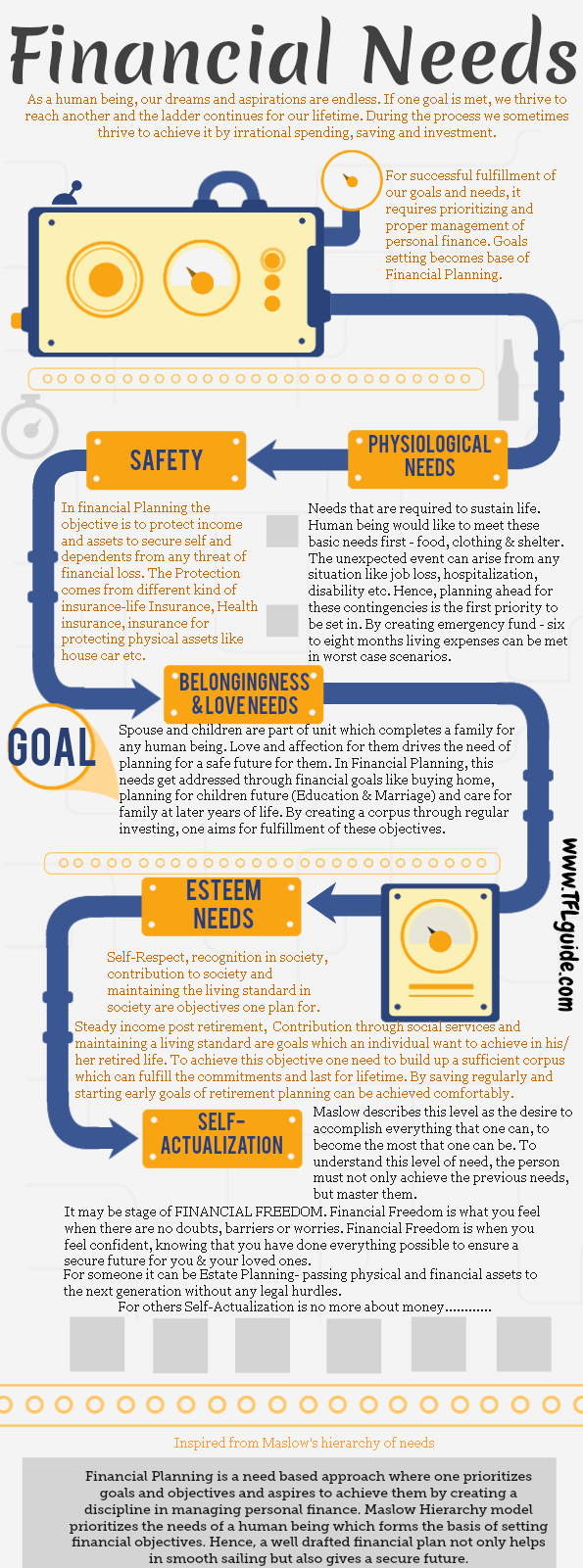
When I looked at his plan, I understood the problem immediately. He had planned extensively for Level 4 of Maslow’s hierarchy. He had barely thought about Levels 1 and 2. The pyramid was being built from the top down.

⚡ Quick Answer

Maslow’s hierarchy maps directly to financial planning: physiological needs (emergency fund, term insurance), safety needs (health insurance, income protection), social belonging (family security, estate planning), esteem needs (retirement corpus, wealth accumulation), and self-actualisation (purpose-driven wealth, legacy). Most Indians spend nearly all their attention on levels 3-4 while levels 1-2 remain poorly addressed. Build the base first.

Maslow's hierarchy of needs and financial goals India

What Maslow Tells Us About Financial Priorities

Abraham Maslow’s hierarchy proposes that human motivation follows a sequence. You cannot genuinely pursue higher-order needs until lower-order ones are reasonably satisfied. The pyramid is familiar: physiological needs at the base, then safety, love and belonging, esteem, and self-actualisation at the top.

The financial parallel is not metaphorical. It is operational. Most Indian families invest for Level 4 goals (the retirement corpus, the children’s education fund, the investment property) while Level 1 and Level 2 protections are incomplete. This creates a structural fragility that looks invisible until something goes wrong.

Vikram had no term insurance. His health cover was an employer policy that would lapse on retirement. His emergency fund was three months of expenses in a city where a hospitalisation routinely costs Rs 5-10 lakh. The pyramid was visibly top-heavy.

Level 1: The Financial Foundation

Physiological needs map to the most basic financial instruments: an emergency fund, term insurance, and basic health cover. These are not glamorous. They do not grow your wealth. They prevent your wealth from being destroyed in a crisis.

For a senior Indian executive, the emergency fund question is not “should I have one” but “how large.” The standard 3-6 months advice is designed for salaried employees with predictable income and minimal family medical complexity. For a 50-year-old with ageing parents, a dependent spouse, and a child still in college, 9-12 months of total household expenses is a more realistic floor.

Term insurance at this level is not optional. A Rs 1 crore term cover bought in your 30s at Rs 8,000-12,000 per year is one of the highest-value financial purchases available in India. Many people skip it because it pays nothing if you survive. That is precisely the point.

Level 2: Safety and Income Protection

Safety needs translate to health insurance, disability income protection, and a basic written financial plan. Health insurance is where I see the most consistent gap among Indian executives.

An employer-provided health policy is a liability disguised as a benefit. It covers you while employed. The moment you retire or change jobs, it lapses. A personal health policy, bought while you are healthy, is what survives job transitions and retirement. Many executives only realise this when they retire at 58 and try to buy individual cover to find premiums that are 3-4x higher.

Buy your personal health policy in your 40s. The premium difference is significant. More importantly, conditions that developed in your 40s will have cleared their waiting period by your 50s if cover was in place early.

The Financial Safety Floor for Senior Executives

For a senior executive family in 2026, the minimum financial safety floor looks like this: 9-12 months of household expenses in liquid instruments, personal health insurance above Rs 25 lakh sum insured, term insurance equal to 10-15x annual income, and a registered will with updated nominations across all accounts and policies. This floor typically requires Rs 50 lakh to Rs 1.5 crore in liquid and insurance instruments. Once it is in place, the risk calculus for everything above changes completely.

This is Maslow’s physiological and safety base. Build it before allocating more to the farmhouse.

Level 3: Social Belonging and Family Security

The third level maps to financial planning for the family unit: adequate protection for dependents, estate planning, and ensuring that the family’s financial life can continue without disruption if the primary earner is unable to contribute.

This is where wills and nominations become essential rather than optional. A family whose breadwinner passes without a registered will and updated nominations faces months or years of legal complexity at the worst possible time. In India, this is still dramatically underaddressed. Most people I meet have neither a will nor coherent nominations across their various assets.

Level 4: Esteem Needs and Wealth Accumulation

This is the level where most financial planning attention sits. The retirement corpus. The children’s education fund. The investment portfolio. The SIPs running for a decade. These goals matter deeply – but they are the fourth priority, not the first.

The tragedy I see repeatedly: a client has built Rs 3-4 crore in mutual fund investments. They have no personal health insurance. They have no will. One serious illness and the retirement corpus starts funding treatment rather than retirement.

Level 5: Self-Actualisation and Legacy

At the top sits what I call purpose-driven wealth: the use of money not just for security and accumulation, but for meaning. Charitable giving. Business succession. Building something that lasts beyond the individual.

Vikram eventually answered his own question. Once we addressed his Level 1-2 gaps and created a proper estate plan, the farmhouse project clarified too. It was not an investment. It was a plan to build a gathering space for his extended family – something he had been trying to recreate since his parents’ home in Mysore was sold. He was not missing money. He was missing meaning, and the inverted pyramid had been obscuring it.

Read: Medium Maximisation: Why More Money Is Not Making You Happier

Most financial plans are built upside down. Are yours?

RetireWise begins every engagement by checking whether the foundation is solid before optimising for the goals at the top.

See How RetireWise Structures Financial Planning

Vikram had Rs 12 crore and felt like something was missing. The farmhouse was not the answer. The base of the pyramid was.

Build the foundation. Then build the rest. In that order.

Which level of the financial hierarchy are you building right now?

RetireWise works with senior executives to build complete financial plans – from the safety floor up to legacy and succession.

Book a Free 30-Min Call

Your Turn

Look at the infographic above and ask yourself honestly: which level of the financial pyramid do you spend the most time and money on? And which level have you left incomplete? Share in the comments.