Home Blog Page 29

8 Smart Ways to Increase Your Credit Score in India

16

“Your credit score is a financial report card that follows you everywhere.” – Suze Orman

A client called me a few years ago, furious. He had been offered a home loan at 9.5% by his bank. His colleague, earning the same salary at the same company, had got the same bank’s offer at 8.7%. Same loan amount. Same tenure. The difference over 20 years: more than Rs 12 lakh in extra interest.

The reason? My client’s credit score was 680. His colleague’s was 780.

Your credit score is not just a number lenders check when you apply for a loan. It determines the terms on which you can borrow – and for many Indians approaching retirement with a home loan still running or planning to take one, even a modest score difference can cost lakhs over the loan tenure.

⚡ Quick Answer

A CIBIL score above 750 gets you the best loan rates in India. Below 700, you pay a premium. The fastest ways to improve your score: pay all dues on time without exception, keep credit card utilisation below 30% of your total limit, avoid multiple loan applications in a short period, and check your credit report annually for errors. Score improvement takes 6-12 months of consistent behaviour – there are no shortcuts.

How to increase CIBIL credit score in India - practical tips

How Credit Scores Work in India

India has four licensed credit bureaus: CIBIL (TransUnion), Experian, Equifax, and CRIF High Mark. Most lenders primarily use CIBIL scores, which range from 300 to 900. A score above 750 is considered excellent. Between 700 and 750 is good. Below 700 is where lenders start applying risk premiums.

Your score is calculated from five factors, weighted approximately as follows: payment history (35% – did you pay on time?); credit utilisation (30% – what fraction of your available credit are you using?); length of credit history (15% – how long have your accounts been open?); credit mix (10% – do you have a healthy variety of secured and unsecured credit?); and new credit enquiries (10% – have you applied for multiple loans recently?).

Understanding these weights tells you exactly where to focus improvement efforts.

8 Ways to Improve Your Credit Score

1. Check your credit report for errors first. Before doing anything else, get your free annual credit report from CIBIL, Experian, or CRIF. Errors are more common than most people expect – wrong personal details, accounts that aren’t yours, payments incorrectly marked as missed, or loans that were closed but show as active. Dispute errors directly with the bureau. A genuine error removal can improve your score significantly within 30-60 days without any change in your actual financial behaviour.

2. Never miss a payment – automate everything. Payment history is the largest factor in your score. Even a single missed EMI or credit card payment can drop your score by 30-50 points and stays on your record for years. Set up auto-pay for every recurring obligation: EMIs, credit card minimum amounts, and utility bills. The minimum amount auto-pay on credit cards is a safety net – you should still pay the full balance ideally, but the auto-pay ensures you never accidentally miss even the minimum.

3. Keep credit card utilisation below 30%. If your total credit card limit across all cards is Rs 5 lakh, try to keep the combined outstanding balance below Rs 1.5 lakh at any time. High utilisation (above 50%) signals financial stress to lenders. This is the second fastest way to improve your score after fixing errors – reduce the outstanding balance and your utilisation ratio improves immediately at the next reporting date.

“A good credit score is built over years of boring consistency – paying on time, every time, without exception. It cannot be manufactured quickly, but it can be destroyed quickly. One missed payment on a large loan undoes months of careful behaviour.”

– Hemant Beniwal, CFP, CTEP | Founder, RetireWise

4. Keep old credit cards active. Length of credit history matters. An old credit card with a good payment record is a genuine asset to your credit profile. Do not close old cards just because you rarely use them. Use each card for a small purchase once every few months to keep it active. If a card is cancelled due to inactivity, the positive history of that account disappears from your score calculation.

5. Avoid multiple loan applications in a short period. Every time a lender pulls your credit report for a loan application, it creates a “hard enquiry” that slightly reduces your score. Multiple hard enquiries within a few months signal credit-seeking behaviour and can reduce your score meaningfully. If you are shopping for a home loan, do your research first and limit formal applications to 2-3 lenders rather than applying to 8-10 simultaneously.

6. Maintain a healthy credit mix. A mix of secured loans (home loan, auto loan) and unsecured credit (credit cards, personal loans) signals to lenders that you can responsibly manage different types of credit. A person with only credit cards and no loan history has a thinner credit profile than one who also has a home loan with a clean repayment record.

7. Obtain settlement certificates for closed loans. When you repay a loan in full, the lender does not always update the credit bureau records promptly. Get the “No Dues Certificate” or “Settlement Certificate” from every lender when you close a loan, and follow up to confirm it has been updated in the bureau’s records. Loans showing as “active” when they are closed can unnecessarily affect your score and DTI (debt-to-income ratio) calculation.

8. Be selective about loan guarantees. If you co-sign or become a guarantor for someone else’s loan, their repayment behaviour affects your credit score. If they default, your score suffers as if it were your own default. Only guarantee loans for people whose financial discipline you trust completely – and even then, understand that you are accepting a credit risk on their behalf.

Is your overall financial picture optimised for retirement?

A RetireWise retirement plan looks at your full financial position – liabilities, credit structure, insurance, and investments – to build a plan that maximises what you have available to compound toward retirement.

Book a Free 30-Min Call

CIBIL’s Four Basic Rules

CIBIL itself summarises the fundamentals simply. Pay your bills on time – every time, without exception. Keep your balances low relative to your credit limits. Maintain a healthy mix of credit types – a home loan, a vehicle loan, and a couple of credit cards is a stronger profile than only credit cards. Apply for new credit sparingly – not because you cannot afford it, but to avoid signalling that you are actively seeking credit.

These four rules cover the vast majority of score improvement for most people. Complex credit strategies are unnecessary if these basics are consistently followed.

Read – 7 Costly Credit Card Mistakes Almost Everyone Makes

Read – 7 Financial Planning Mistakes That Are Costing You Retirement Security

Frequently Asked Questions

How long does it take to improve a credit score?

Realistic timelines: fixing genuine errors (30-60 days after dispute resolution); reducing utilisation ratio (1-2 months after paying down balances); building consistent payment history (6-12 months of clean payments to see meaningful improvement). Going from 650 to 750 typically takes 12-18 months of disciplined behaviour. There are no legitimate shortcuts – any service claiming to improve your score quickly for a fee is either fixing errors (which you can do yourself for free) or making promises it cannot keep.

What is a good CIBIL score to get the best home loan rates?

Most major lenders – SBI, HDFC, ICICI, Axis – reserve their best rates for borrowers with scores of 750 and above. Between 700-750, you typically pay 0.25-0.50% more. Below 700, the premium can be 0.50-1.00% or higher, and some lenders may decline entirely. On a Rs 50 lakh home loan over 20 years, the difference between 8.5% and 9.5% is approximately Rs 7-8 lakh in total interest paid. Building your score before applying for a large loan is one of the highest-return financial improvements you can make.

Should I check my own credit score? Does it affect my score?

Yes, check it – and no, it does not affect your score. Checking your own credit report creates a “soft enquiry” which has no impact on your score. Only “hard enquiries” (when a lender checks your score for a loan application) reduce your score marginally. You are entitled to one free credit report per year from each of the four bureaus (CIBIL, Experian, Equifax, CRIF). Check at least once a year to catch errors early before they affect a loan application at a critical time.

A credit score above 750 is not a luxury for people planning large loans or nearing retirement. It is financial infrastructure that determines the cost of every rupee you borrow. Building and maintaining it costs nothing beyond consistent, disciplined behaviour – but the value it returns when you need it is substantial.

Pay on time, every time. Keep your balances low. Check your report annually. That is 90% of the work.

Want a retirement plan that accounts for your liabilities and credit position?

RetireWise builds retirement plans that account for outstanding loans, EMI obligations, and credit health – not just investments.

See Our Retirement Planning Service

💬 Your Turn

Have you checked your CIBIL score recently? Did you find any errors that affected it? Share your experience in the comments.

5 Reasons You Should Not Retire (Even If You Can)

“Hemant, I want to retire.”

Prakash (name changed) sat across from me — 54, VP at a large pharma company, children settled, corpus looking healthy. He had the look of a man who had already decided. The meeting, he thought, was a formality.

I smiled. “Let me ask you 5 questions first. If you can answer all 5, I will help you retire tomorrow.”

He leaned back, confident. “Go ahead.”

What followed was a conversation I have had hundreds of times in 25 years. And almost every time, the person who walks in wanting to retire walks out wanting to wait.

⚡ Quick Answer

Retirement is not just a financial decision — it is a life decision. Most senior executives focus on the corpus but ignore longevity risk, loss of identity, unfinished goals, wasted expertise, and social isolation. This article presents 5 reasons to reconsider retirement through a real advisor-client conversation.

Question 1: “How Long Do You Think You Will Live?”

Prakash: “I don’t know — 75? 80 maybe?”

Hemant: “India’s average life expectancy is around 71 years. But that is an average — it includes villages with poor healthcare, labourers, smokers. For someone like you — urban, educated, access to good hospitals — the number is closer to 82-85. Maybe more.”

Prakash: “Okay… so?”

Hemant: “So if you retire at 54, your corpus needs to last 28-31 years. That is not a retirement. That is a second career in money management — except this time, you cannot make a single mistake.”

Most retirement calculators assume 20 years. Reality is demanding 25-30. Every additional year you work does three things: it adds to the corpus, it delays withdrawals, and it shortens the period your money needs to survive. Working just 2-3 years longer can add ₹1-2 crore to your comfortable horizon at 75. Think about what ₹1 crore means at that age.

Question 2: “What Will You Do on Day 4?”

Prakash: “Day 4? What do you mean?”

Hemant: “Day 1 you celebrate. Day 2 you sleep in. Day 3 you take your wife out for lunch. Day 4 — what do you do?”

Prakash: (long pause) “I will… travel. Read. Maybe consult.”

Hemant: “Maybe. Or maybe you will sit in the drawing room at 10 AM wondering why nobody has called. Work gives you more than a salary, Prakash. It gives you structured time, social interaction, and a reason to get dressed in the morning.”

I have seen this pattern dozens of times. Rajiv (name changed), a senior bank executive, retired at 57 with excellent finances. Within 18 months — restless, short-tempered, increasingly disconnected. The corpus was intact. The person was not.

If you have a second career, a consulting practice, or a passion you have been building on the side — excellent. But “I will figure it out after I retire” is not a plan. It is a wish. And wishes do not pay the emotional bills.

Question 3: “Are All Your Financial Goals Actually Done?”

Prakash: “Yes — children are settled, house is paid off.”

Hemant: “What about your daughter’s overseas MBA she mentioned last year? Your mother’s long-term care? That Goa property you and your wife keep talking about?”

Prakash: (shifting in his chair) “Those are… optional.”

Hemant: “Today they are optional. At 65, when you cannot fund them, they become regrets.”

This is the pattern I see most often. Executives at 52-55 think their goals are done because the big ones — house, children’s education — are checked off. But there are always second-tier goals hiding in the background. A parent’s care. A lifestyle aspiration. A child’s wedding the way they want it.

Your 50s are the decade when income is highest and children are becoming independent. It is the most powerful accumulation window of your entire career. Closing it early costs more than most people calculate.

“Retirement is wonderful if you have two essentials — much to live on and much to live for.”

— Unknown (often attributed to various financial thinkers)

Not sure if your corpus covers ALL your goals — not just the obvious ones?

A 30-minute conversation can reveal the gaps hiding behind the confidence.

Talk to RetireWise

Question 4: “What Happens to Everything You Know?”

Prakash: “What do you mean? I will relax. Let the younger generation take over.”

Hemant: “You have 30 years of pharmaceutical industry experience. Regulatory knowledge. Supply chain expertise. Market understanding that took decades to build. When you retire, all of that either disappears — or you redirect it.”

Prakash: “Redirect it where?”

Hemant: “Teaching. Mentoring startups. Board advisory. Industry consulting. Writing. These are not ‘keeping busy’ activities — they are genuine contributions. And they typically pay enough to supplement retirement income while keeping your brain sharp and your purpose alive.”

The Japanese call it “ikigai” — a reason for being. It does not disappear at 60. It just needs a new expression. I have seen retired clients who mentor young professionals come alive in ways their corporate careers never allowed. The happiest retirees are not the ones with the largest corpus. They are the ones who found something to do on Day 4.

Question 5: “Who Will You Have Coffee With on Tuesday Morning?”

Prakash: (long silence)

Hemant: “This is the question nobody asks at retirement planning workshops. For 30 years, your social life has been built around work — colleagues, industry events, office lunches, WhatsApp groups with professional peers. The day you retire, that architecture collapses. Almost overnight.”

Prakash: “I have friends outside work.”

Hemant: “Do you? When was the last time you met them on a weekday? Your children are in other cities. Your wife has her own routine. Research consistently shows that social isolation is one of the biggest predictors of depression and cognitive decline in retired individuals.”

This is the one that hits hardest. Prakash sat quietly for a full minute after this question.

“I never thought about the social part,” he finally said. He is not alone. In 25 years, I have heard that sentence more times than I can count.

Prakash: “So… you are saying I should not retire?”

Hemant: “I am saying retirement is not a finish line. It is a transition. And transitions need preparation — not just financial preparation, but life preparation. Retirement expectations versus reality are very different things.”

Prakash: “What did you recommend?”

Hemant: “Work two more years. Use that time to build your Day 4 plan, strengthen your social circle outside work, and close the financial gaps we identified. Then retire — not because you are running from work, but because you are running toward something better.”

He did exactly that. Retired at 56 with a consulting practice already set up, a morning walking group, and a mentoring commitment at IIM Ahmedabad. His corpus was ₹40 lakhs larger. His life was immeasurably richer.

Retirement should be a beginning — not an ending you are unprepared for.

We help executives plan not just the corpus but the life that follows. Because a post-retirement plan is not complete until Day 4 has an answer.

Plan Your Complete Retirement

The question is not “can I afford to retire?” The question is “am I ready to live the life that comes after?”

Plan the money. But also plan the days.

💬 Your Turn

If Hemant asked you these 5 questions today, which one would you struggle to answer? Share below — the most common answer I get: “I never thought about the social part.”

LIC Term Plans in 2026: New Tech Term Plan, What It Covers, and How It Compares

A client called me last year asking whether he should buy LIC’s term plan or a private insurer’s. He had been an LIC policyholder his entire life – endowments, money-back plans, the works. Switching to a private insurer felt uncomfortable even though the numbers clearly favoured it.

I told him what I tell everyone: choose based on three things – the claim settlement ratio, the premium, and the sum assured you actually need. Brand loyalty is not a valid criterion for a product whose entire value lies in a claim being paid after you are gone.

If you are evaluating LIC term plans in 2026, here is what you need to know.

Quick Answer (2026)

LIC’s current term plans are the New Tech Term Plan (Plan 954, online) and the New Jeevan Amar (Plan 955, offline). Amulya Jeevan II and Anmol Jeevan II have been discontinued. LIC’s claim settlement ratio (98.7% in FY 2023-24) is among the highest in India. LIC premiums remain higher than comparable private insurer offerings for the same sum assured and tenure. For a Rs. 1 crore, 30-year term, LIC typically charges 15 to 25% more than HDFC Life Click2Protect or ICICI Prudential iProtect Smart. The right choice depends on whether the premium gap matters more to you than LIC’s perceived reliability.

LIC Term Plan 2026 - New Tech Term Plan Review

Table of Contents

The Discontinued Plans: Amulya Jeevan II and Anmol Jeevan II

LIC Amulya Jeevan II (for sum assured of Rs. 25 lakh and above) and LIC Anmol Jeevan II (for sum assured below Rs. 25 lakh) were LIC’s primary term products through much of the 2010s. Both have been discontinued. LIC replaced them with the New Tech Term Plan (Plan 954) for online purchase and New Jeevan Amar (Plan 955) for offline purchase in 2023.

If you hold an existing Amulya or Anmol Jeevan II policy, it continues to be valid until its term ends. Existing policyholders are not affected by the discontinuation. The plans simply cannot be purchased new.

LIC’s Current Term Plans in 2026

LIC currently offers two term insurance products.

New Tech Term Plan (Plan 954): LIC’s online term plan, available directly on the LIC website and through aggregators. The online channel allows lower premiums compared to the offline route since agent commission is not embedded. Available for individuals aged 18 to 65, with sum assured options from Rs. 50 lakh to no upper limit. Policy terms from 10 to 40 years. Maximum maturity age 80 years.

New Jeevan Amar (Plan 955): LIC’s offline term plan, purchased through LIC agents. Premiums are higher than the New Tech Term Plan for the same cover due to the distribution channel. Available for sum assured from Rs. 25 lakh upward. Policy terms 10 to 40 years. If you prefer the offline agent relationship, this is the product.

Both plans offer level sum assured (the death benefit stays constant throughout the policy term) and increasing sum assured options (the death benefit increases by 10% annually up to a maximum of double the original sum assured). The increasing option is useful for inflation-proofing the life cover over a long term.

New Tech Term Plan (Plan 954): Key Features

The New Tech Term Plan is a pure term plan – it pays the sum assured on death of the policyholder during the policy term and has no maturity benefit, surrender value, or investment component. This is the correct design for term insurance.

Key features of Plan 954 in 2026:

Sum assured: Minimum Rs. 50 lakh, no upper limit. This is a significant improvement over earlier LIC term plans – higher sum assured options were limited.

Policy term: 10 to 40 years, with maximum maturity age of 80. A 40-year-old can take a 30-year term to cover to age 70.

Premium payment options: Regular pay (throughout the policy term), limited pay (5, 10, 15 years), or single premium. Limited pay is useful for those who expect income to reduce after retirement.

Death benefit options: Lump sum, monthly income, or a combination. The monthly income option is useful for dependents who need regular cash flow management rather than a large lump sum.

Riders: Accidental death and disability benefit rider available. Critical illness rider not available as a standalone addition on Plan 954 – this is a gap compared to some private insurers.

Claim settlement ratio (FY 2023-24): LIC settled 98.74% of individual death claims. This is among the highest in the industry and the reason many buyers choose LIC despite higher premiums.

Tax Benefits

Premium paid on LIC New Tech Term Plan qualifies for deduction under Section 80C up to Rs. 1.5 lakh per year. Death benefit received by the nominee is tax-free under Section 10(10D) with no upper limit. Under the new tax regime, Section 80C deductions are not available, so the tax benefit calculation changes for those who have opted for the new regime.

LIC vs Private Insurers: The Honest Comparison

The comparison that matters in 2026 is LIC New Tech Term Plan vs the leading private alternatives: HDFC Life Click2Protect Super, ICICI Prudential iProtect Smart, and Max Life Smart Secure Plus.

On premium: for a 35-year-old non-smoker male seeking Rs. 1 crore term cover for 30 years, indicative annual premiums in 2026 are approximately Rs. 9,000 to Rs. 11,000 for private insurers (HDFC, ICICI, Max Life) and Rs. 12,000 to Rs. 14,000 for LIC New Tech Term Plan. The gap is 20 to 35% depending on the specific comparison. Over a 30-year term, this premium difference compounds significantly.

On claim settlement ratio: LIC at 98.74% is the benchmark. HDFC Life (99.5%), Max Life (99.5%), and ICICI Prudential (97.9%) are all at or above comparable levels in FY 2023-24. The claim settlement gap between LIC and the major private insurers has effectively closed over the past decade.

On features: private insurers typically offer more rider options (critical illness, waiver of premium, income benefit) and more flexibility in death benefit structures. LIC’s product is simpler and more standardised.

“The LIC premium premium – the extra cost people pay for the LIC brand – was justified when private insurers had claim settlement ratios of 85 to 90%. When the ratios converge to 97 to 99% across major insurers, the premium premium needs to be reconsidered. Both are good choices. The question is whether the price difference matters to you.”

Why Term Insurance Matters for Retirement Planning

Term insurance is the foundation of retirement planning for anyone with dependents and a retirement corpus that has not yet been built. The logic is simple: if you die in your 40s or early 50s before your retirement corpus is complete, your family needs income replacement. Term insurance provides that replacement at the lowest possible cost.

The sum assured needed is not a number to guess at. A reasonable starting calculation: 15 to 20 times annual income, plus outstanding liabilities (home loan balance, other debts), minus existing liquid assets the family could access. For a 40-year-old earning Rs. 25 lakh annually with Rs. 40 lakh in home loan outstanding and Rs. 30 lakh in liquid savings, a minimum sum assured of around Rs. 3.5 crore is appropriate.

Term cover becomes less critical as the retirement corpus grows. Once your assets exceed your liabilities and your dependents are financially independent, the need for life cover reduces. Many people let their term policy lapse or not renew after their children are working and the home loan is repaid. This is a reasonable decision for those whose retirement corpus is adequate.

For the 45 to 60 age group specifically: if the retirement corpus is not yet complete, term cover remains essential. The cost of a new term policy at 50 is high – a 50-year-old buying Rs. 1 crore term for 20 years will pay Rs. 35,000 to Rs. 55,000 annually depending on health and insurer. This is the cost of not having bought it at 35. Buy term insurance early; the compounding effect on savings from lower premiums is significant.

Is Your Life Cover Adequate for Your Retirement Plan?

RetireWise reviews insurance adequacy as part of retirement planning – ensuring your term cover aligns with your retirement corpus build-up timeline. Explore our approach.

See Our Services

Frequently Asked Questions

Are LIC Amulya Jeevan II and Anmol Jeevan II still available?
No. Both plans have been discontinued by LIC. LIC’s current term plans are the New Tech Term Plan (Plan 954, online) and New Jeevan Amar (Plan 955, offline). Existing policyholders with Amulya or Anmol Jeevan II policies are unaffected – their policies continue until term end.

Is LIC New Tech Term Plan better than private insurers?
It depends on what matters to you. LIC has one of the highest claim settlement ratios in the industry (98.74% in FY 2023-24) and the government-backed trust factor. Private insurers like HDFC Life and Max Life now have comparable claim settlement ratios and offer lower premiums (15 to 30% cheaper for the same cover) and more product features. If premium saving over 30 years matters, compare multiple options and choose the one that offers the best combination of price, claim history, and features.

How much term insurance do I need?
A starting calculation: 15 to 20 times annual income, plus outstanding loan balances, minus existing liquid assets. Review this calculation every 5 years – as your retirement corpus grows and loans reduce, the required sum assured decreases. Many advisors recommend letting term cover step down in tranches as wealth grows rather than holding maximum cover until the policy expires.

Can I buy a LIC term plan if I am 50 years old?
Yes. LIC New Tech Term Plan is available for ages 18 to 65, with maximum maturity age of 80. A 50-year-old can take a 30-year policy. However, premiums at 50 are significantly higher than at 35 or 40, and a medical examination is typically required for higher sum assured amounts. Pre-existing conditions may affect eligibility or result in premium loading. If you have no term cover at 50, take it immediately – the cost of not having it is far higher than the premium.

Before You Go

Related reading: Critical Illness Insurance: What It Covers and How Much You Need and 5 Investment Risks Every Retirement Investor Must Understand.

Do you have a term plan – LIC or private? What influenced your decision? Share in the comments.

One question for you: Given that LIC’s premium is 20 to 30% higher than comparable private insurers for the same sum assured, how much extra would you pay for the LIC brand – and does the claim settlement ratio data change that calculation for you?

7 Costly Credit Card Mistakes Almost Everyone Makes

“The first step to getting out of debt is understanding how you got into it.” – Suze Orman

Rishi joined his first job at 22, excited and financially free for the first time. Within six months he had three credit cards. Within a year he had a payment nightmare he could not wake up from.

His story is not unusual. Credit cards are the most misunderstood financial instrument in the Indian wallet – simultaneously useful and dangerous, depending entirely on how they are used. The 7 mistakes below cover nearly every way I have seen credit cards derail otherwise sensible financial plans.

⚡ Quick Answer

The 7 costliest credit card mistakes are: ignoring hidden charges, paying only the minimum due, treating your credit limit as disposable income, missing payment due dates, carrying too many cards, using cards for cash advances, and ignoring your credit card statement. The most expensive of these by far is paying only the minimum – credit card interest at 36-42% per year is one of the most destructive financial forces available to retail consumers in India.

Credit card mistakes that cost you money - 7 errors to avoid in India

Mistake 1: Not Checking for Hidden Charges

Credit card companies compete aggressively for customers with zero joining fees, reward points, and cashback promises. What the marketing does not highlight: annual fees that kick in after the first year, foreign transaction fees (typically 3-3.5% of the transaction), fuel surcharges, cash advance fees (2-3.5% of the amount withdrawn), and late payment fees that range from Rs 500 to Rs 1,300 depending on the outstanding amount.

Before applying for any card, read the Schedule of Charges document, not just the brochure. A premium credit card with Rs 5,000 annual fee can be justified if you use the lounge access and reward benefits – but only if you actually use them. Most people do not.

Mistake 2: Paying Only the Minimum Due

This is the most expensive credit card mistake and the one that traps the most people.

When you pay only the minimum due (typically 5% of the outstanding balance or Rs 200, whichever is higher), the remaining balance attracts interest at 3-3.5% per month – which is 36-42% per year. This is not a modest interest rate. It is roughly 5-6 times what a good equity mutual fund is expected to return annually.

A simple illustration: an outstanding balance of Rs 50,000 at 3.5% monthly interest, with only minimum payments made, would take over 10 years to clear and would cost more than Rs 90,000 in interest alone. The bank earns more than you borrowed.

Pay the full statement balance every month, on time, without exception. If you cannot do this, you are spending beyond your means and the credit card is amplifying the problem.

“Credit card debt at 36-40% per year is not debt. It is a financial emergency. I have seen it wipe out years of savings and destroy retirement plans that were otherwise well-constructed. Get out of it as fast as possible and never return.”

– Hemant Beniwal, CFP, CTEP | Founder, RetireWise

Mistake 3: Treating Your Credit Limit as Disposable Income

Your credit limit is not your money. It is borrowed money that must be repaid. Spending up to your limit because it is available is the most common path from financial stability to financial crisis.

A practical rule: never use more than 30% of your total credit limit across all cards. This protects your credit score (high utilisation damages it) and ensures you always have capacity to pay the full balance at month end without straining your bank account.

Mistake 4: Missing Payment Due Dates

A single missed payment activates three simultaneous penalties: a late payment fee, interest charges on the entire outstanding amount from the transaction dates (not from the due date), and a mark on your credit report that reduces your CIBIL score by 30-50 points.

Set up auto-pay for the full statement amount on a fixed date each month. This eliminates the risk of forgetting. If cash flow is tight in a given month, auto-pay at least the minimum to avoid the credit score damage – then clear the balance as quickly as possible.

Is credit card debt affecting your retirement savings rate?

A RetireWise retirement plan looks at your full financial picture – liabilities, expenses, and savings rate – to identify where restructuring would free up more for retirement corpus building.

Book a Free 30-Min Call

Mistake 5: Holding Too Many Cards

Each additional credit card creates a new due date to track, a new statement to check, a new annual fee to evaluate, and a new temptation to use. Multiple cards also create multiple opportunities for fraud, and managing them all requires discipline that most people do not consistently apply.

Two to three cards is adequate for most people: one for daily expenses and rewards accumulation, one as a backup with a different network (Visa/Mastercard), and possibly a co-branded card if you frequently use a specific airline or retailer and genuinely benefit from the specific rewards. Beyond three, the management overhead and fraud risk outweigh the reward benefits for most users.

Mistake 6: Using Credit Cards for Cash Advances

A credit card cash advance is among the most expensive forms of short-term borrowing available in India. Unlike regular purchases, cash advances have no interest-free period – interest starts from the day of withdrawal at 3-3.5% per month. The cash advance fee itself is typically 2.5-3.5% of the amount. A Rs 20,000 emergency cash advance can cost Rs 700 in fees plus interest from day one.

If you genuinely need emergency cash, a personal loan or borrowing from family is significantly cheaper. The credit card cash advance should be an absolute last resort.

Mistake 7: Ignoring Your Credit Card Statement

Credit card fraud and billing errors are more common than most people realise. Unauthorised transactions, duplicate charges, and service subscriptions you forgot to cancel all appear on your statement. If you are not checking monthly, you may be paying for them for months before noticing.

Check your statement immediately when it arrives each month. Dispute any transaction you do not recognise within the dispute window (typically 30-45 days from the statement date). Most banks have a zero-liability policy for fraudulent transactions reported within the window – but only if you report promptly.

Read – 8 Smart Ways to Increase Your Credit Score in India

Read – 7 Financial Planning Mistakes That Are Costing You Retirement Security

Frequently Asked Questions

Should I close credit cards I don’t use?

Generally, no. Closing a credit card reduces your total available credit, which increases your credit utilisation ratio and can lower your CIBIL score. It also removes the history of that card from your credit report, which can shorten your average account age. The exception: a card with a high annual fee that you receive no value from is worth closing after weighing the cost against the credit score impact. If you close a card, close a newer one rather than an old one – the older card contributes more to your credit history.

Is it better to have one premium card or multiple basic cards?

One premium card used well beats multiple basic cards managed poorly. A premium card (annual fee Rs 3,000-10,000) typically offers airport lounge access, higher reward rates, and travel benefits that justify the fee if you travel moderately. A basic card with no fee is fine if the premium benefits do not apply to your lifestyle. The decision should be based on actual benefits used, not aspiration about benefits you might use someday.

What should I do if I already have significant credit card debt?

Stop using the cards immediately for new purchases – use only cash or debit for current expenses. Prioritise paying off the highest-interest card first (typically the one with the smallest outstanding balance if rates are similar, or the highest rate card if rates differ significantly). Consider requesting a balance transfer to a card offering 0% or low-rate balance transfer promotions – many banks offer 3-6 months of reduced interest on transferred balances. If the total debt is large (over Rs 2-3 lakh), a personal loan at 12-15% to clear the credit card debt at 36-42% is a significant net saving even with the personal loan interest cost.

A credit card used correctly is a convenient, zero-cost instrument that builds your credit score and earns small rewards. A credit card used incorrectly is a 36-42% per year debt trap that destroys savings and retirement plans faster than almost any other financial mistake. The difference is entirely in the behaviour, not the card.

Pay the full balance. Every month. Without exception.

Want help building a retirement plan that starts with a clean financial foundation?

RetireWise builds retirement plans that account for your liabilities and debt obligations – not just your investment portfolio.

See Our Retirement Planning Service

💬 Your Turn

Which of these 7 mistakes have you made at some point? The minimum payment trap catches almost everyone at least once. Share your experience in the comments.

Top 10 Credit Score Myths That Need to Die (CIBIL Facts Every Indian Should Know)

“The creditworthy person is someone who has learned to defer gratification.” – Unknown

A client came to me two years ago. He wanted to buy a second property – a flat in Bengaluru for his daughter. Good income, solid savings, no history of defaults. He went to the bank expecting a straightforward home loan approval.

The bank came back with a higher interest rate than expected. His CIBIL score was 710. Not terrible, but not the 750-plus that earns the best rates. He had no idea his score was that low. He had never checked it – because he assumed people who never miss EMIs have nothing to worry about.

He was wrong. And he is not alone. There are persistent myths around credit scores in India that cost people real money – in higher loan rates, loan rejections, and missed opportunities.

⚡ Quick Answer

A credit score (CIBIL score in India) is a three-digit number between 300 and 900 based on your repayment history, credit utilisation, credit mix, and account age. A score above 750 typically gets you the best loan rates. Common myths – checking your score damages it, only loan defaulters need to care, income affects the score – are all false. Check your score annually, pay bills on time, keep credit utilisation below 30%, and do not close old credit cards.

Credit score myths and facts - CIBIL score guide for Indian borrowers

Myth 1: Checking Your Own Credit Score Damages It

Fact: Checking your own credit report is a “soft inquiry” and has absolutely no impact on your score. Your CIBIL score is exactly the same whether you check it once a year or once a month.

What does damage your score is a “hard inquiry” – when a lender pulls your report because you applied for a loan or credit card. Multiple hard inquiries in a short period suggest to credit bureaus that you are desperately seeking credit, which is a negative signal. But your own periodic check? It does nothing negative, and it is the only way to catch errors or identity theft early.

Myth 2: Credit Score Does Not Matter If You Have No Loans

Fact: You do not know when you will need credit. A medical emergency, a business opportunity, a home purchase – these can arrive without notice. When they do, you want your credit score to already be in good shape.

Building a strong credit score takes time – typically 12-24 months of consistent credit behaviour. You cannot build it quickly in an emergency. Starting to care about your credit score only when you need a loan is like starting to save for retirement at 58.

Beyond loans, insurance companies increasingly use credit scores to assess premiums. Future landlords may check scores. In some roles, employers review credit history. The relevance of your credit score extends well beyond bank loans.

“My client never missed an EMI in his life – yet his score was below 750. The reason was high credit card utilisation. He was using 70% of his available credit limit each month. Good payment history matters, but it is not the only factor. Understanding all the factors is what protects you.”

– Hemant Beniwal, CFP, CTEP | Founder, RetireWise

Myth 3: Carrying a Credit Card Balance Improves Your Score

Fact: This is one of the most expensive myths in personal finance. Carrying a balance means paying interest – typically 24-42% annually on credit cards. It does nothing positive for your score. Worse, carrying a high balance relative to your credit limit damages your score through high credit utilisation.

The optimal credit utilisation ratio – the percentage of your available credit limit you are using at any time – is below 30%. If your combined credit card limit is Rs 5 lakh, try to keep your outstanding balance below Rs 1.5 lakh when your statement is generated. Above 30% utilisation, scores tend to drop. Above 50%, the damage is significant.

Myth 4: Your Income Affects Your Credit Score

Fact: CIBIL and other credit bureaus do not have access to your income data. Your salary, bank balance, assets, and net worth are not factors in your credit score calculation. A person earning Rs 5 lakh per month can have a lower score than someone earning Rs 80,000 – if the former has been less disciplined about repayments.

Credit scores measure creditworthiness – specifically, your pattern of borrowing and repayment – not your wealth. Income affects your loan eligibility (how much you can borrow), but not your credit score (whether you repay what you borrow).

Is poor credit score planning quietly costing you money on your loans?

A RetireWise retirement plan reviews your complete financial picture – including debt management and credit health – to ensure every aspect of your finances supports your retirement goals.

Book a Free 30-Min Call

Myth 5: You Can Take a Loan in Your Spouse’s Name If Your Score Is Bad

Fact: Credit scores in India are individual. Your spouse has their own CIBIL score based entirely on their own credit history – completely separate from yours. This means your poor score does not automatically damage your spouse’s score.

However: for joint loans (both names on the application), lenders typically evaluate both scores. If one score is poor, the loan may be rejected or offered at a worse rate. And if your spouse takes a loan as the primary borrower while you are a co-applicant, your score does affect the assessment.

Myth 6: Closing Old Credit Cards Improves Your Score

Fact: This often does the opposite. Two factors are at play. First, closing an old card reduces your total available credit limit, which increases your credit utilisation ratio on remaining cards – typically hurting your score. Second, old accounts contribute to the “average age of credit accounts” factor, which older is better. Closing a 10-year-old credit card removes that history from your active accounts.

The practical rule: do not close old credit cards unless they have a significant annual fee and you genuinely get no value from them. If the card is free or low-cost, keep it open and make one small transaction every few months to keep it active.

Myth 7: Multiple Credit Cards Always Hurt Your Score

Fact: Having multiple credit cards is not inherently negative. What matters is how you use them. Multiple cards with low utilisation on each, all paid in full every month, can actually improve your score by keeping total utilisation low and demonstrating credit discipline across multiple lines of credit.

What hurts is applying for many new cards in a short period (multiple hard inquiries) or carrying high balances across multiple cards. The number of cards is less important than the behaviour around them.

Myth 8: A Good Score Guarantees Loan Approval

Fact: A good CIBIL score (750 and above) significantly improves your chances of loan approval and better rates – but it is not the only factor lenders consider. Income stability, employment type, existing EMI obligations relative to income, the type of loan requested, collateral availability, and the lender’s own risk appetite all matter.

A score of 800 with an unstable income history or very high existing EMI burden may still result in a qualified approval. The score is a strong factor, not the only one.

Myth 9: A Bad Score Cannot Be Fixed

Fact: A poor credit score is not permanent. Credit scores are dynamic – they respond directly to your current behaviour. The path to score improvement is consistent and takes time, but it is reliable: pay all bills on time (EMIs, credit card dues, utility bills linked to credit), reduce outstanding balances, avoid new credit applications for 6-12 months, and check your report for errors (which you can dispute with CIBIL if found). Most people with poor scores see meaningful improvement within 12-18 months of disciplined behaviour.

Myth 10: CIBIL Decides Whether You Get a Loan

Fact: CIBIL (and other credit bureaus like Experian, Equifax, and CRIF) are information companies. They compile your credit history and generate a score. They do not approve or reject loans – that decision belongs entirely to the lending institution, which uses the score as one input among several.

Different lenders have different score thresholds and risk policies. The same score might result in approval at one bank and rejection at another. If you are rejected at one institution, the rejection itself does not affect your score – but the hard inquiry from your application does slightly.

Read – 7 Costly Credit Card Mistakes Almost Everyone Makes

Read – 8 Smart Ways to Increase Your Credit Score in India

Frequently Asked Questions

What is a good CIBIL score in India and how do I check mine for free?

A score of 750 or above is generally considered good and qualifies you for the best loan rates from most lenders. Scores between 700 and 749 are fair – you will likely get approved but may not get the best rate. Below 700, approval becomes harder and rates higher. You can check your CIBIL score for free once a year at the CIBIL website (cibil.com). Alternatively, several banks and fintech platforms (Paytm, BankBazaar, etc.) offer free credit score checks with monthly monitoring.

How long does negative information stay on my credit report?

In India, CIBIL typically retains credit history for 7 years. A default, missed payment, or settlement (settled for less than the full amount) will appear on your report for up to 7 years from the date of the negative event. However, the impact on your score diminishes over time as you build more recent positive history. The most recent 24 months of behaviour carry the most weight in score calculations.

Can errors in my CIBIL report affect my score, and how do I dispute them?

Yes – errors in credit reports are more common than most people realise. Loans you have repaid may still show as outstanding, accounts that are not yours may appear (especially if someone has similar details), or settled loans may be incorrectly listed as written-off. Check your report carefully. To dispute an error, raise a dispute directly on the CIBIL website with supporting documentation (NOC letter from the lender, repayment proof). CIBIL is required to investigate and respond within 30 days. Correcting errors can significantly improve a score that was unfairly low.

Your credit score is a financial vital sign. Like your blood pressure, you cannot feel when it is going wrong – you only find out when it causes a problem. Check it annually, correct errors promptly, and manage the factors that drive it: payment history, utilisation, credit age, and new applications. A score above 750 is genuinely achievable for anyone with disciplined financial habits.

Know your score. Understand what drives it. Protect it proactively.

Want a complete financial health review including your credit and debt position?

RetireWise retirement planning covers your complete financial picture – investments, insurance, tax, and debt – to build a plan that is solid on every dimension.

See Our Retirement Planning Service

💬 Your Turn

Have you checked your CIBIL score recently? Were you surprised by what you found? Share your experience in the comments – especially if you have successfully improved a poor score.

LIC Single Premium Endowment Plan Review: The Real Return Nobody Tells You

“The most dangerous words in investing are: this time it’s different.” — John Templeton

Your LIC agent called it a smart investment. One premium, insurance plus savings, tax benefit under 80C. The perfect product for someone who just received a lump sum — a bonus, a gratuity, a PF withdrawal.

Here is what they did not tell you.

The actual return on LIC Single Premium Endowment Plan — after accounting for real bonus rates, the cost of embedded insurance, and now the 2023 Budget tax change — is somewhere between 4.5 and 5.5% per annum for most investors. That is below inflation. That is below SCSS. That is below a simple bank FD for senior citizens.

And since April 2023, if your single premium exceeded Rs 5 lakh, your maturity proceeds are fully taxable. The one tax advantage this product was sold on — gone.

This review will show you exactly why this product fails on both counts it promises — protection and investment.

⚡ Quick Answer

LIC Single Premium Endowment Plan (Plan 917) is a non-linked, participating endowment plan. Pay once, get insurance cover plus savings over 10 to 25 years. The real IRR is approximately 4.5 to 5.5% — well below what alternatives like PPF, ELSS, or even SCSS can deliver. Since Budget 2023, single premium policies with premium above Rs 5 lakh have lost their Section 10(10D) tax-free maturity status. Our verdict: the plan fails on both protection and investment. A term plan plus PPF or mutual fund SIP is a far superior combination for the same money.

LIC Single Premium Endowment Plan Review 2026

What Is LIC Single Premium Endowment Plan (Plan 917)?

LIC Single Premium Endowment Plan is a non-linked, participating, individual life assurance savings plan. You pay a single lump sum premium at the start. In return, LIC provides two things: life cover for the policy term, and a maturity benefit at the end of the term (sum assured + bonuses if you survive).

The plan has gone through several versions. The original reviewed here in 2014 was Table 817. The current active version is Plan 917 (UIN 512N283V03). The structure is the same — the numbers are slightly worse.

  • Entry age: 90 days to 65 years
  • Policy term: 10 to 25 years (maximum maturity age 75 years)
  • Minimum sum assured: Rs 50,000; no upper limit
  • Premium: single lump sum payment at start
  • Loan: available after 1 year; up to 90% of surrender value
  • Surrender: first year — 75% of premium; after first year — 90% of premium
  • Riders: Accidental Death and Disability Benefit and Term Assurance Rider available

The plan participates in LIC’s profits, earning Simple Reversionary Bonus each year plus Final Addition Bonus at maturity or death. But as we will show — this bonus story is not as attractive as it sounds.

The Tax Change Nobody Is Telling Policy Buyers

This is the single most important update to any existing review of this product. Finance Act 2023 removed the Section 10(10D) tax-free exemption on maturity proceeds for life insurance policies where the annual premium exceeds Rs 5 lakh.

For single premium endowment plans, this means: if your single premium paid was more than Rs 5 lakh, your maturity amount is no longer tax-free. It will be taxed as income from other sources at your applicable slab rate. For someone in the 30% bracket, this wipes out a significant portion of already modest returns.

🚨 If you invested more than Rs 5 lakh in a single premium endowment plan after April 1, 2023: Your maturity amount is taxable. The tax-free maturity benefit that agents used as a selling point no longer applies. This change was introduced in Budget 2023 and applies to policies issued on or after April 1, 2023. Policies purchased before this date are not affected. If you are unsure of your policy’s tax status, consult a CA or SEBI-registered advisor before making any decisions.

The original 80C deduction on the premium paid still applies — up to Rs 1.5 lakh limit. But on a single premium of Rs 5 lakh or more, only Rs 1.5 lakh qualifies. The rest earns no deduction and the maturity is also taxable. The tax “efficiency” of this product has collapsed.

The Real Return: What the IRR Actually Says

When LIC sells this plan, they show you a bonus illustration. It looks attractive on paper. Let us break down what you actually earn.

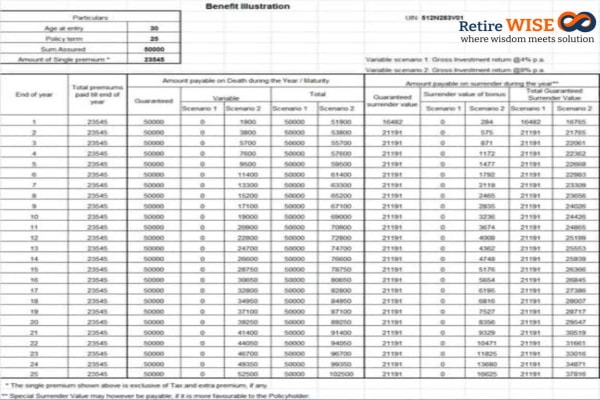
Here is an illustration for a 30-year-old investing in Plan 917 with a 25-year term:

Parameter Amount Notes
Sum Assured Rs 1,00,000 Base cover
Single Premium (approx.) Rs 62,355 Your one-time payment
Estimated maturity (at 8% assumed return) ~Rs 2,50,000 Includes sum assured + bonuses
Actual IRR ~5 to 5.5% Based on current bonus rates

Illustration based on LIC published premium tables and historical Simple Reversionary Bonus rates. Actual returns depend on LIC’s future bonus declarations, which are not guaranteed.

⚠️ The 8% assumption is misleading: LIC must show illustrations at 4% and 8% assumed investment return. The 8% figure is what LIC would need to earn internally to generate the illustrated maturity amount. This is not what you earn. Your actual return — the IRR on your premium — is approximately 5 to 5.5%. A 25-year PPF earns 7.1% tax-free. A 5-year SCSS earns 8.2% with your principal intact. An ELSS held for 25 years has historically delivered 12 to 15% CAGR.

Now Add Back the Insurance Cost You Are Paying

Here is the deception at the heart of every endowment plan. You are told you are getting insurance plus investment. What you are actually getting is an expensive insurance policy where the premium funds both the cover and the investment — and neither is optimal.

For a 30-year-old, a pure term plan for Rs 1 crore cover costs approximately Rs 8,000 to Rs 12,000 per year. A 25-year single premium term plan would cost roughly Rs 1.5 to Rs 2 lakh.

If instead of buying the LIC Single Premium Endowment Plan, that same person:

  • Spent Rs 1.5 lakh on a single premium term plan for Rs 50 lakh cover
  • Invested the remaining Rs 60,000+ in a PPF or liquid mutual fund

They would have better insurance coverage, better investment returns, and full liquidity. This is what “keep insurance and investment separate” actually means in practice.

Three Arguments Agents Will Give You — and Why They Fail

Argument 1: Family protection. You need lakhs in cover — ideally Rs 50 lakh to Rs 1 crore for a senior executive. To get Rs 50 lakh cover from an endowment plan, your premium would run into several lakhs. A term plan gives you the same cover for a fraction of the cost. The protection argument simply does not hold up at any realistic coverage level.

Argument 2: Guaranteed returns. The bonuses are not guaranteed. LIC declares them annually based on its surplus. Bonus rates have been declining over the past decade. What was illustrated in 2014 at 6% IRR is now closer to 5% in practice. There is no contractual guarantee on the bonus component — only on the sum assured.

Argument 3: Tax benefit. Section 80C deduction still applies on the premium up to Rs 1.5 lakh. But post-Budget 2023, if your single premium exceeds Rs 5 lakh, maturity proceeds are taxable. For most senior executives making large lump sum investments, the tax exemption on maturity is gone. And 80C space is better used for EPF, PPF, or ELSS — all of which give better returns.

What Should You Do Instead?

Need Better Option Why It Wins
Life cover Pure Term Plan 10x the cover for 1/10th the cost
Safe long-term savings PPF 7.1% tax-free, sovereign guarantee, 15-year lock-in matches retirement horizon
Wealth creation over 10+ years ELSS / Diversified Equity MF Historical 12-15% CAGR, LTCG tax-efficient, liquid after 3 years
Senior citizen income SCSS + Debt SWP 8.2% + flexible withdrawal + principal intact
80C tax saving ELSS or PPF Better returns, same or better tax benefit

The fundamental principle has not changed since 2014. Keep insurance and investment separate. A single premium endowment plan bundles both in a way that optimises neither. You end up with insufficient cover and inadequate returns — two problems instead of zero.

The RetireWise Verdict on LIC Single Premium Endowment Plan

Avoid. The IRR of 4.5 to 5.5% is below inflation and well below what alternatives deliver. The tax advantage on maturity is gone for policies with premium above Rs 5 lakh (post-Budget 2023). The insurance cover provided is expensive relative to pure term plans. If you already hold this policy, do not panic — evaluate surrender value, remaining term, and alternative deployment before making any decision. If you are being sold this product today, the answer is no.

Already Hold This Policy? What to Do

If you bought this plan before April 2023 and your premium was under Rs 5 lakh, your maturity is still tax-free. Sit tight — surrender charges mean you lose value by exiting early. Calculate your remaining term and surrender value before deciding.

If your premium was above Rs 5 lakh and the policy was issued on or after April 1, 2023, your maturity is taxable. In this case, model out the post-tax return carefully against alternatives. For most people in the 30% bracket, it may make more sense to surrender and redeploy — but run the numbers first with a SEBI-registered advisor before acting.

For a comprehensive understanding of how to structure retirement savings across products, read our guide on best investment options for senior citizens in India. And for understanding how insurance and investment interact in retirement planning, see our post on LIC Jeevan Akshay VII — when insurance products make sense.

Have a lump sum to deploy wisely?

At RetireWise, we help senior executives structure lump sum inflows — gratuity, PF, property proceeds — into a layered retirement income plan. Insurance where it belongs. Growth where it belongs.

Talk to a Retirement Specialist

A product that promises both insurance and investment — and delivers neither adequately — is not a compromise. It is a trap dressed as convenience.

Keep insurance and investment separate. Always.

💬 Your Turn

Have you been sold a single premium endowment plan? Did you know about the 2023 tax change? Share your experience below — your story could help someone avoid the same mistake.

Originally reviewed by Jitendra PS Solanki, CFP & SEBI-registered Investment Adviser. Updated and significantly expanded by Hemant Beniwal, SEBI-registered RIA, to reflect LIC Plan 917, Budget 2023 tax changes, and current 2026 market conditions.

8 Ways a Smaller House Saves You Money and Builds Retirement Wealth

23

“The most important financial decision many Indians make is not which mutual fund to buy. It is how big a house to buy.”

I have a small house. Not because I cannot afford a larger one. Because I made a deliberate choice years ago when we were buying, and I have not regretted it once.

The standard aspiration in Indian cities is to buy the largest house your loan approval allows. 3 BHK if you can afford 2 BHK. Villa if you can afford an apartment. The bigger the house, the more successful the life. This belief is so deeply embedded that suggesting otherwise feels almost antisocial.

But the financial math of a smaller house is powerful in a way that most buyers do not calculate when they are swept up in the excitement of purchase. And the retirement math is even more powerful.

⚡ Quick Answer

A smaller house does not just cost less to buy. It costs less every year to own, maintain, furnish, insure, and eventually sell. The capital freed by choosing a smaller house, invested consistently over 15-20 years, can produce more retirement wealth than the house itself. This is not a call to live uncomfortably. It is a call to size the house to your actual life rather than your imagined life.

8 ways a smaller house saves money and accelerates retirement wealth creation

The Purchase Cost Is Just the Beginning

Most buyers compare houses by purchase price and EMI. A 2 BHK at Rs 80 lakh versus a 3 BHK at Rs 1.2 crore. The EMI difference is Rs 25,000-30,000 per month on a 20-year loan. That difference, invested in equity mutual funds for 20 years at 12% CAGR, produces approximately Rs 2.5-3 crore of additional retirement corpus. The extra bedroom the 3 BHK provides is real. The Rs 2.5-3 crore opportunity cost is also real.

But the ongoing costs tell an equally important story.

“I have seen clients whose retirement planning was completely undermined by a house purchase decision made at 35. Not a bad investment – a house that was simply too large for their actual needs, that consumed capital and cash flow for 25 years.”

– Hemant Beniwal, CFP, CTEP | Founder, RetireWise

8 Ways a Smaller House Saves You Money

1. Lower EMI, more investable surplus. The most direct saving. Every rupee of lower EMI that goes into a SIP instead is a rupee compounding toward retirement. Over a 20-year loan term, the compounding effect of a smaller loan can be transformative.

2. Lower property tax. Property tax in Indian cities is calculated on the annual rental value or capital value of the property, which is directly related to area and location. A smaller house in the same locality pays significantly lower municipal tax every year. This is a permanent annual saving that runs for as long as you own the property.

3. Lower home insurance cost. Home insurance premiums are typically calculated as a percentage of the property value plus contents value. A smaller home with fewer contents costs measurably less to insure adequately every year.

4. Lower maintenance costs. Painting, flooring, electrical work, plumbing, waterproofing. Every maintenance cost scales with area. A 1,000 sq ft apartment costs roughly half as much to paint as a 2,000 sq ft apartment. Over 20 years of ownership, maintenance cost differences across house sizes add up to lakhs.

5. Lower furnishing costs. A larger house demands more furniture, more curtains, more lighting, more décor. The aspiration to fill a large house completely is a consistent source of spending that a smaller home avoids by design. Many families buy large houses and then spend years trying to furnish them adequately.

6. Lower utility bills. Electricity for air conditioning, lighting, and appliances scales directly with the number of rooms and the area being cooled and heated. A 4-room house uses noticeably more electricity than a 3-room house of the same construction quality, simply because there is more space to manage thermally.

Is your house size helping or hurting your retirement plan?

A RetireWise retirement plan accounts for your actual cash flows including EMI, maintenance, and the opportunity cost of capital tied up in property.

Book a Free 30-Min Call

7. Higher liquidity when you need it. A well-located smaller apartment is significantly easier to sell or rent than a large one. The buyer pool for a 2 BHK is many times larger than for a 4 BHK at the same price point. In a retirement scenario where you need to liquidate property for corpus or downsize to release capital, a smaller property is a more liquid asset.

8. The warmth dividend. This is personal, not financial. I genuinely believe that families living in appropriately sized homes interact more, communicate more, and build stronger relationships than families spread across oversized spaces where family members can disappear for entire evenings into separate rooms. The financial case for a smaller house is strong. The human case is equally strong.

The Retirement-Specific Calculation

For a 40-year-old choosing between a Rs 80 lakh 2 BHK and a Rs 1.2 crore 3 BHK, here is what the difference looks like at retirement (assuming 20-year loan, 8.5% interest rate, 12% equity CAGR):

EMI difference: approximately Rs 29,000 per month. Invested in equity for 20 years at 12%: approximately Rs 2.9 crore additional retirement corpus at age 60.

Annual maintenance/tax/utility difference: approximately Rs 60,000-80,000 per year. Invested over 20 years: approximately Rs 50-70 lakh additional corpus.

Combined: Rs 3.5-3.6 crore more retirement corpus from choosing the smaller house. The 3 BHK has one extra room. The 2 BHK has Rs 3.5 crore more retirement security. That is the trade-off, made explicit.

This does not mean everyone should buy the smallest possible house. It means the house size decision should be made with this calculation in mind, not purely on aspiration or what the loan approval allows.

Read – Hidden Charges in Buying and Selling a House: What No One Tells You

Read – The Real Key to Wealth Creation: Why Starting Early Beats Everything Else

Frequently Asked Questions

Is buying a house still a good investment in India?

It depends entirely on location, price paid, and how you define “investment.” A well-located residential property in a growing urban area may appreciate at 8-10% CAGR over 15-20 years. After accounting for property tax, maintenance, and the cost of capital tied up, the real return is often 5-7%. Equity mutual funds have historically returned 12-14% over the same horizon. A house is an asset and a home – but treating it primarily as an investment relative to equity often disappoints. Buy the house you need to live in, at a price that does not compromise your retirement savings.

Should I buy a second property for rental income in retirement?

The rental yield on Indian residential property is typically 2-3% of purchase price – one of the lowest in the world. A Rs 1 crore apartment generates Rs 20,000-30,000 per month in rent before taxes and maintenance. The same Rs 1 crore in a balanced retirement portfolio generating 8-9% produces Rs 65,000-75,000 per month. Rental income has the further complication of tenant management, vacancy periods, maintenance disputes, and illiquidity. For most retirees, a financial portfolio provides better and more flexible retirement income than a second property.

We already bought a large house. What should we do?

If the EMI is manageable and the house is right for your family stage, no action is needed. The decision is made. The relevant question now is: given this cash flow reality, are the remaining years of your career being used to build adequate retirement savings alongside the EMI? If the house is consuming too much cash flow to allow meaningful retirement savings, prepaying the loan aggressively (to reduce the EMI burden) and then redirecting the freed cash flow to SIPs may be the right path.

Living in a smaller house is not a sacrifice. It is a choice to keep more of your money working for your future rather than your walls. The families I have seen thrive in retirement are not the ones who owned the largest houses. They are the ones who sized their houses sensibly and invested the difference consistently.

Your house is a home. Your retirement corpus is your freedom. Do not trade one for the other.

Want to know how your current property decision is affecting your retirement plan?

RetireWise builds retirement plans that account for your actual net worth including property, outstanding loans, and investable corpus.

See Our Retirement Planning Service

💬 Your Turn

Did you size your house based on need, aspiration, or loan eligibility? Looking back, would you make the same decision? Share in the comments.

QROPS & UK Pension Transfer to India — The Complete NRI Guide (2026 Rules, Tax, HMRC List)

7

Suresh (name changed) worked in London for 14 years. Software engineer. Good salary. Contributed diligently to his employer’s pension scheme every month.

When he returned to Bangalore in 2019, he assumed his UK pension would follow him. Just transfer it, right? Like moving money between bank accounts.

Six months of emails, three rejected applications, one 25% tax charge threat, and a conversation with a solicitor later — Suresh still had £180,000 locked in a UK pension fund he couldn’t touch, couldn’t invest the way he wanted, and couldn’t easily bring home.

His question to me: “Is there any legal way to get my own money back to India without losing a quarter of it to the UK taxman?”

The answer is yes. But it’s complicated. And the rules have changed so dramatically since this post was first written in 2013 that almost everything about UK pensions for returning NRIs looks different today.

This is the guide I wish Suresh had found before making his first application.

⚡ Quick Answer

QROPS (now officially called ROPS — Recognised Overseas Pension Schemes) allows NRIs to transfer their UK pension to an approved scheme in India. If you’re resident in India AND the receiving scheme is in India, the 25% Overseas Transfer Charge does NOT apply. Several Indian insurers (HDFC Life, ICICI Prudential, Tata AIA, Kotak, SBI Life, LIC) are on the HMRC list. But being on the list ≠ HMRC approval. The UK Lifetime Allowance was abolished in April 2024. And with flexi-access drawdown now available, transferring may not always be the best option. This guide covers everything — rules, tax, the DTAA, alternatives, and the traps.

QROPS UK pension transfer to India for NRI - guide to recognised overseas pension scheme rules HMRC 2026

What Exactly is QROPS (Now Called ROPS)?

Let me clear up the terminology first, because this confuses almost everyone.

QROPS stands for Qualifying Recognised Overseas Pension Scheme. This was the original name HMRC gave to non-UK pension schemes that met their criteria for receiving transfers from UK registered pension schemes.

Since March 2017, HMRC renamed these to ROPS — Recognised Overseas Pension Schemes. You’ll see both terms used interchangeably online, including on HMRC’s own website. For this guide, I’ll use QROPS since that’s the term most NRIs search for, but know that ROPS is the current official name.

The core idea is simple: if you’ve built up a pension in the UK and you’ve left (or are leaving) the country, you can transfer that pension to an approved overseas scheme without triggering UK tax charges — provided you meet certain conditions.

Think of it like this. Your UK pension is a locked safe. QROPS is a set of approved keys. If you use the right key (an HMRC-listed scheme in the right jurisdiction), the safe opens without penalties. Use the wrong key — or try to force it — and you lose 25% immediately, plus potential further charges.

The 25% Overseas Transfer Charge — The Rule That Changed Everything

This is the single most important rule that NRIs need to understand. In March 2017, the UK government introduced a 25% Overseas Transfer Charge on QROPS transfers. This was a seismic change that made many advisors’ old recommendations obsolete overnight.

Here’s how it works: When you transfer your UK pension to a QROPS/ROPS, the UK pension scheme deducts 25% of the transfer value as a tax charge — unless you qualify for an exemption.

The exemptions that matter for Indian NRIs:

The 25% charge does NOT apply if, at the time of transfer, both you (the member) AND the QROPS are in the same country. This is the golden rule for NRIs returning to India. If you are tax resident in India and you transfer to an Indian ROPS-listed scheme — no 25% charge.

Other exemptions include transfers where both member and QROPS are in the EEA, or where the QROPS is an occupational pension scheme of the employer. But for most Indian NRIs, the “same country” exemption is the relevant one.

🚫 Critical Warning

If you transfer to a QROPS in a third country (say Malta or Gibraltar) while you’re resident in India, the 25% charge WILL apply. The “same country” exemption requires both you and the scheme to be in the same jurisdiction. And HMRC monitors this for 10 full UK tax years after the transfer. If you move to a different country within that period, the charge can be applied retrospectively.

This 10-year monitoring period is crucial. Even after a successful transfer to an Indian ROPS, HMRC watches. If the receiving scheme reports any non-compliance during those 10 years — such as paying benefits before the minimum pension age, or making payments that exceed the allowed limits — you could face retrospective charges.

Which Indian Schemes Are on the HMRC ROPS List?

HMRC publishes an updated list of ROPS every two weeks. As of early 2026, several Indian insurance companies have schemes on this list, including HDFC Life, ICICI Prudential Life, Tata AIA Life, Kotak Mahindra Life, SBI Life, Bajaj Allianz Life, LIC, and Axis Max Life.

You can check the current list directly on the UK government website at gov.uk/guidance/check-the-recognised-overseas-pension-schemes-notification-list.

But here is the critical caveat that HMRC itself states clearly — and which the original version of this post quoted verbatim from their website — being on the list is NOT the same as being approved by HMRC. The list only means the scheme has notified HMRC that it believes it meets the conditions. HMRC has not independently verified this.

This is not a technicality. I’ve seen cases where NRIs transferred to a listed scheme, only to face complications later because the scheme’s actual terms didn’t fully comply with HMRC requirements. The burden of due diligence falls on you and your UK pension trustee, not on HMRC.

What should you verify before transferring to any Indian ROPS:

Does the scheme have a minimum pension age of 55 (rising to 57 from April 2028)? Does it restrict tax-free lump sum to no more than 30% of the fund value? Is the scheme regulated by IRDAI (Insurance Regulatory and Development Authority of India)? Can the scheme report to HMRC as required for the 10-year monitoring period? Is it open to both residents and non-residents? What are the expense ratios and management charges?

That last point deserves emphasis. In my experience checking several of these schemes, some Indian QROPS carry expenses that are significantly higher than what you’d pay keeping the pension in the UK. If you’re paying 2-3% annual management charges in India versus 0.5-1% in the UK, the transfer might cost you more in fees over 20 years than the tax you’d save. Always check the numbers before moving.

The 2024 Game-Changer: UK Lifetime Allowance Abolished

Until April 2024, the UK had a Lifetime Allowance (LTA) — a cap on the total value of pension savings you could accumulate tax-efficiently. It was £1,073,100. If your pension exceeded this, you faced a punitive tax charge of 55% on the excess taken as a lump sum, or 25% if taken as income.

This was one of the biggest reasons NRIs transferred to QROPS — to escape the LTA charge. If your UK pension was approaching or exceeding £1 million, moving it to a QROPS jurisdiction that didn’t have an equivalent cap was a no-brainer.

From 6 April 2024, the UK abolished the Lifetime Allowance entirely. It has been replaced by two new allowances that only affect the tax-free portions of pension withdrawals — the Lump Sum Allowance (LSA) of £268,275 (the maximum tax-free cash you can take in your lifetime) and the Lump Sum and Death Benefit Allowance (LSDBA) of £1,073,100.

This changes the calculus significantly. If your primary reason for considering QROPS was to escape the LTA, that reason no longer exists. You can now build up an unlimited pension pot in the UK without facing the old LTA charge. The only restriction is on how much you can take tax-free — but that was always capped at 25% anyway.

For NRIs with larger pension pots (say £500,000+), this is genuinely important news. The case for transferring to India has weakened for high-value pensions, because one of the main tax advantages has disappeared.

Flexi-Access Drawdown — The Alternative to QROPS Transfer

Here’s something most NRI articles on QROPS don’t discuss: you don’t have to transfer at all.

Since the UK Pension Freedoms reforms of 2015, anyone over 55 (rising to 57 from April 2028) with a Defined Contribution pension can access their entire pension pot through flexi-access drawdown. You take 25% tax-free as a lump sum, and then draw down the remainder as income — paying UK income tax on each withdrawal.

For an NRI who is tax resident in India, the India-UK Double Taxation Avoidance Agreement (DTAA) comes into play. Under Article 20 of the India-UK DTAA, pension income paid to a resident of India is taxable only in India — not in the UK. This means you can potentially claim relief from UK tax on your pension drawdown payments.

The process requires filing a UK self-assessment tax return and claiming DTAA relief — or applying for a UK tax code adjustment. It’s bureaucratic, but doable with a cross-border tax advisor.

Why does this matter? Because if you can draw your UK pension while living in India, paying only Indian tax rates (which are likely lower than UK rates for most retirees), you may be better off NOT transferring to a QROPS at all. You avoid transfer fees, you avoid the 10-year HMRC monitoring period, you keep access to UK-regulated investment platforms with lower costs, and you still pay Indian tax rates.

This isn’t the right choice for everyone. If your pension is with a Defined Benefit (final salary) scheme, the rules are different — and transfer values for DB schemes have been volatile. If you have multiple small pension pots scattered across old employers, consolidating into an Indian ROPS might simplify your life. But the point is: QROPS transfer is a choice, not a necessity.

UK pension decisions are permanent. Get them right the first time.

Whether to transfer, where to transfer, and how to structure withdrawals — every NRI situation is different.

Speak to a Cross-Border Financial Planner →

How UK Pension Income Is Taxed in India — The DTAA Explained

This is the section that saves NRIs lakhs of rupees — and which most advisors in India don’t explain properly.

The India-UK Double Taxation Avoidance Agreement (DTAA), signed in 1993 and updated by protocol in 2012, has specific provisions for pension income.

Article 20 — Pensions and Annuities: Pension income paid to a resident of India (other than government pension covered under Article 19) is taxable ONLY in India. This means the UK has no taxing right on your private pension income once you’re an Indian tax resident.

What this means practically: If you’re resident in India and drawing a UK private pension, you declare the income in your Indian tax return and pay Indian income tax on it. You should not be paying UK tax on the same income. If UK tax is being deducted at source, you can claim it back through the DTAA relief mechanism.

Government pension (Article 19): If your UK pension is from government service (civil service pension, NHS pension, etc.), the rules are different. Government pensions can be taxed by the paying country (UK) unless you are a national of the receiving country (India) and not also a national of the UK. Most returning NRIs who are Indian nationals can claim DTAA relief even on government pensions — but the mechanism is different and you should get professional advice.

State Pension: The UK State Pension is payable worldwide and cannot be transferred to a QROPS. If you’re entitled to a UK State Pension, you’ll receive it in the UK and it will be frozen at the rate when you left (the UK does not uprate State Pension for residents in India, unlike for EEA residents). Under the DTAA, it should be taxable only in India.

The practical tax advantage: UK income tax rates for 2025-26 are 20% (basic), 40% (higher), and 45% (additional). Indian rates under the new tax regime max out at 30% above ₹15 lakh. For pension income in the £20,000-40,000 range, you might save 10-15% in tax by being taxed in India instead of the UK. On a £30,000 annual pension, that’s £3,000-4,500/year saved — approximately ₹3-5 lakh annually.

The QROPS Transfer Process — Step by Step

If after considering the alternatives you decide a QROPS transfer is the right move, here’s how the process works:

Step 1: Confirm your UK tax residency status. You must be non-UK tax resident. HMRC uses the Statutory Residence Test (SRT) to determine this. Generally, if you’ve spent fewer than 16 days in the UK in the tax year (or fewer than 46 days with no ties), you’re non-resident. If it’s borderline, get a formal ruling.

Step 2: Confirm your India tax residency. You should be tax resident in India (present for 182+ days in the financial year, or 60+ days if your India income exceeds ₹15 lakh). This is needed for the “same country” exemption to the 25% charge.

Step 3: Choose an Indian ROPS-listed scheme. Check the HMRC list (updated fortnightly). Verify the scheme’s terms, charges, investment options, and reporting capabilities. Popular options include pension/annuity plans from HDFC Life, ICICI Prudential, Tata AIA, and Kotak Life.

Step 4: Request a transfer from your UK scheme. Contact your UK pension provider and request an overseas transfer. They will ask you to complete HMRC Form APSS263 (Application for an Overseas Transfer). The UK scheme trustee will conduct due diligence on the receiving Indian scheme.

Step 5: The UK scheme processes the transfer. If everything checks out, the UK scheme transfers the funds directly to the Indian ROPS. This can take 3-6 months. Sometimes longer.

Step 6: HMRC reporting begins. The Indian ROPS must report to HMRC annually for 10 UK tax years. This includes confirming that benefits are being paid in accordance with the rules — minimum pension age, lump sum limits, etc.

Important: You cannot transfer a UK State Pension. You cannot transfer a pension from which you’re already receiving an annuity. And Defined Benefit (final salary) scheme transfers above £30,000 require advice from an FCA-regulated UK financial advisor before the scheme will process the transfer.

When QROPS Makes Sense — And When It Doesn’t

After researching this area extensively and advising NRI clients through the process, here’s my honest assessment:

QROPS transfer makes sense if:
You are permanently returning to India with no intention of going back to the UK. You have a Defined Contribution pension of moderate value (£50,000-300,000). You want to consolidate multiple UK pension pots into one Indian scheme for simplicity. The receiving Indian scheme has reasonable charges (under 1.5% annually). You’re under 55 and want to align your pension with your Indian retirement planning.

QROPS transfer may NOT make sense if:
You have a large Defined Benefit pension (transfer values can be significantly discounted and you lose guaranteed income). Your pension pot is very large (£500,000+) — the LTA is now abolished, and UK-based drawdown with DTAA relief may be more tax-efficient. You might return to the UK in the future — the 10-year monitoring creates complications. The Indian ROPS charges are significantly higher than your current UK scheme. You’re already over 55 and can access your pension through flexi-access drawdown in the UK.

The uncomfortable truth about QROPS advice: Many advisors who recommend QROPS transfers earn commission from the receiving scheme. The commission can be 5-7% of the transfer value. On a £200,000 pension, that’s £10,000-14,000 going to the advisor. This doesn’t mean their advice is wrong — but it does mean you should always get a second opinion from someone who doesn’t benefit financially from the transfer happening. I’ve personally checked several arrangements where the expenses were so high that the client would have been better off leaving the pension in the UK.

What Happens to Your UK Pension If You Do Nothing?

Here’s the option nobody discusses: leave it where it is.

Your UK pension doesn’t disappear when you leave the UK. It continues to grow (for Defined Contribution schemes) or continues to accumulate benefits (for Defined Benefit schemes). When you reach the minimum pension age (currently 55, rising to 57 in April 2028), you can access it — from anywhere in the world.

For a Defined Contribution scheme, you can take 25% tax-free and draw the rest through flexi-access drawdown. Under the DTAA, the taxable portion should be taxable only in India. You’d receive payments in GBP and convert to INR. There’s currency risk, but also potential currency benefit — the GBP/INR rate has historically trended in favour of GBP holders over long periods.

For a Defined Benefit scheme, doing nothing means you receive a guaranteed inflation-linked income for life from retirement age. This is often the most valuable option and should not be given up lightly. A DB pension guaranteeing £15,000/year index-linked for life has a capital value of £300,000-500,000. Transferring that to a QROPS converts guaranteed income into invested capital with no guarantees.

My advice to NRIs who ask: unless you have a compelling reason to transfer NOW, consider waiting. The rules are still evolving. India-UK DTAA may be updated. And you can always transfer later — but you can never reverse a transfer once it’s done.

Key Dates and Numbers Every NRI Should Know

Rule Current Position (2026)
Overseas Transfer Charge 25% — exempt if member and ROPS in same country
HMRC Monitoring Period 10 UK tax years after transfer
Minimum Pension Age 55 (rising to 57 from April 2028)
UK Lifetime Allowance Abolished from April 2024
Lump Sum Allowance (tax-free cash) £268,275 maximum in lifetime
Tax-free lump sum from QROPS Up to 30% if non-UK resident for 5+ tax years
Unauthorised Payment Charge 55% (for accessing before min age or non-compliance)
India-UK DTAA Pension Article Article 20 — pension taxable only in country of residence
UK State Pension Not transferable. Frozen rate for India residents. DTAA relief available.
DB Scheme Transfer Threshold £30,000+ requires FCA-regulated advice

Suresh’s Decision — And What It Teaches Us

Back to Suresh. After reviewing all options, here’s what we decided:

His £180,000 DC pension was with a low-cost UK provider charging 0.4% annually. He was 48 — seven years away from being able to access it. Transferring to an Indian ROPS now would lock him into a scheme with 1.8% annual charges and limited investment flexibility. He wouldn’t be able to access the money for another 7 years anyway.

We chose to leave it in the UK. When he turns 55 (or 57, depending on when the age changes take effect), he’ll take 25% tax-free as a lump sum and set up flexi-access drawdown. Under the DTAA, his drawdown income will be taxable in India, not the UK. He’ll receive approximately £5,000/year in pension income (₹5-6 lakh) alongside his Indian investments and NPS contributions.

Total cost of this strategy: zero transfer fees, zero 25% charge risk, zero HMRC monitoring complications. He keeps his money in a low-cost UK platform and pays tax only in India.

Would this work for everyone? No. An NRI with 5 small pension pots totalling £80,000 across different UK employers might be better off consolidating into one Indian ROPS for simplicity. Someone who has already returned to India permanently and is over 55 might find an Indian annuity scheme more convenient than managing UK drawdown from abroad.

The right answer depends on your pension type, your value, your age, your residency plans, and your tolerance for complexity. There is no universal answer.

Your UK pension is one of the largest financial assets you own

The transfer decision is irreversible. Don’t make it based on a blog post — make it based on professional cross-border advice tailored to your situation.

Get NRI Financial Planning Help →

Suresh told me something that stayed with me. “I spent 14 years earning that pension. I almost lost 25% of it in one wrong decision made in 15 minutes.” Your UK pension deserves the same care you put into earning it.

The right transfer decision isn’t always to transfer. Sometimes the smartest move is to do nothing — but do it deliberately, with full knowledge of your options.

💬 Your Turn

Are you an NRI with a UK pension? Have you already transferred, or are you still deciding? What’s the biggest challenge you’ve faced — tax confusion, HMRC paperwork, or finding the right scheme? Share your experience below.