Home Blog Page 27

LIC eTerm Plan Review — Discontinued, Here’s What Replaced It

If you’re searching for the LIC eTerm Plan to buy it online — stop. You can’t.

LIC eTerm has been discontinued. So has its successor, the LIC Tech Term Plan (Plan 854). Neither is available for new buyers anymore.

But before you panic — LIC hasn’t abandoned online term insurance. They’ve replaced both plans with something newer: the LIC New Tech Term Plan (Plan No. 954). And it’s actually a better product than the old eTerm ever was.

Let me walk you through what happened, what’s available now, and whether LIC’s current offering deserves your money — or whether you should look elsewhere.

⚡ Quick Answer

LIC eTerm Plan is discontinued — you cannot buy it anymore. Existing policyholders are still covered under their original terms. The replacement is LIC New Tech Term Plan (Plan 954), which offers ₹50 lakh+ cover, level or increasing sum assured, and online-only purchase. It’s a decent plan, but premiums remain higher than top private insurers like HDFC Life or Tata AIA.

LIC eTerm Plan Review - Discontinued, Replaced by LIC New Tech Term

🚫 Product Discontinued

LIC eTerm Plan and LIC Tech Term Plan (854) are no longer available for purchase. If you already hold either policy, your coverage continues unchanged. For new buyers, LIC now offers the New Tech Term Plan (954).

What Was LIC eTerm Plan?

LIC eTerm was LIC’s first online-only term insurance plan — a pure protection plan with no maturity benefit. It was launched when LIC finally decided to enter the online term insurance space, years after private insurers had already made online plans mainstream.

At the time, it was a big deal. LIC — the giant that had always relied on its army of agents — selling a plan directly online, cutting out intermediaries. The premiums were lower than LIC’s offline term plans, though still higher than what private insurers charged.

The plan served its purpose for a few years. But as the market evolved and IRDAI pushed for better products, LIC withdrew it and launched the Tech Term (Plan 854), which was later replaced by the current New Tech Term (Plan 954).

LIC New Tech Term Plan (954) — The Current Offering

This is what you should be looking at if you want an online term plan from LIC today.

Feature Details
Plan Number 954 (UIN: 512N351V01)
Plan Type Non-linked, non-participating, pure risk premium, online-only
Entry Age 18 to 65 years
Policy Term 10 to 40 years (maturity age cannot exceed 80)
Minimum Sum Assured ₹50 lakh
Sum Assured Options Option 1: Level (fixed throughout) | Option 2: Increasing (10% annual increase after year 5, for 10 years)
Premium Payment Regular pay or Limited pay (term minus 5 or 10 years)
Payment Frequency Yearly or half-yearly
Smoker Differentiation Yes — non-smokers pay lower premiums
Women’s Discount Yes — discounted rates for women
Purchase Mode Online only — through LIC’s website
Surrender Value None — pure protection, no cash value
Loan Facility Not available

What’s Better Than the Old eTerm?

The New Tech Term improves on the old eTerm in a few meaningful ways.

Increasing Sum Assured option. This is genuinely useful. With inflation eating into the value of money every year, a ₹1 crore cover today will feel like ₹50 lakh in 15 years. The increasing SA option (10% annual increase after year 5 for the next 10 years) partially addresses this. Most private insurers charge extra for this — LIC builds it in.

Limited pay option. You can pay premiums for a shorter period (policy term minus 5 or 10 years) and stay covered for the full term. This means if you take a 30-year policy with limited pay (minus 10), you pay for 20 years but remain covered for all 30. Useful for people who want to be done with premium payments before retirement.

Wider entry age. The new plan allows entry up to age 65 (old eTerm was 60). Better for people who realize late that they need coverage.

The Honest Assessment: Should You Buy LIC New Tech Term?

Here’s where I need to be direct with you.

LIC’s New Tech Term is a decent product. It’s not a bad plan. But it’s also not the best value for money in the market — and there’s one simple reason: premiums.

LIC’s term insurance premiums are consistently higher than comparable plans from HDFC Life, ICICI Prudential, Tata AIA, and Max Life. For the same sum assured, same age, same term — you’ll pay more with LIC. Sometimes 20-30% more.

The question people really want answered is: “Is the LIC brand name worth paying extra for?”

My honest answer after 18+ years in financial planning:

If trust is your primary concern — and you genuinely cannot sleep at night unless your term plan is with LIC — then yes, buy it. Peace of mind has value. Don’t let anyone shame you for choosing LIC. A slightly more expensive term plan that you actually BUY is infinitely better than a cheaper plan you keep “researching” for years while your family remains unprotected.

If value matters to you — and you’re comfortable that private insurers with 98%+ claim settlement ratios are reliable — then you’ll find better deals elsewhere. Private insurers have been paying claims in India for over 20 years now. They’re no longer “new” or “untested.” Read more about how to choose the best term plan.

Factor LIC New Tech Term Top Private Insurers
Premium Higher Lower (often 20-30% less)
Claim Settlement Ratio ~98% (high volume) 98-99%+ (lower volume)
Brand Trust Highest in India Growing — 20+ year track record
Increasing SA Option Built-in (Option 2) Available, sometimes extra cost
Payment Flexibility Yearly / half-yearly only Monthly / quarterly / yearly
Rider Options Accidental Death Benefit only Critical illness, waiver of premium, disability
Online Process Functional but basic Smoother UI, video medical, instant issuance

Confused between LIC and private term plans?

The right answer depends on your age, health, budget, and how much cover you actually need. A fee-only advisor can help you decide without earning commission from any insurer.

Get Unbiased Insurance Guidance →

What If You Already Hold LIC eTerm or Tech Term?

Good news — your policy is safe. Discontinuation only means LIC isn’t selling it to NEW buyers. Your coverage, premiums, and terms remain exactly as they were when you bought the policy.

Keep paying your premiums on time. Keep your nominee details updated. And make sure your family knows the policy exists and how to file a claim.

One thing I always tell clients: the worst thing that can happen isn’t a claim denial. The worst thing is when your family doesn’t even KNOW you had a term plan. I’ve seen cases where policies went unclaimed for years simply because the family didn’t know they existed. Don’t let that happen to yours.

NRIs — Can You Still Buy LIC Term Plans Online?

Yes. NRIs can purchase the LIC New Tech Term Plan online, provided they are present in India for the medical examination. The coverage is valid even when you’re living abroad.

However, the process isn’t as smooth as it sounds. LIC’s online platform still has limitations for NRI purchases — KYC requirements, payment processing through Indian bank accounts, and medical test scheduling can be frustrating when you’re visiting India for just a few weeks.

If you’re an NRI looking for term insurance, you have two options: buy from LIC when you’re next in India and have enough time to complete the process, or consider private insurers whose online processes are more NRI-friendly. Either way, don’t delay the decision. I’ve seen too many NRI families left unprotected because the paperwork felt “too complicated” during a short India visit.

Tax Benefits on LIC Term Plans

Whether you buy LIC or any private insurer’s term plan, the tax treatment is the same:

Section 80C: Premiums paid on term insurance qualify for deduction up to ₹1.5 lakh per year. This reduces your taxable income.

Section 10(10D): The death benefit — the sum assured paid to your nominee — is completely tax-free. Your family receives the full amount without any tax deduction.

These benefits apply regardless of which insurer you choose. Don’t let anyone use “tax benefit” as a selling point for a specific plan — they all qualify equally.

The Bottom Line on LIC Term Plans

LIC’s journey in online term insurance — from eTerm to Tech Term to New Tech Term — reflects how even the biggest institution in Indian insurance has had to evolve with the market. The current Plan 954 is a solid, no-frills product backed by the most trusted insurance brand in India.

Is it the cheapest? No. Is it the most feature-rich? No. But does it work? Yes — and for millions of Indians who will only buy insurance if it says “LIC” on it, that matters more than saving ₹2,000 a year on premium.

If you haven’t bought a term plan yet — from LIC or anyone else — please do it today. The company you choose matters far less than the decision to actually get covered.

Need help calculating your ideal term cover amount?

Most people either over-insure (wasting money on premiums) or under-insure (leaving their family exposed). A financial planner can calculate your exact Human Life Value.

Calculate Your Insurance Need →

Products come and go. eTerm came and went. Tech Term came and went. The New Tech Term will eventually be replaced too. But the need for your family’s financial protection? That doesn’t have a plan number — and it never expires.

The best time to buy a term plan was 10 years ago. The second best time is today.

💬 Your Turn

Did you hold the old LIC eTerm or Tech Term? Have you considered the New Tech Term, or did you switch to a private insurer? What drove your decision — trust, premium, or something else? Share below.

Why Market Predictions Fail (And What to Do Instead)

“The only function of economic forecasting is to make astrology look respectable.” – John Kenneth Galbraith

In 2010, a German octopus named Paul correctly predicted eight consecutive World Cup match results and became an international celebrity. In 2014, a turtle called Big Head took up the role. Every January, financial newspapers publish their “Top Picks for the Year.” Every December, someone tallies the score – and the results are quietly forgotten.

I have been in financial advisory for 25 years. In that time, I have seen every kind of market prediction: Sensex targets for year-end, “this stock will 10x in 3 years,” “real estate in this city will double.” Some come true by chance. The vast majority do not. And yet clients keep asking: “What do you think the market will do this year?”

My honest answer: I do not know. And neither does anyone else.

⚡ Quick Answer

Market predictions fail because markets are complex adaptive systems driven by millions of human decisions, unexpected events, and feedback loops no model can capture. Expert forecasters are wrong more often than right – and the one big call they get right is celebrated while many wrong calls are forgotten. The alternative is not to guess better. It is to build a financial plan designed to withstand uncertainty rather than depend on predicting it correctly.

Why market predictions fail and what to do instead

Why Predictions Are So Tempting

Carl Richards, the financial planner and author of The Behavior Gap, identified four reasons why we are drawn to predictions despite their poor track record.

It is fun. As social creatures, we enjoy being “in the know.” Having a market view makes us feel informed. Sharing it makes us feel valuable. The prediction is entertainment as much as information.

It is genetic. Our ancestors survived by predicting dangers. The rustle in the bushes might be a predator – better to predict and prepare. This survival instinct misfires badly in financial markets where randomness is far more prevalent than pattern.

We want control. Uncertainty is genuinely uncomfortable. A prediction – even a bad one – offers the illusion of control. The discomfort of not knowing pushes us toward anyone who claims certainty.

We forget quickly. The forecaster who predicted the 2020 crash is celebrated. The same forecaster’s 15 wrong calls in preceding years are invisible. Selective memory keeps prediction culture alive despite its poor aggregate track record.

“Every January I get calls asking what the market will do this year. My answer has not changed in 25 years: I do not know, and you should not trust anyone who claims to. What I know is what your financial plan needs – and that has nothing to do with where the Sensex ends in December.”

– Hemant Beniwal, CFP, CTEP | Founder, RetireWise

Why Predictions Structurally Fail in Financial Markets

Unknown unknowns. The biggest market-moving events are almost always things no one predicted: a pandemic, a war, a sudden regulatory change. By definition, the events that cause the largest movements are the ones not in any model.

Self-defeating prophecy. If a credible analyst publishes a “Sensex will reach X by December” prediction and millions act on it, those actions change the outcome. Predictions about social systems change the systems they describe.

Expert disagreement. For every analyst predicting a bull market, another predicts a bear market. Both cannot be right. When we “believe experts,” we are actually choosing which expert confirms what we already wanted to do.

Compound variables. A single market prediction requires getting right: GDP growth, corporate earnings, RBI rate decisions, global macroeconomics, FII sentiment, domestic retail flows, political stability – simultaneously and in correct interaction. The probability of getting all of these right is vanishingly small.

Is your retirement plan built on predictions or designed to withstand uncertainty?

RetireWise builds retirement plans that perform across multiple market scenarios – not plans that depend on a particular forecast coming true.

Book a Free 30-Min Call

What Works Instead: Planning Under Uncertainty

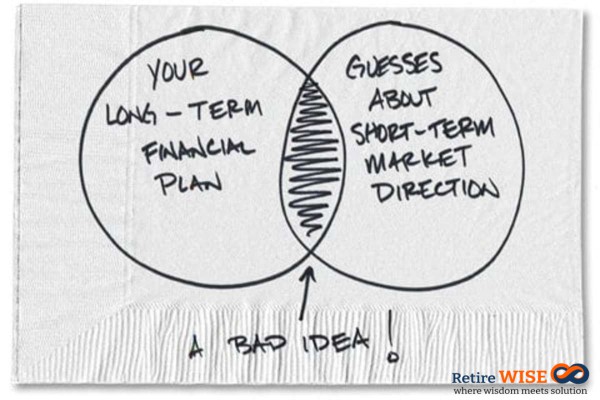
The alternative to prediction is not paralysis. It is building a financial plan designed to be robust across multiple possible futures rather than optimised for one predicted future.

Save more and spend less. This works regardless of market direction, interest rates, or any macroeconomic scenario. The savings rate is the one variable entirely within your control.

Invest consistently. Money waiting for the “right time” is not protecting you – it is costing you compound growth. Time in the market consistently outperforms timing the market over long horizons.

Diversify across asset classes. No one knows which asset class will outperform next year. A well-diversified portfolio reduces the damage from any single wrong prediction and smooths the ride across market cycles.

Work the plan with regular reviews. Good financial planning is not a one-time event. It requires regular review, rebalancing when allocations drift, updating projections when life circumstances change, and maintaining discipline when markets are uncomfortable.

Build flexibility into the plan. Things will not go exactly as planned. A good plan anticipates that changes will be needed and builds in the flexibility to make them without abandoning the fundamental structure.

Read – Timing the Market vs Time in the Market: What the Data Shows

Read – Portfolio Rebalancing: When and How to Do It

Frequently Asked Questions

If predictions are unreliable, should I ignore all market analysis?

No. Valuation analysis (are markets cheap or expensive relative to historical averages?), economic trend analysis (is the interest rate cycle turning?), and scenario planning (what would my portfolio look like under a 30% correction?) are all valuable. What to avoid is treating specific point predictions (“Nifty will reach X by December”) as the basis for major financial decisions. Use analysis to understand the range of possible outcomes, not to bet on one predicted outcome.

How should I handle the constant stream of market predictions in financial news?

Reduce your consumption significantly. Most financial news is prediction-driven content with no bearing on your long-term outcomes. Check your portfolio against your target allocation half-yearly, not against daily price movements. If allocation has drifted significantly, rebalance. Otherwise, let the plan run. The investor who reads less financial news and checks their portfolio less frequently consistently outperforms the one who does both daily.

What should I do when a market expert makes a very confident prediction?

Ask: what is this person’s track record on past predictions? In most cases, that track record is either unavailable or quietly poor. Ask also: what would I do differently if this prediction were correct, and what is the cost of being wrong? For most long-term investors, the cost of acting on a wrong prediction – selling at the bottom, missing the recovery – is very high. That asymmetry should make you cautious about acting on any single forecast, however confidently stated.

The future is uncertain. No prediction changes that. What you can change is whether your financial plan is designed to perform across a wide range of futures, or whether it depends on one specific future coming true. The former is financial planning. The latter is speculation dressed in professional language.

Plan for uncertainty. Do not bet on predictions.

Ready to build a retirement plan that does not depend on predicting the future?

RetireWise builds retirement plans stress-tested across multiple market scenarios – designed to deliver your goals whether markets cooperate or not.

See Our Retirement Planning Service

💬 Your Turn

Have you ever acted on a market prediction and regretted it? Or do you have a system that keeps you away from prediction-driven decisions? Share in the comments.

5 Insurance Policies You Probably Don’t Need – And One You Must Never Drop

“Insurance is not about getting the best deal. It is about having the right cover at the right time – and letting go of what no longer serves you.”

A client walked into my office a few years ago carrying a folder thick enough to be mistaken for a legal brief. Inside: eleven insurance policies. Term plans, endowment policies, ULIPs, a money-back plan, two health policies, a personal accident rider, and something his banker had sold him as “a guaranteed savings plan with life cover.”

He was paying Rs 1.8 lakh per year in premiums. Of that, Rs 1.1 lakh – more than 60% – was going to policies he did not need, did not understand, or that were actively working against his retirement goals.

Eleven policies. And his family was actually underinsured on the things that mattered.

⚡ Quick Answer

Insure things where the financial impact of loss is catastrophic and you cannot self-fund: term insurance, health insurance, critical illness. Skip or exit policies where the premium serves the seller more than you: investment-linked insurance, child plans, redundant death riders, bank-sold home loan protection plans. As you approach retirement, review every life insurance policy – several may have outlived their purpose, and freeing those premiums is one of the highest-return decisions you can make.

5 insurance policies you may not need - how to rationalise your insurance portfolio

The Framework: How to Think About Any Insurance Decision

Two questions determine whether insurance is worth buying: what is the probability of the event occurring, and what is the financial impact if it does?

High probability, high financial impact (health emergencies, motor accidents): insure without question. Low probability, high financial impact (premature death when you have young dependents, critical illness): insure after evaluating your situation. High probability, low financial impact (phone screen cracks, extended warranties): self-fund. Low probability, low financial impact (credit card loss, flight delays): ignore entirely.

Most insurance mis-selling happens in the bottom two quadrants. Products are dressed up to appear high-impact when they are not. The premium flows to the seller. You get cover for something that was never a real financial threat.

“In 25 years of reviewing client portfolios, I have never met anyone underinsured on things that did not matter. But I regularly meet people paying thousands per year on wrong policies while being underinsured on term and health.”

– Hemant Beniwal, CFP, CTEP | Founder, RetireWise

Policy 1: Insurance Mixed With Investment

This is the single most pervasive insurance mistake in India – and it costs families crores over a lifetime.

ULIPs, endowment plans, money-back policies, guaranteed return plans with life cover – all mix insurance and investment in a way that does neither well. The insurance component is expensive: a pure term plan gives 5-10x more cover for the same or less premium. The investment component is expensive: fund charges, mortality charges, and premium allocation charges reduce your effective returns significantly versus a mutual fund.

The product is structured this way because it generates far higher commissions for the seller. Your banker recommends it because the branch has insurance sales targets. Your agent recommends it because the first-year commission runs 25-35%.

What to do: Buy a term plan for life cover. Invest in mutual funds for wealth creation. Keep them separate. If you have an existing endowment or ULIP, evaluate whether surrendering makes sense after accounting for surrender charges. Here is a guide to exiting mis-sold insurance policies.

Policy 2: Life Insurance on a Child’s Name

The purpose of life insurance is to replace income that dependents will lose if the insured person dies. A child has no income. There is nothing to replace.

Child insurance plans – marketed as “securing your child’s future” – are typically endowment or ULIP structures on the child’s name. They are a marketing construct, not a financial solution. If you want to secure your child’s future, insure your own life adequately and invest separately for their education goals.

What to do: Large enough term insurance on your life plus dedicated SIPs for your child’s goals is the correct structure. Nothing else is needed.

Policy 3: Life Insurance After Retirement

This is the retirement angle that most insurance discussions completely miss.

Life insurance protects your dependents from the financial loss of your income. Once you retire, there is no active income to replace. If your children are earning, your home loan is cleared, and your spouse has her own income or pension – life insurance after 60 is, for most people, serving no real financial purpose. You are paying premiums to leave a legacy, not to protect a livelihood.

The exception: if your spouse depends entirely on your pension (which stops when you pass), or if you have outstanding liabilities. In those cases, some cover is warranted. Otherwise, freeing up Rs 30,000-80,000 per year in premiums and redirecting that to your retirement corpus for another 5-7 years is a meaningful decision.

What to do: At age 55-60, review every life policy. For each one ask: whose income am I protecting, and does that person still depend on my income? If the answer is no, plan a systematic exit.

When did you last review whether each policy still serves its purpose?

An insurance audit is part of every RetireWise retirement plan – identifying what to keep, what to exit, and how to redirect freed premiums.

Book a Free 30-Min Call

Policy 4: Accidental Death Rider When You Already Have Term

Accidental death insurance is largely redundant if you already have adequate term life insurance. Term insurance pays on death from any cause – accident, illness, or otherwise. Adding a separate accidental death policy means paying twice to protect against the same financial loss.

Where personal accident insurance adds genuine value: disability and income replacement cover. If an accident leaves you unable to work, term insurance does not pay because you are alive. A disability income rider or standalone personal accident policy covering loss of income from disability fills a real gap that is significantly underutilised in India.

What to do: If your personal accident policy covers only death and you have adequate term cover, it is likely redundant. If it covers disability and income replacement, it earns its premium.

Policy 5: Home Loan Protection Insurance Sold by Your Bank

When you take a home loan, your bank will almost certainly try to sell you a home loan protection plan – often presenting it as compulsory or strongly recommended. It is neither.

These plans are typically single-premium policies where cover reduces as your loan balance reduces. They are significantly more expensive than a plain term plan providing equivalent cover. They also lock you into the lender in a way that complicates refinancing to a better rate later.

The right solution: your existing term insurance (sized correctly) already covers your family’s ability to repay the home loan if you die. There is no need for a separate, expensive, loan-linked policy. More on why home loan protection insurance is usually a bad deal.

The Sunk Cost Trap in Insurance

The most common reason people keep paying for policies they should exit: “I have already paid so much, I cannot stop now.” This is the sunk cost fallacy. The premiums you have already paid are gone – irrelevant to whether you should continue. The only relevant question: does continuing this policy justify the ongoing premium? If the answer is no, exit – even if you have been paying for 12 years. Every year you keep a wrong policy is a year that money could have been compounding in your retirement corpus.

A policy kept out of guilt is not protecting you. It is just costing you.

The One Insurance You Must Never Drop: Health

Everything above is about rationalising. This is about holding firm.

Health insurance becomes more expensive and harder to obtain after 60. Pre-existing conditions create waiting periods. Many insurers limit or decline cover above certain ages. The medical costs of ageing are significant and inflation-linked at 12-15% annually.

Buy comprehensive personal health insurance in your 40s. Maintain it continuously through retirement. Never depend solely on an employer group policy that stops the day you retire. Never lapse a health policy and try to restart it – the underwriting at re-entry is far more stringent than at original entry.

Read – Critical Illness Insurance: Why Your Health Insurance Is Not Enough

Read – How Much Health Insurance Do I Need in India?

Frequently Asked Questions

Should I surrender my LIC endowment policy?

It depends on how many years you have paid and how many remain. In the early years (under 5), surrender charges are high and the case for exiting is strongest. After 15+ years on a 20-year policy, you may be close enough to maturity that surrendering costs more than waiting. Always model the numbers for your specific policy rather than applying a general rule.

At what age should I stop paying for life insurance?

Once your retirement corpus can sustain your spouse without your income, and your children are financially independent, the primary purpose of life insurance is fulfilled. For most people this happens between 55 and 65. At that point, making policies paid-up or letting them lapse is usually the right approach.

Is health insurance still needed after retirement?

Always. Buy personal family floater health insurance in your 40s, keep it running through retirement, and review the sum insured every few years to keep pace with medical inflation running at 12-15% annually.

More insurance is not better insurance. The right insurance is. And in retirement, much of what you paid for in your 30s and 40s has done its job. Releasing those premiums and redirecting them – even for 5-7 years – adds meaningfully to your corpus.

Review, rationalise, redirect. That is the insurance strategy for retirement.

Want a complete insurance audit as part of your retirement plan?

RetireWise reviews every policy you hold – what to keep, what to exit, and how to redirect freed premiums into your corpus.

See Our Retirement Planning Service

💬 Your Turn

Have you ever done a full audit of your insurance policies? What did you find – and what did you decide to exit? Share in the comments.

It’s a bull run when… [infographics]

Yesterday I got a call from my close friend; he is a banker – heading loan department. Before even saying Hi-hello, he said “I have 2-3 lakhs to invest for 6 months, please tell me few good stocks.” I was NOT surprised/shocked & told him, you called the wrong guy. I know he was frustrated at the end of the call but I can’t help. (before election results he told me that he is planning to sell ESOPs)

This conversation reminded me of this awesome article “It’s a bull run when…” by Mudar Patherya that was published in Business Standard. I have just picked few points & created this infographics… Here you go….

Bull Market

Please share, if you come across something similar happening around you in last few weeks or if you remember something from last bull run 2004-2008.  

How Smartphones Are Sabotaging Your Financial Decisions (2026 Update)

“The phone is the most powerful financial tool most people have ever owned. It is also the most powerful financial saboteur.”

I went to a restaurant some years ago for dinner with my family. When I looked around, something caught my attention. Nearly every table had the same feature: smartphones, face down or being scrolled. Couples, families, friends. Conversations replaced by screens. The device meant to keep us connected was separating everyone in that room.

I thought about this for a while and wrote about it. But what I did not explore deeply enough was the financial dimension. Because the smartphone is not just a social disruptor. For the Indian investor in 2026, it has become one of the most powerful engines of bad financial decision-making ever invented.

⚡ Quick Answer

Smartphones have made financial transactions instant, frictionless, and emotionally charged. One-click EMI approvals, instant stock trading, crypto apps, and shopping notifications have made it easier than ever to spend and invest impulsively. The same device that enables SIP automation and portfolio tracking also enables 2am stock tips, thematic NFO subscriptions, and unplanned EMI purchases. Used with awareness, a smartphone is a powerful financial tool. Used without awareness, it is retirement wealth destruction at scale.

Smartphones and financial decisions - how your phone is affecting your retirement wealth

The Financial Damage Has Multiplied Since 2014

When I first wrote this post in 2014, the financial damage from smartphones was mostly limited to higher phone bills, gadget upgrades, and increased shopping. Those problems still exist. But the financial risk profile of a smartphone has transformed since then.

In 2014, you could not invest in the stock market from your phone in under 60 seconds. You could not buy crypto with a fingerprint. You could not approve a Rs 2 lakh EMI for a new television at midnight on a Tuesday. You could not subscribe to a thematic NFO on a friend’s WhatsApp tip while sitting in traffic.

All of these are now possible. And each one represents a channel through which impulsive, emotion-driven financial decisions can be made before the rational mind has time to intervene.

“The best financial decisions are made when you are calm, unhurried, and not looking at a screen that is designed to make you feel urgency. Most financial decisions made on smartphones fail that test on all three counts.”

– Hemant Beniwal, CFP, CTEP | Founder, RetireWise

How Smartphones Are Damaging Finances in 2026

Instant EMI for everything. Buy Now Pay Later (BNPL) and instant EMI options are embedded in every major e-commerce app. A Rs 80,000 phone can become Rs 6,700 per month for 12 months with two taps. The friction of a bank visit or a credit application that previously made large purchases feel substantial has been entirely eliminated. The result: consumer debt has grown significantly among Indian salaried professionals who use BNPL without tracking total monthly EMI commitments.

App-based trading and impulsive equity decisions. Trading apps with real-time market data, social sentiment feeds, and one-tap order execution have made equity investing simultaneously more accessible and more dangerous. The investor who previously had to call a broker, discuss the trade, and wait for execution had time for second thoughts. The investor with a trading app can buy and sell emotionally, repeatedly, in response to each day’s market news. This churn is the primary destroyer of investor returns in direct equity portfolios.

WhatsApp and Telegram “investment groups.” Financial misinformation travels at phone speed in 2026. Stock tips, NFO recommendations, crypto opportunities, and “guaranteed returns” schemes propagate through WhatsApp groups faster than any regulator can respond. The combination of social proof (everyone in the group is saying the same thing) and urgency (“only valid today”) makes these channels particularly dangerous.

Notification-driven impulse spending. Shopping apps send 5-10 notifications per day to active users. Flash sale alerts, personalised recommendations, “item in your cart” reminders. Each notification is a purchase trigger designed by algorithm. The average Indian urban professional receives dozens of commercial notifications per day and does not notice the cumulative effect on purchasing behaviour.

Are your financial decisions being made thoughtfully or reactively?

A RetireWise retirement plan creates a framework where major financial decisions are pre-planned, not reactive to market news or notifications.

Book a Free 30-Min Call

How to Use Your Smartphone as a Financial Asset, Not a Liability

The smartphone itself is neutral. It enables both the best and worst financial behaviours. The difference is awareness and deliberate configuration.

Use it for automation, not manual decisions. The best financial use of a smartphone is setting up SIPs that execute automatically, bill payments that run on schedule, and insurance renewals that happen without intervention. Automating the good decisions removes willpower from the equation. The phone works for you while you sleep.

Turn off all shopping and trading app notifications. You do not need to know about a sale in real time. Sales are always available if you look. The notification exists to generate urgency, not to serve you. Turning off commercial notifications from shopping apps and trading apps removes the most effective purchase triggers from your daily environment.

Delete or move trading apps off the home screen. If executing an emotional trade requires three additional taps and a search, you have introduced enough friction to prevent most impulse decisions. Studies on behaviour change consistently show that adding small amounts of friction to a behaviour significantly reduces its frequency.

Designate “financial decision time.” Major financial decisions such as new investments, fund switches, large purchases, or loan applications should not be made on the phone in casual moments. Set aside a specific time (monthly, half-yearly) to review and make financial decisions with your full attention, at a table, with access to your financial plan. This is when the smartphone becomes an asset: you can run calculations, check statements, and execute pre-decided actions deliberately.

Read – How to Stop Buying Things You Never Use: The Retirement Cost of Impulse Purchases

Read – 7 Ways to Kickstart the Saving Habit That Actually Sticks

Frequently Asked Questions

Is using trading apps for investing bad?

Not inherently. Trading apps and mutual fund apps have democratised investment access in India in a genuinely positive way. The problem is not the tool but the behaviour it enables. Using a mutual fund app to set up and monitor a long-term SIP portfolio is excellent. Using a trading app to react to daily market movements with buy/sell decisions is destructive. The same phone enables both – your configuration and habits determine which one you end up doing.

My teenager is constantly on their phone and I worry about financial habits. What should I do?

This is a financial education opportunity. Teenagers who understand that every notification from a shopping app is a commercial sales attempt, that “no cost EMI” is not free money, and that impulsive purchases compound into significant amounts over years are much better equipped for financial adulthood than those who learn these lessons after their first decade of earning. Have the conversation explicitly, with examples and numbers.

I check my portfolio every day on my phone. Is that a problem?

For most investors, yes. Daily portfolio checking creates anxiety around short-term fluctuations that are irrelevant to a 15-year retirement horizon. It increases the probability of making reactive decisions (selling during a correction, switching funds after short-term underperformance) that reduce long-term returns. Half-yearly portfolio reviews are sufficient for most retirement investors. If you find yourself checking daily and feeling anxious, remove the app from your home screen as a first step.

Your smartphone is the most powerful financial device you will ever own. It can automate your retirement savings, track your progress, and execute your investment decisions effortlessly. It can also approve an EMI at midnight, subscribe to a crypto scheme on a friend’s tip, and drain your savings through daily sale notifications. The phone does not decide. You decide how to use it. But that decision requires awareness that most people never apply to their financial apps.

Use the phone to automate the right decisions. Do not let it make the wrong ones for you.

Want a retirement plan that removes impulsive financial decisions from the equation?

RetireWise builds retirement plans with automated SIPs, pre-planned rebalancing, and a clear framework that makes reactive decisions unnecessary.

See Our Retirement Planning Service

💬 Your Turn

Has your smartphone ever led you to make a financial decision you later regretted? And what have you done to protect yourself from impulsive financial decisions on your phone? Share in the comments.

6 Financial Lessons From People Who Built From Nothing

“The greater danger for most of us lies not in setting our aim too high and falling short; but in setting our aim too low, and achieving our mark.” – Michelangelo

Some of the most useful financial lessons do not come from finance books. They come from watching how people with nothing – no inherited wealth, no connections, no safety net – build something that lasts.

In 2014, I wrote a post drawing financial parallels from the rise of a leader who started with no money, no family backing, and no margin for error. The lessons I pulled out then are, I think, even more relevant now. The world has changed. The principles have not.

Here are six financial mindset lessons from the playbook of people who built their lives from scratch – with nothing given and nothing guaranteed.

⚡ Quick Answer

The six financial lessons: visualise a clear outcome and take calculated risk; build your plan with micro-level detail; accumulate resources before you act; be patient when you are confident in your direction; prepare for disruptions without losing sight of the bigger goal; and enjoy milestones without losing the discipline that created them. These are not productivity slogans. They are the architecture of every successful financial life I have seen in 25 years of advising.

Six financial mindset lessons for long-term wealth building

Lesson 1: Visualise the Outcome Clearly – Then Move Toward It

People who build something from nothing almost always start with an uncomfortably specific picture of what they are building toward. Not “I want to be financially free someday.” Something specific: “I want ₹5 crore by age 55 so that I never have to work for someone else again.”

This specificity matters because vague goals produce vague action. A retirement target of “enough money” will never be reached because there is no number to plan around, no SIP amount to calculate, no asset allocation to build. You will keep spending and investing loosely, and you will arrive at 60 with whatever is left over.

The people who build wealth from scratch tend to have a precise number in their head, a precise date, and a precise plan for how to get there. They do not change the destination every time the market moves. They adjust the route, not the goal.

In financial planning, this is called your North Star number – the corpus that generates enough passive income to cover your life, indefinitely, without you needing to work. Calculate it. Write it down. Build toward it with the same focus that any ambitious person brings to their most important goal.

“Life’s biggest financial stopper is the thought: what if I fail? People avoid risk to avoid that feeling. But wealth – like any meaningful achievement – only lives on the other side of calculated risk.”

– Hemant Beniwal, CFP, CTEP | Founder, RetireWise

Lesson 2: Build Your Plan With Micro-Level Detail

Large ambitions are achieved through small, precise actions. Not a vague intention to “save more” – but a specific SIP of ₹18,000 on the 5th of every month, into three specific funds, reviewed every six months against a specific benchmark.

I have seen more financial plans fail from vagueness than from bad markets. The person who says “I’ll invest more next year when I get my increment” and the person who says “I will increase my SIP by 10% every April 1st, automatically, regardless of market conditions” – these two people will be in radically different financial positions at 55.

Detail is protection against drift. When you have specified exactly what you will do and when, there is no room for “I meant to, but…” The plan either runs or it doesn’t. And when it doesn’t, you know immediately – because you had a clear specification to check against.

Your financial plan should include: specific monthly savings amounts, specific products those savings go into, specific review dates, specific trigger conditions for changes, and specific exit criteria for investments. Not a general intention. A precise instruction you give yourself in advance.

Lesson 3: Accumulate Your Resources Before You Act

A common financial mistake is starting before you are ready – investing in equity before you have insurance, buying a second property before the emergency fund is built, starting a business before you have 18-24 months of living expenses set aside.

People who build wealth from scratch have an unusual relationship with preparation. They are patient about readiness and ambitious about the goal. They spend years building the foundation before they start the structure.

In financial terms: insurance before investing, emergency fund before equity, clarity about your goals before choosing products. The order matters as much as the actions themselves.

Every rupee invested before the foundation is built is a rupee at risk of being liquidated in the first crisis. And a liquidated equity investment at the bottom of a market correction is worse than never having invested at all – you realise the loss and miss the recovery.

Is your financial foundation actually in place?

Emergency fund, insurance, clear goals – in that order. A 30-minute conversation will tell you where the gaps are.

Book a Free 30-Min Call

Lesson 4: Be Patient When You Are Confident in Your Direction

This is perhaps the hardest lesson in investing. Patience is not passive. It is an active choice, made repeatedly, in the face of short-term noise.

When a portfolio you built for 15 years shows a 30% drawdown in one quarter, patience is not the natural response. Panic is the natural response. The investor who stays the course – who keeps buying, who does not sell, who remembers why they built the portfolio in the first place – is doing something genuinely difficult.

The financial parallel to a person who holds their course under sustained pressure is the investor who does not sell quality equity positions because markets are volatile, who does not stop SIPs because NAVs are down, who does not change their asset allocation based on every news cycle. If your plan was built on sound reasoning, the evidence against it needs to be substantial and fundamental – not a quarter of bad returns, not a scary headline.

In equity, nothing meaningful happens overnight. The 12% CAGR that equity delivers over 15-20 year periods does not arrive smoothly – it arrives in lurches, after long flat periods, after scary drops. The investor who gets the 12% is the one who stayed invested through all of it.

Lesson 5: Prepare for Disruptions Without Abandoning the Plan

Even the best-designed plan will be disrupted. A job loss, a medical emergency, a market crash, a family obligation that consumes a year’s savings – these are not exceptions. They are the rule. Every long financial journey will encounter at least one of these.

The question is not whether disruption will happen. It is whether your plan is designed to absorb disruption without collapsing.

This is where the emergency fund earns its keep. Not the 3-month emergency fund. The 12-month emergency fund. And the personal insurance policies that run regardless of employment status. And the SIPs that continue even at a reduced amount during a lean period. These are not nice-to-haves. They are the shock absorbers that prevent a temporary crisis from becoming a permanent setback.

The financial plan that has no room for things going wrong will go wrong the moment something goes wrong. Build the capacity for disruption into the plan itself – not as an afterthought, but as a core design principle.

Read – Career Instability and Financial Planning: What the TCS Layoffs Taught Us

Lesson 6: Enjoy Your Milestones Without Losing the Discipline That Created Them

This one is subtler. When you hit a major financial milestone – corpus hits ₹1 crore, you pay off the home loan, you reach financial independence – there is a temptation to relax. To spend more freely. To tell yourself you have earned it.

And sometimes you have. Celebrating financial milestones is healthy. What is not healthy is treating every milestone as a reason to reset your standards.

The people who sustain wealth across decades do not change who they are when the money arrives. They celebrate quietly, reset the next goal, and keep the same habits – the same discipline about savings rate, the same scepticism about market noise, the same preference for boring, consistent investments over exciting ones. Success does not change the rules. It just raises the stakes.

The Common Thread in Every Financial Success Story

In 25 years of advising, I have never met a client who built serious wealth through a clever product or a market-timing stroke of genius. Every single person who arrived at retirement with genuine financial freedom had some version of the same story: they started early, they had a clear goal, they built a foundation before they invested, they stayed patient through multiple corrections, and they did not let lifestyle inflation consume the gains. The financial lessons above are not sophisticated. They are not new. They are simply what works – when actually applied, consistently, over a long enough period to allow compounding to do its work.

The gap between knowing these principles and living them is where most financial plans fail.

Read – The Law of the Farm: Why Patient Investors Always Win

Frequently Asked Questions

What is the single most important financial mindset shift for long-term wealth?

Moving from income-focused thinking to net worth thinking. Most people optimise for a good salary. People who build lasting wealth optimise for the gap between what they earn and what they spend – and they invest that gap consistently, regardless of how much the salary is. A person earning ₹5 lakh a month who saves 40% will build more wealth than one earning ₹10 lakh who saves 10%.

How do I stay patient during a market crash?

Build the conviction before the crash, not during it. If you have a written financial plan with a clear rationale for why you own what you own, you will find it far easier to hold through a 30% drawdown. The investors who panic-sell are almost always investors who never had a clear reason for buying in the first place.

Is it better to have a simple financial plan or a detailed one?

Simple to understand but detailed in execution. The goal, the target corpus, the asset allocation – these should be simple enough to explain in 2 minutes. The SIP amounts, the review dates, the specific funds, the trigger conditions for rebalancing – these should be specific enough to act on without decision-making at the time of action. Simplicity at the strategy level, precision at the operational level.

Every person who built wealth from nothing had one advantage over the people who started with more: they could not afford to be careless. That discipline, applied consistently over years, is the actual source of their wealth.

It’s not a Numbers Game. It’s a Mind Game.

Ready to build a financial plan with the same clarity and discipline?

25 years. 500+ families. A written plan built around your North Star number.

See Our Retirement Planning Service

💬 Your Turn

Which of these six lessons resonates most with where you are right now in your financial journey? And which one are you finding the hardest to actually apply? Share in the comments.

Financial Planning Infographics: The Rubik’s Cube of Your Financial Life

Financial planning can feel overwhelming – too many moving parts, too many products, too many opinions. This infographic cuts through the noise.

It was the visual that became the foundation of my CNBC book “Financial Life Planning” – built around the Rubik’s cube metaphor. Just as solving a Rubik’s cube requires understanding all sides simultaneously, financial planning requires seeing all the components of your financial life together – not one piece at a time.

Financial Planning Infographics

Financial Planning Infographics - Parts of Financial Puzzle, Life Stages, Common Misconceptions
Financial Planning Infographics

The infographic covers the parts of your financial puzzle, the gap between what people wish for and what actually happens, problems people face at different life stages, common misconceptions about financial planning, and how a structured planning process addresses them.

Erno Rubik, who invented the Rubik’s cube in 1974, once said: “If you are curious, you’ll find the puzzles around you. If you are determined, you will solve them.” That framing applies perfectly to financial planning. The puzzle is solvable – but only if you understand all its dimensions at once.

Ready to Solve Your Financial Puzzle?

RetireWise helps executives aged 45-60 build a retirement plan that brings all the pieces together – income, investments, insurance, estate planning, and tax. Explore how we work.

See Our Services

Which piece of your financial puzzle do you find hardest to solve – investing, insurance, tax, or estate planning? Share in the comments.

What Investors Lost Between the 2009 and 2014 Elections — And What It Teaches Us About Market Timing

Every election cycle in India brings the same conversations. Should I exit before the results? What if the wrong party wins? Should I wait until the market settles down?

In 25 years of advising, I have watched investors make this mistake repeatedly — exiting before elections, missing the rally, re-entering after the news is priced in, and ending up worse than if they had simply stayed put.

The period between 2009 and 2014 is one of the most instructive examples in recent Indian market history.

⚡ Quick Answer

Investors who exited Indian equity markets during the 2009-2014 election uncertainty — trying to avoid political risk — missed significant returns while sitting in cash or debt. The Sensex delivered strong returns over this period for those who stayed invested. Market timing around elections has historically destroyed more wealth than it has protected. The data consistently shows that time in the market beats timing the market.

The Relationship Between Risk and Return

Why do people take investment risk at all? Because risk and return have a relationship. Higher potential returns come with higher short-term volatility. The investor who tolerates that volatility — who does not exit when headlines are frightening — captures the return that the fearful investor leaves on the table.

Elections are one of the most powerful triggers of financial anxiety. The outcome is uncertain. The stakes feel high. And the financial media amplifies every uncertainty into a crisis narrative.

But here is what the data shows consistently: election outcomes, while meaningful for policy, are rarely as deterministic for long-term market returns as investors fear in the moment.

What Actually Happened Between 2009 and 2014

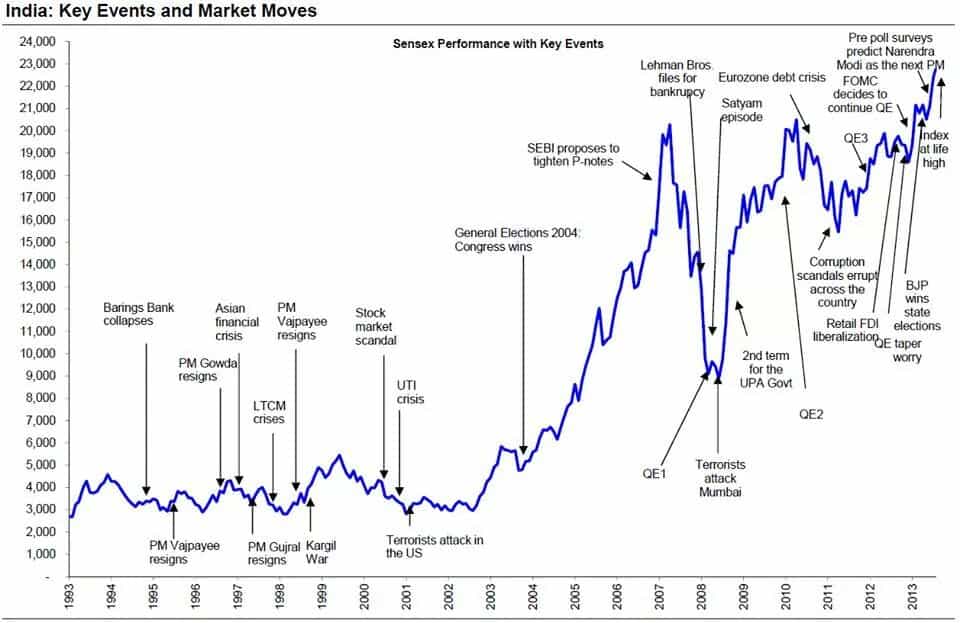
The UPA government won the 2009 elections with a stronger-than-expected majority. Markets surged 17% on a single day — one of the largest single-day rallies in Sensex history. Investors who had exited ahead of “election uncertainty” missed this entirely and re-entered at higher levels.

The five years that followed were a period of policy paralysis, high inflation, a weakening rupee, and significant corporate governance concerns. The Sensex essentially went nowhere in real terms between 2010 and 2013. Many investors — frustrated by the stagnation — exited.

Then 2014 arrived. The BJP’s landslide victory triggered a strong rally. Investors who had been sitting on the sidelines, waiting for “political clarity,” found themselves chasing a market that had already priced in the new government.

The investors who simply stayed invested through the entire 2009-2014 cycle — doing nothing, continuing their SIPs, not reacting to political news — captured the full return of the period.

Is your portfolio making decisions based on news — or based on a plan?

A fee-only advisor builds a plan that is designed to survive elections, market crashes, and news cycles — without constant intervention.

Talk to a RetireWise Advisor

The Cost of Missing the Best Days

There is a well-documented phenomenon in equity markets globally: the best single days of returns are often clustered around periods of maximum uncertainty — exactly when most investors have exited or are considering exiting.

A Sensex investor who stayed fully invested over the last 20 years captured significantly higher returns than one who missed even the 10 best days of that period. Missing the 10 best days — which represent less than 0.2% of total trading days — can cut long-term returns roughly in half.

The investor who exits before elections to “wait for clarity” is precisely the investor most likely to miss the best days.

What About Genuine Policy Risk?

Elections do matter for specific sectors. A government change can significantly affect infrastructure, defence, pharmaceuticals, and energy policy — creating both winners and losers at the sector level.

But for a diversified equity investor — one holding a broad market index fund or a diversified equity mutual fund — individual sector policy shifts are largely self-correcting over time. A new government may hurt some sectors and help others, but the aggregate market reflects the overall economic trajectory, not any single policy outcome.

The practical implication: if you hold concentrated positions in policy-sensitive sectors ahead of elections, some caution is warranted. If you hold a diversified equity fund, election timing is largely noise. The urge to do something during uncertainty is one of the most expensive biases in investing.

The Pattern Repeats Every Election Cycle

2014. 2019. 2024. Every election brings the same anxiety, the same exit conversations, and the same regret among investors who exited and missed the rally.

The lesson is not that elections do not matter. It is that predicting election outcomes, predicting market reactions to those outcomes, and predicting the timing of those reactions are three separate and extremely difficult forecasting problems that even professional fund managers consistently get wrong.

The investor who stays invested, keeps their SIP running, and ignores election noise is not being naive. They are being rational about the limits of their own forecasting ability. Behavioural finance has documented extensively why this kind of action bias destroys long-term returns.

Frequently Asked Questions

Should I exit equity mutual funds before Indian elections?

No. The evidence from every Indian election cycle — 2009, 2014, 2019, 2024 — is that investors who exited ahead of elections and re-entered after the results were announced consistently underperformed those who stayed invested. The problem is timing two decisions correctly: when to exit before the event, and when to re-enter after it. Both decisions must be right to benefit from the exit. Most investors get one or both wrong, and end up paying transaction costs, short-term capital gains tax, and missing some of the best market days in the process.

How do elections affect stock market performance in India?

Elections create short-term volatility but do not reliably predict long-term market direction. The 2009 election result caused a 17% single-day Sensex surge — investors who had exited missed this entirely. The 2014 and 2019 BJP wins triggered strong pre- and post-result rallies. But the 5 years between 2009 and 2013 were largely flat despite a stable government. Market performance over 5-10 years reflects corporate earnings growth and economic fundamentals, not which party wins. Short-term election-related volatility is noise for a long-term investor.

Which sectors are most affected by election results in India?

Infrastructure, defence, public sector banks, and energy are most directly affected by election outcomes since government spending and policy priorities shift significantly between governments. Pharmaceuticals, IT, and export-oriented sectors are less affected by domestic political outcomes. For investors with concentrated positions in policy-sensitive PSU or infrastructure stocks, some rebalancing before high-uncertainty elections may be warranted. For investors in diversified equity mutual funds with broad market exposure, election-driven sector shifts largely offset each other.

What is the cost of missing the 10 best market days in a long-term investment?

Research on the Sensex and global equity markets consistently shows that missing even 10 of the best trading days over a 20-year period can cut long-term returns roughly in half. For example, a Rs 10 lakh investment growing at 14% CAGR over 20 years becomes approximately Rs 1.37 crore. If the investor missed 10 of the best days — which are clustered around periods of maximum fear and uncertainty — the ending corpus might be closer to Rs 60-70 lakh. The best days tend to occur during exactly the periods when investors are most tempted to exit.

The charts from 2009-2014 tell a story that every election cycle confirms: the investors who lost the most were not the ones who picked the wrong outcome. They were the ones who exited and tried to re-enter at the right time. The ones who simply stayed invested came out ahead.

Do the Right Thing and Sit Tight. Through elections, through crashes, through noise. That is the strategy.

💬 Your Turn

Have you ever exited or paused your SIPs before an election — and what happened after? Share your experience below.