Home Blog Page 2

The ₹10 Crore Retirement Dream vs. The ₹60,000 Reality

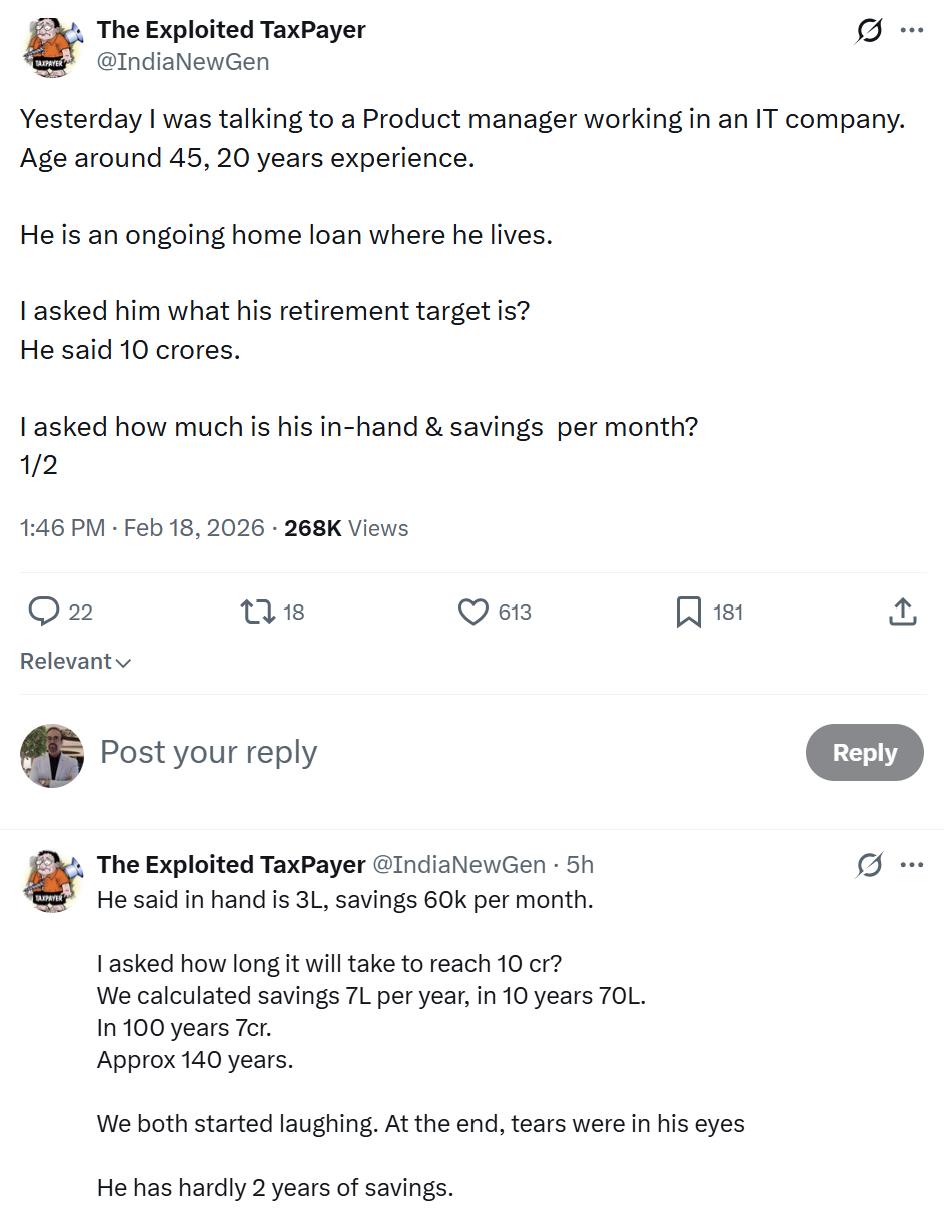
Yesterday, a Twitter thread went viral.

45-year-old product manager in an IT company with ₹3 lakh in-hand salary and 20 years of experience

Retirement target: ₹10 crore
Monthly savings: ₹60,000.

Twitter thread showing a 45-year-old IT professional with ₹3 lakh salary, a ₹10 crore retirement target, and only ₹60,000 monthly savings

When someone did the math for him, he started laughing. Then there were tears.

Because the numbers showed something he’d been avoiding for years: at his current savings rate, he’d reach ₹10 crore in approximately 140 years.

He has 15 years until retirement.

This isn’t a story about one person.

This is the story of middle-class India — and the harsh truth about retirement planning in India.

Middle-class couple in India reviewing retirement savings calculations, illustrating the aspiration-execution gap in retirement planning

8 Facts About Retirement Planning

The Aspiration–Execution Gap in Retirement Planning

We’ve all seen retirement calculators in India.

Punch in some numbers. Get a target retirement corpus. Feel momentarily anxious. Close the tab.

₹5 crore. ₹8 crore. ₹10 crore.

These numbers float around in our heads as vague targets — “somewhere around there should be fine.”

But here’s what I’ve learned after reviewing hundreds of retirement plans: most people treat their retirement number like a wish, not a plan.

They know the destination. They have no idea what the monthly ticket costs.

A ₹10 crore retirement corpus in India at age 60 sounds reasonable if you’re 45 and earning well.

But reasonable and achievable are not the same thing.

The gap between “I want ₹10 crore” and “I’m saving ₹60,000 a month” is where retirement savings gaps quietly grow.

The Math Nobody Wants to Do

Let me show you what ₹60,000 per month actually becomes.

Assume you’re 45. You have 15 years until 60.

Assume a consistent 12% annual return (which is optimistic for a balanced portfolio as you near retirement).

₹60,000 monthly SIP for 15 years = approximately ₹2.5 crore.

Not ₹10 crore. Not even close.

To reach ₹10 crore in 15 years at 12% returns, you’d need to save roughly ₹2.4 lakh per month.

Four times what he’s currently doing.

And that’s assuming no market crashes, no job loss, no medical emergencies, and a disciplined 12% return every single year.

The brutal truth? Most people in their 40s are tracking toward 20-30% of what they actually need.

Not because they’re irresponsible.

Because they started late, and nobody showed them the real math.

The Home Loan Trap and Its Impact on Retirement Savings

Here’s the part that makes this worse.
The 45-year-old in that thread? He has an ongoing home loan.

This is the Indian middle-class script:

Age 28-32: Get married, buy a house, take a 20-year loan.
Age 32-45: Pay EMI religiously. Feel like you’re “investing.”
Age 45: Realize the EMI ate your prime compounding years.
Age 48: Start panicking about retirement.

A ₹50 lakh home loan at 8.5% interest over 20 years costs you roughly ₹80 lakh in total payments.

That ₹30 lakh in interest? That’s ₹30 lakh that didn’t compound in your retirement corpus.

I’m not saying don’t buy a home.

I’m saying the home loan delay is why most people reach 45 with ₹2-3 lakh saved instead of ₹50-60 lakh.

And once you’re 45 with ₹2 lakh saved and ₹10 crore needed, the math stops being forgiving.

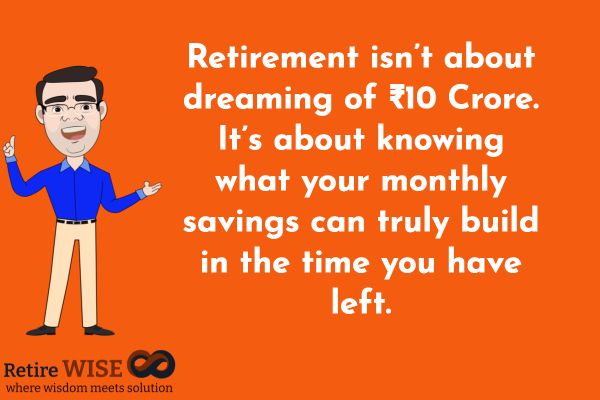
Retirement planning illustration showing three options to bridge the savings gap: increase savings rate, extend working years, or redefine retirement goals

What To Do After Retirement in India ?

The Recalibration Nobody Wants in Late Retirement Planning

So what does this 45-year-old do now?

He has three options. None of them are comfortable.

Option 1: Radically increase savings rate.

Cut lifestyle. Delay purchases. Push monthly savings from ₹60k to ₹1.5-2 lakh. Possible? Maybe. If both spouses work. If kids are done with expensive school years. If there’s zero lifestyle creep.

Realistic? For most people, no.

Option 2: Extend working years.

Don’t retire at 60. Work till 65. Maybe 67.

Buys you more earning years, more compounding years, and fewer withdrawal years.

The math works. The reality is harder. Not everyone’s body cooperates. Not every industry keeps you past 55.

Option 3: Redefine retirement.

This is the one nobody wants to hear, but it’s the most honest.

If ₹10 crore isn’t reachable, what is?

Maybe ₹4 crore is reachable. What does retirement look like on that?

Smaller house. Tier-2 city instead of metro. Simpler lifestyle. No foreign vacations.

Not a failure. Just a recalibrated reality.

The mistake isn’t ending up with ₹4 crore instead of ₹10 crore.

The mistake is reaching 58 still believing you’re on track for ₹10 crore when you’re not.

WHAT I’VE LEARNED IN 25 YEARS

I’ve had this exact conversation — the laughing that turns into tears — more times than I can count.

And here’s the pattern:

The people who sleep well at night did the uncomfortable math at 35.

The people who panic did the math at 50.

Same math. Different outcomes.

Because at 35, you still have options. The compounding window is open. Small course corrections create big results.

At 50, you have options too. Just harder ones.

The gap between aspiration and execution doesn’t close by itself.

It closes when you stop guessing and start calculating your real retirement corpus requirement.

Not someday.

Today.

Because 140 years is a long time to wait for ₹10 crore.

10 Myths that skew Retirement planning

10 Myths About Retirement planning

Retirement planning has gained prime importance largely due to changes in the lifestyle of people, an increase in life expectancy, the concept of nuclear families, and an urge to live independent retirement life without being financially dependent on children.

This article also got published on FirstBiz – a business news website owned by Network18.

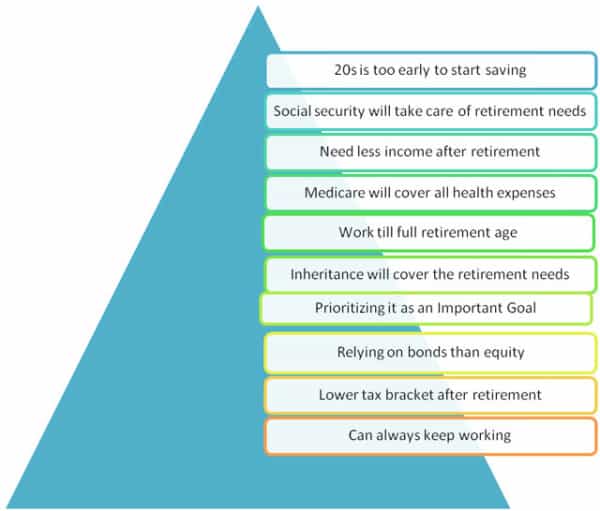
Infographic listing 10 common myths about retirement planning that mislead Indian investors and savers

Read: 5 reasons you should never retire

One has to be very cautious and meticulous while preparing a correct retirement plan to lead a financially comfortable retired life. Over this, there are many lies/myths surrounding retirement planning which need to be dispelled or it may hinder your progress in planning for retirement. Below are a few of them

1. Too early to start saving in the 20s

Why be bothered when I am just starting my career, is what many think. It’s a general myth that they can save later on in life for their retirement in their 40s. People think that since salary is low at earlier stages, it would be better to contribute bigger amounts when the salary gets fatter. Small savings at initial years of employment in life is more beneficial than saving a large amount at a later stage in life. A SIP (systematic investment plan) in the mutual fund of Rs 1000 for 35 years compounded at an annual rate of 15 percent can give approx Rs 1.45 Cr, where as Rs 10,000 for 10 years will give you only Rs 27.5 lakh amount earning a similar return.

[ss_click_to_tweet tweet=”10 big Lies that skew Retirement Planning” content=”” style=”default”]

2. Social security will take care of retirement needs

During their careers, people generally don’t bother about their retirement life as they think that social security benefits will take care of their retirement needs. This is very common with people serving in government departments. But, social security benefits don’t guarantee the same standard of living of a person in the post-retirement phase considering the inflation and the old structure of defined benefit plan.

3. Need less income after retirement:

It’s a myth that one will spend less money after retirement. It has been observed that people spend more money in the initial years of their retirement. This is the time when they freak out, purchase what they have been longing and do things they had been postponing due to their hectic work style during their career. They spend money on holidays, gifts and hobbies.Visual depiction of retirement myths, illustrating how common misconceptions can derail financial planning for retirees in India

Read: Is Rs 1 Crore enough to retire?

4. Medicare will cover all health expenses

Medicare doesn’t cover all health-related expenses. There are many costs which are not covered under medical insurance and the burden of these costs falls directly on the person. Even medical insurance covers only a portion of doctor’s fees and treatment and not the entire treatment. These costs are estimated to be huge and must be considered well while preparing a retirement plan.

5. Work until full retirement age

People believe that they will work until full retirement age which is 60/65 in most cases. But one cannot be certain that one will be able to work until the age of 65. It has been observed in many cases that one has to unwillingly take early retirement due to some untoward circumstances like health issues or shifting to another country. Thus one should start saving for their retirement from the initial years and must not rely on the savings of the last years of employment.

6. Inheritance will cover the retirement needs

Calculative Indian minds should not forget at least this! If one is likely to inherit some fortune in the future, it doesn’t mean that one should not bother about retirement needs. It can be likely that the inheritance could be used for paying off the debts or building assets for the future generations.

Graphic showing the big lies that skew retirement planning, including inheritance reliance, social security dependence, and underestimating post-retirement expenses

Read: Retirement Planning Vs Child Future Planning

7. Prioritizing it as an Important Goal

The greatest challenge faced in retirement planning is that it is never given prime priority. When one prioritizes his or her desires, retirement planning never finds the first place and one keeps postponing or putting it off until other desires are met.

8. Rely on Bonds than Equity

It’s a myth that one should invest in bonds which are safe investments for retirement and should keep away from stocks. While planning retirement for a 30-year period, one can invest in stocks either directly or through equity mutual funds which are professionally managed. Inflation can erode the returns of your investment in bonds. Also if you are planning for 25 years plus, equity is best in terms of returns.

9. Lower tax bracket after retirement

It is not necessary that income after retirement will fall in lower tax bracket. It may be possible that income clubbed together from all the sources (like from pension, rental income, interest, capital gains and income from other investments) can raise an individual to a higher tax bracket.

10. Can always keep working

A person may want to keep working even after retirement, either part-time or full-time. But it may not be possible for all.

Thus few of these myths related to retirement planning can obstruct us in building a correct and suitable plan to fulfill the needs of our post-retirement life stage. A true financial planner tries his effort best to eradicate and educate these myths. One needs to understand the implications and should take advice from a professional for building a successful Retirement Plan.

If you would like to know how you need as retirement corpus & how you can achieve that –

check my Do It Yourself book “Financial Life Planning”

The Parent Who Can’t Let Go – And the Retirement That Pays the Price

“The greatest gift you can give your children is not money. It is the confidence that they can manage without it.”

A client of mine – a 58-year-old senior manager in Jaipur – called me last year in a mild panic. His retirement planning was going smoothly. Then his 32-year-old son called him three times in one week: to ask whether he should open an FD, switch his SIP, and whether to accept a job offer in another city.

The son is a chartered accountant. He advises companies on financial decisions for a living. But he could not make a personal financial choice without calling his father first.

This is not a parenting story. This is a retirement planning story.

⚡ Quick Answer

Helicopter parents who extend over-involvement into their children’s adult financial lives create two problems simultaneously: financially incompetent adult children, and depleted retirement savings from funding those adults indefinitely. A July 2025 Business Today article called Indian retirees going broke helping their children a financial time bomb. The fix starts with understanding that the most loving thing you can do is stop rescuing.

How helicopter parenting destroys financial independence and parents retirement

What Helicopter Parenting Does to Money

The term describes a parent who hovers – making decisions for children instead of letting them make decisions themselves. At 8, it means choosing their friends. At 18, filling their college application. At 32, answering every financial question they should answer themselves.

Most discussions focus on the psychological damage – reduced autonomy, anxiety, dependence. All real. But there is a financial dimension that matters directly for retirement planning, and it almost never gets discussed.

The damage runs in two directions simultaneously. The adult child develops no financial competence because every decision was made for them. And the parent funds the gap between what the adult child earns and what they spend – often directly from retirement savings.

In July 2025, Business Today described this pattern as a financial time bomb. A retired government officer receives Rs 1 crore as his retirement corpus. One child needs startup capital. Another needs help with a franchise. The retiree hands over large portions – moved by love and guilt – with no structured plan for his own next 25 years. The result: mounting anxiety, shrinking savings, no safety net.

“He became the ATM for everyone else and forgot to keep cash for himself. This is not generosity. This is financial self-neglect, wrapped in emotional guilt.”

– Girish Agrawal, Mutual Fund Advisor, quoted in Business Today, July 2025

Five Financial Symptoms of Helicopter Parenting

The adult child cannot make financial decisions independently. They call before opening a bank account, choosing a mutual fund, or negotiating a salary. This is the result of never being allowed to decide and live with consequences. Financial competence is built through practice, not observation.

The adult child spends recklessly because a safety net always exists. When parents will always bail you out, there is no real cost to overspending. The subconscious knowledge that someone will cover the gap removes the incentive to manage money carefully.

The adult child is financially dependent well into their 30s. Paying rent, funding weddings, covering EMIs, financing ventures – each payment seems small and loving in isolation. Across a decade, it represents a systematic transfer of retirement savings from parent to child.

The parent’s retirement corpus is quietly depleted. Rs 2 lakh for a wedding venue upgrade. Rs 5 lakh for a car down payment. Rs 8 lakh to bridge a home loan gap. Each feels like a one-time gesture. Together they permanently reduce the corpus that must fund 20-30 years of retirement.

The parent delays or forgoes their own retirement. I have met clients in their 60s still working not because they want to, but because they cannot afford to stop. The plan was viable. Then the children needed help, repeatedly. And by the time they looked up, the corpus was insufficient.

Has supporting your children affected your retirement plan?

A retirement review can show exactly what the financial impact has been – and what needs to change for your plan to survive.

Book a Free 30-Min Call

The Uncomfortable Truth About Helping

Every helicopter parent believes they are doing the most loving thing. Protecting their child from failure. Saving them from struggle. Giving them what they did not have.

But 25 years of watching families across financial cycles has shown me this: the children who struggle financially in their 40s and 50s are disproportionately the ones who never had to solve a financial problem in their 20s. The adults who manage money well are almost always people who had skin in the game early – who paid their own bills, made mistakes, and absorbed consequences before the stakes were catastrophically high.

Financial competence is not taught. It is practised. You cannot practise something that someone else always does for you.

There is a deeper issue that Indian families rarely articulate: parents who fund adult children indefinitely are betting that they will never need that money themselves. Betting against major health crises, against inflation eroding the corpus, against living longer than planned. In most cases, at least one of these assumptions will be wrong.

The Real Cost of Each Transfer

Every rupee transferred from your retirement corpus to your adult child is a rupee that will not compound for your own use. A Rs 10 lakh transfer at age 58, which could have remained invested for 15 years at 10% CAGR, represents Rs 41 lakh of foregone retirement wealth. That is the real cost – not Rs 10 lakh, but Rs 41 lakh. Most parents make this calculation once, feel it is affordable, and move on. But across multiple such transfers, the cumulative cost can be the difference between a secure retirement and a dependent one. Your children have their entire earning life ahead. You have a finite window to accumulate. Prioritising their comfort over your security is not noble. It is dangerous.

Secure your own financial oxygen mask before helping others with theirs. This is not selfishness. It is the only sustainable arrangement.

What to Do Instead

Give responsibility early, not late. A child who manages a small pocket money budget from age 10 – and faces real consequences when it runs out – is being trained for financial life. The earlier the practice, the less expensive the mistakes.

Let them fail at low stakes before the stakes are high. A 20-year-old who runs out of money mid-month and has to skip eating out learns a lesson no lecture can teach. A 35-year-old who has never had that experience will make the same mistake with a home loan EMI and a family to support.

Teach by doing, not by deciding for them. Involve your children in family financial decisions – show them your budget, explain your investment thinking, include them in insurance and retirement conversations. Transfer understanding, not just outcomes.

Protect your retirement first. A financially secure parent is an asset to their children. A financially depleted parent is a burden on them. The most loving thing you can do for your children in their 30s is to not become their financial dependent in your 70s.

Read – Retirement Planning vs Child Future Planning: Which Comes First?

Read – 8 Facts About Retirement Planning You May Not Have Known

Frequently Asked Questions

Is it wrong to help my adult children financially?

No. Helping in a genuine crisis is reasonable. The problem is systematic, unconditional support that removes the need for financial competence and depletes your retirement savings. The test: does the help build independence or fund dependence? If continued support would be needed indefinitely for your child to remain financially stable, it is not help – it is a substitute for the skills they need to develop.

How much financial support for adult children is too much?

Any amount that requires you to reduce retirement savings, stop SIPs, borrow, or delay your own retirement is too much. Your retirement corpus is not a shared resource. Once your own financial security is fully funded, surplus wealth can be shared. But funding their lifestyle while your own plan is incomplete is the wrong sequence.

How do I raise financially independent children?

Give them money decisions early with real consequences. Let them fail at small things before stakes are high. When they are adults, treat financial requests as specific transactions – not open-ended entitlements. The goal is an adult who does not need you financially, and is therefore free to choose involvement rather than obligated to it.

The greatest risk to your retirement is not a market crash. It is quietly funding an adult child’s life while your own corpus silently shrinks. Love that protects your child from every consequence is not protecting them. It is preparing them to fail when you are no longer there to catch them.

It’s not a Numbers Game. It’s a Mind Game. And this one starts at home.

Is your retirement plan resilient to real-world family demands?

RetireWise builds plans stress-tested not just against markets, but against the financial decisions families actually make.

See Our Retirement Planning Service

💬 Your Turn

Do you recognise helicopter parenting patterns in your family – as a parent or someone raised that way? What financial habit did you carry from how money was handled in your home? Share in the comments.

Should You Buy an Electric Car in India? The Honest Financial Case (2026)

“In theory, there is no difference between theory and practice. In practice, there is.” – Yogi Berra

Every few months, a client calls excited about an electric car. They have done the research – lower running costs, lower maintenance, better technology, cleaner conscience. They have read the brochure. They have not run the numbers.

That is my job. And the numbers tell a more complicated story.

⚡ Quick Answer

For daily commuters covering 80-150 km per day, EVs now make strong financial sense – running costs are 70-80% lower than petrol. For typical urban families doing 30-50 km per day, the higher upfront cost takes 5-7 years to recover. The financial case depends entirely on your usage. Infrastructure and resale value remain real concerns in 2026.

📋 FACTCHECK NOTE – April 2026

This post has been updated from a 2021 version. Key corrections: FAME-II scheme ended March 2024 and has not been renewed in its original form; EV prices have changed significantly since 2021 with new models and variants; state incentive tables from 2021 are obsolete. Numbers below are current as of early 2026 – verify with the FAME portal and your state transport department for latest incentives before purchase.

Total Cost of Ownership – What It Actually Includes

The sticker price is not the cost of a car. This is true for any car, but it matters more with EVs because the gap between upfront cost and running cost is larger than with petrol cars.

Total Cost of Ownership (TCO) covers upfront costs (purchase price, registration, road tax), running costs (fuel/electricity, insurance), and maintenance costs (service, spares, battery health). For a fair comparison, you must calculate TCO over the same period – typically 5 years or 1 lakh kilometres.

EV Prices in India – 2026 Reality

The market has changed dramatically since 2021. Entry-level EVs are now genuinely accessible:

Segment Example Models Price Range (ex-showroom)
Entry hatchback Tata Tiago EV Rs 8-11 lakh
Compact SUV Tata Nexon EV, MG ZS EV Rs 14-20 lakh
Mid-size SUV Tata Punch EV, Mahindra BE6 Rs 10-18 lakh
Premium Hyundai Ioniq 5, Kia EV6, BYD Atto 3 Rs 45-65 lakh

Comparable petrol cars still cost Rs 5-10 lakh less in the same segment. The entry-level EV-to-petrol gap has narrowed, but it has not closed.

Running Costs – Where EVs Clearly Win

This is the strongest financial case for EVs in 2026. The numbers are now compelling:

Petrol at Rs 95-100 per litre, with a car giving 15-17 km/l, works out to Rs 5.5-6.5 per km. Diesel is slightly cheaper per km but the gap has narrowed.

An EV like the Tata Nexon EV Long Range (465 km real-world range) consumes approximately 0.14-0.17 kWh per km. At Rs 8-10 per kWh (domestic tariff in most cities), the cost is Rs 1.1-1.7 per km. That is a saving of Rs 4-5 per km on every kilometre driven.

ANNUAL RUNNING COST COMPARISON (50 KM/DAY, 18,000 KM/YEAR)

Petrol car (15 kmpl, Rs 100/litre): Rs 1,20,000/year

EV (Rs 9/kWh, 0.16 kWh/km): Rs 25,920/year

Annual fuel saving: Rs 94,000

At this usage, a Rs 5L price premium recovers in under 6 years. Higher daily usage = faster payback.

Maintenance – A Genuine Advantage

EVs have far fewer moving parts than internal combustion engine cars. No engine oil changes, no spark plugs, no air filters, no clutch, no exhaust system. Annual maintenance on an EV typically costs Rs 8,000-15,000 versus Rs 20,000-40,000 for a comparable petrol car.

The battery is the biggest variable. Current-generation lithium-ion batteries in Indian EVs typically carry an 8-year warranty. Real-world degradation at 5-6 years shows 10-15% range reduction in most Indian climates – acceptable for most users. Battery replacement, if needed outside warranty, remains expensive (Rs 2-4 lakh for compact segment).

Considering a large purchase? Run it through a financial plan first.

At RetireWise, we help senior executives evaluate big financial decisions in the context of retirement planning. SEBI Registered. Fee-only.

See How RetireWise Works

Central Government Incentives – 2026 Status

The FAME-II scheme (Faster Adoption and Manufacturing of Hybrid and Electric Vehicles) ended on March 31, 2024 and has not been renewed in its original form. The government is working on a successor policy under PM E-Drive, with a budget of approximately Rs 10,900 crore – focused more on electric buses, two-wheelers, and charging infrastructure than passenger four-wheelers.

What still applies in 2026 for individual buyers:

GST on EVs remains at 5% versus 28% + cess (up to 22%) on petrol/diesel cars – this is a significant and ongoing structural advantage. Registration fee waiver is still available in most states. Section 80EEB of the Income Tax Act still allows a deduction of up to Rs 1.5 lakh on interest paid on EV car loans for first-time buyers. This deduction applies to loans sanctioned between April 1, 2019 and March 31, 2025 – check current status with your CA.

The Honest Concerns – What the Brochure Doesn’t Say

Public charging infrastructure has improved significantly since 2021 but remains uneven. Tier 1 cities (Mumbai, Delhi, Bangalore, Chennai, Pune, Hyderabad) now have reasonable coverage. Tier 2 cities are improving. Highway coverage on major routes is adequate. Off-highway and remote areas remain genuinely problematic.

If you live in an apartment without dedicated parking and a charging point, home charging is not possible. You become dependent on public chargers – which adds friction and cost. This is a real constraint for a significant portion of urban Indian families.

Resale value of EVs in India is still uncertain. The first generation of EVs is now reaching the 4-6 year mark and resale prices show meaningful depreciation. Battery health uncertainty makes buyers cautious. This may improve as the market matures, but in 2026 it remains a genuine risk.

Who Should Buy – and Who Should Wait

The financial case for an EV is now strong if you drive 80+ km per day, have home charging available, are buying in Tier 1 cities with good infrastructure, and plan to keep the car 6+ years. Fleet operators and daily commuters in large cities should almost certainly choose EV today.

The financial case is still marginal if you drive under 40 km per day, live in an apartment without home charging, frequently travel to Tier 2/3 towns, or are buying as a second car primarily for weekend use.

The environmental case is separate from the financial case. If reducing your carbon footprint matters to you and the finances are roughly equal, the EV choice is clearly better. But do not let the green argument override a genuinely unfavourable financial analysis for your specific situation.

“The EV question is not really about the car. It is about your daily usage pattern, your parking situation, and how long you keep cars. Run your specific numbers before you run to the showroom.”

– Hemant Beniwal, CFP, CTEP | Founder, RetireWise

Read next: Before Buying a Car – 4 Questions That Could Save You Rs 80 Lakh

Every large purchase is also a retirement decision.

RetireWise helps senior executives connect today’s spending decisions to tomorrow’s retirement. SEBI Registered. Fee-only.

See the RetireWise Service

The EV market in India in 2026 is genuinely different from 2021. The technology is better, prices are lower, and infrastructure has improved. The financial case is now real for the right buyer. But “right buyer” matters enormously here – and most people skip that analysis entirely.

Run your numbers first. Then visit the showroom.

💬 Your Turn

Do you own an EV or are you considering one? What is your daily commute and parking situation? The numbers look very different depending on both. Share below.

5 Questions to Ask Your Financial Advisor at Every Review Meeting

0

“The best investment you can make is in yourself.” – Warren Buffett

Hiring a financial advisor is not the end of your financial responsibility. It is the beginning of a different kind of engagement – one where you are the owner of the plan and the advisor is the specialist executing it. The single biggest mistake I see clients make after engaging an advisor is complete disengagement. They sign the papers and then check in only when something goes wrong.

By then, it is often too late to course-correct without pain.

The right relationship with a financial advisor is an active, informed one. You do not need to understand every technical detail – that is what the advisor is for. But you should understand your own financial position, what your advisor is doing and why, and whether you are on track for your goals. These five questions, asked at every review meeting, will ensure that standard is met.

⚡ Quick Answer

The five questions every client should ask their financial advisor: (1) What is my current net worth and am I on track for my retirement goal? (2) How is my overall portfolio performing relative to benchmarks, after all costs? (3) Are any new investment opportunities relevant to my situation? (4) Does my portfolio need rebalancing? (5) What gaps exist in my current financial plan? These questions create accountability, surface problems early, and ensure your advisor stays aligned with your goals rather than their own convenience.

5 questions to ask your financial advisor - retirement planning review checklist

Question 1: What Is My Current Net Worth, and Am I On Track for My Retirement Goal?

This is the foundational question. Your net worth – total assets minus total liabilities – is the scoreboard of your financial life. It should be updated at every review, accessible to you at any time, and mapped against your target retirement corpus.

A good advisor will have this number ready without being asked. They will show you not just where you are, but whether the trajectory – given your current savings rate, investment returns, and timeline – will get you to your goal. If you are behind, they will show you what needs to change: higher savings, different allocation, extended timeline, or revised lifestyle expectations in retirement.

Red flag: An advisor who cannot give you a clear, current net worth figure and a projection toward your retirement goal at each review meeting is not managing your plan – they are managing your investments. These are different things.

“The most common reason financial plans fail is not bad investment choices. It is the absence of regular, honest review. A client who asks the right questions at every meeting forces that honesty. The plan stays alive.”

– Hemant Beniwal, CFP, CTEP | Founder, RetireWise

Question 2: How Is My Portfolio Performing, After All Costs?

Portfolio performance must be evaluated correctly. The right comparison is not “has my portfolio gone up?” – it is “how has my portfolio performed relative to appropriate benchmarks, net of all charges, costs, and advisor fees?”

A large-cap equity portfolio should be compared to the Nifty 50 or Nifty 100 total return index. A multi-cap portfolio should be compared to a blended benchmark. If your portfolio is consistently underperforming its benchmark net of costs, the asset allocation, fund selection, or both need review.

Ask your advisor to present portfolio performance this way at every review. If they present only absolute returns (“your portfolio is up 15%”) without the benchmark comparison and cost deduction, you do not have enough information to evaluate whether the advice is adding value.

Red flag: An advisor who consistently presents only the best-performing investments in your portfolio at reviews, without discussing the laggards, is not giving you a complete picture.

Do you have an advisor who gives you honest answers to these five questions?

RetireWise retirement planning includes a half-yearly review with net worth update, portfolio performance against benchmarks, and clear assessment of whether you are on track for your retirement goal.

Book a Free 30-Min Call

Question 3: Are There New Investment Opportunities Relevant to My Situation?

The investment landscape changes. New products launch. Tax laws change. Interest rate cycles shift. What was optimal last year may not be optimal this year.

Ask your advisor at every review whether any new or changing opportunities are worth considering for your specific situation – not generically, but in the context of your goals, timeline, tax position, and existing portfolio. This could be a new debt fund category created by SEBI, a change in LTCG treatment, an NPS contribution opportunity, or a sector rebalancing based on valuation changes.

The key is the specificity to your situation. Generic recommendations (“everyone should buy X because Y”) are a signal of lazy advising. Good advice is specific: “Given your tax bracket, your home loan prepayment in year 3, and your 12-year retirement horizon, here is why this particular change is worth considering.”

Red flag: Recommendations with no explanation of why they fit your specific situation, or a pattern of recommending products that generate higher commissions without equivalent benefit to you.

Question 4: Does My Portfolio Need Rebalancing?

Asset allocation drifts over time. A bull market in equities can push your equity allocation from 60% to 75% without any action on your part. A market correction can push it the other way. Your portfolio should be reviewed against your target allocation at every meeting, and rebalanced when drift is significant.

Ask this question directly. If the answer is always “no, it is fine” without showing you the current vs target allocation, probe further. Rebalancing also considers life stage: if you are 3-5 years from retirement, your allocation should be gradually shifting toward more conservative instruments regardless of market conditions.

Red flag: If your advisor never suggests rebalancing, either they are not reviewing the allocation carefully or they are avoiding the transaction costs associated with rebalancing (which should not be their consideration – it is your portfolio).

Question 5: What Is Missing from My Financial Plan?

This is the most important question and the least asked. Life changes constantly. Job changes, inheritance, medical diagnoses, children leaving home, parents requiring care, early retirement opportunity – every major life change has a financial dimension that should update the plan.

Ask your advisor explicitly: “Given everything that has changed in my life since our last review, what adjustments does my plan need? What are the gaps?” A proactive advisor will have already flagged these in the meeting. If they have not, the question forces the conversation.

Common gaps found in this review: insurance cover that has not been updated after salary increases, nomination details that are outdated, retirement corpus projections that do not account for a child’s return from abroad, or tax liability from a property sale that was not planned for.

Red flag: Irregular reviews (less than half-yearly), advisors who are not current on your life changes, or meetings that feel generic rather than specific to your situation.

Read – How to Choose a Financial Advisor in India

Read – Portfolio Rebalancing: When and How to Rebalance

Frequently Asked Questions

How often should I review my financial plan with my advisor?

At minimum, half-yearly. Under normal conditions, a half-yearly review covers the net worth update, performance review, rebalancing check, and gap assessment. Additionally, whenever a major life event occurs – job change, significant salary increase, marriage, divorce, child birth, inheritance, serious illness, property purchase – schedule an unplanned review immediately. Do not wait for the next scheduled review when the trigger is significant.

What should I do if my advisor cannot or will not answer these questions clearly?

Press first: some advisors need prompting to present this level of detail, especially if your relationship was built on a more transactional basis. If after prompting the advisor still cannot provide clear net worth tracking, benchmark-adjusted performance, and a specific answer on whether you are on track for retirement – consider whether this advisor is the right fit for the level of engagement your retirement planning requires. The quality of your answers to these five questions over the next 15-20 years will significantly affect your retirement outcome.

Is it appropriate to question recommendations that seem to benefit the advisor more than me?

Not only is it appropriate – it is your responsibility. Ask why a specific product was recommended over alternatives. Ask what the expense ratio is and how it compares to other options in the same category. Ask whether the advisor receives any commission or trail income on the recommendation. A good advisor welcomes these questions because they are confident in the rationale. If the question creates defensiveness or deflection, that is information worth noting.

Hiring a financial advisor does not transfer ownership of your financial future to someone else. It gives you access to expertise that should help you make better decisions. The five questions in this article are the mechanism by which you stay the owner of your plan, hold your advisor accountable to your goals, and ensure the relationship remains genuinely advisory rather than transactional.

Ask the right questions. Demand honest answers. Your retirement depends on both.

Looking for a retirement advisor who answers all five questions clearly at every review?

RetireWise builds and reviews retirement plans with full transparency – net worth tracking, benchmark performance, allocation review, gap analysis, and a clear view of whether you are on track for the retirement you have planned.

See Our Retirement Planning Service

💬 Your Turn

Do you currently have a financial advisor? Which of these five questions do you find hardest to get a straight answer on? Share in the comments.


FD Sweep-In Facility: The 15-Minute Move That Earns You More on Idle Cash

“The simplest way to grow your wealth is to stop it from shrinking unnecessarily.” – Unknown

A client in her early 40s had Rs 8 lakh sitting in her savings account at 2.7% interest. She was not spending it. She had not invested it. She was just letting it sit there – because “it might be needed.”

When I pointed out that her Rs 8 lakh was earning about Rs 18,000 a year while inflation was eroding its purchasing power, she looked surprised. She genuinely did not know there was a middle ground between “completely liquid savings” and “locked-in FD.”

The FD Sweep-In facility is that middle ground. Most people who would benefit from it have never used it.

⚡ Quick Answer

The FD Sweep-In facility automatically transfers your savings account balance above a set threshold into a linked FD – earning FD rates while keeping full liquidity. When you need money, it sweeps back automatically. No manual intervention. No penalty for early exit. The difference between savings account rates (2.7-4%) and FD rates (6.5-7.5% at major banks) is the return you are leaving on the table by not using it.

📋 FACTCHECK NOTE – April 2026

Interest rates updated: savings account rates at major banks range from 2.7-4% (some small finance banks offer higher); FD rates at major banks range from 6.5-7.5% for 1-3 year tenures as of early 2026. Rates change frequently – verify current rates with your specific bank before setting up the facility.

Why Cash Piles Up – and Why It Costs You

Large balances accumulate in savings accounts for specific reasons: property sale proceeds awaiting reinvestment, bonuses received, maturity amounts from old insurance plans, profits booked from equity, gifts received. The money sits there while you decide what to do next.

Savings account interest at most banks is 2.7-3.5%. With inflation running at 5-6%, you are losing purchasing power on every idle rupee. The loss is invisible – your balance does not decrease – but the value does.

FDs at major banks currently offer 6.5-7.5% for 1-3 year tenures. Senior citizens get an additional 0.25-0.5%. The difference between 3% and 7% on Rs 5 lakh is Rs 20,000 per year. Over 3 years, that is Rs 60,000 – just from making the money work properly.

How the Sweep-In Facility Works

You link your savings account to an FD account. You set a threshold – say Rs 30,000. Any balance above this threshold is automatically swept into the linked FD in multiples of Rs 1,000. When you need to withdraw more than your current savings balance, the shortfall is swept back from the FD automatically, with interest credited for the period it was in the FD.

EXAMPLE – HOW THE NUMBERS WORK

Savings balance: Rs 1,05,000 | Threshold: Rs 30,000

Auto-swept to FD: Rs 75,000 (earning 7% vs 3% in savings)

Extra annual interest: Rs 3,000 on this amount alone

If Rs 40,000 is needed: Rs 10,000 auto-swept back from FD with proportional interest. You pay nothing extra. Lose no days of earned interest.

Key Features to Know

The FD linked to your savings account works like a regular FD for interest purposes – it earns the same rate as a standalone FD of the same tenure. Minimum FD tenure is typically 1 year, maximum 5 years at most banks. The minimum initial FD amount is usually Rs 20,000-25,000.

Most banks follow LIFO (Last In, First Out) for sweep-outs – the most recently swept amount comes back first. This is mathematically optimal because it maximises the time that older, larger deposits stay in the higher-interest FD.

There are no charges for the sweep-in or sweep-out. No penalty for “premature withdrawal” from the linked FD via auto-sweep. This is the key advantage over a regular FD, where breaking before maturity typically incurs a penalty of 0.5-1%.

✅ Sweep-In vs Flexi Deposit – Not the Same

A Flexi Deposit requires you to manually deposit the surplus and manually request withdrawals. Sweep-In is fully automatic. Both offer similar returns but Sweep-In is more convenient and eliminates the risk of forgetting to deposit or missing the window. If your bank offers Sweep-In, it is almost always the better option.

Who Benefits Most

The Sweep-In facility is particularly valuable for anyone who regularly receives lumpy income – bonuses, consulting payments, dividends, rental income – and holds it in savings while deciding what to do with it. Instead of the money sitting idle at 3%, it earns 7% until you deploy it.

It is also ideal for emergency funds. Your Rs 3-6 lakh emergency fund, which you hope you never touch, is the perfect candidate for Sweep-In. It earns FD rates while remaining completely accessible in minutes if needed. Most people keep emergency funds in savings accounts purely out of habit – not because it is the right choice.

Is your emergency fund earning what it should?

At RetireWise, cash flow optimisation is part of every retirement blueprint. SEBI Registered. Fee-only.

See How RetireWise Works

How to Set It Up

Check your bank’s net banking portal under “Fixed Deposits” or “Sweep-In” settings. Most major banks (SBI, HDFC, ICICI, Axis, Kotak) allow setup entirely online. If not available online, visit your home branch with your savings account details and request the Sweep-In facility activation.

Steps: open a new FD if you do not have one already, select the Sweep-In option during FD opening, link it to your savings account, and define the threshold limit. The system handles everything from there.

Tax Treatment

Interest earned on the swept-in FD is taxable as income. TDS is deducted if the interest exceeds Rs 40,000 (Rs 50,000 for senior citizens) in a financial year. The interest must be declared in your ITR regardless of TDS. This is identical to regular FD taxation – Sweep-In offers no special tax treatment, but it also carries no additional tax burden.

“Most people know they should make their money work harder. Very few take the 15 minutes needed to actually do it. The FD Sweep-In is that 15-minute action with a permanent return improvement.”

– Hemant Beniwal, CFP, CTEP | Founder, RetireWise

Read next: Are You Holding Too Much Cash? The Laddered Approach to Managing Liquidity

Small optimisations compound into significant wealth over time.

RetireWise helps senior executives find and fix every inefficiency in their financial life – including the ones hiding in plain sight. SEBI Registered. Fee-only.

See the RetireWise Service

My client set up the Sweep-In facility that same week. Her Rs 8 lakh went from earning 3% to earning 7.1%. The extra Rs 32,800 per year required exactly zero ongoing effort from her. That is what financial efficiency looks like in practice – not a dramatic strategy, just a 15-minute action on a Tuesday afternoon.

Your savings account is not a parking lot. Make it work.

💬 Your Turn

Do you have Sweep-In set up on your account? If not – how much is sitting idle in your savings account right now, and what is it earning? The comment section is a good place to be honest about this.

6 Money Fears That Are Quietly Destroying Your Financial Future

After 25 years of sitting across from clients, I’ve come to one conclusion about why people don’t build the wealth they’re capable of building.

It’s not ignorance. It’s not bad markets. It’s not even bad advisors.

It’s fear.

Fear of investing. Fear of losing. Fear of being wrong. Fear of talking about it. Fear lives deeper than logic — which is why showing someone a compound interest table rarely changes their behaviour, but one bad investment memory from 15 years ago still does.

Bill Bachrach, whose work on values-based financial planning influenced how I think about client conversations, said something I’ve quoted hundreds of times: “Money is significant only to the extent that it allows you to enjoy what is important to you.” Fear is what stands between you and that freedom.

⚡ Quick Answer

The 6 most common money fears are: losing all your money, losing your job, never having enough, making investment mistakes, getting financially hacked, and the fear of talking about money. All six have solutions — but only if you’re willing to name them first.

Fear 1: “I Will Lose All My Money”

This is the fear that keeps money in savings accounts earning 3%, while inflation quietly eats it at 7%. The fear isn’t irrational — it’s just calibrated to the wrong threat. The real risk isn’t that you’ll lose money in the markets. It’s that your money will slowly, silently lose its value sitting still.

I have a client — a VP at a manufacturing company in Pune — who kept Rs. 40 lakh in a savings account for three years because he was “waiting for the right time.” By the time he invested, inflation had effectively cut that to Rs. 34 lakh in purchasing power. He didn’t lose money. He just didn’t protect it.

The solution isn’t to become fearless. It’s to take the first small step. Start with Rs. 5,000 in a balanced fund. Watch it for six months. Feel what it’s like to be invested and survive a bad month. That’s how you recalibrate a fear that’s been fed by inaction.

Fear 2: “I Will Lose My Job”

Post-COVID, this fear has a new texture. Senior executives who once felt untouchable — who had spent 20 years building domain expertise — watched colleagues get laid off overnight. That shook something deep.

The financial dimension of this fear is the most actionable. An emergency fund of 6-9 months’ expenses doesn’t just protect you financially — it changes how you show up at work. When you’re not financially desperate, you negotiate better, you take better risks, and you’re less likely to accept a bad deal out of fear.

Beyond the fund: the professional response to this fear is skills upgradation, not anxiety management. The person who is hardest to lay off is the one who does what no one else can, who has built relationships that cross org chart lines, and who has a reputation that travels.

💡 The Emergency Fund Rule

For a senior executive with monthly expenses of Rs. 1.5-2 lakh and a family, a minimum 9-month emergency fund is appropriate — not 3-6 months as commonly quoted. At your income level, finding a comparable role takes time. The fund buys you the time to find the right one, not just any one.

Fear 3: “I Will Never Have Enough Money”

This one shows up in my office wearing different costumes. Sometimes it’s the executive with Rs. 3 crore saved who lies awake wondering if it’s enough. Sometimes it’s the one with Rs. 30 lakh who believes he’s already too far behind to catch up.

Both are expressions of the same thing: a retirement number that lives only in the imagination, never on paper.

The antidote is arithmetic, not reassurance. Calculate your post-retirement monthly expense. Multiply by 12 to get your annual need. Multiply by 30 (conservative longevity assumption for Indian retirees). That’s your target corpus. Now subtract what you have. Now you have a gap, not a cloud of anxiety.

A gap can be worked on. An unnamed fear cannot. Most people I work with discover the gap is smaller than the fear suggested — and the few where it’s larger, knowing the number early is the only thing that gives them time to close it.

Fear 4: “I Will Make Mistakes While Managing My Money”

Here’s an uncomfortable truth I’ve had to share with clients: you probably will make mistakes. So will I. The question is whether you make expensive, irreversible ones, or cheap, instructive ones.

The most expensive mistakes I’ve seen are: leaving money in a savings account for 10 years out of fear of investing, buying a ULIP because the agent was a friend and you didn’t want to say no, and stopping a SIP in March 2020 at the bottom of the COVID crash.

None of these came from engaging with investing. They came from avoiding it — from delegating financial decisions to inertia, relationships, or panic.

Start small. Get a second opinion before any decision above Rs. 5 lakh. Work with a SEBI-registered advisor who is legally bound to act in your interest. The goal isn’t to never make mistakes. It’s to never make the same mistake twice.

Fear 5: “My Online Financial Identity Will Get Stolen”

This is the one fear on this list that is not irrational. Cybercrime in India crossed Rs. 1,750 crore in reported losses in FY2024. Banking fraud via OTP scams, UPI phishing, and SIM swapping is real and growing.

But the response to this fear should be hygiene, not paralysis. Here’s the minimum you should be doing:

Never share OTPs. No bank will ever call you asking for one. Not HDFC. Not SBI. Not anyone. If someone asks — hang up.

Enable login alerts on every financial account. Every bank, every MF portal, every demat account. A 2-minute setup that gives you real-time visibility.

Review your CAS and bank statements monthly. Not annually. Monthly. Fraud caught in 48 hours is recoverable. Fraud caught in 6 months often isn’t.

Freeze your credit with CIBIL and Experian if you’re not actively borrowing. Free to do. Prevents new loans being fraudulently opened in your name.

Fear 6: “I Am Scared to Talk About Money”

This is the fear that makes everything else harder. And it’s the most Indian of all six.

We don’t talk about salaries. We don’t tell our spouse what we earn. We don’t tell our children what we own. We don’t tell our parents what we’ve invested. And then we’re surprised when families fight over estates, when wives discover accounts their husbands never mentioned, when children find out about LIC policies only from the agent’s death claim visit.

Money silence isn’t modesty. It’s risk. Every year you don’t have a money conversation with your spouse is a year where they are one health emergency away from financial chaos.

You don’t need to show your salary slip. But your spouse should know: where the investments are, who the advisor is, where the will is, and what the emergency fund account number is. That conversation isn’t awkward — it’s the most loving financial act you can do for your family.

It’s not a Numbers Game. It’s a Mind Game.

Fear is not something you overcome once. It comes back — every time markets fall, every time you hear about a friend’s fraud, every time you get a salary slip that’s less than you expected. The difference between people who build wealth and those who don’t isn’t that one group feels no fear. It’s that one group takes the next step anyway.

Which of these fears is holding you back?

A single conversation often uncovers what 10 years of avoidance hasn’t. Fear thrives in silence.

Talk to a RetireWise Advisor

💬 Your Turn

Which of these 6 fears resonates most with you? Share it below — or tell us what’s stopped you from taking a financial step you know you should have taken by now.

The Real Role of a Financial Advisor: What Most Indians Never Get to Experience

Ask most Indians what a financial advisor does and the answer is predictable: sells mutual funds, suggests insurance, files taxes.

That answer describes a salesperson with a financial license. Not a financial advisor.

In 25 years of practice, I have found that the most valuable things a good advisor does have nothing to do with product selection. They are harder to quantify, less visible, and almost never discussed. Yet they are the difference between financial plans that survive reality and those that collapse under it.

Quick Answer

A genuine financial advisor does far more than recommend products. Their real roles include: behavioural coach (stopping you from making panic decisions), financial organiser (building systems that actually run), accountability partner (ensuring you follow through), life-event navigator (handling the financial complexity of job changes, inheritance, retirement), and honest truth-teller (saying what others will not). Most people never experience a real advisor because most advisors are actually salespeople.

Role 1: Behavioural Coach

This is the most valuable thing a good advisor does. And the least visible.

When the Sensex drops 20% in a month, the instinct is to exit. When a “guaranteed 18% return” scheme appears, the instinct is to invest. When a colleague brags about doubling money in a small-cap fund, the instinct is to chase.

A good advisor’s job is to intercept those instincts before they become decisions.

The research is clear: the average investor earns significantly less than the average fund because of behavioural mistakes – panic selling at bottoms, chasing performance at tops, over-trading, under-diversifying. DALBAR’s annual Quantitative Analysis of Investor Behaviour consistently shows this gap to be 3-5% per year in equity markets. Over 20 years, that gap is the difference between a good retirement and a mediocre one.

The advisor who talked you out of selling your equity fund in March 2020 – when the Sensex fell 38% in six weeks – added more value than years of product selection. Behavioural finance explains exactly why smart people make irrational money decisions – and how to stop.

Role 2: Financial Organiser

Most Indian families, even high-earning ones, have chaotic financial lives. Insurance policies bought 15 years ago that nobody can find. Fixed deposits in four different banks with different maturity dates. Mutual fund investments across 11 AMCs with no coherent strategy. EPF accounts from three previous employers sitting uncollected.

A good advisor brings order to this chaos. They build a consolidated view of what exists, where it is, what it costs, and what it is for. This is unglamorous work. But it is the foundation on which every other financial decision rests.

The family that knows exactly what they own, what they owe, and what each investment is meant to accomplish is in a completely different position than the family improvising in the dark. Managing your financial documents well is the first step toward financial clarity.

Is your financial advisor actually advising – or just selling?

A SEBI-registered fee-only advisor has no products to sell and no commissions to earn. Their only incentive is your financial success.

Talk to a RetireWise Advisor

Role 3: Accountability Partner

Knowing what to do and actually doing it are two very different things in personal finance.

Most people know they should increase their SIP with every increment. They know they should review insurance coverage annually. They know they should update their Will after a major life event. But without someone checking, these things get perpetually deferred.

A good advisor creates a review structure – annual meetings, quarterly check-ins, trigger-based reviews for major events – that ensures the plan is actually executed, not just agreed upon. The plan that lives only on paper has zero value. The plan that is reviewed and updated regularly is the one that actually works.

Role 4: Life-Event Navigator

Financial decisions become most complex and most consequential during major life transitions: a job change with an ESOP vesting decision, an inheritance that arrives with family complications, a divorce with shared assets, a parent’s health crisis requiring sudden liquidity, a child’s foreign education with currency and loan decisions.

These moments require someone who understands your complete financial picture and can help you navigate with both technical competence and personal context. A product-seller cannot do this. An advisor who has been tracking your financial life for years can.

In 25 years, I have seen more wealth destroyed during life transitions than during any market crash. Because people made large, irreversible decisions under emotional pressure without proper guidance.

Role 5: Honest Truth-Teller

Perhaps the rarest role of all.

The advisor who tells you your retirement plan is underfunded – even when you do not want to hear it. The one who tells you the ULIP you bought 10 years ago should be surrendered. The one who says your real estate “investment” has returned less than an FD after costs and you should stop calling it an investment.

Most people in the financial industry tell clients what they want to hear. The business incentive is to keep clients happy, not to keep clients honest. A genuine fiduciary advisor tells you what you need to hear, not what is comfortable.

This honesty is what distinguishes advice from service. And it is the quality most worth paying for.

The Number That Shows Whether You Have a Real Advisor

Here is a test I give clients who are evaluating whether their existing advisor is genuinely working for them.

“In the last market correction, did your advisor call you proactively before you called them?”

If the answer is no – if you had to reach out first, or worse, if you sold in panic and only heard from the advisor afterwards – you do not have a behavioural coach. You have a transaction processor.

The advisor who earns their fee is the one whose phone is ringing you at 9 AM the day the Sensex drops 1,200 points. Not to tell you what happened. To tell you not to do anything. That call – the one that stops you making a Rs 50 lakh mistake – is worth more than any product recommendation they will ever make. Choosing the right financial advisor is one of the most important financial decisions you will make.

Frequently Asked Questions

What is the difference between a fee-only advisor and a commission-based advisor in India?

A fee-only advisor charges you directly for advice – typically a fixed annual fee, an hourly rate, or a percentage of assets managed. They earn nothing from the products they recommend, so their incentive is purely your financial outcome. A commission-based advisor earns from the products they sell – mutual fund trail commissions, insurance premiums, ULIPs. Their recommendations are structurally influenced by what pays them more. SEBI-registered Investment Advisers (RIAs) are fee-only by regulation – they cannot accept commissions from product manufacturers. This is the distinction worth understanding before hiring any advisor.

How do I know if my financial advisor is actually a SEBI-registered RIA?

Every SEBI-registered Investment Adviser has a registration number starting with INA (for individuals) or INB (for non-individuals). You can verify this on the SEBI intermediaries database at sebi.gov.in. An advisor without a SEBI RIA registration is either a mutual fund distributor (regulated by AMFI), an insurance agent (regulated by IRDAI), or operating outside any regulated framework. Only a SEBI RIA is legally permitted to charge fees for financial advice without also selling products.

How often should I meet my financial advisor?

At minimum: once a year for a comprehensive review of your financial plan, net worth, and investment portfolio against your goals. Additionally: whenever a major life event occurs – job change, promotion, inheritance, marriage, birth of a child, a parent’s health event, an ESOP vesting. And proactively during market corrections – a good advisor reaches out to you during these periods, not the other way around. If your advisor only contacts you when it is time to renew a policy or invest a maturity amount, that is a signal about what kind of relationship you have.

What should I expect in a first meeting with a financial advisor?

A genuine first meeting should involve extensive listening, not presenting. The advisor should want to understand your current financial position (income, assets, liabilities), your goals and timelines, your risk tolerance, your family situation, and your existing products. They should ask about your worst financial decision, your financial fears, and your retirement vision. If the first meeting feels like a sales pitch for a specific product, you are talking to a salesperson, not an advisor. The plan should come later. Understanding comes first.

The financial advisor who changes your life is not the one who found you the best-performing fund. It is the one who stopped you from making a catastrophic mistake, built order into your financial chaos, held you accountable to your own goals, and told you the truth when everyone else was flattering you.

Products are easy to find. Genuine advice is rare. Know the difference – and choose accordingly.

Your Turn

Has your advisor ever played any of these roles for you – or have your interactions mostly been about product recommendations? What do you wish your advisor did differently? Share below.