
Home Blog Page 18

Holding Period and Investment Risk: What 38 Years of Sensex Data Actually Shows

“The stock market is a device for transferring money from the impatient to the patient.” – Warren Buffett

My client Ramesh was 42 when he first came to me. Smart man – senior manager at a manufacturing company in Pune. He had been investing in equity mutual funds for 6 years. Good SIPs, decent fund selection. He should have been on track.

But in 2020, when markets crashed 38% in March, he redeemed everything. Moved it all to a savings account. “I’ll re-enter when things stabilise,” he told me. Markets recovered to pre-crash levels by December 2020. Ramesh re-entered in January 2021.

By exiting and re-entering, he locked in a 38% loss on paper and missed the full recovery. His actual corpus was 35% less than if he had simply done nothing.

Ramesh’s problem was not fund selection. It was his investment horizon. He said he was a long-term investor. He behaved like a 6-month investor.

⚡ Quick Answer

The longer you hold equity investments, the lower the probability of a loss – and the higher the likely return. Indian data from 38 years of Sensex history shows that probability of loss drops from 35% at 1 year to near zero at 10+ years. But the real insight is deeper: your holding period is not just until retirement. It includes the 20-25 years you spend withdrawing your corpus after retirement. Total effective holding period for most investors is 40-55 years, not 15-20.

What Is Your Investment Horizon – Really?

Most financial planning conversations treat investment horizon as the time until retirement. If you are 40 planning to retire at 60, your horizon is described as “20 years.” This is wrong – and the error is expensive.

Your retirement corpus, once built, must last another 25-30 years if you retire at 60 and live to 85-90. During those 25 years, a portion of your corpus continues to be invested. Some of it is in equity. Some is being withdrawn for living expenses.

This means a 40-year-old’s effective investment horizon is not 20 years. It is 40-45 years (20 years of accumulation + 20-25 years of withdrawal). The implications are significant – especially for how much equity you should hold, both before and during retirement.

What the Data Actually Shows

Jeremey Siegel’s research on 200 years of US market data, and 38 years of Sensex data compiled by Indian mutual fund researchers, both point to the same conclusion: holding period is the single most powerful risk-reduction tool available to equity investors.

Holding Period (Sensex, 1980-2018) Loss Probability Average Annual Return
1 Year 35% ~18%
3 Years 21% ~16%
5 Years 14% ~15%
7 Years 8% ~15%
10 Years 3% ~15-16%
15+ Years ~0% ~15-16%

Note: This is historical Indian equity data. Past performance does not guarantee future results. But the directional truth – that longer holding periods reduce risk – is robust across 200 years of US data and 40+ years of Indian data.

What Asset Allocation Does Holding Period Suggest?

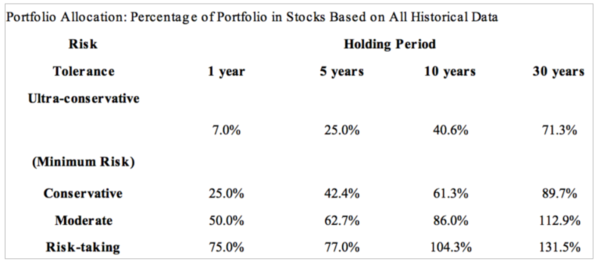
Here is the insight that most people find uncomfortable: even conservative, risk-averse investors with a 30-year horizon should hold significant equity. Siegel’s research shows that an ultra-conservative investor with a 30-year horizon optimises their risk-adjusted return at approximately 70% equity allocation – because over 30 years, equity risk drops dramatically while debt’s purchasing power erosion remains constant.

Read that again. For a 30-year horizon, 70% equity is the optimal allocation for a conservative investor. Not 30%. Not 50%. This is counter-intuitive but mathematically sound. The longer the holding period, the more equity you should hold – because time removes the dominant risk of equity (short-term volatility) while leaving intact its primary advantage (long-term real returns).

The Retirement Gap Nobody Plans For

Most Indian investors plan carefully for the accumulation phase – the 25-30 years of saving before retirement. Almost nobody plans for the withdrawal phase – the 25 years of spending after retirement. But your corpus does not retire when you do. It keeps working for another quarter century.

Here is what this means in practice. The most common mistake I see at age 60: moving the entire corpus into FDs and debt “because I’m retired now and can’t take risk.” But consider this – a 60-year-old Indian executive today has a 35-40% probability of living past 85 (LIC mortality data). That means a 25-year withdrawal horizon. And over 25 years, the Sensex data above shows near-zero loss probability for equity.

A retiree at 60 with Rs 3 crore corpus can reasonably hold 30-40% in equity for the portion they will not need for 10+ years. A 0% equity allocation in retirement means that portion earns 7-7.5% in FDs while inflation runs at 5-6%. Real return: near zero. Over 25 years, this is a major compounding failure.

The right question is not “should I be in equity?” It is “which part of my corpus do I need in the next 1-3 years?”

Only that portion needs to be in low-risk instruments. The rest has a 10-25 year holding period – and should be invested accordingly. This single insight changes retirement planning completely.

Most retirement plans fail not because of bad investments – but because of wrong asset allocation at retirement.

At RetireWise, we build withdrawal strategies alongside accumulation plans. SEBI Registered. Fee-only.

See How RetireWise Works

Why We All Act Like Short-Term Investors

Ramesh was not irrational. He was human. The pain of watching Rs 30 lakh become Rs 19 lakh in one month is visceral in a way that “I’ll recover it in 2 years” is not.

Behavioural finance researchers Shlomo Benartzi and Richard Thaler documented this in a landmark 1995 paper as Myopic Loss Aversion. The finding: investors who evaluate their portfolios frequently experience far more “losses” than those who check infrequently, simply because short-term volatility creates the feeling of loss even in a rising long-term market. The more frequently you check, the more likely you are to make a panic-driven decision.

In Indian context: the average equity SIP investor exits within 3.2 years (AMFI data). A 3-year holding period has a 21% loss probability. The same investor holding for 10 years drops to 3%. The investor’s behaviour – not the market – is the primary source of their underperformance.

A SEBI study from 2023 found that 9 out of 10 individual equity investors underperform a simple Nifty 50 index fund over a 5-year period. The primary reason: premature exits and ill-timed re-entries during corrections. The behaviour gap – the difference between what the market returns and what the investor actually earns – is estimated at 3-4% annually in India. On a Rs 50 lakh corpus over 20 years, a 3% behaviour gap means Rs 75-80 lakh less wealth at retirement. That is the cost of checking your portfolio too often.

The Practical Answer: How to Use This

Set your investment horizon not from today to retirement, but from today to the year you need the money. For a retirement goal, part of your corpus will not be needed for 30-40 years. That portion can bear equity risk. Part will be needed in years 1-3 of retirement. That should be in debt.

This is the bucket strategy – and it is not just a withdrawal tool. It is also a psychological tool. When you know that your 3-year living expenses are safe in an FD, you can watch your equity portfolio fall 30% without panic. You do not need the money this year. The 30% fall is temporary on a 15-year holding period. The damage only becomes permanent when you sell.

“Investing is not a numbers game. It is a mind game. The math says hold for 15 years. The mind says sell today. The investor who wins is the one whose structure prevents the mind from winning.”

– Hemant Beniwal, CFP, CTEP | Founder, RetireWise

Read next: How to Save for Retirement in India – The Complete Guide

Your retirement plan needs a withdrawal strategy, not just an accumulation target.

RetireWise builds complete retirement blueprints for senior executives. SEBI Registered. Fee-only.

See the RetireWise Service

Ramesh called me last year. He is 45 now. He stayed invested through 2022’s correction and 2023’s recovery. His corpus is back on track. The lesson he said it took him three market cycles to learn: “The market will come back. The question is whether I will still be invested when it does.”

Your investment horizon is longer than you think. Start counting from today – not from retirement.

💬 Your Turn

Have you ever exited an investment during a market fall and later regretted it? What was your actual holding period when you sold? Share below – your experience might save someone else from the same decision.

Income Tax Return Filing FAQs: Everything Salaried Indians Need to Know (2026)

“In this world nothing can be said to be certain, except death and taxes.” – Benjamin Franklin

Every July I receive a surge of messages asking the same questions. Did anything change this year? Do I need to file even if TDS was deducted? What is Form 26AS? How do I e-verify?

Income tax return filing is not complicated – but the questions are real, and the stakes of getting it wrong are real. This post answers the most common questions in plain language, updated for current rules.

⚡ Quick Answer

You must file an ITR if your total income exceeds the basic exemption limit (Rs 3 lakh under new regime, Rs 2.5 lakh under old regime) – even if TDS has been fully deducted. The deadline for salaried individuals is July 31st each year. Filing after the deadline attracts a late fee under Section 234F (up to Rs 5,000). Always verify your return within 30 days of filing using Aadhaar OTP, net banking, or the ITR-V physical submission route.

Income tax return filing FAQs India 2026

My employer already deducted TDS. Do I still need to file?

Yes. TDS deduction and ITR filing are two separate obligations. TDS is the tax withheld at source by your employer. ITR filing is your declaration to the Income Tax Department of your total income from all sources during the year.

Filing is mandatory if your total income exceeds the basic exemption limit, regardless of TDS. Filing is also required if you want to claim a refund of excess TDS, carry forward capital losses, or meet other specific conditions. In practice, virtually all salaried individuals above the basic exemption limit are required to file.

What is the last date for filing ITR?

For salaried individuals and those not requiring a tax audit, the deadline is July 31st of the assessment year. For FY 2025-26 income, the deadline is July 31, 2026.

Missing this deadline does not mean you cannot file – you can file a belated return until December 31st. But a late fee under Section 234F applies: Rs 1,000 if income is below Rs 5 lakh, Rs 5,000 for income above Rs 5 lakh. Interest under Section 234A also applies on any outstanding tax. File on time to avoid both.

What happens if I do not file by the due date?

A late fee under Section 234F applies as described above. Additionally, if you have unpaid tax (tax due after TDS and advance tax credits), interest accrues at 1% per month under Section 234A from the due date until the actual filing date. If you have capital losses you want to carry forward to future years, those cannot be carried forward in a belated return.

What is Form 26AS?

Form 26AS is a consolidated tax credit statement available on the Income Tax portal. It shows all TDS deducted on your income during the year, advance tax you have paid, self-assessment tax payments, and high-value transactions reported by banks and financial institutions. It is essentially the Income Tax Department’s record of what they know about your income and tax payments.

Before filing your ITR, always cross-check Form 26AS with your Form 16 and other income documents. Any mismatch between Form 26AS and your return can trigger a notice. You can access Form 26AS through the Income Tax e-filing portal under “My Account.”

AIS (Annual Information Statement), introduced in 2021, provides even more detail than Form 26AS – including mutual fund transactions, dividends, stock transactions, and foreign remittances. Check both before filing.

Tax filing is not just compliance – it is the foundation of your financial record.

RetireWise integrates tax planning into every financial plan – ensuring that investment decisions, redemptions, and income are structured with tax efficiency from the start.

See How RetireWise Approaches Tax Planning

What is ITR verification and why is it mandatory?

Filing the return is not the final step. You must verify it within 30 days of filing (reduced from 120 days as of 2023). An unverified return is treated as not filed – the filing is invalid until verification is complete.

You can verify electronically using Aadhaar-based OTP (the fastest method), net banking, bank account EVC, or Demat account EVC. Alternatively, you can print the ITR-V acknowledgement, sign it, and send it to the Centralised Processing Centre in Bengaluru by speed post within 30 days.

For most individuals, Aadhaar OTP verification is the simplest route and takes under two minutes on the Income Tax e-filing portal.

Can I revise my ITR after filing?

Yes. A revised return can be filed if you discover an error or omission in the original return – provided the original return was filed before the due date. You can revise up to December 31st of the assessment year or before the completion of assessment, whichever is earlier.

Common reasons to file a revised return: missing income from interest or dividends that appeared in AIS after the original filing, incorrect deduction claims, or clerical errors in personal details. Filing a revised return does not attract any penalty if done within the allowed window.

Which ITR form should I use?

The correct form depends on your income sources. ITR-1 (Sahaj) is for salaried individuals with income from one house property, no capital gains, and total income up to Rs 50 lakh. ITR-2 is for individuals with capital gains (from mutual funds, stocks, or property) or income from more than one house property. ITR-3 is for individuals with business or professional income in addition to salary.

Most salaried professionals who have invested in mutual funds or sold property during the year need ITR-2. Using the wrong form can result in a defective return notice from the Income Tax Department.

What is Form 10E and do I need it?

Form 10E is required if you received salary in arrears during the year – typically when a pay revision is implemented with retrospective effect. The arrear amount, if taxed entirely in the year of receipt, may result in a higher tax outgo than if it had been received in the years it pertained to. Form 10E allows you to claim relief under Section 89(1) to spread the tax burden.

If you are claiming Section 89(1) relief in your ITR, you must file Form 10E on the Income Tax portal before filing the return – otherwise the ITR will be processed with a mismatch.

Read: Year-End Tax Planning Guide

ITR filing is one of the least glamorous parts of personal finance – and one of the most important. Filed correctly and on time, it is your annual declaration that your financial affairs are in order.

File early. Verify immediately. Keep a copy.

Is your investment portfolio structured for tax efficiency – not just returns?

RetireWise builds financial plans where tax planning and investment planning work together – not as separate silos managed in March panic.

Book a Free 30-Min Call

Your Turn

Have any other questions about ITR filing that are not covered above? Or have you had a specific experience with a revised return, a mismatch notice, or a tricky deduction? Share in the comments – the answers help everyone.

PAN-Aadhaar Linking: Current Status, Consequences, and What to Do in 2026

“Compliance is not optional. It is the foundation on which every other financial decision rests.”

A client called me in 2023 in a mild state of panic. His bank had flagged his account and stopped processing some transactions. His mutual fund folios were showing a “pending” status on his KYC. His broker had sent him a notice he had not read properly.

The reason: his PAN had become inoperative because he had not linked it to his Aadhaar by the deadline.

He had seen the linking requirement come up repeatedly over the years, assumed it was optional bureaucracy, and ignored it. The consequences were very real: frozen financial transactions, pending KYC, and a Rs 1,000 penalty he had to pay before his PAN could be reactivated.

If you have not yet addressed your PAN-Aadhaar status, this post covers exactly what you need to know in 2026.

⚡ Quick Answer

The PAN-Aadhaar linking deadline passed in 2023. If you linked before the deadline, no action is needed. If you linked after June 30, 2023, you paid (or need to pay) a Rs 1,000 penalty. If your PAN is currently inoperative due to non-linking, it must be linked with the penalty payment before it is reactivated. An inoperative PAN blocks income tax filings, financial KYC, mutual fund transactions, and banking services. Check your status now and act if needed.

PAN Aadhaar linking - current status, penalty and how to check 2026

Where Things Stand in 2026: The Complete Timeline

The PAN-Aadhaar linking saga has gone through multiple deadline extensions since it was first introduced in 2017. Here is the condensed timeline that matters:

The original deadline was July 2017. It was extended multiple times – to 2018, 2019, 2020, 2021, then again. By 2022, the government introduced a late fee structure: link between April 1, 2022 and June 30, 2023 and pay Rs 1,000. The final deadline was June 30, 2023. After that date, PANs of those who had not linked became inoperative.

As of 2026: If your PAN became inoperative and you have since linked it with the Rs 1,000 penalty payment and the income tax department has processed the linking, your PAN should have been reactivated (typically within 30 days of linking). If you have not linked at all, your PAN remains inoperative and you must link and pay the penalty before it can be reactivated.

What an Inoperative PAN Actually Means

An inoperative PAN is not just an administrative inconvenience. The consequences cascade across your entire financial life.

Income tax: you cannot file income tax returns with an inoperative PAN. Any return filed is treated as invalid. TDS (tax deducted at source) on your income is deducted at a higher rate – typically 20% instead of 10% – when the deductor finds your PAN is inoperative.

Mutual funds and investments: KYC for mutual funds is tied to your PAN. An inoperative PAN can freeze your ability to make fresh investments, trigger redemptions, or update your folio details. SEBI requires active PAN for KYC compliance.

Banking: large transactions, new account openings, and certain banking services require a valid PAN. Banks may flag accounts associated with inoperative PANs.

Property transactions: any property purchase or sale above Rs 10 lakh requires valid PAN quoting. An inoperative PAN blocks or complicates large property transactions.

“The clients who came to me with PAN-Aadhaar problems in 2023-24 uniformly said the same thing: they had seen the notices, assumed it could be dealt with later, and put it off. By the time they dealt with it, their mutual fund transactions were frozen. The Rs 1,000 penalty was the least of the inconvenience.”

– Hemant Beniwal, CFP, CTEP | Founder, RetireWise

How to Check Your Current PAN-Aadhaar Status

Visit the Income Tax e-filing portal at incometax.gov.in. Under “Quick Links” on the home page, look for “Link Aadhaar Status.” You can check the linking status without logging in by entering your PAN and Aadhaar number.

The status will show one of three results: “Your PAN is linked with Aadhaar” (action complete, nothing needed), “Your request for linking is under process” (linking submitted, waiting for IT department to process), or a status indicating your PAN is not linked.

If you are uncertain about your PAN’s operative status, you can also check by logging into the e-filing portal and looking at your profile. The portal displays a notification if your PAN is inoperative.

Is your retirement plan compliant and current?

A RetireWise retirement plan ensures your financial documentation, KYC, and compliance status does not create obstacles at critical points in your retirement journey.

Book a Free 30-Min Call

How to Link PAN and Aadhaar in 2026 (If Still Needed)

If your PAN is still unlinked or inoperative, the process requires paying the Rs 1,000 penalty first, then completing the linking.

Step 1: Pay the penalty via NSDL/Protean. Go to the NSDL TIN website (tin.tin.nsdl.com) or the Protean portal. Select “e-Pay Tax” or use the direct link for PAN-Aadhaar linking fee payment under Challan 280. Select “Fee for PAN-Aadhaar linking” as the payment category. Pay Rs 1,000.

Step 2: Wait for payment to reflect. Allow 4-5 days for the payment to be processed and reflected in the Income Tax system before attempting to link.

Step 3: Link via the e-filing portal. Go to incometax.gov.in. Under “Quick Links,” select “Link Aadhaar.” Enter your PAN and Aadhaar number. Enter the OTP sent to your Aadhaar-registered mobile number. Submit.

Step 4: Wait for processing. The Income Tax department typically processes linking requests within 30 days. Once processed, your PAN status changes from inoperative to active.

Important note on name and date of birth matching. Your PAN and Aadhaar must have matching names and dates of birth. If there is a mismatch (a different spelling of your name, a different date format), the linking will fail. You will need to correct the details in either your PAN records (via NSDL/Protean) or your Aadhaar records (via UIDAI) before the linking can succeed.

Read – ELSS vs PPF: Which Is Better for Tax Saving and Retirement?

Read – Why Fixed Deposit Returns Are Always Negative in Real Terms

Frequently Asked Questions

I am an NRI. Does PAN-Aadhaar linking apply to me?

Non-resident Indians are exempt from the mandatory PAN-Aadhaar linking requirement. The exemptions also include foreign nationals, persons above 80 years of age, and residents of Assam, Jammu and Kashmir, and Meghalaya (as of the original notification – verify the current exemption list with a tax professional as the rules may have been updated). If you are an NRI with a PAN and you have received notices, check your residency status documentation with your tax advisor before assuming the requirement applies.

My PAN became inoperative. Will past ITR filings be affected?

Income tax returns filed with an inoperative PAN after the June 30, 2023 deadline may be treated as defective. If this applies to you, consult a tax professional – there may be options to rectify the returns after PAN reactivation. Additionally, any refunds pending against returns filed with an inoperative PAN may be on hold until the PAN is reactivated and any compliance issues are resolved.

Can I invest in mutual funds while my PAN is inoperative?

No. SEBI and AMFI require a valid, operative PAN for KYC compliance in mutual fund transactions. Fresh investments, SIP registrations, redemptions in some cases, and folio updates all require active KYC backed by a valid PAN. If your PAN is inoperative, link it and wait for reactivation before attempting mutual fund transactions. Existing SIPs may also be paused by the fund house until PAN status is resolved.

The PAN-Aadhaar linking requirement has been in place for years. If you have handled it, you are done. If you have not, the time to act is now – not because a new deadline is approaching, but because every day with an inoperative PAN is a day with restricted access to your own financial accounts and instruments.

Check your status today. It takes two minutes. The consequences of not checking can take months to unwind.

Tax compliance is one piece of a complete retirement plan.

RetireWise builds retirement plans that account for documentation, compliance, taxation, and long-term financial structure – not just investment allocation.

See Our Retirement Planning Service

💬 Your Turn

Have you checked your PAN-Aadhaar linking status recently? Did you face any issues with your mutual funds or banking as a result of the deadline? Share in the comments.

Why You Should Be Sceptical of Investment Gurus (Including the Famous Ones)

A client came to me in 2023 after spending two years following a popular financial influencer on YouTube. He had done exactly what the channel advised: concentrated heavily in small-cap stocks, invested in a few “multibagger” themes, and held through a 40% drawdown because the creator kept saying “stay the course, this is your wealth creation journey.”

When he finally came to me, the conversation was uncomfortable. Not because his portfolio was ruined – it was recoverable. But because he had made three years of significant financial decisions based on content optimized for views, not for his specific situation, goals, or risk profile. The guru had never met him. Did not know his age, his dependents, his timeline, or how much of his net worth was in those positions.

This is the investment guru problem. It is not that every expert is wrong. It is that generic advice, delivered confidently to millions, is almost never right for any one specific person.

Quick Answer

Investment gurus – whether on TV, YouTube, or in print – are worth following selectively and never blindly. Research by CXO Advisory Group tracked 6,582 predictions from 68 investment experts over 14 years and found an average accuracy rate of just 47%. That is essentially a coin flip. The deeper problem is that even accurate advice may be wrong for your specific situation. The solution is not to ignore all expertise – it is to filter every recommendation through your own goals, timeline, and risk profile before acting.

Why you should be sceptical of investment gurus

Table of Contents

The Forecasting Problem: 47% Accuracy Is a Coin Flip

CXO Advisory Group conducted one of the most comprehensive studies of investment expert forecasting ever done. They tracked 6,582 predictions from 68 different market commentators and analysts between 1998 and 2012. The average accuracy rate: 47%. Not 47% wrong. 47% right.

Think about what that means. A dartboard would do better. A coin flip would match it. Yet these were credentialed, experienced professionals with platforms, track records, and confident delivery. The problem is not their intelligence. It is the fundamental unpredictability of markets over short to medium timeframes.

Markets are influenced by millions of simultaneous decisions, geopolitical events, policy changes, technological disruptions, and human psychology – all interacting in ways that resist prediction. The expert who correctly called the 2008 crash often missed the 2013 rally. The one who called the 2020 recovery missed the 2022 correction. Accuracy in one cycle does not predict accuracy in the next.

“Anyone who can make a simple thing complex is considered an investment guru. The real skill is making complexity simple and actionable. Most media commentary does the opposite – it makes simple things complex to justify the expert’s existence.”

The 2026 Version: Finfluencers and Social Media Gurus

The investment guru problem has evolved significantly since 2017. Television anchors with questionable accuracy have been joined by a new category: finfluencers – financial influencers on YouTube, Instagram, and Telegram who have built large audiences with a combination of confident delivery, engaging content, and the appearance of accessibility.

The finfluencer category has some genuinely good educators who explain concepts clearly without pushing products. It also has a significant population of people with no professional qualifications, no regulatory oversight, and strong incentives to create content that generates views – not content that generates good financial outcomes for followers.

In 2026, SEBI has tightened regulations on unregistered investment advice and finfluencer activity. But enforcement is imperfect and the content landscape is vast. The relevant questions to ask about any financial content creator are: Are they SEBI registered? Do they disclose conflicts of interest? Are they recommending specific securities without registration? Do they show their full track record or only their wins?

The Telegram Channel Problem

Many retail investors in India receive stock tips through WhatsApp forwards and Telegram channels. These are often part of pump-and-dump schemes where promoters accumulate a stock, generate buzz through “tip” channels, and exit after retail investors drive the price up. Following unverified tips from anonymous channels is not investing. It is participating in a scheme where you are almost certainly the uninformed party on the wrong side of the trade.

5 Specific Problems With Following Investment Gurus

1. Their advice is not for your situation. When a financial expert recommends gold, small-cap stocks, or international equity, they are making a general market argument. They do not know your age, your existing portfolio, your upcoming financial obligations, or your actual ability to tolerate a 40% drawdown. Advice that is correct in the abstract may be completely wrong for your specific situation.

2. Forecasts are usually one-sided. Good analysis considers multiple scenarios, including the ones that prove the analyst wrong. Most public financial commentary does not do this. It presents a confident narrative built around supporting evidence while downplaying or ignoring contradictory data. An expert who does not acknowledge what would make their thesis wrong is not doing analysis. They are telling a story.

3. Biases operate even in good-faith experts. Confirmation bias leads analysts to seek evidence that supports their existing view. The herd instinct makes contrarian positions professionally risky – agreeing with consensus is safer for a career than being wrong alone. Recency bias distorts perception of long-term probabilities. These biases affect even genuinely well-intentioned experts. Understanding this does not mean dismissing expert opinion. It means evaluating it critically.

4. The incentive structure creates conflicts. Financial media needs content that generates engagement. Predictions, controversy, and confident calls generate more engagement than “stay the course and review annually.” Fund managers have incentives tied to asset gathering. Product distributors have commission incentives. Even independent analysts may have speaking fees, book sales, or subscription products that create subtle conflicts. Understanding someone’s incentive structure helps you evaluate their advice more accurately.

5. Single-event reasoning is unreliable. “The Fed is raising rates so bonds will fall.” “Oil prices are rising so aviation stocks will suffer.” These simple causal chains often miss the complexity of how markets actually price in expectations. If the Fed rate hike was anticipated, markets may have already priced it in. If the narrative is widely known, the trade may already be crowded. Simple single-event investment theses are usually incomplete.

Something Worth Noticing

The experts who are most confident are not necessarily the most accurate. Calibrated uncertainty – being honest about what is and is not knowable – is actually a marker of analytical quality, not weakness. The financial commentator who says “I think X is likely but Y is also plausible and here is what I would watch for” is giving you more useful information than the one who says “X is definitely happening.”

What Is Worth Listening To

This is not an argument for ignoring all financial expertise. There is genuine wisdom in the investment literature, and some commentators and practitioners distill it well. The distinction is between timeless principles and timely predictions.

Warren Buffett’s advice to invest based on business fundamentals, hold for the long term, and avoid market timing has been consistently useful because it describes how wealth is actually built over decades – not because he predicted any specific market move correctly. His track record on specific market timing is actually quite mixed.

Charlie Munger’s emphasis on living below your means, avoiding debt for consumption, and investing what remains is useful because it is behaviorally sound and applicable to almost anyone regardless of their market view.

Jim Rogers’ advice that sometimes the best investment decision is no decision at all reflects a real truth about how overtrading destroys returns. The average Indian retail investor trades far too frequently, generating costs and taxes while underperforming a simple SIP in an index fund.

George Soros’s observation that recognizing and accepting mistakes quickly is the key to long-term success applies directly to portfolio management. The investor who holds a losing position because “it will come back” is letting ego override arithmetic.

These principles are worth internalizing. Specific market calls from the same people are not worth acting on without your own analysis.

The Right Framework: Filter, Don’t Follow

The goal is not to avoid all financial expertise. It is to consume it critically and filter it through your own situation before acting.

When you encounter investment advice – from any source – ask four questions. First, is this person’s incentive aligned with my outcome or with something else? Second, are they acknowledging what could make them wrong, or only presenting supporting evidence? Third, does this advice apply to my specific situation – my timeline, my existing portfolio, my risk tolerance? Fourth, is this a timeless principle or a specific prediction?

Timeless principles can be adopted. Specific predictions should be held lightly and tested against your own thinking. Generic advice that does not account for your situation should be filtered or discarded.

The best financial decision-making combines a clear personal financial plan with selective use of expertise filtered through your own judgment. A good advisor – one whose incentives are aligned with yours – helps you do this filtering. They translate market noise into action relevant to your specific situation. That is the actual value of professional advice.

For more on how to evaluate financial advisors, see our guide on choosing the right financial advisor in India.

Curious About RetireWise?

RetireWise works with Indian executives aged 45 to 60 on retirement planning – not generic market calls, but personalized plans tied to specific numbers and goals. If you want to understand what evidence-based financial planning actually looks like, explore what we do.

Explore RetireWise

Frequently Asked Questions

Are financial influencers worth following?
Some are. Financial educators who explain concepts clearly, disclose conflicts, and avoid specific stock recommendations can be genuinely useful for building financial literacy. The problem is with those who make specific recommendations without SEBI registration, do not disclose affiliations or conflicts, and build audiences on confident predictions rather than sound process. Check credentials before acting on any specific advice.

How do I know if an investment tip is legitimate?
Legitimate investment advice from a SEBI-registered advisor will include a risk disclosure, will be tied to your specific situation, and will come with a rationale you can evaluate. Anonymous tips on WhatsApp or Telegram, recommendations with urgent deadlines, and “guaranteed return” claims are almost always illegitimate regardless of how credible the source appears.

Should I completely ignore CNBC and financial news channels?
Financial news channels have a place for staying informed about macro developments. They are poor sources for specific investment decisions. The incentive of a news channel is to fill airtime with compelling content, not to give you actionable advice suited to your situation. Use them for context, not for buy and sell decisions.

What is the difference between a financial educator and a financial advisor?
A financial educator explains concepts, products, and principles. They may have no regulatory obligation to act in your interest. A SEBI-registered investment advisor has a fiduciary obligation to provide advice suited to your specific situation and must disclose conflicts of interest. For financial education, educators can be useful. For decisions that affect your money, work with a registered advisor.

Is Warren Buffett’s advice useful for Indian investors?
The principles are – long-term thinking, investing in what you understand, avoiding market timing, staying rational during volatility. The specific portfolio calls are not directly applicable. Buffett invests in US companies with characteristics very different from Indian markets. The principles translate; the specific holdings do not.

Before You Go

Related reading: 10 Investment Mistakes That Cost Indian Investors Lakhs and Mis-Selling in Mutual Funds and Insurance.

Who is the investment expert you find most credible – and what makes you trust them? Share in the comments below.

One question for you: The last time you made an investment decision based on something you saw or read online, did you verify whether the advice applied to your specific situation before acting?

Sensex and Nifty Explained: What the 80,000 Milestone Means for Your Retirement

“The stock market is a device for transferring money from the impatient to the patient.” – Warren Buffett

I started my career in financial services in 2003. The Sensex was around 3,000. Every client I met that year told me the same thing: markets are down, equities are finished, who will invest now?

Twenty-three years later, the Sensex crossed 80,000 in 2024. The Nifty 50 crossed 24,000. The investors who stayed invested through those 23 years of crashes, corrections, elections, global crises, and pandemics built extraordinary wealth. The ones who tried to time the Sensex mostly did not.

Understanding what the Sensex and Nifty actually are is the foundation of understanding why long-term equity investing works for retirement wealth.

⚡ Quick Answer

The Sensex is the stock market index of BSE (Bombay Stock Exchange) tracking 30 large companies. The Nifty 50 is NSE’s (National Stock Exchange) index tracking 50 large companies. Both measure the combined market value of their constituent stocks and move when those values change. The Sensex was at 100 in 1978-79 and crossed 80,000 in 2024, a CAGR of approximately 14%. This long-term return is what makes equity the backbone of retirement wealth creation in India.

What is Sensex and Nifty - explained for retirement investors in India

What Is the Sensex?

Sensex stands for Sensitive Index. It is the benchmark stock market index of the Bombay Stock Exchange (BSE), India’s oldest stock exchange. The Sensex tracks 30 large, financially sound companies that are selected as representatives of different sectors of the Indian economy.

The base year for the Sensex is 1978-79 with a base value of 100. From that base, the Sensex reached 1,000 by 1990, 10,000 by 2006, 30,000 by 2019, 50,000 in 2021, and 80,000 in 2024. That journey from 100 to 80,000 over approximately 45 years represents a CAGR of roughly 14%.

The 30 companies in the Sensex are reviewed and updated periodically by BSE’s Index Committee. As of 2026, the Sensex includes companies like Reliance Industries, HDFC Bank, Infosys, ICICI Bank, TCS, Bharti Airtel, ITC, Kotak Mahindra Bank, Axis Bank, Bajaj Finance, L&T, Sun Pharma, and others across sectors including banking, technology, energy, consumer goods, and manufacturing. The composition changes as companies grow or decline in market significance.

“In 2003, every client I had was convinced equities were finished. The Sensex was at 3,000. Twenty years later it was at 80,000. The clients who stayed invested built wealth. The clients who waited for confidence to return bought at higher prices every time.”

– Hemant Beniwal, CFP, CTEP | Founder, RetireWise

What Is the Nifty 50?

Nifty 50 is the benchmark index of NSE (National Stock Exchange), India’s largest stock exchange by trading volume. It tracks 50 large companies across 13 sectors. The base year is 1995-96 with a base value of 1,000.

The Nifty 50 is broader than the Sensex (50 stocks vs 30) and is the index most commonly used as a benchmark for equity mutual funds and index funds in India. When a fund manager says their fund outperformed the benchmark, the benchmark is usually the Nifty 50 or its total return index (TRI) variant.

The Nifty 50’s composition is managed by NSE Indices Limited and reviewed semi-annually. Major current constituents include the same large-cap names as the Sensex plus additional companies like Tata Consumer, Grasim, JSW Steel, ONGC, UltraTech Cement, and others.

How Are They Calculated? Free Float Market Capitalisation

Both indices use a methodology called free float market capitalisation weighting. Here is what that means in plain language.

Market capitalisation of a company is its total share price multiplied by total shares outstanding. A company with 100 crore shares at Rs 100 per share has a market cap of Rs 10,000 crore.

Free float adjusts this by excluding shares held by promoters, government, or strategic investors that are not available for public trading. Only the shares that can actually be bought and sold in the market count toward the index weight.

So a company with 40% promoter holding and 60% freely traded shares gets counted at 60% of its full market cap for index purposes. This makes the index reflect actual investable market value rather than total corporate value.

Does your retirement portfolio participate in India’s long-term equity story?

A RetireWise retirement plan maps the right equity allocation to your specific timeline, risk capacity, and corpus target.

Book a Free 30-Min Call

Key Differences Between Sensex and Nifty

Exchange: Sensex belongs to BSE, Nifty 50 belongs to NSE. Both exchanges trade the same underlying stocks, so the indices largely move in the same direction. The day-to-day correlation between Sensex and Nifty is extremely high, above 0.99.

Number of stocks: Sensex tracks 30 companies, Nifty 50 tracks 50. The Nifty is slightly more diversified, though the top 10 companies in both indices are largely the same and dominate the index weight.

Benchmark usage: The Nifty 50 is more commonly used as a mutual fund benchmark in India. Most equity mutual funds compare their performance against the Nifty 50 TRI (Total Returns Index, which includes reinvested dividends) rather than the Sensex.

Index funds and ETFs: Nifty 50 index funds and ETFs are available from all major fund houses and are among the most liquid investment products in India. Nifty 50 index investing is the simplest, lowest-cost way to participate in Indian large-cap equity.

What the 80,000 Sensex Means for a Retirement Investor

When the Sensex crosses a round number milestone, newspapers fill with headlines about whether markets are “too high” or “in a bubble.” For a retirement investor with a 15-20 year horizon, this framing is mostly irrelevant.

What matters is this: Rs 10,000 invested in a Nifty 50 index fund in January 2003 (Nifty around 1,000) would have grown to approximately Rs 2.4 lakh by early 2026 (Nifty around 24,000), a 24x return over 23 years. Rs 5,000 per month SIP in the same period would have accumulated to approximately Rs 80-90 lakh from Rs 13.8 lakh invested. That is the power of staying in the market through every crash, correction, election, and crisis.

The Sensex’s journey from 3,000 to 80,000 was not smooth. It included a 60% crash in 2008, a 38% crash in 2020, and multiple corrections of 20-30% in between. Every single one of those crashes felt like the market would never recover. Every single one recovered and went on to new highs. That pattern is what a retirement investor should understand and internalise before building an equity portfolio.

Read – Indian Equities: Past, Present and Future – A 2026 Update for Retirement Investors

Read – It’s Tomorrow That Matters: Why Difficult Markets Are the Retirement Investor’s Best Friend

Frequently Asked Questions

Is the Sensex or Nifty a better indicator of market performance?

Both are good indicators and move in near-perfect correlation. For mutual fund performance evaluation, the Nifty 50 TRI (Total Returns Index) is more accurate because it includes dividend reinvestment. For general market discussion and media reporting, the Sensex is more commonly cited because of its longer history. For investment decisions, use the Nifty 50 TRI as your benchmark for any actively managed equity fund you evaluate.

Should I invest in a Nifty 50 index fund or an actively managed fund?

Both have a place. Index funds offer low cost (expense ratios of 0.1-0.2%), predictable market-matching returns, and no fund manager risk. Actively managed funds aim to beat the index but not all do consistently. For the core of a retirement portfolio, a Nifty 50 or Nifty 100 index fund provides solid, low-cost equity exposure. Actively managed funds can add to this for investors who want to attempt index-beating returns in a portion of their allocation.

How often do the Sensex and Nifty constituent companies change?

The Nifty 50 is reviewed semi-annually (typically in March and September). The Sensex is reviewed every six months by BSE’s Index Committee. Companies are added or removed based on market cap, trading volume, financial health, and sector representation. Historically, 2-3 companies change in each review cycle, though the core of major banks, technology companies, and consumer names has been relatively stable for over a decade.

The Sensex crossing 80,000 is not a signal to exit. It is not a signal to celebrate. It is evidence of what 14% annual compounding over 45 years produces. The investors who will benefit from the Sensex’s next journey are the ones sitting quietly in index funds and diversified equity portfolios today, letting compounding do its work.

Do the Right Thing and Sit Tight.

Want a retirement plan that captures the long-term India equity story the right way?

RetireWise builds retirement plans with the right equity allocation, systematic investment plan, and rebalancing framework for your specific timeline.

See Our Retirement Planning Service

💬 Your Turn

Have you ever panicked and sold equity during a market crash – and how did that decision play out in hindsight? Share your experience in the comments.

How to Send Money to India: NRI Remittance Guide (Compare the Real Cost)

0

“The goal of money management is not to make a fortune. It is to preserve and grow what you have.” – Unknown

Every NRI sending money home is essentially running a mini foreign exchange business – whether they realise it or not. The difference between using the right channel and the wrong one can be thousands of rupees per transfer. Over a year, if you are sending money regularly, it can easily be Rs 50,000-1 lakh in unnecessary losses.

The landscape has changed significantly from even five years ago. Several services from the 2010s have shut down or been acquired. New players have entered. Rates and fees fluctuate constantly. This guide focuses on the framework for choosing – not a static list of services that will be outdated within months.

⚡ Quick Answer

The cheapest way to send money to India is almost always through a dedicated remittance service rather than your bank’s international wire transfer. The three things that determine total cost are: exchange rate markup (the biggest cost), transfer fee (usually Rs 0-500), and delivery speed. Services like Wise (formerly TransferWise), Remitly, and Xoom typically offer significantly better rates than banks. For large transfers (above Rs 5 lakh equivalent), compare at least 3 services on the same day – rates fluctuate. Never use credit cards for remittances – the fees are prohibitive. Check the recipient’s total credit including any deduction at the Indian end.

Cheapest way to send money to India - NRI remittance guide

The Real Cost of Sending Money: Exchange Rate Markup Is Everything

Most people focus on the transfer fee (“zero fee!” is a common marketing hook). The transfer fee is rarely the main cost. The exchange rate markup is.

The real exchange rate – what banks use when they trade with each other – is called the mid-market rate. It is publicly available on Google or XE.com at any moment. When a service quotes you a rate of Rs 82 per dollar when the mid-market rate is Rs 84, that Rs 2 difference per dollar is their margin. On a $5,000 transfer, that is Rs 10,000 in margin extracted from you – regardless of whether they advertise zero fees.

The total cost of any remittance = transfer fee + exchange rate margin. Always calculate both, using the mid-market rate as your benchmark. Services that show “the real exchange rate” (i.e., close to mid-market) with a transparent small fee are almost always cheaper than services that advertise zero fees but give you a worse rate.

How to Compare Services Properly

The only accurate comparison is the one you do on the same day with the same amount. Do not compare yesterday’s rate for Service A with today’s for Service B. Rates change by the hour.

When comparing, always enter the same source amount and check what the recipient receives in rupees. That final number – rupees in the recipient’s account – is the only number that matters. Then compare that against the mid-market rate equivalent to understand the effective cost.

For large one-time transfers (a property payment, a significant family obligation, moving proceeds from a sale), spending 20-30 minutes comparing 3-4 services can save meaningful amounts. For regular smaller remittances, choose one reliable service and set up automation.

Every rupee you save on remittances is a rupee available for your India financial goals.

WiseNRI works with NRI clients to optimise every aspect of their India finances – from remittance strategy to NRE/NRO account structuring to India-based investment planning.

Explore NRI Financial Planning

Services Currently Worth Evaluating (as of 2026)

Wise (formerly TransferWise) uses the mid-market rate and charges a transparent small percentage fee. Widely regarded as one of the most cost-effective services for USD/GBP/EUR to INR transfers. Transfers typically complete in 1-2 business days. Available for transfers from US, UK, EU, Australia, Canada, Singapore, and many other countries.

Remitly offers two tiers: Economy (3-5 business days, lower fee) and Express (same day, higher fee). Competitive rates from the US. Has strong bank coverage across India. Good app experience for repeat transfers.

Xoom (a PayPal service) offers competitive rates and has the advantage of PayPal’s compliance infrastructure. Good for US-based NRIs. Delivery options include bank deposit, cash pickup at specific locations in India, and home delivery in some cities.

Western Union and MoneyGram have the broadest physical agent network globally, which matters if either the sender or recipient needs cash pickup. For bank-to-bank transfers, they are generally not the cheapest option, but for cash-based needs or transfers from countries with limited digital remittance options, they remain relevant.

Your bank’s international wire is almost always the most expensive option for regular remittances. Banks typically have large exchange rate markups and fixed transfer fees of $15-45. For large transfers where you want the security of your established banking relationship and are willing to pay a premium for it, it remains an option – but calculate the cost first.

NRE vs NRO: Where the Money Goes Matters

This is the question most remittance guides skip, but it is as important as the transfer cost. Foreign remittances credited to your NRE (Non-Resident External) account are fully repatriable – you can move the money back out of India freely. Money in an NRO (Non-Resident Ordinary) account has repatriation limits and may require more documentation.

If you are sending money to India as an investment that you may want to move back, credit it to your NRE account. If you are sending money for family expenses, property maintenance, or India-based obligations, an NRO account is typically appropriate. Get the structuring right at the remittance stage rather than trying to fix it later.

Read: When Is the Right Time to Send Money to India?

Remittance is not just a transaction. It is part of your overall NRI financial strategy. The channel you use, the account you credit, and the timing of large transfers all have meaningful financial consequences. Spend an extra 15 minutes on each significant transfer – the arithmetic usually makes it worthwhile.

Compare rates. Not just fees. Always.

Are your India remittances structured correctly for your NRE/NRO accounts and repatriation needs?

WiseNRI helps NRI clients get every aspect of their India finances right – from remittance channel to account structuring to investment planning.

Book a Free 30-Min Call

Your Turn

Which service do you currently use for sending money to India – and have you compared it against alternatives recently? What has been your experience? Share in the comments.

ELSS vs PPF: Which Is Better for Tax Saving and Retirement? (2026 Update)

“Tax saving should be the result of your investment planning – not the reason for it.”

Every March, I get the same calls. Someone needs to show tax-saving investments to HR by the 31st. They ask: ELSS or PPF?

Before I answer, I ask a question they did not expect: which tax regime are you in?

Because if they are in the new tax regime – which became the default for salaried employees from FY 2023-24 and was made even more attractive in FY 2024-25 – Section 80C does not apply at all. The ELSS vs PPF debate is irrelevant to them. Neither gives a tax benefit. The entire premise of the question collapses.

This is the most important update to this article. Before comparing ELSS and PPF, you must first confirm that the comparison matters for your specific situation.

⚡ Quick Answer

ELSS and PPF both qualify for Section 80C deduction under the old tax regime only. Under the new tax regime (default from FY 2023-24), neither provides any tax benefit. For investors in the old regime: ELSS offers higher long-term returns with equity risk and a 3-year lock-in; PPF offers guaranteed returns (currently 7.1%) with a 15-year lock-in and tax-free maturity. The right choice depends on your risk profile, investment horizon, and retirement timeline.

ELSS vs PPF comparison for tax saving and retirement planning in India 2026

Step Zero: Which Tax Regime Are You In?

The Finance Act 2020 introduced an optional new tax regime with lower slab rates but no deductions. From FY 2023-24, the new regime became the default. FY 2024-25 made it more attractive still: the standard deduction was raised to Rs 75,000 and tax slabs were revised. A salaried employee earning up to Rs 12.75 lakh effectively pays zero tax under the new regime.

If you are in the new regime, investing in ELSS or PPF purely for tax saving makes no sense. They remain valid as investments – PPF for guaranteed debt returns, ELSS for equity exposure – but the 80C rationale disappears entirely. For the remainder of this article, we assume you are in the old regime.

“The question is never ELSS or PPF. The question is: what is your actual retirement goal, what is your risk capacity, and which instrument serves that goal? Once you answer those, the right choice becomes obvious.”

– Hemant Beniwal, CFP, CTEP | Founder, RetireWise

How Much Do You Need for Retirement?

Before choosing between ELSS and PPF, you need a retirement number. Without it, neither instrument has context.

A simple estimate: take your current monthly expenses, apply 7% inflation for the years to retirement, and calculate the corpus needed to generate that inflated expense for 25 years. If your current expenses are Rs 80,000 and you retire in 20 years, your monthly expenses at retirement will be approximately Rs 3.1 lakh. To generate Rs 3.1 lakh per month for 25 years from a corpus earning 8%, you need approximately Rs 4-4.5 crore.

Can Rs 1.5 lakh per year in 80C investments build Rs 4.5 crore alone? Not entirely – but it is a meaningful contribution. The instrument you choose determines how large that contribution becomes.

ELSS vs PPF: The Core Comparison

ELSS: Diversified equity mutual funds with a 3-year lock-in. 80C deduction up to Rs 1.5 lakh per year. Long-term capital gains above Rs 1.25 lakh per year taxed at 12.5% (from FY 2024-25). Historical category returns: 12-14% CAGR over 15-20 year periods. Returns are not guaranteed. Fully liquid after the 3-year lock-in.

PPF: Government-backed debt instrument. 80C deduction up to Rs 1.5 lakh per year. Current interest rate 7.1% per annum, compounded annually. Maturity proceeds fully tax-free (EEE status). Lock-in: 15 years with partial withdrawal allowed after 7 years. Maximum investment: Rs 1.5 lakh per year.

Is your 80C allocation actually building toward your retirement corpus?

Most people invest for the tax receipt. A RetireWise advisor maps your 80C choices to your actual retirement target.

Book a Free 30-Min Call

The Return Math Over 15 and 20 Years

Rs 1.5 lakh per year invested for 15 years: PPF at 7.1% produces approximately Rs 40 lakh, fully tax-free. ELSS at 12% CAGR produces approximately Rs 74 lakh before tax, Rs 66-68 lakh net of 12.5% LTCG. ELSS advantage: approximately Rs 26-28 lakh more over 15 years.

Over 20 years the gap widens considerably. PPF: approximately Rs 64 lakh. ELSS at 12%: approximately Rs 1.35 crore pre-tax, Rs 1.2 crore post-tax. Nearly double.

The catch: ELSS delivering 12% depends on equity market returns. In poor equity periods – 2000-2003, 2008-2013 – the returns were far lower. PPF’s 7.1% is guaranteed regardless. The risk-adjusted comparison is closer than headline return numbers suggest.

Who Should Choose What

ELSS makes more sense if: Your investment horizon is 10+ years, your risk profile can handle equity volatility, you would invest in equity anyway (ELSS adds the tax benefit on top), and you are in the 30% tax bracket (Rs 45,000 tax saved in Year 1 alone on Rs 1.5 lakh invested).

PPF makes more sense if: Your risk profile is conservative, you specifically need the EEE tax status, you are within 5 years of retirement and want guaranteed returns for that portion of the corpus, or your 80C room after EPF and insurance is small – PPF fills it efficiently.

For most senior executives, both have a role: If your 80C limit is Rs 1.5 lakh and EPF covers Rs 80,000, you have Rs 70,000 left. Consider Rs 30,000-40,000 to PPF (guaranteed debt in the retirement bucket) and Rs 30,000-40,000 to ELSS SIP (equity with tax benefit). Neither needs to be all-or-nothing.

The 30-Year Retirement Lens

If you are 35 today and retire at 65, your PPF account matures at 50 and can be extended in 5-year blocks. By retirement at 65, 30 years of PPF at Rs 1.5 lakh per year at 7% creates approximately Rs 1.5 crore fully tax-free – a meaningful guaranteed anchor for the corpus.

Alongside that, 30 years of ELSS at Rs 1.5 lakh per year at 12% creates approximately Rs 4.1 crore pre-tax, Rs 3.6 crore post-tax. Combined, the 80C bucket alone has built Rs 5 crore – with ELSS providing growth and PPF providing the guaranteed floor.

Read – When Not to Invest in ELSS: 5 Situations Where It’s the Wrong Choice

Read – NPS: A Retirement Advisor’s Honest Review

Frequently Asked Questions

Can PPF interest rate change?

Yes. It was 8% as recently as 2019-20 and dropped to 7.1% in April 2020, where it has stayed since. It is reset quarterly by the government and has ranged from 12% in the 1980s to the current 7.1%. For retirement planning, use 7% as a conservative assumption to avoid overestimating PPF maturity values.

Can I invest in both ELSS and PPF in the same year?

Yes – and for most investors with adequate 80C room, this is the right approach. The Rs 1.5 lakh annual 80C limit can be split across EPF, PPF, ELSS, and life insurance premiums in any combination. The split should reflect your desired debt-equity allocation within the tax-saving bucket, not just which instrument performed better last year.

Does employer EPF count toward my Rs 1.5 lakh 80C limit?

Only your own employee EPF contribution counts toward the Rs 1.5 lakh 80C limit. The employer’s matching contribution is not your contribution for 80C purposes, though it accumulates tax-free. Check your salary slip for the employee EPF contribution amount before deciding how much additional 80C investment is needed.

ELSS vs PPF is not a battle with a winner. They serve different purposes, carry different risks, and work best together in a balanced 80C allocation. But none of this matters if you are in the new tax regime – where 80C is irrelevant. Confirm your tax regime first. Then optimise within it.

Tax saving should follow your investment plan. Never the other way around.

Want a retirement plan where ELSS, PPF, and NPS all serve one clear goal?

RetireWise builds retirement plans where every 80C decision serves the corpus target – not just the March deadline.

See Our Retirement Planning Service

💬 Your Turn

Are you in the old or new tax regime – and has that changed how you think about ELSS and PPF? Share in the comments.

How NRIs Can Use DTAA to Reduce Tax in India: Complete 2026 Guide

A client in the US had NRO fixed deposits in India earning around Rs. 8 lakh in interest annually. His bank was deducting 30% TDS – Rs. 2.4 lakh per year – before crediting the remainder to his account. He had been accepting this for four years.

When we reviewed his situation, we found that India-US DTAA limits interest TDS to 15%. He had been overpaying by Rs. 1.2 lakh per year for four years. That is Rs. 4.8 lakh sitting with the income tax department that he could have either not paid in the first place (by submitting his Tax Residency Certificate to the bank) or claimed back through ITR filings.

This is the DTAA gap in practice. Most NRIs know DTAA exists. Very few understand how to use it, what documents it requires, and where it actually applies.

Quick Answer

DTAA (Double Tax Avoidance Agreement) allows NRIs to avoid being taxed twice on the same income in both India and their country of residence. India has DTAAs with over 90 countries. To claim DTAA benefits: confirm the treaty exists between India and your country, submit a Tax Residency Certificate and Form 10F to the Indian payer before payment is made, and file an Indian ITR if you want to claim refunds retroactively. DTAA most commonly reduces TDS on NRO interest (from 30% to 10-15%), dividends (from 20% to 10-15%), and royalties.

NRI DTAA Double Tax Avoidance Agreement India 2026

Table of Contents

What Is DTAA and Why It Matters for NRIs

Double taxation occurs when the same income is taxed by two different countries. An NRI earning interest from Indian bank deposits has income that India treats as taxable (at source) and that their country of residence may also tax as part of their global income. Without a treaty, they pay tax twice.

To address this, India has signed Double Tax Avoidance Agreements with over 90 countries including the USA, UK, UAE, Singapore, Canada, Australia, Germany, Netherlands, and most Gulf countries. Each treaty specifies which country has the right to tax which types of income, and at what rates.

The treaty does not eliminate tax liability – it prevents double payment. You still pay tax, but only once, and only at the lower of the two applicable rates.

For most NRIs, DTAA is most relevant for NRO account interest, dividends from Indian companies and mutual funds, royalties, and fees for technical services. Property sale gains are typically governed by separate domestic rules with DTAA playing a smaller role.

“DTAA is not a loophole. It is a treaty right. An NRI who does not use DTAA is overpaying tax they are legally entitled to not pay. Submitting the right documents to your Indian bank takes 30 minutes. The savings compound every year.”

The Three DTAA Relief Methods Explained

DTAA treaties use three main mechanisms to prevent double taxation. Understanding which method applies to your situation determines how much relief you receive and through which process.

Exemption Method. The income is taxed in one country and fully exempt in the other. The tax is deducted at source in the country where income arises, and the other country does not tax it at all. For example, under India-UAE DTAA, certain income types may be exempt in one jurisdiction entirely. This is the simplest and most favorable method.

Example: Income Rs. 1,000 earned in India, taxed at 20% (Rs. 200). Exempt in UAE. Total tax paid: Rs. 200.

Deduction Method. Tax paid in the source country is deducted from the total global income before calculating tax in the residence country. The residence country taxes only the net figure. This is less favorable than exemption because you still pay some tax in the residence country, just on a reduced base.

Example: Income Rs. 1,000 earned in India, taxed at 20% (Rs. 200). Residence country taxes Rs. 800 (Rs. 1,000 minus Rs. 200) at 10% = Rs. 80. Total tax paid: Rs. 280.

Tax Credit Method. This is the most common DTAA method. Your total global income is taxed in the residence country. The tax already paid in India is then credited against your residence country tax liability – you only pay the difference if the residence country rate is higher, or get a refund if it is lower.

Example: Income Rs. 1,000 from India at 20% = Rs. 200 paid in India. Residence country taxes Rs. 1,000 at 10% = Rs. 100. Since Rs. 200 already paid exceeds Rs. 100 due, you get a credit/refund of Rs. 100 from the residence country. Total effective tax: Rs. 200 (only the India rate, since it is higher).

Which Method Applies to You?

The method applicable depends on the specific DTAA between India and your country of residence, and the type of income. For most NRIs in the US, UK, or Singapore, the tax credit method applies for interest income. For NRIs in UAE (which has no income tax), the exemption effectively applies since there is no UAE tax liability to coordinate with.

Where DTAA Applies: Income Type by Income Type

NRO Account Interest. Most relevant use of DTAA for NRIs. Standard Indian TDS on NRO interest is 30% plus cess (31.2% effective). DTAA typically reduces this to 10 to 15% for most countries. Submit TRC and Form 10F to your bank annually before interest payments to get the reduced rate at source.

Dividends. TDS on dividends from Indian companies and mutual funds is 20% for NRIs. Under DTAA with most countries, this reduces to 10 to 15%. Submit documents to the company or mutual fund’s registrar before dividend payment date.

Royalties and Technical Fees. Standard TDS is 10%. DTAA may reduce this further to 10% in most treaties, so the benefit here is primarily in avoiding double taxation rather than a rate reduction. Some treaties have lower rates – check the specific treaty for your country.

Capital Gains. DTAA treatment of capital gains from Indian investments is complex and varies significantly by treaty. For most countries, India retains the right to tax capital gains from Indian assets under the domestic law. DTAA primarily prevents the residence country from also taxing the same gains, rather than reducing the Indian tax rate. Consult a tax advisor for property sale transactions specifically.

Salary/Employment Income. If you are an NRI employed by an Indian company and working outside India, the income is typically taxable only in your country of residence under most DTAAs. However, if you physically work in India for part of the year, the portion of salary attributable to Indian work days becomes taxable in India.

How to Claim DTAA Benefits: Step by Step

Step 1: Confirm your country has a DTAA with India. India’s income tax website (incometaxindia.gov.in) lists all active DTAAs. Check the relevant treaty document for the specific income type and applicable rate. Note that the treaty rate and the domestic rate may differ – you are entitled to apply whichever is more beneficial.

Step 2: Obtain a Tax Residency Certificate (TRC). The TRC is issued by the tax authorities of your country of residence. It confirms your tax residency status for the relevant financial year. This is the primary document required by Indian payers to apply DTAA rates. Renew it annually – Indian banks and companies require a current-year TRC.

Step 3: Complete Form 10F. This is a self-declaration form from the Indian income tax department. It supplements the TRC with information that TRCs from some countries may not include. Since 2022, Form 10F must be filed online on the income tax portal using your Indian PAN. The bank or company will ask for a copy.

Step 4: Submit documents to the Indian payer before payment. Submit the TRC, Form 10F, a self-declaration of no permanent establishment in India, a copy of your PAN, and passport copy to your bank, mutual fund, or company before the interest, dividend, or other payment is made. The payer will then deduct TDS at the lower DTAA rate rather than the standard domestic rate.

Step 5: File Indian ITR to claim refunds for past over-deductions. If TDS was deducted at the standard rate in previous years and you had a lower DTAA entitlement, file an ITR-2 for those years (within the time limit) to claim a refund. Include the foreign tax credit claim if your residence country also taxed the same income.

DTAA Rates for Common NRI Countries

Country Interest (NRO) Dividends Royalties
USA 15% 15% / 25% 15%
UK 15% 10% / 15% 15%
UAE No specific DTAA rate on interest – domestic rate applies; no UAE income tax No UAE tax No UAE tax
Singapore 15% 10% / 15% 10%
Canada 15% 15% / 25% 15%
Australia 15% 15% / 25% 10% / 15%

Rates vary within treaties depending on the ownership stake (dividends) and other conditions. Always verify rates against the actual treaty text for your specific situation.

3 DTAA Mistakes NRIs Make

1. Not submitting documents before payment. DTAA benefits at source require proactive document submission before the payment is made. If you miss this window, the full domestic TDS rate is deducted and you must file an ITR to claim a refund. Given ITR processing timelines of 3 to 6 months, this is a significant cash flow cost. Set a calendar reminder to submit TRC and Form 10F to each Indian payer at the start of each financial year.

2. Assuming UAE NRIs get the same benefit as US/UK NRIs. UAE has no income tax, so the DTAA with UAE operates differently. The practical benefit for UAE-based NRIs is that they do not face double taxation (since UAE does not tax their income), but they cannot use DTAA to reduce the Indian TDS rate the same way US/UK NRIs do. NRO interest is still taxed at 30% in India – the benefit is that it is not taxed again in UAE.

3. Not filing ITR to claim past refunds. Many NRIs who were over-taxed in previous years do not file ITRs because they assume the statute of limitations has passed or the refund is too small. In fact, ITRs can generally be filed for the current year and two preceding years. For Rs. 1 lakh or more in annual over-deductions, filing amended ITRs is worth the effort.

NRI Tax and Financial Planning

WiseNRI.com helps NRIs structure their Indian investments to minimize tax under DTAA, ensure correct TDS deductions at source, and file Indian ITRs. For NRI-specific financial planning, visit our dedicated platform.

Visit WiseNRI.com

Frequently Asked Questions

Which countries have a DTAA with India?
India has DTAAs with over 90 countries as of 2026. Key countries include the USA, UK, UAE, Singapore, Canada, Australia, Germany, Netherlands, Japan, Mauritius, France, Switzerland, and most Gulf and Southeast Asian countries. A full list is available on the Income Tax India website. Countries without a DTAA with India include some smaller jurisdictions – residents of those countries pay tax in both countries with no treaty relief.

How do I get a Tax Residency Certificate?
Apply to the tax authority in your country of residence. In the USA, this is IRS Form 8802. In the UK, it is an HMRC certificate. In most countries, the process takes 2 to 4 weeks. The certificate is typically valid for one financial year and must be renewed annually for ongoing DTAA claims.

Can I claim DTAA benefits retroactively?
Not at source. DTAA rate reduction at source requires document submission before payment. For past years where standard TDS was deducted, you can claim a refund by filing an Indian ITR for those years (within the 2-year statute of limitations for regular ITR filing, longer for belated returns in some cases). Consult a tax advisor for the precise applicable window.

Does DTAA eliminate Indian tax entirely for NRIs?
No. DTAA prevents double taxation – it does not eliminate Indian tax. For most income types, India retains the right to tax at the treaty rate (typically 10 to 15% for interest and dividends). NRE account interest is the notable exception – it is fully exempt from Indian tax under domestic law regardless of DTAA.

Is Form 10F mandatory for DTAA claims?
Yes, since 2022. Form 10F must be filed online on the income tax portal using your PAN. Earlier, a physical self-attested form was sufficient. The online requirement was implemented to prevent fraudulent DTAA claims. If you do not have an Indian PAN, getting one is a prerequisite for DTAA claims through Indian payers.

Before You Go

Related reading: TDS for NRIs: Complete Guide to 2026 Rates and NRI Tax Planning: Complete 2026 Guide.

Are you currently using DTAA to reduce your Indian TDS? Share which country you are in and what benefit you are getting in the comments below.

One question for you: Have you submitted your TRC and Form 10F to your Indian bank this year, or has your NRO interest been taxed at 30% when you were entitled to a lower treaty rate?