Home Blog Page 19

Family Floater Health Insurance: When It Works and When It Does Not (2026 Guide)

A client came to me for a portfolio review and casually mentioned that his family had a Rs. 5 lakh floater health policy covering himself, his wife, and his father-in-law aged 67. He was 38. He had been renewing it for six years without incident.

I asked him to calculate the premium trajectory. The premium had doubled in four years. And the Rs. 5 lakh cover – which felt adequate in 2019 – would barely cover three days in a good private hospital in his city in 2026 for a cardiac procedure.

Two problems. The premium was being driven up by the inclusion of his father-in-law, who was now 67 with a hypertension diagnosis. And the sum assured had not kept pace with medical inflation, which in India runs at 12 to 14% annually. He was paying more every year for less effective cover.

Family floater health insurance is a genuinely useful product when structured correctly for the right family. It is an expensive mistake when used indiscriminately. Here is what you need to know before buying or renewing.

Quick Answer

A family floater health insurance policy covers the entire family under one sum assured that any member can use. It is cost-efficient when all members are young and healthy – typically a couple under 45 with children under 18. It becomes problematic when the eldest member is above 45, when parents are included, or when one member has a chronic condition. For families with older members or known health risks, individual policies for each member often work out cheaper and more effectively than a floater. In 2026, a family of four in a metro needs a minimum Rs. 15 to 20 lakh floater or equivalent individual covers to be meaningfully protected.

Family Floater Health Insurance Policy India 2026

Table of Contents

How a Family Floater Policy Works

A family floater policy provides a single sum assured that any family member can draw from during a policy year. If you have a Rs. 15 lakh floater covering four members and one member uses Rs. 8 lakh for a hospitalization, the remaining Rs. 7 lakh is available for any other member for the rest of that policy year.

This is both the strength and the vulnerability of floaters. The pooled sum assured is efficient when claims are spread across years. If two family members have major hospitalizations in the same year, the floater may be exhausted before the second claim is fully covered.

Most good floater policies today include sum restoration features – where the sum assured is automatically reinstated after a claim. This significantly reduces the exhaustion risk and is a feature worth prioritizing when comparing policies.

The premium for a floater is calculated primarily based on the age of the oldest member covered, the sum assured, and the insurer’s rating of the risk profile. This is why including older members – especially parents – can sharply escalate the premium.

When a Family Floater Makes Sense

A family floater works best for a young nuclear family where all members are healthy. Specifically: both spouses are under 40, children are under 18, no member has a significant pre-existing condition, and the family lives and seeks treatment primarily in one city.

In this scenario, the statistical probability of two members having major claims in the same year is low. The pooled sum assured is unlikely to be exhausted. And the premium based on the younger ages is genuinely cost-efficient compared to buying four separate individual policies.

Administrative simplicity is another real benefit. One policy, one renewal date, one premium, one insurer relationship. For a busy family, this matters. And a single large sum assured – Rs. 15 to 20 lakh – gives each member meaningful protection individually, unlike a fragmented set of smaller individual policies.

“There is no single best health insurance policy. There is only the right structure for your family’s specific age profile, health history, and city of residence. A floater is a tool, not an answer.”

When a Family Floater Does Not Make Sense

The eldest member is above 45. Premiums are linked to the oldest member’s age. Above 45, and especially above 55, premiums escalate sharply and the insurer’s risk appetite narrows. What costs Rs. 18,000 per year at 38 may cost Rs. 45,000 or more at 52 for the same cover. At some point, individual policies priced separately by age become the more efficient structure.

A member has a chronic condition. If one family member has diabetes, hypertension, heart disease, or any condition requiring regular hospitalization, a floater is vulnerable. That member will consistently draw from the shared pool, potentially exhausting it before others can use it. An individual policy with a higher sum for the higher-risk member, combined with a simpler floater for others, is often more effective.

Children are approaching adulthood. Most floaters cover children only until 18 or 21. As children approach that age, they will need to be moved to individual policies. The transition requires planning – you need to ensure waiting periods have been served before the child’s policy is needed. Do not wait for the existing floater to exclude them before acting.

No Claim Bonus is pooled. In an individual policy, only the person who claimed loses the NCB. In a floater, any claim by any member resets or reduces the bonus for all. For a large family where at least one member claims every year, the NCB benefit of a floater is effectively never realized.

The Renewal Trap

Many people stay in an expensive floater because switching feels risky – they fear losing waiting period credits or NCB. IRDAI’s portability rules allow you to port a policy while retaining waiting period credits, provided you port before the renewal date and maintain continuity. Do not let inertia keep you in a policy structure that no longer serves your family’s profile.

Floater vs Individual: The Real Comparison

The right comparison is not just premium. It is: what cover does each structure actually deliver per rupee of premium, given this family’s specific risk profile?

For a family of two adults aged 32 and 30, plus two children aged 6 and 3, a Rs. 15 lakh floater from a reputable insurer like Star Health, Care Health, or Niva Bupa will typically cost Rs. 20,000 to Rs. 28,000 per year in 2026 in a metro, depending on the plan features chosen.

Four individual policies of Rs. 5 lakh each for the same family would cost Rs. 22,000 to Rs. 30,000 collectively – with the adults individually covered at Rs. 5 lakh each and children at a lower premium. The total individual cover is Rs. 20 lakh (4 x 5 lakh) vs the shared Rs. 15 lakh floater, at a similar premium band.

On this comparison, individual policies with lower sums may actually provide more total cover per rupee than a floater. The floater only wins if the family’s claims are concentrated in one or two members in the same year. Individual policies win if claims are spread across years and members.

For a family in their 40s with children under 25, the premium differential is more pronounced. The floater premium with a 44-year-old as the eldest member can easily be 60 to 80% higher than individual premiums for the same family structured separately by age. Run the comparison before assuming a floater is cheaper.

How Much Cover Does a Family Actually Need in 2026?

The Rs. 3 to 5 lakh floater that was considered adequate in 2015 is meaningfully inadequate in 2026. Medical inflation in India has averaged 12 to 14% annually. A cardiac bypass surgery that cost Rs. 4 lakh in 2015 costs Rs. 10 to 14 lakh at a good private hospital in 2026. A major orthopedic procedure runs Rs. 4 to 8 lakh. Cancer treatment can run Rs. 20 to 50 lakh over a treatment course.

For a family of four in a metro in 2026, a base floater of Rs. 15 to 20 lakh is the minimum meaningful cover. For families with older members or higher risk profiles, Rs. 25 to 30 lakh base plus a super top-up of Rs. 50 lakh or more is worth considering.

Super top-up plans provide cover above a deductible threshold and are significantly cheaper than base plans of equivalent size. A Rs. 50 lakh super top-up with a Rs. 10 lakh deductible from Star Health or Care Health costs Rs. 6,000 to Rs. 10,000 per year for a 35-year-old. Combined with a Rs. 10 to 15 lakh base floater, this provides Rs. 50 lakh in effective cover at a fraction of the cost of a straight Rs. 50 lakh base policy. See our detailed guide on how much health insurance you actually need for the full framework.

Should You Include Parents in a Family Floater?

Almost never. This is one of the most common and expensive health insurance mistakes Indian families make.

Including parents aged 60 or above in a floater covering you and your children dramatically increases the premium based on their age. It also concentrates claim risk – parents are far more likely to claim than young adults and children, meaning the shared sum assured is disproportionately drawn on for their hospitalizations, leaving less cover for your nuclear family.

The better structure: a separate individual policy for each parent, ideally a senior citizen-specific plan from insurers like Niva Bupa Senior First, Star Senior Citizen Red Carpet, or Care Senior. These are designed for the specific risk profile of older members and priced accordingly. They are usually cheaper than the premium increase you would pay by adding parents to your floater.

If your parents already have a health policy and you are helping them with renewals, focus on maintaining continuity and upgrading their sum assured. Do not bring them into your floater to save administrative effort – it will cost more and provide less.

The Right Structure for Most Urban Families in 2026

Nuclear family (both spouses under 40, children under 18): Rs. 15 to 20 lakh base floater from a reputable insurer, plus Rs. 50 lakh super top-up. Parents (60+): separate senior citizen individual policies. This structure gives meaningful cover for all generations without one group’s risk profile inflating the other’s premium.

Learn More About Retirement and Insurance Planning

Healthcare is one of the biggest threats to a retirement corpus. RetireWise helps executives aged 45 to 60 build retirement plans that account for realistic healthcare costs – not just investment returns. Explore what we do.

Explore RetireWise

Frequently Asked Questions

What is the difference between a family floater and individual health insurance?
A family floater provides one shared sum assured that any family member can use. Individual policies give each member their own separate sum assured. The floater is more cost-efficient when the family is young and claims are unlikely to overlap. Individual policies are better when members have different risk profiles or when the eldest member is above 45.

Can I add my parents to a family floater policy?
Most insurers allow it, but it is usually not advisable. Adding parents above 60 significantly increases the premium based on their age and concentrates claim risk on the shared pool. Separate senior citizen policies for parents are almost always a better structure financially.

What happens to the floater if the sum assured is exhausted?
If your floater does not have a sum restoration feature, remaining claims in that policy year must be paid out of pocket until renewal. This is why sum restoration is one of the most important features to check when buying a floater. Most quality plans from Star Health, Care Health, and Niva Bupa now include automatic restoration.

How much sum assured should a family floater have in 2026?
A minimum of Rs. 15 to 20 lakh for a family of four in a metro. For families with members above 45 or any chronic conditions, Rs. 25 lakh base plus a Rs. 50 lakh super top-up is a more appropriate structure. Do not rely on Rs. 5 lakh or Rs. 10 lakh policies – they are meaningfully inadequate for 2026 treatment costs in private hospitals.

What is a super top-up and should I get one?
A super top-up policy pays claims above a threshold (the deductible) after your base policy is exhausted. A Rs. 50 lakh super top-up with a Rs. 15 lakh deductible means once your base policy of Rs. 15 lakh is used in a year, the super top-up covers the next Rs. 50 lakh. The premium is a fraction of a straight Rs. 50 lakh base policy. Almost all families should consider adding a super top-up to their base cover.

Is a family floater good for retirement planning?
Not on its own. As you approach 50 and beyond, a floater becomes an increasingly expensive and inadequate structure. A comprehensive retirement plan should model healthcare costs separately – estimating realistic medical inflation, building a dedicated healthcare reserve, and ensuring health cover is structured to be renewable for life. A floater that may lapse or become unaffordable at 65 is not a retirement healthcare strategy.

Before You Go

Related reading: How Much Health Insurance Do You Need in India? and Health Insurance Portability: Complete Guide.

What structure does your family currently use – floater or individual? Share in the comments, including what made you choose it.

One question for you: When did you last review whether your current health insurance structure still fits your family’s age profile – or are you still on the same policy you bought five years ago?


Tax Saving Questions Answered: The Honest Guide for FY 2025-26

17

Every year between January and March, I get the same questions. Repeated, urgently, from engineers, doctors, senior executives — intelligent people who somehow get to March 15th without a tax plan.

The questions are rarely new. But the urgency is always real.

So here is a compilation of the most useful tax-saving questions — with honest, straightforward answers for the FY 2025-26 filing season.

Quick Answer

Tax saving should be the result of your investment planning — not the other way around. The best tax-saving instruments for most salaried individuals in FY 2025-26 are ELSS (3-year lock-in, equity returns), NPS (additional Rs 50,000 deduction under 80CCD(1B)), and health insurance premiums under 80D. Always choose the New Tax Regime vs Old Tax Regime based on your actual numbers — not what your colleague did.

Q: Should I choose the Old Tax Regime or the New Tax Regime for FY 2025-26?

This is the most important tax question for most salaried individuals right now.

The New Tax Regime (NTR) offers lower tax rates but removes almost all deductions — no 80C, no HRA, no 80D, no home loan interest deduction.

The Old Tax Regime (OTR) has higher rates but allows all standard deductions.

For someone with Rs 20+ lakh income who maximises 80C (Rs 1.5L), 80CCD(1B) NPS (Rs 50,000), 80D health insurance (Rs 50,000+), and HRA — the Old Tax Regime often still saves more tax. For someone with fewer deductions or lower income, the New Tax Regime’s lower rates frequently win.

The honest answer: run the actual calculation for your specific numbers. Do not choose based on what your friend or colleague chose. A 15-minute calculation can save you Rs 30,000-50,000 per year.

Confused about which tax regime saves you more?

A review of your specific income and deductions gives you a clear answer — not a guess. See how RetireWise approaches tax-integrated financial planning.

See Our Services

Q: I have not done any tax planning. It is February. What should I do?

First: stop panicking. Most instruments can still be invested before March 31st and will count for this financial year.

What you can still do in February-March: invest in ELSS mutual fund (counts for 80C), contribute to PPF, pay health insurance premium for 80D, make NPS contribution for 80CCD(1B), pay children’s school fees (counts for 80C if you have school-going children).

What you cannot do in February-March: start a new PPF account and expect full year benefits, change your HRA structure, restructure your salary.

The better lesson: start in April for the next year. Spreading Rs 1.5 lakh across 12 months as a SIP in ELSS is better than a lump sum in March — for your returns and your cash flow.

Q: What is the best 80C investment for someone who already has EPF and life insurance premiums?

This is the right question to ask — and most people do not.

EPF contributions (both yours and your employer’s share for your portion) count toward 80C. Life insurance premiums count toward 80C. If these two together already use up most of your Rs 1.5 lakh limit, do not add more instruments just to “use up” the deduction.

If you still have room, ELSS is almost always the best marginal 80C investment: 3-year lock-in (shortest among 80C options), equity market exposure (best long-term returns), and no guaranteed return premium products. Avoid adding endowment plans or money-back policies purely for 80C — the returns are poor and you are locking in an annual commitment for 10-20 years.

Q: I contributed to NPS this year. Can I claim both 80CCD(1) and 80CCD(1B)?

Yes. Section 80CCD(1) covers NPS contributions up to 10% of basic salary (within the Rs 1.5 lakh overall 80C ceiling). Section 80CCD(1B) provides an additional Rs 50,000 deduction for NPS contributions over and above the 80C limit.

This means a salaried individual who maximises both 80C (Rs 1.5 lakh) and 80CCD(1B) (Rs 50,000) gets a total deduction of Rs 2 lakh from these sections alone.

Important: 80CCD(1B) is only available in the Old Tax Regime. If you choose the New Tax Regime, this deduction is not available.

Q: My company offers a health insurance cover. Do I still need to buy personal health insurance for 80D benefit?

Company-provided group health insurance does not qualify for 80D deduction — because you are not paying the premium. Only premiums you personally pay qualify.

More importantly: company health insurance stops the day you resign, retire, or are laid off. This is exactly when you are most likely to need health coverage. Building your own health insurance, separate from employer cover, is essential — not just for tax saving, but for continuity of coverage through career transitions.

The 80D deduction (up to Rs 25,000 for self and family; additional Rs 25,000 for parents) is a secondary benefit. The primary reason to have personal health insurance is protection. The tax benefit is a bonus.

Q: I want to save tax and also invest. Which is the best instrument?

ELSS is the best overlap: it saves tax (80C) and it is an equity investment with long-term wealth creation potential. It has the shortest lock-in of all 80C instruments (3 years). Over 10+ years, ELSS funds have historically delivered CAGR in the range of 12-15%.

NPS (via 80CCD(1B)) is the second-best overlap: additional Rs 50,000 deduction, long-term equity exposure through the equity fund option (up to 75% equity allocation for those below 50), and compulsory long-term discipline. The drawback: you cannot access the full corpus at retirement — 40% must be annuitised.

Everything else — PPF, tax-saving FDs, NSC, endowment plans — offers guaranteed but inflation-matching or below-inflation real returns over long periods. Use them for safety and stability, not for wealth creation.

Q: Can my spouse and I both claim HRA independently?

Yes — if you both receive HRA as part of your separate salaries, you can both claim HRA exemption independently, provided you each pay rent from your own accounts. If only one of you officially pays rent (even if the other contributes informally), only that person can claim HRA.

A common mistake: couples where both earn and both pay rent, but only one files the rent receipts and claims HRA. This leaves a legitimate deduction unclaimed.

Q: Is it too late to do tax planning in March?

It is never too late to do what you can do right now. But the real answer is: tax planning done in March every year is expensive. Not because March investments do not count — they do. But because March planning is reactive, rushed, and often leads to wrong instrument choices.

The April approach is different: you look at your full-year income projection, your existing 80C commitments (EPF, insurance premiums), how much room remains, which instrument best matches your investment goal, and you spread the investment systematically across the year.

Tax saving is a side effect of good financial planning. When the plan is right, the tax efficiency follows naturally. 11 unusual ways to save tax in India gives you ideas beyond the standard 80C list.

Frequently Asked Questions on Tax Saving

Which tax saving investment gives the best returns in India?

ELSS mutual funds have the best return potential among all 80C instruments — with 10+ year historical CAGR of 12-15%. They also have the shortest lock-in at 3 years. NPS is the second-best for returns via the equity option, with the added benefit of an extra Rs 50,000 deduction under 80CCD(1B). PPF and tax-saving FDs are safe but real returns after inflation are often minimal.

How do I decide between the Old and New Tax Regime?

Run the actual numbers for your specific income and deductions — do not rely on rules of thumb. Generally, the Old Regime wins if you have significant HRA, home loan interest, and can fully utilise 80C + 80D + 80CCD(1B). The New Regime often wins for those with lower deductions. A 15-minute calculation each April is the only reliable way to choose.

Can I invest in both ELSS and PPF for 80C?

Yes. Both qualify under Section 80C, which has a combined ceiling of Rs 1.5 lakh per financial year. ELSS for growth and equity exposure; PPF for guaranteed, tax-free debt returns. The allocation between them should depend on your overall asset allocation and proximity to retirement.

Is NPS worth investing in beyond the 80CCD(1B) tax benefit?

It depends on your retirement planning structure. NPS forces long-term discipline, offers genuine equity exposure, and has low fund management charges. The 40% annuity requirement at maturity is the main drawback. For most salaried individuals, the Rs 50,000 80CCD(1B) deduction alone justifies the annual NPS contribution. Whether to go beyond that depends on your other retirement corpus sources.

Tax saving is not a March activity. It is not a product category. It is a natural outcome of a financial plan built around your real goals — executed consistently throughout the year.

Your Turn

What is your most pressing tax question for this year? Or what tax mistake have you made in the past that you would warn others about? Share in the comments — the most useful answers come from real experience.

How an Economic Crisis Can Be Beneficial for Long-Term Investors

“Be fearful when others are greedy, and greedy when others are fearful.” – Warren Buffett

In March 2020, the Sensex fell 38% in 40 days. I had clients calling me in a panic. One wanted to redeem everything. Another wanted to stop all SIPs. A third was convinced the market would go to zero.

None of them did any of those things. By December 2020, their portfolios had fully recovered. By December 2021, they had significant gains above pre-crash levels.

Economic crises feel catastrophic while they are happening. For the long-term investor who stays rational, they are something else entirely.

⚡ Quick Answer

Economic crises offer three genuine benefits to long-term investors: they create buying opportunities at discounted prices, they force better personal finance habits (budgeting, emergency funds, reduced discretionary spending), and they teach the single most important investing skill – staying in the market through volatility. The investors who benefit most from crises are those who prepare before one arrives, not those who react after.

Logic vs Emotions in investing during economic crisis

What an Economic Crisis Actually Does

An economic crisis reduces business activity, employment, and consumer spending simultaneously. Asset prices fall – sometimes sharply. Sentiment turns negative. News coverage amplifies the fear. Most people respond by doing the worst possible thing: selling.

The 2008 global financial crisis, the 2013 taper tantrum, the 2016 demonetisation shock, the 2020 COVID crash, the 2022 rate-hike correction – every one of these felt like permanent damage at the time. Every one of them recovered. The investors who benefited from the recovery were those who either stayed invested or added at lower prices.

This is not hindsight optimism. It is the documented pattern of every market downturn in history. Markets have always recovered – the only variable is how long the recovery takes.

Benefit 1: A Genuine Buying Opportunity

When markets fall 30-40%, you are buying the same companies – the same earnings power, the same management, the same products – at a 30-40% discount to last month’s price. For a long-term investor with a 10-15 year horizon, this is not a risk. It is an opportunity.

The challenge is emotional. Everything in the environment during a crisis says “sell.” The news is negative. Your portfolio is down. Your colleagues are anxious. The brain’s loss aversion mechanism – which makes losses feel twice as painful as equivalent gains feel pleasant – screams that you should exit.

The investors who continue their SIPs through a crash are not being reckless. They are systematically buying more units at lower prices. When the market recovers, those cheaper units produce outsized returns. This is rupee cost averaging working exactly as designed.

The next crisis will arrive. Is your plan built to survive it?

RetireWise builds retirement plans with stress tests that show exactly what happens to your corpus under a 30%, 40%, or 50% market fall – so you know in advance whether your plan holds.

See How RetireWise Stress-Tests Financial Plans

Benefit 2: Better Personal Finance Habits

A crisis forces clarity about what is essential. Discretionary spending that felt non-negotiable suddenly becomes obviously cuttable. Lifestyle inflation that had crept in quietly gets reversed. The difference between needs and wants – blurred in good times – becomes very sharp very fast.

This enforced discipline has a lasting effect. Many investors who built strong financial habits did so because a crisis forced them to. The 2008 crash converted a generation of leveraged investors into cautious accumulators. The 2020 crash showed a generation of young professionals what a genuine market fall looked like – and many of them doubled their SIPs in the recovery because they had seen that crashes are not permanent.

The emergency fund, often dismissed as unnecessary during good times, becomes urgently real during a crisis. The investor who had 9 months of expenses in a liquid account during the 2020 lockdown had choices. The investor with 2 months had fear.

Benefit 3: The Most Important Investing Lesson You Can Learn

Nobody becomes a great long-term investor without surviving a crisis with their money still in the market. Reading about market volatility is abstract. Experiencing it – watching a portfolio you have built over years drop 30% in a month – teaches the skill in a way no book can.

The investors who stay through a crisis learn that the newspaper’s description of financial Armageddon and the eventual outcome of their portfolio are two very different things. They develop the emotional memory that says “I have been here before. It recovered. This will too.”

That memory – earned through experience, not theory – is arguably the most valuable asset a long-term investor can have.

The critical caveat: these benefits apply only to investors with the right structure in place before the crisis hits. Adequate emergency fund. Term insurance. Appropriate asset allocation. Debt levels low enough that they do not need to liquidate investments to meet expenses. Without that structure, a crisis is genuinely destructive – not an opportunity.

Read: Does Loss Aversion Affect My Finances? Two Nobel Laureates Say Yes

The investors who benefit from crises are not the ones who predicted them. They are the ones who were prepared for them – and stayed rational when everyone else did not.

Focus on your long-term plan. Not on the crisis du jour.

Good investors do not predict crises. They prepare for them.

A 30-minute conversation can show you whether your retirement plan has the resilience to survive – and benefit from – the next one.

Book a Free 30-Min Call

Your Turn

Which crisis hit your portfolio hardest – and what did you do? Stay, sell, or add? And looking back, was that the right call? Share in the comments.

CPSE ETF Review 2026: What Changed and Should You Invest?

“Thematic funds are like single-crop farms. In good years, the harvest is spectacular. In bad years, there is nothing to fall back on.”
– Hemant Beniwal

In January 2017, when I first wrote about the CPSE ETF, it had just completed a fresh tranche and my inbox had the usual question: “Hemant, should I invest?”

My answer then was cautious: it can be a small part of your portfolio if you understand the concentrated risk. Nothing about that answer has changed. But a lot about the fund itself has – and investors following the 2017 version of this post are working with stale information.

Here is the updated picture.

⚡ Quick Answer

The CPSE ETF is now managed by Nippon India Mutual Fund (not Reliance, which exited the MF business in 2019). It tracks the Nifty CPSE Index – 10 large PSU companies, mostly in energy and oil. AUM has grown to over Rs 30,000 crore. The 5-year return has been strong due to the PSU rally, but it remains a concentrated thematic bet on government-owned enterprises. For most long-term investors, a diversified equity fund remains a better core holding. CPSE ETF is a satellite position at best – 5% of equity allocation maximum.

CPSE ETF Nippon India - review and should you invest

What Is CPSE ETF? The Basics (Updated)

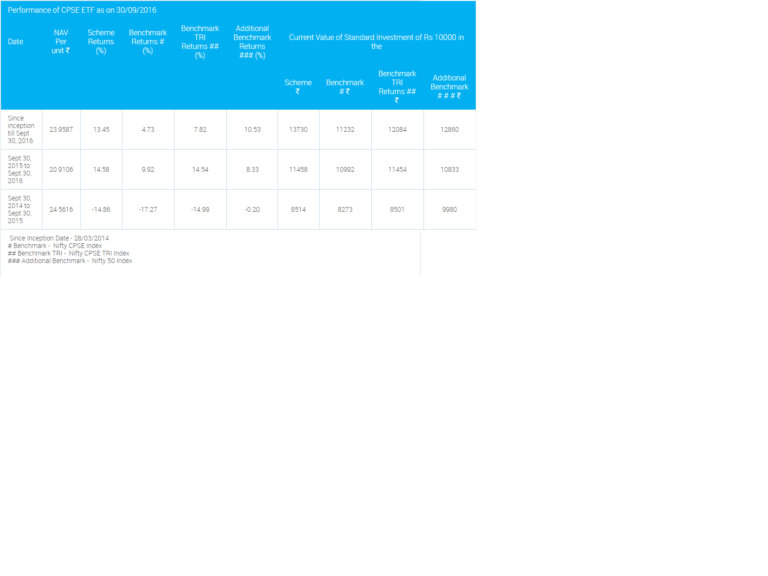
The Central Public Sector Enterprises (CPSE) ETF was launched by the Government of India in March 2014 as part of its disinvestment programme. The idea was straightforward: instead of direct share sales, the government would package PSU stocks into an ETF and offer them to retail investors, often at a small discount.

In 2019, Nippon Life Insurance acquired Reliance Capital’s stake in Reliance Mutual Fund. The fund house was renamed Nippon India Mutual Fund. The CPSE ETF – previously marketed as “Reliance CPSE ETF” – is now the Nippon India CPSE ETF. The fund itself, its objective, and its underlying index are unchanged. Only the AMC name is different.

The ETF tracks the Nifty CPSE Index, which consists of 10 Maharatna and Navratna public sector companies. As of 2025, these include NTPC, Power Grid Corporation, Coal India, Bharat Petroleum (BPCL), Oil and Natural Gas Corporation (ONGC), Indian Oil Corporation, NHPC, NLC India, SJVN, and Container Corporation of India. The composition has evolved slightly from the original 2014 index, but the heavy concentration in energy, power, and oil and gas remains.

Performance: What Actually Happened

The story of CPSE ETF performance is a tale of two eras – and both contain important lessons.

From 2017 to 2021, the fund delivered poor returns. PSU companies were out of favour. Government interference in business decisions, underinvestment, and competition from private sector players kept valuations suppressed. Investors who bought in 2017 on the back of “discount + loyalty units” and held through this period were frustrated.

From 2021 to 2024, the picture reversed dramatically. The government’s push on infrastructure, energy transition, and capital expenditure drove a sharp PSU re-rating. The Nifty CPSE Index surged. As of early 2025, the 5-year return was approximately 42% CAGR – among the strongest thematic ETF performances in that period.

Both eras are real. Both were unpredictable. And that is precisely the point about thematic investing.

The Thematic Investor’s Trap

In 25 years of advising, I have watched investors make the same mistake with every thematic fund: they buy after a period of strong performance, when the fund is on the cover of financial magazines and agents are pitching it actively. They buy at high valuations, after the easy money has been made. Then they hold through a long underperformance cycle and sell in frustration – just before the next recovery. This pattern has repeated with IT funds, pharma funds, infrastructure funds, and now PSU funds.

The best time to invest in a thematic fund is when nobody is talking about it. That is also, unfortunately, the hardest time to do so emotionally.

The Real Risks Worth Understanding

The CPSE ETF carries risks that a diversified equity fund does not. Understanding them matters before you commit any allocation.

Government policy dependency is the biggest one. The companies in the CPSE index do not make purely commercial decisions. Fuel price deregulation, disinvestment plans, environmental regulations, and infrastructure spending decisions are all made in New Delhi – not in boardrooms. A change in government priorities can materially affect returns across the entire fund in a way that has nothing to do with business fundamentals.

Sectoral concentration is the second issue. As of 2025, the fund has dominant exposure to energy, power, and oil and gas. If crude oil prices fall sharply, if renewable energy disruption accelerates faster than expected, or if government capex spending slows – the entire fund is exposed simultaneously. A diversified fund would be insulated by its other holdings.

Liquidity on the exchange matters for ETF investors. Bid-ask spreads on CPSE ETF can widen during volatile market periods. If you need to exit quickly in a falling market, the price at which you actually sell may be worse than the NAV you expect.

What Changed: RGESS and the Discount Model

Two features of the original CPSE ETF structure have been discontinued. The Rajiv Gandhi Equity Savings Scheme (RGESS), which previously allowed first-time investors a Section 80CCG tax deduction for investing in CPSE ETF, was abolished with effect from FY 2017-18. No new RGESS deductions are available.

The discount model – where new tranches were offered at 3-5% below market price, with loyalty units for long-term holders – was a feature of government-led FFOs (Further Fund Offers). Recent tranches have not followed this structure. Do not invest expecting a guaranteed discount. Evaluate the fund on its merits as a thematic equity investment.

Should You Invest? The Honest Assessment

If you have no equity exposure to PSU or infrastructure-linked companies in your existing portfolio, CPSE ETF can add a small diversification benefit. These companies tend to move somewhat differently from private sector-heavy indices, particularly during periods of government capex cycles.

But that is a minor portfolio optimisation argument. It is not a compelling standalone investment thesis for most investors.

The fund is appropriate for: investors who have a genuine view on the India infrastructure and energy investment cycle; those comfortable holding through multi-year underperformance when PSU stocks are out of favour; and those who want diversified PSU exposure without picking individual stocks.

It is not appropriate for: conservative investors who cannot stomach sector-level volatility; anyone treating it as a core equity holding; retirees or near-retirees who cannot afford a 3-5 year wait if the PSU cycle turns unfavourable.

If you do invest, keep it to 5% of your equity allocation at most. And review whether the PSU cycle is at an early or late stage before adding more.

A thematic fund should never be your only equity holding.

A diversified equity allocation – across market caps, sectors, and styles – is what actually builds long-term retirement wealth.

See How RetireWise Structures Portfolios

The core principle has not changed since 2017: thematic ETFs reward investors who buy early and hold patiently through cycles. They punish investors who chase recent performance and sell on frustration.

Whether CPSE ETF belongs in your portfolio depends entirely on where you are in your financial journey – not on its recent returns.

Past performance tells you where the train has been. It does not tell you where it is going next.

Invest in themes you understand. Size them as if you might be wrong.

Building a retirement portfolio means making decisions you can hold through cycles – not just through rallies.

That is what we build at RetireWise.

Book a Free 30-Min Call

Your Turn

Have you invested in CPSE ETF or any other PSU-focused fund? What was your experience across the down cycle of 2017-2021 and the recovery since? Share in the comments.

TDS for NRIs in India: Complete Guide to 2026 Rates and Rules

An NRI client once received a rental payment from his tenant in India with 30% already deducted. He was surprised – he had assumed TDS on rent was the tenant’s problem, not his. When he asked whether he could get a refund, the answer was yes, but only after filing an Indian income tax return for that year.

This is the pattern with NRI taxation in India. The rules are not designed to be punitive – they follow a withholding tax logic common globally. But they catch people unprepared because NRIs often assume the same rules apply to them as to resident Indians. They do not.

This guide covers TDS rates on all major income sources for NRIs in India, updated for the rules in force after the July 2024 Union Budget.

Quick Answer

TDS for NRIs is governed by Section 195 of the Income Tax Act. Key 2026 rates: NRO account interest – 30% TDS; NRE and FCNR interest – nil TDS; equity STCG – 20% TDS; equity LTCG above Rs. 1.25 lakh – 12.5% TDS; property sale proceeds – 20% TDS (LTCG) or applicable slab (STCG); rent income – 30% TDS; dividends – 20% TDS. DTAA with your country of residence may reduce these rates. Always apply for lower deduction certificate if eligible or claim refund via ITR filing.

TDS for NRIs India 2026 - Complete Guide

Table of Contents

TDS on Bank Account Interest

NRIs typically hold three types of bank accounts in India, and the tax treatment differs significantly across them.

NRO (Non-Resident Ordinary) Account. Interest earned on NRO accounts is fully taxable in India at the applicable rate. TDS is deducted at 30% plus applicable surcharge and 4% Health and Education Cess. On a 30% base rate, the effective TDS with cess works out to 31.2% for income below Rs. 50 lakh. Higher surcharges apply above Rs. 50 lakh. NRO interest is typically eligible for DTAA benefits – if your country has a treaty with India, you can claim the lower treaty rate by submitting a Tax Residency Certificate (TRC) and Form 10F to your bank.

NRE (Non-Resident External) Account. Interest earned on NRE savings and fixed deposits is fully exempt from Indian income tax for as long as you maintain NRI status. No TDS is deducted. This exemption ceases on the year you become a resident again, so plan accordingly if you are planning to return to India.

FCNR (Foreign Currency Non-Resident) Account. Interest on FCNR deposits is also fully exempt from Indian income tax and no TDS applies. The exemption continues as long as NRI/RNOR status is maintained.

“The NRI who parks money in NRO deposits without checking the TDS implications often discovers at year end that 30% of their interest income has already been withheld. File your ITR to claim a refund if the actual tax liability after deductions is lower than the TDS deducted.”

TDS on Dividends

This is one of the most misunderstood areas for NRIs. Prior to April 2020, dividends from Indian companies were tax-free in the hands of investors under the Dividend Distribution Tax (DDT) regime. That changed with Budget 2020.

Since FY 2020-21, dividends are taxable in the hands of the recipient. For NRIs, TDS on dividends from Indian companies and mutual funds is deducted at 20% plus applicable surcharge and cess. The effective rate before DTAA benefits is 20.8% for income below Rs. 50 lakh.

Under DTAA with several countries (USA, UK, UAE, Singapore, Netherlands), the dividend TDS rate can be reduced – often to 10 to 15%. Submit your TRC and Form 10F to the company or mutual fund to claim the reduced rate at source. If this is not done before payment, you can claim a refund via your income tax return.

TDS on Capital Gains from Equity and Mutual Funds

Post the July 2024 Union Budget, capital gains tax rates changed materially. The new rates apply to transactions from 23 July 2024 onwards.

Short-Term Capital Gains (STCG) on listed equity shares and equity mutual funds (held less than 12 months): taxed at 20%. TDS at 20% plus surcharge and cess applies for NRIs. Earlier this was 15% – the increase to 20% took effect from 23 July 2024.

Long-Term Capital Gains (LTCG) on listed equity shares and equity mutual funds (held 12 months or more): gains above Rs. 1.25 lakh per year are taxed at 12.5% without indexation. TDS at 12.5% plus surcharge and cess applies for NRI sellers. The Rs. 1.25 lakh exemption threshold increased from Rs. 1 lakh from July 2024.

Debt mutual funds and bonds. STCG (held less than 24 months): taxed at slab rate. LTCG (held 24 months or more): taxed at 12.5% without indexation from July 2024, removing the earlier 20% with indexation benefit. This was a significant change that increased the effective tax on debt fund redemptions for NRIs.

Property (immovable assets). STCG (held less than 24 months): taxed at slab rate. LTCG (held 24 months or more): taxed at 12.5% without indexation from July 2024. The buyer of NRI-owned property must deduct TDS at 20% (LTCG rate plus surcharge) before paying the NRI seller. This often surprises NRIs selling property in India – the buyer has a legal obligation to deduct TDS.

TDS on Property Sale: The Buyer’s Obligation

When an NRI sells immovable property in India, the buyer must deduct TDS under Section 195 before remitting the sale proceeds. This is not optional. A buyer who fails to deduct TDS becomes liable for the tax amount plus interest and penalties.

The TDS rate for LTCG on property is 20% plus applicable surcharge and cess. For STCG, the rate is the applicable slab rate – which for most transactions defaults to 30% plus surcharge and cess at source.

NRIs who believe their actual capital gains will result in lower tax than the TDS deducted can apply to the Income Tax Officer for a Certificate of Lower Deduction under Section 197. This requires filing Form 13 in advance of the transaction and typically takes 4 to 6 weeks. Without this certificate, the full TDS rate applies at source regardless of the actual gain.

Lower Deduction Certificate: Plan Ahead

If you are selling property in India as an NRI and your actual tax liability will be significantly lower than the statutory TDS rate, apply for a Lower Deduction Certificate at least 6 weeks before the anticipated transaction date. The certificate specifies a reduced TDS rate that the buyer can apply. This avoids a large refund process and the 6 to 12 month wait for ITR processing.

TDS on Rent and Other Income

When a resident Indian pays rent to an NRI landlord, TDS must be deducted under Section 195. The applicable rate is 30% plus surcharge and cess on the gross rental payment – not on the net income. Tenants who fail to deduct this TDS are personally liable for the tax amount.

Other income categories and their base TDS rates for NRIs:

Income Type Base TDS Rate
Professional / Technical services fees 10%
Royalties 10%
Rental income from property 30%
Insurance policy maturity proceeds (taxable) 30%
Any other income 30%

All rates above are base rates. Add surcharge (applicable for income above Rs. 50 lakh) and 4% Health and Education Cess to arrive at the effective TDS rate.

Surcharge and Cess: The Full Picture

In 2026, the effective TDS rates for NRIs include surcharge and 4% Health and Education Cess on top of base rates. The surcharge structure:

Income between Rs. 50 lakh and Rs. 1 crore: 10% surcharge on tax. Income between Rs. 1 crore and Rs. 2 crore: 15% surcharge. Income between Rs. 2 crore and Rs. 5 crore: 25% surcharge. Income above Rs. 5 crore: 37% surcharge (capped at 15% for capital gains under the new regime).

For a practical example: NRO interest income of Rs. 10 lakh in a year. Base TDS: 30% = Rs. 3 lakh. Surcharge (income below Rs. 50 lakh): nil. Health and Education Cess at 4% of Rs. 3 lakh: Rs. 12,000. Total TDS: Rs. 3,12,000 on Rs. 10 lakh interest.

How DTAA Can Reduce Your TDS

India has Double Taxation Avoidance Agreements with over 90 countries. For NRIs resident in these countries, DTAA can reduce the applicable TDS rate on several income types – most commonly on NRO interest, dividends, and royalties.

To claim DTAA benefits, the NRI must submit to the Indian payer a Tax Residency Certificate (TRC) from their country of residence, a self-attested Form 10F, and a declaration of no permanent establishment in India. These documents must be submitted before the payment is made – retroactive DTAA claims require an ITR refund.

Common DTAA rates on NRO interest: USA – 15%, UK – 15%, UAE – no DTAA on interest but other benefits apply, Singapore – 15%, Canada – 15%. The exact rates depend on the specific treaty provisions. A detailed guide on how DTAA works for NRIs is available at NRI DTAA rules and benefits.

How to Claim a TDS Refund

If TDS has been deducted at a higher rate than your actual tax liability (after deductions and DTAA benefits), you can claim a refund by filing an Indian Income Tax Return for that financial year.

NRIs with income from India must file ITR-2. The filing deadline is 31 July of the assessment year for non-audit cases. The refund, once processed, is credited to the bank account specified in the return – which must be a bank account with Indian banking operations (NRO or NRE account linked to PAN).

Refund timelines have improved significantly – most straightforward refunds from e-filed returns are processed within 3 to 6 months. Ensure your PAN is linked to Aadhaar and your bank account is pre-validated on the income tax portal to avoid refund delays.

NRI Tax and Financial Planning

WiseNRI.com handles NRI financial planning including tax-optimized investment structures, DTAA applications, and comprehensive NRI wealth management. For NRI-specific planning, visit our dedicated platform.

Visit WiseNRI.com

Frequently Asked Questions

Is NRE account interest taxable in India?
No. Interest on NRE savings accounts and NRE fixed deposits is fully exempt from Indian income tax for as long as the account holder maintains NRI status. No TDS is deducted. This exemption applies under Section 10(4) of the Income Tax Act.

What is the TDS rate on NRO fixed deposits?
30% plus applicable surcharge and 4% Health and Education Cess. For most NRIs with NRO income below Rs. 50 lakh, the effective rate is 31.2%. If your country has a DTAA with India and you submit TRC and Form 10F to your bank, the rate can be reduced to the treaty rate (typically 10 to 15%).

Did the capital gains tax rates change for NRIs in 2024?
Yes, significantly. From 23 July 2024: STCG on listed equity increased from 15% to 20%; LTCG on listed equity above Rs. 1.25 lakh increased from 10% to 12.5% (the exemption threshold also increased from Rs. 1 lakh to Rs. 1.25 lakh); debt fund LTCG now taxed at 12.5% without indexation (previously 20% with indexation).

Who deducts TDS when an NRI sells property?
The buyer. Under Section 195, the resident Indian buyer must deduct TDS at the applicable capital gains rate before remitting the balance to the NRI seller. If the buyer fails to deduct, they become personally liable. NRI sellers can apply for a Lower Deduction Certificate in advance if their actual tax liability is lower than the statutory rate.

Do NRIs need to file an income tax return in India?
NRIs must file an ITR in India if their total Indian income exceeds the basic exemption limit (Rs. 3 lakh in FY 2025-26 under the new regime, Rs. 2.5 lakh under the old regime), or if they have any capital gains from Indian assets regardless of amount, or if they want to claim a TDS refund. Even if TDS has been fully deducted, filing an ITR is the only way to claim refunds or carry forward losses.

Before You Go

Related reading: Tax Planning for NRIs: Complete 2026 Guide and How NRIs Can Use DTAA to Reduce Tax.

Have a specific TDS situation you are trying to navigate? Share in the comments below.

One question for you: Are you submitting your TRC and Form 10F to your Indian bank before interest payment dates to claim the DTAA rate at source, or waiting to claim refunds later via ITR?

Cost of Higher Education in India 2026: Are You Financially Ready?

My elder daughter started college last year. The first-year fee statement arrived and I sat with it for a long time.

Not because we could not manage it. But because I remembered what my entire education — from Class 1 through my MBA — had cost my parents. This one year, at one institution, cost more than all of that combined.

That moment clarified something I had been telling clients for years: education inflation is the most underestimated financial risk in India. And most parents are not ready for it.

Quick Answer

Education costs in India are rising at 10-12% annually — nearly double the general inflation rate. A professional degree that costs Rs 15-20 lakh today will cost Rs 40-50 lakh in 10 years. For international education, costs have risen even faster due to rupee depreciation and institutional fee increases. Starting early, using dedicated instruments like Sukanya Samriddhi for daughters, and keeping education funds separate from retirement savings are the three most important principles.

What Higher Education Actually Costs in India in 2026

The numbers have moved significantly even in the last 5 years. Here is a realistic picture of current costs:

Engineering (IITs): Rs 2.5-3.5 lakh per year in fees. But total cost including hostel, books, and living expenses runs Rs 4-5 lakh per year. A 4-year BTech at IIT: Rs 16-20 lakh total.

Engineering (private colleges, tier-1): Rs 8-15 lakh per year for top private engineering schools. A 4-year degree can easily exceed Rs 40-50 lakh.

MBA (IIMs): The two-year fee at older IIMs ranges from Rs 23-28 lakh. Living expenses and opportunity cost push total cost to Rs 30-35 lakh.

MBBS (government): Relatively affordable — Rs 25,000-1 lakh per year in fees. But the process requires years of preparation and a seat is far from guaranteed.

MBBS (private): Rs 50 lakh to Rs 1.5 crore for the full degree depending on the college and state. This is not a typo.

International education (undergraduate): US, UK, and Australia range from Rs 35-70 lakh per year in total costs including tuition, living, and travel. A 4-year US degree for an Indian student: Rs 1.5-2.5 crore.

The Education Inflation Problem

These numbers are intimidating today. What makes them truly alarming is the inflation rate. Education costs in India have historically risen at 10-12% annually — consistently outpacing general inflation (CPI).

At 10% annual inflation, a cost that is Rs 15 lakh today becomes:
Rs 24 lakh in 5 years, Rs 39 lakh in 10 years, Rs 63 lakh in 15 years.

A parent with a 5-year-old child looking at IIT engineering today is not planning for Rs 20 lakh. They are planning for Rs 40-50 lakh by the time their child is ready.

A parent planning for international education for a 5-year-old is looking at Rs 4-6 crore by the time that child is 18.

Have You Calculated Your Education Corpus Target?

Most parents find the gap between what they have saved and what they need is significant. The earlier you know, the more time you have to close it. See how RetireWise builds goal-linked financial plans.

See Our Services

The Three Mistakes Parents Make with Education Planning

Mistake 1: Planning for today’s costs, not future costs. A parent saving Rs 5,000 per month for “IIT fees” for their 8-year-old may be saving enough for today’s IIT — but not for the IIT fee in 10 years. Always inflate your target at 10% minimum.

Mistake 2: Mixing education funds with retirement savings. This is the most dangerous mistake I see. When education time comes, parents withdraw from their retirement corpus — reducing the compounding years and permanently impairing retirement. Education planning and retirement planning must be completely separate buckets. They have different time horizons and different liquidity needs.

Mistake 3: Using low-return instruments for a long-horizon goal. A parent who starts saving for a child’s education at birth has 17-18 years. That horizon is long enough to absorb equity market volatility and benefit from compounding. Parking education savings in a savings account or FD for 18 years — while education inflation runs at 10% — means you are falling behind every year.

What to Use for Education Planning

Sukanya Samriddhi Yojana (for daughters only): Currently offering 8.2% interest, fully tax-free, backed by the government. Maximum Rs 1.5 lakh per year per account. Can be opened for girls under 10 years of age. The account matures when the girl turns 21 (with partial withdrawal allowed at 18 for education). For a daughter born today, this is the foundation. Complete guide to Sukanya Samriddhi Yojana including 2026 rules.

Equity mutual funds via SIP: For a 10-15 year horizon, equity SIPs remain the best wealth-creation tool. Target 12% CAGR. Start early. Don’t stop during market corrections. A Rs 10,000 monthly SIP started when a child is born, continued for 18 years at 12% CAGR, builds approximately Rs 80 lakh.

PPF: Tax-free, government-backed, 15-year lock-in with partial withdrawal from year 7. Works well as the debt component of an education corpus. Current rate: 7.1%.

Education loans: Not a planning failure — a legitimate tool. Premier institution degrees (IITs, IIMs, top foreign universities) have strong return on investment. Education loans up to Rs 4 lakh need no collateral; above Rs 7.5 lakh require collateral. Interest on education loans is deductible under Section 80E. However, loan should be a supplement to savings — not a replacement for it.

How Much Should You Be Saving?

A rough framework: if your child is young (under 5) and you are planning for a Rs 50 lakh corpus in 15-17 years, you need approximately Rs 8,000-10,000 per month in equity mutual funds (at 12% CAGR).

If your child is 10 and you are starting now, you need approximately Rs 20,000-25,000 per month for the same Rs 50 lakh target in 8 years — at a more conservative return assumption since the horizon is shorter.

The same target, the same goal — but starting 10 years later costs 2.5x more per month. This is the compounding penalty for delay. The cost of delaying financial decisions is always higher than you expect.

The Conversation Most Parents Avoid

There is one more thing — the most uncomfortable part of education planning.

At some point, you need to have a conversation with your child about what is affordable and what is not. Not every dream is financially achievable without severe cost to other family goals — including your retirement.

I have seen parents take Rs 1 crore education loans for their children, impair their own retirement, and then spend their final working years anxious about money. That is not good parenting. That is financial martyrdom.

The right approach: plan for a strong corpus, be honest about what is achievable, and involve your child in the financial reality of their educational choices. Children who understand the cost of their education make better use of it.

Frequently Asked Questions on Education Planning

How much should I save per month for my child’s higher education in India?

It depends on your child’s age and your target corpus. A rough guide: for a Rs 50 lakh corpus needed in 15 years, you need approximately Rs 8,000-10,000 per month in equity mutual funds (assuming 12% CAGR). For the same target in 8 years (child currently 10), you need Rs 20,000-25,000 per month. Always inflate your target at 10% annually from today’s cost — education inflation is that high.

Is Sukanya Samriddhi better than a mutual fund SIP for a daughter’s education?

Use both. Sukanya Samriddhi offers guaranteed, tax-free returns at 8.2% with government backing — this is the safe debt component of your daughter’s education corpus. Equity mutual fund SIPs offer higher long-term return potential (12%+ CAGR historically) but with market risk. A combination gives you safety plus growth, and together they can build a more complete corpus than either alone.

Should I take an education loan or use my savings for my child’s college fees?

Ideally, use savings for the bulk of the cost and education loans as a supplement for the remainder. Education loans for premier institutions (IITs, IIMs, top foreign universities) make financial sense because the degree’s ROI justifies the borrowing. The critical mistake to avoid: withdrawing from your retirement corpus for education fees. Retirement savings, once touched, cannot be rebuilt. Education loans can be repaid from the graduate’s future income.

At what age should I start saving for my child’s education?

The day the child is born, ideally. An 18-year SIP has dramatically more compounding power than a 10-year SIP. A Rs 5,000 monthly SIP started at birth compounds to approximately Rs 37 lakh at 12% CAGR. The same Rs 5,000 SIP started when the child is 8 grows to only Rs 15 lakh in 10 years. Every year of delay effectively doubles the required monthly saving to reach the same target.

Education is the best gift you can give a child. But giving it at the cost of your own financial security is not a gift — it is a transfer of anxiety from one generation to the next. Plan for both. They are not mutually exclusive.

Start early. Inflate your target. Keep education funds separate from retirement. These three principles will serve you better than any specific product recommendation.

Your Turn

What education goal are you planning for — and what instrument are you using? Or have you already navigated this and want to share what worked? Your experience is valuable to parents who are just starting this journey.

UPI in 2026: How India’s Payment System Works and Why It Matters for Retirement

“India did not get a digital payments revolution. India built one.”

A client of mine retired in early 2024 at 62. He had spent his entire career writing cheques and visiting bank branches. His biggest concern about retirement was not about money. It was about managing finances without his office’s accounts team.

Six months later, he called me to say retirement had solved the problem he did not know needed solving. He was doing everything on his phone. SWP proceeds landing directly in his account. Electricity bills, grocery payments, medical bills, children’s school fees for the grandchildren – all on UPI. He had not visited a bank branch once.

UPI is now so embedded in Indian daily life that writing a basic explainer about “what is UPI” feels almost unnecessary. But understanding how UPI works, what its limits are, and how to use it safely in retirement is still genuinely valuable – especially for the generation that is transitioning from paper-based finance to digital.

⚡ Quick Answer

UPI (Unified Payments Interface) is India’s real-time digital payment system built by NPCI (National Payments Corporation of India). It allows instant bank-to-bank transfers using just a UPI ID or mobile number, available 24×7 with no transaction charges for individuals. In 2025-26, UPI processed over 18,000 crore transactions worth over Rs 250 lakh crore annually, making it the world’s largest real-time payments system. For retirement investors, UPI is the primary mechanism for receiving SWP income, paying insurance premiums, managing household expenses, and transferring funds between family members.

UPI India - how it works and how to use it safely in retirement

How UPI Works: The Simple Version

UPI connects your bank account to a UPI ID (like yourname@okaxis or mobilenumber@upi). When you make a payment, you enter the recipient’s UPI ID or scan their QR code, enter the amount, and authenticate with your UPI PIN. The money moves directly from your bank account to theirs in seconds, 24 hours a day, 7 days a week, including holidays.

No card numbers to type. No net banking credentials to remember. No transaction fees for individuals. No settlement delays. The receiver gets the money instantly.

The main UPI apps used in India are PhonePe, Google Pay, BHIM, Paytm (UPI mode), Amazon Pay, and bank-specific apps (SBI YONO, HDFC PayZapp, ICICI iMobile, Kotak 811, and others). All UPI apps are interoperable – you can send money from Google Pay to a PhonePe user without any friction.

“India has leapfrogged two decades of financial infrastructure in under a decade. UPI is not a convenience feature. It is the financial backbone on which a billion Indians now manage their daily lives.”

– Hemant Beniwal, CFP, CTEP | Founder, RetireWise

UPI vs Other Payment Methods: Where Each Fits

UPI vs NEFT/RTGS: NEFT and RTGS require the recipient’s account number and IFSC code. They have transaction size requirements (RTGS minimum is Rs 2 lakh) and until recently had banking-hours restrictions. UPI needs only a UPI ID or phone number, works 24×7, and has no minimum amount. For routine transfers of Rs 1 lakh and below, UPI is faster and simpler than NEFT.

UPI vs IMPS: IMPS (Immediate Payment Service) is the older version of instant bank transfers requiring account number and IFSC. UPI replaced most IMPS use cases for individuals by removing the need to know banking details. If a recipient does not have a UPI ID, IMPS is still the fallback for instant transfers.

UPI vs e-wallets (Paytm wallet, PhonePe wallet): E-wallets hold money inside the app ecosystem. UPI draws directly from your bank account. For most purposes, UPI is superior: your money stays in your bank earning interest, there is no need to “load” a wallet, and UPI acceptance is near-universal. Wallets have a specific use case for small-value purchases at merchants who accept them but not UPI, which is now rare.

UPI Transaction Limits: What You Need to Know

As of 2025-26, the standard UPI transaction limit is Rs 1 lakh per transaction for most categories. Specific categories have higher limits: UPI for capital market and IPO applications allows up to Rs 5 lakh per transaction. Some banks set their own lower limits for new users during a probation period.

For larger transfers (home loan EMIs, investment lump sums, large property-related payments), RTGS or NEFT remains appropriate. For everyday retirement income management and routine payments up to Rs 1 lakh, UPI covers virtually everything.

Is your retirement income system set up for the digital age?

SWP income, pension credits, insurance renewal, family transfers – RetireWise builds retirement plans that integrate cleanly with how you actually manage money today.

Book a Free 30-Min Call

UPI Safety: The Rules That Protect You

UPI is a very safe system. However, the vast majority of UPI fraud happens not because of system failures but because users are manipulated into sharing their UPI PIN or approving incoming money requests.

The single most important UPI safety rule: your UPI PIN is only needed to send money, never to receive it. If someone calls you claiming to be your bank or a government official and asks you to “verify” your UPI PIN or approve a “collect request” to receive money, it is a fraud. You enter your PIN only when you initiate a payment. If a collect request appears on your app, approve it only if you know exactly why money is leaving your account.

Common UPI fraud patterns to know: fake collect requests disguised as “receive money” offers, QR code fraud where scanning a code initiates a payment rather than a receipt, and vishing calls where fraudsters impersonate banks or mutual fund companies asking for UPI PIN confirmation. NPCI has no mechanism to send money to you via UPI that requires your PIN.

UPI in Retirement: Practical Use Cases

For retirees, UPI streamlines several financial tasks that previously required branch visits or cheques.

SWP (Systematic Withdrawal Plan) proceeds from mutual funds credit directly to your registered bank account and can be moved via UPI to family members or spent instantly at merchants. Insurance premium renewals can be paid directly from your bank via UPI without entering card details. Medical expenses at hospitals and pharmacies can be paid instantly with the UPI QR code at the counter. Utility bills, domestic staff payments, and household expenses are all UPI-friendly. Sending money to children or grandchildren for education expenses or emergencies takes 30 seconds.

For retirees managing joint finances with a spouse, linking separate bank accounts to a shared family UPI arrangement provides each person independence while maintaining visibility.

Read – The Real Key to Wealth Creation: Why Starting Early Beats Everything Else

Read – The 50-30-20 Rule: How to Budget Your Way to Retirement Wealth

Frequently Asked Questions

Can I use UPI to pay mutual fund SIPs directly?

Yes. Most mutual fund platforms (MFU, Groww, Zerodha Coin, CAMS, KFintech, and individual fund house apps) accept UPI for SIP payments and lump sum investments. The UPI mandate feature allows you to pre-authorise recurring SIP debits without entering your PIN each month – similar to a standing instruction but executed via UPI.

Is there a charge for UPI transactions?

For individual users, UPI is free. No transaction charges, no monthly fees, no minimum transaction requirements. NPCI and the government have maintained the zero-fee framework for person-to-person and person-to-merchant UPI transactions. There are small merchant discount rates (MDR) for certain commercial transactions, but individuals making or receiving personal payments pay nothing.

What happens if I send money to the wrong UPI ID?

UPI transactions are instant and generally irreversible once processed. Always verify the recipient name that appears after entering a UPI ID before confirming the payment. If you send money to the wrong person, you can raise a dispute through your UPI app or bank, and NPCI has a mechanism to attempt reversal – but recovery is not guaranteed if the recipient has already withdrawn the funds. For first-time transfers to a new UPI ID, send a small test amount (Rs 1) first to verify the correct recipient before sending the full amount.

UPI has not just simplified payments. It has made financial independence in retirement genuinely possible for a generation that grew up managing money at bank branches. The retiree who masters UPI does not need a family member to accompany them for every financial transaction. That independence is worth more than the convenience.

Digital financial independence is real independence. Learn the tool.

Want a retirement plan that accounts for how you will actually manage money in retirement?

RetireWise builds retirement plans that cover not just the corpus and returns, but the income flow, tax efficiency, and practical day-to-day financial management in retirement.

See Our Retirement Planning Service

💬 Your Turn

How has UPI changed how you manage your household finances? Are there any financial tasks you still prefer to handle at a bank branch? Share in the comments.

NRI Tax Planning Using DTAA: A Beginner’s Guide to Avoiding Double Taxation

2

One of the most common concerns I hear from NRI clients is about double taxation. They are earning in the US, UK, UAE, or Australia. They also have income from India – rental income, FD interest, mutual fund dividends. And they are worried about being taxed on the same income twice.

The good news: India has signed Double Tax Avoidance Agreements (DTAA) with over 90 countries. If you understand how to use them, you can significantly reduce – and in many cases eliminate – the double tax burden legally.

Quick Answer: DTAA for NRIs

DTAA (Double Tax Avoidance Agreement) is a treaty between India and another country that prevents the same income from being taxed twice. As an NRI, if your Indian income (FD interest, rental income, capital gains) is already being taxed in India via TDS, you can claim credit or exemption for this tax in your country of residence using DTAA. The three methods are: exemption (taxed in one country, exempt in other), deduction (tax paid in source country deducted from global income), and tax credit (tax paid in one country credited against the other). Form 10F filing is now mandatory online through the income tax portal.

What is double taxation?

Double taxation occurs when the same income is subject to tax in two different countries. For NRIs, this typically happens in two situations:

First, when you have income sources in India – FD interest, rental income, capital gains from mutual funds or property – that India taxes at source (via TDS), while your country of residence also wants to tax your worldwide income.

Second, if you are a resident in India working as a freelancer for a foreign company, your income may be taxable both in India (where you reside) and in the foreign country (where the income originates).

What is DTAA and which countries are covered?

India’s Double Tax Avoidance Agreement is a bilateral treaty that defines which country has the right to tax specific types of income and at what rate. India has DTAA with over 90 countries including the US, UK, UAE, Canada, Australia, Germany, Singapore, and most major economies where Indian diaspora lives and works.

The UAE DTAA is particularly significant because the UAE has no personal income tax – NRIs in UAE can use DTAA to get zero or very low TDS on their Indian income, since the UAE has no domestic tax to credit against.

Three methods of relief under DTAA

Exemption method: The income is taxed in only one country – either the country of residence or the country of source. Tax is deducted at source (TDS) in India at the DTAA rate (which is often lower than the standard Indian rate). The other country exempts this income from tax entirely. This is the most common method for NRE FD interest and certain types of dividend income.

Deduction method: Tax is paid in the country where the income is earned (India). This tax paid in India is then deducted from your total global income before calculating tax in your country of residence. You pay tax in your resident country only on the net (after deducting India tax paid).

Tax credit method: Your total global income (including Indian income) is taxed in your country of residence. However, the tax you already paid in India is given as a credit against your resident country’s tax liability. You pay the difference if your resident country’s rate is higher. This is the most common method used in the US and UK.

NRI tax planning requires understanding both countries’ rules

DTAA reduces your tax burden – but getting it wrong (wrong forms, missed deadlines, incorrect TDS rates) can create complications in both countries. RetireWise works with NRIs to structure their India income for tax efficiency.

Book a Clarity Call

Documents required to claim DTAA benefits

To claim DTAA benefits in India – particularly for lower TDS on Indian income – you need to submit the following to your Indian bank or income payer before the tax deduction:

  • Tax Residency Certificate (TRC): Issued by the tax authority of your resident country. Confirms your tax residency status, nationality, address, and tax identification number.
  • Form 10F: Required under the Income Tax Act of India. Must be filed online through the income tax e-filing portal (incometax.gov.in). Since 2022, online filing of Form 10F is mandatory – the old offline submission is no longer accepted. The form must be filed for each financial year you want to claim DTAA benefits.
  • Self-declaration: A declaration stating your country of residence for the relevant financial year and confirming DTAA applicability.
  • Self-attested copy of PAN card
  • Self-attested copy of passport

Submit these to your bank or deductor before the income payment. Once submitted, the bank will deduct TDS at the DTAA rate (which is typically lower than the standard rate) instead of the full Indian rate.

The 2026 update: online Form 10F is mandatory

This is the most important procedural update of recent years. CBDT had initially made online Form 10F mandatory from July 2022, with some extensions for NRIs without a PAN. From 2023-24 onwards, online filing through the income tax portal is required for all NRIs claiming DTAA benefits.

The process: log into the income tax e-filing portal (incometax.gov.in) with your PAN credentials, navigate to e-File > Income Tax Forms > File Income Tax Forms > Form 10F, and complete and submit the form electronically for the relevant assessment year.

NRIs without a PAN who do not earn taxable income in India above the basic exemption limit may be exempt from this requirement, but should verify with a tax advisor for their specific situation.

For a complete guide to DTAA with country-specific rates and detailed examples, read: How NRIs Can Use DTAA to Reduce Tax in India: Complete 2026 Guide

Frequently asked questions

Which countries have DTAA with India?

India has Double Tax Avoidance Agreements with over 90 countries including the US, UK, UAE, Canada, Australia, Singapore, Germany, Netherlands, Japan, and most major economies. The specific DTAA rates and provisions vary by country – for instance, the India-UAE DTAA allows NRIs in the UAE to claim lower TDS rates on Indian income since the UAE itself imposes no personal income tax. A full list is available on the Income Tax India website.

How do I file Form 10F online as an NRI?

Log into the Income Tax e-filing portal (incometax.gov.in) using your PAN credentials. Navigate to e-File > Income Tax Forms > File Income Tax Forms and select Form 10F. Fill in the required details including your tax residency information and submit electronically. You will also need your Tax Residency Certificate (TRC) from your country of residence. File Form 10F for each financial year in which you want to claim DTAA benefits – it must be filed before your Indian income payer deducts TDS.

Does DTAA eliminate all Indian tax on NRI income?

Not necessarily. DTAA reduces the tax burden and prevents double taxation, but does not always eliminate Indian tax entirely. Under the exemption method, some income types are fully exempt from Indian tax for NRIs in certain DTAA countries. Under the tax credit method, India still deducts TDS but at the DTAA rate (which is often lower than the standard rate), and you claim credit for this in your resident country. The specific treatment depends on the type of income and the DTAA provisions between India and your country of residence.

Are you an NRI with income in India? Share your experience with DTAA – which country you are based in and what has worked or not worked in claiming DTAA benefits.