

Last Updated on April 10, 2026 by Hemant Beniwal
“Financial freedom is available to those who learn about it and work for it.” – Robert Kiyosaki
What does financial freedom actually mean to you? Not the Instagram version with Bali sunsets and laptops on the beach. The real version. The one where you can answer this question honestly: if you stopped working tomorrow, how long would your money last?
If the answer makes you uncomfortable, you’re not alone. Most Indians earning ₹3 lakh+ per month still can’t answer this question with confidence. And that’s the gap between dreaming about financial freedom and actually achieving it.
Freedom is not a word. It’s a feeling. It’s what you feel when there are no doubts, no barriers, and no financial worries keeping you up at night. It’s knowing that you and your family are protected regardless of what happens to your job, the economy, or the stock market.
⚡ Quick Answer
Financial freedom means having assets that generate enough income to cover your lifestyle without needing to work. It’s not about having the best house or car. It’s about having the freedom to choose. The path requires widening the gap between income and expenses, converting savings into income-producing assets, and building a system that survives inflation for 30+ years.
Read More – Follow the 50 30 20 Rule to Make Better Financial Life
Financial Freedom Is Not What You Think
Financial freedom is not about having the biggest house in town or the latest model car or a foreign trip every year. I’ve seen people with all of those things who are deeply financially stressed because they’re one job loss away from disaster.
In simple language, financial freedom means having money or assets that provide you a perpetual income sufficient for a comfortable lifestyle. But it’s actually more than that. It’s having the freedom to choose: work because you want to, not because you have to. Spend time with family without worrying about the next EMI. Sleep peacefully knowing your retirement is sorted.
But Why Should You Want Financial Freedom?
There should be a strong motivation behind your desire for financial independence. “I’m tired of my job” is not strong enough fuel for a multi-decade journey. You need something deeper.
A few months back, I got an email from a 25-year-old reader:
📌 Reader’s Email
“I have ₹30 lakh in bank FDs at 9% interest. I’m 25, newly married, and I need ₹30,000 per month. I’m really tired and need rest. Is this possible?”
My reply was direct: “Tired at 25 is not a good sign. Take a 15-day break. You are the biggest asset of your family, much bigger than ₹30 lakh.” Yes, ₹30,000 per month is possible from that portfolio. But the value of ₹30,000 will shrink sharply every year because of inflation. Job frustration isn’t a strong enough reason to stop working at 25. You need a bigger motivation: more time with family, work of your choice, social impact, creative pursuits.
Must Check – Behavioural Finance: How Your Mind Sabotages Your Money Decisions
The 4 Building Blocks of Financial Freedom
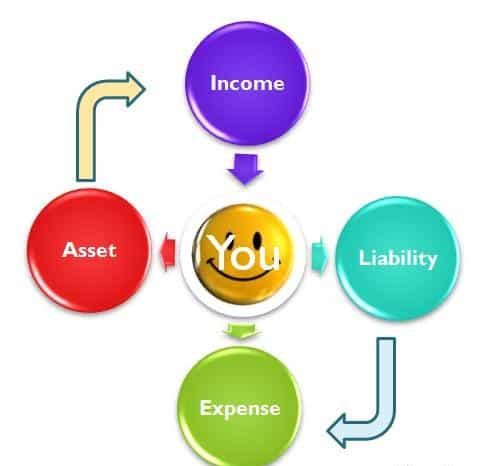
1. Income: It’s Not Just Your Salary
Your salary depends on things partly outside your control: your company, the economy, your boss’s mood. But here’s what most people get wrong: a salary increase alone will never make you financially free.
I’ve seen it hundreds of times. Someone gets a 30% hike, feels rich for two months, then their expenses rise to match the new income. Next year, same frustration. The problem was never how much they earned. It was how much they kept.
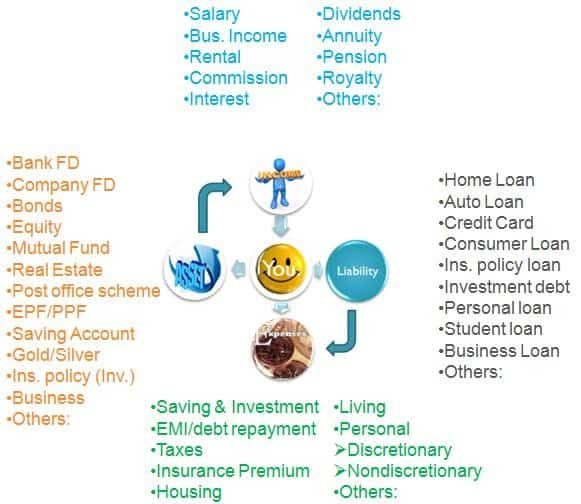
Think beyond salary. Rental income, dividend income, interest income, side income from skills. The more income sources you have, the less dependent you are on any single one.
2. Expenses: The Part Nobody Wants to Face
I know most readers want to skip this section because it hits where it hurts. But the truth is simple: the greater the gap between earning and spending, the faster you achieve financial freedom.
Whether you earn ₹1 lakh a month or ₹10 lakh a month, without a budget, your money will find a way to disappear. A budget isn’t punishment. It’s your most powerful wealth-building tool.
Check – 6 Steps of Financial Planning Process
3. Assets vs. Liabilities: The Question That Changes Everything
Robert Kiyosaki said it best: “An asset puts money in your pocket. A liability takes money out.”
Now ask yourself honestly: is your house an asset or a liability? If it’s generating rental income, it’s an asset. If you’re paying EMI on it, living in it, and it’s not generating any income, it’s a liability disguised as an asset. Your car? Almost always a liability. That gold jewellery sitting in the locker? A liability with storage costs.
If you want financial freedom, spend your life buying income-generating assets. If you want to stay trapped, keep buying liabilities and calling them investments.
4. Inflation: The Silent Thief
₹30,000 per month feels comfortable today. In 20 years, you’ll need ₹1.2 lakh per month for the same lifestyle (at 7% inflation). Any financial freedom plan that doesn’t account for inflation is just a slow path to poverty. This is why FDs alone can never make you financially free. The real return on FDs after inflation and tax is often negative.
Want to calculate your actual financial freedom number?
It’s not a round number you picked from the internet. It’s a specific calculation based on your expenses, inflation, and life expectancy.
What Nobody Tells You About Financial Freedom
The FIRE movement (Financial Independence, Retire Early) has exploded in India. The FIRE_Ind subreddit has over 65,000 members. A 2024 survey found 43% of Indians under 25 want to retire before 55.
But here’s what the spreadsheet warriors won’t tell you: the popular “25x expenses” rule and “4% withdrawal rate” come from American research based on US inflation (2-3%) and US market returns. In India, where inflation runs at 6-7% and healthcare costs rise at 12-14%, the maths is far less forgiving.
I’ve seen clients who “achieved FIRE” at 45 and came back to me at 52, stressed because their corpus was shrinking faster than they planned. They underestimated healthcare inflation, overestimated market returns, and forgot about the lifestyle creep that happens when you have unlimited free time.
Real financial freedom in India isn’t about hitting a number and quitting your job. It’s about building a system that generates income, adjusts for inflation, and survives for 30-40 years without you touching the principal. That requires a withdrawal strategy, not just an accumulation strategy.
16 Rules for Your Financial Freedom Journey
Must Read – The 3 Stages of Retirement
Financial freedom isn’t about retiring early. It’s about having choices.
The choice to work because you love it. The choice to say no. The choice to sleep peacefully.
Frequently Asked Questions
What is financial freedom in simple terms?
Financial freedom means your assets generate enough income to cover your lifestyle without you needing to work. It’s not about having crores in the bank. It’s about having a system where your money works for you, covering expenses, inflation, and emergencies for the rest of your life.
How much money do I need for financial freedom in India?
The popular “25x annual expenses” rule gives a rough estimate. If you spend ₹1 lakh per month (₹12 lakh per year), you’d need ₹3 crore. But in India, with 6-7% inflation and 12-14% healthcare inflation, you likely need 30-35x expenses. The exact number depends on your age, lifestyle, health, and withdrawal strategy.
Is the FIRE movement realistic in India?
Partially. The principles of saving aggressively and investing wisely are sound. But the American 4% withdrawal rule doesn’t directly apply to Indian conditions where inflation is higher and social security is almost non-existent. A realistic FIRE plan in India requires a lower withdrawal rate (3-3.5%), healthcare inflation adjustment, and a proper withdrawal strategy, not just an accumulation target.
What’s the first step toward financial freedom?
Change the formula. Most people save what’s left after spending. Flip it: spend what’s left after saving. Start with a budget, automate your investments through SIPs, and work with a financial planner to calculate your actual freedom number based on your specific circumstances.
Financial freedom isn’t a destination. It’s a direction. Every rupee you save and invest wisely is one step closer. Every impulse purchase is one step back.
Do the Right Thing and Sit Tight.
💬 Your Turn
What does financial freedom mean to you personally? Not the textbook definition. Your definition. And what’s the one thing stopping you from getting there? Share in the comments.
Dear Hemant
I have recently read something on the subject financial freedom. I really want to be financially free means I don’t want to work further to earn money. I have Rs. 50 lacs cash in my SB a/c, I am of 54 and free from all debt with my own house. Now I need your advice how can I earn atleast Rs.500000 P.M regularly from Rs30 lacs
Hello I am so delighted I found your web site, I really found you by mistake,
while I was browsing on Bing for something else, Anyhow I am here now and would
just like to say thank you for a incredible post and a all
round enjoyable blog (I also love the theme/design), I don’t
have time to read it all at the minute but I have bookmarked it and also added your
RSS feeds, so when I have time I will be back to read a great deal more, Please
do keep up the awesome jo.
Dear Hemanth
I do not agree with the Robert’s argument(In his book RichDad PoorDad)
that House is a liability. In India especially in TamilNadu a house which was Rs.8,00,000 some five years backs now cost Rs.40,00,000 (5 times increased).Even if a house in its most bad condition cost Rs.500000 / to renovate. Robert’s view are OK for all countries? As you told I expect you should write a separate articel about this. Please reply.
Hi Hemanth or any of the experienced folks,
I have few questions on my Financial situation and require your inputs on the same. (Little Background: Aged 30 yrs, male, married and kid of one daughter of 1.2 yrs.) Current Investment: 1. Term Insurance=50,00,000, 2. LIC Jeevan Anand=10614/-PA till 2023 (SA=1.5 Lakh), 3. LIC Jeevan Ankur=8814/-PA till 2030 (SA=2 Lakh), ICICI Pru Life stage wealth=50000/- PA till 2017 (SA=5 Lakh), PPF=100000 till date. Future milestone: House=50 L in 01-02yr, Children education=30 L in 15yr, Retirement=01 Crore in 20 yr. I just started with 02 mutual fund (HDFC top 200 and HDFC equity) of Rs. 1500/- every month for 12 months. How I should invest and what should be my time frame for those investments. Please provide me a balanced portfolio. Please guide.
Hi,
I am an avid reader of yours and appreciate a lot of your viewpoints. However I do not agree with your viewpoint to shun all debt. Especially for house even if you have the money you should never use it, instead take a debt. Leverage has its own value and should be used effectively.
TOWARDS TIME AND FINANCIAL INDEPENDENCE
Deriving from the way Robert T Kiyosaki has divided the world population of earners into four quadrants in his famous book “The Cash Flow Quadrant”, and how Burke Hudges has explained the ‘bucket carrying‘ concept in his famous book “The Parable of Pipeline”, I am convinced and thus strongly advocate that in this era of fast, and stress and tension filled life, we critically need to scan for options that will provide us TIME AND FINANCIAL FREEDOM. And, the sooner – the better.
What does that mean and translate into??? It means that we need to look for options which can help us move from the quadrant where we are trading our time for money, to the quadrant where we leverage other’s time to make money work for us. In plain terms – move from the ‘Active’ income side to the ‘Passive’ income side. And the good thing is that the transition can also be gradual. Some of the benefits of having a source of Passive Income are as under:-
• Escape from JOB (also Just-Over-Broke) cycle i.e. ‘off to office – back to home – off to office’.
• Time, as well as financial independence.
• Adequate time to pursue other interests.
• Spend quality, as well as quantity time with near and dear ones.
• No inherent fear of ‘retirement’ and ‘post – retirement’ blues.
• Contribute to charity.
• Future generations also get benefited.
Means to generate passive income are many, and thus can be adopted as per the capability, interests and the risk taking appetite of respective individual. One can reap benefits from investments in realty, earnings from investments in equity, write books or use net resources (like writing blogs) to obtain royalty or commission/ad revenues, or earn through Network Marketing, and many more.
I have discovered that Network Marketing happens to be a source which involves least risk, minimum investment and comparatively higher returns. One can get a very good insight into this field by reading “The Book on Network Marketing” by Richard Kall, and “Network Marketing – Business of the 21st Century” by Robert T Kiyosaki. (The pdf version of these are available on net).
I have no hesitation in saying that we, those in and also those out of uniformed life, need to take a serious stock of the environment around us and strive to reach the point where we can have ‘time for ourselves’ at the earliest. Look for your options…..and not run away from them.
Marathon Versus Relay: Our life is a race, but we can decide if we want to be a participant in a ‘marathon’ run, or a ‘relay’ race. Obviously, we run all alone in a marathon run and our success depends on our individual capability. We keep succeeding, till we keep running. It is synonymous with a person working on a job where he follows the of ‘off to office – back to home – off to office’ cycle. He gets a salary till he maintains this cycle. Thereafter, probably his next generation also takes the same cue and follows suit. This is what majority of the population does.
Alternatively, a few decide to run a ‘relay’ race. The first person runs for some distance, and then passes on the baton to the next person. The second person also does the same, and the cycle follows. In the end, when the team wins, it is victory for all of them. This is the essence of Network Marketing, where the effort is at team level with collective victory also providing for time and financial freedom. This way, they have all created a ‘pipeline’ of wealth for themselves.
There is a very thin wall separating the ‘marathon’ runners from the ‘relay’ runners. It is only incumbent on us to make a little effort and break this wall to become a part of the ‘relay’ runners or ‘pipeline’ builders.
My sole intention is ‘to make you think’ and possibly prod you towards a better life. However, the prerogative to take that ‘hint’ is and will always be with you. You decide, how you want to be the master of your future. Only YOU have to take decision to ‘make money work for you’, to stop becoming a ‘bucket carrier’ and to lay the ‘pipeline of wealth’ instead. Only YOU have to take actions to prevent yourself from getting exhausted in the ‘marathon’ of life, and instead form your team and run a ‘successful relay’ race. So,
• Act quickly.
• Learn, then earn.
• Raise yourself, and then HELP mankind.
• Enjoy – the much desired time and financial freedom.
Now, go ahead and arm yourself with adequate knowledge about the subject from the various sources you can think of. My best wishes will always be with YOU.
Lt Col Ranvir Singh (Retd)
Hi Hemant,
I am Rahul, age 30, IT Professional (only breadwinner in family), married since 5 years (& have a daughter of 2.5 years).
I have a LIC Moneyback Policy since last 6 years for which a pay a premium of INR 18000 annually & it pays me back INR 50000 every 4 years. Also, I started a ULIP Child Plan (ICICI Smart Kid) where I pay INR 25000 annually for a SA of INR 5 lakhs, last year. These 2 policies, 1 Term Insurance Plan (from ICICI), 1 Mediclaim Plan & 1 ELSS constitute my tax planning.
I am going to dis-continue the LIC Moneyback Policy, immediately & might re-consider dis-continuing the ULIP Child Plan as well. I believe, one should never fall in trap of low-yielding policies such as Moneyback, Income, Endowment, ULIP etc. at least, at my current stage. I already have monthly SIP worth INR 21000 in 6 Equity mutual funds.
Could you please suggest where should I channel this INR 18000 annually (+ INR 25000, probably)? My goals are house (2 years from now), daughter’s study & marriage, pension(25 years from now) & a significant health corpus. I dont have any loans/debts etc.
Your suggestions regarding best possible avenues for investment of INR 18000 annually (+ INR 25000, probably), would be highly appreciated.
Really a nice article….. Thanks.
hey. tried using the search field to look up on ICICI. it’s busted. you may want to give it a look.
Hi Hemant,
An excellent post. Thanks!!!
I have read Robert Kiyosaki’s Rich Dad & Poor Dad and you have quoted the phrase reg Asset and Liability. I wonder when i think that Home is a liability and Rental is an assest (income) which means to have seconday income (rental) you have to go through liability first… Pl correct me if i am wrong…
Regards,
Chandra
Hi Hemanth,
Very nice article once again on financial freedom, I have 3 LICs polices (Jeevan Anand, Jeevan Saral,Jeevan chhaya with each of 5 Lacks S.A-Total of Rs 15L). after reading your articles, have changed my investment approach since I am paying very high amount for these policies but am getting very less insurance coverage when I compared with my premium amount approximately 75K p.a.
Hence I am going to paid-up my existing 3 polices from this month onwards. Planned to take 2 term policies from both private and government sectors.
In the month of June-12. I have started “BSLI Term insurance” with S.A of Rs 3035000/- and this month I am planning to take one more term plan “Amulya Jeevan” with S.A of Rs 2500000/- from LIC.
Requesting you please confirm your opinion on Amulya Jeevan-Term plan from LIC where I am paying Rs 9125/-p.a for next 35 years.
Ragrards,
Kamati
Good one Hemant.
I’ll add few more:
1) I won’t buy any kind of insurance product except Term policy
2) I’ll read and associate more with folks who’re already on the path of Financial Freedom
3) I’ll give more in charity (Believe me this works) 🙂
Vikas
great article. came across an excellent definition of ” Financial freedom”— A person has Financial freedom when his /her passive income is more than 3x monthly expenses. A person earns passive income when he does,nt have to work for it . regds
Hemant Sir,
i m right now 20 years old and wanted to invest in mutual funds via SIP of Rs.8,000/- per month for next 20 years, Ma target is to achieve 2 crore in next 20 years. Tell me the best funds or what type of planning shud i do??????
You are Right Hemant but People in 25 wouldn’t concentrate on this even though they understood. But when we Entered in 30’s we didn’t t have more chances to
Invest since we have family responsibilities.How ever I am a bit luck since i am investing from past six years regularly in some stocks and mutual funds upto 30 Lakhs but some how my money didnt grown much as i expected however i will regularly follow you tips which are always excellent and helpful
Apart from just the financial tips that are necessary to achieve financial independence, the greatest need is to first develop the right mindset about want vs need. If only needs are catered to then probably 90% of the financial tips get covered in that (like multiple loans for multiple properties and credit card debt, bigger and better cars…the list is endless really)
hi hemant..
what can i do to start …at present i hv 5000-8000 pr mth as saving..what should be my asset allocation….there is not any deduction from my employer for pension..
i hv started post office RD of 500 from last mth..
i decided to take term plan of 15 lacs from lic Anmol jeevan..
hi,hemant..
excellent article for a person like me…
i m 29 yrs old ,i employed in gov job last yr only and from a mth ago visiting from site to site to understand ABC of financial planning…
today i get a start by ur article also i get the motivation and attitude …
thanks sir..
Dear Hemant,
Thank you for this article, it is excellent and helpful
Dear Mr. Hemant,
I like your article so much. I am 33 year of age with 3 year old son, me & my wife is working i have 14 lakh bank loan & my total family income is 6.0 PA.
i have some financial & insurance query kindly guide me.
Query 1- should i secure my home loan?
Query 2- Please suggest which one is good for me “LIC Jeevan Saral & Kokak Capital Multiplier Plan” if other please tell me.
Query 3 – I want to secure my child’s future so should i take traditional child plan or should i go with SIP or mutual fund for his future.
Query 4 – I want to invest in SIP with tax saving please guide me where should i go.
I am not so much of knowledge of finance & investments & please correct me where you feel i am wrong..
Super Like. Easy to comprehend. Need posts like this than Rich Dad, Poor Dad.
Please carry on good work.
Hi Hemant,you are so right about financial planning.The rich makes money work for them, while the poor work for money.As most of us want money but don’t know how to keep and grow it,your precious advice is most needed.Thanks you so much and best wishes !
It is definitely an excellent blog. Thank you, Hemant, for bringing it out. Your E-Mailsalso are nicely designed and unobtrusive.
I am 59 and retiring next year from a PSU. pension is not much, but I shall have good amount from PF/VPF. I am disappointed at all the offerings on Retirement Planning, as they address the people who have time horizon available for planning, normally the question of how to build up a corpus. However, their is very little literature on how to spend the retirment funds and how to allocate the funds in different options. One website advised of making three portions of the corpus and invest in FDs of various time frames. I missed that now. Can you give a thought and bring out some such guidance for people who are retiring immediately?
Hi Hemant
Your tips are very useful.
Hi Hemant,
Excellent article! Every line of article reminds of advice my dad gave me when I started earning. The best quote from him was, “A penny saved is a penny earned”.
Excellent Post
Dear Hemant
I have recently read something on the subject financial freedom. I really want to be financially free means I don’t want to work further to earn money. I have Rs. 30 lacs cash in my SB a/c, I am of 52 and free from all debt with my own house. Now I need your advice how can I earn atleast Rs.500000 P.M regularly from Rs30 lacs
Hello Hemant,
Your articles are so very interesting and informative.I just have a query for you.Am now an NRI @ 45 and will retire by 56 or so.Have lttle investments in MF and equity and insuraance.Can you please suggest me an investment where I can earn 25000 montly after my retirement.(It should be guaranteed unlike MIP?
thanks,
Meera.
Financial freedom is not tough to achieve but only you need to manage your finances and budget to get it . There are lot of peoples who are in debt , they always seek help from others to get out of it. So the first step would be debt , if you will overcome your debt then you can move towards financial freedom very easily. You just need to follow some tips to achieve your financial freedom …. 🙂
Thanks Denny.
Let me add one more tip to your Financial Freedom Tips:
I will always keep myself fit and invest in my physical fitness.
Does it make sense?
Hi sanjay,
NO …
Thanks Tinks for your reply
I have another Q between ELSS and PPF which one one should choose ? ELSS will not be tax exempted from next year ?
Hi ankur,
You can choose PPF not ELSS as the reason mentioned by you is correct.
Can you pls suggest I am planning to take Jeevan Saral 60000/- per annum and also planning to invest 60000/- per annum in mutual funds also have EPF account for 100000/- per annum
Hi Ankur,
Don’t take any of the LIC policies because the premium in comparison with the term plan if you are comparing is very high.what i will suggest is that you should have a term plan which must be 10-15 times of your income.
It’s good to hear from you that you are planning to invest in mutual funds rather then going in direct equity, I will suggest you to first see the horizon of your goals and according to that you should start investing in Mutual funds through SIP’s. You should continue your EPF account and build that corpus for your retirement don’t take money out of EPF account.
I have found a solid way to get financial freedom for forever…
I can share the tool if somebody wants to achieve Financial Freedom in next 5/8 yrs…
Mr Bhupesh,
This is the place where you can share anything which is beneficial for all to achieve financial freedom. So share it for all readers of this portal.
Regards,
Mr Bhupesh,
Hope you don’t mind the tool you are going to provide will benefits other or not that i dnt know but yes one thing is sure financial freedom is not just for 5/ 8 yrs its for your whole financial life…
how is sundaram select midcap appreciation in the portfolio of an SIP along with HDFC top 200 nd HDFC equity.
Hi Feroz Ikbal
You can consider these two funds.
1 ICICI Prudential Focused Bluechip Equity
2 HDFC Midcap Opportunities.
Hi Hemant
Having read your answers to queries I also would want you to suggest to me as to the investments i should make. I am 49 and my husband 51 We have
Lic Jeevan suraksha 30000
market plus 10000
sbi life scholar II 93500
sbi life long pension 40000
icici pinnacle II 50000
icici life stage wealth 24000
icici life stage pension 60000
uti mf div yield 1000 p.m
also suggest term plan if it is good at this age and which is better icici or kotak
Hi Sangeeta,
I am not sure what was your thought process behind buying all these policies. Are you planning for your retirement or your agent’s retirement.
Read this & think
https://www.retirewise.in/2010/04/what-is-insurance-investment-or-expense.html
Hi Hemant,
One question on SIP. Suppose after completing the 10 yrs of SIP i get a heavy amount will I have to show it in my income tax return . Will it be applicable for TDS.
reagrds,
Munish
Hi Munish,
Right now there are no long term capital gain tax on Equity Mutual Funds.
Thanks a lot hemant.
Believe me every time when i feel the financial freedom I always think of you and your guidance .
You really change my perception toward life and money.
Regards,
Munish K. Singh
great work @ hemant…i want to take one advice from you… i did a mistake by buying LIC samridhi plus of rs. 20000/= per year. on march 2011. after going through your eye opener review on samridhi plus, i want to discontinue the policy within 1 year. can you tell me, how can i discontinue the policy nd what amount i will get after discontinuation of the policy?
regards
kousik
Hi Dr Kaushik,
Yes you can do it – your fund will be converted into cash and you will receive it after completion of 5 years.
Hi Hemant
I agree with you that the most important factor to achieve financial freedom is to have confidence in you that you can take care of your financial destiny without taking help from somebody.This will come only if you will continually increase your knowledge of personal finance and money management.Your posts contain a wealth of information.If the reader takes the trouble of going through your posts he will get all the answers regarding investing in mutual funds.But my impression is that most of the readers are asking the questions without taking the trouble of reading the posts.
The readers can take a small step towards achieving financial freedom if they start investing in mutual funds by choosing their funds and managing their portfolio.In this way you can experience the thrill of designing your own portfolio and managing your own finances.This involves the following simple steps.
1 Choose the right funds for your portfolio.
2 Invest on your own, either directly through the fund house or the registrar and transfer agent.
3. Start investing through SIP.When you opt for SIP through ECS, this gives you freedom from filling forms and writing cheques.
4.Keep track of the performance of the funds in your portfolio against benchmarks and peers and take corrective action whenever needed.
Hi Hemant ,
On point no. 5 & 8 is really useful for the guys like me . In the present time some expenses are just for making appearance in the outer world. And point 5 atleast we should not depend on the single income source.
Gr8888888 Article .
Thanks Munish.
I tried to cover lot of areas in this articles but I don’t how many people actually get benefited by such content.
Hello I want to deal in mutual funds online. Currently I have an account with United Bank of India. This Bank does not have tie ups with any of the Fund Houses. So I am not able to invest online. I would like to open a new Bank Account with a Nationalised Bank barring State Bank of India since it has too much rush. Neither do I want to open an Account with a Private Bank since their charges & Min. Balance requirements are too high. So please suggest me which Nationalised Bank has tie-ups with most fund houses & allow to invest online easily.
Hi Singh, there is another option as well without opening another bank account. Most fund houses now a days offer direct investment with them like HDFC, Reliance, Fidelity etc. All you have to do is visit their branch and give them a cancelled cheque (for SIP), copy of PAN, KYC form (if already not compliant) and address proof. Viola. You are done. If you are doing SIP, they will deduct directly from your bank account every month. You can also apply for internet access, where you can login to the fund house website and purchase using your debit card or internet banking gateway. Hope this helps.
If you really want to open an account, demat account would be advisable but mind you, they will have some charges for maintaining your account as well as for every transaction (for SIP – Rs.10 plus ST, for Purchase – Rs.100 plus ST). Goodluck.
There are other avenues as well. You can try fundesupermart or Fundsindia
Just need to check if these websites support your bank.
Hi Hemant
I have recently read something on this subject which I would like to share.
What is financial freedom?
1 To have enough money to meet your needs and some surplus to invest.
2 To be free from debt.
3 To be a strong financial provider for your family.
What to do to achieve financial freedom?
1 Make your freedom list by writing your important financial goals.
2 Quantify your freedom goals by writing the time and the amount required to achieve each goal.
3 Save and invest regularly to achieve financial freedom.
4.Be patient. Give time to your investments to grow.
Hi Anil,
I liked the process to achieve financial freedom – everyone should do this.
Great Article Hemant !
These tips are really useful for our financial future ,
One can really print them and paste it at the place where they can see it daily , so that it will help reader to not to deviate from track once they start the journy
Thank You !
Regards
Rohan
Thanks Rohan for such a nice comment.
I think people should do this thing – everyone should make 10 good pointers (may be their week points) & paste it on their wall or keep it in their diary. This will keep them motivated.
Hi Hemant
In the statement given below I think the word reduce should be replaced by increase.
But the truth is – greater the gap between earning and spending, the faster we will achieve financial freedom. And you can reduce this gap by managing expenses.
Done.
Good article. My surplus are invested in FDS and Equity. I may have to find other sources of income. I am looking for Good MF for SIP, but somehow, i am not able to find one good one. I am aged 53 years.
Hi Mr Nair,
Anil has written something specially for you
https://www.retirewise.in/2011/07/best-mutual-fund-for-sip.html
Great article.
Really wish i knew all this 10 years ago!
Hi Sumant,
If this is the case why don’t you help other people – so they don’t write this message after 10 years.
been recommending books and forwarding good blogs (such as this one) to people. Some take the effort to read, learn and implement the learning. Some don’t. I guess some people have to go through some hard experiences before they accept the importance of saving/investing/asset allocation planning/risk management.
Hi Sumant,
I really appreciate your effort but as they say “you can lead a horse to water but you can’t make it drink” – it’s there financial life so let them chose their fate.
Hi Hemant ,
After reading your articles on TFL guide , there is a lot of positive change in my attitute towards finances. I always forward your article links to my family and friends. I have even shared the TFL guide link on my FB wall. But there is not a single response to it :-(. I think people find financial planning very boring and time consuming.
U rightly said “we can lead horse to water but u cant make it drink”. But I ll continue with my efforts .
Thanks and Warm Regards.
Moksha
Thanks Moksha 🙂
good one!!
Hemanth,
Should we rather keep others away from this financial knowledge? 😉 As more people becoming rich means more chance of the cost of living going high. Is not ‘being rich’ just a comparative state of mind (like “what other’s can’t afford that I can” sort of feeling). So if someone has missed the knowledge and just started gaining it, should he rather keep others away to stay ahead in the race? 😀 😀
Ram
Yet another excellent article, Thank you. My eyes were full reading the financial freedom tips. Simple things but makes a lot of difference.
I have a question on tip no. 5. How could a common man create 5 other sources of income? I am 29 with about 2 lacs of investments (mostly done recently in past 2 years), the dividends I get every year is only about 500-1000 INR. One reason could be because I have selected Growth Option. But just wondering.
Hi Mansoor,
Basic source of income are mentioned in the 2nd pic but you need to be bit creative to find more sources.
One of my client who is a tech geek runs a blog which generates some additional income through ad revenues. I know one more guy who is in govt. service support her wife (who was earlier homemaker) to sell merchandise on rediff. So good answer is Think & think creative.
It makes sense, thank you.
Hey Hemant,
Although the above advise was for Mansoor, still I would like to thank you as it is really too good. “Think Creative” I believe this is what would work for me to generate a 2nd source of income.
Once again A Big Thank You !!
Regards, Nishi
thank you sir..for giving wonderful article..
Hello Mr. Masoor,
Thats a problem with common man… a common man is ready to think out of the box…A common man has to create a income source which can generate money for him even though he is not actively working for money… I mean he should work for projects through which he can generate PASSIVE INCOME where his presence is not necessary…. But common man always think that JOB is the only area from where can generate his income… This is because of fear / lack of knowledge or due to high risk involve in Passive Income generating projects….
If you need any more information on Passive Income generation process and different ways then lots of Books / articles are available…you can search them…or you can write to me at
emailThank you so much for this article! It hits the right notes at so so many places. You are very right when you say a raise in salary doesn’t really solve any issues. We all need to know how to manage money better and how to make it work for us, instead of us working for it 🙂
Thanks!
Thanks Sameera.
Hemantji,
Many many thanks for the Financial Freedom Trips provided by you, which will be help us to rethink our future.
Again Thanks.