

Last Updated on April 10, 2026 by Hemant Beniwal
“An investment in knowledge pays the best interest.” – Benjamin Franklin
Which investor sits across from you at the dinner table?
I don’t mean literally. I mean this: after 25 years of advising Indian families on their money, I’ve noticed that every investor falls into one of seven personality types. And here’s the uncomfortable part. Most people think they’re Type 2 (the disciplined one) when they’re actually Type 5 or Type 6. The gap between who you think you are as an investor and who you actually are is where most of the money gets lost.
The first step to becoming a better investor isn’t picking better stocks or mutual funds. It’s honestly identifying your investor personality and understanding the blind spots that come with it.
⚡ Quick Answer
Indian investors broadly fall into 7 personality types: Only Savers, Regular Investors, Window Shoppers, Seasonal Traders, Scapegoats, Hi-tech Lalajis, and Mr. Cool. The first two are unshaken by markets. The other five react to market swings in predictable, often costly, ways. Identifying your type is the first step toward fixing your investment behaviour.
The 7 Types of Indian Investors
Over the years, I’ve classified investors into 7 broad categories. The first two are the Rajnikants of the investment world. Market crashes, bull runs, WhatsApp forwards, TV pundits – nothing shakes them. The other five? They dance to the market’s tune whether they realise it or not.
1. The Only Saver
This is still the largest category of investors in India. Tell them about equity and they look at you like you just suggested bungee jumping without a rope. Their entire financial life revolves around FDs, PPF, and post office savings. “Equity is risky, why take the risk?” is their standard response.
Meera (name changed), a 48-year-old school principal in Jaipur, had ₹45 lakh sitting in bank FDs earning 6.5%. After inflation and tax, her real return was negative. She was losing purchasing power every single year and calling it “safe investing.”
The blind spot: They confuse volatility with risk. The real risk is that their money loses buying power silently, year after year.
2. The Regular Investor
A rare breed. Genuinely rare. These investors have a long-term view on equity and never discuss daily market movements. They invest when there’s surplus. They withdraw when there’s need. They don’t try to time the market because they understand that time IN the market beats timing the market.
You feel comfortable in their company because they talk sense about money. They read, they learn, and they stay the course. If you’re truly a Type 2, you probably don’t need this article. But keep reading anyway. You might discover you’re not as disciplined as you think.
Must Read – Why Should You Invest Regularly? Benefits of Regular Investing
“The difference between a good investor and a bad one isn’t knowledge. It’s behaviour. The good investor does the boring thing consistently.”
Now come the five investor types who are actually affected by market ups and downs.
3. The Window Shopper
These people are the most informed non-investors you’ll ever meet. They read every article on Moneycontrol. They watch every episode of market analysis on TV. They’ll debate PE ratios with you at a dinner party. But ask them to show their portfolio and there’s an awkward silence.
They never invest their own money. They’re the non-playing captain who talks strategy from the dugout but won’t step onto the pitch. Knowledge without action is just entertainment.
4. The Seasonal Trader
Experienced but broke. That’s the simplest way to describe this type. These investors are usually close to trading desks or brokerage employees. They live in a fantasy that they get “inside news” before everyone else. They’re always waiting for the “right opportunity to make a killing.”
High volume of trades. Impressive stories at parties. But ask them their XIRR over 10 years and the conversation changes topic real fast. India now has over 21 crore Demat accounts, but SEBI data shows 88% of retail traders in the F&O segment lose money, averaging about ₹1.25 lakh per year per account. Most seasonal traders are in this 88%.
5. The Scapegoat
This investor is every product seller’s best friend. Agents complete the majority of their sales targets from this one type. The Scapegoat takes advice from everyone: colleagues, the panwala, fellow bus commuters, WhatsApp university graduates. Zero discrimination.
Ramesh (name changed), a 42-year-old IT manager in Bangalore, had 11 insurance policies, 3 ULIPs, 2 endowment plans, and zero term insurance. His total annual premium was ₹4.2 lakh. His actual life cover? Less than ₹25 lakh. Brokers enjoyed his money while his family remained dangerously underprotected.
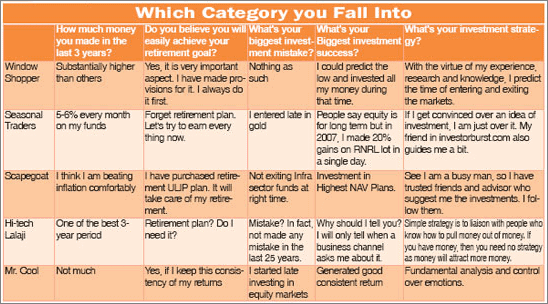
6. The Hi-Tech Lalaji
Champions of their business. Disasters in their investments. These investors suffer from the “I know everything” syndrome. Because they built a successful business, they assume investing is just another domain they can master without help.
Their common reactions: “Don’t give me advice, I’ve been investing before you were born.” “I traded gold when it was Rs 600 per tola.” “Pay for financial advice? Make me your partner instead.”
The irony? The more successful someone is in their career, the harder it is for them to admit they need help with money. Running a business well and investing well are completely different skills.
7. Mr. Cool
This is the investor everyone should aspire to be. Mr. Cool never panics and holds his nerve at all times. Cool and confident. Works against herd mentality. Ready to listen to opposing viewpoints. Takes decisions independently and sticks to them.
They follow a disciplined, process-driven approach and rarely fall for dubious schemes. They value transparency and appreciate that wealth is built over decades, not months. In my experience, less than 5% of investors genuinely qualify as Mr. Cool. Most people who think they’re Mr. Cool are actually Type 4 or Type 6 in disguise.
Read – KISS Strategy in Financial Products
Not sure which investor type you really are?
A structured financial plan starts with understanding your behaviour, not picking products.
What Nobody Tells You About Investor Types
Here’s something interesting that most articles on investor psychology skip entirely.
Your investor type isn’t fixed. It changes with market conditions. The same person who is Mr. Cool during a bull run becomes a pure Only Saver when markets crash 30%. I’ve seen CXOs who managed ₹500 crore budgets at work turn into panicked Scapegoats during the March 2020 crash, calling me three times a day asking if they should “exit everything.”
The real question isn’t “which type am I?” It’s “which type do I become when things go wrong?” Because that’s the version of you that makes the most expensive decisions. Your calm-weather personality is irrelevant. It’s the storm-weather personality that determines your actual returns over 20-30 years.
This is exactly why having a system matters more than having willpower. A written financial plan with pre-decided rules for market crashes acts as a behavioural anchor. It doesn’t eliminate fear, but it gives you something to hold onto when your instincts are screaming “sell everything.”
How to Move from Your Current Type to Mr. Cool
Identify your real type honestly. Not the type you want to be. The type you actually are when markets fall 20%. Ask your spouse or your advisor. They know better than you do.
Build a written investment policy. Not a vague plan in your head. A written document that says exactly what you’ll do when markets crash, when they boom, and when you’re tempted to “just try” F&O trading.
Stop taking financial advice from unqualified people. Your colleague, your cousin, the “finfluencer” on Instagram. SEBI has literally partnered with Google to crack down on unregistered finfluencers spreading misleading advice. If they’re not SEBI-registered, their opinion isn’t worth your money.
Get a fee-only financial advisor. Not because you’re not smart enough to invest yourself. But because a good advisor acts as a behavioural coach, stopping you from becoming your worst investor type at the worst possible moment.
Must Read – Behavioural Finance: How Your Mind Sabotages Your Money Decisions
Your portfolio reflects your personality, not your intelligence
The best investors aren’t the smartest. They’re the ones who know their weaknesses and build systems around them.
Frequently Asked Questions
What are the main types of investors in India?
Indian investors broadly fall into 7 types: Only Savers (FD/PPF only), Regular Investors (disciplined, long-term), Window Shoppers (informed but never invest), Seasonal Traders (high activity, low returns), Scapegoats (buy whatever agents sell), Hi-Tech Lalajis (overconfident businesspeople), and Mr. Cool (disciplined, process-driven). Most investors are either Type 1 or Type 5.
How do I know which type of investor I am?
The best test is to ask yourself: what did I actually do during the last market crash? If you panic-sold, you’re not Mr. Cool regardless of what you believe. Ask your financial advisor or spouse for an honest assessment. Your behaviour during market stress reveals your true investor type.
Can I change my investor personality type?
Yes, but not through willpower alone. You need a written financial plan with pre-decided rules, a trusted advisor who acts as a behavioural coach, and the humility to admit your blind spots. The goal isn’t to eliminate fear or greed. It’s to build a system that prevents those emotions from driving your investment decisions.
Why do most Indian retail investors lose money in trading?
SEBI data shows 88% of retail F&O traders lose money, averaging ₹1.25 lakh per year per account. The reasons are predictable: overconfidence, herding behaviour, acting on unverified tips, and confusing speculation with investing. India’s 21+ crore Demat accounts represent massive participation but not necessarily massive wisdom.
The market doesn’t care which type of investor you are. It treats all personalities equally. But your returns? Those are entirely a product of your behaviour.
It’s not a Numbers Game… It’s a Mind Game.
💬 Your Turn
Be honest. Which of the 7 types do you actually see in yourself? Not which one you want to be. Which one are you really? Share in the comments.
sir i have the following mutual fund investment:
all sips-
birla mnc -1000,hdfc midcap-2000,sbi emerging bussiness-2000
icici fmcg -1000,sbi fmcg-1000,reliance banking -2000
can robecoinfrastructure-3000
icici focc bluchip-2000, uti opp -2000
icici tax saver-3000, franklin india tax shield-3000
please analyse my portfolio and give your valuble comments… i am expecting 15% returns in 15 years.
Its good that you are investing thru SIP but ur portfolio is way too diversified. Over diversification kills returns so it is suggested to go for maximum 4 sips.. which may consist of 5000 in Large cap, 5000 in midcap, 5000 in gold & 5000 can be put in some sector specific fund keeping in view your risk taking appetite.
This is a general suggestion based on assumption that you are willing to diversify over various class & will continue for 10 yrs or more..
Hi Hemant
For most part of my life I have been a saver only.However I turned in to an investor for about five years when I was posted in Mumbai.Then I invested in mutual funds of UTI,Birla Sunlife,Morgan Stanley,Canara Bank and IDBI Bank.But my favourite was UTI.I just invested in some funds and forgot about them.No PAN or KYC was required for investment in mutual funds those days.There was no issue of third party cheques.In fact I made many investments in mutual funds through CITIBANK with my credit card which was being used as charge card by me.The names of fund houses have changed. Canara has become Canara Robeco, IDBI has become Principal but I am still remaining invested in my old funds.Of course the concept of SIP was not popular those days.One made additional purchases whenever one had money.The concept of ULIP was started by UTI and I had invested a lot in them as it was much different from the ULIPs which we have these days.About five years back I became a scapegoat when one of my relatives sold me one ULIP and relationship manager of my bank made me to invest me in some worthless schemes of SBI Mutual funds.Now I have again turned into a regular investor and so far I have been able to keep away from ULIP products.
Hemant
My confession is that I am a SCAPEGOAT 🙁 got butcherred by so many agents.
Now I am learning things.
Hi Ashwani,
Great you shared this – people accept it or not but 90% of readers who are reading articles on TFL are either only savers or Scapegoats. And nothing to hide every investor I have met in last 10 years has moved from these steps only.(No Shortcuts)