
Last Updated on April 21, 2026 by teamtfl
“Diversification is protection against ignorance. It makes little sense if you know what you are doing.” – Warren Buffett
Let me tell you about a trip to Hyderabad.
I was there for a 10-day training. Before leaving Jaipur, I was excited about one thing: eating Biryani. Hyderabad Biryani is legendary and I intended to make full use of my time there. I ate Biryani at every meal. The gali behind Charminar. The thela outside Salarjung. Biryani for lunch, Biryani for dinner. By day 8, I had to cut the trip short and rush home. My throat was ruined from the spices. Today, if Biryani is served at a buffet, I feel nauseous at the smell.
I have never forgotten this lesson in concentration. Too much of even a good thing eventually makes you sick. Sector funds work exactly this way.
⚡ Quick Answer
Sector funds are mutual funds that invest in a single sector – pharma, banking, technology, FMCG, infrastructure, etc. They are the riskiest category in equity mutual funds. When the sector does well, they outperform dramatically. When it does poorly, they underperform dramatically. For most investors, sector funds should not be part of the core portfolio. If held at all, they should be a small satellite allocation (5-10% maximum) for investors who have a specific, informed view on a sector that is underrepresented in their existing diversified funds.

What Is a Sector Fund?
A diversified equity mutual fund invests across sectors – banking, technology, pharma, FMCG, auto, chemicals, and more. The fund manager decides sector allocation based on their assessment of growth opportunities. A typical large-cap fund might have 15-20 different sector exposures at any point in time.
A sector fund, by contrast, invests primarily in one sector. A banking sector fund holds only banking and financial services stocks. A pharma fund holds only pharmaceutical and healthcare companies. The entire portfolio is concentrated in one theme.
This concentration is both the attraction and the danger. When the sector is in a tailwind, a sector fund dramatically outperforms diversified funds. When the sector is facing headwinds, it dramatically underperforms – and there is no other sector in the portfolio to cushion the fall.
“I have recommended sector funds to clients exactly twice in 25 years – once for pharma when it was under 4% in diversified funds and the sector was undervalued, and once in a situation where the client explicitly understood the risk and wanted targeted exposure. Both times, it was the exception, not the rule. Sector funds are not a strategy. They are a tactical bet.”
– Hemant Beniwal, CFP, CTEP | Founder, RetireWise
The IT Sector Fund Lesson: 2000-2003
The clearest Indian example of sector fund risk is the IT sector fund boom and bust of 1999-2003. During the bull run, IT sector funds were generating extraordinary returns. Advisors and investors piled in. By 2000-2001, many retail investor portfolios had 40-60% allocation to IT-related funds – both dedicated IT sector funds and diversified funds that had loaded up on tech stocks.
When the correction came, NAVs fell from Rs 100 to Rs 15-20. Investors who had not seen a full market cycle refused to sell, waiting for recovery. Some waited years. Some swore off equity entirely. AMCs quietly merged underperforming sector funds into diversified funds or renamed them to reduce the association.
The lesson is simple but ignored in every bull run: when everyone is talking about a sector fund and returns have been extraordinary for 2-3 years, the best returns are usually already behind it. The retail investor who buys at peak enthusiasm is typically buying someone else’s exit.
The Risk That Is Often Missed: Overlap With Existing Holdings
Here is the risk that most investors do not calculate. Banking and financial services already constitute roughly 25-30% of most large-cap and Nifty 50 index funds. If you add a banking sector fund on top of your existing diversified equity funds, you are not adding diversification – you are increasing concentration in a sector that is already your largest exposure.
The question to ask before any sector fund is: what is my existing exposure to this sector across all my equity funds? If the answer is “already significant,” adding a sector fund increases risk, not returns.
Do you know your actual sector concentration across all your mutual funds?
A RetireWise retirement plan includes a portfolio audit that maps your true sector exposure across all funds – identifying unintended concentrations before they cause problems.
When Sector Funds Can Make Sense
Sector funds are not universally wrong. There are specific situations where a small allocation makes sense.
When a sector is genuinely underrepresented in diversified funds. If your analysis shows that a sector you believe has strong structural growth is less than 3-5% of your diversified fund portfolio, a targeted sector fund adds exposure without necessarily increasing risk. This requires actual research, not recency bias.
When you have a long time horizon and can hold through full cycles. Sector funds can go through 5-7 year underperformance periods. If you cannot hold through a prolonged downturn without panic selling, a sector fund will hurt you.
As a maximum 5-10% satellite allocation for experienced investors. Never as the core. Always alongside a well-diversified core portfolio of 3-4 diversified equity funds. Chris Gayle in your cricket team is fine if you have 10 reliable players alongside him. 11 Chris Gayles is a disaster.
Never for first-time investors or those who have not seen a full market cycle. If you have only invested in rising markets, you do not know how you will behave when a sector fund drops 50% over two years. Find out with diversified funds first.
Sector Funds vs Theme Funds
Theme funds are somewhat broader than sector funds. While a sector fund might invest only in pharma companies, a theme fund might cover the “healthcare” theme – which could include pharma, hospitals, medical equipment, and diagnostics. An “infrastructure” theme might cover construction, steel, cement, power, and logistics together.
This gives theme funds slightly better diversification within their domain than pure sector funds. But they still carry concentrated risk – if the theme falls out of favour or faces regulatory headwinds, the entire fund suffers. The same principles apply: satellite allocation only, not core portfolio.
Read – Mutual Funds or Direct Equity? What New Investors Must Know
Read – Investment Vehicles and Gears: Matching Your Investments to Your Goals
Frequently Asked Questions
Which sector funds have performed well historically in India?
Pharma, healthcare, and IT sector funds have delivered strong long-term returns in India over 10-20 year periods, primarily because these sectors had structural growth tailwinds (global pharma exports, IT services exports) that sustained outperformance over full cycles. But – and this is critical – the historical outperformers are not necessarily the future outperformers. A sector that has delivered 25-30% CAGR for 3 years is often already fully valued. Looking backward at which sector funds performed well tells you nothing reliable about which will perform well going forward.
Should I exit a sector fund that has lost 30-40% of its value?
This depends entirely on whether your original thesis for holding the sector fund remains intact. If you bought a pharma fund because you believed the sector had strong structural growth prospects and that view has not changed, a 30-40% correction is a revaluation opportunity, not a reason to exit. If you bought because it was the top-performing category last year, and the structural case was never clearly articulated, the correction is telling you something about the validity of the original premise. In either case: get the sector allocation question right before the next decision, not just the return question.
How do I decide if a sector fund fits my retirement portfolio?
Four questions. First: is this sector genuinely underweighted in my existing diversified funds? Second: do I have a specific, reasoned thesis for why this sector will outperform – not just that it has been outperforming? Third: can I hold this for 7-10 years without needing the money, through any correction that may come? Fourth: will the allocation be 10% or less of my total equity portfolio? If all four answers are yes, a sector fund can be a small satellite position. If any answer is no, stick with diversified funds.
I went back to eating Biryani eventually. But I learned to have it as part of a meal, not as the entire meal. Sector funds work the same way. Used with discipline as a small part of a well-diversified portfolio, they can add value. Used as a primary strategy, driven by recent performance or market excitement, they destroy wealth reliably – one overvalued sector at a time.
Core first. Satellite second. Never reverse that order.
Want a retirement portfolio with the right core-satellite balance?
RetireWise builds retirement portfolios grounded in diversified equity funds – with any satellite allocations sized appropriately and monitored annually.
💬 Your Turn
Have you ever invested in a sector or theme fund? What was your experience – did the thesis play out, or did you get caught in a correction? Share in the comments.
i hav the following lumpsum amount invested since last avg 8 yrs
bsl frontline equity fund-15000
icici taxplan -10000
icici focused bluechip-10000
icici discovery-rs1000 sip since last 3 yrs
templeton india equity income fund-15000
hdfc balance fund-5000
hdfc top 200-15000
hdfc eqity-5000
hdfc gold fund-5000
hdfc tax saver-10000
sbi pharma fund-5000
sbi dynamic bond fund-50000
sbi ultra short term bond -15000
axis triple advantage-8000
icici dynamic -6000
dsp blackrock mip-15000
ft india prima plus -sip rs 1000/- last 3yrs
ft tax shield-5000
sbi global fund-6000
hdfc-mip ltp -3000 sip sine 30 months
hdfc mip stp-8000
hdfc gold -sip rs2000 since lst 1 year
dear mr.hemant my above total invest ment is 3.43 lak as on date and presnt value is 7.31 lak pls guide me which fund i should exit,retain or increase the amount of investment my goal is 20 lak by 2020.
Hi Hemant,
Could you please let me know which fund to choose in large cap category. Currently I have started investing in Quantum Long Term Equity and Religare Equity Fund in SIP mode. How good or bad is my fund selection.
Thanks in advance.
Hi Ranjan,
Read below to know more:
https://www.retirewise.in/2013/01/best-mutual-funds-to-invest-in-2013-india-top-schemes.html
Good Evening Sir,
I have been studying your blog from one month. Wonderful knowledge i have been taken from them about stock market and mutual funds. I felt very happy to meet you through this blog.
Now come to point, I have invested in RNRL fund Rs.20000 in the NAV of 10/- ( while i did not know anything at that time about that fund.) I withdrawn same amount in the year 2012 without single rupee profit.
I have an to invest in MUTUAL FUNDS within 3 or 4 months in SIP mode. I will contact you later with my full profile.
thanking you sir.
Dear sir I want to know about “bharti axa ajeevan sampati” insurance plan in term of regular income and life insurance …… Thank you
Hi Gaurav,
Read to know about investing in insurance
https://www.retirewise.in/2010/04/what-is-insurance-investment-or-expense.html
Hi Hemant,
Nice Article, simple and logical. I have a portfolio in which I am investing 2000/- per month for each fund from last around 2 years. I will like to know your valuable comments on it.
1. ICICI Prudential Focused Bluechip Equity
2. Franklin Templeton Franklin India Bluechip
3. HDFC Equity
4. HDFC Top 200
5. IDFC Premier Equity
6. ICICI Prudential Discovery
7. HDFC Prudence
8. Reliance Pharma Fund
9. Reliance Banking Fund
10. Goldman Sachs Gold Exchange Traded Scheme Gold ETF
Hi Ravi,
Read below to know more on creating an investment portfolio..
https://www.retirewise.in/2011/12/core-satellite-fund-portfolio-investment-approach.html
sir i want to start 3 new sip for 1000/- each in equity, balance & ETF please suggest me best fund in this categary
Hi avi,
Read below to know more:
https://www.retirewise.in/2013/01/best-mutual-funds-to-invest-in-2013-india-top-schemes.html
I want to invest in pharma fund. Can you please advice if there is any good pharma fund to invest?
Hi Chetan,
The list and performance is mentioned in the article.
Thanks Guys for such valuable info..
Need your expert advice on two SIP.
1. Reliance power diversified mutual fund: I have a monthly SIP of Rs.3000 for last 29 moth and as on today I am at a loss of Rs.14,000. Should I continue considering the huge loss. If answer is Yes to discontinue, please suggest a good SIP as on date.
2. Birla Sunlife growth: After Rs.3000 for 28months investment, there a negetive return of Rs.3000. Should I continue considering the huge loss. If answer is Yes to discontinue, please suggest a good SIP as on date.
Thanks
Hi Manas,
For exiting from any scheme you need to analyse on certain parameters such as the performance of the scheme with its peers, the sector outlook, the change in objective of the scheme if any, and others. Once you have analyzed on these you will come to know whether exiting the scheme and incurring loss is more viable then holding it.
Thanks Hemant. Great effort taken by you to explain sector funds.
Besides the article the comments and queries from different visitors of your blog help to understand the concept with so many good examples.
I feel really good after reading articles on TFL.
Regards,
Nishi
i have following sips- RS.2000 each in 1) uti opp 2) hdfc midcap 3) sbi emerging bussiness 4) reliance banking 5) icici FMCG ….. 6) 3000 in CAN rebeco infrastrur 7) 1000 in birla mnc fund & 8) HAVE ICICI FOCC BLUE CHIP FOR BULK INVEST MENT ….
at present i have 40 % in large cap , 30% in mid cap & 20% in banking fund… i also invest in gold coins & some debt instruments (7000 per month)….
i am looking forward to a 10 to 15 years period … i monitor the markets closely & make lump sum investments in icici foccussed blue chip…
I will double my sip in uti opp & birla mnc & start a sip of 4000 in icici focc blue chip by year end….
please send your valuable comments….. please reply…. please guide me…..
Hi Sak,
Read below to know more on creating an investment portfolio
https://www.retirewise.in/2011/12/core-satellite-fund-portfolio-investment-approach.html
Hi,
I would like to make a one time investment for 2 lacs.
Could you pl suggest should I go with sector fund or opt for balanced fund. Pl recommend the MF name as well. Time horizon is 5-10 years.
Hi Neeraj,
Diversified equity or balanced fund are better in comparison to Sector Funds.
mY PORTFOLIO:
icici FOCOSSED BLUE CHIP : rS 2000
HDFC EQUITY : Rs 2000
rELIANCE rEG sAV FUND : Rs 2000
DSP BR SMALL AND MID CAP : Rs 2000
HDFC EQUITY OPPURTUNITIES: Rs 1000
ICICI FMCG : RS 2000
RELIANCE PHARMA : RS 1000.
Hello Swta
I think you need to understand the risk associated with thematic funds and invest accordingly.
FMCG has done exceedingly well this year and pharma though has been a steady performer.
I will advise you to increase allocation to ICICI Pru Focussed Bluechip Equity to 3000 and give Reliance Regular Savings a miss.
My portfolio for you will look like
ICICI Pru Focussed Bluechip Equity – 3000
HDFC Equity – 2000
UTI Dividend Yield Fund – 3000
DSPBR Small and mid cap or HDFC Mid cap opportunities – 2000
ICIC FMCG or Reliance Pharma – 2000 (You can choose one sector fund)
Keep it simple and consistent.
Thanks
Salil
I am 21yrs old and started my investments recently.I have started investing in UTI dividend yield plus and quantum long term equity,both through SIP’s.I want to invest in HDFC equity and reliance pharma and IDFC small & mid cap,all through SIP’s .
Is it a right thing to do.Please help me out.
thanks in advance
Hi Krishna Kirti
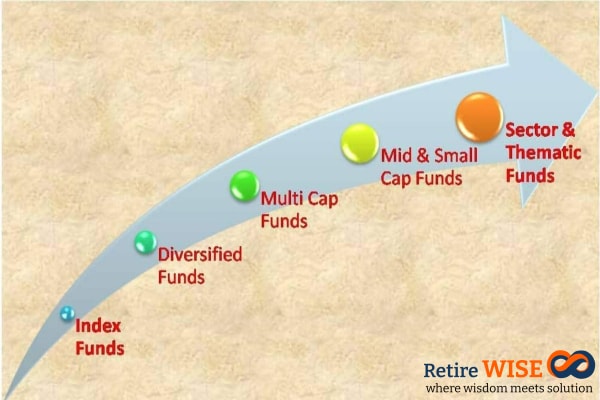
While constructing your mutual fund portfolio you should adopt core and satellite approach. The core should have exposure to large and large and midcap funds. Satellite can have exposure to multicap funds, mid and small cap funds ans sector funds.The funds you want to invest in should be in satellite. Before this you must have a strong core. Hence you should invest in funds like ICICI Prudential Focused Bluechip Equity and DSPBR Top 100 etc before going for satellite funds. Please read the post-Best Mutual Fund For SIP for further information.
As i am already in 20 percent profit thanks
Hi Sushil
It is difficult to say whether this return can be sustained over a longer period.However, there is no harm provided the exposure is not very high.
Hi hemant first of all thanks for such a nice article pl tell how much profit should be expected in one market cycle by sector fund i have invested 6 months back in fmcg fund what is the growth potential of this fund
Hi Sushil,
I don’t know about the cycles – will they be 3 years or 30 years. Sector funds can five -90% return to even +1000% return – this we have already seen in past.
FMCG is one of the top performing category in the last 5year – if you would have invested Rs 100 2 years back it would have become Rs 200. (double in 2 years – 40% CAGR)
Fasten your seat-belts if you have significant exposure to sector fund.
I think booking timely profits from sector funds can be an option and investor can re-invest the profit in its core portfolio holding of diversified mutual fund portfolio. It again depends from investor to investor.Some investors are comfortable enough to treat it any other Mutual Fund through SIP and keep investing for 5-10 years horizon. For instance , you wont be complaining if you had invested regularly through SIP in funds like Reliance Banking and Reliance Pharma since their inception.Excellent returns.
Hi Salil
I agree.
Well researched guide. The analogies were great..Chris Gayle, Yousf Pathan, eating Biryani in Hyderabad. The logic about Banking fund was nice. “If you talk about banking, it’s already 20-25% in every diversified equity fund – so when you add banking sector fund you are increasing risk.”
Keep up the good work.
Hi Hemant
I would like to know which school of thought you belong to as far as investment in sector funds is considered.Please explain what you mean by the following.
If you follow Shariah Rules or you would like to avoid particular stock for any other reason – you can construct your equity portfolio with sector funds.
Hi Anil,
I think it is clear from the article that I belong to which school of thought. 🙂
Shariah Rules are followed by Muslims for their investment – where they can’t invest in banks, liquor cos etc
Hi Hemant
Thanks! I have exited from ICICI Prudential Infrastructure Fund. I made small lump sum investments in FMCG and Healthcare funds when the market tanked recently to 17500 level. My SIPs in mainstream funds are continuing.
Yes Anil, I agree..Lumpsum investment when the market tanks is one of the better ways to invest in sector funds. FMCG, Pharma and Banking have performed exceptionally well in the last few years whereas Infrastructure sector have disaapointed in the last 4 years. However most of the experts are saying that Infrastructure sector will start performing in the next 6 months time n it can better the other sectors too..Only time will tell..
Hi Manoj
Thanks.Yes,most experts think that there will now be only two more hikes in the interest rates by the RBI and after that interest rate sensitive sectors will start performing.Let us wait and watch.
Hemant u r simply supperb explained the sector funds, i have in mind i have to know abt SF, today it is very clear to me…
thanks keep rocking posts…………
Thanks Vijay.
ok..i think i finally made my decision..after analysing all the facts.. n considering my age of 26..i decide to go with Rs. 1000 each with HDFC top 200 n DSP BR equity fund..
Thanks Hemant n Anil..
Great 🙂
Hello Hemant,
Sorry, i did not go with DSP BR equity fund.. I went with a more aggressive fund which has also been doing well since last 3 yrs as i can afford some risk..i.e DSP BR small n midcap fund.i hope it is also a good fund..so now i have one large cap fund i.e HDFC top 200 n one mid cap DSP just for some diversification..
thnx hemant.. tc n continue posting such eye opening articles 🙂
Thanks Anil for the info on investment of lumpsum funds..n I have seen the SIP chart that Hemant has posted many days back on the 10 best SIP funds n the list says that Reliance growth fund has given the best returns..Dats y it is getting harder for me.I made my mind to go with SIP’s n now the confusion is which 2 that i need to choose out of 5..
1) HDFC equity fund
2) HDFC top 200
3) DSP BR top 100
4) DSP BR equity fund
5) Reliance growth fund
Hello Hemant,
Thanks a ton for your previous reply.. I would like to divide my amount of SIP to 1000 each in Reliance growth fund which has done as well as HDFC equity..just for a case of diversification..
Also let me know which is the best mutual fund to invest in lumpsum in case the market crashes as it did couple of yrs back.. Can u name 1 or 2 ?
Hello Manoj
Just now I have received my Portfolio Valuation from CAMS and KARVY.It shows a decent growth for my lump sum investment in ICICI Prudential Discovery Fund and HDFC Midcap Opportunities Fund made when the market had tanked..On the other hand return from Reliance Growth Fund has been very poor.Perhaps you can consider these funds if they can fit in your portfolio.I am thinking of exiting from Reliance Growth Fund.
The Cavalcade of Risk 5th Anniversary Edition is up, and your post is in it.
Please let your readers know.
Thanks hgstern.
My experience is mixed.Three years back when I had absolutely no idea of investing in mutual funds,I relied solely on the wisdom of relationship manager of my bank.He started my SIP in ICICI Prudential Infrastructure fund.My SIP is still continuing though the returns are nominal.On the other hand, I have myself made small lump sum investments in some of the funds included in your list whenever the market has substantially tanked and so far I am satisfied with the returns.
Hi Anil,
I have a very solid reason for not investing in infrastructure funds – I have hinted it in above article. You can also check it here
https://www.retirewise.in/2011/05/mutual-fund-question.html
Thanks Hemant.I agree.I think now I should exit ICICI PrudentiaL Infrastructure Fund.
Hi Hemant,
Nice article.
You may wish to touch upon sector rotation funds. Are these available in India now?
Regards,
Sanjay
Hi Sanjay,
I think there are 2 funds on this theme one from Principal & another from Sundaram but both are not doing good.
Hello Hemant,
Another fantastic analysis from u about sector funds.. I have started investing Rs. 4000 per month in HDFC tax saver for IT purpose.. i want to invest 2000 per month SIP in diversified funds. I have seen many of ur posts in which u talked about this n have suggested HDFC top 200 n DSP BR top 100 funds.. Yesterday I went to both Mutual fund offices n talked about my investment..HDFC person told me that HDFC equity fund is better than top 200 as it has given a touch better returns over the years n i have also checked performance chart where it is true that HDFC equity fund performed better..
Coming to DSP BR person.. he told me that DSP BR top 100 is good if u invest lumpum amount..If u want to invest in SIP format then go for DSP BR equity fund..
I want your views on this Hemant..as i m not sure wht to do.. Do you see any logic in what they have said or its a marketing strategy?
Please let me know only one good fund for SIP out of these 4 that I have mentioned above..
Hello Manoj
I have SIPs in both HDFC Equity and HDFC top 200. No doubt the returns of HDFC Equity are definitely better than that of HDFC top 200.HDFC Equity being a multicap fund is slighly riskier than HDFC top 200 which is a conservative type of fund.If you have risk appetite go for HDFC Equity.Otherwise go for HDFC top 200.Both funds are quite good.
Since you have already invested in HDFC tax saver, for the sake of diversification you can select DSP Blackrock top 100.SIP is always preferable particularly in choppy market conditions.
Thanks Anil for your info..I will try to go for HDFC equity fund based on performance n also it has been rated as the best fund in year 2010.. I know that DSP BR top 100 has done well in the last few years but DSP BR is not the brand that will allow me to have a good sleep at night..HDFC is something that I know n since Equity fund is going on well since 1995..i prefer going for it..
If Hemant is looking at this..I wanna know his views too..
Hi Anil & Manoj,
I am happy to see that you guys are developing your thought (investment) process.
Doesn’t make much difference that you go for HDFC Top 200 or HDFC Equity – ask that AMC guy to give in writing that X will perform better than Y.
One of them is large cap & other is multicap so depending on your portfolio you can choose them.
And I was just wnoedring about that too!
😉
Thanks for sharing the information, Hemant. Very useful article!
🙂
HI Anil
I think you need to give time to diversified equity funds. They will reap very good dividends in long run.
For sectoral funds , it is high risk high return investment.
No one can time the market , so no one knows what level of Sensex is optimal for investment.So a SIP is suggested.On top of this investment , you can invest lump sum amount in staggered manner when market tanks. But again its for high risk investors.
Hi Salil,
I agree with you – people should stick with diversified equity funds.
Even concept of high risk high return is not clear with investors – they think if they will take higher risk they will get higher returns. (probability of getting higher returns in sector funds or direct stocks is very low)
Hi Salil
Thanks for your advice.Core of my portfolio is made of SIPs in diversified equity funds.My investment in sector funds is very small and is made only in lump sum when the market tanks considerably.
Hi Anil
That is the right approach
-Salil
I have one question regarding the mode of investment in sector funds.Some advisors suggest only lump sum investments at the correct time and do not favour SIPs in sector funds.I have also gained from this approach.I invested lump sum amounts in some sector funds when the sensex was around 17500.My investment has grown in all sector funds now.On the other hand most of my SIPs in diversified equity funds are showing negative returns.
Hi Anil,
My answer is “it depends” – I think this is the most common phrase we as a planner use. 😉
But I must tell & I have shared in 1st para of article – these are very risky funds & only purchased after thorough research.
It’s like we are trying to beat fund managers and I clearly believe we can’t in long term. We were right this time but there is no guarantee that we can repeat the success.
In such cases always keep your bets small.
Hi Hemant
Recently I have read one article in a leading Personal Finance Magazine.As per the author, FMCG and Pharma are very defensive sectors with low risk. The author suggests that investors with low risk appetite can consider investment in these sector funds.
Hi Hemant ,
Very Nice Article !
It truly shows that you have done lots of research before writting this article !
About your question ,
Yes i have invested sectoral funds but like many others – i also catched the train very late
During 2007-2008 (start) … i have invested in infrastructure and energy funds … and most of them are still bleeding….
i guess i have learned my lesson – never trust the agent in these cases and take proper financial advice before these kind of investments
Thanks Rohan.
Yes Lots of research – I thought it was first article after changing name to Guide. So I tried & made it a mini guide. 🙂