Home Blog Page 17

ULIP vs Mutual Fund + Term Insurance: The Updated 2026 Comparison

“Do not mix investment and insurance. This principle has not changed in 25 years – and it will not change in the next 25.”

A client came to me with a ULIP he had been paying into for 9 years. He was paying Rs 1.2 lakh per year. His fund value was Rs 9.8 lakh.

Nine years. Rs 10.8 lakh invested. Rs 9.8 lakh current value. A negative return on 9 years of savings.

I showed him what Rs 1.2 lakh per year in a diversified equity mutual fund would have produced over the same 9 years. At a modest 12% CAGR: approximately Rs 18.5 lakh. Plus he would have had a Rs 50 lakh term cover – which he could have bought for Rs 12,000 per year instead of the embedded ULIP mortality charges.

The ULIP had consumed the difference in charges and mortality costs. He was not in a bad ULIP – it was a major insurer’s product. He was simply in the wrong product for his goals.

⚡ Quick Answer

ULIPs combine insurance and investment in one product. Mutual funds with a separate term plan keep these apart. For most investors, keeping insurance and investment separate is better: you get more life cover per rupee from a term plan, and more investment returns per rupee from a mutual fund. ULIPs have legitimate uses in specific tax and estate situations – but they are not the default right choice for wealth creation or retirement planning.

ULIP vs mutual fund plus term insurance - which is better for retirement planning in India

What Changed After 2020: IRDAI’s ULIP Reforms

When I first wrote this article in 2017, the ULIP vs mutual fund debate was more one-sided than it is today. SEBI and IRDAI have since intervened. IRDAI’s 2020 guidelines significantly reduced the charges cap on ULIPs: total charges capped at 2.25% per annum for policies with terms of 10+ years. Fund management charges alone cannot exceed 1.35%.

These reforms made ULIPs meaningfully more competitive on costs. The highest-charging ULIPs of 2010-2015 (which consumed 5-7% of premium in early years) no longer exist in the same form. Modern ULIPs from reputable insurers are a different product from the ones that earned the industry’s poor reputation.

That said, the fundamental principle remains intact: for pure investment + term insurance needs, mutual fund + term plan still outperforms on flexibility, liquidity, and cost transparency. ULIPs are no longer definitively worse – but they are still not the default right choice.

“My view was that the ULIP vs mutual fund debate was settled. It is mostly settled. But the question has evolved: it is no longer ‘is your ULIP robbing you?’ It is ‘does a ULIP serve your specific situation better than the alternative?’ That is a more nuanced question.”

– Hemant Beniwal, CFP, CTEP | Founder, RetireWise

The Core Comparison: ULIP vs MF + Term Plan

Life insurance coverage: A term plan provides the most life cover per rupee – a 35-year-old non-smoker can buy Rs 1 crore of cover for approximately Rs 10,000-15,000 per year. A ULIP with the same annual premium provides insurance as a fraction of the sum assured, with mortality charges increasing with age. For pure life protection, term plan wins decisively.

Investment returns: Equity mutual funds are dedicated investment vehicles with no embedded insurance costs and typically lower expense ratios than ULIP equity funds. A well-run diversified equity fund at 0.8-1.5% TER compares to ULIP equity funds at 1.35% FMC plus mortality charges. Over 15-20 years, this cost difference compounds meaningfully.

Flexibility: Mutual funds offer daily liquidity after any exit loads expire. ULIP has a 5-year lock-in (IRDAI mandated). Partial withdrawals from ULIP are allowed after 5 years, but with restrictions. Fund switching within ULIP is free (up to a certain number of switches per year) and has no capital gains implications – which is the ULIP’s most significant practical advantage over mutual funds for active asset allocation.

Tax treatment (post FY 2021-22): ULIPs where annual premium exceeds Rs 2.5 lakh are now treated as capital assets for taxation purposes – gains are taxed like equity mutual funds (12.5% LTCG above Rs 1.25 lakh, 20% STCG). For ULIPs where annual premium is below Rs 2.5 lakh, the traditional EEE (Exempt-Exempt-Exempt) tax benefit remains. This 2021 amendment reduced the tax advantage of high-premium ULIPs significantly.

Have a legacy ULIP you are not sure whether to continue or exit?

The surrender vs continue decision depends on your specific policy, charges, surrender value, and retirement plan. A RetireWise advisor can run the numbers for your situation.

Book a Free 30-Min Call

When ULIP Actually Makes Sense

There are specific situations where a ULIP is the right product:

Annual premium below Rs 2.5 lakh and long lock-in acceptable: For this premium range, the EEE tax benefit is intact. If you want a long-term investment with forced savings discipline, no desire for active management, and the premium is comfortably within Rs 2.5 lakh per year, a low-cost ULIP from a reputable insurer is a reasonable choice.

Estate planning and keyman insurance: ULIPs have specific advantages in estate planning contexts and for business keyman covers. The insurance component can be structured to pass proceeds to nominees efficiently. For complex estate situations, consult a tax and legal advisor alongside a financial planner.

Investors who cannot maintain the SIP discipline: The ULIP lock-in forces saving. Investors who have a history of stopping SIPs during market corrections or spending bonus money before it can be invested may benefit from the commitment mechanism of a ULIP – even at a slight cost efficiency disadvantage.

What to Do If You Have a Legacy ULIP

Many clients I work with are 45-55 and have ULIPs bought in 2008-2015 – some delivering poor returns, some performing reasonably. The question is always: should I continue or surrender?

The calculation: compare the current surrender value vs the projected maturity value, factoring in: remaining years to maturity, current fund performance, remaining charges, and what the same money would earn in an equivalent mutual fund. If the policy is within 3-4 years of maturity, continuing is usually better – most charges have already been paid and surrendering now crystallises the loss without benefit. If the policy is early-stage (years 1-5) and showing poor performance, surrendering and redirecting may make sense after accounting for surrender charges.

Never make this decision based on sentiment or the agent’s persuasion. Run the numbers.

Read – 5 Insurance Policies You May Not Need – And One You Must Never Drop

Read – Types of Mutual Funds: The Complete 2026 Guide

Frequently Asked Questions

I was sold a ULIP as a retirement plan. Is it suitable?

ULIP can be one component of a retirement plan if costs are low, the policy horizon is long, and premium is below Rs 2.5 lakh per year. But ULIPs should not be the primary retirement vehicle for most professionals – their returns are typically below equivalent mutual fund + term plan combinations over 15-20 year horizons due to embedded charges. If your retirement plan relies predominantly on a ULIP, get an independent second opinion on whether the projected corpus is adequate.

Can I switch funds within my ULIP?

Yes – most ULIPs allow fund switches (between equity, balanced, and debt options within the policy) a certain number of times per year for free. This is one of ULIP’s genuine advantages over mutual funds: you can shift from equity to debt as retirement approaches without triggering a capital gains tax event. In mutual funds, the same shift is a redemption and reinvestment – and may trigger LTCG.

What is the minimum lock-in period for ULIPs?

IRDAI mandates a 5-year lock-in for all ULIPs. You cannot surrender or make full withdrawals before 5 complete policy years. Partial withdrawals are allowed from the 6th year in most policies. If you need liquidity before 5 years, a ULIP is the wrong instrument – use open-ended mutual funds instead.

The ULIP vs mutual fund debate is no longer as black-and-white as it was a decade ago. Modern ULIPs with capped charges are better products than their predecessors. But the fundamental principle has not changed: if you need life insurance, buy a term plan. If you need investment returns, invest in mutual funds. Combining them rarely produces the best of both – it usually produces an acceptable compromise of each.

Separate your insurance needs from your investment needs. Clarity serves both better.

Want an insurance and investment review as part of your retirement plan?

RetireWise reviews your complete financial structure – term cover, health insurance, ULIPs, endowments, and investments – to ensure every rupee is working as hard as it can.

See Our Retirement Planning Service

💬 Your Turn

Do you have a ULIP in your portfolio – and are you clear on how it fits into your overall retirement plan? Share your experience in the comments.


Hindsight Bias: Why Every Investor “Knew It Was Coming” (And Why That Is a Problem)

“In retrospect, it was obvious.” – Almost everyone, after every market crash.

After the Sensex crashed 38% in March 2020, I heard this from several people: “I knew something was coming. I just didn’t act on it.” After the mid-cap correction of 2018, the same thing. After every market event, in fact, there is a chorus of “I saw it coming.”

Most of them did not see it coming. But hindsight makes them believe they did.

This is hindsight bias – and it is one of the most expensive behavioural traps in personal finance.

⚡ Quick Answer

Hindsight bias is the tendency to believe, after an event occurs, that you had predicted or anticipated it all along. In investing, it leads to overconfidence (believing your past correct calls mean you can predict the future), selective memory (remembering the right calls and forgetting the wrong ones), and mistaken risk assessment (underestimating how uncertain things actually were before the event happened). The fix is systematic – not intuitive.

Hindsight bias and investing - how it affects financial decisions

What Hindsight Bias Actually Is

Hindsight bias is a cognitive pattern where, once we know the outcome of an event, we reinterpret our earlier thinking to make it seem like we expected that outcome. The clouds looked dark, so naturally we “knew” it would rain. The team had momentum, so of course we “knew” they would win. The market had been overvalued for months, so obviously we “knew” a correction was coming.

The problem: before the event, we also had other thoughts. We thought the rain might pass. We thought the other team might come back. We thought the market might keep running. Hindsight selectively deletes the alternative possibilities we were actually holding in mind.

This is not dishonesty. It happens automatically, below the level of conscious awareness. The brain rewrites the memory of uncertainty into a memory of clarity – and it does it without your permission.

Three Ways Hindsight Bias Damages Investment Decisions

Overconfidence in future predictions. If you believe you correctly predicted the 2020 crash – even though the actual situation was far more uncertain than you now remember – you will make larger, less diversified bets based on your next “prediction.” The overconfidence compounds over time. Investors who attribute past correct calls to skill rather than probability develop a dangerous certainty about the future.

Selective memory about past performance. Most investors remember their successful investment calls clearly and forget their unsuccessful ones. The stock that tripled becomes a story they tell. The three stocks that went nowhere, or the fund they exited at the bottom, fade from memory. The result is a systematically inflated sense of historical accuracy – which produces systematically poor future decisions.

Poor risk assessment before the fact. Hindsight bias makes historical events look inevitable and obvious. When investing in a new situation, this false clarity about past events makes the current uncertainty seem like a solvable puzzle rather than genuine unpredictability. An investor who “knew” about every past correction starts to believe they can navigate future ones too – which leads to market timing attempts that almost never work.

The market’s unpredictability is not a bug in the system. It is the system.

RetireWise builds retirement plans that do not depend on predicting the market – because the evidence is clear that nobody can do that consistently.

See How RetireWise Builds Prediction-Independent Plans

The Investment Parallel: “I Knew the Tech Bubble Would Burst”

In 1998-2000, thousands of investors poured money into technology stocks. After the crash of 2000-2002, many claimed they had seen it coming. But at the time, the smartest investors in the world – running billions of dollars – were deeply invested in technology. The uncertainty was real. The outcome looked obvious only after it happened.

The same pattern played out in 2007-2008 with real estate and financial stocks. In 2021-2022 with new-age startup IPOs in India. The bubble is always obvious in retrospect. It is genuinely uncertain in real time.

The investor who says “I knew” is not lying intentionally. But they are making decisions based on a false memory of their own predictive ability – which will lead them to take concentrated, poorly-timed bets on future “obvious” outcomes.

Four Ways to Counter Hindsight Bias

Keep an investment journal. Write down your reasoning before you make an investment decision – and your expectation of how it will perform. Review it 12-24 months later. This creates an honest record that the brain cannot retroactively edit. The difference between what you wrote and what you now remember thinking is the clearest measure of your hindsight bias.

Review all decisions, not just the right ones. Most investors do post-mortems only on their successes. An honest review covers every significant decision – the funds you exited that then recovered, the stocks you sold before they doubled, the investments you did not make that would have worked. This corrects the selective memory that inflates perceived accuracy.

Seek out the pre-event uncertainty. When reviewing a past event – any market crash, correction, or rally – deliberately recall the alternative scenarios that were genuinely possible at the time. For the March 2020 crash: in February 2020, COVID-19 looked like a regional Chinese health issue to most analysts. A 38% global market crash was one of many possible outcomes, not an obvious one.

Focus on process, not outcome. A good investment decision based on sound reasoning that does not work out is still a good decision. A bad decision that happens to work out is still a bad decision. Evaluating your process rather than your outcomes is the only way to avoid the hindsight bias trap of using results to validate reasoning that may not have been sound.

Read: Behave Yourself Financially: 5 Patterns That Cost Indian Investors the Most

Nobody predicted the 2020 crash in February 2020 with certainty. Nobody predicted the recovery in April 2020 with certainty. The investors who did well were not the ones who predicted correctly. They were the ones who built portfolios that did not depend on prediction.

Process beats hindsight, every time.

Have you ever made a major investment decision based on “I knew this would happen”?

A structured financial plan removes the need to predict. RetireWise builds plans that work across market conditions – not plans that depend on being right about what comes next.

Book a Free 30-Min Call

Your Turn

Can you think of a market event where you genuinely did not see it coming at the time – but believed afterward that you had? Or a decision where your memory of why you made it turned out to be very different from what you actually wrote down? Share in the comments.

Low Risk High Return Investment: Why It Does Not Exist and What to Do Instead

“There is no such thing as a free lunch.” – Milton Friedman

It is the most asked question in personal finance, and the most reliably exploited one.

Every few years, a new “low risk, high return” investment category emerges. Fixed maturity plans with “guaranteed” 12% returns. NCDs from real estate companies offering 14%. Infrastructure bonds. Multi-level marketing “investment” schemes. Crypto platforms promising 20% annual yields. Each one attracts investors who want the security of a fixed deposit with the returns of equity.

Every time, some investors lose money. Sometimes, a lot of money.

The search for low risk and high return simultaneously is not a strategy. It is a vulnerability – and the financial product industry knows it.

⚡ Quick Answer

In genuine financial markets, low risk and high return do not coexist sustainably. Higher returns always come with higher risk – either explicitly (volatility, credit risk, liquidity risk) or implicitly (hidden fees, lock-in, complexity that conceals risk). Investments that claim to offer both simultaneously are either mis-priced (temporarily, before the market corrects), mis-selling (hiding the real risk), or fraudulent. The appropriate goal is not low risk and high return – it is the best risk-adjusted return for your specific investment horizon.

Low risk high return investment India - the truth about risk and return trade-off

Why Low Risk and High Return Cannot Coexist

The reason is structural and has been understood since the foundation of modern finance theory.

In an efficient market, investors demand compensation for risk. Higher risk investments must offer higher expected returns – otherwise rational investors would not hold them. If a genuinely low-risk investment offered high returns, every investor would rush to buy it, driving up its price and driving down its future returns until the risk-return relationship was restored.

This is not theoretical abstraction. It is observed every day in Indian markets. Government bonds yield less than corporate bonds because they carry less credit risk. Large-cap stocks yield less over time than mid-cap stocks because they are less volatile. Bank FDs yield less than corporate FDs because they are safer. In each case, the higher return comes with explicitly higher risk.

When something appears to break this pattern – offering high returns with apparently low risk – one of three things is happening. Either the risk is real but not yet visible (a corporate FD from a company that later defaults). Or the risk is hidden in the product’s structure (a ULIP with opaque charges that erode returns). Or it is simply not true (a fraudulent scheme).

“In 25 years I have never seen an investment that genuinely offered high returns without commensurate risk. What I have seen is investors who discovered the risk after committing their money – when it was too late to exit without loss.”

– Hemant Beniwal, CFP, CTEP | Founder, RetireWise

The Indian Investor’s Trap: Chasing Both Simultaneously

The search for low risk, high return is especially acute in India because of our savings culture. Most Indian families built wealth through FDs – guaranteed, predictable, no-stress. The transition to market-linked instruments feels uncomfortable. So when something appears to offer “equity-like returns with FD-like safety,” it exploits exactly the psychological tension the investor is experiencing.

The pattern repeats with remarkable consistency: real estate company NCDs (National Company Debentures) in the 2010s offered 14-16%, justified as “secured by property.” When several real estate companies defaulted, investors discovered the security was worth far less than the outstanding debt. Infrastructure bonds from mid-sized companies offered 12-13% with “sovereign-like” framing. Many defaulted.

In each case, the promised return was real. The promised safety was not. The gap between the apparent risk and the actual risk was exactly what the issuer was monetising at the investor’s expense.

What the Risk-Return Trade-Off Actually Means for Retirement

The practical implication for retirement planning is direct: the appropriate risk level changes with your investment horizon, not with your desire for safety.

With 15-20 years to retirement: equity-level risk (and return) is appropriate. Short-term volatility is manageable because time allows recovery. The expected return of 12-14% CAGR from equity is the right target for long-term retirement corpus building.

With 5-10 years to retirement: transitioning toward lower risk is appropriate – not because “low risk with high return” exists, but because the investment horizon is shortening and the cost of a severe drawdown is rising. Hybrid funds (40-60% equity) and balanced advantage funds accept some return reduction in exchange for genuine risk reduction.

With under 3 years to retirement: capital preservation dominates. Short-duration debt, FDs, and liquid funds are the right instruments – not because they offer high returns, but because the retirement date creates a hard deadline that cannot accommodate recovery time from a market correction.

Is your portfolio matched to your actual investment timeline – not your desire for safety?

A RetireWise retirement plan determines the right risk level for your specific situation – and helps you earn the best possible return at that risk level.

Book a Free 30-Min Call

Recognising “Low Risk, High Return” Red Flags

Four signals that an investment is hiding risk behind a high-return promise:

The return is significantly above comparable instruments. If SBI FDs are at 7% and a corporate product is offering 13%, the 6% difference is not “extra return for the same risk.” It is compensation for real additional risk. Always ask: what risk is being taken to generate this extra return?

The structure is complex or opaque. Legitimate high-return instruments like equity mutual funds are transparent – the portfolio is published monthly, performance is easily trackable. Products that cannot explain clearly where the returns come from in simple terms are products that do not want you to understand the risk.

The lock-in is long and exit is restricted. Illiquid investments often claim safety by pointing to the absence of price volatility. But the absence of a visible price is not the absence of risk – it is the absence of price discovery. Unlisted investments, real estate, private credit – these carry real risk that just cannot be seen in a daily NAV.

There is pressure to decide quickly. “This tranche closes on Friday.” “Only 50 units left.” Urgency in investment decisions is a red flag without exception. The best investments do not need artificial scarcity to sell.

Read – Long Term vs Short Term Investments: The Only Framework You Need

Read – How Financial Product Advertisements Manipulate Your Investment Decisions

Frequently Asked Questions

What is the best risk-adjusted investment option in India in 2026?

For long-term equity (7-plus years): diversified equity mutual funds (large and flexi-cap) have historically delivered 12-14% CAGR, with commensurate short-term volatility. For medium-term (3-7 years): balanced advantage or aggressive hybrid funds offer 9-12% with lower drawdown risk. For short-term (under 3 years): short-duration debt funds, arbitrage funds, or bank FDs offer 6-8% with very low volatility. The “best” investment is the one correctly matched to your timeline and risk capacity – not the one promising the highest return.

Are there any genuinely low-risk options that beat inflation?

A few instruments can beat inflation with relatively low risk under specific conditions. RBI Floating Rate Savings Bonds (currently 8.05%, taxable) beat inflation after tax for investors in lower tax brackets. Sovereign Gold Bonds provide inflation protection over long periods plus 2.5% annual interest. PPF at 7.1% is tax-free under the old tax regime and can be marginally positive in real terms. These are not “high return” options – they are inflation-preserving options with low risk. That is a legitimate goal for the debt portion of a retirement portfolio, but not a substitute for equity’s wealth-building role.

My parents’ generation earned 14% on FDs. Why can’t I?

They could because inflation was also higher in the 1990s. The real return (after inflation) on those 14% FDs was often 2-4% – comparable to what you earn today on a 7% FD with 4.5-5% inflation. The nominal rate was higher because the nominal inflation was higher. The real purchasing power return was similar. What has changed is the nominal environment, not the fundamental risk-return relationship. Chasing the 14% of the 1990s in 2026 means accepting 1990s-level credit or investment risk – which is not what most investors intend when they say they want “safe high returns.”

The desire for low risk and high return is completely understandable. It is also the most reliable vulnerability that bad financial products exploit. The protection against it is not investment sophistication – it is the simple understanding that higher returns always come with higher risk, visible or not.

If an investment looks too good to be true, the risk is real. You just haven’t found it yet.

Want a retirement portfolio that earns the best return for the risk you can actually afford?

RetireWise builds retirement plans around the correct risk-return framework for your specific timeline – not the return you want, but the return that is achievable safely.

See Our Retirement Planning Service

💬 Your Turn

Have you ever been attracted to an investment that promised high returns with low risk? Did the reality match the promise? Share in the comments.

Does Loss Aversion Affect My Finances? Two Nobel Laureates Say Yes

“Losses loom larger than gains.” – Daniel Kahneman

I write a lot about behavioural finance. Colleagues sometimes ask why. The answer is simple: I firmly believe investing is not a Numbers Game – it is a Mind Game.

In 2017, the Nobel Prize in Economic Sciences went to Richard Thaler for his contributions to behavioural economics. The concept I want to discuss today was introduced by Daniel Kahneman – who passed away in March 2024 – in his landmark book Thinking Fast and Slow. Kahneman was also a Nobel Laureate. Two Nobel prizes, one core insight: the way human beings feel about losses is fundamentally different from the way they feel about equivalent gains.

That asymmetry has destroyed more Indian investment portfolios than any market crash ever has.

⚡ Quick Answer

Loss aversion is the human tendency to feel the pain of a loss approximately twice as intensely as the pleasure of an equivalent gain. In investing, it causes four specific errors: holding losing investments too long (hoping they recover), selling winning investments too early (fearing they will fall), avoiding equity markets entirely (because the volatility feels like permanent loss), and concentrating savings in low-return instruments that feel “safe.” The antidote is not to eliminate loss aversion – that is impossible – but to build systems that reduce how often you have to make loss-aversion-driven decisions.

Loss aversion by investors - behavioural finance India

What Loss Aversion Actually Is

Loss aversion is a human tendency to avoid a loss as much as possible. A loss of Rs 1,000 gives most people considerably more pain than the pleasure they derive from gaining Rs 1,000. The ratio, as Kahneman and Tversky estimated in their original research, is approximately 2:1. Losing feels roughly twice as bad as winning feels good.

This is not irrational in an evolutionary sense. In ancient times, being careless in hunting, getting injured, or being excluded from the group could be fatal. Caution about losses was survival instinct. Those of us alive today are the descendants of the cautious ones. Loss aversion is literally in our evolutionary inheritance.

The problem is that this instinct, which served our ancestors well on the savanna, works against us in long-term wealth building.

How Loss Aversion Shows Up in Everyday Financial Life

Before we get to investing, consider some ordinary examples. We hesitate to sell a favourite old car or a piano even when neither is being used. If forced to sell, we ask for a high price – because giving something up feels like a loss, and we need to be compensated more than its market value to justify that feeling.

We buy the “Buy 2 Get 1 Free” offer even when we do not need three of the item. The fear of losing the free one is stronger than the rational calculation about whether we actually need three.

We stay in an unsatisfying job because leaving feels like losing what we have built, even when staying means missing what we could build. Loss aversion applies as much to accumulated career capital as to money.

The Four Ways Loss Aversion Costs Indian Investors Money

1. Holding losing investments too long. Many investors do not sell loss-making investments – stocks, funds, or even ULIPs bought a decade ago – because selling would make the loss “real.” As long as it is on paper, hope remains. In practice, this holding delays redeployment of capital into instruments that could actually serve the goal.

2. Selling winning investments too early. We tend to book profits quickly on rising investments because we fear the gain will disappear. The result: we cut our winners and hold our losers. This is the precise opposite of what long-term wealth building requires.

3. Avoiding equity markets entirely after a loss. An investor who experienced the 2008 crash, the 2020 crash, or any significant drawdown sometimes exits equity entirely and never returns. They miss the subsequent recovery and compound the loss in real terms. The market does not guarantee returns – but the investor who is not in the market definitely does not get them.

4. Concentrating savings in “safe” low-return instruments. An FD at 6.5% feels safe. Inflation at 7% quietly erodes the corpus. The investor who concentrates entirely in FDs to avoid the “risk” of equity is experiencing a guaranteed real loss while believing they are being cautious. Loss aversion makes the volatility of equity feel more dangerous than the slow certainty of inflation erosion.

The Retirement-Specific Cost of Loss Aversion

For a senior executive building a retirement corpus, loss aversion in the accumulation phase typically shows up as too-conservative an asset allocation in the 40s and 50s – precisely when the time horizon still allows equity to do its work. A 48-year-old with a 15-year retirement horizon who keeps 80% of their corpus in FDs because “equity is risky” is making a loss-aversion driven decision that will cost them crores in foregone compounding. The FD does not feel risky. But the real risk – outliving the corpus – is not on the FD statement.

Kahneman’s insight was that we are not afraid of risk. We are afraid of loss. Those are not the same thing – and confusing them is one of the most expensive mistakes in retirement planning.

Three Practical Ways to Reduce Loss Aversion’s Impact

1. Check your portfolio less frequently. This is the most underrated intervention in behavioural investing. A portfolio reviewed daily shows losses approximately 50% of the time over any given period. A portfolio reviewed annually shows gains approximately 75% of the time, simply because markets trend upward over time. The investor who checks daily feels more loss than the investor who checks annually – even when they hold the same portfolio. Reduce the frequency of review and you reduce the trigger for loss-aversion driven decisions.

2. Separate “stressful” decisions from “automatic” ones. Automate what can be automated – SIPs, rebalancing triggers, asset allocation. The decision to invest should not require a monthly act of will. When the decision is automatic, loss aversion does not get a vote. The investor who needs to consciously decide each month whether to continue their equity SIP will eventually stop during a crash. The investor on autopilot will not.

3. Use loss aversion as a tool rather than fighting it. Loss aversion can be channelled productively. Frame your investment decisions in terms of what you will lose by not investing – not what you might lose by investing. The retired investor who understands that a 100% FD portfolio means a near-certain real loss over 20 years is using loss aversion correctly. The fear of the slow certain loss (inflation erosion) can be more motivating than the abstract fear of equity volatility.

Read: Behave Yourself Financially: 5 Patterns That Cost Indian Investors the Most

Loss aversion is wired into your brain. Its cost to your retirement corpus is not inevitable.

RetireWise builds retirement plans that account for investor behaviour – including the decisions you are likely to make under stress – and creates guardrails that keep the plan on track.

See How RetireWise Manages Investor Behaviour

Daniel Kahneman spent his career proving that the investor’s worst enemy is not the market. It is the investor’s own mind, doing exactly what evolution designed it to do – avoiding loss at almost any cost.

Investing is not a Numbers Game. It is a Mind Game.

Which loss-aversion pattern do you recognise in yourself?

Recognising it is the first step. Building a plan with an advisor who understands it is the second.

Book a Free 30-Min Call

Your Turn

Which of the four loss-aversion patterns has cost you the most? Have you ever held a losing investment far too long – or sold a winner too early? Share your experience in the comments. These real situations help more than any theory.

Equal Weight vs Market-Cap Index Funds: What Indian Investors Need to Know

23

“Simplicity is the ultimate sophistication.” – Leonardo da Vinci

When a client asks me about index funds, most people picture the standard Nifty 50 index fund. Reliance Industries gets about 9-10% of the portfolio. HDFC Bank gets 7-8%. The top 10 stocks account for nearly 55-60% of the total fund. The other 40 stocks share the remaining 40-45%.

This is market-capitalisation weighting – the standard approach. Larger companies get larger allocations automatically.

But there is a different approach. An equal-weight index fund gives every stock in the Nifty 50 exactly 2% of the portfolio. Reliance gets 2%. A smaller Nifty 50 constituent also gets 2%. No single company dominates. All 50 are treated identically.

This sounds like a small difference. Over time, the difference in behaviour – and sometimes returns – is meaningful.

⚡ Quick Answer

Market-cap weighted index funds (standard Nifty 50 funds) give the largest companies the biggest allocations. Equal-weight index funds give every constituent the same allocation – about 2% each for Nifty 50. Equal-weight funds tend to perform better when small and mid-cap stocks within the index outperform large-caps, and worse when large-caps lead. For retirement portfolios, market-cap weighted index funds remain the simpler, lower-cost core holding. Equal-weight can serve as a satellite allocation for investors seeking broader diversification within large-cap indices.

Equal weight index fund vs market cap weighted - how they differ and which is better

How Market-Cap Weighting Works

In a market-cap weighted index fund, each stock’s weight equals its market capitalisation as a proportion of the total market cap of all index constituents. As a company’s share price rises, its weight in the index increases automatically. As it falls, its weight decreases.

This has two effects. First, the fund automatically reduces exposure to stocks that have underperformed and increases exposure to stocks that have outperformed – which sounds sensible. Second, it concentrates the portfolio in a small number of very large companies. In the Nifty 50, the top 10 stocks have historically accounted for 55-65% of the total index weight.

For investors in a standard Nifty 50 index fund, their portfolio is effectively a concentrated bet on Reliance, HDFC Bank, ICICI Bank, Infosys, TCS, and a handful of other mega-caps, with 40 other companies as minor supporting actors.

How Equal Weighting Works Differently

An equal-weight index fund starts the same: it holds all 50 stocks in the Nifty 50. But instead of proportional market-cap weights, each stock gets exactly 1/50th of the portfolio – approximately 2%.

Because stock prices move at different rates, the weights drift away from equal over time. The fund must periodically rebalance – selling stocks that have risen above 2% and buying stocks that have fallen below 2%. This rebalancing is the mechanism that gives equal-weight funds their distinct character.

In effect, equal-weight funds systematically “sell high and buy low” within the index – trimming winners and adding to laggards at each rebalancing. This contrarian discipline can add return over long periods, particularly when smaller companies in the index outperform the mega-caps.

“Equal-weight index funds are not for everyone – and they are not a replacement for a standard index fund. They are an additional diversification tool. The question to ask is not ‘which is better?’ but ‘which is appropriate for my specific situation?'”

– Hemant Beniwal, CFP, CTEP | Founder, RetireWise

Equal Weight vs Market-Cap: Performance Comparison

The Nifty 50 Equal Weight Index has historically delivered returns that are broadly comparable to the standard Nifty 50, with periods of outperformance and underperformance depending on market conditions.

Equal-weight tends to outperform when: mid-size Nifty 50 companies (ranks 20-50 in the index) grow faster than the top 10; when the market rally is broad-based rather than driven by a few mega-caps; and after periods of high concentration in large-caps when mean reversion favours smaller companies.

Equal-weight tends to underperform when: mega-cap stocks lead market rallies (as happened significantly during 2020-2022 when technology and financial sector giants drove Nifty returns); and during periods of “flight to quality” where investors favour the largest, most liquid companies.

The DSP Nifty 50 Equal Weight Index Fund (DSP dropped “BlackRock” from its name after the JV restructured in 2018) tracks the Nifty 50 Equal Weight Index. It carries a slightly higher expense ratio than standard Nifty 50 index funds due to more frequent rebalancing. As of 2026, the fund remains one of the primary vehicles for accessing equal-weight large-cap exposure in India.

Does your retirement portfolio have the right index exposure?

A RetireWise retirement plan evaluates whether market-cap or equal-weight index exposure – or a combination – is appropriate for your specific goals and timeline.

Book a Free 30-Min Call

Key Differences: A Practical Summary

Concentration risk. Market-cap funds are highly concentrated in a few mega-caps. Equal-weight funds are diversified more evenly across all 50 constituents. If you are concerned about over-concentration in Reliance or HDFC Bank in your portfolio (for example, because you also hold large individual positions in these), an equal-weight fund reduces that concentration.

Rebalancing frequency and cost. Equal-weight funds must rebalance more frequently to maintain equal weights. This increases trading costs and, for investors in taxable accounts, potential short-term capital gains implications. Standard Nifty 50 index funds rebalance only when the index composition changes.

Expense ratio. Equal-weight index funds carry slightly higher expense ratios than market-cap weighted index funds due to the additional rebalancing activity. The difference is modest – typically 0.1-0.3% additional TER – but relevant for long-term compounding.

Behaviour in different markets. Standard Nifty 50 funds are more defensive in bear markets because mega-caps tend to be more stable. Equal-weight funds can be more volatile in corrections because smaller Nifty 50 companies fall more sharply. For retirement portfolios where capital preservation near withdrawal matters, this volatility characteristic is worth understanding.

Read – ETF and Index Funds India: The 2026 Guide for Retirement Investors

Read – Standard Deviation in Mutual Funds: What It Means for Your Retirement Portfolio

Frequently Asked Questions

Should I replace my standard Nifty 50 index fund with an equal-weight fund?

Not necessarily. A standard Nifty 50 index fund remains the simpler, lower-cost, lower-maintenance core equity holding for most retirement investors. Equal-weight can complement it – perhaps 20-30% of the large-cap allocation in equal-weight and the rest in standard market-cap – but replacing the standard fund entirely removes the benefits of market-cap weighting (automatic rebalancing to winners, lower volatility from mega-cap stability). The combination approach is more nuanced but can add diversification.

What is the DSP Nifty 50 Equal Weight Index Fund, and how has it performed?

DSP Mutual Fund (formerly DSP BlackRock) runs the DSP Nifty 50 Equal Weight Index Fund, which tracks the Nifty 50 Equal Weight Index. Since DSP dropped the BlackRock name in 2018, the fund has continued under DSP management. Performance relative to the standard Nifty 50 TRI has been broadly comparable over long periods, with periods of significant outperformance and underperformance depending on market conditions. Always check current NAV and trailing returns on the AMC website or AMFI before investing, as performance changes with market conditions.

Is equal-weight indexing suitable for SIP investing?

Yes. A SIP in an equal-weight index fund works exactly like a SIP in any other fund – regular investments, automatic execution, rupee cost averaging. The slightly higher volatility of equal-weight funds actually helps SIP investors: they buy more units during corrections (when smaller index constituents fall more) and fewer during rallies. For a long investment horizon of 10 or more years, this characteristic works in the SIP investor’s favour.

The choice between market-cap and equal-weight indexing is not about which is universally better. It is about which is appropriate for your portfolio, your existing concentration, and your investment horizon. Both approaches have merit. Neither is a replacement for having a thoughtfully constructed retirement plan.

Understand what you own before you decide which index strategy to use.

Want a retirement portfolio with the right index exposure for your goals?

RetireWise builds retirement portfolios that combine index and active strategies based on your specific timeline and risk profile – not generic allocations.

See Our Retirement Planning Service

💬 Your Turn

Do you use a standard Nifty 50 index fund, an equal-weight index fund, or both in your portfolio? What was your reasoning? Share in the comments.

The Planning Fallacy: Why Your Financial Plan Is Probably Too Optimistic

“Plans are useless, but planning is indispensable.” – Dwight D. Eisenhower

When I was writing my book “Financial Life Planning,” the publisher asked me how long it would take. I did a quick calculation based on how fast I write, how many chapters I had outlined, and my weekly availability. Six months, I said confidently.

It took almost a year.

I am a financial planner. I spend my professional life helping people build realistic financial plans. I still fell prey to the planning fallacy – the very bias I warn clients about every week.

⚡ Quick Answer

The planning fallacy is the tendency to underestimate how long something will take, how much it will cost, and how many obstacles will arise – while simultaneously overestimating the benefits. Defined by Nobel laureate Daniel Kahneman and Dan Lovallo, it affects everyone from government infrastructure projects to individual retirement planning. In personal finance, it shows up as underestimated retirement expenses, optimistic savings projections, and overstated investment return assumptions. The antidote is reference class forecasting: use actual data from similar situations, not your best-case vision.

Planning fallacy in financial planning - how to avoid it

What Is the Planning Fallacy?

Nobel laureate Daniel Kahneman and his colleague Dan Lovallo defined it precisely: the planning fallacy is our tendency to underestimate the time, costs, and risks of future actions while simultaneously overestimating the benefits of those same actions.

The bias is not limited to amateurs or careless planners. India’s infrastructure projects – highways, metro rail lines, power plants – routinely run over budget and past deadline. The original cost estimate for one recent metro project in a major city was Rs 1,985 crore. The revised estimate: Rs 3,000 crore. The original timeline: December 2014. The revised timeline: years later.

These are not simple cases of incompetence. They involve hundreds of engineers, project managers, and financial analysts. The planning fallacy is systematic and affects experts as much as it affects laypeople – because the bias operates at the level of how we visualise the future, not at the level of our expertise.

How It Shows Up in Your Finances

When most investors plan, they visualise the project succeeding as planned. The house renovation takes the quoted 3 months. The child’s wedding costs the initial budget of Rs 25 lakh. The retirement plan delivers the assumed 12% equity return every year without interruption. They do not factor in delays, cost overruns, life events, or market volatility.

The planning fallacy in personal finance produces three consistent patterns.

Underestimated retirement expenses. I ask new clients to estimate their monthly retirement expenses. Most say Rs 60,000-80,000 per month. When we build a detailed budget, the number is routinely Rs 1.2-1.5 lakh – because they forgot to include rising medical costs, domestic help, increased travel, and occasional major expenses like home repair or grandchildren’s education support. The planning fallacy made the comfortable version feel realistic.

Overestimated savings capacity. Many clients commit to a savings rate at the start of a financial plan that they cannot actually maintain. They are seeing the best-case version of their income and expenses, not the version that includes the car breakdown, the family emergency, the salary plateau for two years, or the lifestyle expansion that follows a promotion.

Underestimated insurance needs. When I ask investors how much life insurance they need, the instinctive number is often Rs 50 lakh to Rs 1 crore. The actual calculation – covering current liabilities, future educational expenses, spouse’s income replacement, and retirement corpus shortfall – often produces a number of Rs 2-3 crore. The planning fallacy compressed the need to fit the comfort zone.

Your financial plan is only as good as the assumptions it is built on.

RetireWise stress-tests every plan with realistic – not optimistic – assumptions for inflation, expenses, medical costs, and market returns. The uncomfortable number is more useful than the comfortable one.

See How RetireWise Builds Realistic Plans

How to Counter the Planning Fallacy

Use reference class forecasting. This is Kahneman’s prescribed antidote. Instead of asking “how long will this take based on my specific plan?” ask “how long do similar projects actually take?” If house renovations in your circle routinely run 50% over budget and timeline, your renovation will probably do the same. Use the outside view, not your inside optimism.

In financial planning, this means using actual historical data rather than your personal return assumptions. If diversified equity funds have delivered 12-13% CAGR over 20-year periods in India, plan conservatively at 10-11% and treat the upside as a buffer – not as the baseline.

Build in explicit buffers. If your realistic monthly retirement expense is Rs 1.2 lakh, plan for Rs 1.5 lakh. If your child’s education is likely to cost Rs 45 lakh in 15 years, plan for Rs 55 lakh. If you think you need Rs 2 crore of life cover, buy Rs 2.5 crore. The planning fallacy systematically pushes you toward optimistic numbers; a deliberate buffer corrects for it.

Review your plan against reality annually. The planning fallacy compounds silently when plans go unreviewed. An annual review – where you compare the plan’s assumptions against what actually happened – allows you to catch the drift early. A savings rate that was meant to be 25% but has been 18% for three years is a gap that compounds into a significant shortfall if not caught and addressed.

Separate aspirational goals from funded goals. A well-structured financial plan distinguishes between goals that are fully funded (meaning there is a sufficient SIP or corpus already in place), goals that are partially funded (requiring additional commitment), and goals that are aspirational (desired but not yet backed by any funding). Most investors treat all goals as if they are funded. Separating them reveals the planning gaps that the fallacy hid.

Read: How to Set SMART Financial Goals

The planning fallacy is not a flaw of intelligence. It is a feature of how human minds visualise the future. Knowing about it does not make you immune – it makes you alert enough to build corrective structures into your plan.

Plan pessimistically. Live optimistically.

Are your financial plan’s assumptions realistic or optimistic?

RetireWise reviews the assumptions behind every plan – inflation rate, return expectations, expense projections, insurance adequacy – and replaces comfortable guesses with calibrated estimates.

Book a Free 30-Min Call

Your Turn

What is your most recent example of the planning fallacy – a project, purchase, or financial goal where the estimate and reality diverged significantly? Share in the comments. Recognising the pattern is the first step to correcting for it.

Where is Your Post Retirement Plan? The Bitter Truth Behind One Number

I was speaking at a corporate workshop in Pune last year. About 40 people in the room — mostly senior managers, early 50s, earning well.

I asked one question: “How many of you have a written post-retirement plan — not a vague idea, but an actual plan with numbers?”

Three hands went up. Three out of forty.

I wasn’t surprised. Because the number I’m about to share with you explains everything about why retirement in India is a slow-moving crisis that nobody wants to talk about.

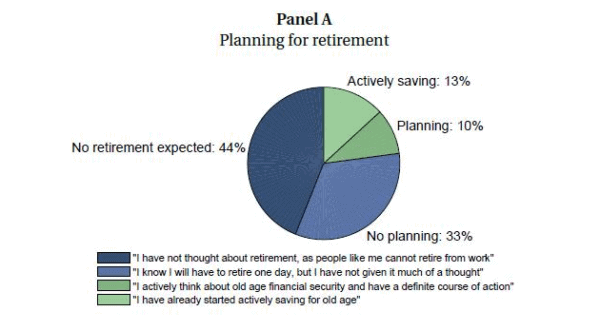
Infographic showing key statistics about post retirement planning in India - only 10 percent actively plan for retirement

The number is 77%.

Seventy-seven percent of Indians have no post-retirement plan. Not a bad plan. Not an incomplete plan. No plan at all.

This comes from an RBI survey on household finances. And while the survey itself is a few years old, every subsequent study has confirmed the same direction — the number hasn’t meaningfully improved. If anything, with the gig economy expanding and formal pension coverage shrinking, it may be worse today.

Let me unpack what 77% actually means — not as a statistic, but as a lived reality.

⚡ Quick Answer

77% of Indians have no post-retirement plan according to RBI data. Over 50% expect to depend on their children. India ranks dead last (48th of 48) in the 2024 Mercer Global Pension Index. The retirement savings gap is growing at 10% annually. The bitter truth: if you haven’t planned, you’re not an exception — you’re the majority. And the majority is in trouble.

What Does 77% Look Like In A Room?

Picture a family gathering. Ten uncles sitting around after dinner, talking about property prices and their children’s careers. Comfortable. Confident. Seven of them have no idea how they’ll fund the next 25 years of their lives after they stop earning.

That’s the RBI finding: 44% of people haven’t thought about retirement planning because they feel they can never stop working. Another 33% know they’ll retire someday but haven’t thought about it or planned anything. Together, that’s your 77%.

And here’s where it gets darker. When the same survey asked people how they plan to fund their retirement, more than 50% said they’ll depend on their children. Another 25% said they didn’t know.

Let me say that again. Half the country’s retirement plan is: “Mere bachche dekh lenge.”

“Your children are not your retirement plan. They have their own EMIs, their own dreams, their own emergencies. Love them enough to not become their biggest financial burden.”

— Hemant Beniwal

Why 77% Isn’t Just A Planning Problem — It’s A Math Problem

Let me show you what happens when you don’t plan, using real 2026 numbers.

Take a 40-year-old earning ₹1.5 lakh per month today. Monthly household expenses: around ₹75,000. They plan to retire at 60.

At 7% inflation (the conservative number for India), their monthly expenses at retirement will be approximately ₹2.9 lakh. Not ₹75,000. Not ₹1 lakh. Nearly ₹3 lakh a month — just to maintain the same lifestyle.

If they live to 85 (which is entirely reasonable for a healthy urban Indian today — India’s life expectancy is already 70.82 and climbing), they need a retirement corpus of roughly ₹5-6 crore. That accounts for inflation continuing at 6-7% through retirement and a modest 8-9% return on a balanced portfolio.

Now ask yourself: does the average Indian professional have ₹5-6 crore saved for retirement? Most don’t even have ₹50 lakh.

This is what 77% looks like in rupees. It’s not that people don’t care. It’s that they haven’t done the math. And the math is unforgiving.

The Pension Myth That Makes It Worse

In many countries, a government pension provides a safety net. In India, that net has holes big enough to fall through.

Over 90% of India’s workforce is in the unorganized or gig sector — with zero pension coverage. No EPF. No gratuity. No employer contribution. Even for those in the organized sector, the Employee Pension Scheme (EPS) pays a maximum of ₹7,500 per month. Seven thousand five hundred rupees. That barely covers electricity and groceries in a metro city.

In the 2024 Mercer Global Pension Index, India ranked dead last — 48th out of 48 countries surveyed. Last. Behind countries with a fraction of our GDP.

This means one thing: you are your own pension fund. The government won’t save you. Your employer’s contribution alone won’t save you. Your children — who have their own homes to buy and their own children to educate — shouldn’t have to save you.

NPS is a step in the right direction, especially with additional tax benefits now available. But it’s one instrument. A post-retirement plan needs a full withdrawal strategy, not just an accumulation strategy.

77% have no plan. You’re reading this — which means you still have time to not be one of them.

Let’s build a retirement plan that survives inflation, medical costs, and 25+ years of life after your last salary.

Start Your Retirement Plan

The Three Silent Killers Inside That 77%

I’ve worked with hundreds of families over 18+ years. The ones who end up in the 77% don’t get there because they’re irresponsible. They get there because of three things:

First: debt that follows you into retirement. The RBI data shows that mortgage exposure actually increases as people approach retirement age. People take bigger home loans in their 40s, upgrade in their 50s, and carry EMIs into their 60s. A retirement with a running EMI isn’t really a retirement. It’s continued employment without the employment.

Second: gold and real estate obsession. Indian households convert savings into gold and property — almost reflexively. But gold doesn’t generate income. Property is illiquid. When you need ₹3 lakh a month in retirement, you can’t sell one room of your house every quarter. A diversified portfolio with proper retirement instruments generates monthly cash flow. A flat in Noida does not.

Third: medical inflation eating the corpus alive. Medical inflation in India has been running at roughly 10% per year — double the general inflation rate. A hospital stay that costs ₹5 lakh today will cost ₹13 lakh in 10 years. Your health insurance covers hospitalisation. It doesn’t cover the daily cost of being old — medicines, physiotherapy, domestic help, transport to doctors. That’s an out-of-pocket expense that grows every year.

What The Other 23% Do Differently

The 23% who have a plan aren’t geniuses. They’re not richer than you. They did three things:

They started early. Not at 55 — at 35 or 40. The difference between starting to invest ₹30,000/month at 35 versus 45 is the difference between ₹3.5 crore and ₹1.2 crore at retirement (assuming 12% equity returns). Same monthly investment. Same effort. Wildly different outcomes. Time is the only asset that money can’t buy back.

They got professional help. Not a bank relationship manager pushing the latest ULIP. A fee-only financial planner who built a retirement savings strategy — with inflation adjustments, worst-case scenarios, and a withdrawal plan for after retirement.

They reviewed annually. A retirement plan isn’t a document. It’s a living system. Tax rules change (senior citizens now get ₹1 lakh deduction on interest income under Section 80TTB — up from ₹50,000). Markets shift. Life happens. The 23% adjust. The 77% hope.

RBI survey chart showing 77 percent of Indians have no post retirement plan with breakdown of retirement intentions

“The bitter truth about retirement planning is not that it’s complicated. It’s that it’s simple — and people still don’t do it. Because ‘later’ feels like a plan. It isn’t.”

— Hemant Beniwal

If You’re Reading This, You Have What The 77% Don’t

Awareness.

You know the number now. You can’t un-know it. The question isn’t whether retirement is coming — it’s whether you’ll meet it with a plan or a prayer.

Here’s what I’d tell you if you were sitting across from me right now:

Don’t calculate your retirement corpus based on today’s expenses. Project them forward at 7% inflation. The number will shock you — and that shock is the beginning of real planning.

Don’t count on post-retirement income. If it comes, great. Build your corpus assuming it won’t.

Don’t mix insurance with investment. Your insurance policies are probably not retirement instruments, no matter what the agent told you.

Don’t wait for a “better time” to start. There is no better time. There’s only less time.

And most importantly — make sure your nominee structures are in order. A corpus without clear succession planning creates a different kind of crisis for your family.

The 77% don’t have a plan. Today, you stop being one of them.

Whether you’re 35 or 55, a real post-retirement plan starts with one honest conversation about your numbers.

Book Your Retirement Planning Session

In that Pune workshop, the three people who raised their hands? They weren’t richer than the rest. They weren’t smarter. They’d just had one conversation with a planner, five years earlier, that the other thirty-seven kept postponing.

Seventy-seven percent is not a statistic. It’s a warning. And you still have time to heed it.

💬 Your Turn

Be honest — are you in the 77% or the 23%? And if you’re in the 77%, what’s the one thing that’s stopped you from making a post-retirement plan? Share in the comments — no judgment, just honesty.

Medium Maximisation: Why More Money Isn’t Making You Happier

“Money is a tool. Used properly it makes something beautiful. Used wrong, it makes a mess.”
– Bradley Vinson

A client called me a few weeks before his retirement date. After 32 years in the same company, he had accumulated a corpus that would have seemed impossible to him at 30. The number was large. By any measure, he had done well.

But he was anxious. Almost panicked.

I asked him what was wrong. He said: “Hemant, my number isn’t as large as my colleague’s. He built more than me.”

I asked: “What do you plan to do in retirement?”

He had a list. Travel with his wife. Spend more time with grandchildren. Take up photography. Read the books that had been sitting on his shelf for years.

“And can your corpus fund all of that?” I asked.

“Yes. Comfortably. But it isn’t as large as his.”

This is Medium Maximisation. And it is one of the most quietly destructive forces in financial life.

⚡ Quick Answer

Medium Maximisation is the psychological trap of optimising for the instrument instead of the outcome. Money is a medium – a tool to fund a life you want. When money becomes the goal itself, the original goal disappears. The result is people who are financially successful but don’t know what they were working toward. The fix is not earning less. It is keeping the actual goal visible.

Medium maximisation money as a tool not a goal

What Is a Medium?

A medium is something you receive as an intermediate step toward what you actually want. Reward points on a credit card are a medium – they are not useful by themselves, only in exchange for something. Salary is a medium. The score on an exam is a medium. The number in your investment portfolio is a medium.

The economist Raj Raghunathan at the University of Texas conducted a study where he asked people to name three wishes they would ask for if a genie appeared before them. Most people wished for money, success, fame, and power. Very few wished for happiness directly – even though the reason they wanted all those other things was to be happy. They were wishing for the medium, not the outcome.

Medium Maximisation occurs when the pursuit of the medium becomes the goal. When the number in the portfolio becomes the point, instead of what the portfolio enables.

Why This Happens – and Why It Is Getting Worse

The problem with money as a medium is that it is quantifiable, trackable, and comparable in a way that genuine wellbeing is not. You can check your net worth on your phone every morning. You cannot check how much meaning your life has.

Social comparison makes it worse. In previous generations, you compared yourself to neighbours and colleagues you could count on one hand. Today, LinkedIn shows you every peer’s promotion, every classmate’s IPO windfall, every connection’s milestone. The comparison set has grown from 20 people to 2,000. And the richest, most successful examples are algorithmically elevated to the top of your feed.

The result is a treadmill. You reach the number you thought would be enough. The comparison set has moved. The number no longer feels sufficient. You keep running.

Research in happiness economics has consistently shown that above a certain income threshold – sufficient to cover needs and basic comforts – additional wealth does not meaningfully increase life satisfaction. The Nobel laureate Daniel Kahneman’s famous study found that emotional wellbeing plateaued at an income level that would today be roughly equivalent to a middle-class professional income in India’s major cities. Beyond that point, more money correlated with more stress, not more happiness.

What I See in Retirement Planning Consultations

Over 25 years, the most consistent pattern I see is this: clients who have defined what they want from retirement – specifically, not vaguely – feel much better about their financial situation than clients who have focused purely on corpus accumulation. A person with Rs 2 crore and a clear picture of how they want to live their retirement is less anxious than a person with Rs 5 crore who has no idea what they are saving toward. The number alone does not create certainty. The purpose behind the number does.

I now ask every new client two questions at the start: “What are you trying to fund?” and “What does a good day look like for you at 65?” The answers change everything about how we structure the plan.

The Investing Version of Medium Maximisation

Medium Maximisation shows up in investing in ways that are easy to miss because they look like discipline.

The executive who saves 50% of his income, drives a car he doesn’t need, takes no holidays, and defers every pleasure in life “until the number is right” – is he being responsible? Or has the corpus become an end in itself?

The investor who refuses to spend on his health, his children’s experiences, or the trip he has been promising his wife for a decade – because “I need to keep compounding” – is optimising the medium at the expense of the outcome.

I have seen people die before reaching retirement with Rs 3-4 crore in assets and a list of things they were going to do “once they had enough.” The corpus was never touched. The list was never started. The medium was maximised. The outcome was missed entirely.

This is not an argument for reckless spending. Emergency funds matter. Retirement planning matters. Long-term investing matters. The point is that the corpus is instrumental – it is supposed to fund a life, not become the life.

How to Reorient From Medium to Outcome

The solution is not complicated. But it requires ongoing conscious effort because the culture around us constantly reinforces Medium Maximisation.

The first step is specificity. “I want to be financially secure” is a medium goal. “I want to fund 25 years of retirement at Rs 1.5 lakh per month in today’s money, travel once a year, and have a reserve for health emergencies” is an outcome goal. The first number is abstract and always insufficient. The second number can be calculated, planned for, and reached.

The second step is periodically spending money on experiences rather than accumulating it. Research consistently shows that spending on experiences – holidays, learning, relationships, time – produces lasting happiness more reliably than spending on objects. Objects normalise quickly. Experiences become part of your identity and memory. The Diwali trip to Rajasthan your family took in 2022 will still be a good memory in 2042. The television upgrade will be forgotten in a month.

The third step is to distinguish between spending that makes life uncomfortable and spending that makes life richer. Some discomfort is worth enduring for long-term financial security. Routinely sacrificing experiences and health for marginal corpus additions past a reasonable target is not discipline. It is Medium Maximisation with good branding.

Money as a Tool for Retirement – The Right Framework

In retirement planning, this distinction matters most. Many clients approaching retirement have accumulated more than they will ever need. The psychological difficulty is giving themselves permission to spend it.

The fear of “running out” is real and worth taking seriously. But it can also become a rationalisation for never using the corpus at all – for treating the number as an end rather than a means.

A well-structured retirement plan – with clear income projections, stress-tested withdrawal rates, a bucket strategy for stability, and regular reviews – addresses the legitimate fear of running out. Once that structure is in place, the question “do I have enough to do X?” has a genuine answer. And if the answer is yes, then not doing X is a choice, not a necessity.

A retirement plan is not just a withdrawal spreadsheet. It is a plan for a life.

We help clients figure out how much they need, structure the plan around what they actually want to do, and give them the clarity to stop running on the treadmill.

See How RetireWise Builds Life Plans

When my anxious client asked me about his number being smaller than his colleague’s, I asked him one more question: “What does your colleague plan to do in retirement?”

He paused. “I don’t know actually. He has never mentioned it.”

I said: “Maybe ask him.”

A few weeks later he called me back. His colleague had no plan. No list. No idea. He had just kept accumulating because that was what he knew how to do.

The larger corpus was the medium. The outcome remained undefined.

Money is a powerful tool. But a tool without a purpose is just weight you are carrying.

What are you building the corpus for? If you cannot answer that clearly, the number will never be enough.

The most important part of retirement planning is knowing what you are planning for.

We start every engagement by answering that question first. The numbers follow from the life design.

Book a Free 30-Min Call

Your Turn

If you are honest with yourself: do you know specifically what you are accumulating toward? Or has the number itself become the goal? What would change if you had a clear answer to that question?