Home Blog Page 30

What Mutual Fund Scheme Documents Actually Tell You (And the 3 Things You Must Check)

7

A client once came to me after losing money in a debt mutual fund. He had invested based on an agent’s recommendation – “safe fund, better than FD.” When the fund suspended redemptions during the 2020 Franklin Templeton crisis, he was shocked. “Why didn’t anyone tell me this could happen?” he asked.

The answer was in the Scheme Information Document. The fund’s mandate explicitly allowed investment in lower-rated debt instruments. The risk was disclosed. He had never read it.

The mutual fund disclaimer – “Mutual Fund investments are subject to market risks, read all scheme related documents carefully” – is not a legal boilerplate to scroll past. It is pointing you to documents that contain material information about what you are actually buying.

Quick Answer

The three documents SEBI requires every mutual fund to provide are the Scheme Information Document (SID), Statement of Additional Information (SAI), and Key Information Memorandum (KIM). The SID covers what the fund invests in, who manages it, and the risks. The KIM is the abridged readable version. Most investors never read any of them – which is why they are repeatedly surprised by outcomes that were clearly disclosed. For retirement investors specifically, the three things most worth checking in any fund document are the investment objective (does it match your goal?), the risk factors (specifically the credit and liquidity risks), and the fund manager’s track record.

Mutual Fund Scheme Documents India - SID SAI KIM Explained

The Three Documents Every Mutual Fund Must Provide

SEBI regulations require every mutual fund scheme to maintain and make available to investors three key documents.

Scheme Information Document (SID) – The detailed prospectus for the specific scheme. Typically 80 to 120 pages. Covers the investment objective, asset allocation pattern, types of instruments the fund can invest in, risk factors specific to this scheme, fund manager details, load structure, redemption process, and tax treatment. This is the authoritative document for understanding what the fund actually does.

Statement of Additional Information (SAI) – The background document about the Asset Management Company (AMC) as a whole. Covers the AMC’s history, key personnel, governance structure, legal proceedings and penalties, investor rights, and general information applicable across all schemes. This is the document to read when evaluating the AMC rather than a specific scheme.

Key Information Memorandum (KIM) – The abridged, investor-friendly version of the SID and SAI combined. Typically 20 to 30 pages. This is the practical starting point for most investors. All KIMs are standardised in format by SEBI, which makes comparison between funds easier.

Additionally, each AMC publishes a Monthly Factsheet which gives current portfolio holdings, recent returns, and fund manager commentary. This is the most current source of information about what the fund actually holds right now.

The 5 Things Worth Actually Reading in the SID

Most people are not going to read 100 pages of mutual fund documentation, nor should they. The sections that contain material information relevant to an investment decision are:

Investment Objective and Asset Allocation. What does the fund intend to do? What percentage of the portfolio can be in equity, debt, and cash? What types of equity (large-cap, mid-cap, small-cap, sectoral) or debt instruments (government securities, corporate bonds, money market instruments) can the fund manager choose? A fund with “up to 100% equity, minimum 20% equity” has much more flexibility – and therefore more risk – than a fund with “70 to 80% large-cap equity only.” The asset allocation table tells you this directly.

Risk Factors – specifically the scheme-specific ones. Every SID has two risk categories: standard risks (applicable to all mutual funds, mostly boilerplate) and scheme-specific risks. The scheme-specific risks are what you need to read. A debt fund that can invest in lower-rated bonds carries credit risk and liquidity risk that a pure government securities fund does not. A small-cap fund carries higher concentration risk and volatility than a flexi-cap fund. The scheme-specific risks section makes the fund’s actual risk profile explicit.

Fund Manager Background. How long has the fund manager managed this specific scheme? What other schemes do they manage? A fund manager running 12 different schemes simultaneously is a material fact. The SID and AMC website both disclose this. It does not disqualify the fund, but it is worth knowing who is actually making the investment decisions.

Load Structure. Exit load is the fee charged when you redeem before a certain holding period. Many equity funds charge 1% exit load for redemptions within 1 year. This affects your net returns on short-term redemptions. The SID states the load structure clearly.

Benchmark. Every fund has a benchmark index against which its performance is measured. If a fund is classified as a large-cap fund but benchmarked against the Nifty 500 Total Return Index rather than the Nifty 50 TRI, understand why – the benchmark choice reveals something about how the fund intends to position itself.

What the KIM Tells You About a Debt Fund (This Is Where Risk Hides)

For debt mutual funds, the scheme documents contain information that is genuinely critical and often overlooked. The 2020 Franklin Templeton episode, where six debt funds were wound up and investors could not redeem for months, was entirely predictable from reading the fund documents. Those funds had invested in relatively illiquid instruments at higher yields – the SIDs disclosed this. Investors either did not read the documents or did not understand what the credit quality and maturity profile disclosures meant.

In a debt fund’s KIM, pay particular attention to: the credit quality distribution (what percentage is AAA vs AA vs A vs below investment grade), the average maturity and modified duration (higher duration means higher sensitivity to interest rate changes), and any mention of structured debt, credit opportunities, or dynamic duration strategies. These are the signals that a fund is taking more risk to generate higher yields.

For retirement investors specifically: a debt fund in your portfolio is supposed to provide stability and liquidity, not to maximise returns by taking credit risk. The KIM tells you whether the fund is actually doing that.

Where to Find These Documents

Every AMC’s website publishes current SIDs, SAIs, and KIMs for all schemes. AMFI’s website (amfiindia.com) also aggregates these. For any scheme you are evaluating, download the KIM first – it is the most readable version and covers the key information. If a specific section raises questions, go to the full SID.

These documents are updated when material changes occur (change in investment objective, fund manager change, load restructuring) and at minimum annually. Always read the current version, not a cached version from a few years ago.

Building a Retirement Portfolio You Actually Understand

RetireWise helps clients understand what they are invested in – not just what they own. Explore how we approach retirement portfolio construction.

See Our Services

One question for you: For the mutual funds you currently hold, do you know the fund manager’s name, the credit quality profile of debt funds, and the specific risk factors disclosed in the scheme documents? If not, which fund would you start with?


7 Financial Lessons from Sachin Tendulkar’s Farewell Speech That Still Hold True

26

November 2013. Sachin Tendulkar walked off the Wankhede Stadium pitch for the last time, folded his hands, and stood at the crease for a few moments before leaving. Then, from the centre of the ground, he spoke for 25 minutes without notes – or rather, with a small paper of pointers so he would not forget anyone. From his late father to the groundsmen who prepared the pitch, the speech was as precise and complete as the innings he had played for 24 years.

I was watching from home. What struck me was not the sentiment – it was how much of what he said mapped directly onto the financial lives of his fans in the stands, the people earning Rs. 40,000 a month in Mumbai, saving erratically, planning retirement vaguely, hoping it would all work out.

Seven things Sachin said that day have stayed with me. All of them translate.

Why This Speech Still Matters

Sachin’s farewell speech was not about cricket. It was about a career built on discipline, coaching, sacrifice, balance, and purpose – all of which have direct financial equivalents. The lessons he described from 24 years of professional excellence map onto what separates the people who retire financially secure from those who do not.

7 Financial Lessons from Sachin Tendulkar's Farewell Speech

1. Retirement Is Inevitable – Plan for It Before It Plans Itself

Sachin said: “My life, between 22 yards for 24 years, it is hard to believe that that wonderful journey has come to an end.”

Every professional career ends. Gymnasts retire at 18. Athletes at 25. Cricketers at 35. Senior executives at 55 or 60. The difference is that Sachin had known since he was a teenager that his career had a finite window. Most people do not think about retirement with that same clarity until they are uncomfortably close to it.

The financial translation: your career income has a finite runway. The corpus you need for the 25 to 30 years after that runway ends must be built during it. There is no replacement for starting early and being specific about when the clock ends.

2. There Are No Shortcuts

Sachin said his father told him at age 11: “Chase your dreams, but make sure you do not find shortcuts. The path might be difficult, but don’t give up.”

In financial planning, shortcuts wear different masks each decade. In the 1990s it was chit funds. In the 2000s it was real estate that “always goes up.” In the 2010s it was penny stocks and IPO flipping. In the 2020s it is crypto, F&O trading, and finfluencer tips on Instagram. The instrument changes. The promise of easy money without patience is the constant.

The only reliable path to retirement wealth in India is the one Sachin took to cricket excellence: consistent effort, appropriate risk-taking, long time horizon, and the discipline to ignore noise. A SIP in a diversified equity fund, sustained through market corrections, is boring and effective. Shortcuts are exciting and usually expensive.

3. Every Exceptional Performer Has a Coach

Sachin described how his first coach, Ramakant Achrekar, never once said “well played” – because he believed praise would make the young Sachin complacent. And despite talent that required no coach to be visible, Sachin continued to work with coaches throughout his career.

The question I ask clients: if the God of Cricket needed a coach, what makes you think you can manage your retirement plan alone? A financial advisor does what a good coach does – provides perspective without emotional attachment, prevents impulsive decisions during difficult periods, and holds you accountable to your plan when you want to deviate.

The investor who managed their own portfolio during March 2020 and sold at the bottom (as many did) needed a coach. The investor who called their advisor, heard “hold, do not sell,” and stayed invested, recovered fully within 9 months. The same information, but one person had someone to stop them from a panic decision.

4. A Partner’s Contribution Is Often Invisible But Decisive

Sachin acknowledged that his wife Anjali, who was a doctor, stepped back from her career to manage the family so he could play without distraction. “Without that, I don’t think I would have been able to play cricket freely and without stress.”

In households where one spouse manages the home and family while the other builds their career, the financial contribution of the homemaker is real but rarely quantified. The time freed for the working spouse to focus, the childcare and elder care managed, the household decisions handled – these have direct economic value and should be explicitly factored into financial planning, insurance decisions, and retirement goal-setting.

Practically: a homemaker’s goals – including what she wants her retired life to look like – should get equal weight in the financial plan. And her financial literacy should be prioritised, not deferred to “when she’s interested.” If something happens to the earning spouse, she needs to be able to navigate the financial picture independently.

5. The Time You Do Not Spend Cannot Be Bought Back

This was the only regret Sachin expressed: “I wanted to spend so much time with them on special occasions like their birthdays, their annual days, their sports day, going on holidays, whatever. I have missed out on all those things.”

The financial equivalent is not just about money – it is about what money is for. The retirement plans that I find most fragile are the ones built entirely around a number, with no thought about what the person will do after the number is reached. Retirement is not just a financial event. It is the sudden availability of all the time that was previously consumed by career.

The practical reflection: financial planning should include life planning. What do you want the first year of retirement to look like? The first month? The first week? What relationships, activities, and purposes will structure your days? The people who transition well to retirement are those who have thought about this, not just the corpus.

6. Health Is the Asset That Protects All Other Assets

Sachin thanked his doctors, physios, and trainers specifically: “They have put this difficult body together to go back on the field and be able to play.”

For a retirement investor, health is the single biggest variable that can disrupt a well-structured financial plan. A serious illness in the decade before retirement can derail the corpus. A poor health trajectory in retirement creates expenses that no fixed withdrawal rate can comfortably accommodate.

The financial action: critical illness insurance, adequate health insurance with no corporate group cover dependency, and – critically – the investment in diet, exercise, stress management, and regular health monitoring that no insurance can fully replace. A healthy retirement is far less expensive than an unhealthy one.

7. Build Toward Something Larger Than Yourself

Sachin ended by saying he felt fortunate to serve the nation through cricket. He was not just playing for himself. There was a purpose larger than personal achievement.

In financial planning, the people who sustain discipline longest are those who have a reason that extends beyond their own comfort. The parent saving for a child’s education. The executive building generational wealth. The person who wants to fund a cause they believe in during retirement. Purpose anchors the plan when motivation wavers.

The best retirement plans are not built around a number. They are built around a vision of what the money will enable – for oneself, for one’s family, and for something beyond both.

A Retirement Plan Built Around What Matters to You

RetireWise starts the retirement planning process by understanding what the client is building toward – not just the corpus target. Explore our approach to goal-based retirement planning.

See Our Services

One question for you: Of these seven lessons, which one resonates most with where you are right now in your financial life – and what would it take to act on it?

7 Ways to Buy Gold This Diwali: From Best to Worst for Your Wallet

Every October, the same conversation starts in Indian households.

“Should we buy gold this Diwali?”

Gold and Diwali are inseparable in Indian culture. The festival marks an auspicious time for purchases, and gold jewellery has been part of the celebration for generations. But the way most Indians buy gold – heavy jewellery with high making charges – is one of the most financially inefficient forms of the purchase.

If you want to buy gold this Diwali, there are better and worse ways to do it. Here is an honest comparison.

Quick Answer

For investment purposes, Sovereign Gold Bonds are the best form of gold – they earn 2.5% annual interest on top of gold price appreciation, have zero storage cost, and are tax-efficient at maturity. For physical gold needs (jewellery, gifting, tradition), buy hallmarked BIS 916 jewellery and minimise making charges. Gold ETFs are a good liquid alternative. Never buy gold coins or bars from banks – the buyback terms are poor.

Option 1: Sovereign Gold Bonds (Best for Investment)

Sovereign Gold Bonds (SGBs) are government securities denominated in grams of gold. You invest in gold without physically owning it – and earn an additional 2.5% per annum interest on your investment, paid semi-annually.

At maturity (8 years), redemption is completely tax-free. If sold on the exchange after 5 years, long-term capital gains apply. No storage risk, no making charges, no purity risk.

For pure investment – if your goal is to benefit from gold price appreciation over 5-10 years – SGBs are unambiguously the best form of gold ownership.

Note: the RBI has not issued new SGB tranches since February 2024. But existing bonds trade actively on the NSE and BSE secondary market. You can buy them through your demat account at prices often at a small discount to current gold price – making it an even better entry point than a fresh tranche. The 2.5% interest and tax-free maturity benefit still apply. Complete guide to Sovereign Gold Bonds – how they work, returns, and tax treatment.

Option 2: Gold ETFs (Good Liquidity, No Storage)

Gold Exchange Traded Funds track the price of physical gold and trade on the stock exchange like shares. You buy and sell in real time through your demat account. Each unit represents approximately 1 gram of gold (varies by fund).

Advantages: instant liquidity, no storage cost, transparent pricing, can invest small amounts.

Tax treatment: gains held under 24 months are short-term capital gains taxed at your slab rate. Gains held over 24 months are long-term at 12.5% without indexation (post-2024 Budget changes).

The difference from SGBs: no additional interest income, no tax-free maturity. But Gold ETFs have no lock-in and can be sold any time – useful if you need flexibility.

How much gold should actually be in your portfolio?

A fee-only advisor determines the right gold allocation for your overall portfolio – and the most tax-efficient form to hold it.

Talk to a RetireWise Advisor

Option 3: Gold Mutual Funds (For Non-Demat Investors)

Gold mutual funds invest in Gold ETFs. If you do not have a demat account, this is how you access gold ETF exposure. You can invest via SIP or lump sum. Same tax treatment as ETFs.

Slightly higher expense ratio than direct ETFs, but the convenience of no demat account and SIP availability makes it practical for regular gold accumulation.

Option 4: Digital Gold (Convenient but Costly)

Platforms like Google Pay, PhonePe, and Paytm offer digital gold – you buy fractional amounts of physical gold held in a vault on your behalf.

Advantages: buy in rupees as small as Re 1, instant and convenient.

Disadvantages: storage charges apply, spread between buy and sell price is often 2-3%, and there is counterparty risk with the platform and vault provider. No regulatory framework as strong as SGBs or SEBI-regulated ETFs.

Appropriate for small, occasional purchases or gifting. Not recommended as a significant investment vehicle.

Option 5: Physical Gold Jewellery (Tradition Over Returns)

Jewellery is the form most Indians default to at Diwali. It serves cultural and emotional purposes – and there is nothing wrong with buying jewellery for these reasons.

But as an investment, physical jewellery is expensive. Making charges range from 8-25% of the gold value and are not recovered on resale. A Rs 1 lakh jewellery purchase might net you Rs 80,000-85,000 on resale at the same gold price.

If buying jewellery: always buy hallmarked BIS 916 jewellery (22 karat, Bureau of Indian Standards certified). Insist on a receipt showing gold weight, karat, and making charges separately. Compare making charges across jewellers – they vary widely.

Option 6: Gold Coins and Bars (Avoid Banks)

Physical gold coins and bars (24 karat, 999 purity) are an option for those who want physical gold without jewellery making charges.

Buy from jewellers or certified dealers – not banks. Banks in India sell gold coins but do not buy them back. You will end up selling at a discount to a jeweller or exchange, negating any cost advantage.

Storage and insurance add ongoing costs. For amounts above Rs 2-3 lakh in physical gold, a bank locker becomes necessary.

Option 7: Gold Savings Schemes (Use Carefully)

Many jewellers offer gold savings schemes – pay a fixed amount monthly for 11 months and receive a bonus gram or discount in the 12th month.

These can be useful for accumulating gold for a specific jewellery purchase. However, the schemes offer no investment returns and carry jeweller default risk. Only use schemes from well-established, reputable jewellers. Never participate from small or unknown jewellers.

The Gold Allocation Question Most People Never Ask

Here is something I ask every client who mentions buying gold at Diwali.

“If you count all your gold jewellery at current market value, what percentage of your total investment portfolio does it represent?”

Most people have never done this calculation. When they do, the answer is often surprising. A middle-class Indian family with 300-400 grams of jewellery accumulated over 20 years – weddings, Diwalis, birthdays – is holding Rs 27-36 lakh in gold at April 2026 prices. For a family with Rs 60-80 lakh in total investable assets, that is 35-50% in a single asset class that earns nothing, requires storage and insurance, and cannot be sold in pieces without making charges.

The right gold allocation for most investors is 5-10% of the investment portfolio. It is a hedge – not a primary wealth-building tool. Equity grows wealth over time. Gold preserves it. Knowing which job your assets are doing prevents the mistake of over-allocating to the comfort of something that glitters. Why buying gold purely for returns is usually a mistake.

Why Indians Over-Buy Gold at Diwali

The Diwali gold purchase is not primarily a financial decision. It is a social one.

Psychologists call it social proof – the tendency to look at what others are doing and assume it is correct. When every family in the building is going to the jeweller on Dhanteras, not going feels like doing something wrong. The peer pressure is real, the cultural significance is real, and the auspiciousness belief is deeply held.

The result: Indians buy gold at Diwali at peak emotional motivation, with peak social pressure, which is often also near-peak seasonal gold prices driven by the same demand surge. The optimal time to buy gold for investment purposes – when prices are lower and motivation is lower – is exactly when nobody is talking about it.

This does not mean avoid buying gold at Diwali. It means understand what you are doing. Buy jewellery as jewellery. Buy it with intention and joy, not FOMO. And if you want gold as investment, use the SGBs or ETFs route – which is available every day of the year, not just at Diwali.

Frequently Asked Questions

Are Sovereign Gold Bonds still available to buy in 2026?

The RBI has not issued new SGB tranches since February 2024, and no new tranches have been announced as of April 2026. However, existing SGBs trade actively on the NSE and BSE secondary market. You can buy them through your demat account at prevailing market prices – often at a small discount to the current gold price. The 2.5% annual interest income and the tax-free maturity benefit both apply to secondary market purchases. Check your broker app under “Sovereign Gold Bonds” in the bond section.

What is the making charge on gold jewellery and how do I minimise it?

Making charges are the fee jewellers charge for crafting jewellery – ranging from 8% for simple machine-made pieces to 25%+ for intricate handcrafted designs. These charges are not recovered on resale; the jeweller buys back at gold value only. To minimise: buy simpler designs, ask for the making charge rate explicitly before purchasing, compare across multiple jewellers (rates vary significantly), and avoid large branded retail chains where making charges are typically higher than local jewellers.

Is digital gold on Google Pay or PhonePe safe?

Digital gold on these platforms is backed by physical gold held in vaults by MMTC-PAMP or SafeGold – established vault operators. However, the regulatory framework is weaker than SGBs or SEBI-regulated ETFs. Key considerations: the platform takes a 2-3% spread on each transaction, storage charges apply for extended holding, and there is no statutory investor protection comparable to SEBI oversight. Digital gold is reasonable for small purchases or gifting. For investment amounts above Rs 10,000-15,000, a Gold ETF or SGB is the better choice.

How is gold taxed in India in 2026?

Physical gold and Gold ETFs: gains held under 24 months are short-term capital gains taxed at your income slab rate. Gains held over 24 months are long-term capital gains taxed at 12.5% without indexation (per 2024 Budget amendments). Sovereign Gold Bonds: gains at maturity (8 years) are completely tax-free. The 2.5% annual interest is taxable as income. If sold before maturity on the exchange, LTCG at 12.5% applies after 12 months. SGBs remain the most tax-efficient gold investment for a long-term horizon.

Gold at Diwali is a tradition worth honouring. But the form you choose makes a significant financial difference. Buy jewellery for love and culture. Buy SGBs or ETFs for investment. Know which purpose you are serving before you open your wallet.

Shubh Diwali – and may your gold work as hard for your future as it shines in your home today.

Your Turn

How do you buy gold at Diwali – jewellery, SGBs, ETFs, or something else? Has your approach changed over the years? Share below.

SEBI Registered Investment Adviser (RIA) in India: What It Means and Why It Matters for Clients

Before 2013, someone could call themselves a “Financial Planner,” “Wealth Manager,” “Investment Specialist,” or “Retirement Coach” without any qualification, any regulatory oversight, or any obligation to act in the client’s interest. They could earn commissions from product sales while claiming to be advisors. The client had no way to know the difference.

I was running an advisory practice at the time. The frustration of being equated with commission agents who sold whatever product generated the highest payout was real. Then SEBI introduced the Investment Adviser Regulations in 2013. From October 2013 onwards, anyone providing investment advice for consideration had to be registered with SEBI – as an Investment Adviser – or cease calling themselves an advisor.

That was a significant moment. Twelve years later, the regulatory framework has evolved considerably. Here is what investors need to understand about SEBI-registered Investment Advisers in 2026.

Quick Answer

A SEBI Registered Investment Adviser (RIA) is a person or entity registered with SEBI under the Investment Advisers Regulations 2013. The registration number is publicly verifiable on SEBI’s website. RIAs are required to act in the client’s best interest, provide advice suitable to the client’s profile, maintain fee transparency, and segregate advisory from distribution activities. Not every “financial planner,” “wealth manager,” or “investment consultant” in India is a SEBI RIA. Verify before engaging. RetireWise’s registration number is INA100001927.

SEBI Registered Investment Adviser India 2026

What Changed When SEBI IA Regulations Came Into Effect

Before 2013, investment advice in India was largely unregulated. Mutual fund distributors, insurance agents, stock brokers, and bank relationship managers all gave investment advice as part of their sales function – with no obligation to act in the client’s interest, no disclosure of conflicts, and no minimum qualification requirements for providing financial planning services.

SEBI’s Investment Advisers Regulations 2013 created a new, separate category. An Investment Adviser is defined as any person who, for consideration, is engaged in the business of providing investment advice to clients. Critically, SEBI included “Financial Planning” within the definition of investment advice – covering comprehensive financial planning that goes beyond just product recommendation.

The regulations mandated: minimum qualification (post-graduation with relevant certification, or graduate with 5 years of relevant experience), NISM certification, registration with SEBI, a documented client agreement, risk profiling, suitability assessment for all advice, fee disclosure, and separation of advisory from distribution activities.

The 2020 Amendments: The Segregation Requirement

The most significant update to the IA regulations came in 2020. SEBI mandated that an Investment Adviser cannot simultaneously be a mutual fund distributor earning trail commission on the same client’s investments. An IA must choose: advisory fees from clients, or distribution commissions from AMCs. Both from the same client is not permitted.

This was a structural change that forced clarity. Many practitioners who previously called themselves advisors while primarily earning distribution commissions had to either register as distributors (giving up the advisor title) or register as pure advisors (giving up distribution income). The segregation requirement significantly reduced the conflict of interest that had characterised much of the industry.

The implication for clients: a SEBI RIA who charges an advisory fee is legally required to not simultaneously earn distribution commissions from the products they recommend to you. This does not eliminate all conflicts but it eliminates the most obvious one.

How to Verify a SEBI RIA

Verification takes 2 minutes. Go to SEBI’s website (sebi.gov.in) and use the “Registered Intermediaries” search or the SEBI Intermediary Portal (siportal.sebi.gov.in). Search by name, firm name, or registration number. A genuine SEBI RIA will appear with their registration number, registration date, and validity status.

Registration numbers for individual RIAs have the format INA followed by digits. For corporate RIAs (registered as a company), the format is INH followed by digits. Any advisor claiming SEBI registration should be able to provide this number immediately. Verify it independently before engaging.

What to check beyond the registration number: is the registration current and valid? Has there been any regulatory action, penalty, or suspension listed? SEBI publishes enforcement actions on its website – a quick search of the advisor’s name against SEBI’s orders database is worth 5 minutes.

What a SEBI RIA Must Do That an Unregistered Advisor Does Not Have To

Registered Investment Advisers are bound by a code of conduct that includes: acting in the best interest of the client (fiduciary duty), providing advice suitable to the client’s risk profile and financial situation, disclosing all conflicts of interest, maintaining client records including risk profiles and advice given, charging fees in a transparent manner (no hidden embedded commissions on the advisory side), and having a written client agreement.

SEBI RIAs must also pass the National Institute of Securities Markets (NISM) Series X-A and X-B certifications, maintain their registration through annual compliance filings, and carry professional indemnity insurance.

An unregistered “advisor” has none of these obligations. They can recommend products based on commissions, fail to disclose conflicts, and face no regulatory sanction because they are outside the framework. The title “financial advisor” or “wealth manager” is not protected – anyone can use it. Only “Investment Adviser” and the provision of investment advice for consideration requires SEBI registration.

The Single Question Every Investor Should Ask Before Engaging an Advisor

“Are you a SEBI Registered Investment Adviser, and what is your registration number?”

If the answer is no – or if the registration cannot be independently verified – you are dealing with an unregistered person giving financial advice, with no regulatory protection for you if things go wrong.

This does not mean unregistered people cannot have knowledge or give useful information. It means they have made no legal commitment to act in your interest, and you have no regulatory recourse if they do not.

Working With a SEBI Registered Investment Adviser

Hemant Beniwal is a SEBI Registered Investment Adviser (INA100001927), CFP, and CTEP with 25 years of experience. RetireWise works exclusively with executives aged 45-60 on retirement planning. Explore our services.

See Our Services

One question for you: Is your current financial advisor SEBI-registered? Have you verified their registration number independently on SEBI’s website?

How to Write a Will in India: The Step-by-Step Guide (2026)

Before any major combat mission, soldiers are given time to write what the army calls a “last letter.” These are not legal documents. They are emotional ones – memories, regrets, instructions for the family, directions for what to do if they do not come back.

We civilians have the same obligation. We just have no commanding officer to force us to do it.

A Will is your last letter – made legally binding. It answers the question your family will have to answer themselves if you do not: who gets what, who decides, and who protects the people you love most.

Most Indians never write one. Not because they do not care. But because of something far more human – and far more dangerous.

⚡ Quick Answer

A Will is a legal document that directs how your assets are distributed after death. Without one, Indian courts apply intestacy laws – which may not match your wishes at all. Any adult can write a Will on plain paper. Two witnesses and an executor are required. Registration is not mandatory but strongly recommended. Review it every 3-5 years, or after every major life event.

Why a Will Matters More Than Most People Think

Here is what most people get wrong: they assume their spouse and children will automatically inherit everything. In India, that is not how it works.

If you die without a Will, the Indian Succession Act (or the Hindu Succession Act for Hindus) determines who gets what. These laws distribute assets in fixed ratios across Class I and Class II heirs. Your wishes are irrelevant. Your family’s dynamics are irrelevant. The court decides – based on rules written in 1925.

Real problems I have seen in 25 years of practice: a daughter-in-law receiving a share of ancestral property her in-laws never intended her to have. A second marriage creating unintended inheritance conflicts. A business partner receiving nothing despite a lifetime of contribution, because it was never documented. A drug-addicted uncle receiving guardianship of young children because the court had no other direction.

A Will prevents all of this. One document. One afternoon. Permanent peace of mind for everyone you love.

“In 25 years of financial planning, I have never once heard a family say – thank God he did not leave a Will. But I have seen the destruction when there was none.”

– Hemant Beniwal, CFP, CTEP | Founder, RetireWise

🚫 The Nominee Misconception

A nominee is not the same as a legal heir. A nominee is a custodian – they receive the asset but are legally obligated to pass it to the legal heirs. The only exception is shares in a demat account, where the nominee is the actual heir. For all other assets – bank accounts, mutual funds, insurance – a Will overrides the nominee in a dispute. Always have both.

The 8 Essential Sections of a Valid Will

There is no prescribed format for a Will in India. It can be written on plain paper. But it must be detailed enough to be unambiguous – because ambiguity in a Will is an invitation for litigation.

State your full name, address, and that you are of sound mind and making this Will voluntarily. This clause identifies the state of the testator and automatically nullifies any previous Will. Do not skip the “sound mind” declaration – it is your first line of defense against a legal challenge.

List all assets – immovable (property, land), financial (bank accounts, mutual funds, PPF, EPF, NPS, FDs, shares, bonds), physical (jewellery, vehicles, valuables), and digital (passwords, crypto, domain names). For financial assets that change frequently, use language like “all financial assets held in my name as on the date of my death.” For property, include survey numbers and registration details.

Direct how outstanding loans, credit cards, home loans, and funeral expenses should be paid from the estate before distribution. If you have a business with liabilities, specify how those should be handled separately from personal assets. Failure to address this clause can leave your beneficiaries inheriting debt they did not expect.

Be specific. Name the asset and name the beneficiary. “I bequeath my flat at [full address] to my son Rahul Sharma” is far stronger than “my son gets the flat.” For liquid assets, specify percentages or amounts clearly. If creating a trust for minor children, specify the trustee, the age at which the child receives the corpus, and how the funds should be used in the interim.

The executor is the person responsible for carrying out your Will. Choose someone trustworthy, relatively young, and ideally with some financial literacy. The executor can be a beneficiary – that is legally permitted. For minor children, name a guardian explicitly. Do not leave this to the court. A court-appointed guardian will not know your child the way you do.

Direct how any estate-related taxes or liabilities should be paid – from the estate before distribution, or by specific beneficiaries. India currently does not have an inheritance tax, but capital gains tax applies when inherited assets are sold. Your Will can direct how tax costs should be handled so beneficiaries are not surprised.

Sign every page – not just the last one. Two witnesses must be present and must sign the Will in your presence. Witnesses cannot be beneficiaries – this is critical. Choose neutral witnesses who are likely to be alive and accessible for years. A doctor’s certificate confirming you were of sound mind at the time of signing adds an extra layer of protection against challenges.

Registration is not legally required in India (except in Goa, where it is mandatory). But it is strongly advised. A registered Will is far harder to challenge because the registrar verifies your identity and the authenticity of the document. Register with your local Sub-Registrar’s office. The fee is nominal. Note: a registered Will can only be revoked or superseded by another registered Will.

A Will is part of a complete retirement plan.

At RetireWise, estate planning is one of the layers in our retirement blueprint – alongside corpus sizing, withdrawal strategy, and insurance review.

See How RetireWise Works

The Will Validity Gap: When Your Will Becomes Financially Obsolete

Most financial planning content on Wills stops at “write one and register it.” Here is what they do not tell you – and this is the part that matters most for senior executives with complex financial lives.

A Will is valid from the day it is signed. But it reflects your financial reality on that specific day. The problem is that your financial reality changes – dramatically – over a 10 to 20 year period. And your Will does not update automatically.

Consider what happens to a Will written at age 42 by the time the person is 58:

Life Event Will Impact if Not Updated
Sold the family home, bought a new one Old property no longer exists; new one not in Will
ESOP vesting – large shareholding created Not mentioned; subject to intestacy laws
Children now adults – guardianship irrelevant Minor issue, but signals the Will is dated
Named executor has died Court appoints an executor – not your choice
Started a business partnership Business succession not addressed
Added a new NPS or mutual fund account May be covered by “all assets” clause, or may not be

THE WILL REVIEW TRIGGER LIST

Review your Will immediately after any of these events:

Marriage or divorce – Purchase or sale of property

Birth of a child or grandchild – Death of a named beneficiary

Death of named executor or guardian – Major ESOP vesting

Starting or selling a business – Moving country (NRI status change)

Minimum: review every 5 years even if none of the above apply.

The Will Validity Gap is not just a legal risk. It is a financial planning risk. A Will that is 15 years old and addresses 30% of your current net worth is effectively incomplete. The remaining 70% will be distributed by the court – not by you.

My recommendation: treat your Will like your investment portfolio. Review it at the same time you do your annual financial plan review. One hour per year. That is all it takes to keep it current.

Why Smart People Keep Postponing Their Will

Here is the uncomfortable truth: most people reading this article already know they need a Will. And most of them will close this tab without writing one.

This is not laziness. It is psychology.

Behavioural finance research is clear on this. Writing a Will requires us to confront our own mortality – which our brains are specifically wired to avoid. Psychologists call this mortality salience. When death becomes mentally visible, we do not face it. We redirect. We check email. We tell ourselves we will do it next weekend.

There is a second cognitive bias at work: optimism bias. We systematically underestimate the probability that something bad will happen to us specifically, even when we know the base rates. “People die without wills” is abstract. “I could die this year” is personal – and our brain rejects it as unlikely.

And a third: present bias. Writing a Will has costs today – time, money, emotional discomfort – and benefits only in a future we cannot feel. Our brain discounts future benefits heavily. The result: perpetual deferral.

📌 The Reframe That Works

Stop thinking about a Will as preparation for your death. Think of it as a gift to the people you love most – delivered at the moment they need it most. You will not be there to help them when you are gone. Your Will is your proxy. It speaks for you when you cannot speak for yourself.

Research on decision-making also shows that people are more likely to complete tasks when they are broken into small, specific steps rather than kept as large, vague intentions. “Write a Will” is a vague intention that stays on a to-do list for years. “Call a lawyer this Friday and schedule a first appointment” is a specific action that actually gets done.

One more thing worth saying: the fear of having the conversation with your family about your Will is often larger in imagination than in reality. In my experience, families are not uncomfortable talking about it. They are relieved. They have been wondering about it too, and did not know how to bring it up.

The decision to write a Will is not about you. It is about every person who depends on you. Do the right thing and sit tight – except this time, do not sit tight. Act.

Special Note for NRIs

If you are an NRI with assets in both India and overseas, write two separate Wills – one for Indian assets, one for assets in your country of residence. A single global Will must comply with the laws of every country where you hold assets, which creates enormous complications. Two separate Wills, each governed by the relevant jurisdiction, is the cleaner approach.

Also be aware: the legal framework for succession depends on your religion in India (Hindu Succession Act, Indian Succession Act for others). If you have changed your religious status, citizenship, or domicile, get a legal review of which law applies to you.

Read: NRIs Should Read This Before Making a Will (WiseNRI)

Your Will is one layer. Your retirement plan is the whole structure.

At RetireWise, we help senior executives build a complete retirement blueprint – corpus, withdrawal strategy, estate planning, and risk management. SEBI Registered. Fee-only.

See the RetireWise Service

Those soldiers who wrote their last letters did not do it because they expected to die. They did it because they loved the people they were leaving behind – and they wanted them to be okay. You are in the same position. Just with more time, and no excuse.

Write the Will. Do it this week. Your family will never thank you for it – because they will never need to. That is exactly the point.

💬 Your Turn

Do you have a Will? If yes – when did you last review it? If no – what has been stopping you? I read every comment and I would genuinely like to know.

SIP vs Value Cost Averaging: Which One Actually Wins? (The Answer Isn’t What You Think)

20

“If the rain is good, a farmer does not decrease the distance between the two saplings that he sows in order to get more yield.”

Markets were volatile. A few mutual fund companies had started recommending “value averaging” as a smarter alternative to SIP. Clients were calling, asking whether they should switch. One of them put it bluntly: “My SIP just keeps buying even when markets are falling. Is there a smarter way?”

It is a reasonable question. The answer is more nuanced than most people expect.

⚡ Quick Answer

SIP (Rupee Cost Averaging) invests a fixed amount regularly regardless of market levels. VCA (Value Cost Averaging) adjusts the investment amount to maintain a target portfolio growth rate – buying more when markets fall, less or even selling when markets rise. For most Indian investors, SIP wins on simplicity, discipline, and long-term outcomes. VCA has theoretical advantages but requires active management and access to surplus cash when markets fall hardest.

What is Rupee Cost Averaging (SIP)?

Rupee Cost Averaging is the mechanism behind every SIP. You invest a fixed amount – say Rs 10,000 – every month, regardless of the market level. When the NAV is low, your Rs 10,000 buys more units. When the NAV is high, it buys fewer units. Over time, your average cost per unit is lower than the average NAV over the same period.

This is not magic. It is mathematics. And it is most powerful in two conditions: falling markets (you accumulate more units cheaply) and volatile markets (the averaging smooths out your cost).

The key factor is commitment. SIP works because it removes the timing decision entirely. You do not decide when to invest. You have already decided. The standing instruction does it for you while you sleep.

SIP in a Rising Market

Month Amount NAV Units Bought
Jan Rs 1,000 20 50
Feb Rs 1,000 25 40
Mar Rs 1,000 30 33.33
Total Rs 3,000 Avg: Rs 24.54 123.33

A lumpsum investor who put Rs 3,000 in January at NAV 20 would own 150 units. The SIP investor owns only 123 units – SIP is slightly disadvantaged in a straight bull market. But nobody gets a straight bull market. Real markets oscillate.

What is Value Cost Averaging (VCA)?

Value Cost Averaging was developed by Michael Edelson of Harvard Business School. The idea: instead of investing a fixed amount, you invest whatever amount is needed to keep your portfolio growing at a predetermined target rate.

If your target is portfolio growth of Rs 1,000 per month and your portfolio grew by Rs 1,200 this month (markets went up), you invest only Rs 800. If your portfolio fell by Rs 200 (markets dropped), you invest Rs 1,200 to get back on track. In extreme cases, you might sell units if the portfolio grows far ahead of target.

The result: you systematically buy more when markets are cheap and less when they are expensive. Theoretically, this improves your average cost per unit compared to simple SIP.

SIP vs VCA – The Honest Comparison

Factor SIP VCA
Investment amount Fixed every period Variable – depends on portfolio performance
Cash requirement Predictable Unpredictable – higher when markets fall hardest
Discipline required Low – fully automated High – requires active monitoring and action
Theoretical return advantage Lower in volatile markets Higher – if executed perfectly
Suitable for long horizons (15-20 years) Yes No – difficult to maintain discipline over decades
Behavioural risk Low High – most investors cannot execute at crash lows

Your SIP strategy is a foundation. Your retirement corpus is the building.

At RetireWise, we integrate your investment strategy into a complete retirement blueprint. SEBI Registered. Fee-only.

See How RetireWise Works

The Real Problem With Both Strategies – What Neither Camp Tells You

The debate between SIP and VCA assumes you will actually keep investing when markets are crashing. This assumption is almost always wrong.

Consider what happened in March 2020. Sensex fell 38% in 40 days. This was the single best time to be investing more – especially in a VCA framework. In reality, millions of SIP investors cancelled their SIPs. Millions more stopped logging in to their mutual fund accounts. Almost nobody increased their investments voluntarily.

VCA requires you to invest your largest amounts precisely when fear is highest – when markets have fallen 30%, news channels are predicting economic collapse, and your portfolio is deeply in the red. The strategy is mathematically sound. Psychologically, it is nearly impossible for most investors to execute consistently.

SIP wins not because it is mathematically superior. It wins because it is psychologically executable. You set it up once and it runs on autopilot through every market cycle – good and bad – without requiring you to make a decision at the moment when human judgment is most unreliable.

THE REAL ADVANTAGE OF SIP OVER 20 YEARS

Not the average cost per unit.

Not the theoretical return advantage.

The fact that it kept running in 2008, 2020, and every crash in between.

The strategy that gets executed beats the strategy that does not – every single time.

“It’s not a Numbers Game… It’s a Mind Game. In longer tenure of 15-20 years, the difference between exact timing and awkward timing averages out and comes very close to SIP. So why take the mental stress?”

– Hemant Beniwal, CFP, CTEP | Founder, RetireWise

Read next: SWP Is Not a Retirement Strategy – It’s Just a Tool. Here’s What Actually Works.

You have been building a corpus. Now you need a plan to live from it.

The RetireWise Retirement Blueprint covers both accumulation and withdrawal – so your corpus lasts as long as you do. SEBI Registered. Fee-only.

See the RetireWise Service

If the rain is good, a farmer does not decrease the distance between saplings to get more yield. He trusts the process. The SIP investor who stays the course through two decades of market cycles – crashes, recoveries, booms – will end up with far more than the VCA investor who abandoned their strategy in the third crash.

Do the right thing and sit tight. Your SIP already knows what to do.

💬 Your Turn

Have you ever paused or cancelled a SIP during a market crash – and later regretted it? Or stayed the course and seen it pay off? Share your experience below. It might help someone else stay invested.

Core and Satellite Portfolio: The Framework That Gives You Discipline and Opportunity

“Diversification is protection against ignorance. It makes very little sense for those who know what they are doing.” – Warren Buffett

Buffett was talking about concentrated stock picking by experts. He was not talking about you. He was not talking about me. For most investors, diversification is not protection against ignorance – it is protection against certainty. The certainty that you know which one asset class, one sector, or one fund will outperform.

The Core and Satellite approach is how you build a portfolio that captures the benefits of both discipline and opportunity – without letting either destroy you.

⚡ Quick Answer

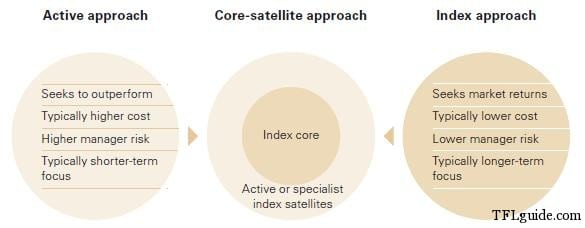
Core and Satellite is a portfolio construction approach: the Core (70-80%) consists of stable, diversified, goal-aligned investments managed with minimal intervention. The Satellite (20-30%) consists of higher-risk, opportunistic positions that add the possibility of outperformance. Core protects your goals. Satellite gives you room to explore. The rule: money can move from Satellite to Core, but never the reverse.

Why Portfolio Construction Matters More Than Fund Selection

Most investors spend 90% of their time choosing funds and 10% thinking about how those funds fit together. This is backwards. The academic evidence is clear: asset allocation (how you split across equity, debt, gold, cash) determines 80-90% of long-term portfolio returns. Fund selection accounts for the remaining 10-20%.

A well-constructed portfolio with average fund choices will almost always outperform a poorly constructed portfolio with great fund choices. Core and Satellite is a construction framework – it helps you think about the whole before worrying about the parts.

What Goes in the Core?

The Core portfolio should contain investments that are directly linked to your financial goals – retirement corpus, children’s education, home purchase fund, emergency fund. These investments need to be stable, diversified, and managed with a long-term horizon. They should not be moved based on market conditions, news events, or “hot tip” opportunities.

Core characteristics: broad diversification across asset classes and geographies, passive or low-intervention management, alignment to specific goals with defined timelines, and rebalancing only when allocations drift significantly (typically 5%+ from target).

For a typical retirement-focused investor with 15-20 years to retirement, a reasonable Core might look like this:

Asset Class Instruments Allocation
Equity Large-cap index fund, Flexi-cap fund 40-50%
Debt EPF, PPF, NPS, short-duration debt fund 30-40%
Gold Sovereign Gold Bonds or Gold ETF 5-10%

The Core should be boring. That is the point. Boring investments, consistently held, produce the wealth that funds retirement. The exciting investments produce the stories.

What Goes in the Satellite?

The Satellite portfolio is where you take calculated, limited bets – on sectors you understand, themes you believe in, or concentrated positions in individual companies you have researched. It should never exceed 20-30% of your total investable portfolio.

Satellite characteristics: higher risk and higher potential return than Core, requires active monitoring and the willingness to exit when wrong, position-specific rather than goal-linked, and strictly ring-fenced from Core capital.

Satellite examples for an experienced investor: a direct equity portfolio of 8-10 individual stocks you have researched, a sector fund in a theme you understand well (healthcare, technology, infrastructure), exposure to international equity for currency and geographic diversification, or alternative assets like REITs.

🚫 The One Rule That Cannot Break

Money can move from Satellite to Core when it performs well and you want to lock in gains. Money should NEVER move from Core to Satellite to “recover” Satellite losses or chase an opportunity. The moment you fund your Satellite from Core capital, you have violated the framework and put your goals at risk.

Is your portfolio built around your goals – or around products?

At RetireWise, we build retirement portfolios with the Core and Satellite framework – keeping your goals protected while giving you room to grow. SEBI Registered. Fee-only.

See How RetireWise Works

Core and Satellite for Different Investors

Risk-averse investor: Core of 70-80% in debt instruments (EPF, PPF, debt mutual funds), 20-30% in equity. Satellite could be a small allocation to mid-cap equity or gold. Preserves capital while staying ahead of inflation.

Passive investor: Core of 70-80% in index funds and ETFs (Nifty 50, Nifty Next 50). Satellite of 20-30% in active funds for potential alpha. Low cost, low effort, market-matching returns with limited scope for outperformance.

Balanced investor: Core of 50% equity (large-cap + flexi-cap funds), 30% debt (EPF + PPF + NPS), 10% gold. Satellite of 10% in mid-cap funds or direct equity. Suitable for 15-20 year horizon.

Aggressive investor: Core of 80% in equity mutual funds across market caps. Satellite of 20% in direct equity, international funds, or thematic bets. High return potential, requires high conviction and higher emotional resilience during downturns.

THE CORE INTEGRITY PRINCIPLE

Your Core portfolio must be sized to achieve your goals even if your Satellite earns zero.

If you need the Satellite to outperform for retirement to work, your Core is underfunded.

Build the Core for certainty. Build the Satellite for possibility. Keep them structurally separate.

“The Core and Satellite approach gives you the best of both worlds: the discipline to stay invested through market cycles, and the freedom to participate in specific opportunities without risking your goals.”

– Hemant Beniwal, CFP, CTEP | Founder, RetireWise

Read next: 15 Types of Risk in Investment Every Indian Should Know

Portfolio construction is a skill most investors never develop.

At RetireWise, we build retirement portfolios from the ground up – Core first, Satellite second, goals always first. SEBI Registered. Fee-only.

See the RetireWise Service

Most people build their portfolio one product at a time – adding things as they hear about them, without any overall architecture. A collection of financial products is not a portfolio. A portfolio has a structure, a purpose, and airtight compartments between what protects your goals and what you are willing to risk.

Build the Core for certainty. Build the Satellite for possibility. Never let one contaminate the other.

💬 Your Turn

Does your current portfolio have a Core-Satellite structure – or is it more of a collection of products bought at different times for different reasons? What would you put in your Satellite today?

Cost Inflation Index (CII) 2026: What Changed for Property and Debt Mutual Funds

For years, Cost Inflation Index was one of the most powerful tax-saving tools available to Indian investors, particularly for debt mutual funds. Then came the Finance Act 2023. In a single amendment, the indexation benefit was removed from debt mutual funds – effective April 1, 2023. Debt fund gains are now taxed at slab rate regardless of holding period. The strategy of holding debt funds for 3 years to get indexation benefit no longer works.

For real estate, the situation is different and more nuanced – indexation still applies for property sold by individuals and HUFs, with some modifications introduced in 2024. Understanding the current rules is essential before making any property sale or debt investment decision in 2026.

Critical Update: Indexation on Debt Mutual Funds Removed (April 2023)

The Finance Act 2023 removed the indexation benefit and the 20% LTCG rate from debt mutual funds. From April 1, 2023, gains from debt mutual funds – regardless of holding period – are taxed at the investor’s applicable income tax slab rate. The strategy of holding a debt fund for 36+ months to claim indexation and pay only 20% tax is no longer available. This significantly changes the tax efficiency comparison between debt mutual funds and fixed deposits.

Cost Inflation Index India 2026 - Capital Gains Tax on Property

What Is the Cost Inflation Index?

The Cost Inflation Index (CII) is a number published annually by the Central Board of Direct Taxes (CBDT) to measure the inflation in the cost of assets. It is used to calculate the indexed cost of acquisition for long-term capital gains tax purposes, reducing the taxable gain to the real (inflation-adjusted) profit rather than the nominal profit.

The concept is straightforward. If you bought a property for Rs. 50 lakh in 2010 and sold it for Rs. 1.5 crore in 2025, your nominal gain is Rs. 1 crore. But the Rs. 50 lakh you paid in 2010 had significantly more purchasing power than Rs. 50 lakh today. Indexation adjusts the purchase price upward for inflation, reducing the taxable gain.

Indexed cost of acquisition = Original purchase price × (CII of year of sale ÷ CII of year of purchase)

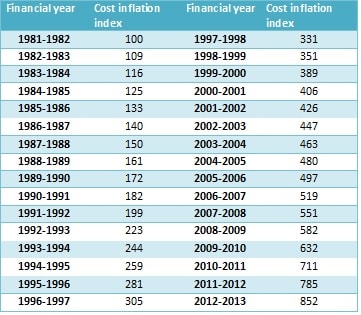
CBDT changed the base year for CII from 1981 to 2001 with effect from FY 2017-18. The current CII series uses FY 2001-02 as the base year (index value 100). The CII for FY 2024-25 is 363.

Where Indexation Still Applies in 2026: Real Estate

For property sold by individuals and Hindu Undivided Families (HUFs), indexation on long-term capital gains is still available in 2026, subject to the post-2024 rules.

The Finance Act 2024 initially proposed removing indexation from property sales and replacing it with a flat 12.5% LTCG rate (without indexation). However, after significant pushback, the government allowed individuals and HUFs to choose between the old regime (20% LTCG with indexation) and the new regime (12.5% LTCG without indexation) for properties purchased before July 23, 2024. For properties purchased on or after July 23, 2024, the flat 12.5% rate without indexation applies mandatorily.

This means for property purchased before July 23, 2024, the calculation that matters is which option produces the lower tax: 20% with indexation vs 12.5% without. For properties held for a long period with significant real price appreciation above inflation, 12.5% without indexation may be lower. For properties in markets with modest real appreciation, 20% with indexation may still be better. Calculate both before selling.

Key rules for property LTCG: the property must have been held for more than 24 months (earlier it was 36 months, changed to 24 months from FY 2017-18) to qualify as a long-term capital asset. Short-term gains (held less than 24 months) are taxed at slab rate regardless.

A Worked Example: Property Sale in 2026 (Pre-July 2024 Purchase)

Property purchased in FY 2010-11 for Rs. 40 lakh. Sold in FY 2025-26 for Rs. 1.8 crore.

CII for FY 2010-11: 167. CII for FY 2025-26: assumed 380 (actual figure published by CBDT before filing).

Indexed cost of acquisition = 40 lakh × (380/167) = Rs. 91.02 lakh.

Taxable LTCG with indexation = Rs. 1.8 crore – Rs. 91.02 lakh = Rs. 88.98 lakh.

Tax at 20% = Rs. 17.79 lakh.

Without indexation: Taxable LTCG = Rs. 1.8 crore – Rs. 40 lakh = Rs. 1.4 crore.

Tax at 12.5% = Rs. 17.5 lakh.

In this case the two options are nearly identical. For a property with higher real appreciation (sold at Rs. 3 crore or more), 12.5% without indexation would typically produce lower tax. For modest appreciation, 20% with indexation often wins. Always calculate both.

Where Indexation No Longer Applies: Debt Mutual Funds (Post-April 2023)

Before April 2023, debt mutual funds with a holding period of more than 36 months qualified for 20% LTCG with indexation benefit. This made them significantly more tax-efficient than fixed deposits for investors in the 30% tax bracket.

After the Finance Act 2023 amendment, debt mutual funds are no longer categorised separately for capital gains purposes. All gains from debt mutual funds are now treated as short-term gains regardless of holding period, and taxed at the investor’s applicable slab rate. For a 30% bracket investor, this means debt fund gains are taxed at 30% – the same as FD interest.

The practical implication for retirement investors: the traditional advantage of holding debt funds in the accumulation phase (3-year lock-in for lower tax) has been eliminated. For liquid funds, money market funds, and short-duration debt funds used as FD alternatives, the tax treatment is now broadly similar. The choice between debt funds and FDs should now be made on other factors: liquidity, credit quality, interest rate sensitivity, and convenience.

What Still Works for Tax-Efficient Fixed Income in 2026

Instruments that still offer tax advantages: PPF (interest tax-free, qualifies under 80C), tax-free bonds (interest tax-free, available in secondary market), NPS (deduction under 80CCD(1B) and employer contribution route). Equity mutual funds still qualify for 10% LTCG on gains above Rs. 1.25 lakh per year for holdings over 12 months. The debt fund tax advantage is gone – but equity’s tax efficiency relative to FDs has increased as a result.

CII Table: FY 2001-02 to FY 2024-25 (New Base Year Series)

The CII table below covers the new base-year series (2001-02 = 100). For property purchases made before 2001-02, the indexed cost uses FY 2001-02 as the notional purchase year using the fair market value as of April 1, 2001.

Financial Year CII Financial Year CII
2001-02 100 2013-14 220
2002-03 105 2014-15 240
2003-04 109 2015-16 254
2004-05 113 2016-17 264
2005-06 117 2017-18 272
2006-07 122 2018-19 280
2007-08 129 2019-20 289
2008-09 137 2020-21 301
2009-10 148 2021-22 317
2010-11 167 2022-23 331
2011-12 184 2023-24 348
2012-13 200 2024-25 363

The CII for FY 2025-26 will be published by CBDT before the filing season. Always use the CBDT-notified CII for the actual year of sale in your calculations.

Tax Planning as Part of Retirement Planning

RetireWise integrates capital gains tax planning into retirement portfolio management – including property sale timing, debt vs equity allocation decisions, and inheritance tax efficiency. Explore our retirement planning approach.

See Our Services

One question for you: If you are planning to sell a property purchased before 2024, have you calculated both the 20% with indexation and the 12.5% without indexation options to see which produces lower tax for your specific situation?