
Last Updated on April 21, 2026 by teamtfl
“Markets are efficient enough that most people can’t beat them after costs. But they are inefficient enough that the wrong behaviour can destroy even the best portfolio.”
Every week someone asks me: which fund should I invest in right now? What is the best high-return investment in India? Is this a good time to enter the market?
These are not bad questions. They are just the wrong questions.
In 25 years of advising investors, I have seen people hold the right funds and still earn poor returns – because they bought at market highs and sold at lows. I have seen people hold mediocre funds and still build substantial wealth – because they stayed invested through every correction for 15 years without panicking.
The secret of high investment returns is not about finding the best fund. It never was.
⚡ Quick Answer
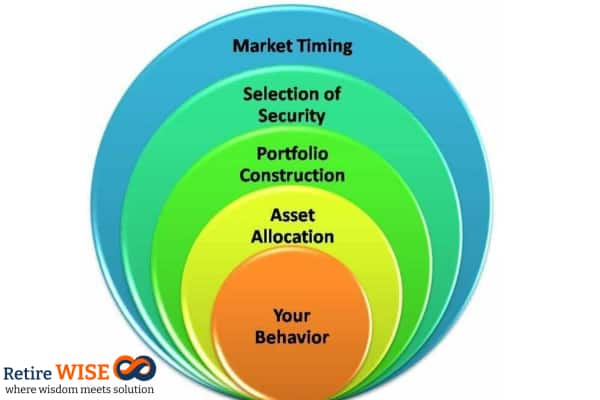
Research consistently shows that market timing contributes roughly 3% to total investment returns. Fund selection contributes 7%. Asset allocation – how you divide your money between equity, debt, and other asset classes – contributes approximately 90%. Yet most investors spend 90% of their energy on timing and fund selection. This is the fundamental mismatch. High returns come from getting asset allocation right and staying in it – not from finding the right fund at the right time.
The 80:20 Rule Most Investors Get Backwards
The 80:20 principle – that 80% of results come from 20% of causes – applies directly to investing. But most investors have it exactly backwards.
They spend 80% of their time and energy on the things that contribute 20% or less to their outcomes: watching market movements daily, asking whether now is a good time to enter, switching between funds based on last year’s returns, reading tips in financial WhatsApp groups.
And they spend almost no time on the thing that drives 80-90% of their long-term returns: deciding the right split between equity, debt, and other asset classes – and then maintaining that split through market cycles.
This is not an opinion. It is one of the most well-replicated findings in investment research, first established by Brinson, Hood, and Beebower in 1986 and consistently confirmed since: asset allocation policy explains the vast majority of portfolio return variability over time.
Why Market Timing Fails Almost Everyone
The most common question I receive during a market correction: “Should I stop my SIP and wait for the market to stabilise?”
The second most common: “The market is near all-time highs. Should I wait for a correction before investing?”
Both questions reveal the same misunderstanding. Market timing requires being right twice – once when you exit and once when you re-enter. Being right once, by luck, is possible. Being right both times, consistently, over a lifetime of investing is essentially impossible for retail investors – and difficult even for professionals.
The data on SIP pausing is instructive. An investor who paused SIPs during the March 2020 COVID crash and re-entered when “the market stabilised” – which was already November 2020, by which time markets had recovered 60% from their lows – missed the best buying opportunity of the decade. The investor who did nothing bought units every month through the crash and doubled their money on those units within 18 months.
Market timing research consistently shows that missing the 10 best trading days in any 10-year period cuts long-term equity returns roughly in half. Those 10 best days almost always occur in the middle of or immediately after market crashes – when most timing investors are out of the market waiting for “stability.”
“The investor’s chief problem – and even his worst enemy – is likely to be himself. It’s not the market that destroys returns. It is the investor’s reaction to the market.”
– Benjamin Graham, adapted
Why Fund Selection Is Less Important Than You Think
Fund selection matters – but far less than the industry wants you to believe.
Consider: the difference in long-term returns between a top-quartile actively managed large-cap fund and a bottom-quartile fund in the same category is typically 1-2% per year over 10 years. That difference is real but not life-changing. The difference between being 100% in equity at 30 versus 100% in FDs at 30 is 6-8% per year for 30 years – a compounding gap that produces completely different retirement outcomes.
Category selection – which type of fund you invest in based on your goals and timeline – matters far more than individual fund selection within a category. A mediocre flexi-cap fund held for 15 years will almost certainly outperform an excellent short-duration debt fund for a 20-year retirement goal. The asset class decision dwarfs the fund selection decision.
There is also a mean-reversion problem with fund rankings. Funds that topped the charts in one 3-year period routinely underperform in the next. Chasing last year’s best performer is a reliable way to buy high and switch just as performance regresses toward the mean.
Asset Allocation: The Decision That Actually Matters
Asset allocation is the deliberate division of your investment portfolio across asset classes – primarily equity and debt in India, with some investors adding gold, international equity, or real estate.
The core principle: different asset classes have different risk-return profiles and low correlation with each other. When equity falls sharply, debt typically holds or rises. When inflation runs high, gold and real assets tend to do well. A portfolio that combines asset classes in the right proportion for your goals and timeline earns better risk-adjusted returns than any single asset class.
The right allocation is not a fixed number. It depends on three things: your investment horizon (how many years until you need the money), your risk capacity (how much of a drawdown your financial situation can absorb), and your risk tolerance (how much of a drawdown you can emotionally handle without making decisions you will regret).
A common framework: subtract your age from 100 to get your equity allocation percentage. At 35, 65% equity, 35% debt. At 50, 50% equity, 50% debt. At 65, 35% equity, 65% debt. This is a starting point, not a rule – individual circumstances vary significantly.
Do you know your current asset allocation – and whether it matches your retirement timeline?
A RetireWise retirement plan starts with asset allocation analysis – mapping your current portfolio against your actual goals and timeline.
Rebalancing: The Discipline That Captures the Asset Allocation Benefit
Knowing your target asset allocation is not enough. Markets move, and they move your allocation with them. After a strong equity rally, an investor who started at 60% equity may find themselves at 75% equity – with more risk than their original plan intended.
Rebalancing means periodically selling the outperforming asset class and buying the underperforming one to restore the target allocation. This is the financial equivalent of “buy low, sell high” – systematically and without emotional decision-making.
Rebalancing half-yearly or annually is sufficient for most investors. Daily monitoring and rebalancing creates transaction costs and tax events without proportionate benefit. The goal is to prevent significant drift from your target allocation, not to micro-manage every fluctuation.
The Retirement Asset Allocation: The Most Critical 10 Years
The five years before and five years after retirement are the most important for asset allocation – and the most often mismanaged.
The risk of maintaining 80% equity at 58, with retirement at 60, is called sequence-of-returns risk: a market crash in those final years before retirement can permanently reduce your corpus even if markets recover later, because you have less time to rebuild. The famous “glide path” approach gradually reduces equity as you approach retirement, not to zero, but to a level where a 30-40% market crash does not derail your retirement income plan.
The risk of moving to 0% equity at retirement is the other extreme: a 25-year retirement requires your corpus to keep growing in real terms. A portfolio entirely in FDs earning 7% against 6% inflation has almost no real growth. Retirees need 30-40% equity in their long-term bucket to sustain the corpus across a 25-year retirement – even after they stop earning.
The right asset allocation at retirement is not safety through debt. It is balance – enough debt stability to fund 3-5 years of expenses without touching equity, and enough equity to ensure the corpus grows in real terms over the full retirement horizon.
Read – Systematic Withdrawal Plan (SWP): The Right Way to Take Income in Retirement
Read – The Law of the Farm: Why Patient Investors Always Win
Frequently Asked Questions
What is the ideal asset allocation for someone 10 years from retirement?
A starting framework: 60-65% equity, 35-40% debt, with the equity portion in diversified mutual funds across large-cap and multi-cap categories. As retirement approaches, gradually reduce equity to 45-50% by retirement date, ensuring the first 3-5 years of retirement expenses are in stable debt instruments. The exact allocation depends on your existing corpus, expected retirement expenses, and other income sources like rental income or pension.
Should I stop SIPs when the market is at all-time highs?
No. SIPs work precisely because you do not try to time entry points. When markets are high, you buy fewer units. When markets correct, you buy more. The averaging effect over 10-15 years is what makes SIPs powerful – not the ability to time any individual entry. Stopping SIPs at market highs means missing both the continued upside (which often persists for 1-2 more years) and the correction buying opportunity.
How often should I rebalance my portfolio?
Half-yearly is sufficient for most investors. The trigger for rebalancing can be either time-based (every April and October) or threshold-based (whenever equity drifts more than 5-10% from target allocation). Time-based rebalancing is simpler and works well for SIP investors. Threshold-based rebalancing is more precise but requires more active monitoring. Either approach is far better than no rebalancing at all.
The secret of high returns is not a secret. It has been documented in academic research for 40 years. Get your asset allocation right for your timeline. Automate your investments. Rebalance without emotion. Stay invested through corrections. The investors who do these four things consistently are the ones who look back at 65 and find that the corpus built itself.
It’s not a numbers game. It’s a mind game. And the mind game is won by the investor who stops trying to be clever and starts being consistent.
Want a retirement portfolio built on the right asset allocation – not fund chasing?
RetireWise builds retirement plans starting from asset allocation analysis – your timeline, your risk capacity, and a portfolio structure that compounds quietly for 20 years.
💬 Your Turn
Do you know your current equity-debt split – and does it match your retirement timeline? Have you ever stopped a SIP because the market felt risky? Share what you learned. The most useful comments here are always the honest ones.
Useful
Hi Hemant,
Very nice article like others.
Just want to know more about “How to do asset allocation and get high returns”?
e.g. – I have planned a portfolio for 15 years. invested 80% in equity MF(small, mid, large cap- 3 funds) and 20% long term equity(2 funds).
After 1 year of SIP if I found out 3 equity MF, 2 performing well quarterly and 1 has less % return compare to last year(say from 20% last year and 15% this year). Then how I can allocate my asset between 3 funds so that I will be on track year-wise for 15 years of my target goal.
Want to talk to you about my new venture ….how?
Really appreciating topic
Hi Hemant,
A very informative article for guidanace of retail investor who go on investing on the advises received by word of mouth by friends and brokers (who has more interest in their commision howsoever small it is).
Hi
I am Planning to start 3 SIP’s of 2K each in following three funds from different Category. Please let me know if I am doing correct choices of fund from each category.
Objective: I want to invest for 20 Years from Now and I am expecting 12 to 14% of returns on compounded basis from this planning.
1.ICICI Pru Focused Blue Chip Equity-(G)-Rank1-
2.HDFC MidCap Opportunities (G)- Rank1
3.HDFC Balanced Fund-(G)-Rank2/HDFC Prudence Fund (G)-Rank2
Note: I already have HDFC Children’s Gif Fund {Investment} SIP of 2K.
Hi Tushar,
Read here to know how to create an investment portfolio..
https://www.retirewise.in/2013/09/core-satellite-fund-portfolio-investment-approach.html
https://www.retirewise.in/2013/01/best-mutual-funds-to-invest-in-2013-india-top-schemes.html
Hi Hemant
I hold investment in franklin India taxsheild since last 2008 and my intial investment of 40K has now grown to 69k. should i redeem or let it continue?I have been told that its best to capitalise on the high returns received and redeem and not wait further as there is a possibility of interest rate dropping. please advise .thanks
Hi Simran,
Do not aim to time the market but keep your investments simple. Invest for your goals and not for returns since every investment has its own risk return characteristics.
Since it was mainly for tax saving , you can exit if you have achieved a reasonable returns and invest the proceeds for your goals.
hi hemant,
i want to ask is there any strategy for a person to create wealth who earns very less and hardly able to save less than 1000/- monthly
thanks.
Dear Param,
Wealth creation is a long term process where many changes happens in any ones personal life wrt. income and savings. Start with your savings and increase it as there is increase in your income.
dear vikas.
thanks for the reply.
if i happened to read hemant ji’s blog 10 year before my financial life would have been different as i was knowing nothing about mutual fund , sip , etc etc.
Thank you Sir Himant, Sir Anil and all…..Gudnit..
Womens Empowerment Plan
Get 24% per annum return & interest payout every quarter.
Grab the secure investment.
hi Finsource, are an agent? if so,you landed on the wrong place.
Dear Sir,
I use Sensex Forward PE to make buy and sell decisions on my mutual fund. I buy when PE is below average and if i need to sell , i do it only when PE goes above.
What flaws can you see in the above method ?
BR/Rama
Excellent way of Explaining the situations with the Good examples,, It is really help us lot, before investing, Thank You,,, Hemanth
Hi, Hemanth!
If I make a savings of 2 lacs in a year, how much do you suggest I should invest in mutual funds or other risky instruments? An online portfolio suggested I go for an “aggressive” portfolio, because I do not have any dependants, am unmarried, young, and without debts. I would like to know your take on it.
Hi Anusha,
It all depends on your risk profile, time horizon & understanding of financial world.
Dear Hemant,
Firstly accept my thanks for such a brilliant article… It really provides a new perspective on how people should plan their portfolio and asset allocation strategy.
I have question regarding the Risk and No change column. In one of your replies you have clarified that the risk is calculated based on the Standard Deviation pattern. Could you please elaborate if the Standard Deviation for a particular Mutual Fund is say “n” how are you calculating the risk and the allocation change for that particular fund.
Thanks in Advance.
Krishnendu
Thanks Krishnendu for appreciating our effort.
Read this article for Standard Deviation & how it is calculated
https://www.retirewise.in/2010/12/standard-deviation-mutual-fund.html
Hi Hemant,
Easily this is my favourite article. I read this again and again every couple of weeks just to keep focussed. I did open up 5 SIPs worth 40000 and sticking to it. I had been investing in direct equities (about 6 lakhs) in infrasturcture and oil stocks (suzlon, essaroil, gmr, unitech and such) which stands at a huge loss and value slightly more than 2 lacs. I continue to buy in small amounts these stocks at the current low prices today which I treat as another SIP for another 10 years. Since I don’t need the money I continue to invest both in mutual funds and direct equities. Hope to achieve a decent return in long term in both the direct equities and MF
Hi Guna,
Averaging may not work in stocks….
I did manage to generate some profit from equities for a year when I entered into equities. Last year, I was abroad on work and failed to pull out of the stocks before I left and did not bother to monitor the portfolio, so the current mess. I was late to wake up into the world of SIPs and mutual funds. I am kind of stuck with the loss I guess. Instead of pulling out the money, I felt I should leave it there as it is now since I don’t need the money any time soon any way and drift into MFs and SIPs henceforth…… Whats your take on that or is there another solution ………..
Hi Hemant
This post has been very helpful in understanding the asset allocation principle. I have few doubts lingering
1. When you say rebalance, do you mean sell some units from equity fund but keep the sip running and use the money to buy some debt fund while keeping the sip running
2. Knowing that there is no exit load after one year, should one carry out the rebalance after one year or do it every six months on a pre decided date treating the exit charges as small and inconsequential to over all picture.
3. The rebalancing principle is to keep the percentage at what was planned for and not timing the market. Am I right
Keep up the good work
I want to know whether it is essential to buy a fresh LIC policy, for taking a Home Loan from LIC Housing Finance Limited. My agent is coercing me for new policy while I already have 03 LIC policy running without any default.
Regards,
Rajiv
Hi Hemant
Thanks for this nice article.
I have query regarding switch . Switching ever time based on market, only broker/AMC will make money due to change over from debt to equity and equity to debt.
Please clarify my view on this. What happens when we switch from one equity funds to debt funds- AMC one who has already deducted expenses will again deduct expenses from new fund investment. Money gets eroded in the process.
Hi Yogesh,
Definitely churning of portfolio will increase expenses of investor & income of brokers.
There will be exit loads & taxes that will eat into your returns.
AMC is not having much of benefit as they are deducting expenses on daily basis.
Hi Hemant,
Thanks for your response. As per your advise, I want to keep my portfolio in the raito of 75% – Equity and 25%- Debt as a start. Please advise:
1. Some good debt funds to invest.
2. How frequently I should review my portfolio and make it balance again 75% – 25%.
Kindly advise.
It is gentle reminder. Please advise.
Yogesh,
You should not stick to 75-25% ratio always. But as per your age and risk appetite. For debt you should consider always consider PPF, dynamic bond funds (eg. birla sunlife dynamic bond fund) they churn their portfolio based on different market cycle. But you need to remain invested in it for the entire interest rate cycle for good returns.
-Purvesh Mehta
Hi Hemant,
Q1) Don’t you think doing asset allocation as you suggested also looks like similar to timing the market and more complex ? Because as per understanding what you are suggesting is that we need to monitor the various asset classes of our portfolio say A and B. Assume at some point of time (i.e. at a predefined date) we need to look both the asset classes and identify which is doing better. The one which gives superior returns is the one from which we need to pull away the profits and re invest it in another asset class which performs least. Assume A is doing best and asset class B doing average. so we decided to move the profit from A to B. Now what is the guarantee that the asset class B will do better in future and beat the asset class A. This is applicable for vice versa scenario too.
I think i am communicating and hope you understand. Please confirm.
I believe the above suggestion works well if two asset allocation growth are mutually exclusive. i.e. if asset class A grows then B will definitely perform low and vice versa.
Q2) It would be of immense help if you give us one real time example and how this really worked well as you suggested. By this we clearly understand the concept behind this article.
Cheers
Sowmi
good
Hi Hemant,
Wish you Happy New Year.
I have one query, Should I withdraw the ULIP, HDFC Std amount, as i have completed 3 yrs of locking period and no good returns on it, though I have continously switching over the funds from equity to liquid in the period.
Is it the right time to withdraw the money or should wait for some time?
Kindly suggest
Regards
Seema
I would rather answer in one sentence to all tax related query. All taxation laws are governed by law, no one can answer except law maker. So we do not know, what will come from “bag” of finance minister next year. Our work is to invest as per our savings for future, we should use available tools to determine exactly what we need to invest, its purely on assumption. In the worst case you can assume it can be taxed. So do SIP as per your plan and leave rest to law maker.
What i understand any asset which is used to make money is capital asset. STT is
applicable anywhere in equities and mutual fund. But that is not a major part.
Thanks Purvesh & Anil……
1.Please tell me is there any time limit for long term capital gain tax. I mean to say if i go for 10 years or 15 years plan then still will it come under long term capital gain????? Is there any time period after which we can say that now it comes under long term capital gain. ?
2. Is Equities are Capital asset ?
3. Are Long term capital gains are fully free from Income Tax ?
4. Is Securities Transaction Tax applicable on Long Term Capital Gain ?
5. Whats the meaning of sale of equities off Market & Sold on a recognized Stock Exchange ? Whats the difference between these two ? Whats the effect of these Two on sale of Equities ?
6. Please tell me if i invest in SIP for long term, which is today non-taxable. If i invest today in SIP, can govt. in future make it taxable ? This question is very important for me
Hi Amit,
Anil is right and as per now there is no capital gain tax on mutual fund returns. And what i assume direct tax code(2012) also do not have long term capital gain tax on mutual fund. Good that you refer the planner, it will also suggest you the funds in which you should invest. But don’t go blindly their way, just look at performance and management record of the mutual fund. Like i said you can invest in the mutual fund i suggest after a proper knowledge. Or you can also refer valueresearchonline.com for more information on any kind of mutual funds. Just stick to basics of SIP, as per your plan 25000/- per month device them in 4-5 funds and invest regularly. What i see confusing in your query is insurance premium as high as 5000 per month. Thats huge and what i assume it will be either a ULIP or LIC’s traditional plan. I hope you know advantage and disadvantage of ULIPs . Also i hope you know plans from LIC which gives returns which do not beat inflation.
Hi Amit,
You have asked this query to Hemant, and he will surely guide you. But i also thought to pitch in with some of my ideas. First of all look at the financial planner provided by franklin templeton investment from link below,
https://www.retirewise.in/2011/04/franklin-templeton-family-solutions.html
I think it will give you rough idea of how much investment you need to make on each of your goal. And the best part is you can assume/consider your own risk adjusted returns. It may also give you asset allocation strategy you can follow.
As the age is on your side you can consider 75-80 % in equity and 20-25% in debt according to your risk appetite. From equity portion you can allocate 70% in large cap /large-mid cap funds like ICICI pru bluechip, HDFC top200, HDFC equity, and 25-30% in small and midcap funds like IDFC premier equity , DSPBR micro cap. I personally have investment strategy like this and willing to increase my allocation as per my savings.
-Purvesh
Dear Purvesh,
I had looked at the planner n checked it. It really very Wonderful. Now according to the planner by investing 5180/- per month for 25 years at a inflation of 6 % & expected rate of return 12%, i will get 98 Lacs after 25 years. Now Please tell me what will be the taxes on the interest generated ? I have heard that the tax is near about 30% on the interest generated. Is it right ? If it is so then the 98 Lacs will reduce to 68.6 Lacs. So, 68.6 Lacs is the amount which i will get after 25 years for my use, which we can say the cash in hand….Is it right ? Please guide me
Hi Amit
When you invest in equity mutual funds for a long time the wealth you create is not treated as your interest income. It is treated as long term capital gains and is tax free right now.
Hi Hemant,
My age is 27, recently married. I can easily invest 25000 /- Per month. I am planning to invest 5000/- every month for 15 years for my Child Education in SIP, 5000/- every month for 20 years for my Child Marriage in SIP, 5000/- every month for 25 years for my retirement in SIP, 5000/- every month for 20 years as a insurance premium & 5000/- every month for 10 years in SIP for investment. Kindly Guide me is it the right decision of mine ? or if not, then kindly recommend me the same ? Also tell me which are the best MF to invest ?
i am investing in diversified mutual funds and in MIPs. Problem is both gets same effect, when funds are down, MIP are also down. (Though it is a debt product, but due to 10% equity investment),
so with this switch over is not possible. it may be possible if we have investment in pure equity funds and pure debt funds
Dear Hemant
Regarding switch ever time based on market, only broker/AMC will make money due to change over from debt to equity and equity to debt.
Please clarify my view on this. What happens when we switch from one equity funds to debt funds- AMC one who has already deducted expenses will again deduct expenses from new fund investment. Money gets eroded in the process.
Dear Hemant,
Is it worth starting an VIP for 2000/- a month in Benchmark CNX 500 Fund for the next fifteen years for my second son who is 10 months old. Thanks
JK
Hi JK,
You can go for it if you think active investing is not your cup of tea. Yesterday I was looking at few figures of last 3 years – sensex has given 3.5% return in this period but average of diversified mutual funds is above 9% in the same period.
Hi Hemant
Thanks! Ultimately it is a question of risk and return. I consider investing in property a huge risk. This alone prevents me from investing in property.
Dear anil , your info regarding real estate is totally in correct. Today ask any fund manager or any person in financial sector about what is asset which give them a maximum return , it is only & only real estate. All other assets cannot match with the returns given by real estate.
But having said this, i will tell you real estate has the lowest liquidity among all classes. so every assest has +ve and _ve .
Hi Kumar
My views on property matters are based on my personal experience.Around 15 years back I invested in a plot in the name of my son.The promoters promised to complete the project with in five years.The project even did not get moving after five years.On enquiry it was found that the proposed project was on a disputed piece of land.It appears that the concerned piece of land was part of the land which the government wanted to acquire.The compensation amount proposed by the government was very low.It became a subject of litigation and the court case dragged for several years.The promoters got some compensation from the government on the directions of the court but the investors got a raw deal.A major portion of the compensation was appropriated by the promoters saying that they had incurred huge charges on account of litigation.I have been recently paid a small amount of compensation after very vigorous follow up.
Hi Hemant
I have noticed that many financial advisers include property also in asset class. Some go to the extent of saying that even if you have one self occupied house there is no harm in acquiring an other house even if you have to take housing loan for it.I have recently come across an article in which the author says that equity is a better investment than property. As per the author the long term returns of equity are much better than that of property.I would like to have your take on it.
Hi Anil,
That’s true that equity as an asset class has given higher returns than real estate. But people compare I bought that corner plot in X colony at y price & now see it is priced at 20Y – in the same period sensex has given 5x returns. But they are actually comparing apple with oranges – in this case they should also check 100s of stocks that become 100x in the same period.
Hi Amit,
I am following your articles lately, and they are quite awesome. I wish I had seen this site a couple of years back.. Kudos..
My question when we have SIPs in different mutual funds, how can we transfer the amount from MFs to Debt at any time. I just did not understand this one.. Please clarify..
Hi Pradeep,
You can switch from equity funds to debt funds or vice versa – to rebalance your portfolio.
AS CORRECTLY SAID BY HEMANT, INVESTMENT IS MIND GAME,THOSE WHO HOLD THEIR EMOTIONS EVENTUALLY WINS. ASSET ALLOCATION IS THE KEY.
I HAVE ADVISED MY CLIENTS TO INVEST IN MF WHICH INCLUDES LUMPSUM & SIP ALLOCATED ACORDINGLY TO RISK PROFILE OF PERSON.
THEY ALL ARE VIEWING THEIR PORTFOLIO & ENJOYING THE BNEFIT OF IT WHEN COMPARED TO INVESTMENT OF THEIR OTHER RELATIVES/ FRIENDS (MOSTLY IN NFO)
Sir,
In the very first I come to know your articles when I read about Reliance Gold MF in Jan-Feb, 2011 and from date I always read your each articles and learn very new concepts with your great articles.
Sir, I am investing in Unit/Share Market from August 2007 and look a great Market fall and also a great earnings from 2007 till date. I also invested in Share as well as MF/SIP and after about 4 years of investment experience, this is my personal view that for a middle class family/ salaried person it is good to invest in FD’s @ 10% p.a. and invest only the money in share market / MF even in SIP for which he must not be care for loss/profit. I think that the share/MF market is a game point and invest a low money and enjoy “Gir Gaya!!!!Gir Gaya!!!! Gir Gaya!!!!” or “market aacha hai” but seriously investment should not be made in share market/MF/SIP.
Sir, This is my only personal views and I want to share with you as you are a great experienced and a very good advisor that how much am I right?? I also agreed that my views may be changed after some of years OR after playing a bit more in the market.
Hi Prakash Kumar
I am surprised to know your views about investing even after four years of investment experience.Stop playing in the market and first get your basics right by going through all the articles of Hemant.
Hi Mr. ANIL KUMAR KAPILA
Sorry, but I can’t understand that you advise me OR surprised on my comment through these lines “Stop playing in the market and first get your basics right by going through all the articles of Hemant”. I will be highly grateful, if you kindly clarify this. further, it is needless to mention that I have read all the articles of Mr. Hemant Sir published after Feb’11. If any prior article of Mr. Hemant, I should read, kindly provide link also.
Regards,
Hi Prakash Kumar
From the Home Page of Hemant’s website you can get a list of all the articles published by him till date.I am sure if you read all the articles you will know the correct way of investing.
Hi Hemant
A very good article as usual !!
About “Asset Allocation”… for a common man, it is easier said than done. For example, if a person makes a one time investment of 70,000 in equity and 30,000 in debt, it is very easy to track and maintain asset allocation over time as he know his initial fixed investment.
However in case a of salaried person, who makes monthly(or any other frequency interval) investment in equity/debt according to his monthly income inflow, it becomes quite cumbersome for “aam aadmi” to derive his current asset allocation.
I only wish if the portfolio tools available at sites such as value research could include FD, PF etc to give a asset allocation ratio.
Hi Deepak,
It’s not that tough…..
I think it is easier for a salaried person as he is having consistent cashflows & investments but businessman always faces problems with his erratic cashflows.
You can make a small sheet in excel & update it every 3rd months – try to re-balance portfolio in 6 months.
Have to agree with Hemant on this one. I myself have a sheet that I monitor each month. While I cant share it, it essentially features income, expenses, investments, summary of assets and % split of assets. All these are on rows month by month.
Gives a very clear and crisp picture of your financial standing.
Hi Hemant,
Very nice article, however i came across one of the fundamentals of equity market. It is time proven that invest only when market PE multiple is around reasonable value may be 14-15. Ofcourse invest in good fundamental stocks and you will make good growth of your investment. So for investor who actually want to start direct equity and find that the market is overvalued like in 2008, then also he choose to invest and will go wrong. He may never come back to direct equity. It is like timing the market, but it is safe also. SIP is the best way to overcome this fear, but some portion of your investment in direct equity investment at right time can take your financial position to great heights. I have also seen economy and market take a turn in few years. So waiting for right PE multiple is not a good option. My age is 31, As i want to invest 25% in debt and 75% in equity. Out of 75% i am investing 55% in SIPs, but i am keen on investing remaining 20% in good stocks at good PE multiple. Is it a right approach?
Hi Purvesh,
PE is one of the simplest things which talks about valuation of market but it is not the full proof or only thing. Let me ask you I have some money to invest today & PE is above 19 – what should I invest or wait.
In 2005 sensex was at 7000 & it’s PE was above 16 & in 2007 senxex touched 21000. My suggestion is stick with basics – use asset allocation strategy with your SIPs.
Behavior is not about timing the market – it is about not doing mistakes.
Hi
nice article and timely one. While reading I eagerly looked for ETF and P/E strategies which we missed.
Regards
Rathisbabu
Hi Rathisbabu,
ETF is an instrument – I have not found any specific strategy in that. For P/E read this
https://www.retirewise.in/2010/11/sensex-pe-ratio.html
Hi Hemant,
Thanks for the pointer
Next time before posting comment, I surely search the past articles.
Thanks
Rathisbabu
Hi Hemant
It is not clear to me how to get the figures of risk given in the table.
Hi Anil,
It is Standard Deviation of the portfolio
https://www.retirewise.in/2010/12/standard-deviation-mutual-fund.html
Hi Hemant
Thanks.
Sales Persons of Quantum Mutual Fund have called me several times from Mumbai.They want me to invest in Quantum Long Term Equity Fund.The track record of the fund looks impressive.The only apprehension I have about this fund house is that it is a direct to investor fund house with no distribution network. I would like to know whether it is safe to invest with this fund house.
WHY NOT ? , Í am in blore. when i got info about quantum, i went thro their web site and found it is a upcoming AMC andit is like TFL/jaga investor and working very hard in the group of well established AMC’s.
then i have selected only one fund and following them. still good and let us see
Thanks,Kumar.
Recently,I saw one interview of Mr Ajit Dayal,the brain behind this fund house and was very much impressed by his views on various investment issues.The major plus point is their low charges.
I have been investing in quantum mutual funds for a long time now and I am very happy with them. The fund (QLTEF) is good. you can invest online with them as well. All you have to do is take a print out of the application form and mail it to them with your KYC. One time hassle.
Their customer service is very good and its easy to interact with them through email and calls as well.
Hi Hemant,
Once again an excellent article from you. I believe this is the kind of eye opener article for those who believe in timing the market.
Regards,
Vishwa.
Hi Vishwanath,
You mean almost 99% 😉
hi hemant….
i am quit new to this investment and all..and hence was quite unable to appreciate the article….but am pretty confident that this forum is going to help me a lot in becoming a “financial literates”.(based on the feedback from some friends and my own vibes,although i believe that both of these sources are not good enough to have good investment skills)..Anyways,can u plz guide that based on what factors shud i decide that what shud be my asset allocation…i m a 29 male with a wife and a daughter (2year old).that would b a great help.
Thanks,
Anu Gupta
Hi Anu,
I am not sure what you mean by this “sources are not good enough to have good investment skills”
My suggestion is as you are new to this world – subscribe to free e-course – in 1 month you will feel the difference
https://www.retirewise.in/free-e-course
Hi Hemant
Beautiful and timely article.I agree that investment in mutual funds should be done with head and not heart. But unfortunately, an investor who has started investing in mutual funds only recently and is in the habit of seeing returns of his investments monthly , will have a sinking feeling in his heart seeing his portfolio giving negative returns months after months.
Then there are some so called experts who are so much pessimistic about the governance that they are advising the new investors to remain away from the market and keep their cash parked only in bank fixed deposits. On the other hand there are some experts who are so much bullish about the market that they are promising extra ordinary returns from the equity mutual funds.I think what is required is a balanced approach.
Hi Anil,
Everyone has to develop his own process & follow it rather than listening to so called experts including me.
End of the day its client’s hard earned money.
Hi Hemant
Thanks. I agree. It is said that with advancing age the allocation in equity has to decrease and that in debt to increase.This means that while rebalancing this aspect has also to be considered.
iwnt to know at present situation of market how we can achieve more than inflation return on our investment
Excellent article Hemant – agree with everything you say. It’s very hard to gain control of your thought process and exercise discipline to overcome emotion, and that’s where the battle is won or lost.
Thanks a Ton Manshu.
Hope people will also understand what we are trying to say 🙂
Hi Hemant ,
Excellent article !
Have one doubt over Asset Allocation ,
Suppose i have decided my current allocation as 75 % in equity and 25% in Debt and according to that have SIP of 6 equity mutual funds of different category and SIP of 2 Debt Funds which i am planning to continue for next 5-10 years
Lets say in by end of 2012 , equity markets have given very good returns
and my current asset allocation looks like 85 % in equity and 15 % in Debt after including the returns
So what should be my strategy now , to reduce the equity SIP outflow and increase it in Debt SIP ? is this advisible ?
Or there are other ways to rebalance the assets ?
Hi Rohan,
Don’t change the SIP amount just shift some amount from equity to debt to bring your asset allocation back to 75:25. In starting days you may feel that it’s not making much sense but once you have a decent portfolio – you will see the difference.
How to invest 10 lakhs amount for a Higher returns after 5 yrs ?
Excellent….
Thanks