
Last Updated on April 19, 2026 by Hemant Beniwal
“The stock market is a device for transferring money from the impatient to the patient.” – Warren Buffett
A new client called me recently, markets were down. He had a perfectly sensible question: why not just buy good companies now, at cheaper prices, and hold for 10-15 years?
It sounds exactly right, it sounds like what Buffett does. It sounds like what your neighbour who bought Infosys shares in 2005 did.
But here is the thing nobody tells you. Identifying a good company is not the same as making money from its stock. And holding that stock when it falls 40% – without panicking, is harder than it sounds on a peaceful Sunday morning.
In 25 years of advising, I have seen this pattern repeat itself endlessly. Smart people. Good intentions. Wrong approach for their stage of the journey.
⚡ Quick Answer
For most new investors, mutual funds are the better starting point – not because stocks are bad, but because mutual funds give you professional management, instant diversification across 30-60 companies, and the discipline of SIP without requiring you to read balance sheets or stay emotionally calm during market crashes. Direct equity can work well, but only for those who have the time, training, and temperament to do it right. Most people overestimate all three.
First, Let Us Clear One Big Confusion
Many new investors think mutual funds and stocks are two completely different things. They are not.
A mutual fund IS stocks. When you invest in an equity mutual fund, the fund manager takes your money and buys shares of companies – the same Reliance, HDFC Bank, TCS, and Infosys that you would buy yourself. If markets are down and a good company’s share price has fallen, a skilled fund manager can buy more of that company’s stock too. That is exactly what active fund managers do.
The difference is not what is bought. The difference is who is doing the buying, how much research goes into each decision, and how many companies are held to spread the risk.
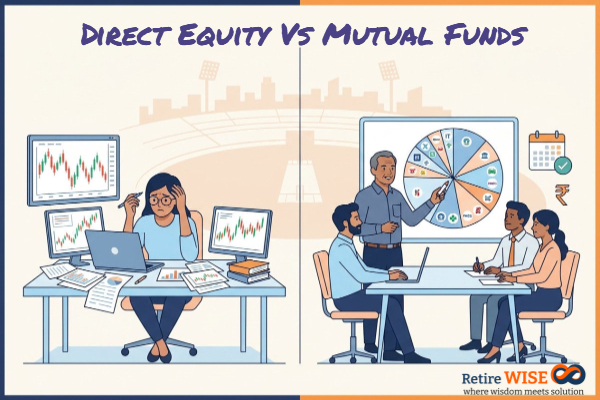
Think of it like cricket. You can walk onto the pitch yourself and face a 140 km/h delivery from Jasprit Bumrah. Or you can have Virat Kohli bat on your behalf. The ball is the same, the stadium is the same. But the outcome is likely to be very different.
What Direct Equity Actually Demands From You
The dream version of stock investing goes like this: buy Infosys at ₹100, hold for 20 years, retire rich. The reality involves a few things that dream does not show.
It demands your time. To pick stocks with any consistency, you need to read annual reports, understand profit margins, track management quality, follow sector news, and monitor global developments that affect Indian companies. This is not a part-time activity. Professional fund managers do this full-time, with a team of research analysts and access to data that retail investors simply do not have.
It demands expertise. SPIVA data from December 2024 shows that 80% of professionally managed large-cap funds failed to beat the Nifty 50 index over 10 years. These are full-time professionals with Bloomberg terminals and decades of experience. If 80% of them cannot consistently beat the market, it is worth asking honestly – what is the realistic outcome for someone checking stock prices between meetings?
It demands emotional steel. Imagine you bought shares of a good, well-run company at ₹500. Over the next 18 months, due to a market correction, the price falls to ₹280. The business is fine. Nothing has changed fundamentally. But your screen shows a loss of 44%. Can you hold? Can you even buy more? Most people cannot. They sell at ₹280, then watch the stock recover to ₹700 over the next two years. This one behavioural mistake alone destroys more wealth than bad stock picks do.
“If 80% of full-time professionals cannot beat the index over 10 years, it is worth asking honestly – what is the realistic outcome for someone checking stock prices between meetings?”
– Hemant Beniwal, CFP, CTEP | Founder, RetireWise
The “Good Stock at a Lower Price” Trap
This is the specific reasoning that trips most new investors: “Markets are down. This is a great company. I will buy at a discount and hold long term.”
The logic seems solid. But it has one hidden problem. “Good company” and “good stock at this price” are not the same thing.
A genuinely strong business can still be an expensive stock. And a stock that has fallen 60% can still be overpriced if the business itself has deteriorated. The key question, the one that separates a skilled investor from someone making an expensive guess – is: Why is this stock available at a lower price?
Sometimes the answer is irrational market fear. The company is fine, investors panicked, and buying is the right call. But sometimes the answer is that analysts who track this company closely have already discovered bad news – a regulatory problem, a management issue, a competitive threat, that has not yet reached your WhatsApp group. You are buying what smart money is selling.
I call this the Discount Store Mistake. When clothes go on sale, buying more makes sense – the quality has not changed, only the price has. But a stock is not a shirt. When a stock’s price falls, it could mean fear (opportunity) or it could mean the business itself has weakened (trap). Without the knowledge to tell the difference, you are not value investing. You are speculating with a value investing label on it.
🚫 The Number That Should Stop You
In FY 2024-25, individual traders in India’s F&O segment lost a combined ₹1,05,603 crore. That is over one lakh crore rupees, gone. The average per-person loss was ₹1.1 lakh. SEBI now mandates this warning at every broker login: 9 out of 10 individual traders incur losses.
What Mutual Funds Actually Give You
Mutual funds solve the three problems that trip up most direct investors, without requiring you to become a full-time analyst.
Diversification built in. A single equity mutual fund holds 30 to 60 companies. If one company in the portfolio runs into trouble (remember the Satyam fraud?), the damage to your portfolio is limited to 2-3%. If you held that company directly and it was 20% of your portfolio, the damage is a different story entirely.
Professional management. Fund managers attend company management meetings, access proprietary research, and track global developments. They are not infallible but they are significantly better positioned than a retail investor with a smartphone and a TV channel.
The SIP discipline. A Systematic Investment Plan makes you invest every month regardless of what markets are doing. When markets fall, you automatically buy more units at cheaper prices. When markets rise, you buy fewer units. Over time, this rupee cost averaging smooths out your average purchase price in a way that is nearly impossible to replicate through manual stock picking.
India’s mutual fund industry today manages over ₹68 lakh crore in assets. Monthly SIP inflows have crossed ₹26,000 crore as of early 2026. These are not uninformed investors, they are millions of people who have understood one simple truth: simplicity, done consistently, beats cleverness done occasionally.
| What You Need | Direct Stocks | Mutual Funds (SIP) |
|---|---|---|
| Time to research | 5-10 hours per week minimum | 30 minutes to set up, then done |
| Knowledge required | Balance sheets, valuations, sector trends | Basic understanding of fund category |
| Diversification | Manual – needs ₹10-15 lakh to spread across 15+ stocks | Automatic – ₹500 SIP gets you 30-60 companies |
| Annual cost | Brokerage + STT + GST on every trade | 0.1% to 1.5% expense ratio (index funds from 0.1%) |
| Tax (2026) | LTCG 12.5% above ₹1.25L / STCG 20% | Same – LTCG 12.5% above ₹1.25L / STCG 20% |
| Emotional demand | Very high – you see individual stock prices daily | Lower – NAV moves slower, SIP runs on autopilot |
| If market falls 30% | You see each stock’s loss individually | SIP keeps buying cheaper units automatically |
New to investing and not sure where to start?
A single 30-minute conversation is enough to build a simple, structured investment plan. No jargon. No products being sold.
The Tax Picture in 2026
One question that comes up often: is there a tax advantage to holding stocks directly versus through a mutual fund?
The answer, as of 2026, is no. Both are taxed identically for equity exposure.
Long-term capital gains (LTCG) on holdings above 12 months: taxed at 12.5% on gains above ₹1.25 lakh per year. This applies to both direct equity and equity mutual funds. Short-term capital gains (STCG) on holdings below 12 months: taxed at 20% for both. Budget 2026-27 made no further changes to equity taxation.
The cost difference is in the expense ratio of mutual funds – typically 0.5% to 1.5% for actively managed funds, and as low as 0.1% for index funds. SEBI’s December 2025 regulations have reduced these caps further from April 2026. Direct stocks carry no annual fund cost but every buy and sell transaction attracts brokerage, STT, exchange charges, and GST. For a genuine long-term investor who buys and holds without churning, direct stocks can actually cost less. But most people do not hold without churning.
Note: Mutual funds and direct stocks have similar taxation, but mutual funds offer an important advantage – you pay tax only when you redeem your investment. In stocks, every sale is a taxable event. This allows mutual fund investors to benefit from better long-term compounding.
The One Edge a Retail Investor Actually Has
A fund manager covering 200 companies across sectors cannot know any single industry or company as deeply as someone who works in it every day. A doctor who understands hospital economics, a telecom engineer who can assess which tower companies are building real infrastructure, a banker who can read between the lines of an NBFC’s loan book – these people have genuine insight that no Bloomberg terminal can replace. Domain expertise from your own profession is the one real edge a retail investor has over a fund manager. If you have that edge in a specific sector, a small allocation to those companies makes sense. Outside your domain of expertise, a mutual fund will almost always serve you better.
Keep your direct equity to the sectors you genuinely understand. Keep everything else in diversified funds.
When Direct Equity Makes Sense
I am not arguing against direct equity. Several of my clients hold individual stocks and do it well. But there is a clear profile of who should be doing this.
You are ready for direct equity if you have 5-10 hours a week to track the companies you own, the emotional discipline to watch your portfolio fall 40% without selling, a total equity corpus large enough that mistakes are not catastrophic, and ideally 3-5 years of following markets before you put serious money at risk.
Even then, the sensible approach is to keep direct equity to 10-20% of your total equity allocation. The rest belongs in diversified mutual funds or index funds. The core of your wealth should be in boring, predictable products. Experimentation happens at the edges – not in the centre.
Read – Direct Investing in Stocks: Why Most Indian Retail Investors Lose Money
The Honest Starting Point for a New Investor
If you are just beginning, here is what I would actually tell you to do – the same thing I tell every new client who asks this question.
Start with a Nifty 50 index fund or a flexi cap fund SIP. Even ₹2,000 or ₹5,000 a month. Set it up on and then do nothing for three years.
Watch how you feel when the market drops 20%. If you stayed the course and even added more, you have the temperament for equity investing and you can start exploring more options. If you panicked and paused the SIP, that is valuable self-knowledge. No book, no course, no YouTube video could have given you that information as honestly as actual money in actual markets.
Think of it like a film. A new actor does not start with a lead role in a big-budget production. They learn their craft first: small roles, understanding the camera, developing their range. Direct equity investing is the lead role. Mutual fund SIPs are where you learn the craft. Most people try to skip directly to the lead role. And most of them get it wrong.
Read – NPS: A Retirement Advisor’s Honest Review
Frequently Asked Questions
Is it better to invest in mutual funds or buy stocks directly?
For most investors, especially beginners – mutual funds are the better choice. They offer instant diversification, professional management, and the SIP discipline that removes emotion from investing. Direct stocks can work well, but only for investors with the time, skill, and emotional discipline to manage a portfolio through full market cycles. The vast majority of retail investors who attempt direct stock picking underperform a simple index fund over 10 or more years.
Do mutual funds also buy stocks? Is it the same as direct equity?
Yes. An equity mutual fund invests in the same stocks that trade on NSE and BSE – the same Reliance, Infosys, HDFC Bank you would buy directly. The difference is that a professional fund manager makes the buy and sell decisions, the portfolio holds 30-60 companies to spread risk, and you benefit from economies of scale. Mutual funds are not a different asset class. They are a smarter delivery mechanism for equity ownership.
What are the tax differences between mutual funds and direct stocks in 2026?
There is no tax difference. Both equity mutual funds and direct stocks are taxed at LTCG 12.5% (above ₹1.25 lakh, for holdings over 12 months) and STCG 20% (for holdings under 12 months). The cost difference is in expense ratios for mutual funds versus transaction costs for direct equity.
How much money do I need to start investing in stocks directly?
There is no minimum for a single stock. But to build a properly diversified portfolio of 15-20 companies, the minimum needed to meaningfully spread concentration risk – most advisors suggest at least ₹10-15 lakh. Below that level, mutual funds give you far better diversification per rupee invested.
The goal of investing is not to feel clever. The goal is to retire with enough. Simplicity, done consistently, gets you there. Complexity, done occasionally, usually doesn’t.
It’s not a Numbers Game. It’s a Mind Game.
Ready to build a proper investment plan?
25 years. 500+ families. A structured plan built around your income, your goals, and your temperament.
💬 Your Turn
Have you tried direct equity investing? Be honest, did your XIRR over 5 years beat a simple Nifty 50 index fund? What was the hardest part – picking the right stocks, or staying calm when they fell? Share in the comments.
Hello Hemant,
I am an avid reader of your blog. I had some questions which i have listed below. If you can assist it would be great.
I have some holdings in below funds
1. BSF 95 Series Regular Plan.
2. Birla Sunlife Frontline Equity.
I have a couple of questions –
1. Why should an investor park money in all the categories i.e. Small, Mid and Large Cap?
2. I plan to start an SIP with 10K amount, can you please advise some suitable funds?
Thanks & Regards,
Ankit.
Hi Hemant,
In my view there is no 1 correct answer. If the AAM aadmi in this example does not have any background or expertise in stock picking skills, then it is best to leave this to a fund manager.
Having said that there are a bunch of Buffett and Munger fans who have the time and skill to structure a good portfolio. They may be able to better MF returns. Risk factors are ofcourse slightly higher here. Its easier said than done though.
In my view for the latter category it could be a blend of both MF and Direct equity.
Cheers!
Hi Experts,
Which one is better Category to invest in Mutual Fund through SIP – Banking OR Technology ? I will be investing 1K for minimum 6 years….
Dayal,
Read this to know more on creating an investment portfolio:
https://www.retirewise.in/2013/09/core-satellite-fund-portfolio-investment-approach.html
Hello Vikas ji,
I’ve managed to create a portfolio and below are is the summary of my monthly investments :
1)PPF 5000 pm
2)2 Tax saving Funds thru SIP 1000+1500 pm
3)Mediclaim 800 pm
4)ICICI Export and other services 1500 pm.
i hope the portfolio is diversified and will help me in achieving my goals like my retirement(Currently 34 yrs) and Child Marriage .
Is there anything else i need to do ….
Kindly guide..
Hemanth Ji, last couple of years you were posted best/recommended mutual funds per yearly basis, but I could’t see your posting for this year. what are the best mutual funds for 2014? Please share the link if you already posted. Thanks.
Dear Sir,
Is NPS is good or not? What are the possibilities in future of this pension scheme. Please advise me for investing money. Should we purchase NPS or other pension plans?
thanx.
Kailash,
You can read about NPS here:
https://www.retirewise.in/2010/06/new-pension-scheme.html
There have been changes made since them which you can get from PFRDA website.
Mutual fund is definitely a better option than stocks. However now there are so many mutual funds that picking the good or appropriate mutual fund is no easy job. The small time investor is still running a huge risk. Everybody talks about the “India growth story” but how are you sure its going to happen? You will say I am being pessimistic but anything is possible in a country like ours with completely skewed policies. If you do not believe that India will do better then you should not be investing here at all!!
Dr.Paul,
Opportunities are there where there is scope of growth. If we go down in history then equities in a more long term has delivered reasonable returns over and above inflation. The mismatch arises when we match wrongly our requirement and expectation. For e.g. for short term gains we move towards volatile assets classes expecting the same returns as in the long term. In my view have the right allocation as per your investment horizon and risk apetite and make your investment simple. With respect to selection of MF schemes, there is lot of assistance available now which you can choose from. If you wish to do it yourself take certain parameters and refine the list.
I am software engineer.I am doing trading from past 3 years.
With personal experiance I can say SIP in Mutuvalfund is better option than direct equity.My mutuval fund investment has given more returns than shares, PPF, fixed deposit, insurance and silver/gold.
@hemant and TFl your doing great job. I recomended this website to my friends too .
Anand,
Thanks.
I think Equity SIPs are one of the best option on comparing with Direct equity or MF
Hi Sanil,
Could you please explain yourself? Equity SIP can either be direct equity or MF. So what are you talking about?
Thanks,
Kuntal.
I have never invested in direct equity. For me mutual funds are the best option.But for investing in mutual funds also one needs periodic monitoring.For regular investment SIP is best.For periodic lumpsum investment one has to be careful and market condition has to be taken into consideration.
Hi Hemant,
This is very Interesting topic and after comparing i find investing in Shares directly as a better option but before sharing why i like that let me share that shares can be purchased now through Systematic Equity Plan as SIP in MF ( This feature is currently in ICICI Direct)on a monthly basis.
Why Shares are Better
1 Own choice of Shares: I like to own shares of MCX and want to retain it for long but no MF has stake in it.
2 Regular Dividend and Bonus payout ( I cant track the dividend or Bonus Issues for MF)
3 Very Low Cost: In Shares you only have to pay the transaction cost only during buy and sell and since the transaction cost is coming down this comes at very cheap rate vs Increasing cost of MF with each year irrespective of performance.
4 MF are not risk free too- Every MF had good holding of Satyam at the time of its fiasco and had put a good dent in NAV due to that.
Thanks and Regards
Chinmay
Hi Chinmay,
Hemant has written a very nice article on ‘Why SIP in Direct Equity makes no sense”. That apart, one can invest in direct equity if he/she has proper technical knowhow.
Thanks,
Kuntal.
ICICI Direct is a very expensive brokerage for small investor
ICICI Direct is a very expensive brokerage for a small investor
Hi Chinmay,
SIP in direct equities/stocks is a biggest myth
https://www.retirewise.in/2012/02/sip-investment.html
Hi Hemant,
Not sure in cost vise which one out of these two is best is it MF or Stock either while purchasing/maintaining an account/ while selling.
As now days most of the purchase are done through online banking. To purchase MF one has to maintain special investment account with the bank and the charges for the same is around Rs200 per quarter not completely sure about this as it will vary with each bank. And if you have the more information on average charges levied by banks then please share. Also there is a management fees deducted every year from the profit of MF share for providing the fund maintains services by MF.
And to maintain a Demat account to purchase stocks with the bank charges are around Rs1000 PA and additional transaction charges will again varies with different banks.
What do you think which one of this have minimal cost?
Thank You,
Ravi
Easiest way to reduce costs for mfs is to invest directly. Is not too much of a hassle and you do not need a demat.
Mutual Funds are supposed to be the BEST vehicle for small and untrained investors. But the practices followed by the AMCs in India leaves a lot to be decided as they are very much skewed in favour of large investors only. Even the normal and genuine things are followed by AMCs only when forced by regulators and then why blame that equity culture is not picking up in India?
Hi Hemant,
Nice article….Explained in a simple way. I think everyone should understand Stock market before investing in either mutual funds / direct equity. Its always good to understand the underlying mechanism of stock market operation before investing thier hard earned money.
Reading all your artciles regularly will definitely help everyone to develop good & much needed knowledge and then they themselves can take a decision whether to invest on MFs or direct equity.
Thank you once again for one more wonderful article.
Regards, Vinay
Thanks Vinay.
Do share the article with your network.
Hi Hemant,
In my opinion, untrained investors should do SIP in 3-4 good quality (not necessarily last year’s top ranked) mutual funds, diversified across AMCs and managers, and then sit tight for many many years, irrespective of market condition. Do not look at NAV every other day, and keep faith in your choice.
Thanks,
Kuntal.
Kuntal,
Yes your views are right. But for a good portfolio diversification is important and it will not be wise to repeat the exposure. So 3-4 SIPs should also be invested across various categories.
For Normal Working Citizens — Mutual Fund is the best which has regulatory responsibilities too. To invest in the Right MF, also needs knowledge , where a good Honest Financial Planning services can be availed.