
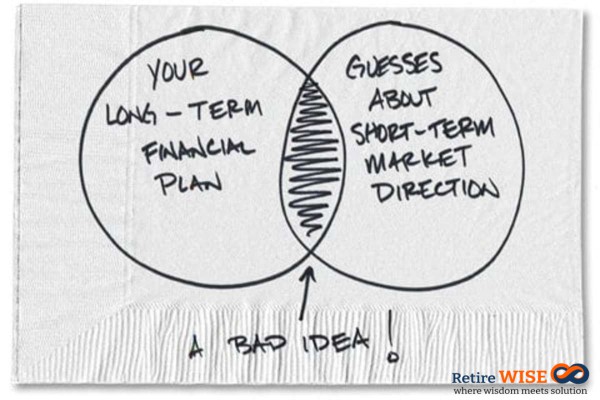
Last Updated on April 22, 2026 by teamtfl
“The only function of economic forecasting is to make astrology look respectable.” – John Kenneth Galbraith
In 2010, a German octopus named Paul correctly predicted eight consecutive World Cup match results and became an international celebrity. In 2014, a turtle called Big Head took up the role. Every January, financial newspapers publish their “Top Picks for the Year.” Every December, someone tallies the score – and the results are quietly forgotten.
I have been in financial advisory for 25 years. In that time, I have seen every kind of market prediction: Sensex targets for year-end, “this stock will 10x in 3 years,” “real estate in this city will double.” Some come true by chance. The vast majority do not. And yet clients keep asking: “What do you think the market will do this year?”
My honest answer: I do not know. And neither does anyone else.
⚡ Quick Answer
Market predictions fail because markets are complex adaptive systems driven by millions of human decisions, unexpected events, and feedback loops no model can capture. Expert forecasters are wrong more often than right – and the one big call they get right is celebrated while many wrong calls are forgotten. The alternative is not to guess better. It is to build a financial plan designed to withstand uncertainty rather than depend on predicting it correctly.
Why Predictions Are So Tempting
Carl Richards, the financial planner and author of The Behavior Gap, identified four reasons why we are drawn to predictions despite their poor track record.
It is fun. As social creatures, we enjoy being “in the know.” Having a market view makes us feel informed. Sharing it makes us feel valuable. The prediction is entertainment as much as information.
It is genetic. Our ancestors survived by predicting dangers. The rustle in the bushes might be a predator – better to predict and prepare. This survival instinct misfires badly in financial markets where randomness is far more prevalent than pattern.
We want control. Uncertainty is genuinely uncomfortable. A prediction – even a bad one – offers the illusion of control. The discomfort of not knowing pushes us toward anyone who claims certainty.
We forget quickly. The forecaster who predicted the 2020 crash is celebrated. The same forecaster’s 15 wrong calls in preceding years are invisible. Selective memory keeps prediction culture alive despite its poor aggregate track record.
“Every January I get calls asking what the market will do this year. My answer has not changed in 25 years: I do not know, and you should not trust anyone who claims to. What I know is what your financial plan needs – and that has nothing to do with where the Sensex ends in December.”
– Hemant Beniwal, CFP, CTEP | Founder, RetireWise
Why Predictions Structurally Fail in Financial Markets
Unknown unknowns. The biggest market-moving events are almost always things no one predicted: a pandemic, a war, a sudden regulatory change. By definition, the events that cause the largest movements are the ones not in any model.
Self-defeating prophecy. If a credible analyst publishes a “Sensex will reach X by December” prediction and millions act on it, those actions change the outcome. Predictions about social systems change the systems they describe.
Expert disagreement. For every analyst predicting a bull market, another predicts a bear market. Both cannot be right. When we “believe experts,” we are actually choosing which expert confirms what we already wanted to do.
Compound variables. A single market prediction requires getting right: GDP growth, corporate earnings, RBI rate decisions, global macroeconomics, FII sentiment, domestic retail flows, political stability – simultaneously and in correct interaction. The probability of getting all of these right is vanishingly small.
Is your retirement plan built on predictions or designed to withstand uncertainty?
RetireWise builds retirement plans that perform across multiple market scenarios – not plans that depend on a particular forecast coming true.
What Works Instead: Planning Under Uncertainty
The alternative to prediction is not paralysis. It is building a financial plan designed to be robust across multiple possible futures rather than optimised for one predicted future.
Save more and spend less. This works regardless of market direction, interest rates, or any macroeconomic scenario. The savings rate is the one variable entirely within your control.
Invest consistently. Money waiting for the “right time” is not protecting you – it is costing you compound growth. Time in the market consistently outperforms timing the market over long horizons.
Diversify across asset classes. No one knows which asset class will outperform next year. A well-diversified portfolio reduces the damage from any single wrong prediction and smooths the ride across market cycles.
Work the plan with regular reviews. Good financial planning is not a one-time event. It requires regular review, rebalancing when allocations drift, updating projections when life circumstances change, and maintaining discipline when markets are uncomfortable.
Build flexibility into the plan. Things will not go exactly as planned. A good plan anticipates that changes will be needed and builds in the flexibility to make them without abandoning the fundamental structure.
Read – Timing the Market vs Time in the Market: What the Data Shows
Read – Portfolio Rebalancing: When and How to Do It
Frequently Asked Questions
If predictions are unreliable, should I ignore all market analysis?
No. Valuation analysis (are markets cheap or expensive relative to historical averages?), economic trend analysis (is the interest rate cycle turning?), and scenario planning (what would my portfolio look like under a 30% correction?) are all valuable. What to avoid is treating specific point predictions (“Nifty will reach X by December”) as the basis for major financial decisions. Use analysis to understand the range of possible outcomes, not to bet on one predicted outcome.
How should I handle the constant stream of market predictions in financial news?
Reduce your consumption significantly. Most financial news is prediction-driven content with no bearing on your long-term outcomes. Check your portfolio against your target allocation half-yearly, not against daily price movements. If allocation has drifted significantly, rebalance. Otherwise, let the plan run. The investor who reads less financial news and checks their portfolio less frequently consistently outperforms the one who does both daily.
What should I do when a market expert makes a very confident prediction?
Ask: what is this person’s track record on past predictions? In most cases, that track record is either unavailable or quietly poor. Ask also: what would I do differently if this prediction were correct, and what is the cost of being wrong? For most long-term investors, the cost of acting on a wrong prediction – selling at the bottom, missing the recovery – is very high. That asymmetry should make you cautious about acting on any single forecast, however confidently stated.
The future is uncertain. No prediction changes that. What you can change is whether your financial plan is designed to perform across a wide range of futures, or whether it depends on one specific future coming true. The former is financial planning. The latter is speculation dressed in professional language.
Plan for uncertainty. Do not bet on predictions.
Ready to build a retirement plan that does not depend on predicting the future?
RetireWise builds retirement plans stress-tested across multiple market scenarios – designed to deliver your goals whether markets cooperate or not.
💬 Your Turn
Have you ever acted on a market prediction and regretted it? Or do you have a system that keeps you away from prediction-driven decisions? Share in the comments.
This post is really amazing.Thanks for sharing such as relevant article.
Hemant ji, very good and real explanation with interconnection of skills and luck. Yes, indeed one should prepare a dreamfile and become devoted to fulfill the same.
Hemant,
Nicely articulated and structured article as always from you. In today’s world predictions are becoming part of assumed reality more and more due to the snowball attack of news and social media from all channels. This is causing stress due to wishful thinking where as the reality is far from the news and media hype.