
Last Updated on April 8, 2026 by teamtfl
“The stock market is a device for transferring money from the impatient to the patient.” – Warren Buffett
My client Ramesh was 42 when he first came to me. Smart man – senior manager at a manufacturing company in Pune. He had been investing in equity mutual funds for 6 years. Good SIPs, decent fund selection. He should have been on track.
But in 2020, when markets crashed 38% in March, he redeemed everything. Moved it all to a savings account. “I’ll re-enter when things stabilise,” he told me. Markets recovered to pre-crash levels by December 2020. Ramesh re-entered in January 2021.
By exiting and re-entering, he locked in a 38% loss on paper and missed the full recovery. His actual corpus was 35% less than if he had simply done nothing.
Ramesh’s problem was not fund selection. It was his investment horizon. He said he was a long-term investor. He behaved like a 6-month investor.
⚡ Quick Answer
The longer you hold equity investments, the lower the probability of a loss – and the higher the likely return. Indian data from 38 years of Sensex history shows that probability of loss drops from 35% at 1 year to near zero at 10+ years. But the real insight is deeper: your holding period is not just until retirement. It includes the 20-25 years you spend withdrawing your corpus after retirement. Total effective holding period for most investors is 40-55 years, not 15-20.
What Is Your Investment Horizon – Really?
Most financial planning conversations treat investment horizon as the time until retirement. If you are 40 planning to retire at 60, your horizon is described as “20 years.” This is wrong – and the error is expensive.
Your retirement corpus, once built, must last another 25-30 years if you retire at 60 and live to 85-90. During those 25 years, a portion of your corpus continues to be invested. Some of it is in equity. Some is being withdrawn for living expenses.
This means a 40-year-old’s effective investment horizon is not 20 years. It is 40-45 years (20 years of accumulation + 20-25 years of withdrawal). The implications are significant – especially for how much equity you should hold, both before and during retirement.
What the Data Actually Shows
Jeremey Siegel’s research on 200 years of US market data, and 38 years of Sensex data compiled by Indian mutual fund researchers, both point to the same conclusion: holding period is the single most powerful risk-reduction tool available to equity investors.
| Holding Period (Sensex, 1980-2018) | Loss Probability | Average Annual Return |
|---|---|---|
| 1 Year | 35% | ~18% |
| 3 Years | 21% | ~16% |
| 5 Years | 14% | ~15% |
| 7 Years | 8% | ~15% |
| 10 Years | 3% | ~15-16% |
| 15+ Years | ~0% | ~15-16% |
Note: This is historical Indian equity data. Past performance does not guarantee future results. But the directional truth – that longer holding periods reduce risk – is robust across 200 years of US data and 40+ years of Indian data.
What Asset Allocation Does Holding Period Suggest?
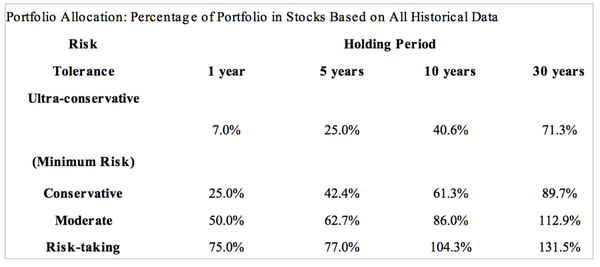
Here is the insight that most people find uncomfortable: even conservative, risk-averse investors with a 30-year horizon should hold significant equity. Siegel’s research shows that an ultra-conservative investor with a 30-year horizon optimises their risk-adjusted return at approximately 70% equity allocation – because over 30 years, equity risk drops dramatically while debt’s purchasing power erosion remains constant.
Read that again. For a 30-year horizon, 70% equity is the optimal allocation for a conservative investor. Not 30%. Not 50%. This is counter-intuitive but mathematically sound. The longer the holding period, the more equity you should hold – because time removes the dominant risk of equity (short-term volatility) while leaving intact its primary advantage (long-term real returns).
The Retirement Gap Nobody Plans For
Most Indian investors plan carefully for the accumulation phase – the 25-30 years of saving before retirement. Almost nobody plans for the withdrawal phase – the 25 years of spending after retirement. But your corpus does not retire when you do. It keeps working for another quarter century.
Here is what this means in practice. The most common mistake I see at age 60: moving the entire corpus into FDs and debt “because I’m retired now and can’t take risk.” But consider this – a 60-year-old Indian executive today has a 35-40% probability of living past 85 (LIC mortality data). That means a 25-year withdrawal horizon. And over 25 years, the Sensex data above shows near-zero loss probability for equity.
A retiree at 60 with Rs 3 crore corpus can reasonably hold 30-40% in equity for the portion they will not need for 10+ years. A 0% equity allocation in retirement means that portion earns 7-7.5% in FDs while inflation runs at 5-6%. Real return: near zero. Over 25 years, this is a major compounding failure.
The right question is not “should I be in equity?” It is “which part of my corpus do I need in the next 1-3 years?”
Only that portion needs to be in low-risk instruments. The rest has a 10-25 year holding period – and should be invested accordingly. This single insight changes retirement planning completely.
Most retirement plans fail not because of bad investments – but because of wrong asset allocation at retirement.
At RetireWise, we build withdrawal strategies alongside accumulation plans. SEBI Registered. Fee-only.
Why We All Act Like Short-Term Investors
Ramesh was not irrational. He was human. The pain of watching Rs 30 lakh become Rs 19 lakh in one month is visceral in a way that “I’ll recover it in 2 years” is not.
Behavioural finance researchers Shlomo Benartzi and Richard Thaler documented this in a landmark 1995 paper as Myopic Loss Aversion. The finding: investors who evaluate their portfolios frequently experience far more “losses” than those who check infrequently, simply because short-term volatility creates the feeling of loss even in a rising long-term market. The more frequently you check, the more likely you are to make a panic-driven decision.
In Indian context: the average equity SIP investor exits within 3.2 years (AMFI data). A 3-year holding period has a 21% loss probability. The same investor holding for 10 years drops to 3%. The investor’s behaviour – not the market – is the primary source of their underperformance.
A SEBI study from 2023 found that 9 out of 10 individual equity investors underperform a simple Nifty 50 index fund over a 5-year period. The primary reason: premature exits and ill-timed re-entries during corrections. The behaviour gap – the difference between what the market returns and what the investor actually earns – is estimated at 3-4% annually in India. On a Rs 50 lakh corpus over 20 years, a 3% behaviour gap means Rs 75-80 lakh less wealth at retirement. That is the cost of checking your portfolio too often.
The Practical Answer: How to Use This
Set your investment horizon not from today to retirement, but from today to the year you need the money. For a retirement goal, part of your corpus will not be needed for 30-40 years. That portion can bear equity risk. Part will be needed in years 1-3 of retirement. That should be in debt.
This is the bucket strategy – and it is not just a withdrawal tool. It is also a psychological tool. When you know that your 3-year living expenses are safe in an FD, you can watch your equity portfolio fall 30% without panic. You do not need the money this year. The 30% fall is temporary on a 15-year holding period. The damage only becomes permanent when you sell.
“Investing is not a numbers game. It is a mind game. The math says hold for 15 years. The mind says sell today. The investor who wins is the one whose structure prevents the mind from winning.”
– Hemant Beniwal, CFP, CTEP | Founder, RetireWise
Read next: How to Save for Retirement in India – The Complete Guide
Your retirement plan needs a withdrawal strategy, not just an accumulation target.
RetireWise builds complete retirement blueprints for senior executives. SEBI Registered. Fee-only.
Ramesh called me last year. He is 45 now. He stayed invested through 2022’s correction and 2023’s recovery. His corpus is back on track. The lesson he said it took him three market cycles to learn: “The market will come back. The question is whether I will still be invested when it does.”
Your investment horizon is longer than you think. Start counting from today – not from retirement.
💬 Your Turn
Have you ever exited an investment during a market fall and later regretted it? What was your actual holding period when you sold? Share below – your experience might save someone else from the same decision.
Your way of analysis is different and genuine. Worth reading.
Thanks
Excellent put up, very informative. I ponder why the other experts of this sector do not
notice this. You must continue your writing. I’m sure, you’ve a huge readers’ base
already!
Thanks Gopal 🙂
Definitely, you can observe that in long term overall risk is reduced with an increase in equity exposure. The more is the holding period, the less is risk and minimum risk point is crossed. In the long run the returns would increase and be definitely bring better results.
Thanks Seema for sharing your views.