
Last Updated on April 22, 2026 by teamtfl
“A fool and his money are soon parted. But a clever man and his money can be parted too – if the scheme is designed well enough.” – Anonymous
Over 25 years of practice, I have seen educated, senior professionals fall for investment fraud. A doctor. An engineer. A retired government officer. A software architect at a large IT company. None of them were stupid. None of them were greedy in an obvious way. All of them lost real money to schemes that, in retrospect, had every red flag in the book.
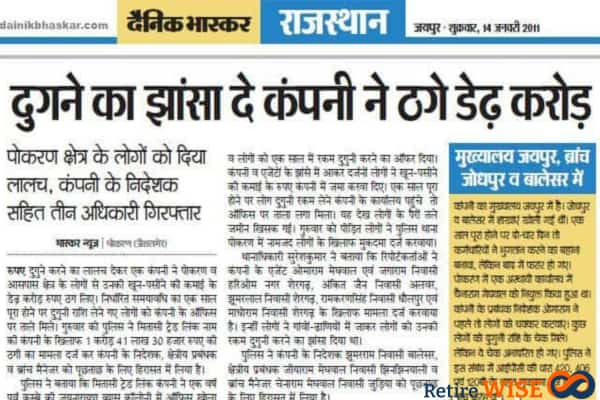
The double-your-money fraud is not a 2011 problem. It is not a rural-only problem. It is not a problem that only affects the unsophisticated. It is a structural human psychology problem – and it recurs, in different packaging, every market cycle.
⚡ Quick Answer
Fraudulent investment schemes – whether Ponzi schemes, chit fund frauds, or “guaranteed high return” deposit schemes – share a consistent anatomy: a professional-looking office, social proof through community networks, promised returns that are 2-3x market rates, and a 1-2 year operating cycle before collapse. The six warning signs that identify every such scheme are covered below. If you see three or more, walk away regardless of who introduced you.
The Anatomy of Every “Double Your Money” Scheme
The mechanics of these frauds have not changed in decades. The packaging changes – from chit funds in the 1980s to plantation schemes in the 1990s to cryptocurrency frauds in the 2020s – but the underlying structure is identical. Understanding it once protects you forever.
Step 1 – The legitimate-looking setup. The scheme operator establishes a visible presence: a proper office in a known location, branded letterheads, a registration under some act (often a micro-finance or NBFC registration that sounds authoritative but provides minimal oversight). The goal is to pass a cursory investigation by a semi-suspicious investor.
Step 2 – Recruitment through trusted networks. Agents are recruited from specific communities, neighbourhoods, or professional networks. They are chosen because they are trusted by the target investors – same caste, same locality, same former employer. The pitch comes from someone you know, not a stranger. This is deliberate. Your guard drops when someone you trust introduces an opportunity.
Step 3 – The promised return. Returns are always 2-3x what conventional instruments offer. In a market where FDs pay 6-7%, these schemes promise 15-24% or “doubling in 3 years.” The promises are vague about the mechanism – “we invest in construction,” “we have a proprietary trading system,” “we generate returns from commodities.” The vagueness is the point. Specific disclosures would invite specific scrutiny.
Step 4 – Early payouts build confidence. In the first year, the scheme pays its early investors on time – sometimes ahead of schedule. Word spreads. The early investors become unintentional advocates. “I got my money back plus interest, it is legitimate.” These payouts come from new investor funds, not from any actual business returns. This is the Ponzi structure.
Step 5 – Scaling before the exit. Once credibility is established, recruitment intensifies. Bigger deposit amounts are solicited. The operator is now focused on maximizing collections before the inevitable collapse.
Step 6 – Collapse and disappearance. When maturity dates arrive in large numbers, the scheme cannot pay. Offices close. Key personnel become unreachable. PDCs bounce. By the time investors organize, file police complaints, and get media attention, the operator has moved to a different city or jurisdiction.
Fraud works because trust is not the same as verification.
A SEBI-registered investment adviser is legally accountable, audited, and required to act in your interest. RetireWise is SEBI registered (INA100001927). The person who introduced you to a “great scheme” is not.
Six Warning Signs That Identify Every Such Scheme
1. Returns significantly above market rates with no clear explanation of how. In 2026, high-quality corporate FDs pay 7-8%. SCSS pays 8.2%. Quality equity mutual funds have generated 12-14% CAGR over long periods with full market risk. Any instrument promising 15-24% with “safety” or “guarantees” is either lying about the returns, lying about the safety, or both.
2. The introduction comes through social or community channels, not formal channels. A colleague, a relative, a community elder – someone you trust – introduces the opportunity. The trust you have in that person is being borrowed to create trust in the scheme. The person who introduced you is almost certainly a genuine believer who has received early payouts. Their belief is real. Their confidence is misplaced.
3. Vague or implausible business model. Ask how the returns are generated. If the answer is vague (“we invest in multiple businesses”), circular (“our model generates these returns”), or sounds implausible (“arbitrage between commodity markets”), it cannot withstand scrutiny. Legitimate investment products have specific, auditable explanations for their return potential.
4. Pressure to decide quickly. “This tranche closes on Friday.” “Only a few spots left.” “Your neighbour has already invested Rs 5 lakh.” Urgency is manufactured. It prevents you from taking the time to verify. Legitimate investment opportunities do not expire in 48 hours.
5. No SEBI registration or verifiable regulatory oversight. Any entity collecting money for investment purposes in India must be registered with SEBI, RBI, or IRDAI depending on the product type. Ask for the registration number and verify it on the SEBI website before giving a single rupee. A “registered under the microfinance act” or “registered with the registrar of companies” is not the same as being a regulated investment entity.
6. Cash preferred or difficult-to-trace payment methods. Legitimate investments can be made through normal banking channels with proper receipts and clear documentation. If an operator prefers cash, asks for transfers to personal accounts, or provides vague receipts, it is a strong signal that they want to limit the paper trail.
Why Smart People Fall For These
I have seen it happen enough times to understand the psychology. It is not stupidity or greed in isolation. It is a combination of social proof (everyone around you is investing), authority bias (the operator has a professional setup and registration documents), and loss aversion in reverse (the fear of missing out on a good opportunity that others are benefiting from).
The most dangerous moment is after the first early payout. At that point, the rational skepticism that might have prevented the initial investment is replaced by lived confirmation. “I invested Rs 1 lakh, got Rs 12,000 interest in 6 months, the scheme is real.” The early payout is specifically designed to produce this effect.
In almost every fraud case I have encountered, the investor who lost the most was not the first investor. It was the investor who received early payouts, became convinced, and then put in a much larger amount in the second or third round.
What To Do If Someone Approaches You
Two simple rules that have never failed: first, verify the SEBI registration number at sebi.gov.in before investing a single rupee – not after, not while “thinking about it,” but before. Second, consult a SEBI-registered investment adviser (not the person who introduced you, not your bank relationship manager, but someone whose regulatory obligation is to advise you correctly) before making any investment outside of known, regulated products.
If you have already invested and are worried, do not invest more to “average out.” That is the most common trap – doubling down to recover earlier losses. File a complaint with SEBI (scores.sebi.gov.in) and your local police economic offences wing immediately, regardless of how unlikely recovery seems.
Read: 7 Financial Planning Mistakes That Are Costing You Retirement Security
The money lost in investment fraud is rarely recovered. The police catch some operators. The investors almost never get their money back. The only protection is not investing in the first place.
If it sounds too good to be true, it is. Every single time.
The best protection against fraud is a financial plan you understand and trust.
When you have a clear retirement plan with known instruments and expected returns, you have a reference point against which any “opportunity” can be immediately evaluated.
Your Turn
Have you or someone you know been approached by a scheme with unusually high promised returns? What made it seem credible at the time? Sharing these real experiences helps other readers recognise the same patterns before they make a costly mistake.
What a person can do if he is cheated by such fraudsters…
Complain to the police.
Hello Sir
This scam has now re-emerged in the form of Digital Profit Course and Digital Money India scam. Thousands of people have enrolled online by paying Rs 3500 to get a book and cd which promises to make them rich within a month.
I don’t know when SEBI will take action against all these criminals.
Regards
Abhay
Nice aricle hemanth.
Hi Hemanth,
Thanks for sharing this.
We need to be aware of chit fund companies who does this kind of cheating.
Small investors like us will get into trap by listening the word money doubling in 2 0r 3 years. Hence this article opens the eyes of such small investors like us to choose the right approach for investment, instead of relying on cheaters and some chit fund companies.
I wonder why people don’t understand this simple principle about investing –
“If its too good to be true, it’s not true.”
Nice article Hemant.
Hi Adheesh,
In 10 years of my career I have seen – first thing people don’t like is simplicity.
They don’t want to understand & learn simple concepts “are ye to simple hai kooch aur different batao.” LOL
They want advisor should show them dreams – so let them sleep & don’t disturb their dreams 🙁
Good topic for public awareness………Come on people wake up. Jaago grahak jaago. Lol!
Thanks Bunny.
Some day people will wake – hope that will not be too late. 🙁
Hope that wake up call is not too costly for people.