
Last Updated on April 14, 2026 by Hemant Beniwal
A celebrity endorses a product. You buy it. It turns out to be a terrible investment. You lose money.
Who is responsible?
In India, the answer has historically been: the celebrity. Social media storms follow. Court notices are sent. News anchors demand accountability from film stars and cricketers who, until last week, were just promoting a brand.
This happens with some regularity in financial products — housing companies, chit funds, deposits schemes. The celebrity is blamed. The investor is portrayed as the victim of deception.
But there is an uncomfortable truth in all of this that nobody wants to say out loud.
⚡ Quick Answer
Brand ambassadors are paid to improve brand recognition — not to verify product quality, financial soundness, or regulatory compliance. The responsibility for evaluating a financial product before investing lies entirely with the investor. Using a celebrity’s face as a reason to invest is a behavioural bias, not due diligence. This post explains why — and what actual due diligence looks like for financial products.
What a Brand Ambassador Actually Does
A brand ambassador is hired for one purpose: to attach positive associations to a product. The celebrity’s fame, trustworthiness, and aspirational appeal transfer — in the viewer’s mind — to the brand.
This is a marketing function. It has nothing to do with product quality, financial soundness, or regulatory compliance.
When Sachin Tendulkar appeared in an advertisement for a financial product, he was paid to appear in an advertisement. He was not hired to audit the company’s books, verify its regulatory filings, or certify that your money would be safe. The same is true for every celebrity endorsement of every financial product in India.
SEBI recognised this distinction long ago. That is why, since 2012, SEBI has prohibited celebrity endorsements of mutual funds. The regulator’s logic was sound: investment products are not consumer goods. The endorsement of a cricketer cannot substitute for a SEBI registration, a regulated structure, and transparent disclosures.
For insurance products, the rules are different — and more permissive. IRDAI allows celebrity endorsements of insurance products. Which is why, if you watch television, you see well-known faces endorsing life and health insurance regularly.
The Real Question: Why Did You Invest?
When I sit with clients who have lost money in poorly chosen financial products, I always ask: what made you invest in this?
The answers are revealing. Very rarely does someone say: “I reviewed the company’s financials, checked their regulatory status with SEBI or MCA, verified their past track record, and concluded it was a sound investment.”
Far more often, the answer is some version of: “Someone I trusted recommended it,” “The returns sounded good,” “A famous person was associated with it,” or “Everyone in my office was investing.”
None of these are investment rationale. They are social proof and authority bias — two of the most powerful cognitive shortcuts that lead to bad financial decisions. Behavioural finance has documented extensively how these biases drive poor investment choices.
The celebrity’s face on a hoarding is designed specifically to trigger authority bias. “If this person I admire trusts this company, I can too.” The marketing team knows exactly what they are doing when they select an ambassador. The question is whether you know what they are doing.
Are you investing based on logic or on social proof?
A fee-only advisor reviews your existing investments for financial soundness — without being influenced by celebrity associations or marketing.
What Due Diligence Actually Looks Like
For any financial product — a deposit scheme, an investment plan, a housing pre-launch — before committing money, ask these questions:
Is the entity regulated? Banks are regulated by RBI. Mutual funds and brokers by SEBI. Insurance companies by IRDAI. NBFCs by RBI. If someone is taking deposits or investments outside these regulated frameworks, that is a red flag regardless of who endorses them.
Is SEBI/RBI registration verifiable? Every regulated entity has a registration number. You can verify it on the SEBI website, the RBI website, or the MCA portal in minutes. If you cannot find the registration, do not invest.
What is the track record? How long has this company been operating? What do their audited financials show? Has there been any regulatory action against them? News searches and ROC filings are publicly available.
What is the actual product structure? A “guaranteed return” scheme that is not an FD from a scheduled bank is not actually guaranteed. Understand exactly what you are investing in, what risk you are taking, and what recourse you have if things go wrong.
Who else has verified this? Not a friend, not a celebrity — a SEBI-registered advisor who has no commission interest in whether you buy or don’t buy.
Celebrities Who Chose Responsibly
To be fair to celebrities: some have drawn their own lines. Amitabh Bachchan stopped endorsing a cola brand after a schoolgirl challenged him publicly about promoting an unhealthy product. Several sportspeople decline tobacco and alcohol endorsements on principle.
In financial products, the same principle applies. A celebrity who declines to endorse an unregulated deposit scheme — even for a large fee — is exercising exactly the kind of responsibility critics demand. And there are some who do make those calls.
But even the most responsible celebrity cannot be your financial research department. Their decision to endorse a product is an economic and personal choice — not a certification of the product’s soundness.
The Accountability That Actually Matters
SEBI and IRDAI are steadily tightening rules around celebrity endorsements of financial products — requiring disclaimers, restricting certain categories, and holding promoters accountable for misleading advertisements. These regulatory improvements are genuinely useful.
But regulatory protection has limits. The most robust protection is your own judgement. Mis-selling is far harder to execute on an informed investor than on one who makes decisions based on trust and social proof.
The celebrity on the hoarding is doing their job. Are you doing yours?
Frequently Asked Questions
Are celebrities legally liable if a financial product they endorse turns out to be a fraud?
Under SEBI’s 2023 advertisement regulations and consumer protection laws, celebrities can be held liable if they endorsed a product with false claims and had reasonable means to verify those claims. SEBI can impose penalties on brand ambassadors for misleading financial advertisements. However, criminal liability is typically reserved for promoters and directors who perpetuated the fraud — celebrities are usually pursued civilly for damages or through SEBI enforcement rather than criminal prosecution. The regulatory framework is tightening, but enforcement remains inconsistent.
Why does SEBI ban celebrity endorsements of mutual funds but IRDAI allows them for insurance?
SEBI’s position is that investment products require investors to make risk-based decisions — and celebrity associations can impair that rational assessment by creating false authority. Insurance is regulated by IRDAI which has a different philosophy: insurance is a protection product and brand awareness is considered a legitimate marketing goal. The inconsistency is real and has been debated. Critics argue that insurance products — particularly ULIPs — have as much complexity and investment risk as mutual funds, and deserve equally strict endorsement rules.
How do I verify if a financial company is genuinely registered with SEBI or RBI before investing?
SEBI-registered entities (mutual funds, stockbrokers, investment advisors, portfolio managers): check sebi.gov.in under the “Intermediaries/Market Infrastructure Institutions” section. RBI-regulated entities (banks, NBFCs): check rbi.org.in under “Financial Education” or the NBFC list. MCA/ROC for company registration: check mcaportal.gov.in. Any investment scheme that does not appear in these registries — regardless of who endorses it — should not receive your money.
What is authority bias in investing and how do I avoid it?
Authority bias is the tendency to trust information or endorsements from people perceived as having high status — celebrities, successful businesspeople, prominent public figures. In investing, it causes people to mistake fame for financial expertise. The defence is simple: separate the celebrity’s fame from the product’s fundamentals. Ask: would I invest in this product if no famous person had endorsed it? If the answer is no, the celebrity is doing work that your analysis should be doing. Never let an endorsement substitute for a regulatory check, a financial review, or advice from a fee-only advisor.
No one is responsible for your money except you. Not the celebrity. Not the agent who sold you the product. Not the friend who recommended it. You. And the only way to exercise that responsibility is to ask the right questions before you invest — not after you’ve lost.
DIY = Destroy It Yourself. But so does investing without asking the right questions.
💬 Your Turn
Have you ever made an investment decision influenced by a celebrity endorsement? And looking back — what was the actual reason you invested, and what should you have checked first? Share below.
Brands often misuse celebrities for their sales,agreed!and they should be fined for fraud if found guilty.But what if any celebrity endorses a brand for money without checking the credentials of the company?If as a customer we should check the product than celebrity should double check before endorsing it because people have trust in them(b’coz their image) and they R in public life.Money should be secondary.At least there should be disclaimer in large fonts.
Good to see a different point of view – “disclaimer in large fonts” is my dream : )
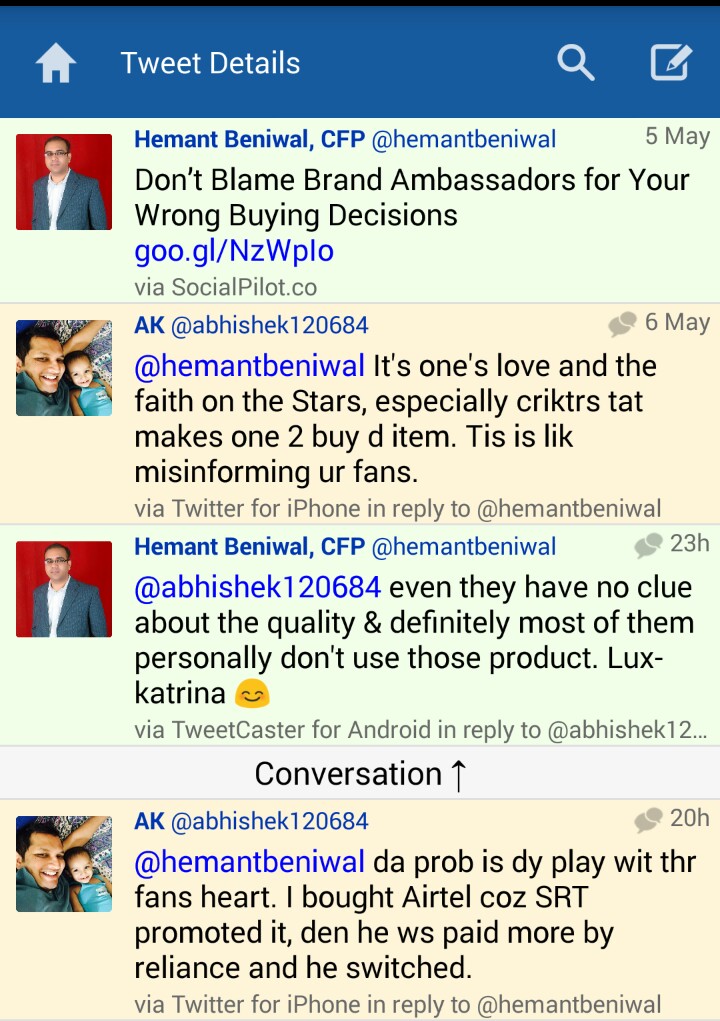
Please help – I am not sure what should I reply to this guy on Twitter
Hi,
if Sachin says, ” Boost is the secret of my energy.” And if some how, it is proved the Sachin never drank any ounce of it? And that he misled people by believing that he had Boost all through his years.
Whats your take on that?
Hi Kapil,
I can guarantee Sachin don’t drink Boost, Dhoni avoids revital & Kohli don’t drive TVS bike – but proving this will not help. We have to understand this is the way ad industry is…. btw someone told me Kaitrina don’t use Lux : )
If celebrities are made responsible, they will avoid appearing in ads, this will give chance to lesser celebrities. The lesser celebrities will not be able to defend them well once the product is found below acceptable standards. Therefore, there is no need of making actors responsible.
In India almost all ads are far from reality and claims made in ads are unreasonable,
there should be some government agency which should monitor the claims of companies, because what companies are doing is fooling and cheating the customers by making false claims. If govt. is not able to curb some NGOs may like to file PIL against such companies.
Completely Agree Prabhakar. Plus there’s a need that we become responsible & control our emotions.