
Last Updated on April 22, 2026 by teamtfl
“Until you can manage your emotions, don’t expect to manage your money.”
– Warren Buffett
A few years ago, I sat across from a client who had been holding a ULIP for eleven years. The returns were poor. The charges had eaten a significant chunk of his corpus. He knew it wasn’t working. And yet he couldn’t bring himself to exit.
“I’ve already put in so much,” he said. “If I leave now, I’ll have wasted everything.”
I asked him one question: “If you hadn’t bought this ULIP, and someone offered it to you today at its current value, would you buy it?” He went quiet. Then he said no.
That silence is where most financial mistakes live. Not in lack of knowledge – in the gap between what we know and what we do.
Rolf Dobelli, in his book The Art of Thinking Clearly, catalogued 99 cognitive errors that systematically distort human decision-making. In personal finance, six of these show up again and again – in my clients, in myself, and in the data. The SEBI Investor Survey 2025, covering over 90,000 households across India, confirmed that behavioural biases remain the single biggest barrier to good financial outcomes – not products, not markets, not advisors.
⚡ Quick Answer
Six cognitive biases consistently destroy financial decisions in India: sunk cost fallacy, herd mentality, confirmation bias, scarcity error, endowment effect, and loss aversion. Each one has a signature symptom. Recognising the symptom in yourself – before you act – is the entire skill.

Why Smart People Make Terrible Financial Decisions
Here is something that still surprises even experienced investors: intelligence does not protect you from cognitive biases. In fact, in some ways it makes you more vulnerable. A smarter person constructs more sophisticated arguments for why their bias is actually rational thinking.
NSE’s own data shows that over 89% of retail derivatives traders in India incur net losses year after year. These are not uninformed people. Many are engineers, doctors, CAs. They have spreadsheets. They have strategies. And they lose money consistently – because a strategy built on a cognitive bias is just an elaborate version of the same mistake.
The six biases below are not abstract theory. Each one has a specific signature. Once you know what it looks like in your own life, you start catching it before it costs you.
1. The Sunk Cost Fallacy – Paying Twice for a Bad Decision
You bought a ticket to a concert. On the day, you’re feeling unwell and have no real desire to go. But you go anyway – because you paid Rs 2,000 for the ticket. You sit through it miserably, leave early, and feel worse than if you’d just stayed home.
The Rs 2,000 is gone whether you go or not. You cannot recover it by attending. And yet we attend.
In investments, this plays out with ULIPs, endowment plans, bad stocks, and underperforming properties that clients hold for years past the point where any rational analysis would say exit. The mental framing is: “I’ve already put in so much.” But the correct question is always the one I asked my client: “Knowing what I know now, would I buy this today?”
Past money spent has zero relevance to future decisions. The only thing that matters is what this investment will do from here.
2. Herd Mentality – The Most Expensive Social Activity
In April 2021, when markets were near all-time highs, SIP registrations hit record levels. By January 2025, after months of corrections, SIP stoppage ratios crossed 100% – more SIPs stopped than were started. Investors poured in at highs. They exited at lows.
This is herd mentality in its purest form. When prices are rising, fear of missing out overrides judgement. When prices are falling, fear overrides judgement in the other direction. In both cases, the crowd is moving, and the individual follows – not because they have analysed the situation, but because everyone else seems to know something they don’t.
The uncomfortable truth is that markets at their most euphoric are the most dangerous – and markets at their most panicked are often the most attractive. Warren Buffett’s instruction to be fearful when others are greedy is not a slogan. It is a description of how money actually moves from impatient hands to patient ones.
3. Confirmation Bias – Only Hearing What You Want to Hear
You’ve decided to buy a particular stock. You search for analysis – and you read everything that confirms your view. Articles suggesting caution get dismissed. Expert opinions disagreeing with you feel “biased.”
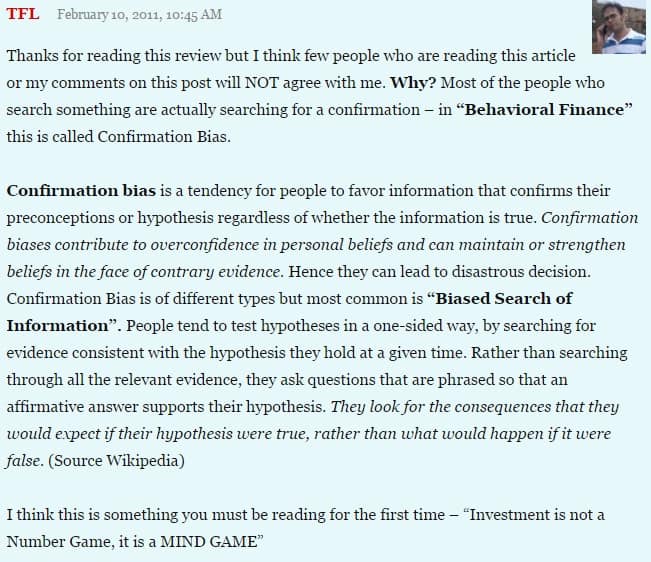
I wrote about this in 2011, when gold was at its peak and investors were flooding into gold funds. The comment sections on gold posts at that time are a masterclass in confirmation bias at work. Anyone suggesting caution was challenged aggressively. Anyone predicting higher prices was treated as authoritative. The crowd had decided, and they were hunting for endorsement, not analysis.
The antidote is deliberate discomfort. Before any major financial decision, actively seek out the strongest argument against what you are planning to do. Not to be talked out of it – but to test whether your reasoning holds up. If you cannot articulate why the opposing view might be right, you haven’t thought clearly enough.
The Pre-Mortem Technique
Before any significant financial decision, I ask clients to do a “pre-mortem.” Imagine it is three years from now and this decision turned out badly. What went wrong? Working backwards from an imagined failure forces you to examine the weaknesses in your own thesis – weaknesses that confirmation bias would otherwise keep you from seeing. It is one of the most useful five minutes you can spend before committing to a major investment.
This is not pessimism. It is intellectual honesty – the precondition for any good decision.
4. The Scarcity Error – Urgency That Isn’t Real
You’ve seen the messages. “Only 3 seats left in this webinar.” “NFO closes Friday.” “Last 2 units at this price.” “Offer valid only until midnight.”
Online platforms have perfected the scarcity trigger. A countdown timer creates urgency where none actually exists. The psychology is straightforward: scarcity signals value. If something is running out, it must be worth having.
In investing, this creates FOMO-driven decisions: NFO subscriptions because “everyone is rushing in”, real estate bookings “before prices go up next month”, and insurance policies bought before the “special premium lock-in expires.”
A real investment opportunity does not evaporate because you took two weeks to think about it. If an advisor or distributor is pressuring you with scarcity language, that pressure is itself a warning signal. Good investment decisions are made from calm analysis, not from urgency manufactured by someone with a sales target.
5. The Endowment Effect – Overvaluing What You Already Own
There is a classic experiment in behavioural economics: people are given a coffee mug and then asked to sell it. On average, they demand roughly twice what they would have been willing to pay for the same mug before owning it. The act of ownership inflates perceived value.
In Indian financial life, this shows up most visibly with inherited property. A family that inherited land in Pune in 1980 will value it far above what any rational analysis of rental yield and opportunity cost would justify. They are not holding it because of the numbers. They are holding it because it is theirs – and that ownership has an emotional premium attached to it.
The same applies to stocks bought at Rs 400 that an investor refuses to sell at Rs 490 because “it should reach Rs 500.” The stock does not know what you paid for it. The market will price it at what it is worth – not at what you feel it should be worth because you own it.
The test is simple: if you did not currently own this asset, would you buy it at today’s price? If the answer is no, the endowment effect may be the only reason you’re still holding.
6. Loss Aversion – Why Losing Hurts More Than Winning Feels Good
Daniel Kahneman and Amos Tversky’s research showed that losses feel roughly twice as painful as equivalent gains feel pleasurable. This asymmetry drives one of the most destructive patterns in investing: selling winners too early and holding losers too long.
A client sells a mutual fund that has given 28% in a year because “I should lock in profits before something goes wrong.” The same client holds a stock down 40% because “I’ll wait for it to come back to my cost price.” The winners leave the portfolio. The losers accumulate.
Over a 10-15 year period, this pattern alone – not market crashes, not bad fund choices – is what separates investors who build wealth from those who don’t. Letting go of a loss feels like admitting failure. But the alternative is paying with years of opportunity cost for the privilege of not admitting it.
The rational framework is the same as with the endowment effect: evaluate every holding on its future prospects, not its history in your portfolio. What it cost you is not a variable. What it will do from here is.
Why Knowing This Is Not Enough
Here is the part that most behavioural finance articles skip: knowing about cognitive biases does not make you immune to them. Kahneman himself, who spent decades studying loss aversion, admitted that knowing about it did not stop him from feeling it.
What actually helps is structure – decisions made in advance, when you are calm, that govern your behaviour when you are not. A written investment policy: “I will rebalance when equity crosses 65% of portfolio.” “I will not react to any market movement within 48 hours of it happening.” “Before exiting any investment, I will run the pre-mortem.”
And the other thing that helps is a trusted advisor who has no emotional stake in your portfolio’s current value – someone who can ask you the question I ask clients: “If you did not already own this, would you buy it today?” That question cuts through every bias listed above. It restores rational framing in a single sentence.
The market rewards clarity of thinking over intensity of research.
A retirement plan that accounts for your behaviour is more valuable than one built only on expected returns.
Rolf Dobelli’s book catalogues 99 errors. In 25 years of practice, these six have cost my clients more money than all market crashes combined. Not because the crashes aren’t real. But because the biases determined how people responded to them.
The market will always provide opportunities to think clearly. It will also always provide opportunities to do the opposite.
Investing is not a numbers game. It is a mind game. And the opponent is always yourself.
The investor who understands their own biases has already won half the battle.
Your retirement plan needs to survive not just market cycles – but your own reactions to them.
That’s what we build at RetireWise. A plan designed around who you are, not just what you own.
Your Turn
Which of these six biases has cost you the most – and looking back, what was the moment you first noticed it was operating? Share in the comments below.
The example in first point is universal truth….many time we are in that situation but every one think but not take the decision.
Yup 🙂
Individuals must take any investment decision after conducting a proper research about the company, also while taking any experts advice they should make sure that the person is having experience of at least 10 or more years in the same filed and is passionate about it.
Hi,
Great article.
I want to borrow some amount. I have learned that banks have a certain eligibility criteria for the borrowers. Do other platforms also have these like peer to peer lending?
Really good article. I could relate to the points.
Thanks Bhargava 🙂
Good article–reg ” Loss aversion “, we would all like to hold on to our winners, only thing is , it is extremely difficult to predict when is the right time to sell, so maybe the best time to sell is when (a) the stock fundamentals have altered drastically over few quarters , or (b) when there is a better investment opportunity or (c) when the funds are required. Some investors fix a certain return , and once the stock reaches this tatget price, sell the stock — which I feel is a good investment technique. Regds
Hi Hemant,
I am able to readily connect to this article and sub-section Endowment Effect.
I have two plots (vacant site) in Bangalore. In one of them, I am constructing the house, by taking home loan from bank. Thinking, should I sell second plot and clear the housing loan or keep it with me to let it grow? If I sell second plot now, may not get much profit. It could barely make break-even of the investment (invested 3 yrs ago). What are your views on this?
Thanks,
Sri
Hi Sri,
I have added your question here https://www.retirewise.in/2016/05/greater-fool-theory-indian-real-estate.html
Thanks Hemant.
Really nice article Hemant!
Thanks Rohan 🙂