
Last Updated on April 23, 2026 by teamtfl
For years, Cost Inflation Index was one of the most powerful tax-saving tools available to Indian investors, particularly for debt mutual funds. Then came the Finance Act 2023. In a single amendment, the indexation benefit was removed from debt mutual funds – effective April 1, 2023. Debt fund gains are now taxed at slab rate regardless of holding period. The strategy of holding debt funds for 3 years to get indexation benefit no longer works.
For real estate, the situation is different and more nuanced – indexation still applies for property sold by individuals and HUFs, with some modifications introduced in 2024. Understanding the current rules is essential before making any property sale or debt investment decision in 2026.
Critical Update: Indexation on Debt Mutual Funds Removed (April 2023)
The Finance Act 2023 removed the indexation benefit and the 20% LTCG rate from debt mutual funds. From April 1, 2023, gains from debt mutual funds – regardless of holding period – are taxed at the investor’s applicable income tax slab rate. The strategy of holding a debt fund for 36+ months to claim indexation and pay only 20% tax is no longer available. This significantly changes the tax efficiency comparison between debt mutual funds and fixed deposits.

What Is the Cost Inflation Index?
The Cost Inflation Index (CII) is a number published annually by the Central Board of Direct Taxes (CBDT) to measure the inflation in the cost of assets. It is used to calculate the indexed cost of acquisition for long-term capital gains tax purposes, reducing the taxable gain to the real (inflation-adjusted) profit rather than the nominal profit.
The concept is straightforward. If you bought a property for Rs. 50 lakh in 2010 and sold it for Rs. 1.5 crore in 2025, your nominal gain is Rs. 1 crore. But the Rs. 50 lakh you paid in 2010 had significantly more purchasing power than Rs. 50 lakh today. Indexation adjusts the purchase price upward for inflation, reducing the taxable gain.
Indexed cost of acquisition = Original purchase price × (CII of year of sale ÷ CII of year of purchase)
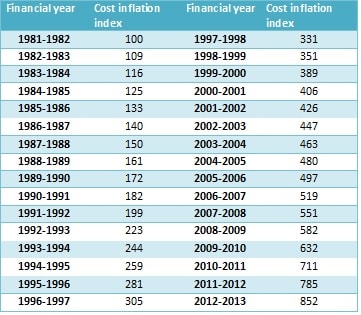
CBDT changed the base year for CII from 1981 to 2001 with effect from FY 2017-18. The current CII series uses FY 2001-02 as the base year (index value 100). The CII for FY 2024-25 is 363.
Where Indexation Still Applies in 2026: Real Estate
For property sold by individuals and Hindu Undivided Families (HUFs), indexation on long-term capital gains is still available in 2026, subject to the post-2024 rules.
The Finance Act 2024 initially proposed removing indexation from property sales and replacing it with a flat 12.5% LTCG rate (without indexation). However, after significant pushback, the government allowed individuals and HUFs to choose between the old regime (20% LTCG with indexation) and the new regime (12.5% LTCG without indexation) for properties purchased before July 23, 2024. For properties purchased on or after July 23, 2024, the flat 12.5% rate without indexation applies mandatorily.
This means for property purchased before July 23, 2024, the calculation that matters is which option produces the lower tax: 20% with indexation vs 12.5% without. For properties held for a long period with significant real price appreciation above inflation, 12.5% without indexation may be lower. For properties in markets with modest real appreciation, 20% with indexation may still be better. Calculate both before selling.
Key rules for property LTCG: the property must have been held for more than 24 months (earlier it was 36 months, changed to 24 months from FY 2017-18) to qualify as a long-term capital asset. Short-term gains (held less than 24 months) are taxed at slab rate regardless.
A Worked Example: Property Sale in 2026 (Pre-July 2024 Purchase)
Property purchased in FY 2010-11 for Rs. 40 lakh. Sold in FY 2025-26 for Rs. 1.8 crore.
CII for FY 2010-11: 167. CII for FY 2025-26: assumed 380 (actual figure published by CBDT before filing).
Indexed cost of acquisition = 40 lakh × (380/167) = Rs. 91.02 lakh.
Taxable LTCG with indexation = Rs. 1.8 crore – Rs. 91.02 lakh = Rs. 88.98 lakh.
Tax at 20% = Rs. 17.79 lakh.
Without indexation: Taxable LTCG = Rs. 1.8 crore – Rs. 40 lakh = Rs. 1.4 crore.
Tax at 12.5% = Rs. 17.5 lakh.
In this case the two options are nearly identical. For a property with higher real appreciation (sold at Rs. 3 crore or more), 12.5% without indexation would typically produce lower tax. For modest appreciation, 20% with indexation often wins. Always calculate both.
Where Indexation No Longer Applies: Debt Mutual Funds (Post-April 2023)
Before April 2023, debt mutual funds with a holding period of more than 36 months qualified for 20% LTCG with indexation benefit. This made them significantly more tax-efficient than fixed deposits for investors in the 30% tax bracket.
After the Finance Act 2023 amendment, debt mutual funds are no longer categorised separately for capital gains purposes. All gains from debt mutual funds are now treated as short-term gains regardless of holding period, and taxed at the investor’s applicable slab rate. For a 30% bracket investor, this means debt fund gains are taxed at 30% – the same as FD interest.
The practical implication for retirement investors: the traditional advantage of holding debt funds in the accumulation phase (3-year lock-in for lower tax) has been eliminated. For liquid funds, money market funds, and short-duration debt funds used as FD alternatives, the tax treatment is now broadly similar. The choice between debt funds and FDs should now be made on other factors: liquidity, credit quality, interest rate sensitivity, and convenience.
What Still Works for Tax-Efficient Fixed Income in 2026
Instruments that still offer tax advantages: PPF (interest tax-free, qualifies under 80C), tax-free bonds (interest tax-free, available in secondary market), NPS (deduction under 80CCD(1B) and employer contribution route). Equity mutual funds still qualify for 10% LTCG on gains above Rs. 1.25 lakh per year for holdings over 12 months. The debt fund tax advantage is gone – but equity’s tax efficiency relative to FDs has increased as a result.
CII Table: FY 2001-02 to FY 2024-25 (New Base Year Series)
The CII table below covers the new base-year series (2001-02 = 100). For property purchases made before 2001-02, the indexed cost uses FY 2001-02 as the notional purchase year using the fair market value as of April 1, 2001.
| Financial Year | CII | Financial Year | CII |
|---|---|---|---|
| 2001-02 | 100 | 2013-14 | 220 |
| 2002-03 | 105 | 2014-15 | 240 |
| 2003-04 | 109 | 2015-16 | 254 |
| 2004-05 | 113 | 2016-17 | 264 |
| 2005-06 | 117 | 2017-18 | 272 |
| 2006-07 | 122 | 2018-19 | 280 |
| 2007-08 | 129 | 2019-20 | 289 |
| 2008-09 | 137 | 2020-21 | 301 |
| 2009-10 | 148 | 2021-22 | 317 |
| 2010-11 | 167 | 2022-23 | 331 |
| 2011-12 | 184 | 2023-24 | 348 |
| 2012-13 | 200 | 2024-25 | 363 |
The CII for FY 2025-26 will be published by CBDT before the filing season. Always use the CBDT-notified CII for the actual year of sale in your calculations.
Tax Planning as Part of Retirement Planning
RetireWise integrates capital gains tax planning into retirement portfolio management – including property sale timing, debt vs equity allocation decisions, and inheritance tax efficiency. Explore our retirement planning approach.
One question for you: If you are planning to sell a property purchased before 2024, have you calculated both the 20% with indexation and the 12.5% without indexation options to see which produces lower tax for your specific situation?
Great Post written by you.
Hi Hemant,
In case I have indexed captial gain of Rs. 10000 then over it I have to pay 20% tax i.e. Rs. 2000.
1. Will this tax be deducted at source i.e. TDS by mutual fund house? TDS certificate will be issued?
2. While filling ITR do I need to show this indexed captial gain of Rs. 10000 as an Income from capital gain?
2.1 In such case for salaried person, the total tax will be levied on sum of Income from Salary and Income from capital gain?
2.2 As long as I am in 20% or 30% bracket I may have to pay additional tax. What if I am in 10% bracket? Will that excess amount be refunded?
3. In case I have capital gain under both calculations i.e. under indexation and without indexation. And its obvious that capital gain under indexation will always be lesser than without-indexation. How can an investor opt for which calculation he can consider? Is there any procedure of following particular capital gain taxing?
Why indexation benefit is not given to Bank FDs.
Dear Sir,
I read your posts regularly. You are great in explaining topics regarding financial planning in very simple way which is very easy to understand.
Thanks a lot.
With regard
Thanks Aman.
Sir,
What about SIP in mutual funds which include a mixture of investments -certain percentage in debt funds and others in equities? How are these taxed? Are they tax free?
Susheel
Hi Susheel,
Gains from equity mutual funds are tax free but gains form debt mutual funds are taxable.
The topic dealt is very informative. Thanksss…
i HAVE Invest in the FMP 366 days….on dated 30th August 2013 & my maturity date is 31st August 2014…….
Would i get the benefit of double indexation or single indexation ???
Hi Sumaya,
With two financial years you will get the benefit of double indexation but this rule may changed in DTC where the investment date rather than financial years will be taken for capital gains calculation.
This is very useful article.
Dear sir, what an enlightening text. Never thought about it. thank you.
Hello Hemanth, Thanks for sharing the great information. It is good lerning for me. I am bit confused on the index numebrs, however the concept was clear to me. I will also look into invsting in FMPs than looking only for FDs.
Thanks
Viswamohan
Great information Hemant. I wasn’t aware of it, longer tenure FMPs seems to be a better option than FDs.
Thanks for educating!
Cost Inflation Index where will we find this for previous year and future years,
how to use this for example
If i sell my property i receive money directly.
when i show capital gain means i need to show this calculation too.
Out of somany articles i found this one most interesting and eye opener
thanks
Mohan
Hi Mohan,
The gains on your property are calculated using Cost Inflation Index. By using CII you indexed your cost of purchase and then calculate the capital gains. For this a simple formula is used
Indexed Cost= Cost of purchase * CII of Year Property is Sold/ CII of Year Property is bought
You will show capital gains calculated by using this formula.
Dear Sir,
This is very useful information for us request you to elaborate more with some more examples.
Regards,
Hi Dishant,
What is the specific example you are looking at?