
Last Updated on April 21, 2026 by teamtfl
“The biggest gift you can give your children is not money. It is the wisdom to handle money when you are no longer there to handle it for them.”
A few years ago, a reader sent me a letter that I still think about. Her elder son was earning Rs 38,000 a month and spending more than Rs 20,000 of it. Her nephew earned Rs 30,000 and saved Rs 18,000-20,000. Both were in their mid-20s, same generation, roughly similar careers. The difference was not income. It was what they had been taught – or not taught – about money before they started earning it.
Her son had grown up watching peers from wealthy families treat luxuries as necessities. He learned to spend to maintain “class.” Her nephew had learned, somewhere along the way, that how much you save matters more than how much you earn.
One of these young men will retire comfortably. The other will retire on whatever is left after decades of lifestyle inflation. The financial habits formed before 25 compound just as powerfully as money does – in both directions.
⚡ Quick Answer
The financial habits your children form before they start earning will determine their financial outcomes more than their salary ever will. Teaching children about money is not about making them miserly – it is about giving them the framework to make conscious choices rather than default ones. This post covers 10 practical lessons, why the retirement angle matters, and how to teach without lecturing.
Why This Matters More Than You Think – The Retirement Connection
There is a retirement angle here that most parents do not consider until it is too late.
In India, the default expectation is that children will support parents in old age. And many do. But the quality of that support – and whether it happens at all – depends heavily on the financial state of your children when you need it.
A child who reaches 40 with high debt, no savings, and poor financial habits cannot support you comfortably even if they want to. A child who has built financial discipline, cleared their debts, and started investing early is genuinely able to support you – financially and otherwise – if the need arises.
Teaching your children about money is not just an investment in their future. It is an investment in your retirement security too. The Rubik’s Cube of family finance has more connected faces than most people realise.
“You cannot teach something you do not practise. The most powerful financial education your children receive is watching how you handle money – every day, without explanation.”
– Hemant Beniwal, CFP, CTEP | Founder, RetireWise
Four Principles Before the 10 Lessons
Educate yourself first. You cannot teach something you do not understand. If you are confused about budgeting, investing, or debt, your children will absorb that confusion. Getting your own financial house in order is the first step to teaching them well.
Set an example, not just a rule. Children learn far more from what you do than what you say. If you preach saving but spend impulsively, they will learn the behaviour, not the lecture. Lead by doing.
Teach one habit at a time. Financial literacy is not a module you complete – it is a set of habits built over years. Do not overwhelm children with everything at once. Pick one concept, practise it until it is absorbed, and then move to the next.
Let them learn by doing – including making mistakes. A 12-year-old who spends their pocket money in two days and has nothing left for the rest of the month is learning something far more valuable than any lecture about budgeting. Let them feel the consequence. Then talk about it without judgment.
Are you building a retirement that is independent of your children’s financial situation?
The best gift you can give your children is a parent who does not need financial support. RetireWise builds retirement plans designed for financial independence.
10 Financial Lessons to Teach Your Children
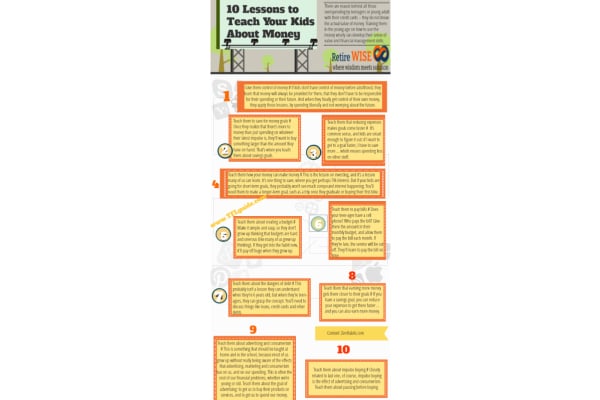
Lesson 1: Money is earned, not given. Children who grow up believing money arrives automatically – from parents, from “the bank,” from some abstract source – develop a fundamentally broken relationship with spending. Connect money to effort from the earliest possible age. Pocket money earned by completing tasks, however small, is worth more educationally than pocket money handed over without context.
Lesson 2: Spend less than you earn – always. This is the single most important financial rule in existence. Every debt crisis, every retirement shortfall, every financial catastrophe traces back to the violation of this rule over time. The earlier a child internalises that lifestyle must fit income – not the other way around – the more financially resilient their adult life will be.
Lesson 3: Save before you spend. The conventional approach is to save what is left after spending. The correct approach is to spend what is left after saving. Teach this with pocket money: when money arrives, a portion goes to savings first. Always. Before anything else. This is the habit that separates people who build wealth from people who do not.
Lesson 4: Distinguish needs from wants. A want is not automatically a bad thing. A need is not automatically a good investment. The skill is in consciously categorising expenditure rather than defaulting to spending on anything that generates desire. A child who can articulate why they want something – and whether it is worth it – is building financial judgment.
Lesson 5: Debt is future income borrowed today. When you buy something on EMI or credit, you are spending money you have not yet earned. The phone you buy in January on 12-month EMI is being paid for by the person you will be in December – who may be under more financial pressure than you are today. Teach children to feel the weight of future obligation before taking it on.
Lesson 6: Compound interest works both ways. Show them the maths. Rs 1,000 saved every month from age 20, growing at 10%, becomes Rs 2.3 crore by age 60. The same Rs 1,000 per month in credit card debt at 36% annual interest becomes a crisis within 2 years. Compounding is the most powerful force in personal finance – and it works for or against you depending entirely on which side of it you are on.
Lesson 7: Never make financial decisions under social pressure. The reader’s letter above captures this perfectly. Her son spent to maintain the appearance of “class” among wealthy peers. Peer pressure is the most reliable engine of financial destruction for young people. The ability to say “I cannot afford that right now” – or better, “I choose not to spend on that” – is a superpower that very few young Indians are taught to exercise.
Lesson 8: Insurance is not an investment. When your child starts their first job, the first financial product a bank will try to sell them is a ULIP or endowment policy dressed up as “savings.” Teach them early that insurance and investment are separate needs served by separate products. A term plan for life cover, a health insurance policy for medical costs, and a mutual fund for wealth building – three separate things, not one bundled product that does all three badly.
Lesson 9: Track where money goes. Most adults have only a vague idea of where their money goes. Most of what they call “discretionary spending” is actually habitual spending that never gets questioned. Teach children to track their expenses – even informally – so spending is a choice rather than something that happens to them. The act of tracking creates awareness; awareness creates choices.
Lesson 10: Time is the most valuable financial asset. A 25-year-old who starts a SIP of Rs 5,000 per month will accumulate more than a 35-year-old who starts a SIP of Rs 15,000 per month, assuming the same return and the same retirement age. The advantage of starting early is so large that it cannot be compensated for by higher contributions later. The earlier they start, the less they need to save. This is the lesson that – if internalised at 22 – changes everything.
Read – Retirement Planning vs Child Future Planning: Why You Must Choose One First
Read – Instant Gratification Is Hazardous to Your Wealth
Frequently Asked Questions
At what age should I start teaching children about money?
Earlier than most parents think. By age 6-7, children can understand the concept of earning and saving. By 10-12, they can manage a small weekly or monthly allowance with guidance. By 15-16, they should understand the basics of budgeting, compound interest, and the difference between needs and wants. The habits formed before 18 are the ones most likely to persist into adulthood – for better or worse.
How do I teach financial discipline without making my children anxious about money?
The goal is not to create anxiety – it is to create awareness and agency. Teach with curiosity, not fear. “What would you do if you had Rs 1,000 right now?” is more effective than “you need to learn about money because life is hard.” Let them make small mistakes with small amounts. Celebrate good choices. Do not punish every poor decision. The emotional tone of financial education matters as much as the content.
My teenage child already has poor spending habits. Is it too late?
No. Habits formed in the teenage years can be changed – particularly when the person developing them starts to feel the consequences. The most effective way to reset spending habits with a teenager is not lecturing: it is giving them real financial responsibility (a monthly allowance for all discretionary expenses), real consequences (when it is gone, it is gone), and genuine curiosity about their choices without judgment. Most teenagers respond to being treated as capable of making good decisions.
The child who learns that saving matters, that debt has a cost, and that compound interest is on their side will retire 10 years earlier than the one who did not. And that child’s parents will sleep easier in retirement too – knowing their financial independence is not contingent on a child’s financial capacity.
Financial education is not a subject. It is a habit. And habits are caught, not taught.
Thinking about how to balance your children’s future with your own retirement?
RetireWise helps senior executives build retirement plans that are financially independent – so your children’s success is a bonus, not a necessity.
💬 Your Turn
What is the one financial lesson you wish you had learned before your 20s? And are you actively teaching that lesson to your children – or hoping they figure it out themselves? Share in the comments.
Great article
is there any possible in telugu language please
nice article, very well explained,
Thanks
Well…parents should be preaching what they practice. And the nuance is to practice in the presence and knowledge of kids. Kids are keen observers of whatever interests them. Well…and once they observe it becomes less difficult to explain things to them…excellent article…i thought the parent’s role was splendidly highlighted…
Hi Hemant,
The article is simply AWESOME.
My mom was very good at saving money and we have learnt a lot on this subject from her.
But as a daughter and now as a mother, I have experienced that only one parent can not sow this seed of financial learning in the child. You have very rightly mentioned that both the parents should first set an example and then teach their children.
Its seen often that many parents are of the opinion that there child is too young to understand financial matters, and that we must not put such pressure on them. They will learn on their own.
I would like to share what my mom did. She gave us piggy banks and inspired us to put all the money which we had into this piggy. Once in a year, after our exam results, she used to buy us new clothes out of those savings. As a child it was a moment of pride for us to wear clothes out of our own savings.
Dear Hemant,
a stunning article that educate even adults like me.
Hi Chuimei,
As Asif said “better late than never”.
Dear Hemant,
Great article. What if we have been conveyed in our
childhood, something would have been changed.
But better late than never.
For our kids, very good lesson.
Keep it up bro
Regards
Hi Asif,
Good that you understand the importance.
Very nice guideline to prepare the kid’s future and parents also.
Thanks Mudrika 🙂
Dear Mr.Hemant,
Greetings. Very good posting for both. Reminder for parents and lesson for kids. Thanks.
sekar
Hi Sekar,
Absolutely – if parents will not follow the rules how they will inspire their kids.
I loved this video which teaches some of the same concepts detailed in this post in a very entertaining way
Hi Sagar,
Thanks for sharing this link here – sometime back I shared this in TFL newsletter.
This post is truely insightful. Thanks
Thanks Vaisahli 🙂
Dear Sir,
Very excellent post for kids future.
Ankush More
Thanks Ankush.
I think if we get our kids (college going) to do part-time work during their holidays or even during their college/university, they will realize the value of money, realize how easy or difficult its to earn something!
Hi Shiv,
This is an awesome idea – this way they will definitely learn the value of money.
Hi Hemant,
thanks for all the informative articles.
Want to know how to escalate when there is poor reply from TATAAIA customer service. When I asked they are not providing. Sad to say they are not helping in paying the premiums.
Have found the solution now – but want their top management to know the bad service they are giving.
Thanks
EXCELLENT…..
🙂
Very useful post.
Thanks Anil.