
Last Updated on April 23, 2026 by teamtfl
“The simplest things are often the truest.” – Richard Bach
When I started in financial planning in the late 1990s, the biggest challenge was not finding the right mutual fund. It was getting people to start. The hesitation was always the same: “I’ll invest when the market is right.” “I’ll start once I understand it better.” “I’ll do it after Diwali.”
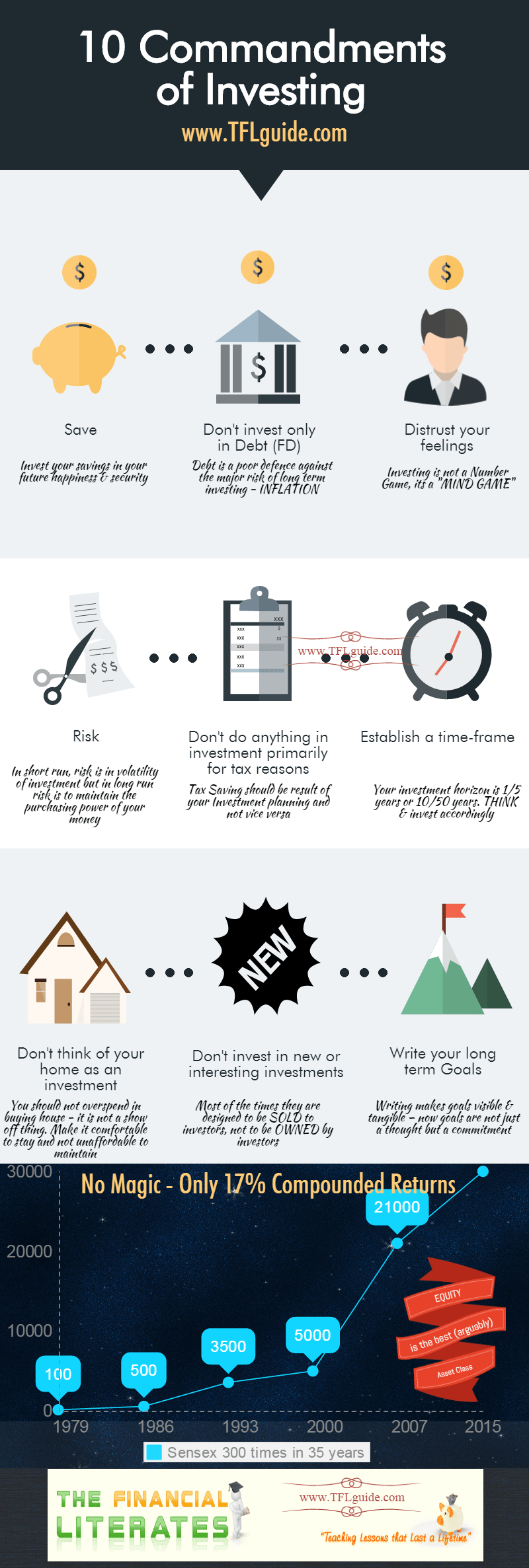
The commandments in this infographic are my answer to those hesitations. None of them are complex. All of them matter.
⚡ Quick Answer
The 10 commandments of investing are timeless principles that determine long-term investment success far more than any fund selection or market timing decision. The core insight: investing is not primarily a technical skill – it is a behavioural one. The investor who starts early, invests regularly, diversifies, ignores short-term noise, and stays the course will almost always outperform the investor who spends their time trying to pick the perfect fund or the perfect entry point.
Why These Commandments Still Matter in 2026
This infographic was created over a decade ago. None of it is outdated. The fundamentals of investing have not changed, and they will not change, because they are grounded in human psychology and economic reality – not in market conditions or product features.
What has changed: the products available (more index funds, direct plans, robo-advisors), the platforms (SIPs are now automated in seconds), and the market level (Sensex was 28,000 in 2015, it crossed 75,000 in 2024). What has not changed: the investor who panics and sells during corrections, who chases last year’s best-performing fund, and who invests in things they do not understand, still loses. Year after year, cycle after cycle.
Let me expand on the three commandments that matter most in my experience.
Start Early and Let Time Do the Heavy Lifting
A 25-year-old who invests Rs 5,000 per month at 12% CAGR until retirement at 60 will accumulate approximately Rs 3.2 crore. A 35-year-old who invests the same amount at the same return will accumulate approximately Rs 1.0 crore. Ten years of delay costs Rs 2.2 crore – not because of the money invested, but because of the compounding years lost.
The mathematics of compounding is unforgiving about time. The first decade of investing is not where the returns come from – it is where the foundation is built. The returns come in the third and fourth decades. Delay the foundation and you get a smaller building regardless of how hard you work later.
Saving for investing is therefore not optional. It is the first commandment because nothing else works without it.
The best time to start was 10 years ago. The second best time is today.
RetireWise builds investment plans that account for your specific starting point, timeline, and goals – and tells you exactly what is achievable from here.
Don’t Put All Eggs in One Basket
This commandment sounds obvious but is violated constantly. The most common violation is not putting all money into one stock – it is putting all of the investment portfolio into a single asset class. The person whose entire retirement savings is in fixed deposits. The person whose entire portfolio is in real estate. The person who took a 2021 tip on a small-cap stock and concentrated 40% of their wealth in it.
Diversification is not about owning many things. It is about owning things that behave differently under different conditions. Equity and debt move inversely in many market conditions. Gold and equity are loosely negatively correlated in crisis periods. A portfolio that combines these in appropriate proportions is more stable than any individual asset, and delivers better risk-adjusted returns over time.
For most Indian investors, a simple three-asset portfolio – equity mutual funds for long-term growth, debt funds or FDs for stability, and 8-10% gold for crisis hedge – is more than sufficient. Complexity beyond this rarely adds value.
Never Time the Market
Market timing is the belief that you can predict when the market will go up and when it will go down – and adjust your investments accordingly. Decades of research and the actual experience of millions of investors confirm that it does not work systematically. Even professional fund managers – who do this full time with teams of analysts – consistently fail to time the market over long periods.
The investor who waits for the “right time” to enter the market is always waiting. In 2020, the right time seemed like after the COVID crash resolved. In 2022, it seemed like after inflation peaked. In 2023, it seemed like after the election uncertainty resolved. Every year has a reason to wait. The investor who waited missed compounding that is now impossible to recover.
SIPs eliminate this problem structurally. When you invest a fixed amount every month regardless of market level, you automatically buy more units when prices are low and fewer when they are high. Over time, this averaging effect produces better outcomes than lump-sum timing attempts by most investors.
Read: What Is Equity? The Right Way to Think About It
These commandments are not exciting. They will not make you rich in a year. They will, with patience and consistency, make you wealthy over two decades – which is the actual goal. Excitement in investing is usually a warning sign, not an opportunity.
Boring, consistent, and patient. That is the winning formula.
How many of the 10 commandments are you currently following?
RetireWise builds investment plans grounded in these principles – with goal-linked asset allocation, automated SIPs, and regular reviews to keep you on track.
Your Turn
Which of these commandments do you find hardest to follow – and which one has made the biggest difference in your own investing? Share in the comments.
Returns from equities may be high but fluctuate. What has been earned in one year may be lost in the next. Even capital can be eroded. There can therefore be no compounding in equities. The compounding rate is arrived at in hindsight to enable comparison with fixed income investments like FD, PPF, NSC etc. which are the right examples for compounding. Financial advisers should know that the lay investor’s understanding of the principal of compounding comes from his experience with FDs and cannot be replicated with investment in equities. I am quite sure the financial advisers know this but not clear why they misapply the principle of compounding to equity investing.
Hi Mahavir,
I completely agree with Volatility point but I in long term it’s important to keep the purchasing power. You should check this https://www.retirewise.in/debt-return/
This is very explanatory infographic. Apart from FDs, investments in PPF ,national saving schemes, annuity plans,equity saving schemes always give you tax benefits under section 80C.
Hemant, Your Infographic is so useful and insightful.
I have taken a print-out and kept it as a page opener in my investment records file. Though nearing my retirement age, these fundamentals still remain so true for me as an investor.
And finaally on your chart on Sensex returns, I drew one comparing the growth of my post tax salary, sesnsex, price of 10 grams of gold and per sq ft rate for a 3 BHK apartment in Adyar, Chennai from 1985 to 2015 and the look of the graph is amazing with sensex giving better yield and return than gold and property. And the post tax salary growth always gave enough indications that opportunities to save and invest in equity was always there, if one only makes a decision and start. No wondr I have asked my chemical engineer daughter to start save, invest in equity and only then think about expenses and spending her monthly salary income.
Hemant, continue the good work. Regards, Dr. S. Hariharan.
Thanks Dr. S. Hariharan for appreciating our effort 🙂
Hi Hemant,
im a NRI, working in singapore. I would like to invest .
am i eligible to to invest ?
Please guide me.
Hi Hemant, Another good and very impressed article for me. You have opened my eys.
I already started thinking and follow as per your guidelines.
Thanks for this article and looking forward for another one.
Another great article Hemant! I have recently started following your blog and the way you put things in perspective is great. I’ve learnt quite a few lessons myself and plan to follow more of your investment guidelines.
Thanks and keep up the good work!