
Last Updated on April 22, 2026 by Hemant Beniwal
“Price is what you pay. Value is what you get.” – Warren Buffett
March 2020. The Sensex fell 38% in 40 days. Clients were calling every hour. One of them asked me a question I have never forgotten: “Hemant, what changed? Three weeks ago everyone was saying the market would hit 45,000. Now the same experts are saying it will fall to 20,000. The companies are the same. What changed?”
The answer to that question is what this article is about. Stock prices are not the same as company values. They move for reasons that go far beyond quarterly earnings – and understanding those reasons is the difference between an investor who holds through corrections and one who sells at the bottom.
⚡ Quick Answer
Stock prices change due to four categories of factors: fundamental (company earnings and growth expectations), economic (GDP growth, interest rates, inflation), technical (momentum, liquidity, algorithmic trading), and sentimental (fear, greed, news, FII flows). In the short term, sentiment and technical factors dominate. In the long term, fundamentals prevail. This is why a great business bought at a reasonable price almost always rewards a patient investor – and why trying to trade on short-term price movements is a game most retail investors lose.
Factor 1: Fundamentals – The Anchor That Always Wins Long-Term
A stock represents ownership in a business. At the most basic level, the price you pay reflects two things: the earnings the business generates today, and the market’s expectation of how those earnings will grow in the future.
Current earnings (EPS). Earnings Per Share – the company’s net profit divided by its outstanding shares – is the most direct measure of what you are buying. The Price-to-Earnings (P/E) ratio tells you how many years of current earnings you are paying for. A P/E of 20 means you are paying 20 years of current earnings for the stock. Whether that is cheap or expensive depends on the growth expectations for those earnings.
Future growth expectations. This is where most of the volatility lives. If a company is expected to double its earnings in 3 years, investors will pay a high P/E today in anticipation of those earnings. If those growth expectations are revised downward – even slightly – the price can fall sharply even though the company’s current earnings are unchanged. This is why high-growth companies have high P/E ratios and are more volatile than slow-growth businesses.
“The question my client asked in March 2020 had a simple answer: sentiment changed, not companies. The businesses were the same. The earnings would recover. The investor who understood this and held – or better, bought more – was rewarded. The one who sold because the price fell missed one of the fastest recoveries in market history.”
– Hemant Beniwal, CFP, CTEP | Founder, RetireWise
Factor 2: Economic Conditions – The Tide That Lifts All Boats
Company fundamentals do not exist in isolation. They are embedded in an economy, and the health of that economy affects every company’s earnings capacity.
GDP growth. When the economy grows, consumer spending increases, businesses invest more, and corporate earnings tend to rise across the board. A strong GDP growth environment creates a tailwind for stock prices. When GDP contracts or decelerates, the reverse happens.
Interest rates. The RBI’s repo rate is the single most important macroeconomic variable for stock prices. When the RBI raises interest rates, two things happen: borrowing becomes more expensive for companies (reducing profits), and fixed-income alternatives like FDs and bonds become more attractive relative to equities (reducing demand for stocks). Both forces push stock prices lower. Rate cuts have the opposite effect. This is why markets often rally when the RBI cuts rates.
Inflation. Moderate inflation is healthy for corporate earnings – companies can raise prices and grow revenues. High inflation erodes consumer purchasing power and squeezes margins. It also typically triggers rate increases from the RBI, with the secondary effects described above.
Do short-term stock market movements keep you up at night?
A RetireWise retirement plan includes a stress-tested investment strategy designed to hold through market volatility – so your retirement corpus is not dependent on predicting market direction.
Factor 3: Technical Factors – The Short-Term Noise
In the very short term – hours to days – stock prices are often driven by factors that have nothing to do with business value.
Momentum and trends. Stocks that have recently risen attract attention. Algorithms and momentum traders buy because the price is rising, not because the business has changed. This creates self-reinforcing uptrends. Until sentiment shifts, at which point the same momentum works in reverse. The oscillations in both directions can be extreme and entirely irrational from a business value perspective.
Liquidity. A heavily traded stock (high liquidity) can absorb large buy and sell orders without moving the price dramatically. A thinly traded small-cap stock can move 5-10% on a relatively small transaction simply because there are few willing buyers or sellers at any given price. Small and mid-cap stocks carry a permanent liquidity discount for this reason.
Institutional flows. Foreign Institutional Investors (FIIs) can move the broader market simply through the scale of their buying and selling. When global risk appetite falls – as in 2022 when the US Federal Reserve began aggressive rate hikes – FIIs sell emerging market equities indiscriminately, regardless of individual company quality. This creates price falls that bear no relationship to the underlying businesses.
Factor 4: Sentiment – The Most Powerful Short-Term Driver
Stock markets are aggregated human psychology as much as they are aggregated business value. And human psychology is driven by two emotions: fear and greed.
In bull markets, optimism feeds on itself. Valuations stretch far beyond what fundamentals justify. In bear markets, fear feeds on itself. Valuations compress far below what fundamentals support. Both extremes create opportunities for investors who understand this dynamic and act counter-cyclically.
News – positive or negative – is the trigger that shifts sentiment. A quarterly earnings beat, a regulatory change, a geopolitical event, a pandemic, a management scandal – each of these shifts the market’s collective mood, which immediately moves prices. Whether those price moves are justified by the underlying business reality is a separate question that the market eventually answers, but usually much later.
The Practical Implication for Retirement Investors
Understanding why stock prices change leads to one clear conclusion for the retirement investor: short-term price movements are mostly noise. They reflect sentiment, momentum, and macroeconomic reactions – not changes in the underlying value of the businesses you own through equity mutual funds.
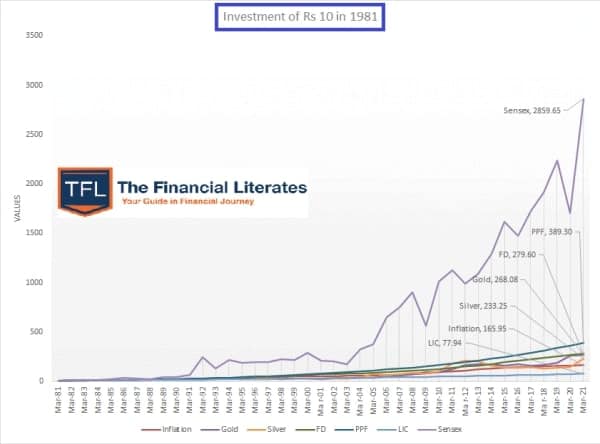
Asian Paints traded at Rs 30 in 2005. Rs 80 in 2009 (after falling through the 2008 global financial crisis). By January 2021, it had touched Rs 2,845 – nearly 35 times the 2009 low. The business was excellent throughout this period. The price reflected that excellence over time, even while short-term movements bore no relationship to the business’s actual quality.
This is why time in the market, not timing the market, is the fundamental principle of equity investing for retirement.
Read – Direct Investing in Stocks: Why Most Indian Retail Investors Lose Money
Read – Portfolio Rebalancing: When and How to Rebalance
Frequently Asked Questions
If fundamentals determine long-term stock value, why do good companies sometimes perform poorly for years?
Even fundamentally strong companies can underperform for extended periods if they are bought at too high a valuation. A wonderful business bought at 60x earnings may take 5-10 years for the business growth to “catch up” to the price paid. This is why valuation – what you pay relative to what you get – matters alongside business quality. It is also why diversifying through mutual funds rather than concentrating in individual stocks protects against paying too high a price for any single business.
How much should I follow daily market news as a retirement investor?
Minimally. The news that drives daily market movements is almost entirely irrelevant to a 15-20 year retirement investment horizon. In 25 years of advising clients, the most financially successful ones were almost always those who checked their portfolios less frequently, not more. If your retirement plan is properly constructed for your risk capacity and timeline, a 20% market correction should trigger a rebalancing review, not a panic exit. Daily news should trigger neither.
Should I try to buy when prices fall sharply, like in a market crash?
Timing market corrections is extremely difficult even for professionals – the 2020 COVID crash recovered faster than almost anyone predicted. A more reliable approach: maintain a standing SIP that automatically buys more units when prices fall (since the same rupee amount buys more units at lower NAVs), and rebalance your portfolio according to your target allocation when equity drifts significantly below its target weight. These mechanical approaches capture the benefit of lower prices without requiring you to predict market bottoms.
Stock prices tell you what someone was willing to pay at a given moment under a given set of emotions. Business value is what the underlying enterprise is actually worth based on its earnings capacity. Over the short term, price and value diverge frequently. Over the long term, they converge reliably. The retirement investor’s job is to own good businesses through good funds, maintain the right allocation, and let time do the work.
Price is what you pay. Value is what you get. Time is what closes the gap.
Want an investment strategy that is designed for long-term value, not short-term noise?
RetireWise builds retirement portfolios based on long-term fundamentals and disciplined allocation – so market volatility is a feature of the plan, not a threat to it.
💬 Your Turn
Has understanding why stock prices change made you a calmer investor? Or do you still find yourself reacting to market movements? Share your experience in the comments.
Thanks Hemant. Excellent article again. Explained in simple terms for laymen as always!
Request you to write a similar basic article on stock market terms, like call and put options, derivatives, forward buying/selling, hedging, etc.
Thanks Dhruv Ji.. I don’t think the terms that you mentioned have any relationship with investments 😉