
Last Updated on April 4, 2026 by teamtfl
The last time every expert told you to buy gold, it was at Rs. 18,800 per 10 grams. That was 2010.
It’s now Rs. 1.52 lakh. The same experts are saying buy again.
Before you do — understand what gold actually is. Not what your jeweller tells you. Not what the WhatsApp forward says. What it actually is, in your financial plan.
We first wrote about this in 2010 when the “should I buy gold?” question was everywhere. Fifteen years later, the question is identical. The price is eight times higher. And the core answer hasn’t changed — though it has some important new nuances.
⚡ Quick Answer
Gold at Rs. 1.52 lakh per 10g (April 2026) isn’t a reason to buy more — or to sell what you have. Gold is insurance, not an investment. Hold 5–15% of your portfolio in gold as an asset allocation anchor. If you’re below that, buy gradually. If you’re above that, stop adding. Don’t chase the rally. For new gold purchases, prefer Sovereign Gold Bonds (SGBs) or Gold ETFs over physical gold — lower cost, no purity risk, and SGBs held to maturity are tax-free.
What Gold Actually Is — and Why That Changes Everything
To understand gold, you have to understand what it’s not. It’s not a business. It doesn’t earn revenue, pay dividends, or create jobs. It doesn’t compound. It sits there, holding value — and sometimes holding it spectacularly well.
Gold is a currency. The oldest one. When paper currencies lose credibility — due to inflation, war, geopolitical panic, or central bank excess — people flee to gold because it can’t be printed. No government can manufacture more of it overnight.
Think of gold the way you think of fire insurance on your house. You don’t buy fire insurance hoping your house burns down. You buy it because if it does, you’re not destroyed. Gold is the fire insurance on your financial plan. When everything else is on fire — equities crashing, currency collapsing, bonds yielding nothing — gold holds. That’s its job. That’s all its job.
The mistake most Indians make is treating gold as a wealth-creation vehicle. It’s not. Over the last 30 years, the Sensex has risen approximately 140 times. Gold has risen approximately 80 times in rupee terms over the same period — impressive, but far behind equities and much of that gain was driven by rupee depreciation against the dollar, not gold’s intrinsic wealth creation.
Why Gold Is at Rs. 1.52 Lakh — and What That Tells Us
Gold crossed Rs. 1.52 lakh per 10 grams in April 2026, an all-time high. Internationally it’s trading at approximately $4,800 per ounce. The rally has been driven by three forces running simultaneously.
First, a weakening US dollar. Gold is priced in dollars globally. When the dollar weakens, gold rises in dollar terms — and since the rupee has also weakened to approximately Rs. 84 per dollar (from Rs. 46 in 2010), the price rise in rupee terms is even more dramatic.
Second, central bank buying. Central banks globally — including India’s RBI — have been accumulating gold aggressively since 2022, reducing dependence on dollar reserves. This structural demand has put a floor under prices.
Third, geopolitical anxiety. US tariff wars, global trade uncertainty, and persistent inflation fears have pushed investors toward safe-haven assets. Gold benefits every time the world feels unstable.
💡 The rupee-dollar factor: In 1980, $1 = Rs. 8. Today, $1 ≈ Rs. 84. Gold was Rs. 1,450 in 1980. Today it’s Rs. 1,52,000. Much of that 105x rise in rupee terms is rupee depreciation, not gold appreciation. In dollar terms, gold has risen from $400/oz in 1990 to $4,800/oz today — about 12x in 35 years. The equity market has done far more over the same period. Gold’s rupee returns look impressive partly because India’s currency has weakened significantly over decades.
Gold’s Price History — What the Long View Shows
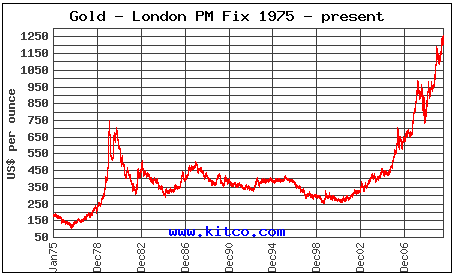
The chart above covers 1975–2010 — a period containing one of gold’s most instructive lessons. Gold ran from $100/oz in 1976 to $850/oz in 1980 on fears of US economic collapse, the Vietnam war hangover, and Iranian revolution-driven inflation. Everyone said buy gold.
Then peace came, inflation eased, and gold crashed. By 1990 it was at $400/oz. By 2000 it was at $250/oz. It took 28 years to recover its 1980 peak price. The people who bought at the top in 1980 had to wait nearly three decades to break even.
Today’s gold at $4,800/oz is driven by similar forces — dollar weakness, geopolitical anxiety, central bank buying. The rally may continue. JP Morgan projects prices could reach $5,000/oz by end of 2026. But nobody can predict when the forces reverse. And when they do, gold corrects — sometimes for decades.
🚨 The expert problem: In 2010, experts were saying buy gold when it was at Rs. 18,800. At Rs. 1.52 lakh, the same experts are saying buy gold. In 1980, experts were saying buy gold at $850/oz. By 2000 it was at $250/oz. Experts don’t know when gold peaks. Neither do we. That’s why the answer isn’t “buy now” or “sell now” — it’s “hold the right allocation and don’t chase.”
How Much Gold Should You Actually Hold?
The right gold allocation for a senior executive building a retirement plan is between 5% and 15% of total investible assets. Where you fall in that range depends on your situation:
| Your Situation | Suggested Gold Allocation | Rationale |
|---|---|---|
| Predominantly equity portfolio, approaching retirement | 10–15% | Gold hedges equity volatility — useful as you near withdrawal phase |
| Already holding significant physical gold (jewellery included) | 5% financial gold only | Count jewellery in total allocation — most Indian families already exceed 15% |
| Large equity corpus, stable income, low anxiety about markets | 5–10% | Insurance allocation — enough to provide a floor, not enough to drag returns |
| Inherited gold or gold-heavy portfolio (>20%) | Rebalance gradually toward 15% | Too much gold drags long-term wealth. Don’t concentrate in any single asset class. |
The most important number in the table above: most Indian families already hold more gold than they think when jewellery is counted. If your household has Rs. 30 lakh in jewellery and Rs. 1 crore in financial assets — you’re already at 30% gold allocation. You don’t need more.
How to Buy Gold in 2026 — Physical vs Sovereign Gold Bonds vs Gold ETFs
If you’ve decided your gold allocation is below target and you want to add, here’s the updated hierarchy of options:
| Option | Pros | Cons | Tax on Gains |
|---|---|---|---|
| Sovereign Gold Bonds (SGBs) | 2.5% p.a. interest + gold price gain. Tax-free on maturity (8 years). RBI-backed. | 8-year lock-in. New issuances paused — buy from secondary market on NSE/BSE. | Tax-free if held to maturity |
| Gold ETFs | Liquid, low cost, no storage risk, exact gold price tracking. | No interest income. Demat account needed. | 12.5% LTCG (held >24 months) |
| Physical gold (coins/bars) | Tangible. No counterparty risk. | Making charges lost. Storage risk. Purity uncertainty. 3% GST at purchase. | 12.5% LTCG (held >24 months) |
| Physical jewellery | Cultural value. Wearable. | Making charges (5–35%) are sunk cost. Resale value always below purchase price. | 12.5% LTCG + making charges lost |
Note: Budget 2024 changed LTCG on gold to 12.5% without indexation for sales after July 23, 2024. SGBs held to maturity (8 years) remain capital gains tax-free. Interest on SGBs is taxable at slab rate.
The verdict is clear: if you’re adding gold to your portfolio for investment purposes, SGBs from the secondary market are the most tax-efficient option. Gold ETFs are the most liquid. Physical gold carries the highest cost and should be bought only for cultural or jewellery purposes — not as an investment vehicle.
Unsure how much gold fits your retirement plan?
At RetireWise, we help senior executives build balanced retirement portfolios — gold, equity, debt, and income all in the right proportions for your specific situation.
Gold vs Equity — The 30-Year Scorecard
Indians love gold. The data suggests they should love equities more.
Gold in rupees went from Rs. 1,450 per 10 grams in 1980 to Rs. 1,52,000 today — approximately 105 times in 45 years, or around 11% per annum. Sensex went from 100 in 1979 to 73,000+ today — approximately 730 times, or around 15% per annum compounded.
The difference between 11% and 15% compounded over 40 years isn’t small. It’s the difference between Rs. 1 lakh becoming Rs. 72 lakh (gold) versus Rs. 2.6 crore (Sensex). Three and a half times more wealth — simply by being in equities instead of gold.
This isn’t an argument against gold. It’s an argument for the right allocation. Gold as 5–15% of your portfolio does its insurance job. Gold as 50% of your portfolio is a drag on your retirement corpus that compounds over decades.
As Warren Buffett said: “We live in a world where 80 years out of 100 will be good. But we don’t know which 20 will be bad.” Gold is for those 20 bad years. Equities are for the other 80.
For more on building a long-term retirement portfolio that gets the equity-gold-debt balance right, read our guide on the best investment options for senior citizens in India. And for how to use your Sensex PE reading alongside gold allocation decisions, see our post on Sensex PE ratio and market valuation.
Frequently Asked Questions
Gold at Rs. 1.52 lakh isn’t a reason to panic or to celebrate. It’s simply doing what good insurance does — being there when the world feels unstable.
Keep the right amount. Don’t chase the rally. Let equities build your wealth.
💬 Your Turn
What percentage of your portfolio is in gold right now — including jewellery? Are you feeling the pressure to buy more at these record levels? Share below.
what u suggest e-gold or etf?
A really gud article on gold price over various decades.
Hi,
I am looking for a platform to trade in Silver and Gold.. buying it physically attracts unnecessary costs and I get it at higher rates than the CMP.. Could you please help me as to where(Broker) I can trade from and also if I need to only trade in futures.. Some directions to know before trading…
Thanks in advance.
Hi Priyesh,
Trading is most expensive hobby that one can have. Even after carnage of silver prices – are you really serious about trading? THINK
Hi Hemant,
You are right trading is expensive and I also know the only person earns even if I make profit or lossess is my broker… I chose the wrong word for my original motive… I am looking at some good schemes to invest in gold, silver etc. I think they are called ETFs but there seems to be many schemes and I dont know which one to go for… I am already taking up HDFC Top 200 Growth SIP the only disappointing fact is I dont get Tax benefit… sheesh it seems somewhere I will have to compromise with some of my needs..
with either tax or higher returns or lower Expenses or liquidity or smaller payments… why cant we have all in one :-((
Hi,
Really good article.
I think only commodity that could be liquidated easily is GOLD, so in What percentage, do you think that, investment in GOLD is necessary in anyones portfolio?
Thanks,
Anupam N
Hi Anupam,
It can be 10% of your portfolio.
Hi Hemant
I have practically no physical gold.I have a daughter who will get married after a few years.I have recently started investing in Reliance Gold Savings Fund.This investment is even less than 1% of my portfolio.
Hi Hemant
Really nice articel, this should help everyone to formulate thier investment strategies in Gold. The data representation is really helpful.
Thanks
Prashant Paul
Thanks Prashant.
Hi………….
My goal is around R.s 50, 00, 000 in after 30 year.
Now i am investing Rs. 1000 in HDFC Top 200 Growth fund.
Also i have one hdfc standard super endorment policy where i am investing Rs. 16000 per annum.
I have one future generali policy where i am investing R.s 5000 Per annum.
& two LIC where i am ivesting Rs 10000 per annum.
My target is in 2035 & 40 minimum amt i will get 50,00,000.
So please advise in which fund i can invest & how many for per month.
Hi Rakesh,
I will suggest you to use planner that is given in this page
https://www.retirewise.in/2011/04/franklin-templeton-family-solutions.html
i like your articles on gold.i want to invest in indian equity mutual fund and shares.how i should i select.pl.gide me.
Hi Anup,
I will suggest – avoid direct stocks. Participate in equities through mutual fund route.
Dear HB,
Wonderful article. You literally shook my desire of buying gold…
Thanks lot
SD
Thanks SD but don’t blame me if gold touches Rs 30000 😉
Hemant,
Good article. I think that gold and real estate are avenues for the people who have loads of black money with them. A service class person, like me, who doesn’t have black money, will rather want to invest more in the equity than gold.
Hi Sumeet,
Yes lots of black money goes in these assets & specially real estate price are affected due to it.
Thanks for updating my knowledge. It is a very good article.
Thanks again.
V K Aggarwal
Welcome Mr Agarwal
Your article on Gold purchase is eye opener.
The timing of article is just perfect
Thanks for keeping us updated.
Thanks Deepak.
But we hate word TIMING 😉
We are the worst timers in the market and we are happy about it. (so we never try to time the market or our views)
We just share what we feel right.