

Last Updated on April 14, 2026 by Hemant Beniwal
Every bull market produces the same type of investor. Confident. Convinced. Certain this time is different.
And every market bubble produces the same ending.
⚡ Quick Answer
A market bubble forms when asset prices rise far above their fundamental value, driven by speculation, easy money, and herd psychology. Bubbles always burst. The damage depends on how leveraged the participants were. The best protection is not to predict the bubble — it is to never be overexposed to any single asset class.
We Have Seen This Before — Many Times
In 1637, tulip bulbs in Holland were selling for more than a skilled craftsman earned in ten years. In 2000, loss-making companies with “.com” in their names were valued higher than century-old manufacturers. In 2021, a single tweet from Elon Musk moved the price of a cryptocurrency by 30%.
India has had its own share. The Harshad Mehta bull run of 1992. The technology euphoria of 1999-2000. The real estate frenzy of 2005-08. The small-cap mania of 2017-18, where mid and small-cap mutual funds attracted billions only to lose 40-60% in the following correction.
Each time, investors who rode the wave up said they knew what they were doing. Each time, the same investors were shocked when it ended.
What Exactly Is a Market Bubble?
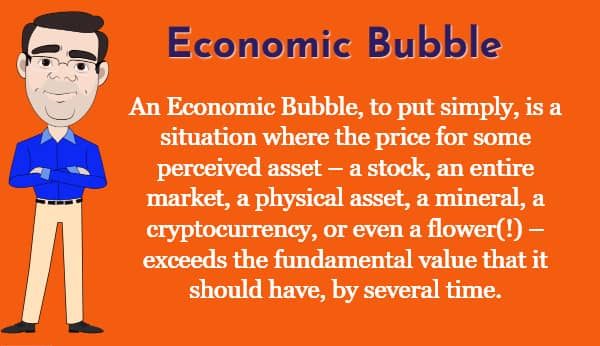
An economic bubble is simple to define: asset prices rise far above what the underlying fundamentals can justify. A stock worth Rs 100 based on its earnings and growth potential trades at Rs 1,000. Real estate in a tier-3 city sells at Mumbai prices. Crypto tokens with no underlying value are worth more than established businesses.
The tricky part is not the definition. It is the psychology. While you are inside a bubble, it does not look like a bubble. It looks like an opportunity. Everyone around you is making money. The financial media calls it a new paradigm. Your neighbour tells you he turned Rs 2 lakh into Rs 20 lakh in six months.
That feeling – that you are missing out on something real – is exactly what a bubble feeds on.
The Anatomy of a Bubble: Seven Stages
Nobel Laureate Robert Shiller identified the common pattern. Every bubble moves through the same stages, even when the underlying asset is completely different.
Stage 1 – The Spark: A new technology, a policy change, or genuine economic improvement creates real enthusiasm. Early investors make real gains. The story is legitimate.
Stage 2 – The Narrative Spreads: Success stories circulate. Word of mouth, WhatsApp forwards, financial TV channels amplify the gains. More people enter.
Stage 3 – Prices Accelerate: Demand exceeds rational buying. Prices rise faster than fundamentals can justify. But the narrative explains it away: “This time is different.” “Old valuation methods don’t apply.”
Stage 4 – General Public Enters: This is the most dangerous stage. People who have never invested before open Demat accounts. Retirees move fixed deposits into equity. Family WhatsApp groups discuss stock tips. This is pure euphoria.
Stage 5 – Smart Money Exits: The people who created the bubble start quietly selling. They call it profit-booking. Prices wobble but recover. The narrative remains intact.
Stage 6 – The Trigger: Something – often a minor event – punctures confidence. A regulatory action. An earnings miss. A rate hike. Suddenly the same investors who were buyers become sellers.
Stage 7 – The Crash: Panic selling overwhelms the market. Leveraged positions unwind. Margin calls force more selling. The crash feeds itself. Prices overshoot on the way down just as they overshot on the way up.
Is your portfolio overexposed to any single theme or asset?
A structured annual review can identify concentration risks before a bubble finds them for you.
The Damage Bubbles Leave Behind
When bubbles burst, the damage is never uniform. It depends on three factors.
How leveraged were the participants? The 2008 global financial crisis was so catastrophic because mortgage-backed securities created an invisible web of leverage. When US housing prices fell, the losses multiplied across the global financial system. The US economy alone suffered an estimated USD 12.8 trillion in losses over the following decade.
In contrast, the dot-com bust of 2000 was painful but contained. Most investors lost their equity – not borrowed money.
How broadly did retail investors participate? The Harshad Mehta crash of 1992 wiped out many retail investors who had taken loans to buy stocks at peak valuations. The same pattern repeated in 2018, when the small and mid-cap correction destroyed portfolios of investors who had SIPed at the top based on recent-return chasing.
How connected was the bubble to the real economy? Japan’s equity and real estate bubble of 1989-92, when burst by the Bank of Japan through interest rate hikes, triggered a deflationary spiral that lasted over a decade. The country is still managing its aftermath.
Can You Spot a Bubble Before It Bursts?
The uncomfortable truth: most people cannot — at least not reliably enough to trade around it. Even professional fund managers get caught. Even economists who correctly identify a bubble can be wrong about the timing by years.
What you can do is watch for the warning signs: Price-to-earnings ratios at multi-decade highs. Widespread retail participation by first-time investors. Extraordinary returns in short periods generating FOMO. A common narrative that “old valuation rules don’t apply.” Borrowed money flowing into speculative assets.
When you see these signs, the right response is not necessarily to exit. It is to rebalance — reduce exposure to the overvalued asset, diversify, and make sure you have no leverage. The goal is not to predict the top. The goal is to be positioned so that a crash does not destroy you.
What History Actually Teaches Investors
Every bubble looks obvious in retrospect. Nobody sees it clearly from the inside. The best protection is not superior prediction — it is superior structure.
Diversification is not exciting. Asset allocation is not exciting. Annual rebalancing is not exciting. But they are the only tools that reliably protect investors from the concentrated damage that bubbles cause.
I have worked with investors who rode the 2017-18 small-cap mania all the way up and all the way down. The ones who were diversified lost less and recovered faster. The ones who concentrated in small-caps on the advice of recent performance stories took years to recover — if they recovered at all.
Like Icarus ignoring his father’s warning about flying too close to the sun, we tend to dismiss caution when the wind is at our back. The lesson is the same every time. The execution, however, requires discipline before the bubble — not during.
Frequently Asked Questions on Market Bubbles
How do I know if a market is in a bubble right now?
There is no single indicator, but warning signs include price-to-earnings ratios far above historical averages, widespread retail participation by first-time investors, assets rising 50-100% in less than 12 months with no fundamental change, and a dominant narrative that “this time is different.” When all four signs appear together, caution and rebalancing are warranted — not necessarily exit.
What is the difference between a market correction and a bubble burst?
A market correction is a normal 10-20% pullback from recent highs, usually driven by profit-taking or short-term uncertainty. A bubble burst is a collapse of 40-80%+ driven by the unwinding of leverage, panic selling, and a fundamental reassessment of asset values. Corrections are healthy and frequent. Bubble bursts are rarer but far more damaging — especially for investors who bought near the peak on borrowed money.
Should I exit the market if I think a bubble is forming?
Probably not entirely. Bubbles can persist for years after they are first identified — investors who exited the US tech bubble in 1998 missed two more years of gains before the 2000 crash. The more practical approach: reduce exposure to the overvalued asset class to a manageable level, eliminate any leverage, and make sure your overall portfolio can survive a 40-50% correction in that asset without disrupting your financial plan.
Are Indian small-cap and mid-cap stocks currently in a bubble?
Hemant to verify current valuations before publishing this answer — market conditions change and I will not put a specific view that could be stale by the time readers see it. What I can say: whenever small-cap and mid-cap valuations significantly exceed their 10-year historical averages on price-to-earnings and price-to-book measures, they deserve reduced allocation, not increased allocation based on recent returns.
You will not be able to time the next bubble. Nobody can. But you can make sure that when it bursts — as all bubbles eventually do — you are not in a position where it ends your financial plan.
Diversify. Rebalance. Do not borrow to invest. These are not exciting principles. They are the ones that keep you solvent when everyone else is not.
💬 Your Turn
Have you ever been caught in a bubble — real estate, crypto, small-caps, or any other? What did you learn from it? Share your experience below. Your story could help someone avoid the same mistake.
Informative article, it’s really helpful for a marketer.
Interesting and insightful one Hemanth.
In hindsight, it is easy to say that it was a bubble. Pertinent question is how to spot the Bubbles while they are building and before they burst. As you indicated at the beginning, in the current situation there are supporting arguments for for both cases i.e. bubble or long term bull run. I am sure that was the case in earlier bubbles too. Your insights will ne helpful.
It was very nicely explained Hemanth and appreciate taking time and bringing such nice blogs. What do you see the current economic growth, stock market are breaking highs.
What is your personal opinion on current situation ? Are we heading towards another bubble ?
Though the financial condition of our nation and world not healthy, due to Corona pandemic market continues to go up…. everyone is waiting when the correction will come…When the bubble will burst…Or may be operators may afraid of pm…..
Comments are closed.