

Last Updated on April 24, 2026 by teamtfl
A picture is worth a thousand words. And some investing concepts that take paragraphs to explain become instantly obvious when you see the right chart.
These five charts come from my own research – most of them took days to build, not hours. They represent ideas I have been explaining to clients for 25 years. They have not changed in importance. But the numbers in some have changed significantly, so this is the 2026 update.
The 5 questions these charts answer
1. Where to invest? (India) 2. Which asset to invest in? (Equity for the long term) 3. How to invest? (SIP) 4. What minimum return to aim for? (At least above inflation) 5. When to invest? (Always – no timing) – Credit to Madhupam Krishna for this elegant summary, which still stands in 2026.
Chart 1 – The long-term asset comparison chart
This chart shows 30-plus years of data across various asset classes – equity, gold, FDs, real estate, and inflation. The conclusion is stark and consistent: in the long term, equity is the clear winner. The difference is not marginal – it is enormous.
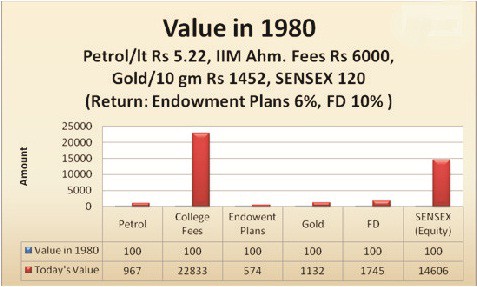
In the 35 years from 1990 to 2025, the Sensex delivered approximately 14 to 15% CAGR. Gold delivered approximately 10 to 11% CAGR. FDs delivered 7 to 8% pre-tax (5 to 5.5% post-tax for a 30% bracket investor). Inflation ran at approximately 6 to 7%.
The implication: FDs and debt instruments have delivered negative real returns (below inflation) for most high-bracket investors in most long periods. Equity has delivered 7 to 8% real returns consistently. This does not mean all your money should be in equity – it means equity must be the primary wealth builder in any long-term plan.
Also read: Why Fixed Deposits and Debt Returns Will Always Give Negative Real Returns
Chart 2 – The negative real return of debt
This chart makes the same point more directly: when you factor in inflation and tax, most debt instruments give negative returns in real terms. This is not a one-year phenomenon – it has been structurally true for most of the past 30 years in India.
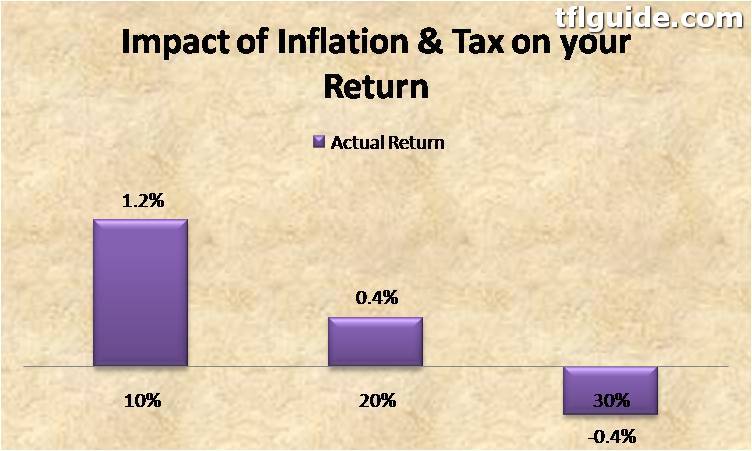
The calculation: SBI FD at 6.75% – 30% tax = 4.72% post-tax return. Inflation at 5.5% (CPI 2024-25 average). Real return = 4.72% minus 5.5% = -0.78%. The FD made you poorer in real terms.
This is not an argument against FDs for short-term goals or emergency funds. They have an important role. It is an argument against treating FDs as a long-term wealth creation tool. Safety is not the preservation of rupee value. Real safety is the preservation of purchasing power.
Chart 3 – Why people lose money in equity
This is a behavioural finance chart that shows the classic pattern: SIP inflows into equity mutual funds peak near market highs and crater near market lows. Investors pile in when others are excited, and exit when others are fearful. The result is that most investors earn far less than the market actually delivers.
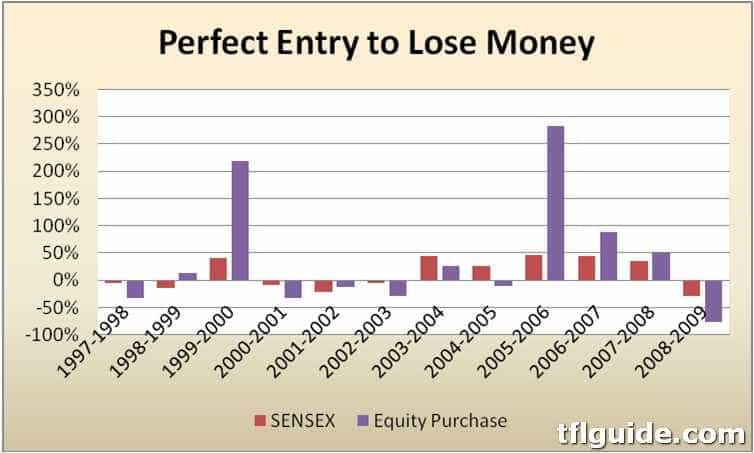
The DALBAR data I have cited elsewhere: US equity markets returned 9.14% annually from 1991 to 2010. Average equity investors received 3.27%. A 5.87% annual gap, compounded over 20 years, is the difference between Rs.1 lakh becoming Rs.58 lakh versus Rs.19 lakh. This is not a market problem. It is a human behaviour problem. Investing is not a numbers game – it is a mind game.
Also read: Behave Yourself Financially – The Most Important Investing Skill
Chart 4 – The magic of SIP through a market cycle
This chart shows what happens when a SIP runs through a semi-circular market – down 50%, then recovering to the original level. The investor feels like they broke even. But the SIP investor who kept investing through the bottom actually earned a 27% CAGR.
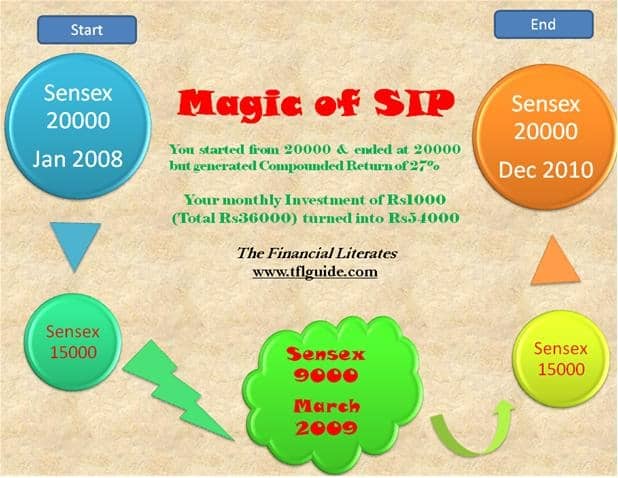
This is the mathematical reality of rupee cost averaging: buying more units when prices are low means your average cost is lower than the average price. When markets recover even to the starting point, you are significantly in profit. The investor who stops their SIP during a crash converts a paper loss into a locked-in shortfall.
Also read: SIP Complete Guide: How Systematic Investment Plans Actually Work
Chart 5 – India’s growth story
This chart shows India’s trajectory toward becoming the world’s third-largest economy – a Goldman Sachs projection that has been tracking well. The 2011 version of this post said India’s GDP growth was “nearing 9 to 10%.” The actual FY2023-24 GDP growth was 8.2%, making India the fastest-growing major economy for the third consecutive year.
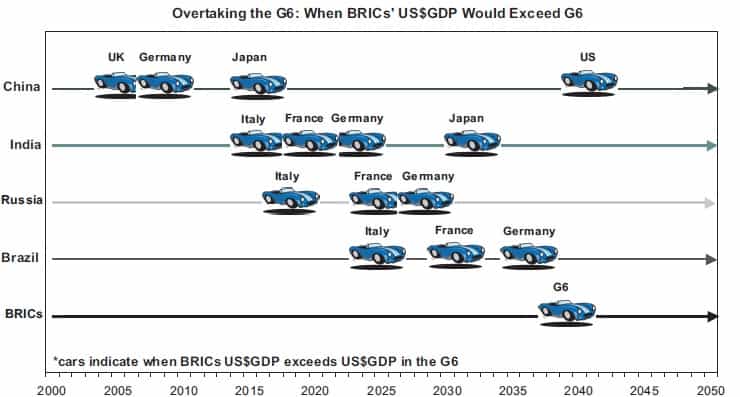
The investing implication is straightforward: if you believe India will grow – and the evidence is strong – equity participation in that growth is the most direct way to benefit. The stock market is, over long periods, a barometer of economic growth. If you do not believe India will grow, there is no rational basis for investing in Indian equity. If you do believe it, there is no rational basis for avoiding it in the long term.
Do these charts describe your current portfolio?
Charts 1 and 2 tell you equity must drive your wealth creation. Chart 3 tells you behaviour matters more than product selection. Chart 4 tells you SIPs must run through corrections, not stop. Chart 5 tells you India is the right place to deploy long-term capital. If your current portfolio reflects all five principles, you are in good shape. If not, a portfolio review might be overdue.
Frequently asked questions
Is equity always better than FDs in India over the long term?
Over any rolling 15-year period in India, diversified equity indices have outperformed FDs significantly after adjusting for tax and inflation. However, equity’s advantage requires time – 5-year periods can produce negative equity returns while FDs deliver positive returns. The comparison is only valid for long-term money (10-plus years). For money needed in under 3 years, debt instruments remain appropriate regardless of their lower returns.
Why do Indian investors underperform the market?
The primary reason is behavioural: investors increase investments when markets are high and attractive, and reduce or stop them when markets fall and are actually better value. This results in a higher average cost than the market’s average price, producing lower returns than a simple buy-and-hold or SIP strategy. Fear and greed override rational decision-making – particularly for investors without specific goal anchors to keep them invested.
Should I continue my SIP during a market crash?
Yes – and ideally increase it if you have the capacity. A market crash means lower prices, which means your monthly SIP buys more units at a lower average cost. When the market recovers, you benefit disproportionately. Stopping a SIP during a crash is the most reliable way to convert a temporary paper loss into a permanent shortfall. The SIP investor who kept investing through the 2008-09 crash recovered much faster than one who stopped.
Which of these five charts was most useful to you? Is there a concept about Indian investing you would like me to visualise? Tell me in the comments.
I have rs.15000 and I want to deposit on sip ..how much I received after five years
Hi Subhash,
Bit wrong question – I will suggest getting in touch with MF agent in your city.
Dear Hemant Beniwal,
I have started reading about financial planning recently and got your site, and you The Financial Literates E-course divided in 8 parts.
I am learning lot and getting my many doubts clear.
Thanks buddy to educate all of us.
You completed certain fine points there. I did a search on the topic and found a good number of folks
will go along with with your blog.
I want to spend money pls guidens me
It is an excelent article to understand that how SIP works and why we should invest through the SIP
Nice article
Dear Sir,
I am weekly reading your TFL guide course very excellent sir.
Sir my one question.
My firend lic agent he saying you invest in LIC jeevan anand plan monthly 2000 for 21 year but pls.suggest to me Where i do invest acutal your i am very cunfuse LIC good OR equity market my future
Because my monthly salary is 8000
Pls.help me sir.
A good indeed. Thanks Hemant for the details. I am a strong beleiver of investing in Equity-Debt mix in approporiate proportions. It will be good if you can provide the readers with some scientific tools which help them to calculate right proportions of investment as per their age and earning potential.
Hi Ajay,
You should check this
https://www.retirewise.in/2011/09/top-10-financial-planning-rules-of-thumb.html
Hi Hemanth,
Excellent work.Your way of presentation is so simple that even a layman can understand, and so detailed to get enough information.
Thanks Sunitha.
thanks for all the articles Hemant. I am taking my own time in going through the articles..better late than never..you make complex topics seem so simple. Keep up the good work.
Thanks Hema 🙂
Hi Hemant
I liked the following points :
Debt creates an illusion of safety but in long term safety is preservation of purchasing power.
There will always be a big gap between Investor returns & Investment Returns.
Dear Hemant,
I have heard this days a lot about Private Equity Invesment .
can you share some article / its Returns or write ups how good or bad is private equity and how to approach it
Regards
Chinmay
Hemant,
I have seen that data at different places. It is probably wrong.
We all know, equity is great over the long run. But this data shows that from 100 “Sensex” went to 1000 in 10 years. 10 times in 10 years? You are very well read. Can you honestly believe this and trust this data?
The fact is, India has very poor system of data collection and maintenance. Ask yourself, why does BSE give Sensex data from 1990 and not from 1986 or from 1979-80 if this data is correct and robust.
We have been engaged in trying to create database of Sensex and earlier data of RBI time series. Neither BSE nor RBI have it/share it.
Hi Hemant,
Sensex was launched in 1986
Which index are you referring to in the chart1 and what is the source. Would be most obliged if you can enligten
Hi Mr Debashis,
I fully agree with you that it was launched in 1986.
But “The base value of the SENSEX is taken as 100 on April 1, 1979, and its base year as 1978-79.” Wikipedia & RBI. Most of the Asset Management Cos use it in their presentations – check this link(slide 5 & 6)
http://www.bseindia.com/downloads/Kotak%20Sensex%20ETF%20low%20res%20PPT%20.pdf
Hi Hemant,
I am regular follower of this website 🙂 and its got a high quality , simple and detailed content. Great effort and keep posting more for yout readers \m/
Thinks Nikita.
Hi Hemant,
U have doing xlent job ,by giving this kind on information and this encourage us to keep invest in good instruments to make good earnings in long term…..
U r on top….gr8 job..
Thanks Vijay – keep adding comments 🙂
Very good article on stock market return. Iwant to know all SIP (equity fund) is eligible for Section 80C?
Thanks
Hi Mahesh,
Not every SIP. There are special fund called ELSS
https://www.retirewise.in/2010/12/elss-tax-mutual-fund-india.html
dear Hemant jee,
thanks to guid me how to invest.plz suggest me top 10 sip fund to invest.is there any web site to know update knowledge of mutual fund?
Hi Tinku,
10 will be over diversification – limit yourself to 5-6 funds.
check the list here
https://www.retirewise.in/2011/02/systematic-investment-plan-mutual-fund-sip-best.html
This is pretty cool – very well presented and of course your research shows in the work itself.
I was most amazed by the data about stock returns and inflows. Does the inflow data include MF and FII purchases as well or is it just retail?
Great job!
Thanks a ton Manshu 🙂
Inflow data includes MF but not FII.
Very good article Hemant. Keep up the good work.
Thanks Shinoj,
This is all bcoz of TFL readers – who keep me motivated. 🙂
Excellent article, SIP calculation and Indian Growth Story are very strong example of why you should invest in Indian Market, and SIP comes handy in your investments, as it offers you multiple benefits like compounding the value of your money.
Thanks
Visited many websites regarding financial guidance and learning. So far you are leading. Great job. Keep it up. Teach us something about currency trading as well.
Hi Anil,
You made me 🙂 by writing first part.
But made me 🙁 by writing second part.
There is no need for any retail investor to learn currency trading or any trading(including equity). Read this
https://www.retirewise.in/2010/05/keep-it-simple-while-investing.html
Awesome post. Thanks.
The SIP return of 27% is a real example? Can you please point me to the data source behind the calculations?
Thanks,
Hi Ranjan,
27% is a real example & source is average of SIP returns.
Data on this article will help you
https://www.retirewise.in/2011/02/systematic-investment-plan-mutual-fund-sip-best.html
Excellent Article and great analysis..Your hardwork really shows HEMANT regarding your research and projections..Only thing i find missing is returns from REAL ESTATE over this period..Please include that part also in the article..
Dhawal Sharma
Hi Dhawal,
Very limited data is available on Real Estate & that too is not reliable but still will try to add something in coming days.
Dear Hemant,
A great analysis by you. I can clearly see the simplest explanation to the 5 basic questions, which bother an investor. And these are:
1) Where to invest? (India)
2) Which asset to invest? (Equity)
3) How to invest? (SIP)
4) What minimum return to aim? (Alteast above inflation)
5) When to invest? (Always, with no timing)
Very intersting and something like Gulzar’s poetry, which has simple words but have a deep meaning.
Thanks Madhupam,
Added your comment in the post.
i want to know about the wealth story of financial market of India from 2006 to 2011 please sent the same sir. thanks a lot
Thanks for suggestion – I will try. But you wrote something similar – which you can read by downloading e-book from top of this page.