
Last Updated on April 8, 2026 by teamtfl
“Diversification is protection against ignorance. It makes very little sense for those who know what they are doing.” – Warren Buffett
Buffett was talking about concentrated stock picking by experts. He was not talking about you. He was not talking about me. For most investors, diversification is not protection against ignorance – it is protection against certainty. The certainty that you know which one asset class, one sector, or one fund will outperform.
The Core and Satellite approach is how you build a portfolio that captures the benefits of both discipline and opportunity – without letting either destroy you.
⚡ Quick Answer
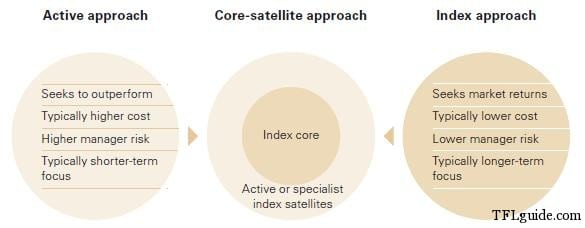
Core and Satellite is a portfolio construction approach: the Core (70-80%) consists of stable, diversified, goal-aligned investments managed with minimal intervention. The Satellite (20-30%) consists of higher-risk, opportunistic positions that add the possibility of outperformance. Core protects your goals. Satellite gives you room to explore. The rule: money can move from Satellite to Core, but never the reverse.
Why Portfolio Construction Matters More Than Fund Selection
Most investors spend 90% of their time choosing funds and 10% thinking about how those funds fit together. This is backwards. The academic evidence is clear: asset allocation (how you split across equity, debt, gold, cash) determines 80-90% of long-term portfolio returns. Fund selection accounts for the remaining 10-20%.
A well-constructed portfolio with average fund choices will almost always outperform a poorly constructed portfolio with great fund choices. Core and Satellite is a construction framework – it helps you think about the whole before worrying about the parts.
What Goes in the Core?
The Core portfolio should contain investments that are directly linked to your financial goals – retirement corpus, children’s education, home purchase fund, emergency fund. These investments need to be stable, diversified, and managed with a long-term horizon. They should not be moved based on market conditions, news events, or “hot tip” opportunities.
Core characteristics: broad diversification across asset classes and geographies, passive or low-intervention management, alignment to specific goals with defined timelines, and rebalancing only when allocations drift significantly (typically 5%+ from target).
For a typical retirement-focused investor with 15-20 years to retirement, a reasonable Core might look like this:
| Asset Class | Instruments | Allocation |
|---|---|---|
| Equity | Large-cap index fund, Flexi-cap fund | 40-50% |
| Debt | EPF, PPF, NPS, short-duration debt fund | 30-40% |
| Gold | Sovereign Gold Bonds or Gold ETF | 5-10% |
The Core should be boring. That is the point. Boring investments, consistently held, produce the wealth that funds retirement. The exciting investments produce the stories.
What Goes in the Satellite?
The Satellite portfolio is where you take calculated, limited bets – on sectors you understand, themes you believe in, or concentrated positions in individual companies you have researched. It should never exceed 20-30% of your total investable portfolio.
Satellite characteristics: higher risk and higher potential return than Core, requires active monitoring and the willingness to exit when wrong, position-specific rather than goal-linked, and strictly ring-fenced from Core capital.
Satellite examples for an experienced investor: a direct equity portfolio of 8-10 individual stocks you have researched, a sector fund in a theme you understand well (healthcare, technology, infrastructure), exposure to international equity for currency and geographic diversification, or alternative assets like REITs.
🚫 The One Rule That Cannot Break
Money can move from Satellite to Core when it performs well and you want to lock in gains. Money should NEVER move from Core to Satellite to “recover” Satellite losses or chase an opportunity. The moment you fund your Satellite from Core capital, you have violated the framework and put your goals at risk.
Is your portfolio built around your goals – or around products?
At RetireWise, we build retirement portfolios with the Core and Satellite framework – keeping your goals protected while giving you room to grow. SEBI Registered. Fee-only.
Core and Satellite for Different Investors
Risk-averse investor: Core of 70-80% in debt instruments (EPF, PPF, debt mutual funds), 20-30% in equity. Satellite could be a small allocation to mid-cap equity or gold. Preserves capital while staying ahead of inflation.
Passive investor: Core of 70-80% in index funds and ETFs (Nifty 50, Nifty Next 50). Satellite of 20-30% in active funds for potential alpha. Low cost, low effort, market-matching returns with limited scope for outperformance.
Balanced investor: Core of 50% equity (large-cap + flexi-cap funds), 30% debt (EPF + PPF + NPS), 10% gold. Satellite of 10% in mid-cap funds or direct equity. Suitable for 15-20 year horizon.
Aggressive investor: Core of 80% in equity mutual funds across market caps. Satellite of 20% in direct equity, international funds, or thematic bets. High return potential, requires high conviction and higher emotional resilience during downturns.
THE CORE INTEGRITY PRINCIPLE
Your Core portfolio must be sized to achieve your goals even if your Satellite earns zero.
If you need the Satellite to outperform for retirement to work, your Core is underfunded.
Build the Core for certainty. Build the Satellite for possibility. Keep them structurally separate.
“The Core and Satellite approach gives you the best of both worlds: the discipline to stay invested through market cycles, and the freedom to participate in specific opportunities without risking your goals.”
– Hemant Beniwal, CFP, CTEP | Founder, RetireWise
Read next: 15 Types of Risk in Investment Every Indian Should Know
Portfolio construction is a skill most investors never develop.
At RetireWise, we build retirement portfolios from the ground up – Core first, Satellite second, goals always first. SEBI Registered. Fee-only.
Most people build their portfolio one product at a time – adding things as they hear about them, without any overall architecture. A collection of financial products is not a portfolio. A portfolio has a structure, a purpose, and airtight compartments between what protects your goals and what you are willing to risk.
Build the Core for certainty. Build the Satellite for possibility. Never let one contaminate the other.
💬 Your Turn
Does your current portfolio have a Core-Satellite structure – or is it more of a collection of products bought at different times for different reasons? What would you put in your Satellite today?
worth article
Hi hemant
I recently started reading your articles and found very informative. I have a question that I have just started investing in 4 mutual fund ( Hdfc top 200, icici prudential discovery, sbi emerging business and uti mnc fund). My plan is to invest regularly in steps of RS 25000 whenever market is down in these funds for one year 5 lakhs each. I have a time horizon of 15 years for this 20 lakh to grow and help in my retirement corpus. My present age is 36 yrs. what’s your view on my fund, investing strategy and time horizon.
Thanks
Hi Rajesh,
Investing regularly is always a viable strategy when you are taking exposure in equity markets. However, markets are difficult to predict and so the investing. More wiser is to invest part of your corpus through SIP so that you can reap the benefits of its volatility. Some part of your funds you can keep aside to top up your investments as and when you get opportunities. This way you will be able to invest more wisely in equity markets.
In my view with such large corpus you should diversify more. This will help you in protecting downside along with generating reasonable returns.
Hemantji Good afternoon,
I am tempted to congratulate you for your dedication and the accuracy of your data. I am MBA(Finance) and PG in Economics as well. I read and share the data with my management students. Good.Keep it up.God bless.
Dr. Milan Chakraborty
HI Hemanth,
Article make easy life for planing investments port polio. Great work.
Great Article Hemant. Thanks.
nice article
This information is of so much importance Hemant.
So crisp and to the point article. Hopefully everyone who reads it should understand the importance of investing wisely.
It is good to understand when you are making investments but ofcourse advise from a financial planner would enhance the benefits and results would be even better.
Hats off to the way to explain concepts.
A couple of months ago I was not sure of what exactly is the term Mutual Fund and today after reading most of your articles, it is clearly understood that MF is the best way to invest. I recommended most of my colleagues and friends to visit TFL often and enhance their financial literacy (I wrote enhance bcoz mostly people say they know it all 🙂 )
Thanks,
Nishi
Thanks Nishi for the appreciation.
Dear Friends / Investors,
A word of caution. !!! We all can see , understand , validate and give suggestions about an surgery. But only the SURGEONS can do the operation successfully. So never attempt to make one portfolio on your own. Please hire a certified and expereinced FP and do the same. You can be an expert on your own field and still this is applicable to you. So let us all hire a good FP but use our knowledge to cross validate him. Hope you all agree.
mr.hemant, i am forwarding your article to a lot of my friends. i am getting a very positive feed back. people appreciate when i share my finance knowledge( ofcourse which i get thru ur article) with them.
my earler request for study material for cfp is still awaited.
is it possible to do cfp without joining any institute.
can you suggest me some good study materials available online for the 6 modules.
Hi Rajesh,
I did it from ICOFP but you can check IMS material – talk to them.
With portfolio strategy, you have hit the nail on its head. A very good article which gives me a clear direction for investing.
Thanks Cheva
such a nice article in such a simple language. any layman without knowledge of investment can grasp this. mr.hemant the strenght of your article is they are crisp, to the point and simple in language.
one more feather.
rajesh
Thanks a ton Rajesh – if you like the articles, must share them with your friends. 🙂
Hi hemant
Wonderful article.. continue your good work
Thanks Vignesh.
Hi Hemant
A very useful article. Hopefully, this will help the readers to design their own portfolios.This has definitely added to my knowledge of this approach.
Hi Anil,
Again important wort is HOPEFULLY 🙂
Great Article Hemant. I’ve been reading up on this strategy for sometime and this articles answers many of my questions.
Thanks Lloyd.
In case if you have some questions feel free to add here.