
Last Updated on April 23, 2026 by Hemant Beniwal
“Champions keep playing until they get it right.” – Billie Jean King
Every four years, the world watches extraordinary athletes compete at the highest level under maximum pressure. I watch too. But I also notice something else: Olympic champions consistently do the things that successful long-term investors do, and fail for the same reasons that losing investors fail.
Neeraj Chopra did not win gold at Tokyo 2020 because of talent alone. He won because the Indian government spent over Rs 5 crore on his coaching, he trained for years under the best coaches available, and he competed with a clear goal and a structured process. The financial equivalent is not complicated to describe. It is simply hard to execute over 20-25 years.
⚡ Quick Answer
Seven financial planning lessons from Olympic athletes: set concrete goals with timelines, start earlier than you think necessary, adapt your plan as circumstances change, get professional help, stay invested through setbacks, measure progress against your own goal rather than others, and take responsibility for your own financial outcomes. The Olympics runs every four years. Your financial plan runs for 30-40 years. The same principles apply.
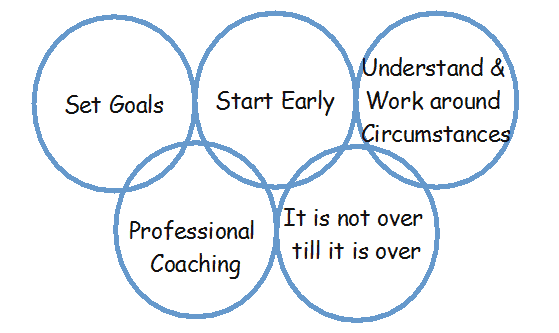
Lesson 1: Set Goals With Specific Timelines
An Olympic sprinter does not train to “run fast.” She trains to run 100 metres in under 10.9 seconds by the qualifying deadline in a specific year. The goal is not abstract. It has a number, a timeline, and a measurable outcome.
The equivalent in personal finance is not “save for retirement.” It is “build a corpus of Rs 4 crore by age 60 to generate Rs 1.5 lakh per month in retirement income.” The specific number changes how you plan, how much you save, and what asset allocation you need. Without the number, you cannot know whether you are on track.
Most Indian investors have vague financial goals. They want to “be comfortable in retirement” or “give their children a good education.” Vague goals produce vague plans that produce disappointing outcomes. Replace every vague goal with a number, a date, and a monthly savings requirement.
Lesson 2: The Earlier You Start, the More You Have to Work With
Michael Phelps began swimming seriously at age 7. Neeraj Chopra began throwing the javelin at 13. P.V. Sindhu was playing badminton at 8. At Paris 2024, the youngest Indian Olympic medalists had already accumulated years of deliberate practice before most of their peers had decided on a sport.
In investing, compounding works the same way. A 25-year-old who starts a Rs 10,000 monthly SIP and continues for 35 years at 12% CAGR accumulates approximately Rs 6.4 crore. A 35-year-old doing the same accumulates approximately Rs 1.9 crore. The difference is not in the monthly amount. It is entirely in the starting age.
But the Olympics also demonstrates that a late start is not fatal. Hoang Xuan Vinh of Vietnam won his country’s first Olympic gold at 41. If you are 42 and have not yet built a serious retirement corpus, you still have 18 years. That is not comfortable, but it is not hopeless. Start now and invest more aggressively than someone who started at 25.
Your retirement corpus is being built right now – or it isn’t.
Every month you delay has a compounding cost you cannot recover. RetireWise builds retirement plans that show you exactly where you stand and what it takes to reach your specific goal.
Lesson 3: Adapt Your Plan as Circumstances Change
No Olympic athlete arrives at the Games with a static plan. They adjust based on conditions, injuries, opponents, and new information. The javelin thrower adjusts for wind. The swimmer adjusts for lane draw. The sprinter adjusts starting block positioning based on track conditions.
A financial plan made at 30 needs updating at 40. Your income will have changed. Your family situation will have changed. Tax rules will have changed. Investment products will have changed. The plan that was appropriate when you had no children, a Rs 60,000 monthly salary, and no home loan may be completely wrong for a 40-year-old with two children in school, a home loan, and Rs 2.5 lakh monthly income.
At minimum, review your financial plan annually. Review it immediately after any major life change: job change, salary increase, marriage, children, inheritance, or health event.
Lesson 4: Get Professional Coaching
The Indian government did not send Neeraj Chopra to the Olympics and tell him to figure it out. They invested in world-class coaching, sports science support, equipment, and competition exposure. The coaching was not a luxury. It was infrastructure.
In personal finance, professional advice works the same way. A SEBI-registered investment adviser brings knowledge, accountability, and the emotional detachment to tell you when you are wrong. The investor who manages their own portfolio without professional input is competing against institutions with research teams, data systems, and decades of experience – with nothing but a brokerage app and a YouTube channel for support.
The question to ask is not “can I do this myself?” Most people technically can. The question is “what does DIY actually cost me in suboptimal decisions, missed opportunities, and behavioural errors over 25 years?” The answer, for most investors, is far more than any advisory fee.
Lesson 5: It Is Not Over Until the Event Ends
At Paris 2024, India’s Manu Bhaker won two bronze medals in shooting – a remarkable comeback for an athlete who had experienced equipment failure at Tokyo that ended her campaign. At the same Games, the Indian women’s hockey team pushed against much stronger opponents despite being significant underdogs going in.
Financial setbacks are inevitable. Job loss, market crashes, medical emergencies, business failures – these happen. The Sensex fell 38% in March 2020. Investors who stayed invested recovered fully by December 2020 and went on to significant gains. Investors who exited locked in their losses permanently and missed the entire recovery.
Staying invested through a downturn is not passive acceptance of losses. It is the active, disciplined recognition that temporary falls are the normal cost of long-term equity returns – and that leaving the market permanently is the only way to guarantee you miss the recovery.
Lesson 6: Compete Against Your Goal, Not Against Others
Olympic athletes are relentlessly focused on their own performance. The sprinter who runs the 100 metres in 9.87 seconds does not lose sleep because someone else ran it in 9.84. Their goal was a personal best, not necessarily a medal. The measurement is against the goal, not against the competition.
Investor benchmarking works the same way. Your relevant benchmark is not your colleague’s portfolio, not the top-performing fund of last year, and not the Nifty return on any given day. It is whether you are on track to reach your specific financial goals at your specific timeline. An investor who needs 10% CAGR to meet their retirement target and is generating 11% has no reason to take more risk trying to match someone else’s 14%.
Chasing performance relative to others is how investors add risk they do not need, chase recent returns, and make the timing errors that destroy long-term compounding.
Lesson 7: Take Full Responsibility for Your Own Outcomes
No Olympic gold medalist blames the track, the weather, or the officiating for not winning. Winners take ownership of their preparation, their performance, and their results. That ownership is exactly what makes further improvement possible.
In financial planning, the investor who blames the market, their advisor, the government, or their employer for their financial position is the investor who will be in the same position in ten years. Taking responsibility does not mean the market is predictable or that bad luck never happens. It means the decisions about savings rate, asset allocation, insurance adequacy, and financial behaviour are yours – and that taking ownership of those decisions is the only way to improve them.
Read: A Dynamic Life Cannot Have a Static Financial Plan
In the Olympics, only the top three get medals. In financial planning, everyone who reaches their goal wins. You are not competing against anyone else. You are competing against your own plan.
Train for your goal. Not for the scoreboard.
Is your financial plan trained for your specific goal – or just pointed in a general direction?
RetireWise builds plans with specific corpus targets, monthly savings requirements, and a stress test to show whether the plan holds when conditions change.
Your Turn
Which Olympic athlete or moment has given you a financial planning insight? And which of the seven lessons is the hardest for you to apply consistently? Share in the comments.