
Last Updated on April 14, 2026 by Hemant Beniwal
Every election cycle in India brings the same conversations. Should I exit before the results? What if the wrong party wins? Should I wait until the market settles down?
In 25 years of advising, I have watched investors make this mistake repeatedly — exiting before elections, missing the rally, re-entering after the news is priced in, and ending up worse than if they had simply stayed put.
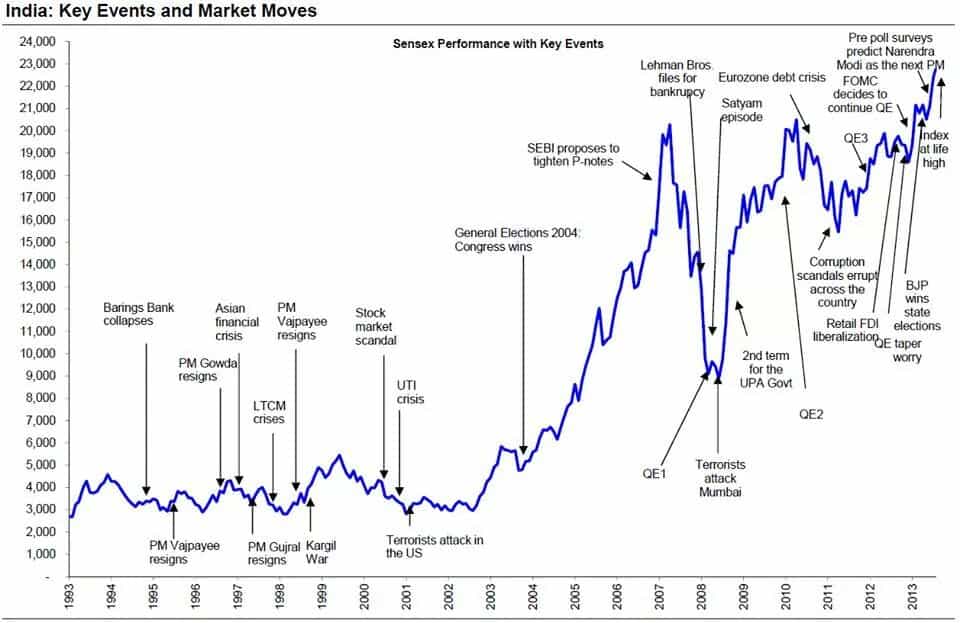
The period between 2009 and 2014 is one of the most instructive examples in recent Indian market history.
⚡ Quick Answer
Investors who exited Indian equity markets during the 2009-2014 election uncertainty — trying to avoid political risk — missed significant returns while sitting in cash or debt. The Sensex delivered strong returns over this period for those who stayed invested. Market timing around elections has historically destroyed more wealth than it has protected. The data consistently shows that time in the market beats timing the market.
The Relationship Between Risk and Return
Why do people take investment risk at all? Because risk and return have a relationship. Higher potential returns come with higher short-term volatility. The investor who tolerates that volatility — who does not exit when headlines are frightening — captures the return that the fearful investor leaves on the table.
Elections are one of the most powerful triggers of financial anxiety. The outcome is uncertain. The stakes feel high. And the financial media amplifies every uncertainty into a crisis narrative.
But here is what the data shows consistently: election outcomes, while meaningful for policy, are rarely as deterministic for long-term market returns as investors fear in the moment.
What Actually Happened Between 2009 and 2014
The UPA government won the 2009 elections with a stronger-than-expected majority. Markets surged 17% on a single day — one of the largest single-day rallies in Sensex history. Investors who had exited ahead of “election uncertainty” missed this entirely and re-entered at higher levels.
The five years that followed were a period of policy paralysis, high inflation, a weakening rupee, and significant corporate governance concerns. The Sensex essentially went nowhere in real terms between 2010 and 2013. Many investors — frustrated by the stagnation — exited.
Then 2014 arrived. The BJP’s landslide victory triggered a strong rally. Investors who had been sitting on the sidelines, waiting for “political clarity,” found themselves chasing a market that had already priced in the new government.
The investors who simply stayed invested through the entire 2009-2014 cycle — doing nothing, continuing their SIPs, not reacting to political news — captured the full return of the period.
Is your portfolio making decisions based on news — or based on a plan?
A fee-only advisor builds a plan that is designed to survive elections, market crashes, and news cycles — without constant intervention.
The Cost of Missing the Best Days
There is a well-documented phenomenon in equity markets globally: the best single days of returns are often clustered around periods of maximum uncertainty — exactly when most investors have exited or are considering exiting.
A Sensex investor who stayed fully invested over the last 20 years captured significantly higher returns than one who missed even the 10 best days of that period. Missing the 10 best days — which represent less than 0.2% of total trading days — can cut long-term returns roughly in half.
The investor who exits before elections to “wait for clarity” is precisely the investor most likely to miss the best days.
What About Genuine Policy Risk?
Elections do matter for specific sectors. A government change can significantly affect infrastructure, defence, pharmaceuticals, and energy policy — creating both winners and losers at the sector level.
But for a diversified equity investor — one holding a broad market index fund or a diversified equity mutual fund — individual sector policy shifts are largely self-correcting over time. A new government may hurt some sectors and help others, but the aggregate market reflects the overall economic trajectory, not any single policy outcome.
The practical implication: if you hold concentrated positions in policy-sensitive sectors ahead of elections, some caution is warranted. If you hold a diversified equity fund, election timing is largely noise. The urge to do something during uncertainty is one of the most expensive biases in investing.
The Pattern Repeats Every Election Cycle
2014. 2019. 2024. Every election brings the same anxiety, the same exit conversations, and the same regret among investors who exited and missed the rally.
The lesson is not that elections do not matter. It is that predicting election outcomes, predicting market reactions to those outcomes, and predicting the timing of those reactions are three separate and extremely difficult forecasting problems that even professional fund managers consistently get wrong.
The investor who stays invested, keeps their SIP running, and ignores election noise is not being naive. They are being rational about the limits of their own forecasting ability. Behavioural finance has documented extensively why this kind of action bias destroys long-term returns.
Frequently Asked Questions
Should I exit equity mutual funds before Indian elections?
No. The evidence from every Indian election cycle — 2009, 2014, 2019, 2024 — is that investors who exited ahead of elections and re-entered after the results were announced consistently underperformed those who stayed invested. The problem is timing two decisions correctly: when to exit before the event, and when to re-enter after it. Both decisions must be right to benefit from the exit. Most investors get one or both wrong, and end up paying transaction costs, short-term capital gains tax, and missing some of the best market days in the process.
How do elections affect stock market performance in India?
Elections create short-term volatility but do not reliably predict long-term market direction. The 2009 election result caused a 17% single-day Sensex surge — investors who had exited missed this entirely. The 2014 and 2019 BJP wins triggered strong pre- and post-result rallies. But the 5 years between 2009 and 2013 were largely flat despite a stable government. Market performance over 5-10 years reflects corporate earnings growth and economic fundamentals, not which party wins. Short-term election-related volatility is noise for a long-term investor.
Which sectors are most affected by election results in India?
Infrastructure, defence, public sector banks, and energy are most directly affected by election outcomes since government spending and policy priorities shift significantly between governments. Pharmaceuticals, IT, and export-oriented sectors are less affected by domestic political outcomes. For investors with concentrated positions in policy-sensitive PSU or infrastructure stocks, some rebalancing before high-uncertainty elections may be warranted. For investors in diversified equity mutual funds with broad market exposure, election-driven sector shifts largely offset each other.
What is the cost of missing the 10 best market days in a long-term investment?
Research on the Sensex and global equity markets consistently shows that missing even 10 of the best trading days over a 20-year period can cut long-term returns roughly in half. For example, a Rs 10 lakh investment growing at 14% CAGR over 20 years becomes approximately Rs 1.37 crore. If the investor missed 10 of the best days — which are clustered around periods of maximum fear and uncertainty — the ending corpus might be closer to Rs 60-70 lakh. The best days tend to occur during exactly the periods when investors are most tempted to exit.
The charts from 2009-2014 tell a story that every election cycle confirms: the investors who lost the most were not the ones who picked the wrong outcome. They were the ones who exited and tried to re-enter at the right time. The ones who simply stayed invested came out ahead.
Do the Right Thing and Sit Tight. Through elections, through crashes, through noise. That is the strategy.
💬 Your Turn
Have you ever exited or paused your SIPs before an election — and what happened after? Share your experience below.
Dear all
from charts we can understand the movements of stocks, but one principle is difficult to chart that is buy at low and sell at high, securing the gain when market is moving upside. One can protect the gains and as well as rebalance the funds in time.
I think Mr. Nilesh Sawant is interested in global funds and that’s why he is asking about choice of USA or EUROPE but as he used the word MNC fund his question and the answer seems to be differnt. There are MNC funds and there are GLOBAL funds.
WE HARDLY KNOW ABOUT INDIA N INDIAN COMPANIES BETTER TO INVEST IN INDIA THAN MNC FUND….
Thanks for your valuable reply.
Respected Sir
. Please guide me about MNC fund? & it is good for long term, in which countries should i invest ? USA or EUROPE
Hi Himant, Pl enlighten me how would war effect stock market and investments?
i have started MF monthly sip in Reliance Gold Saving G Fund Rs. 1,000/- from the year 2011. but return is minus suggest me can i continue for 5 year or stop this sip.
sunil
ITS EXPECTED MODI WILL GOVERN BETTER THAN MMS BETTER TO SWITCH FROM GOLD ETF TO EQUITY SIP AS EQUITY SHOULD GIVE 15% ANNUAL RETURN HEREON FOR NEXT 5 YEARS….
Good returns are seldom made on investments made in good times.
Rather, good returns are typically made on investments made in adverse times.
Dear Hemant
inversely can we say NOW is the time to invest in RE, GOLD… and may not the time to invest in stocks?
Hi Shinu,
I think you have understood it wrong & I don’t want to comment on Gold, already wrote couple of posts in past.
Regarding good returns – here I was talking about returns with lower risk. In last 1 year (adverse times), mid & small cap index doubled.
treat equity/ mutual fund like fd n for long term……expect a bit more than fd n invest in equity/mutual fund only that money which u don’t need immediately or r prepared to loose….
Well said Rajiv…
Why everyone say that we need to put the money in MF which we are prepared to loose? No one from middle class will have money which they are prepared to loose. If that is the case no one is going to invest in MF. We need to understand that MF investment is only for lost term and the money invested in MF should not be considered as contingency fund.