
Last Updated on June 16, 2026 by Hemant Beniwal
A client from Mumbai had been telling me to read this book for years. Die With Zero by Bill Perkins. “You will connect with it,” he kept saying. I bought it, slipped it onto a shelf beside other books I fully intended to get to, and left it there for two-three years.
This month, my wife and I took a week for Nepal. Just the two of us, which happens almost every year – it can be one night staycation or 2-3 days short trip or 1-2 weeks long vacation. This time I packed one small bag and, finally, that book. Seven days in the mountains with no meetings, no portfolios to review, and no particular schedule. By the time we landed back, I had read it and spent few evenings sitting quietly with what it said.
Something became clear on that trip. Not about the book, but about myself. I have been living this philosophy for almost 25 years without knowing it had a name.
⚡ Think
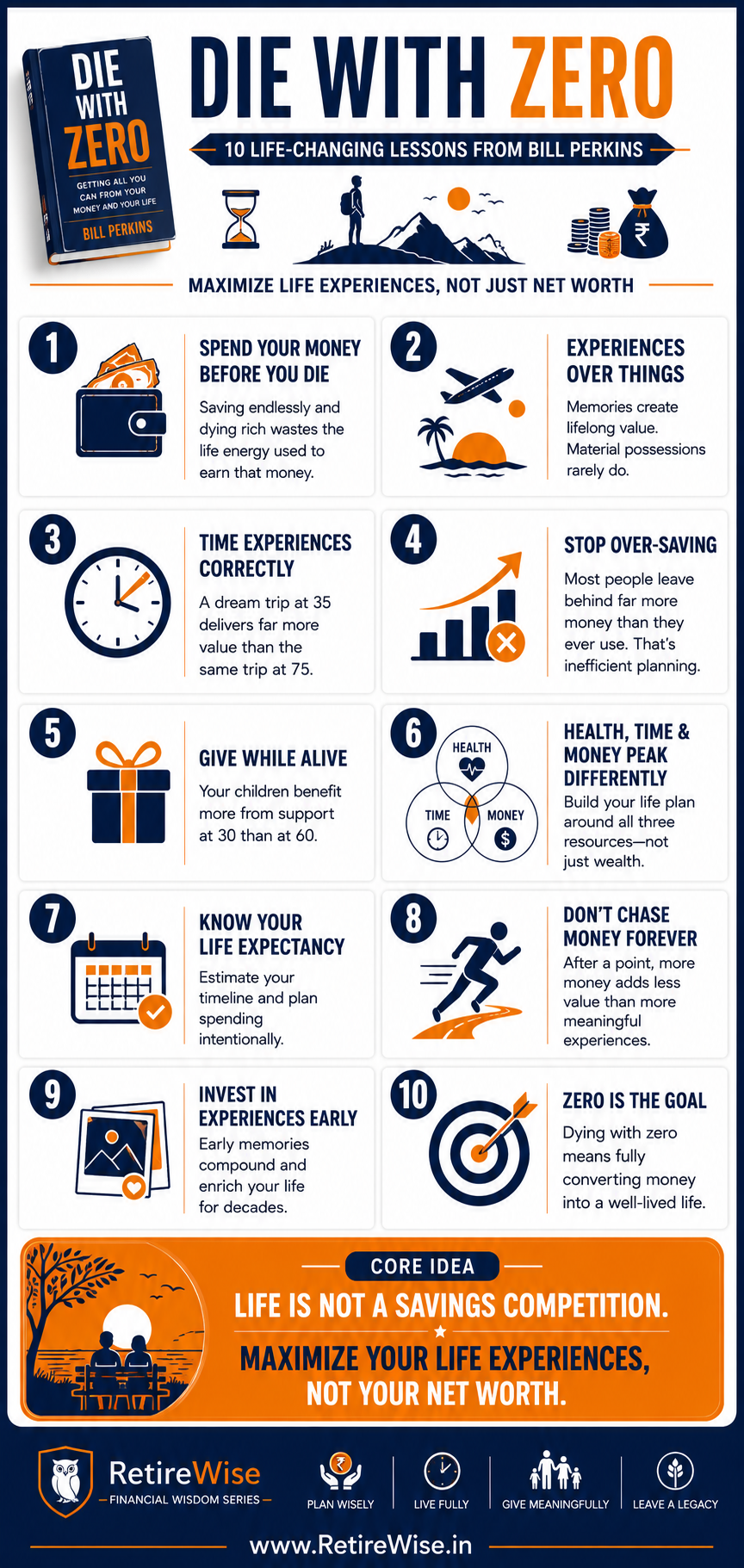
Die With Zero by Bill Perkins makes one central argument: the goal of a good life is not to die with the most money.. it is to spend your time, money and energy on experiences that give you the highest return on life. This piece is my personal reflection on the book, where it resonated with my own journey, where I see it differently, and what it means for how we think about money and living.
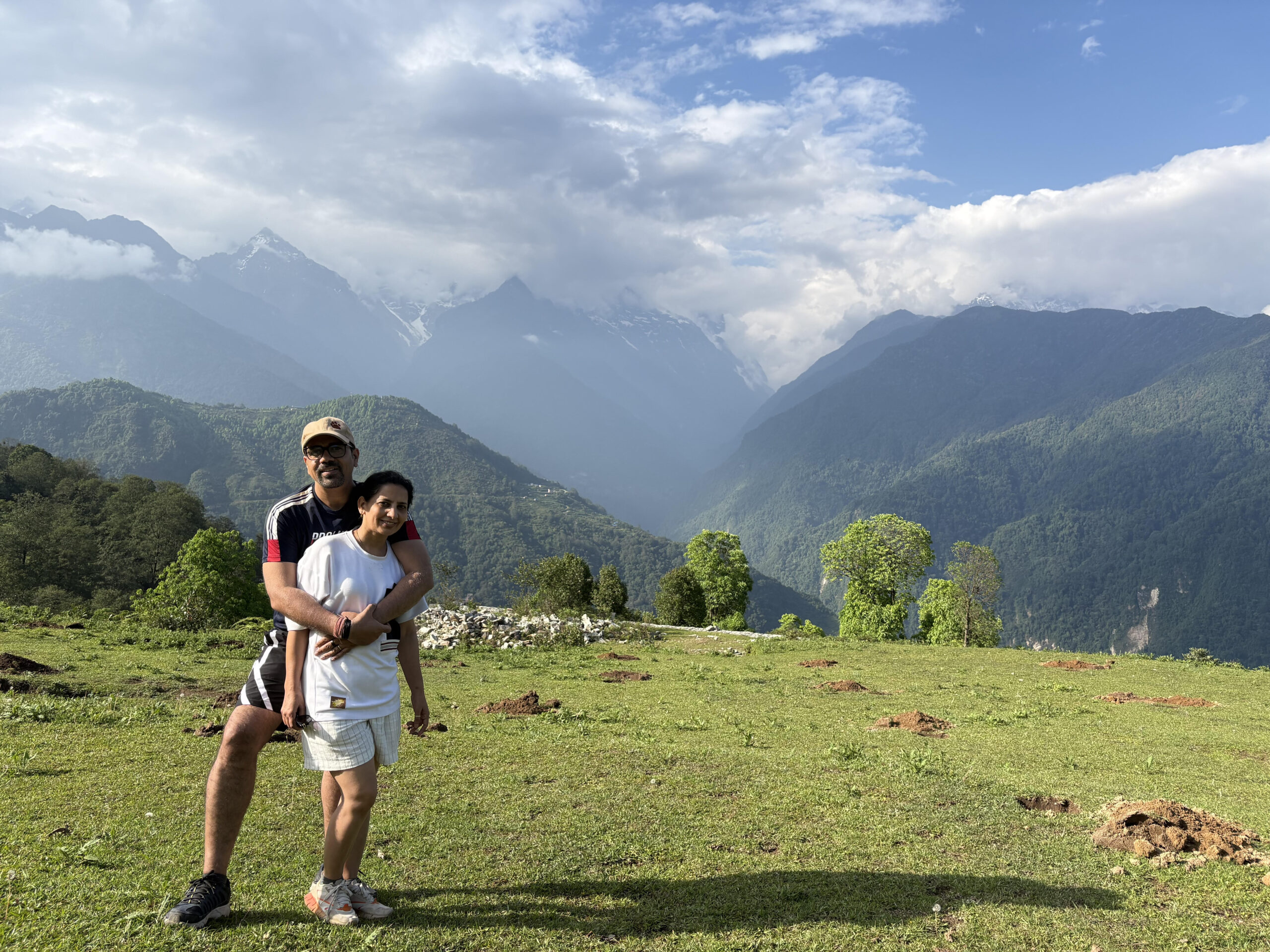
Trek (2026) – Annapurna Foothills, Nepal
The book’s argument is simple but honest. Most people save, defer and wait, hoping to enjoy life someday. But someday is not a guaranteed date on anyone’s calendar. Your health changes. Your energy changes. The capacity to walk 14 kilometres through a mountain village, to absorb a new place and carry it back with you, is not something you can count on at 70. Perkins says aim to die with zero. Spend your money on experiences while you can fully experience them. Live in the right season, not only in the retirement season.
I won’t say I agree with every word. Maybe 80%. But that 80% is not a revelation. It is a mirror.
📖 Perkins makes an argument most financial conversations skip entirely. Every rupee you don’t spend on a meaningful experience during the years you could have fully enjoyed it is not savings. It is, quite simply, a life experience you chose not to have. That is the uncomfortable reframe the book is built around, and it is hard to argue with once you sit with it long enough.
Where I Come From
My mother was careful with money, and she made sure I would be too. Financial discipline was not a subject in our house; it was simply the default. By the time I started working almost 25 years ago, saving was already a habit, not something I thought about consciously.
But one thing my mother was never really able to do was enjoy her own life and create experiences for herself because of our circumstances. My father passed away when I was just two years old, so most of her time and energy went into raising me and my sister. Finally, when she had started traveling and exploring places she had always wanted to visit, God called her away during the 2013 Himalayan floods while she was on a pilgrimage to Kedarnath.
But I saved. And alongside saving, I spent on experiences, not expensive ones, not status ones, just real ones. Travel & sports events, mostly. It has always been my way of stepping out of the work, the clients, the spreadsheets, and breathing properly for a few days.
Twenty Times in the Himalayas
My honeymoon was in Manali, more than two decades ago. That was the first time. I have been back to the Himalayas at least 20 times since, not because I planned some kind of streak but because something about those mountains keeps pulling me back every time I let it. I travel at least three times a year, and one of those trips is always with friends, no family schedule and no fixed programme, just people I genuinely like in places that put your problems at their proper size.
The Nepal trip this month was not our most expensive. Not even close. Eight nights in hotels with breakfast included, total spend under Rs. 30,000 INR. That is not a budget limitation; it is a deliberate choice, because for me the hotel has never been the point.
What I Will Remember
On this trip, I did a 14.5 kilometre day trek in Ghandruk with a local guide. Full day of walking through rhododendron forests and stone villages, with the Annapurna range watching from above. My legs hurt in the way they should. My lungs worked harder than they usually do. I was completely present in a way that cities and routines make genuinely difficult to manufacture.
Last year, I took my whole family to Australia and we did the Great Barrier Reef. Beautiful in every way, genuinely once in a lifetime by most people’s standards. And yet the Ghandruk trek stays with me more. That is not nostalgia talking. Experiences that ask something of you, that require effort and discomfort and real attention, seem to settle into memory differently than the ones you simply purchase and consume.
Getting from Bandipur to Ghandruk took six hours to cover 130 kilometres, two buses, two vans and one shared jeep along a road that wound through valleys I had no name for. We shared the van with families carrying their groceries home – kids going to secondary school in the nearest town. A herd crossed the road somewhere near the halfway point and the driver waited without any sign of irritation. My wife and I barely spoke for much of the journey because there was simply too much to look at – in the bus and outside window. I kept thinking about our Euro rail from Paris to Switzerland in 2018, which was efficient and beautiful and memorable in its own right. But this was different in a way that is hard to explain. The Nepal road will stay with me longer.
The one night we spent at Marina Bay Sands in Singapore on our very first international trip was stunning, the kind of hotel that fully earns its reputation. And the small stone cottage in Bandipur this month, with a wooden balcony and mountains in every direction and complete silence by 8pm, gave me something I cannot honestly say the Singapore hotel gave me more of.
MEMOROIES ALSO COMPOUND
The 2010 Commonwealth Games in India gave me the opportunity to watch legends like Leander Paes, Mahesh Bhupathi, and Sania Mirza play for the country. How can I ever forget the India vs Pakistan hockey match where India thrashed Pakistan, or watching Krishna Poonia create history by becoming the first Indian woman to win a Commonwealth Games gold medal in a track-and-field event?
Then there was the thrill of watching Rafael Nadal defeat Roger Federer in the 2015 IPTL in Delhi. More recently, I’ve enjoyed live performances by Suhani Shah, Sunil Grover, and the “Indian Shakira” herself, Sunidhi Chauhan, in Jaipur.
Experiences like these remind me that while money compounds, memories do too. (that’s one of the most powerful line that I read in Die with Zero)
Some of my most expensive experiences are photographs now. Some of my cheapest are still completely alive.
The three resources that never peak together – Time, Health & Money
Young: time and health, but no money.
Middle-aged: money arrives, but time has quietly shrunk.
Older: money may remain, but health and energy for certain experiences step back.
The window for living fully on all three at once is shorter than almost everyone plans for.
The Calculation I Made Years Ago
Perkins writes about the three resources we manage through life: time, health and money. The problem he identifies is that they never peak at the same time. When you are young, time and health are plentiful but money is not. Middle-aged, the money has arrived but the time has quietly shrunk. Older, the money may still be there but the health and energy for certain kinds of experiences begin stepping back, slowly and then less slowly.
I am passionate about what I do. Advising families through retirement, wealth decisions, the difficult questions that come with real wealth, this is not merely a profession for me. But I made a decision when I started my financial planning practice in 2009 that I would not keep adding more to my plate simply because more was available. More clients, more complexity, more hours. For what, exactly? My time has more value to me than the additional income that would come with it. That is not a financial calculation. It is a life calculation, and one I do not regret.
What I See in the Families I Advise
Most people have not made this calculation, at least not honestly. They are working harder at 52 than they were at 38, the lifestyle has expanded to absorb every additional rupee, and the things that genuinely matter keep getting scheduled for the next milestone. Travel once the kids settle. The long break when things slow down. The reunion with old friends when there is finally time.
And then something changes. The knees start going. A parent needs care. The specific energy required for certain experiences, long treks, slow road journeys, late evenings with people you love in unfamiliar places, begins to fade in a way that no amount of money can fully compensate for. The money may be perfectly fine. The moment is not. The fear that money will run out is one of the most powerful forces in financial decision-making, and it does not always have any relationship to how much someone actually has.
From the Practice
The most common thing I hear from people deferring experiences is not “I can’t afford it.” It is “I just need to get through this phase.” There is always another phase. The question worth asking is whether this one will look different ten years from now when you look back at it.
I am not arguing against saving. A solid financial foundation is what makes experiences possible without anxiety. The Indian default of FDs, gold and property, however comfortable it feels, carries its own quiet long-term risk across 25 to 30 years of retirement. But saving is the vehicle, not the destination. The destination is a life where the living and the planning happen together, not one after the other, not one quietly at the cost of the other. Many people who have built genuinely adequate corpuses still find it almost impossible to spend from them, and that is a problem the planning conversation rarely addresses as seriously as it should.
Three Questions Worth Sitting With
How many experiences have you postponed that had nothing to do with money? What would you do differently if you knew the window for them was shorter than you are assuming? Is your financial plan building the life you actually want, or only a number you hope will feel like enough someday?
These are not trick questions. They are the questions that sit at the border between financial planning and life planning. Financial planning handles the numbers well. Life planning handles the decisions the numbers are meant to be in service of. What retirees actually experience versus what they expected their retirement to look like is often a story about this exact gap, and it is worth sitting with before you finalise your own assumptions about what the years ahead should feel like.
If there is one thing I took from Die With Zero, it is not a financial strategy. It is a question. Are you living the life your financial plan is supposed to be funding, or are you still preparing to live it?
Financial planning is not only about numbers. At its best, it is life planning. A few honest questions about time, priorities and what you actually want from the years ahead can change the direction of your decisions more than any product ever will.
The goal was never the corpus. The goal was always the life the corpus was meant to fund.
Is Your Financial Plan Built Around Your Life?
A few honest questions about time, priorities and what you actually want from the years ahead can change direction more than any product ever will. If you want to think through where you are and where you want to go, I am happy to have that conversation.
💬 Your Turn
Have you read Die With Zero? Or do you have your own version of this, experiences you chose over accumulation, or ones you wish you had not kept waiting? Tell me in the comments below. I read every one.